Key Takeaways
- Ankle pain can stem from various causes, but acupressure offers a natural, effective way to alleviate discomfort.
- Apply acupressure gently at first, focusing on points away from fresh injuries, and increase pressure as swelling subsides.
- Key points like GB40, BL60, and KI3 target different ankle areas, promoting Qi and Blood flow while reducing pain.
- Understand how to use acupressure for ankle pain by integrating it with proper care and adapting to injury stages.
- Seek medical attention for severe symptoms to differentiate between sprains and fractures, ensuring a proper recovery.

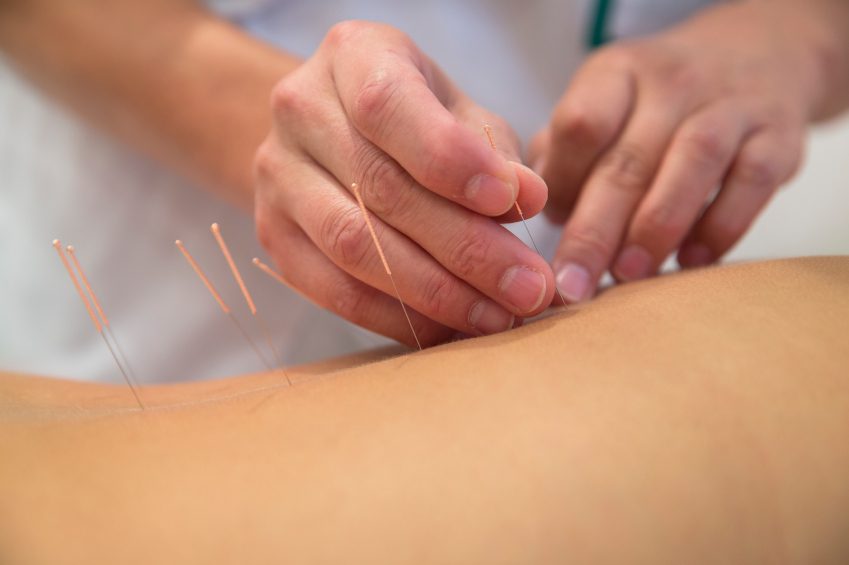
Ankle pain from sprains (the most common cause), overuse, tendon strain, arthritis, or unresolved old injuries can significantly affect your ability to walk, stand, and perform daily activities. Fortunately, acupressure offers an easy, natural way to reduce pain, relieve tension around your ankle, and support recovery, all using your own hands. This straightforward approach can improve your comfort and mobility in a simple, effective way.
Before applying acupressure, consider the timing and proper care. For fresh injuries or sprains, protect and rest the ankle, using gentle compression and elevation to reduce swelling. Avoid firm pressure on an acutely injured or swollen ankle, as it could worsen the condition. Right after the injury, brief ice application can help reduce swelling; Traditional Chinese Medicine suggests switching to gentle warmth after the initial hours to improve circulation and support healing. In the early stage, focus on points away from the injury, such as on the leg or the uninjured side, and apply acupressure gently. Once the swelling subsides, you can use more direct acupressure and warmth. Check the safety section at the end for guidance on when to seek medical help, especially for severe sprains or suspected fractures requiring professional assessment.
In Traditional Chinese Medicine, ankle pain is seen as a blockage of Qi and Blood in the channels crossing the ankle, known as Bi syndrome. Factors like injury, overuse, or cold and dampness buildup can cause Qi and Blood stagnation, leading to pain, swelling, and stiffness. The ankle is a junction for several channels, including the Stomach, Spleen, Gallbladder, Bladder, and Kidney. This complexity explains the distribution of treatment points around the joint and why pain might appear in different areas based on which channels are affected. The listed acupressure points are designed to promote Qi and Blood flow, unblock channels, reduce swelling, relieve pain, and support ligament and tendon healing.
Here are nine acupressure points around the ankle that can help relieve ankle pain.
What Acupressure Points to Press and Why
1. Press on GB40 in front of the outer ankle, the key point for ankle sprains. GB40 sits in the hollow just in front of and below the outer ankle bone, where you can feel a natural depression. Press firmly with your thumb for one to two minutes, gently if the area is acutely injured. GB40 is called “Qiuxu,” and it is one of the most important points for the ankle, especially the outer ankle.
This point is central to treating common ankle sprains because, in most cases, the ankle rolls outward, damaging the outer ligaments where GB40 is located. It helps move stagnant Qi and Blood in the outer ankle, relieving pain and swelling. As one of the most frequently used points for treating ankle sprains and outer ankle pain, it appears in nearly all acupressure treatments targeting the ankle. For outer ankle pain from such sprains, this should be the first point to address. Initially, use gentle pressure if the ankle is still fresh and swollen, then apply firmer pressure as recovery progresses.
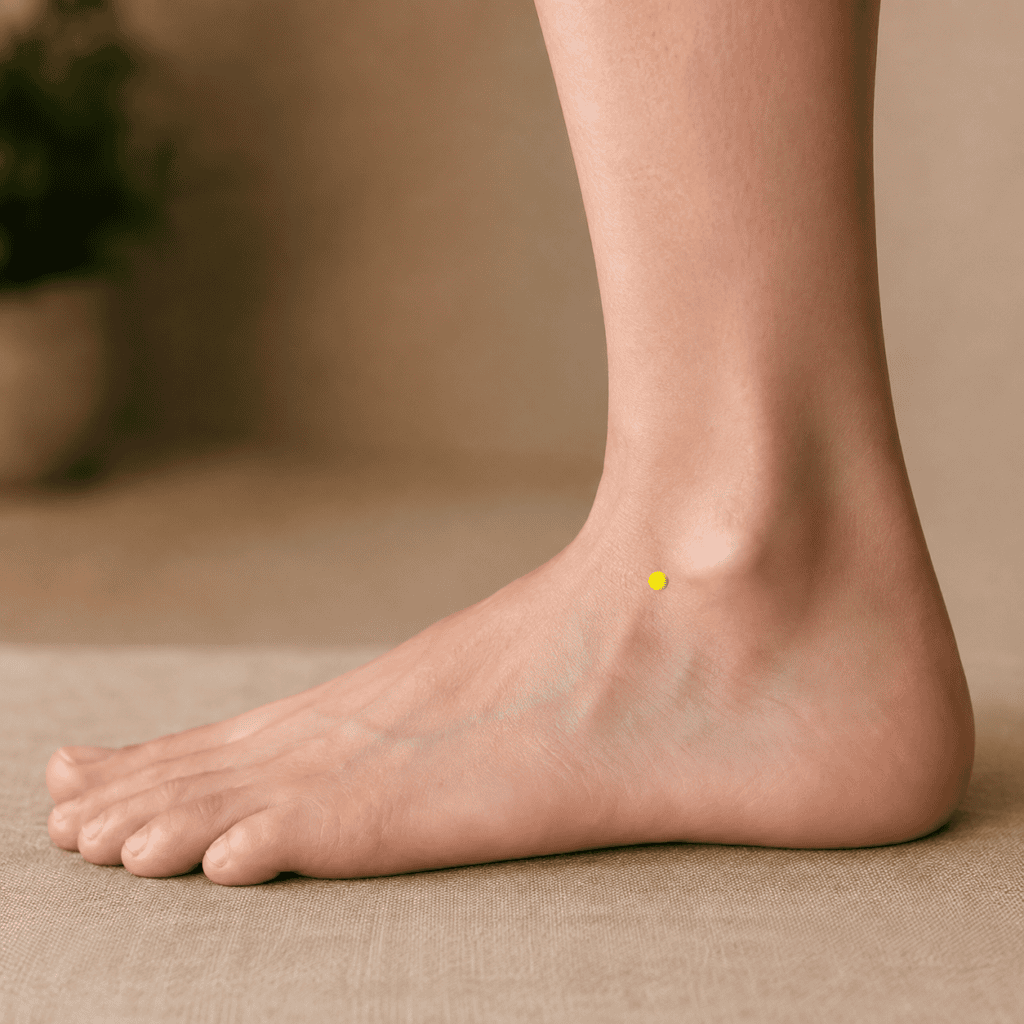
2. Press on BL60 behind the outer ankle to ease pain across the joint. BL60 sits in the hollow between the outer ankle bone and the Achilles tendon, level with the tip of the ankle bone. Press firmly with your thumb for one to two minutes on the affected ankle. BL60 is called “Kunlun,” a major point for ankle and heel pain.
BL60 is a key acupoint for the ankle, often called the ‘aspirin point’ due to its frequent use in pain relief. It helps ease pain in the ankle and heel, located behind the outer ankle bone along the Bladder meridian. The point helps promote the flow of Qi and Blood, reducing pain, swelling, and stiffness around the joint. When combined with GB40, it works well for treating both the front and back of the outer ankle. As a primary point, BL60 is commonly used for various ankle pains, especially those affecting the outer and back areas, and it also relieves heel pain.
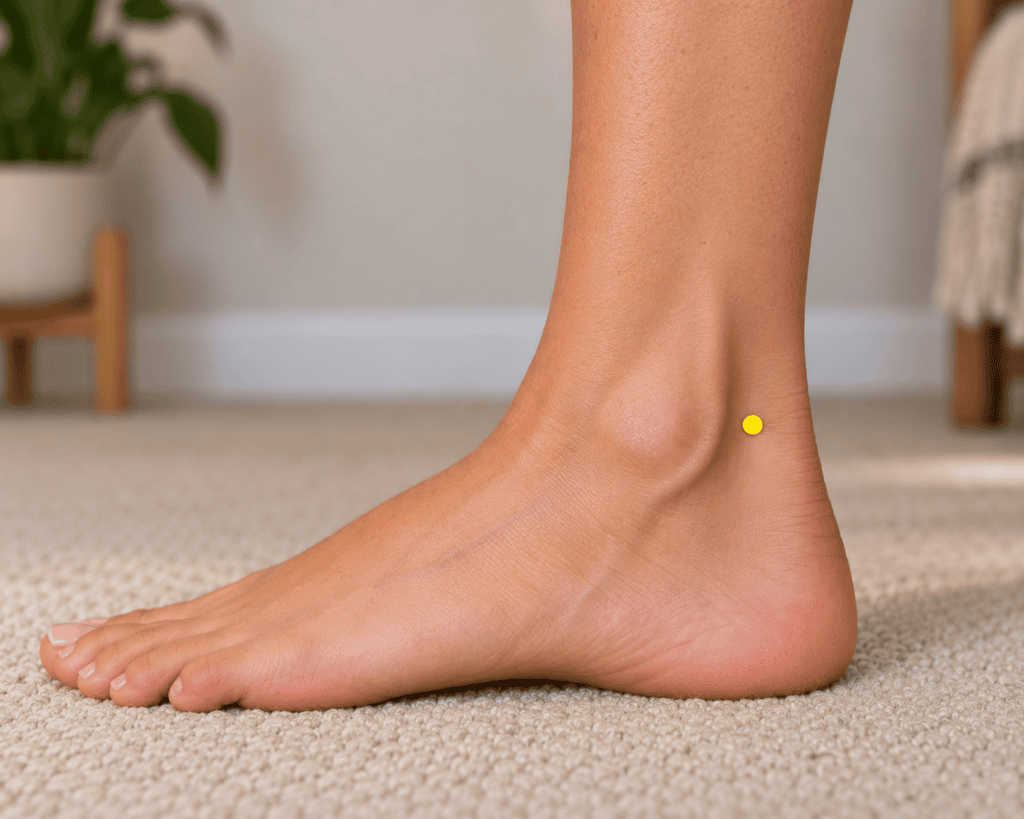
3. Press on KI3 behind the inner ankle for the inner side. KI3 sits in the hollow between the inner ankle bone and the Achilles tendon, level with the tip of the ankle bone, directly opposite BL60. Press firmly with your thumb for one to two minutes on the affected ankle. KI3 is called “Taixi,” the source point of the Kidney and a key point for the inner ankle.
KI3 is located on the inner ankle, directly opposite BL60 on the outer ankle. Pressing both points, one on each side of the joint, treats the entire ankle width. It relieves pain and stiffness on the inner ankle and as the Kidney source point, also supports the joint and the deeper reserves that maintain bone and ligament health. This point is crucial for inner ankle pain and for treating the joint from both sides simultaneously. It is a gentle, easily accessible point behind the inner ankle bone.
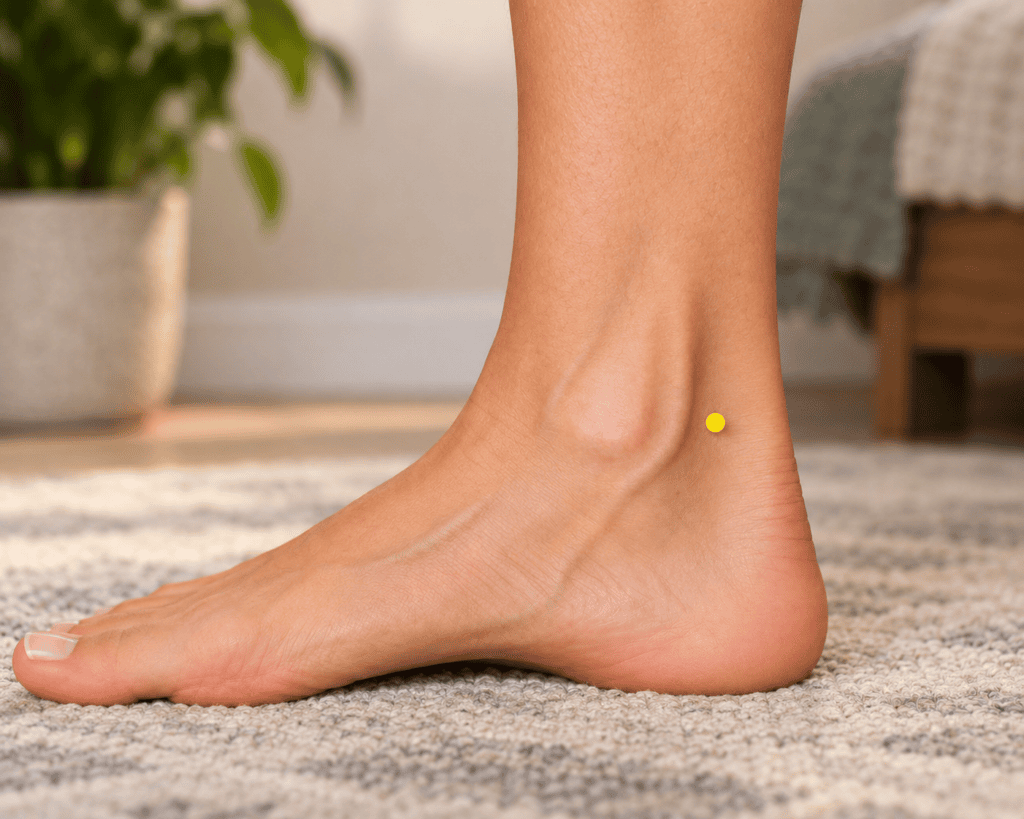
4. Press on KI6 below the inner ankle to support the joint. KI6 sits in the hollow just below the tip of the inner ankle bone. Press firmly with your thumb on the affected ankle for one to two minutes. KI6 is called “Zhaohai,” a point on the inner ankle and the Kidney.
The KI6 point, located just below the inner ankle bone, helps relieve pain and stiffness in the inner ankle. It works alongside KI3, positioned just behind it, to promote the flow of Qi and Blood around the ankle. As part of the Kidney meridian, it also supports joint health. When combined with points on the outer ankle, it helps encircle the entire joint. This point is especially recommended for treating sprains and helps address pain and tension in the lower inner ankle. It is a gentle point that is easy to apply pressure to.
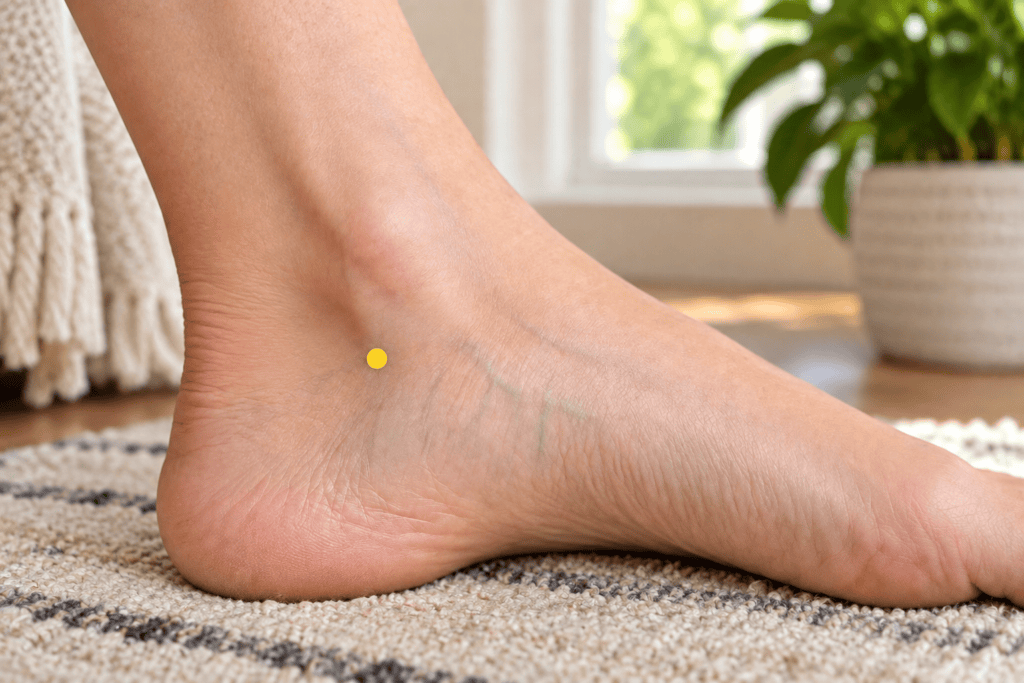
5. Press on ST41 at the front of the ankle to open the joint. ST41 sits in the center of the front of the ankle, in the hollow of the crease where the foot meets the leg, midway between the two ankle bones, between the two tendons you can feel there. Press firmly with your thumb for one to two minutes on the affected ankle. ST41 is called “Jiexi,” and it is the main point for the front of the ankle joint.
The ST41 point lies directly at the front fold of the ankle and serves as the main point for the front part of the joint. It helps relieve pain, swelling, and stiffness in that area and allows the ankle to move smoothly. It promotes the flow of Qi and Blood through the front of the joint, a region that the side points do not reach as directly. This point is particularly effective for pain and limitation when lifting the foot. For pain and stiffness on the front of the ankle, this point helps to open up the joint. Used with the points on either side, it fully encircles the ankle.
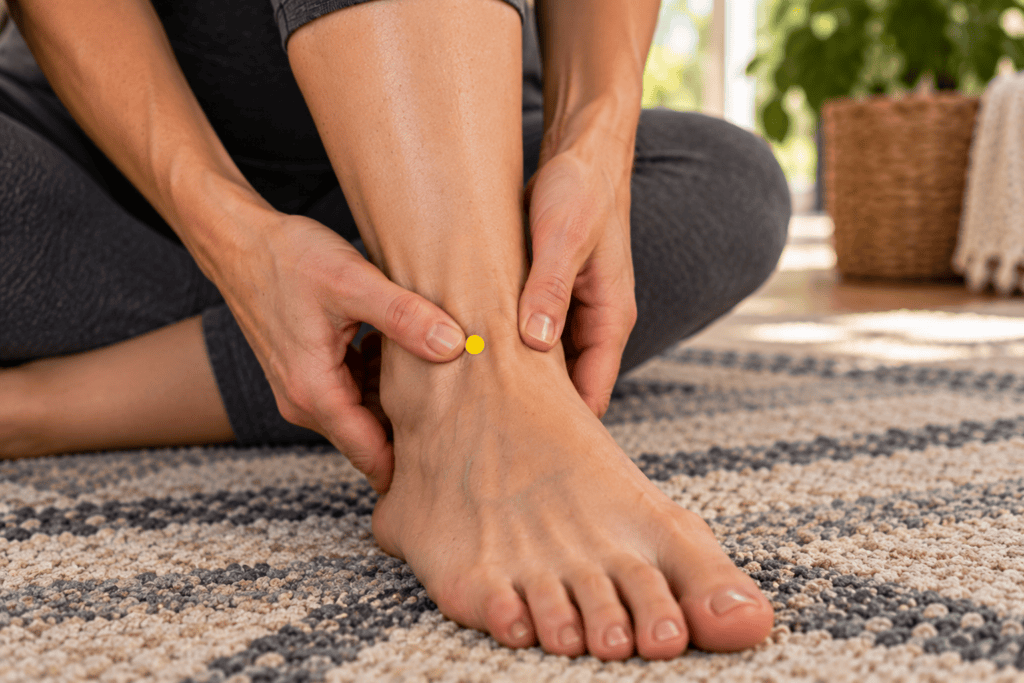
6. Press on SP5 in front of the inner ankle to complete the surround. SP5 sits in the hollow just in front of and below the inner ankle bone, on the inner side of the foot. Press firmly with your thumb for one to two minutes on the affected ankle. SP5 is called “Shangqiu,” a key point on the inner ankle.
The SP5 acupressure point is located on the front-inner part of the ankle and corresponds to GB40, which is at the front-outer ankle. Together, these points treat the front of the joint from both sides and help reduce pain, swelling, and stiffness in the inner ankle. They also help move stagnant Qi and Blood in that area. When used with GB40, BL60, KI3, KI6, and ST41, the points form a complete surround around the ankle, covering its front, back, inner, and outer sides. This demonstrates how Chinese medicine thoroughly targets a joint. For inner and front-inner ankle pain, this point completes the surrounding treatment and is a gentle, effective local point to include.
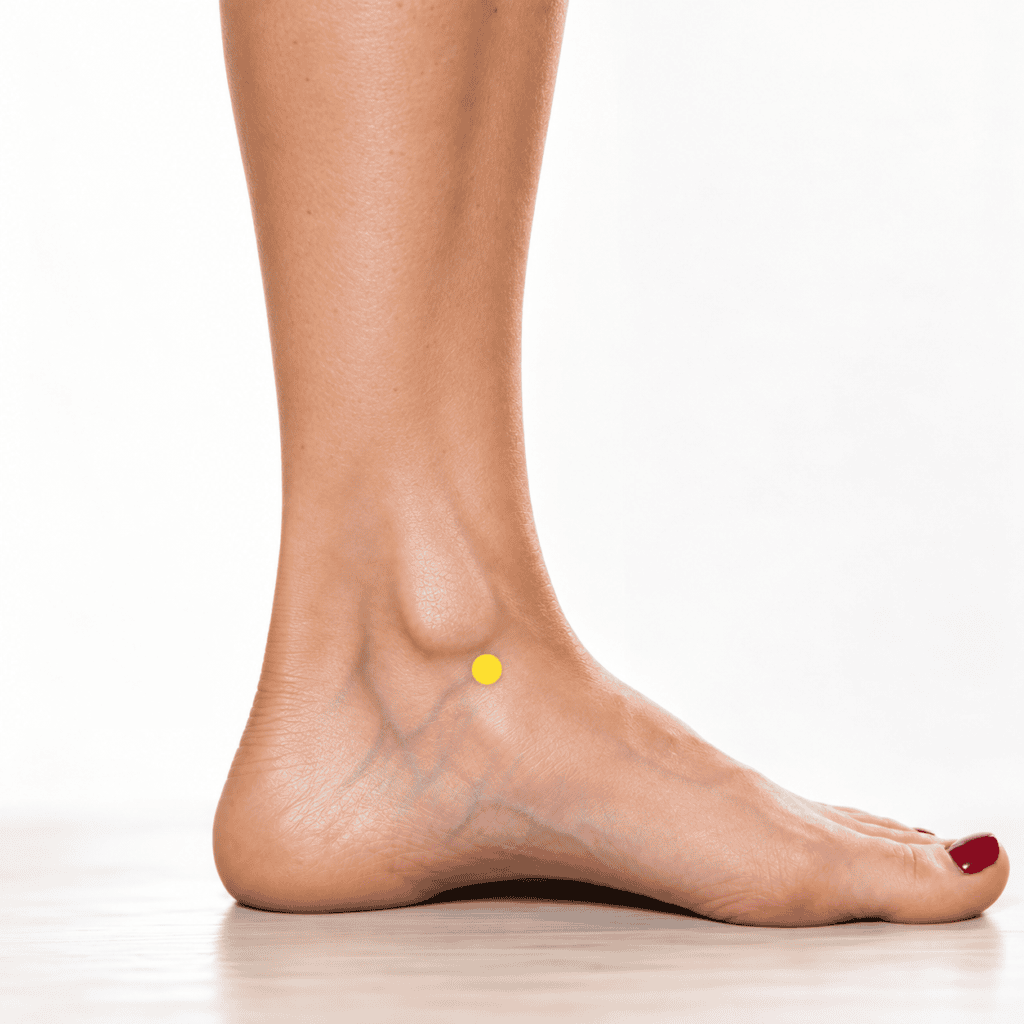
7. Press on the Ashi points gently at the sorest spots. The Ashi points are wherever the tenderness is greatest: the specific sore spots and swollen areas of your ankle. Gently feel around the ankle and press each tender spot gently if the injury is fresh, and more firmly as it settles, for about a minute. “Ashi” means “that’s it,” the sound of finding the exact sore point.
In Traditional Chinese Medicine, tender points are directly treated because pain often marks areas of maximum Qi and Blood blockage. For ankle pain, focus on the most sore and swollen spots near the injury. However, use caution: if the injury is recent, swollen, or bruised, avoid pressing directly on the injured site; instead, treat the surrounding points and distal areas. Use the tender-point technique only after the acute phase has passed. These tender spots accurately correspond to the pain location if you take proper care.
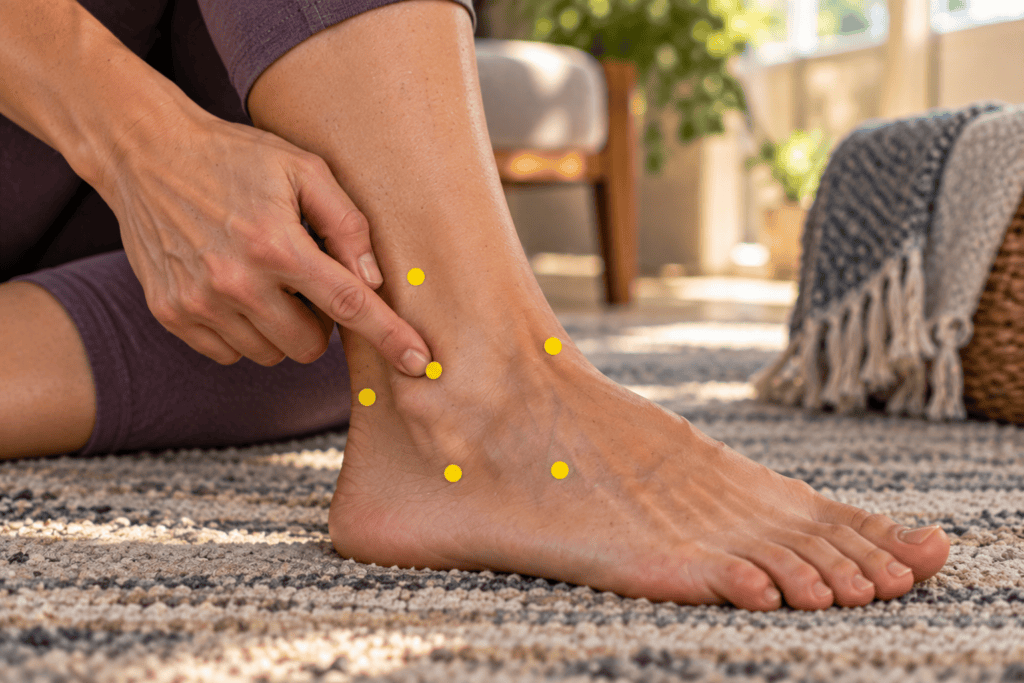
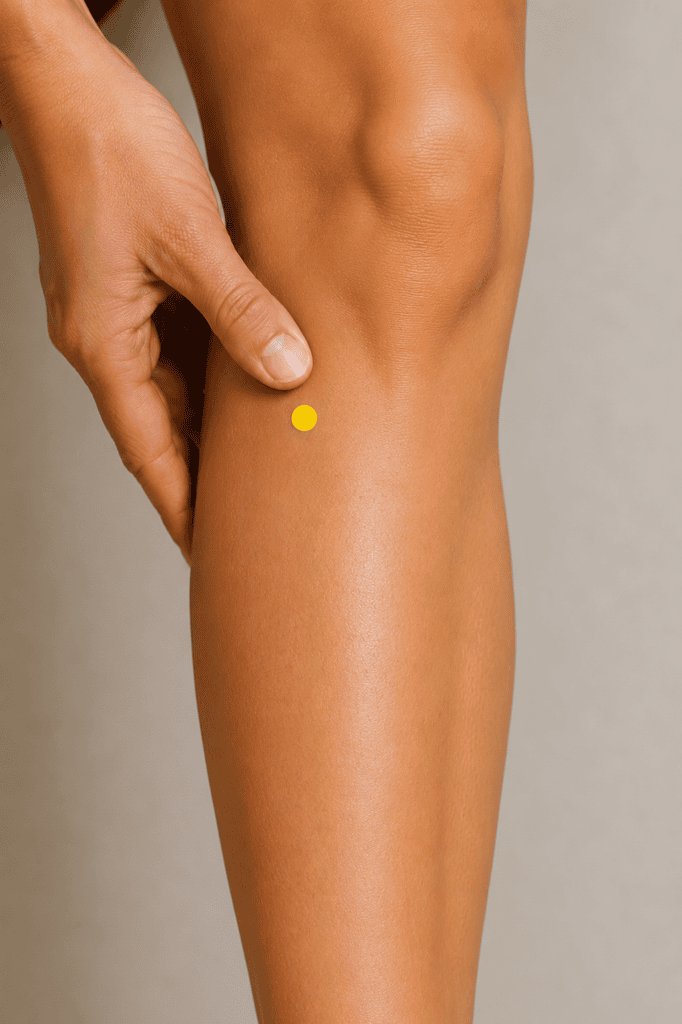
8. Press on GB34 below the outer knee to support the ligaments. GB34 sits on the outer lower leg, in the hollow just below and in front of the head of the fibula, the bony knob below the outer side of the knee. Press firmly with your thumb for one to two minutes on the affected leg. GB34 is called “Yanglingquan,” and it is the influential point for the sinews and tendons of the whole body.
Ankle sprains involve ligament damage, and GB34 is the main point for the body’s sinews, tendons, and ligaments. Although located on the leg away from the ankle, it effectively supports and benefits connective tissue throughout the body. Therefore, it is traditionally used to treat ankle sprains and other ligament or tendon injuries and support healing. Its remote position makes it safe and reliable, even when the ankle is too painful to touch. For ligament healing after a sprained ankle, this point offers full-body tendon support alongside local treatment.
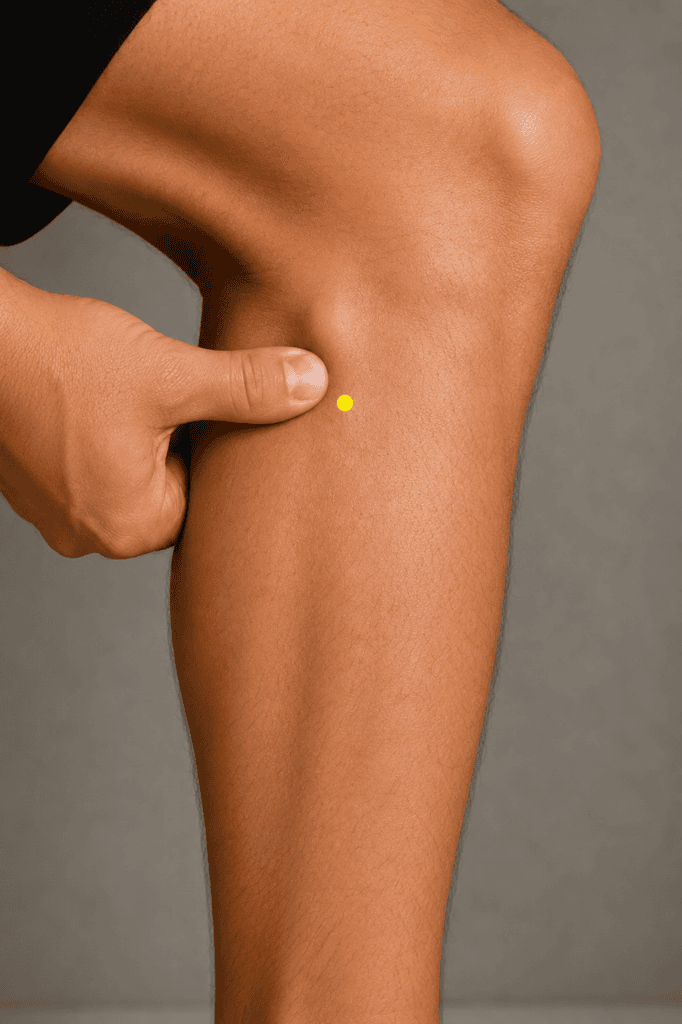
9. Press on ST36 below the knee to support healing and circulation. ST36 sits four finger-widths below the lower edge of the kneecap and one finger-width to the outside of the shinbone, on the muscle that rises when you flex your foot. Press firmly with your thumb for one to two minutes on the affected leg. ST36 is called “Zusanli,” the “Leg Three Miles,” and it is the master point for energy and for the legs.
The ST36 point plays a crucial role in restoring Qi and Blood flow, promoting circulation and vitality in the leg. This supports ankle healing and recovery and is considered a key acupoint for leg health. Like GB34, it sits away from the injured ankle, making it a safe and reliable point to stimulate throughout healing. It helps the body heal the injury and rebuild strength. When recovering from an ankle sprain or strain, this acupoint supports leg healing and complements local ankle treatments by aiding overall body recovery.
Why These Acupressure Points Work
In Traditional Chinese Medicine, ankle pain is seen as a painful blockage caused by Qi and Blood stagnation. This stagnation occurs in the meridians around the joint because of injury, overuse, or cold and damp conditions, affecting all the meridians that pass through the ankle. The nine points are designed to address this whole condition.
- The surrounding ankle points (GB40, BL60, KI3, KI6, ST41, SP5) move the stuck Qi and Blood and treat the joint from all sides, the front, back, inner, and outer.
- The Ashi points work directly on your sorest spots, gently, on a fresh injury.
- The ligament point (GB34) supports the healing of the sprained ligaments and tendons from a distance.
- The healing point (ST36) rebuilds the Qi, Blood, and circulation that the recovery draws on.
The common theme throughout is unblocking the flow around the joint and supporting the ligaments during healing, with points like GB34 and ST36 safe to work on firmly even if the ankle is too sore to touch.
How to Properly Use These Acupressure Points
Adjust your approach based on whether the injury is recent or has healed, and integrate point work with proper care.
- When you sprain your ankle, protect and rest it, use gentle compression, and elevate it to reduce swelling. Apply ice immediately after the injury, then switch to warmth to promote healing, as Traditional Chinese Medicine suggests. At this stage, use gentle acupressure on GB34 and ST36, avoiding deep pressure on the swollen area.
- Once the acute swelling subsides, press firmly on GB40, BL60, KI3, KI6, ST41, and SP5, along with the tender Ashi points, to break up stagnation and alleviate pain. Additionally, apply warmth to the joint to enhance circulation.
- For chronic or long-standing ankle pain rather than a recent injury, start by pressing all the points firmly; applying warmth to the ankle can also be helpful in this situation.
- Hold each point for one to two minutes, gently massage the area around the ankle and calf as it settles, and carry out this treatment a few times each day.
Acupressure supports pain relief and recovery and complements other approaches. For a new sprain, rest and protect the joint, apply compression, and elevate it in the first few days to minimize swelling, which can delay healing if left untreated. Briefly applying ice at first, then switching to warmth, can help facilitate Qi and Blood flow through the injured area. Once the acute stage passes, gentle movement, followed by rehabilitation and strengthening exercises, is crucial for healing and preventing long-term weakness or re-spraining. It’s best to do this under a physical therapist’s supervision, as untreated sprains often recur. A supportive brace may be helpful early on, and gradually returning to activity is essential to protect the healing joint. Acupressure supports all these measures but does not replace them.
When to Get Professional Help
When treating ankle injuries, differentiating a sprain from a fracture is crucial because they can look similar at first. Seek medical attention if you cannot bear weight or have severe pain, swelling, deformity, tenderness, numbness, or tingling, as these may indicate a fracture or serious injury. Also, see a doctor if symptoms persist or the ankle keeps giving way, which may point to instability that requires rehabilitation. Even sprains need proper treatment to prevent chronic pain and recurring injuries. While acupressure and self-care can ease soreness and support recovery, they don’t replace the assessment or rehabilitation needed for serious injuries.
Above and Beyond Acupuncture offers acupuncture, cupping, and lifestyle coaching at the North Frank Lloyd Wright Boulevard location in Scottsdale.
Schedule an appointment online to start your healing journey.
The points above are only as effective as the technique used to apply them. Where to press, how firmly, and for how long all affect the result. For a full breakdown of how to perform acupressure properly at home, read Performing Acupressure in 3 Easy Steps.

About the Publisher
Paul Kerzner, L.Ac., is a licensed acupuncturist and board-certified herbalist, as well as the founder of Above and Beyond Acupuncture in Scottsdale. His own journey from chronic patient to practicing acupuncturist shapes his commitment to providing honest, clinically grounded information about acupuncture and Traditional Chinese Medicine. Learn more about Paul and his clinical approach on the About Us page.