Key Takeaways
- Postpartum anxiety is common and can feel overwhelming, manifesting as restless thoughts and physical symptoms like a racing heart.
- Acupressure offers relief by targeting specific points to calm the mind, settle the body, and support healing, but it should be paired with other forms of support.
- Ten key acupressure points can help alleviate symptoms of postpartum anxiety, including Yintang, HT7, and SP6.
- Daily practice of acupressure on selected points can effectively support recovery and rebuild energy reserves after childbirth.
- If anxiety feels unmanageable, it’s important to seek professional help and support.
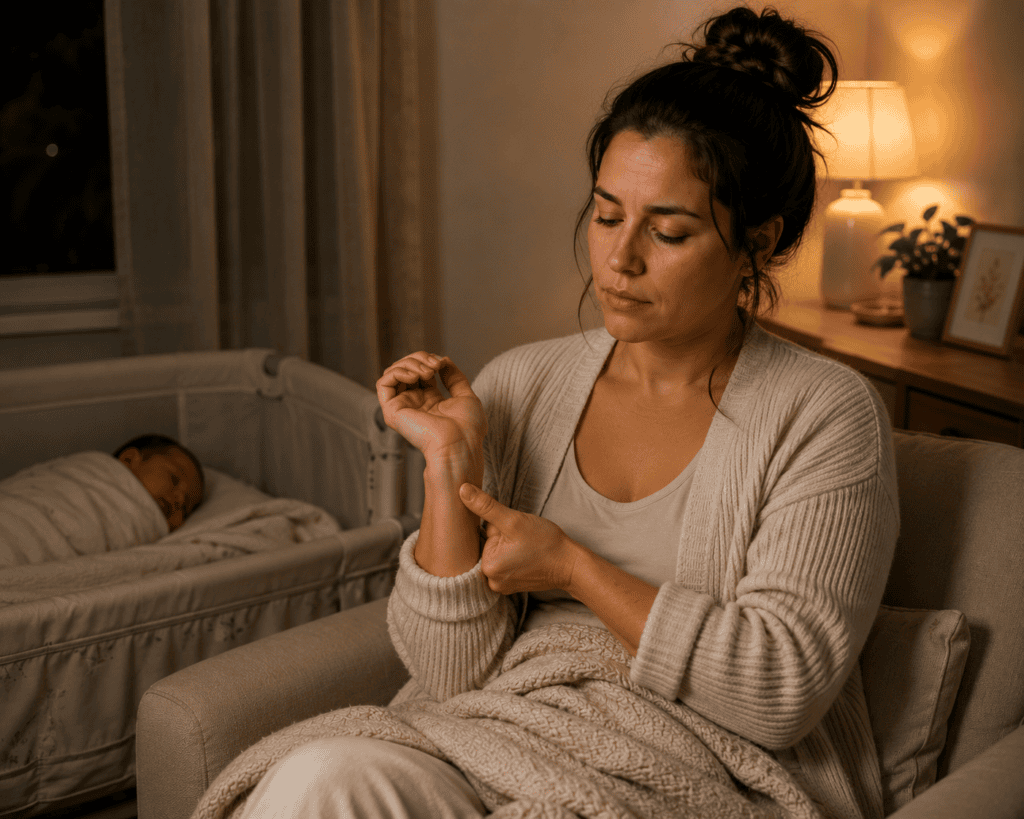
Postpartum anxiety tends to receive less recognition than postpartum depression but is just as common and overwhelming. It can show up as a racing mind that won’t slow down, ongoing worry, and constant checks to see whether the baby is still breathing. Physical signs such as a pounding heart and tight chest can happen unexpectedly. The hardest part is lying awake, both wired and exhausted, unable to sleep even during the short time when the baby finally sleeps. Acupressure gives new mothers a way to find some calm with their own hands, helping them take a few minutes to quiet their busy thoughts and relax their bodies from heightened alertness.
Chinese medicine recognizes this condition with great precision. Childbirth depletes the Blood, which stabilizes the Shen, the mind and spirit. When Blood is deficient, the Shen becomes anxious and restless, leading to postpartum anxiety. Additionally, pregnancy and childbirth draw on the Kidney’s deepest resources; traditionally, the Kidneys are believed to control fear, so their depletion can cause feelings of dread and hypervigilance that contribute to worry. Liver Qi stagnation causes churning, looping, and difficulty letting go.
The outcome is a state of being wired yet exhausted: a body too drained to function and too restless to rest. The following points are designed to calm the floating Shen, steady nervous energy, lessen worry, and replenish the body’s reserves.
Acupressure can assist during this time, but it is not a standalone solution. It helps you stay grounded during anxiety and supports healing. It works best when you have support from loved ones and professional care.
Here are ten acupressure points that can help:
What Acupressure Points to Press and Why
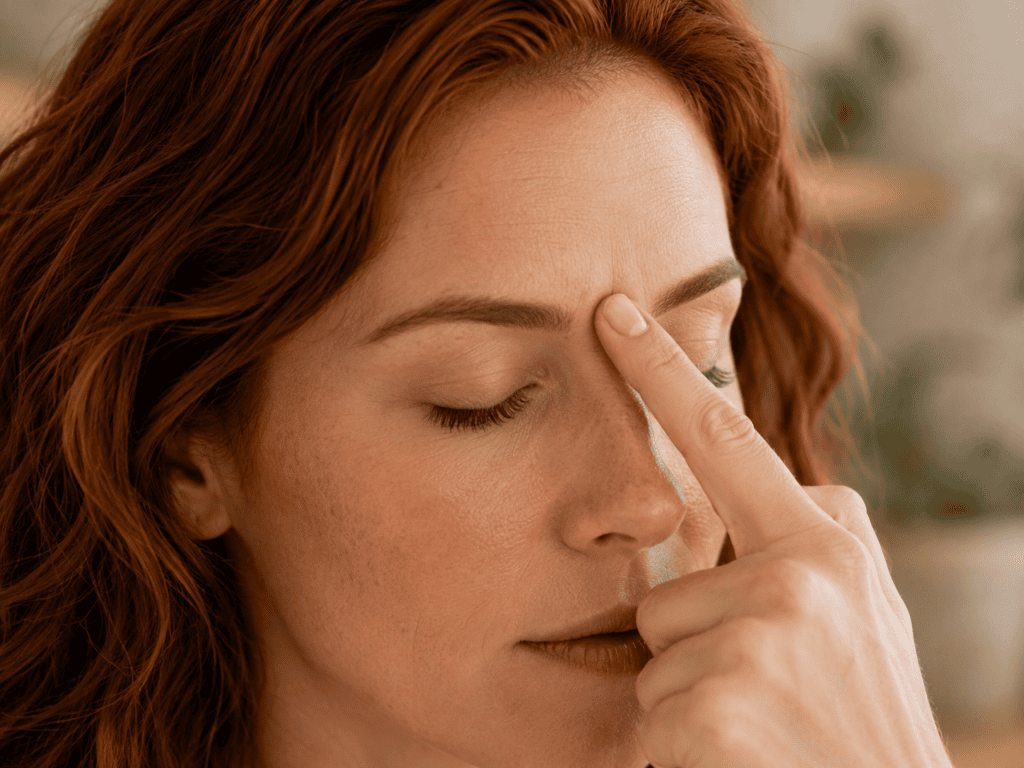
1. Press on Yintang between your eyebrows for a racing mind. Yintang sits in the small hollow directly between the eyebrows, just above the bridge of the nose. Rest a fingertip there and press gently for one to two minutes while your breathing slows. Yintang is one of the most calming points on the body, and it asks almost nothing of you to use.
This is the point for the spinning, worried, will-not-slow mind at the center of postpartum anxiety. It calms the Shen and shifts the body toward the parasympathetic rest state, easing the churn of anxious thought and softening the edge of the worry. In a wired, middle-of-the-night moment when the thoughts are running, a minute of gentle pressure here is the simplest place to start.
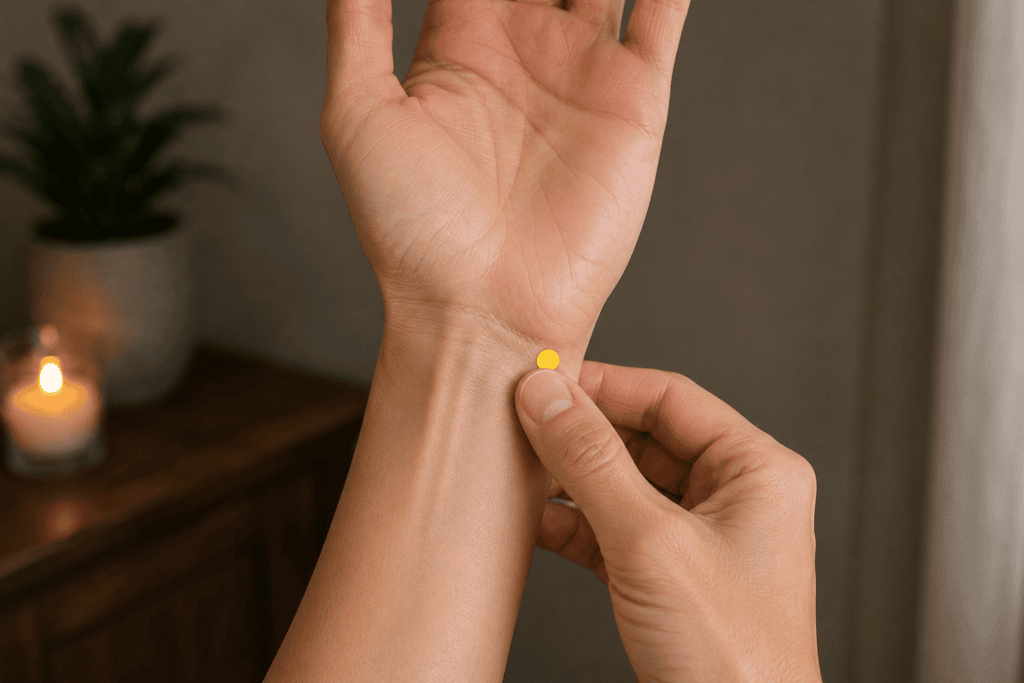
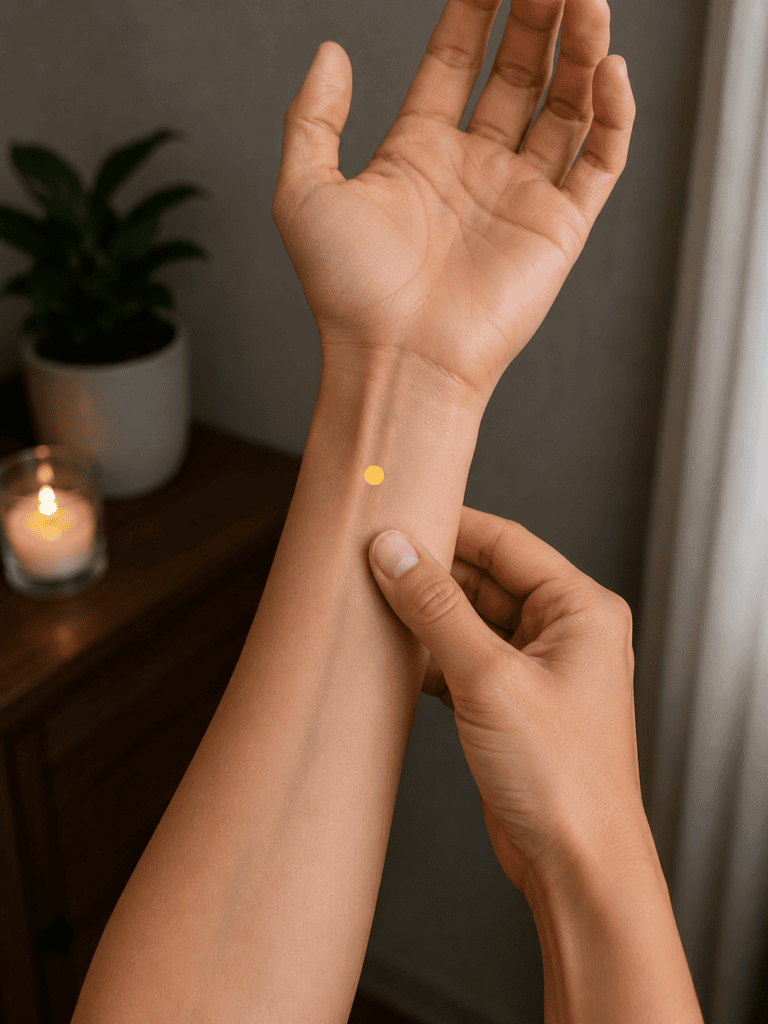
2. Press on HT7 at your wrist for a pounding, restless Heart. HT7 sits at the wrist crease on the pinky side, in the small hollow just inside the bony bump at the base of the hand. Press gently with your thumb for one to two minutes on each hand. HT7 is called “Shenmen,” the “Spirit Gate,” and it is the source point of the Heart channel.
The Heart houses the Shen, and when childbirth depletes the Blood that should anchor it, the Shen grows restless, which shows up as a racing or pounding heart, anxiety that will not quit, and the exhausted wakefulness where the body cannot fall asleep even when the chance is right there. HT7 settles the Heart and the Shen directly. It is completely discreet, easy to press with a thumb while you hold or feed the baby with the other arm.
3. Press on PC6 on your inner forearm for a tight, racing chest. PC6 sits about three finger-widths above the inner wrist crease, in the center of the forearm between the two tendons. Press with your thumb for one to two minutes on each arm. PC6 is called “Neiguan,” the “Inner Pass,” and it opens the chest and calms the Heart region.
Postpartum anxiety often lands physically in the chest, a racing heart, a fluttering, a tight and shallow breath, the bodily surge of alarm. PC6 eases that directly, opening the constricted feeling and settling the physical wave of anxiety, and it quiets the nausea that anxiety can bring as well. Together with HT7 it is one of the strongest points for bringing down an acute surge, and both are within easy reach at any moment of the day or night.
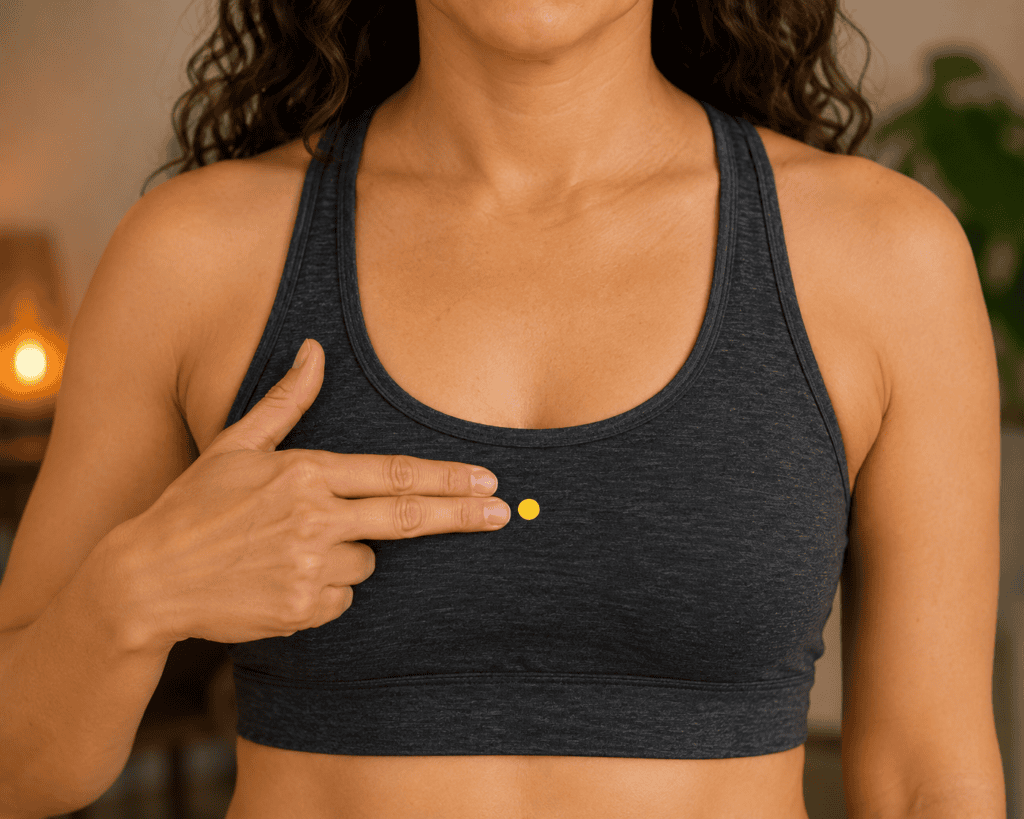
4. Press on CV17 at the center of your chest for anxious pressure. CV17 sits on the midline of the breastbone, level with the space between the fifth ribs, roughly at nipple height. Rest two or three fingertips there and press gently, or tap lightly, for one to two minutes while you breathe slowly. CV17 is called “Shanzhong,” and one of its names is the “Sea of Tranquility.”
Anxiety gathers as pressure behind the breastbone, a held breath, a band of tightness, a sense of not being able to draw a full breath. CV17 is the point that opens it. It gathers and frees the Qi of the chest and releases that constriction, and its calming quality gives the anxious pressure somewhere to soften. A few slow breaths with your hand resting here help unlock a chest that has been braced for hours.
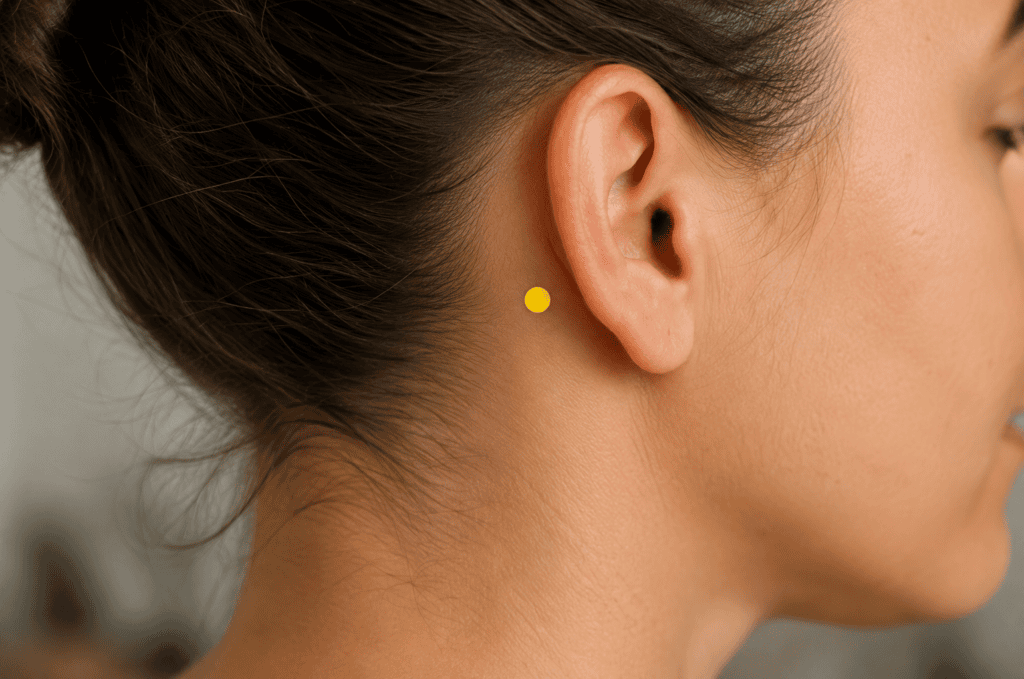
5. Press on Anmian behind your ear for wired, exhausted sleeplessness. Anmian sits behind the ear, in the hollow roughly midway between the bony bump behind the earlobe and the base of the skull. Press gently with a fingertip for one to two minutes on each side. The name Anmian means “Peaceful Sleep,” which is exactly what it is for.
This is the point for the signature cruelty of postpartum anxiety, the wired-but-exhausted insomnia where the body is depleted past the point of function yet will not power down when the baby sleeps. Anmian calms the Shen specifically toward sleep, quieting the overactive mind enough to let the body drop into rest during the windows when rest is possible. Pressing it in the last minutes before you try to sleep, and again if you wake wired in the night, helps the body take the sleep it can get.
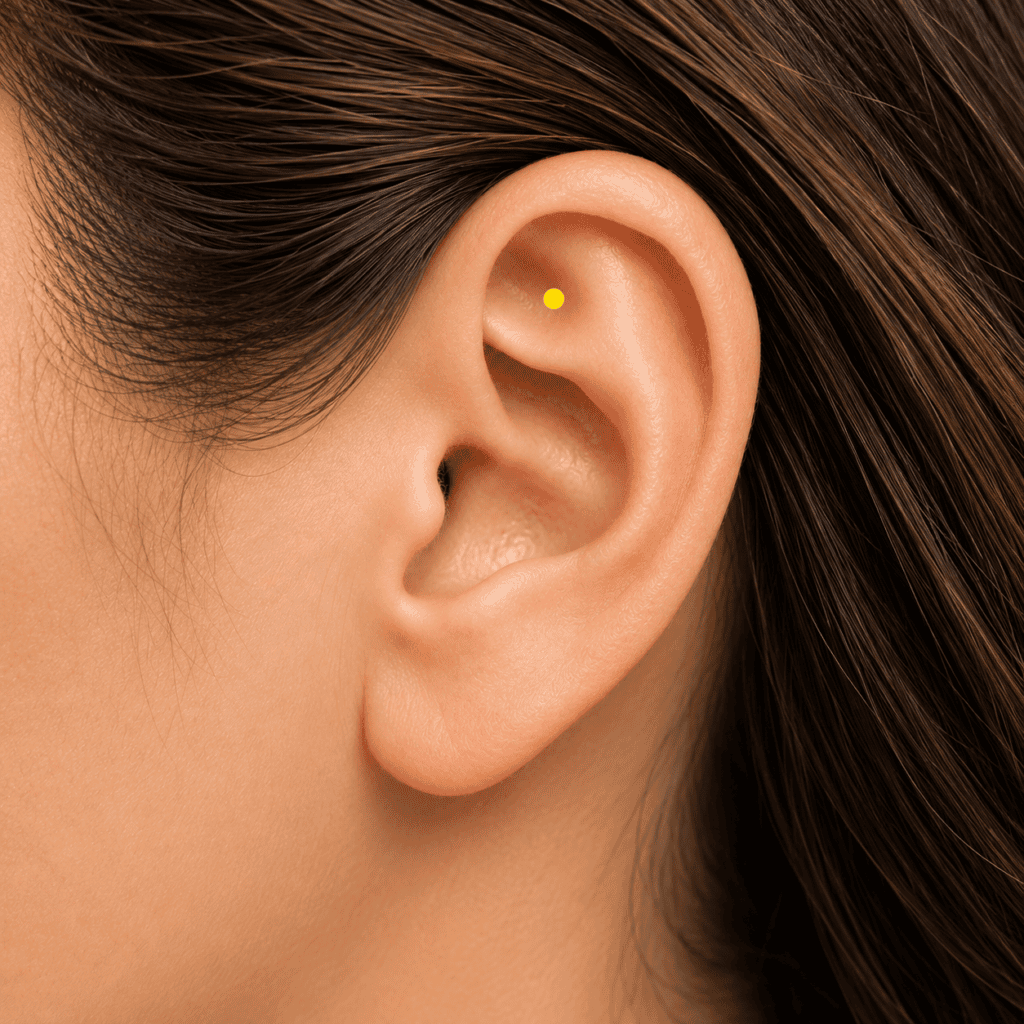
6. Press on Ear Shenmen for a spiraling, panicky moment. Ear Shenmen sits in the upper part of the ear, in the triangular hollow formed where the ridge of cartilage forks near the top. Pinch it gently between your thumb and index finger for one to two minutes. This is the calming master point of the ear, the same point used in the widely known auricular protocols for stress and anxiety.
The ear has a strong influence over the autonomic nervous system, and Ear Shenmen is the point that quiets an overactivated one fast, which makes it the one to reach for in an acute, spiraling, panicky moment. It is also the most discreet point on this list, since holding your ear or resting your hand along the side of your head draws no attention, useful when the anxiety spikes in front of others and you need to settle without stepping away.
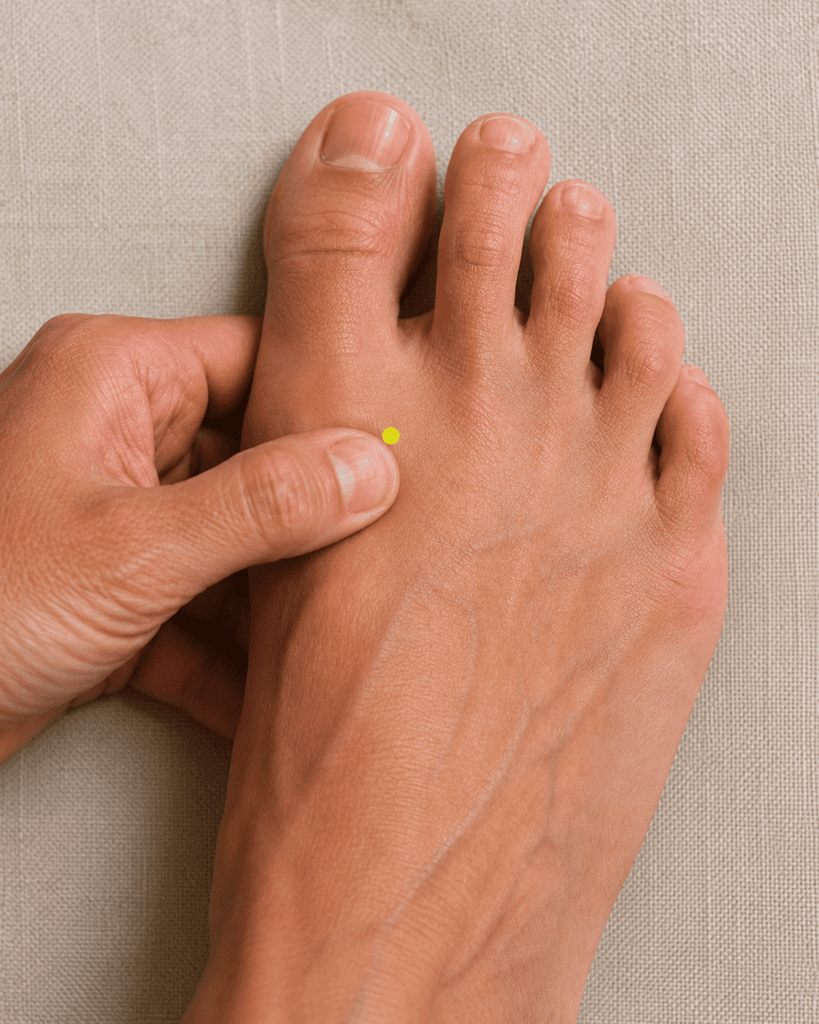
7. Press on LR3 on the top of your foot for churning worry. LR3 sits on the top of the foot, in the webbing between the first and second toes, about two finger-widths back where the bones meet in a small hollow. Press firmly with your thumb for one to two minutes on each foot. LR3 is called “Taichong,” the “Great Rushing,” and it is the primary point for moving stuck Liver Qi.
Postpartum anxiety carries a churning, looping, cannot-let-it-go quality, the same worry running the same track, often with an edge of irritability underneath, which Chinese medicine reads as Liver Qi that has become stuck. LR3 moves that stagnation and releases the pressure behind it, easing the rumination and the tense, wound-up feeling that drives it. For the anxiety that lives in relentless worry rather than in the body, this point reaches what the chest and Heart points cannot.
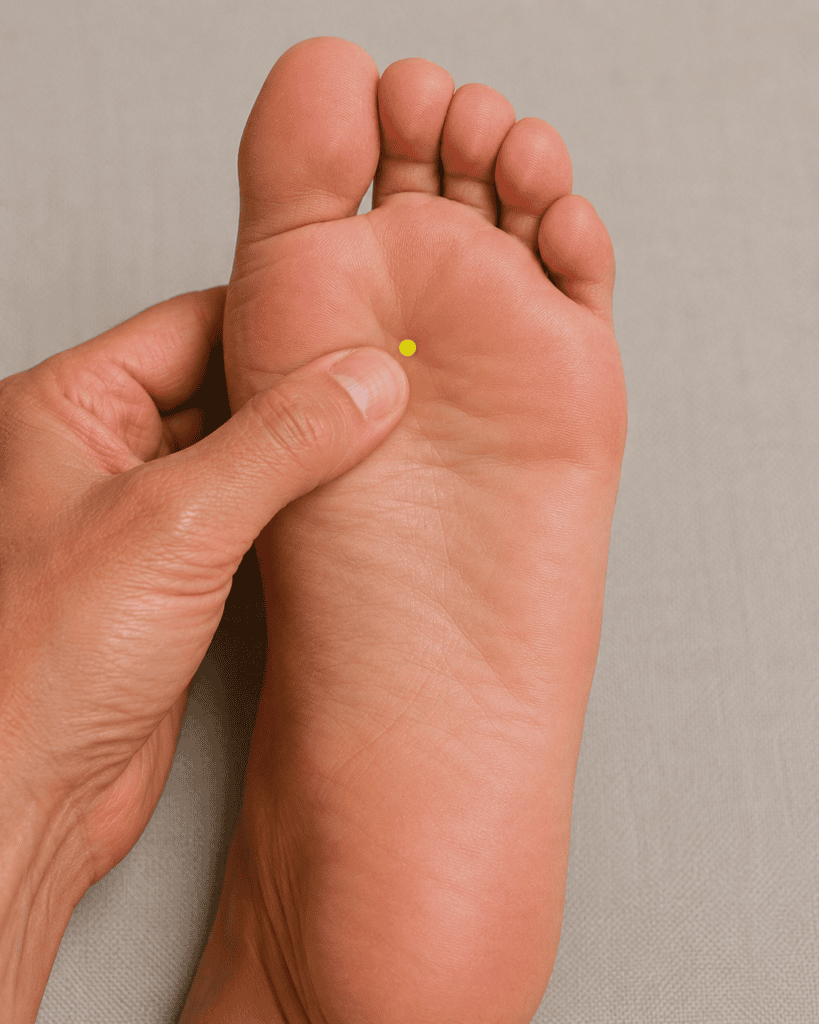
8. Press on KI1 on the sole of your foot to ground wired energy. KI1 sits on the sole of the foot, in the depression that forms just behind the ball of the foot when you curl your toes, roughly a third of the way down from the base of the toes to the heel. Press firmly with your thumb for one to two minutes on each foot, or press the sole against the floor. KI1 is called “Yongquan,” the “Bubbling Spring,” and it is the lowest point on the body.
When anxiety sends the energy rushing upward into a racing head and pounding chest, KI1 draws it back down and grounds it. As the lowest point on the body it has a powerful settling, anchoring effect, and because it belongs to the Kidney channel it speaks directly to the fear that sits under postpartum anxiety. For the ungrounded, floating, cannot-come-down feeling of being stuck in high alert, this point brings you back into your feet and out of your head.
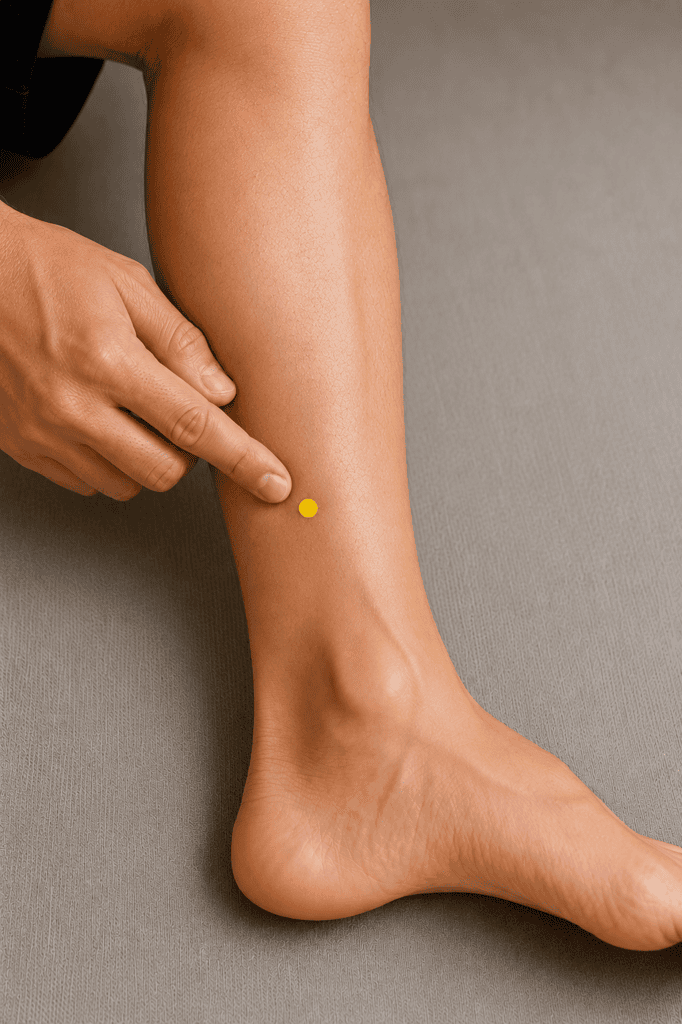
9. Press on SP6 above your inner ankle to anchor the Shen. SP6 sits four finger-widths up from the tip of the inner ankle bone, just behind the back edge of the shinbone. Press firmly for one to two minutes on each leg. SP6 is called “Sanyinjiao,” the “Three Yin Intersection,” where the Spleen, Liver, and Kidney channels meet. Avoided during pregnancy, it becomes a primary point once the baby has arrived.
This is where the root of postpartum anxiety is addressed. SP6 nourishes the Blood that birth emptied, and because it is the depletion of Blood that leaves the Shen unanchored and floating, restoring that Blood is what settles the restless mind at its source rather than only calming it on the surface. It also supports the Spleen that produces the Blood and helps quiet the Shen directly. Worked daily, it is part of the slow rebuilding that makes the anxiety less reactive over time.
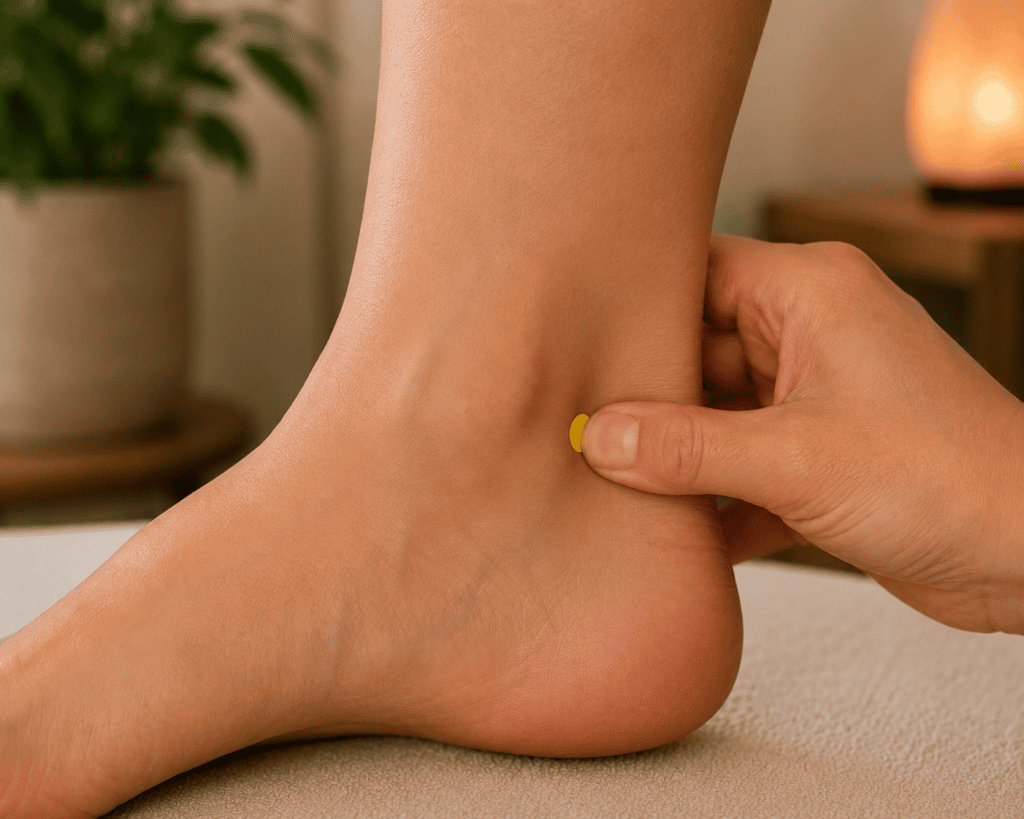
10. Press on KI3 behind your inner ankle for deep fear and dread. KI3 sits in the hollow between the inner ankle bone and the Achilles tendon. Press firmly with your thumb for two to three minutes on each ankle. KI3 is called “Taixi,” the “Great Ravine,” the source point of the Kidney channel.
In Chinese medicine the Kidneys hold the deepest reserves a person has, and they govern the emotion of fear, and pregnancy and birth draw on those reserves more than almost anything in life. When they run low, the result is the deep dread, the hypervigilance, and the underlying fear that sit beneath postpartum anxiety, distinct from surface worry and rooted lower. KI3 tends that deep root. Together with SP6 it forms the rebuilding pair beneath all the calming and grounding the other points provide, the patient work of restoring the foundation the anxiety grows out of.
Why These Acupressure Points Work
In Chinese medicine, postpartum anxiety is seen as an unrooted, unsteady Shen that rests on a physically depleted body. The ten acupressure points address both imbalances at once.
Childbirth drains the Blood that calms the mind, making the Shen restless and causing symptoms like agitation and insomnia. The Kidney reserves, which govern fear, become deficient and are pulled downward, leading to feelings of dread and hypervigilance. Liver Qi stagnation worsens the condition by causing persistent, repetitive worry. These acupuncture points work together to treat all these layers.
- The calming points (Yintang, HT7, PC6, CV17, Ear Shenmen) settle the floating Shen, easing the racing mind, the pounding chest, and the acute surges of anxiety.
- The sleep point (Anmian) quiets the overactive mind specifically toward the rest a wired-but-exhausted body cannot reach on its own.
- The moving point (LR3) frees the stuck Liver Qi behind the churning, repetitive worry.
- The grounding point (KI1) draws the wired energy down out of the racing head and anchors it.
- The rebuilding points (SP6, KI3) nourish the Blood and the deep Kidney reserves whose depletion leaves the Shen unanchored and brings the fear, addressing the root beneath the anxiety.
A common connection that runs through all of this: the ongoing sleep deprivation, recovery challenges, and persistent cortisol spikes due to living in a constant state of hypervigilance. These factors keep the nervous system on high alert, which is why practices that calm the nervous system and restore the body can have a meaningful impact, even through small daily efforts.
How to Properly Use These Acupressure Points
These acupressure points are safe and don’t require using all ten each time. Just a few minutes focusing on two or three points that resonate with your feelings is sufficient, making it easy to incorporate into a busy day with a newborn.
- When the anxiety surges in your body, reach for PC6, HT7, and Ear Shenmen, the fastest to bring down a racing heart and a spiraling moment. Most can be pressed one-handed while you hold the baby.
- When your mind is racing with worry, work Yintang and LR3 to slow the spin and free the churning thought.
- When you are wired and cannot sleep, press Anmian and HT7 before you try to rest, and again if you wake in the night unable to settle.
- When you feel ungrounded and stuck in high alert, press KI1, or simply press both feet firmly into the floor, to draw the energy down.
- Every day, when you can find the minutes, work SP6 and KI3 to rebuild the reserves whose depletion sits under the anxiety. This is the slower, quieter part, and it is where the anxiety gradually loses its grip.
- Keep the pressure firm but comfortable, and let your breathing slow while you press. None of these should ever hurt, and do not ask perfection of yourself. One point, once, in a hard moment still counts.
When to Reach Out for Additional Support
Postpartum anxiety is a common condition that can be effectively treated. Asking for help shows strength, not weakness. If persistent worry, racing thoughts, insomnia, panic episodes, or feelings of being overwhelmed are affecting you, reach out to your doctor, midwife, or a trusted person. They can help you access the support you need.
If you ever have thoughts of harming yourself or your baby, please reach out right away by calling or texting the 988 Suicide and Crisis Lifeline, available any hour of the day. For more on the care available to you through this period, Can Acupuncture Help With Postpartum Depression? covers it in depth, and the anxiety, stress, and depression that so often accompany this period respond well to treatment.
Above and Beyond Acupuncture offers acupuncture, cupping, and lifestyle coaching at the North Frank Lloyd Wright Boulevard location in Scottsdale.
Schedule an appointment online or call us today to start your healing journey.
The points above are only as effective as the technique used to apply them. Where to press, how firmly, and for how long all affect the result. For a full breakdown of how to perform acupressure properly at home, read Performing Acupressure in 3 Easy Steps.

About the Publisher
Paul Kerzner, L.Ac., is a licensed acupuncturist and board-certified herbalist, as well as the founder of Above and Beyond Acupuncture in Scottsdale. His own journey from chronic patient to practicing acupuncturist shapes his commitment to providing honest, clinically grounded information about acupuncture and Traditional Chinese Medicine. Learn more about Paul and his clinical approach on the About Us page.