Key Takeaways
- Heel pain may stem from conditions such as plantar fasciitis, Achilles tendon issues, or heel spurs, leading to discomfort during everyday activities.
- Acupressure alleviates heel pain by stimulating specific points on the foot and calf, enhancing Qi and Blood circulation, and promoting Kidney health.
- Important acupressure points like KI3, BL60, KI6, and Ashi points target pain relief and enhance local blood flow.
- In addition to acupressure, consistent stretching, wearing appropriate shoes, and adequate rest are vital for effectively managing heel pain.
- Consult a healthcare professional if heel pain continues, worsens, or occurs alongside other worrying symptoms or injuries.
Heel pain can make every step uncomfortable, as your heels bear your full weight with each stride.
You might feel sharp pain in the morning, a dull ache in the back, or deep soreness; all are common and limiting. The most typical cause is plantar fasciitis, an inflammation of the tissue along the sole. However, heel pain can also stem from Achilles tendon problems, heel spurs, bruises, or overuse. Acupressure may help by reducing pain, relaxing tension in the foot and calf muscles, and promoting recovery.
In Traditional Chinese Medicine, heel pain is attributed to a blockage of Qi and Blood in the channels around the heel. This often has deeper roots, as the heel connects to the Kidney, which governs the bones, and a channel passes through the heel. Factors like overuse, prolonged standing, poor footwear, and exposure to cold and damp can cause Qi and Blood stagnation, resulting in pain and stiffness. Kidney weakness can predispose the heel to chronic, aching pain, particularly with aging. Additionally, the Bladder channel runs along the back of the leg and heel, linking the heel to the calf and Achilles tendon. The points listed below are intended to promote Qi and Blood flow, release tension in the sole and calf, support Kidney health, and alleviate pain.
Here are nine acupressure points, mainly around the heel and foot, that can provide relief.
What Acupressure Points to Press and Why
1. Press on KI3 behind the inner ankle, the key point for the heel. KI3 sits in the hollow between the inner ankle bone and the Achilles tendon, level with the tip of the ankle bone. Press firmly with your thumb for one to two minutes on the affected foot. KI3 is called “Taixi,” the source point of the Kidney, the system most tied to the heel.
This point is the most crucial for heel pain. As the Kidney’s source point, believed to govern the bones and to have a channel running through the heel, KI3 targets heel pain at its origin, especially when the pain is chronic and aching. Located just above the heel behind the inner ankle, it helps move Qi and Blood around the heel and Achilles and reinforces the Kidney in this region. It is a key point for nearly all types of heel discomfort. For pain in and around the heel, start with this point, as it addresses both the pain and its underlying cause.
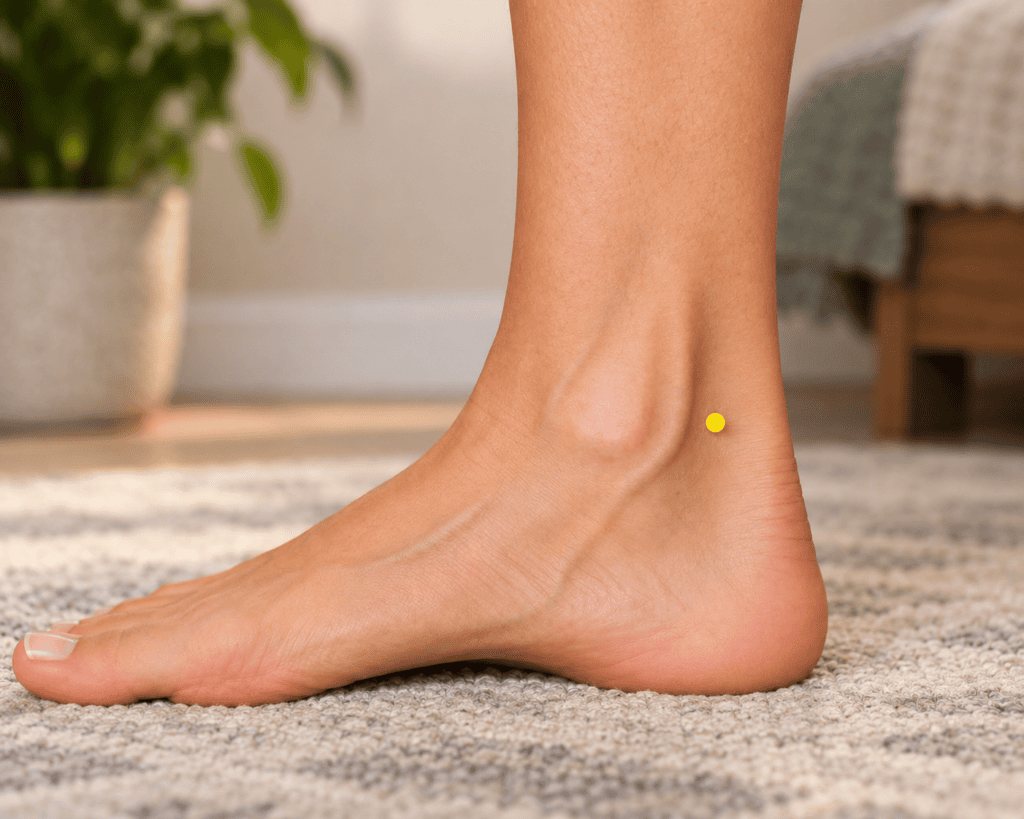
2. Press on BL60 behind the outer ankle to ease the heel and Achilles. BL60 sits in the hollow between the outer ankle bone and the Achilles tendon, level with the tip of the ankle bone, opposite KI3. Press firmly with your thumb for one to two minutes on the affected foot. BL60 is called “Kunlun,” and it is a major point for heel and ankle pain.
BL60 is situated on the Bladder channel just above the heel, opposite KI3. Pressing both points at once targets heel issues from both sides of the Achilles tendon. As a key point for heel and ankle discomfort, BL60 is highly effective for pain along the back of the body, earning it the nickname “aspirin point.” It alleviates pain at the back of the heel and along the Achilles tendon. When dealing with these pains, BL60 acts directly, and when combined with KI3, it covers the area above the heel comprehensively.
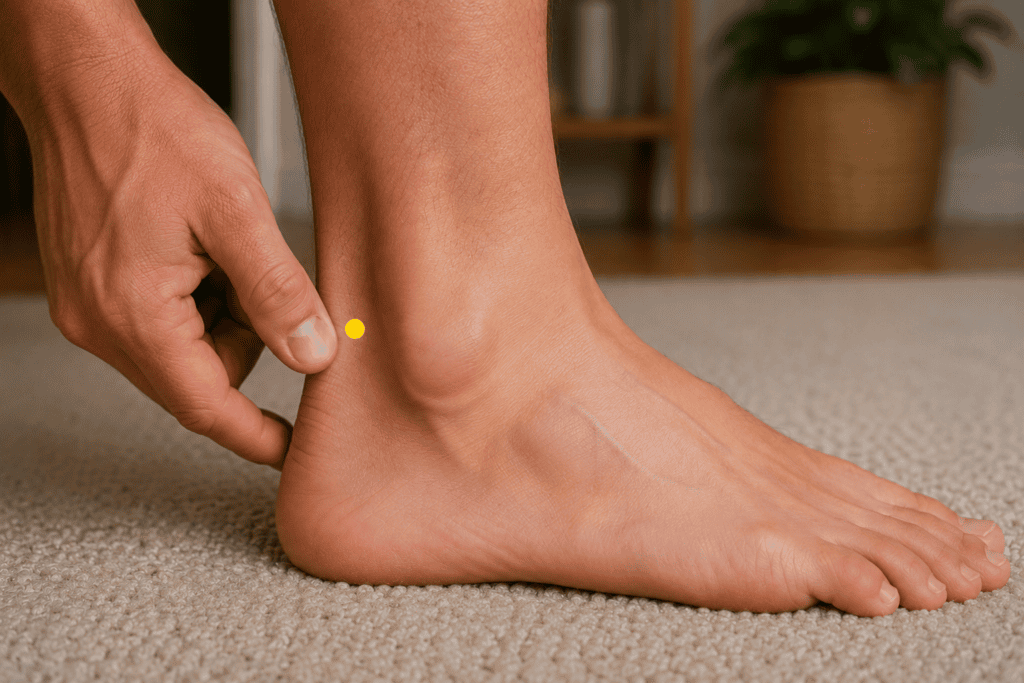
3. Press on KI6 below the inner ankle to support the heel. KI6 sits in the hollow just below the tip of the inner ankle bone, above the heel. Press firmly with your thumb for one to two minutes on the affected foot. KI6, called “Zhaohai,” is a Kidney-channel point near the heel.
KI6 is located on the Kidney channel just below the inner ankle bone, near the heel. It is a useful local point for heel pain relief and supports Kidney health in this area. It promotes the movement of Qi and Blood in the inner heel area and works synergistically with KI3, just above it, to enhance the Kidney’s influence on the heel. For pain on the inner and lower heel, this point provides additional support and complements other ankle-level points to encircle the heel from above.
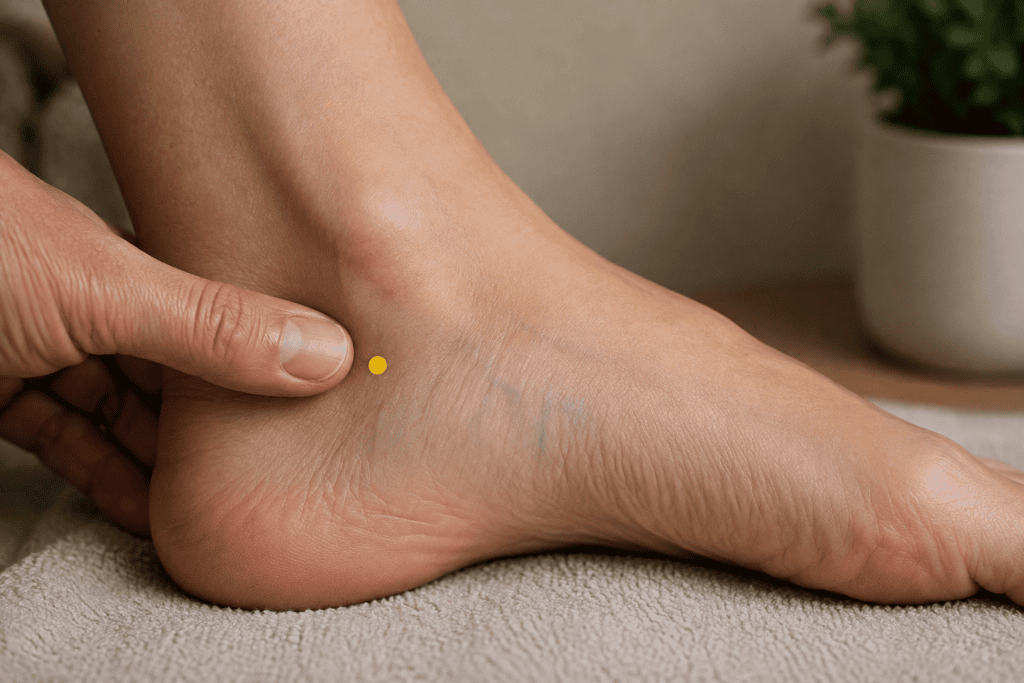
4. Press on BL62 below the outer ankle for the outer heel. BL62 sits in the hollow just below the tip of the outer ankle bone, above the heel. Press firmly with your thumb for one to two minutes on the affected foot. BL62 is called “Shenmai,” a Bladder-channel point near the heel.
BL62 is located just below the outer ankle bone near the heel on the Bladder channel, mirroring KI6 on the inside. Using both points helps treat the lower ankle and upper heel from both sides. BL62 promotes the flow of Qi and Blood in the outer heel, reducing pain and stiffness. When combined with KI3, BL60, KI6, and BL62, these points surround the heel from above and all sides, offering a comprehensive approach in Chinese medicine. For outer heel pain, this point completes the treatment coverage.
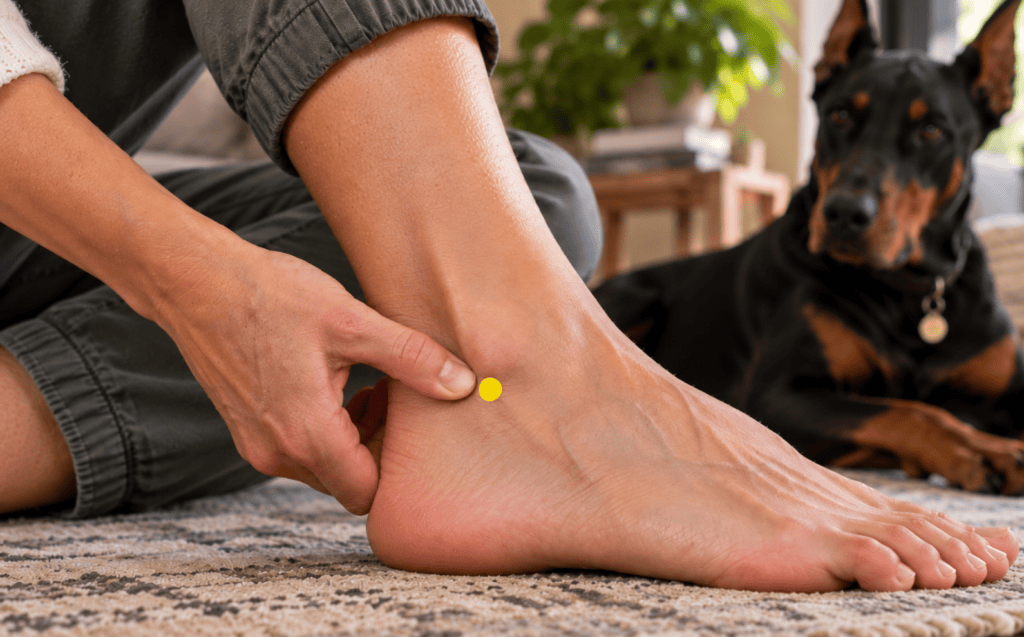
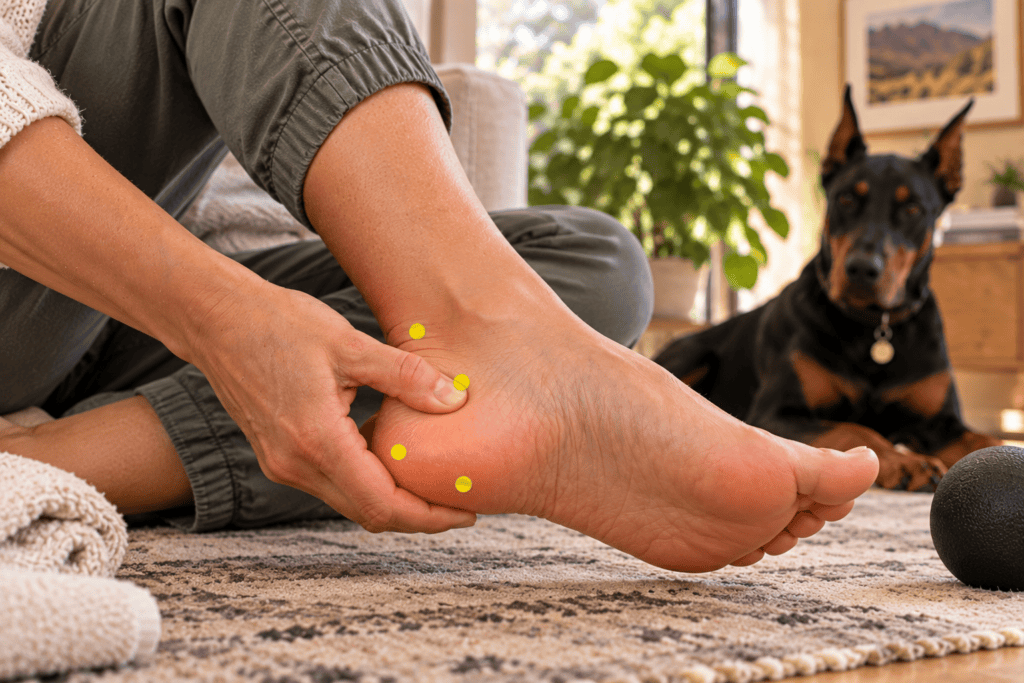
5. Press on the Ashi points right on the sore heel. The Ashi points are the tender, sore spots on the heel itself: the point of maximum pain under the heel, at the back, or wherever it hurts most. Find the sorest spot and press firmly with your thumb, or use a ball under your foot, for about a minute, adjusting to what you can tolerate. “Ashi” means “that’s it,” the sound of finding the exact sore point.
In Traditional Chinese Medicine, practitioners target tender spots where pain indicates Qi and Blood blockages. The heel, especially the underside or the back, is crucial. Pressing or rolling this spot with a ball or ice helps release tension and stagnation. Focusing on this tender area often provides the most significant relief.
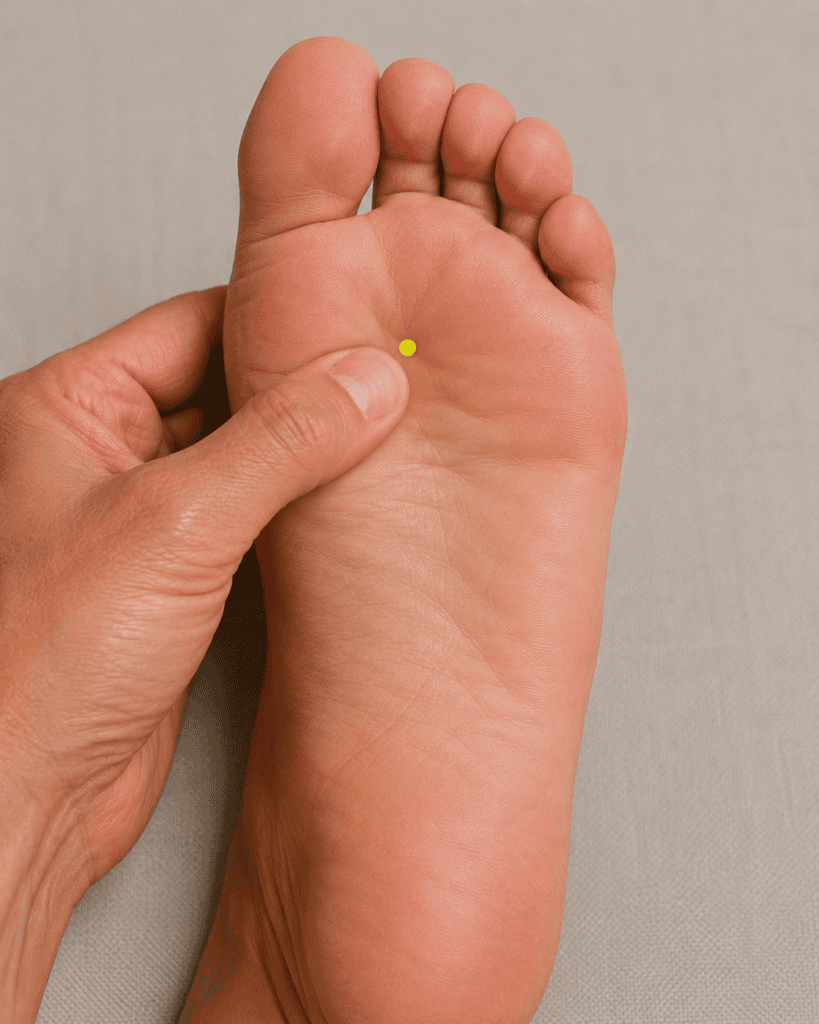
6. Press on KI1 on the sole of the foot to move the Qi and Blood. KI1 sits on the sole of the foot, in the hollow that forms in the center of the ball of the foot when you curl the toes, about a third of the way down from the toes to the heel. Press firmly with your thumb for one to two minutes on the affected foot. KI1 is called “Yongquan,” the “Bubbling Spring,” and it is the first point of the Kidney channel on the sole.
KI1 is the initial point of the Kidney channel and the lowest point on the body, located on the sole. It connects directly to the Kidney, which supports the heel. Pressing this point promotes the flow of Qi and Blood through the sole, supporting the entire foot and heel. Although positioned toward the front of the sole, using it alongside sore heel points helps unblock Qi and Blood across the entire underside, where the plantar fascia lies. For heel pain related to the sole and fascia, this point aids the entire bottom of the foot and helps stabilize the system.
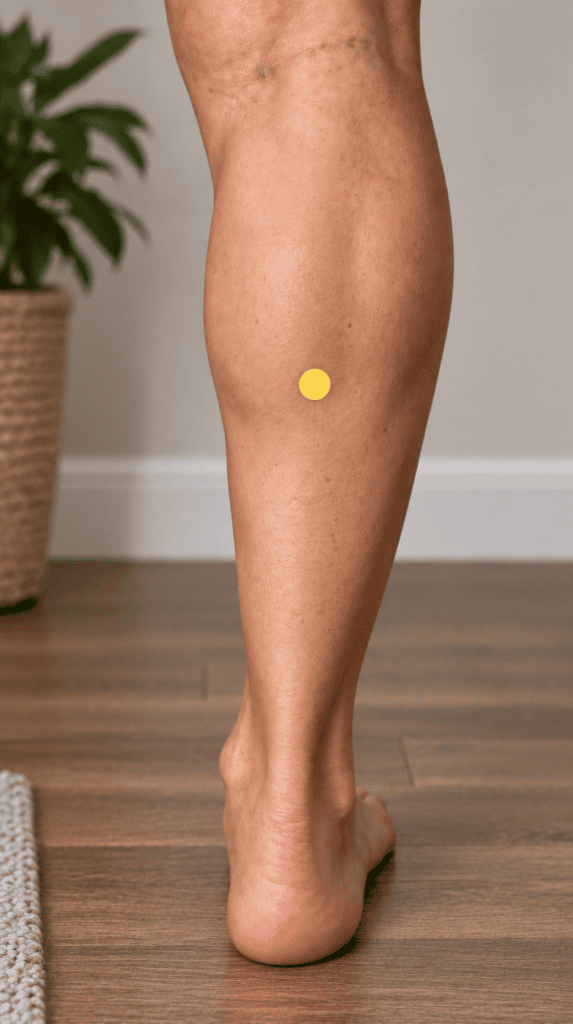
7. Press on BL57 in the calf to release the pull on the heel. BL57 sits in the center of the back of the lower leg, in the hollow where the calf muscle bulges and meets the Achilles tendon, about midway between the back of the knee and the heel. Press firmly with your thumb on the affected leg for one to two minutes. BL57 is called “Chengshan,” the primary point for the calf.
The calf muscles and Achilles tendon connect directly to the heel, so tight calves can pull on the heel and increase discomfort. That’s why BL57, the primary point for the calf, is key to relieving heel pain. It relaxes calf tension that impacts the heel, reducing pressure on the sore area. Situated on the Bladder channel, which extends to the heel, BL57 is particularly effective for heel pain caused or worsened by tight calves or Achilles tendons. Combining this point with calf stretching can help release tension above and lessen heel strain.
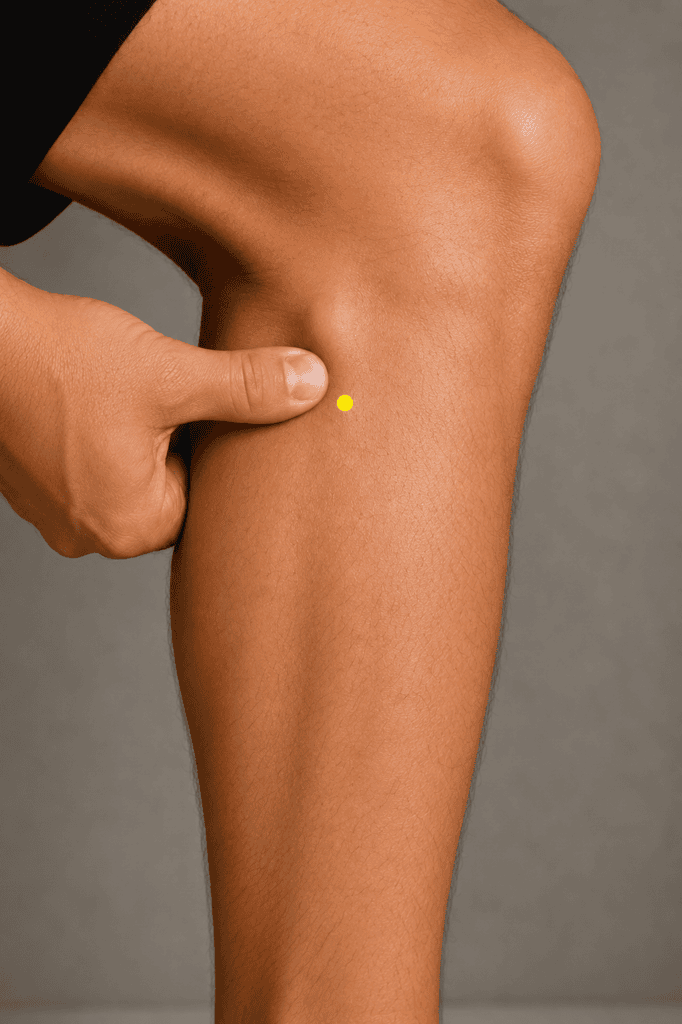
8. Press on GB34 below the outer knee to support the sinews. GB34 sits on the outer lower leg, in the hollow just below and in front of the head of the fibula, the bony knob below the outer side of the knee. Press firmly with your thumb for one to two minutes on the affected leg. GB34 is called “Yanglingquan,” and it is the influential point for the sinews and tendons of the whole body.
Heel pain often involves the plantar fascia and Achilles tendon. GB34 is a key point for tendons and connective tissue, located higher on the leg but still effective for heel and other tendon or fascia issues. It supports connective tissue across the body, making it useful in healing treatments. Because it is away from the painful heel, pressing this point is safe and straightforward. For heel pain related to tendons and fascia, GB34 provides whole-body support to local therapies.
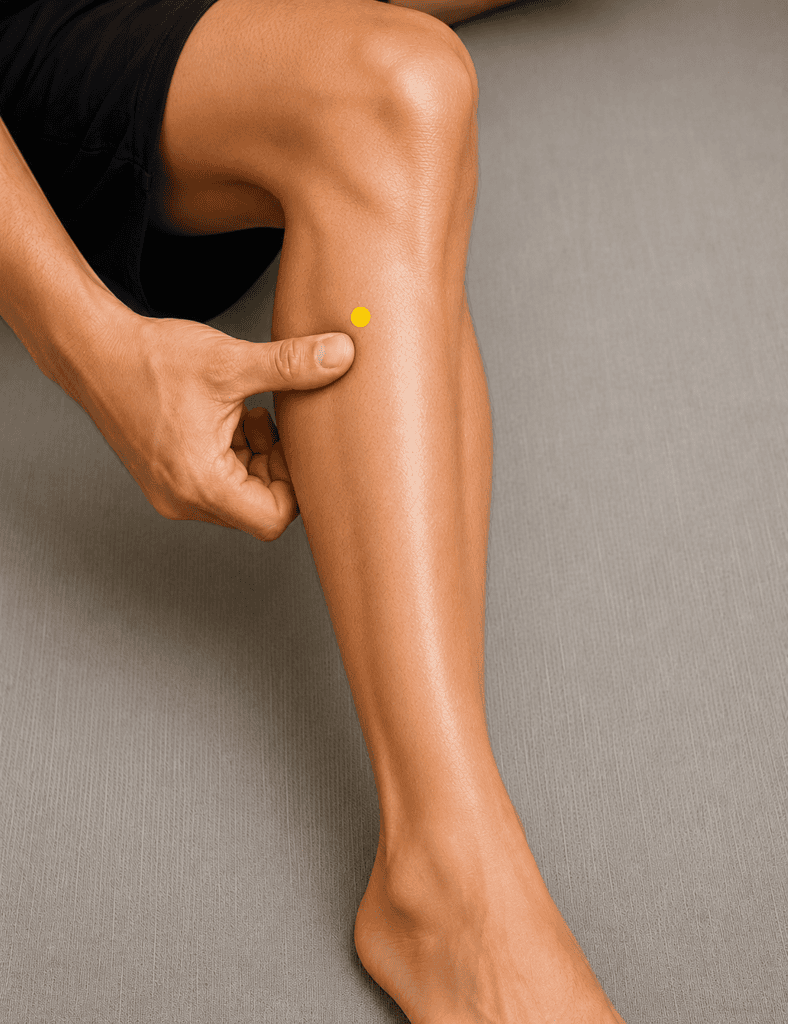
9. Press on ST36 below the knee to support healing and circulation. ST36 sits four finger-widths below the lower edge of the kneecap and one finger-width to the outside of the shinbone, on the muscle that rises when you flex your foot. Press firmly with your thumb for one to two minutes on the affected leg. ST36 is called “Zusanli,” the “Leg Three Miles,” and it is the master point for energy and for the legs.
ST36 aids in rebuilding Qi and Blood, boosting circulation and vitality in the leg to support heel healing and recovery. It is one of the most effective points for the legs. Like GB34, ST36 is located away from the sore heel, making it a safe and reliable point for treatment. It helps the body recover from persistent heel issues and strengthens the foot and leg. For heels recovering from plantar fasciitis, Achilles strain, or ongoing soreness, this point promotes healing in the leg and supports the body during local treatments.
Why These Acupressure Points Work
In Traditional Chinese Medicine, heel pain is considered a local obstruction of Qi and Blood around the heel, often associated with Kidney weakness. The Kidney governs the bones, with its channel passing through the heel, while the Bladder channel links the heel to the calf and Achilles. The nine points discussed target all these aspects.
- The sole points (the Ashi spot, KI1) work the sore heel and the fascia along the underside of the foot directly.
- The calf point (BL57) releases the tight calf and Achilles that pull on the heel from above.
- The support points (GB34, ST36) aid healing of the fascia and tendons and rebuild circulation safely, away from the sore heel.
All of this involves moving stagnant Qi and Blood around the heel, releasing the tension in the calf that pulls on it, and supporting the Kidney and the tissues beneath it. This is why releasing the calf is just as important as working on the heel itself.
How to Properly Use These Acupressure Points
Apply pressure to the heel and calf simultaneously, and use the distal points if pressing on the heel is too painful.
- Target the areas around the heel, such as KI3, BL60, KI6, and BL62. Press firmly into the most tender Ashi point on the heel or roll the heel over a ball placed under the foot.
- Release the calf with BL57, as a tight calf pulls on the heel. If the heel is too tender, use GB34 and ST36 on the leg for tendon support and healing.
- Combine acupressure point work with rolling the sole of your foot over a ball and stretching the calf and sole to help relieve heel pain, especially in the morning.
- Hold each point for one to two minutes, and work the heel a few times a day, especially before getting out of bed and after long periods on your feet.
Acupressure helps reduce heel pain, but several key actions mainly contribute to relief. Regularly stretching the calf muscles and the sole of the foot is highly effective, especially for plantar fasciitis, as it eases the sharp morning pain. Wearing shoes with proper cushioning and arch support is crucial, and walking barefoot on hard surfaces can worsen heel discomfort. Resting the heel from aggravating activities, gradually lowering activity levels, and applying warmth to the heel and calf can help relax tissues and boost circulation, since Chinese medicine advocates warmth to dispel stagnation. Additionally, managing your weight and reducing load can lessen the stress on your heels.
When to Get Professional Help
Heel pain often improves with pressure, stretching, support, rest, and acupressure, which are highly effective. However, you should see a doctor in some cases. If the pain is severe, lasts for several weeks despite self-care, or happens frequently, it’s important to see a healthcare professional or podiatrist. An accurate diagnosis is essential to determine whether the cause is plantar fasciitis, Achilles tendon issues, a heel spur, or another condition, and to guide effective treatment options such as targeted stretching and support strategies that can resolve the problem. Seek medical attention if heel pain results from an injury, or if there’s significant swelling, bruising, or an inability to bear weight, as these could indicate fractures or tendon ruptures, especially if accompanied by sudden, sharp pain at the back of the heel. Also, consult a healthcare provider if symptoms include numbness, tingling, redness, warmth, or fever, which might suggest nerve problems or infection rather than simple heel pain.
While acupressure and proper self-care are helpful for minor heel soreness, they do not replace the necessary medical care and rehabilitation required in more severe or complicated cases.
Above and Beyond Acupuncture offers acupuncture, cupping, and lifestyle coaching at the North Frank Lloyd Wright Boulevard location in Scottsdale.
Schedule an appointment online to start your healing journey.
The points above are only as effective as the technique used to apply them. Where to press, how firmly, and for how long all affect the result. For a full breakdown of how to perform acupressure properly at home, read Performing Acupressure in 3 Easy Steps.
Because plantar fasciitis is by far the most common cause of heel pain, acupressure for plantar fasciitis is the more targeted approach if your pain is the sharp, first-step-in-the-morning kind under the heel and arch.
About the Publisher
Paul Kerzner, L.Ac., is a licensed acupuncturist and board-certified herbalist, as well as the founder of Above and Beyond Acupuncture in Scottsdale. His own journey from chronic patient to practicing acupuncturist shapes his commitment to providing honest, clinically grounded information about acupuncture and Traditional Chinese Medicine. Learn more about Paul and his clinical approach on the About Us page.