Key Takeaways
- A lump in the throat with nothing actually there is called a globus sensation. It is painless and usually harmless, though it can linger and be hard to ignore.
- Acid reflux is the most common cause, and tight throat muscles, postnasal drip, anxiety, and suppressed grief can also trigger it.
- Traditional Chinese Medicine calls it plum pit Qi and traces it to Liver Qi that is stuck, binding with phlegm in the throat.
- Nine acupressure points on the throat, chest, arms, legs, and feet help relax the throat and move the stuck Qi and phlegm behind the feeling.
- Pain, difficulty swallowing, food sticking, unexplained weight loss, or a lump in the neck requires prompt medical evaluation.

Doctors once called this condition globus hystericus and attributed it mainly to nerves. The more accurate current terms are globus sensation or globus pharyngeus. They describe the feeling of a lump or tightness in the throat, or of something caught there when nothing is present. Swallowing food is usually unaffected. The sensation often returns between meals, when swallowing without food, or during stress.
According to Cleveland Clinic, globus sensation is painless, distinguishing it from difficulty or pain when swallowing. The most common cause is acid reflux, including GERD and laryngopharyngeal reflux, which occurs when stomach acid rises into the throat. Tight throat muscles caused by allergies, infections, voice strain, or anxiety can also trigger it, along with postnasal drip, smoking or vaping, and thyroid problems. Strong emotions can play a role too, especially grief that has been held back. There is no single cure, so treatment focuses on the cause. To ease the sensation, Cleveland Clinic suggests sipping water, yawning widely, breathing in steam, and avoiding frequent throat clearing. Many cases resolve on their own, while others persist for months.
Throat clearing is a common reflex, but it rarely brings relief. Each forceful attempt further irritates the throat, so the sensation soon returns. Gentle pressure on specific points can help redirect the urge and ease neck and chest tension that contributes to throat tightness.
Classical Traditional Chinese Medicine texts described this feeling nearly two thousand years ago. Traditionally, it is called plum pit Qi, referring to the sensation of a plum pit lodged in the throat that can neither be swallowed nor coughed up. It is usually attributed to Liver Qi stagnation, when frustration, worry, or suppressed emotion disrupts the smooth flow of Qi. The stagnant Qi combines with phlegm in the throat, making the lump more noticeable during emotional strain.
The nine points below begin at the throat and chest, then address the stuck Liver Qi and phlegm behind the sensation.
What Acupressure Points to Press and Why
1. Press on CV22 at the base of the throat to open the throat. CV22 sits in the hollow just above the top of the breastbone, at the base of the front of the neck. Press very lightly with one fingertip, angling the pressure down toward the breastbone rather than back into the throat, for 30 seconds to one minute. CV22 is called “Tiantu,” the “Heaven’s Chimney.”
CV22 is the primary local point for plum pit Qi. Classical texts describe using it for a blocked or tight throat, the sensation of something stuck, and a persistent cough. Apply only light pressure, as the windpipe lies directly behind it.

2. Press on CV17 on the breastbone to release chest tightness. CV17 sits on the center of the breastbone, level with the space between the fourth and fifth ribs, roughly midway between the nipples. Press gently with two or three fingertips for one to two minutes while breathing slowly. CV17 is called “Shanzhong,” the “Chest Center.”
In Traditional Chinese Medicine, CV17 is the influential point of Qi. It’s used when tension builds in the chest and throat, often accompanied by frequent sighing and the feeling that you can’t quite take a full breath.

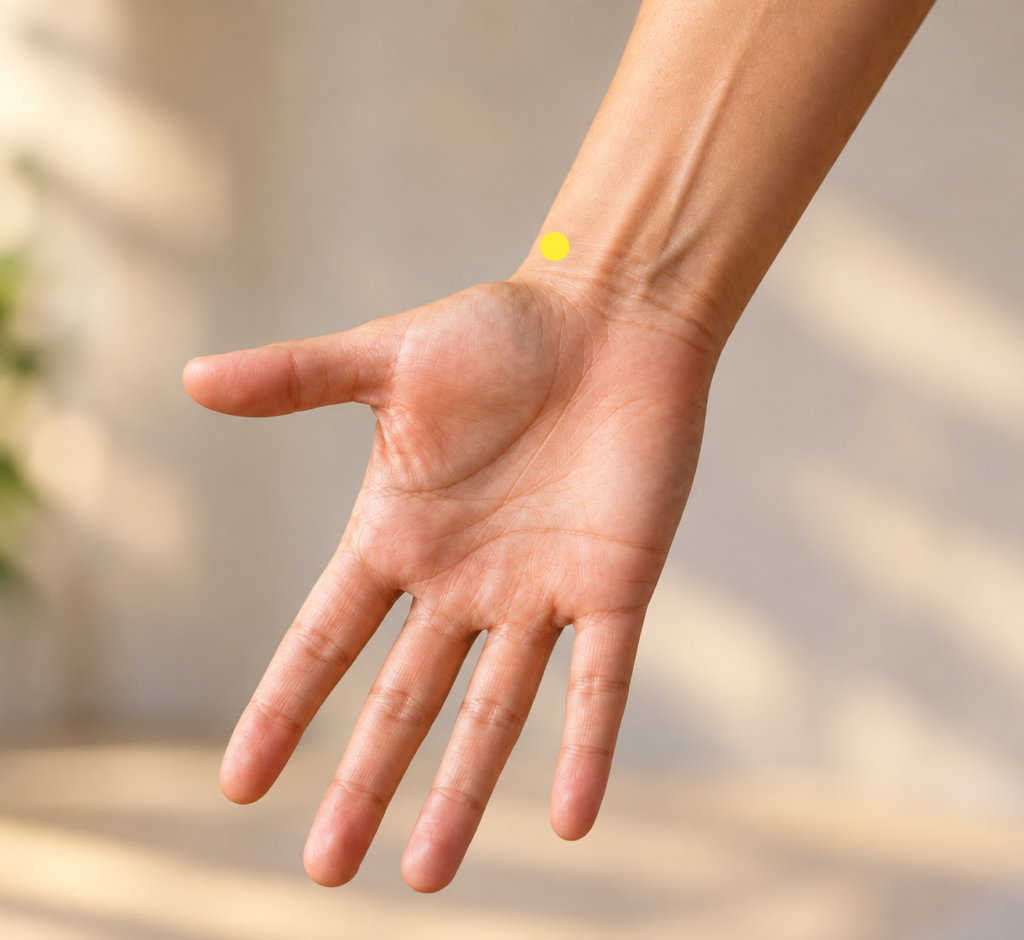
3. Press on PC6 on the inner forearm to open the chest. PC6 sits on the inner forearm, three finger-widths above the wrist crease, between the two tendons. Press firmly with the thumb of your other hand for one to two minutes on each arm. PC6 is called “Neiguan,” the “Inner Pass.”
PC6 is the connecting point of the Pericardium and a classic point for opening the chest. It can ease nausea, belching, and acid rising into the throat, making it suitable for a lump-in-the-throat sensation associated with reflux.
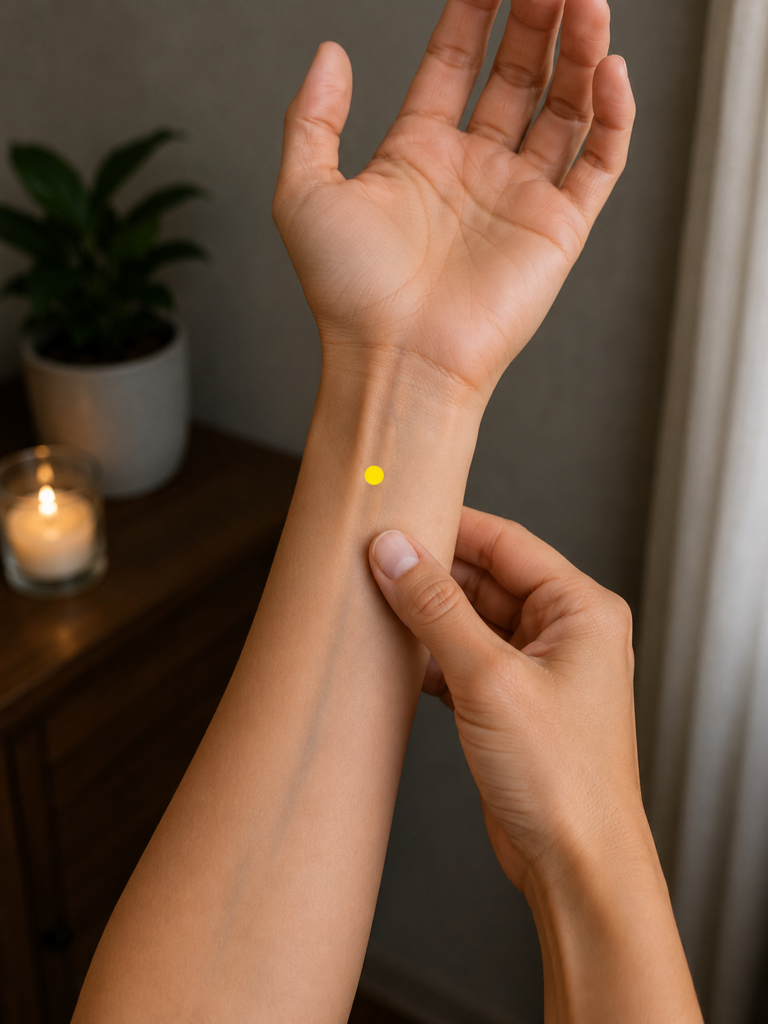
4. Press on HT7 at the wrist crease to calm the mind. HT7 sits on the inner wrist crease, on the little finger side, in the small hollow just inside the tendon. Press gently with the thumb of your other hand for one to two minutes on each wrist. HT7 is called “Shenmen,” the “Spirit Gate.”
HT7 is the source point of the Heart, which houses the mind. It calms anxiety and restlessness and may help when the lump comes with a racing mind, poor sleep, or emotions with nowhere to go.

5. Press on LR3 on top of the foot to smooth the flow of Qi. LR3 sits on the top of the foot, in the hollow between the bones of the big toe and second toe, about two finger-widths back from the web. Press firmly with your thumb for one to two minutes on each foot. LR3 is called “Taichong,” the “Great Surge.”
LR3 is the Liver’s source point and the primary point for Liver Qi stagnation. It is used when frustration, irritability, or stress settles in the body, or when the lump worsens during a difficult week.

6. Press on LI4 on the back of the hand to relax the neck and throat. LI4 sits in the webbing between the thumb and index finger, at the highest point of the muscle when the two are pressed together. Press firmly with the thumb of your other hand for one to two minutes on each hand. LI4 is called “Hegu,” the “Joining Valley.” LI4 is avoided during pregnancy.
The Large Intestine channel runs along the side of the neck, and LI4 is a classic point for throat problems. Paired with LR3, it forms the Four Gates, a combination used to move stagnant Qi throughout the body and calm the mind.
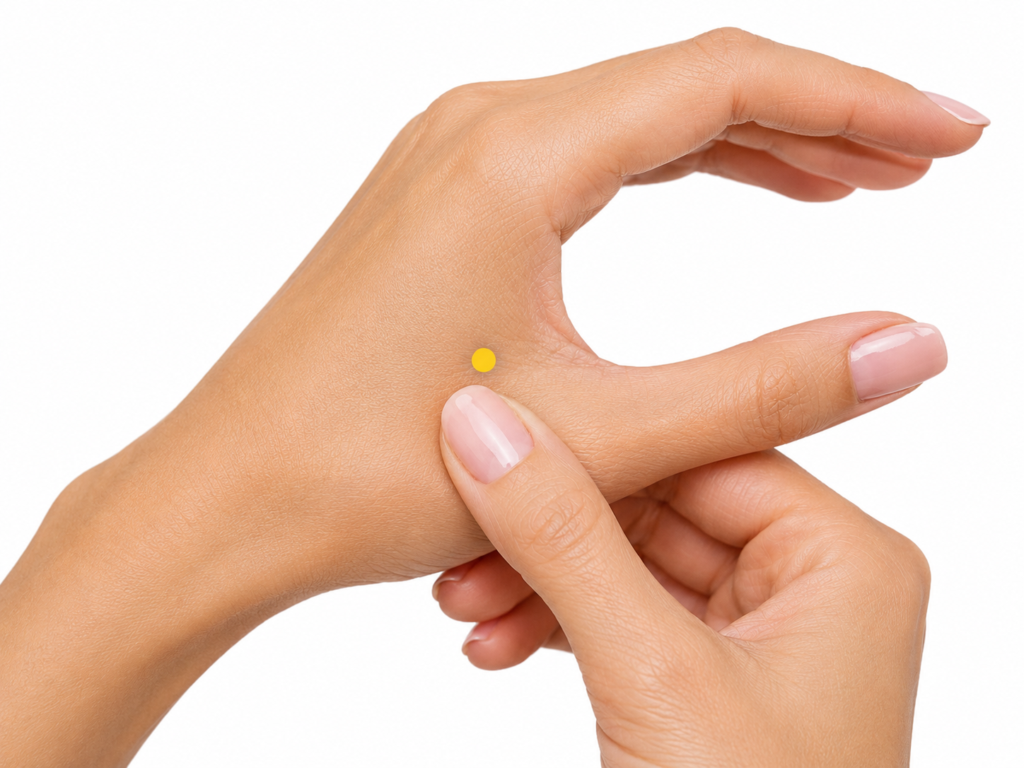
7. Press on LU7 above the wrist to open the throat. LU7 sits on the thumb side of the forearm, about two finger-widths above the wrist crease, in a small groove just above the bony bump at the wrist. Press firmly with the thumb of your other hand for one to two minutes on each arm. LU7 is called “Lieque,” the “Broken Sequence.”
LU7 is the connecting point of the Lung, and the Lung channel reaches the throat. It also opens the Ren channel, which runs up the front of the body to the throat, and it pairs with KI6.
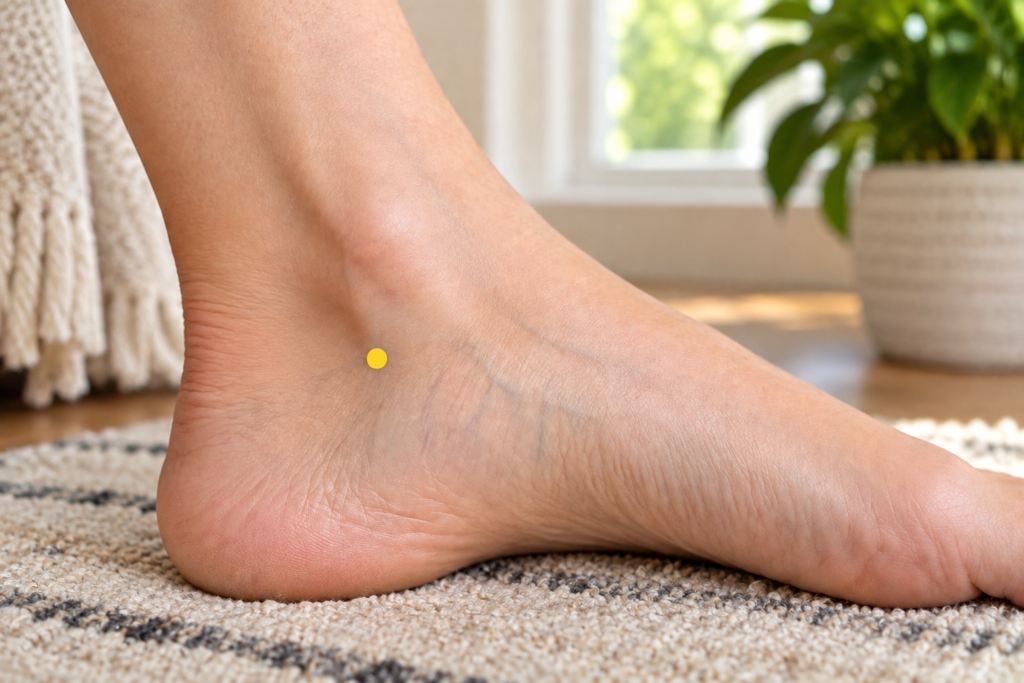
8. Press on KI6 below the inner ankle to moisten the throat. KI6 sits on the inside of the ankle, in the small hollow about one thumb-width directly below the tip of the inner ankle bone. Press gently with your thumb for one to two minutes on each foot. KI6 is called “Zhaohai,” the “Shining Sea.”
KI6 nourishes Yin, the body’s cooling and moistening fluids in Traditional Chinese Medicine. Classical texts list a dry, uncomfortable throat among its primary uses. Together with LU7, it forms one of the most important point pairs for the throat.
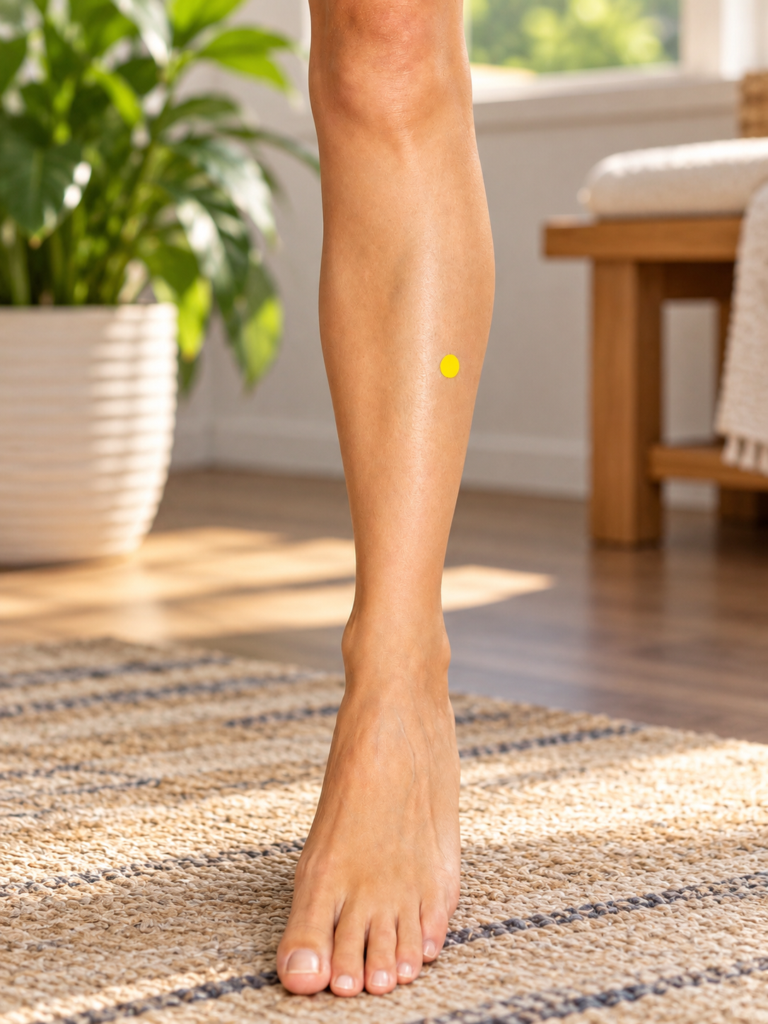
9. Press on ST40 on the outer lower leg to clear phlegm. ST40 sits on the outer lower leg, halfway between the knee crease and the outer ankle bone, about two finger-widths to the outside of the shinbone. Press firmly with your thumb for one to two minutes on each leg. ST40 is called “Fenglong,” the “Abundant Bulge.”
ST40 is the connecting point of the Stomach and the primary point for clearing phlegm in Traditional Chinese Medicine. Phlegm gives plum pit Qi its sticky, stubborn quality, and ST40 helps break it up.
Why These Acupressure Points Work

From a Traditional Chinese Medicine perspective, a lump in the throat reflects a problem with flow. The Liver keeps Qi moving freely, and emotional strain can slow it down quickly. When Qi stagnates in the chest and throat, fluids thicken into phlegm, and the two become lodged together in the narrowest part of the passage. Treatment opens the throat locally, restores the movement of Liver Qi, and clears the phlegm so the throat can relax.
The nine points work together to release the throat and alleviate the tension behind it:
- CV22 and CV17 open the throat and chest.
- LR3, LI4, PC6, and HT7 move stuck Qi and calm the mind.
- LU7 and KI6 open the Ren channel to the throat and keep it moist.
- ST40 clears the phlegm that gives the lump its sticky feel.
How to Properly Use These Acupressure Points

Acupressure for a sensation of a lump in the throat is most effective when practiced as a brief daily routine, with a few additional minutes whenever the sensation intensifies.
- Begin by applying pressure to LR3, LI4, PC6, and HT7 for one to two minutes each to help settle the body before working near the throat.
- Proceed to LU7, KI6, and ST40, then conclude with CV17 and a very light touch at CV22.
- Apply only very light pressure to CV22, angling downward toward the breastbone. Stop if pressure causes coughing, gagging, or discomfort.
- Breathe slowly through the nose while applying pressure. Repeat once or twice daily for at least two to three weeks, as this pattern tends to develop gradually and subside gradually.
Sip water throughout the day rather than clearing your throat, since frequent clearing irritates the lining and can make the sensation worse. Wide yawns or exaggerated chewing motions can help relax your throat muscles, while steam from hot water may soothe dryness. If you have reflux, finish dinner at least three hours before bed, keep portions moderate, and cut back on coffee, alcohol, and spicy or greasy foods. Gentle neck and shoulder stretches can ease tension that affects the throat. Talking, journaling, or releasing emotions may also help with grief or worry you’ve been holding in. Traditional Chinese Medicine recommends warm, simple meals and reducing cold, raw, and dairy-heavy foods, which may contribute to phlegm.
Learn more about acupressure for stress.
When to Get Professional Help

Consult a doctor if a lump in your throat lasts more than a few weeks, worsens, or develops suddenly. Seek prompt medical attention for throat or neck pain; pain or difficulty swallowing; choking; food sticking or regurgitation; unexplained weight loss; muscle weakness; or a visible or palpable neck lump, as these symptoms need evaluation. Hoarseness lasting more than three weeks or a persistent sore throat should also be assessed, especially if you smoke. Call 911 immediately if you have trouble breathing or feel your throat is closing, particularly if your lips, tongue, or face are swollen.
Acupressure is a gentle, supportive practice for a lump in the throat. It complements, and does not replace, diagnosis and medical care.
For related health concerns, acupressure for GERD, acupressure for anxiety, and acupressure for postnasal drip are companion articles.
Above and Beyond Acupuncture offers acupuncture, cupping, and lifestyle coaching at the North Frank Lloyd Wright Boulevard location in Scottsdale.
Schedule an appointment online to start your healing journey.
The points above are only as effective as the technique used to apply them. Where to press, how firmly, and for how long all affect the result. For a full breakdown of how to perform acupressure properly at home, read Performing Acupressure in 3 Easy Steps.

About the Publisher
Paul Kerzner, L.Ac., is a licensed acupuncturist and board-certified herbalist, as well as the founder of Above and Beyond Acupuncture in Scottsdale. His own journey from chronic patient to practicing acupuncturist shapes his commitment to providing honest, clinically grounded information about acupuncture and Traditional Chinese Medicine. Learn more about Paul and his clinical approach on the About Us page.