
Key Takeaways
- Many people are hard on themselves, confusing accountability with self-criticism and emphasizing failures over opportunities for growth.
- Identifying your inner critic is crucial, as it often distorts perceptions and fosters a negative self-narrative.
- Distinguish between actions and identity; mistakes don’t define who you are, and it’s crucial to separate them.
- Practice self-compassion by treating yourself as you would treat a friend, acknowledging struggles without harsh judgment.
- Acupuncture can support mental and physical health by alleviating stress and helping create a holistic approach to self-care.

Do you replay conversations and criticize what you said? Do you fixate on the one thing you did wrong and barely notice everything you did right? When you make a mistake, does your inner voice quickly tell you that you should have known better?
For many people, being hard on themselves feels so normal that they barely notice it. It’s healthy to want to improve, take responsibility, learn from mistakes, and set goals. Problems arise when trying to improve turns into nonstop self-criticism.
You might tell yourself, “I always screw things up,” instead of “I made a mistake.” Or you might wonder, “What is wrong with me?” instead of thinking, “I could have handled that better.” This difference matters. Healthy self-reflection focuses on your actions and what you can learn, while harsh self-criticism targets who you are.
Over time, that inner voice can erode your confidence, strain your relationships, increase your stress, and reduce your willingness to take risks. You might start avoiding situations where you could fail, comparing yourself to others, or feeling like nothing you do is ever enough. Being less critical of yourself doesn’t mean lowering your standards. It means learning to grow without turning against yourself.
Why Am I So Hard on Myself?

People rarely have just one reason to become overly critical of themselves. For some, it starts early in life. Maybe a parent expected perfect grades. Maybe a coach only pointed out mistakes and rarely praised you. Perhaps a teacher embarrassed you for getting something wrong, or you grew up in an environment where praise was rare and criticism was common.
Over time, you might no longer need that person around to hear criticism; you’ve learned to give it to yourself. The outside voice becomes your own. Years later, you may still judge yourself by standards set when you were younger, without ever deciding whether they still fit.
For others, self-criticism grows from very high expectations. There’s always another milestone, financial goal, fitness target, relationship expectation, or new version of yourself to chase. Achieving things isn’t the problem. The problem is when your self-worth depends on achievement. If success means you’re worthy, every setback can feel like proof that you’re not.
The Difference Between Accountability and Self-Criticism

Some people fear that being kinder to themselves might lead to laziness, but self-compassion can coexist with accountability. You can recognize a mistake, accept responsibility, and choose what to improve without being self-critical.
If you missed an important deadline at work, accountability could be expressed as, “I underestimated how long this would take. Next time, I need to start earlier and communicate sooner if I’m falling behind.” Self-criticism might be, “I can’t believe I did this again. I’m terrible at my job. Everyone probably thinks I’m incompetent.”
Both responses acknowledge that something went wrong. However, only one offers guidance on what to do differently next time. Self-criticism might seem like solving the problem, but it’s often just punishment. You can accept responsibility without self-criticism, and you can aim to improve without hating who you are right now.
Recognizing Your Inner Critic

Your inner critic isn’t always bluntly harsh; sometimes it sounds like motivation. It might tell you that you should be further ahead, that others have it all figured out, that you shouldn’t have said something, or that if you were more disciplined, successful, attractive, productive, or confident, things would change.
Since these thoughts happen internally, they might seem like objective observations rather than opinions. However, thoughts are not automatically facts just because they appear in your mind.
A helpful exercise is to start noticing the language you use when speaking to yourself. Focus on absolute words like always, never, should, failure, stupid, lazy, weak, or not enough. You don’t need to confront or argue with every negative thought that comes up. At first, just noticing that the thought has appeared can create a small gap between you and the criticism. This gap can help break the automatic cycle of negative thinking.
Ask Yourself One Important Question

One simple way to spot excessive self-criticism is to ask yourself: Would I talk to someone I care about this way?
If your best friend or partner made the same mistake you just did, would you call them stupid? Would you remind them of similar mistakes over the past decade? Would you label them a disappointment or say that one bad relationship, business decision, awkward conversation, or difficult day defines who they are?
Probably not. You’d likely notice what happened and remember everything else you know about your friend. You’d see the mistake without reducing them to it.
You deserve the same perspective and respect. This doesn’t mean pretending everything you do is great or ignoring your flaws. It means treating yourself with the same fairness, patience, and understanding you’d show someone you care about.
Stop Putting Yourself on Trial

Self-critical people often become their own prosecutors. When something occurs, your mind begins gathering evidence, such as a mistake from three years ago, an embarrassing high school memory, or past criticism. Gradually, a minor event can seem like a legal case against your entire character.
That’s why practicing mindfulness can be beneficial. When you catch yourself telling yourself a story, ask a straightforward question: What objectively happened today?
Maybe you made a mistake, faced rejection, mismanaged a situation, or just had a rough day. Whatever it was, concentrate on that specific event rather than bringing in all past failures. Things from years ago, worries about the future, or remarks someone made about you don’t need to be part of today’s narrative.
Perfectionism Can Keep the Cycle Going

Perfectionism and self-criticism often reinforce each other. You establish a high standard, fall short, criticize yourself, and then impose an even stricter standard. This cycle continues.
This can occur in various areas like careers, parenting, relationships, appearance, exercise, finances, health, and personal growth. You might also become perfectionistic about avoiding perfectionism, making self-improvement another challenge you might fail.
Instead of questioning, “Did I do this perfectly?” consider asking, “Did I manage this reasonably well given the information, energy, and resources I had at the time?” It’s okay if the answer is still no. If you truly handled something poorly, admit it and reflect on what you can learn. Growth involves accountability but also embraces imperfection.
Learn to Separate What You Did From Who You Are

A key shift you can make is to separate events from your identity. For example, saying “I failed at something” differs from saying “I am a failure.” Similarly, “I made a bad decision” is not the same as “I am bad at making decisions,” and “My relationship ended” differs from “I am unlovable.”
The initial statement narrates an event, while the second rephrases it as a judgment about your identity.
When something goes wrong, aim to describe it as precisely as possible. Perhaps you delayed a project, miscommunicated during a conversation, or made a decision you later regret. These are concrete issues you can improve. However, broad judgments about your intelligence, character, or worth are much more difficult to address.
Give Yourself Credit for What Went Right

A self-critical mind often overlooks success. If nine things go well and one goes wrong, it focuses on the one. If someone compliments you, you dismiss it. If you achieve something difficult, you move the goalposts and say, “I should have done that anyway.”
This creates a system where mistakes count against you, but successes don’t count. No matter what you achieve, you never have enough positive evidence to change your mind.
Let some of your successes count. You don’t have to exaggerate or praise yourself all the time. Just be honest. If you did well, acknowledge it. If you showed bravery, appreciate it. If you put in effort, let it count. Celebrate progress, even if the journey isn’t complete.
Practice Self-Compassion Without Turning It Into Another Assignment
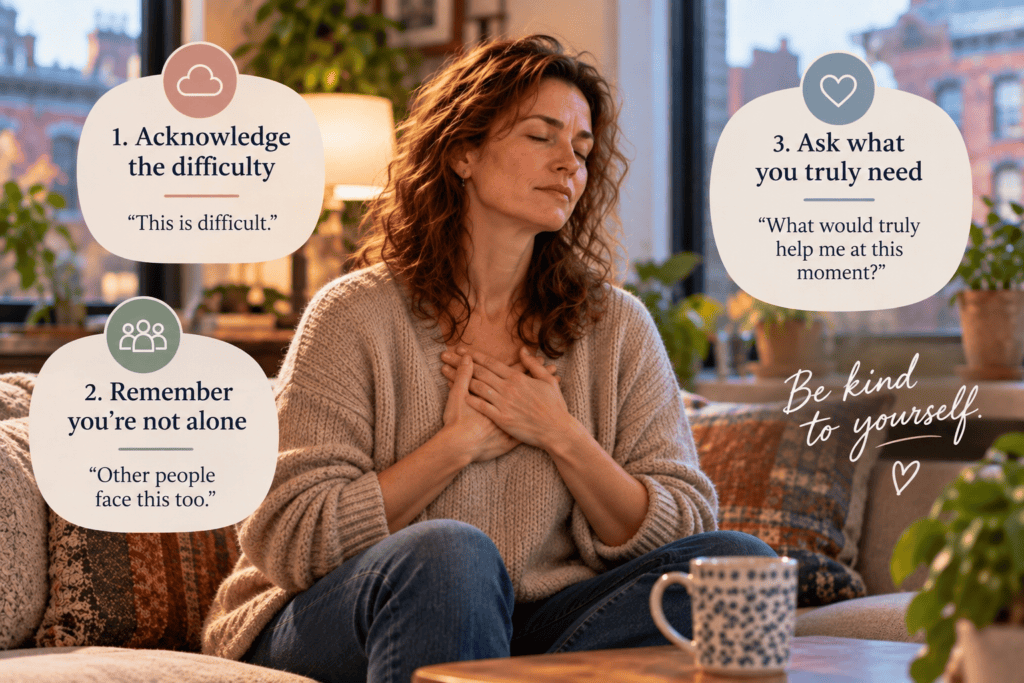
Self-compassion may seem broad, but it’s straightforward. When you face difficulty, begin by acknowledging, “This is difficult.” Remind yourself that struggling is normal: “Other people face this too.” Then consider, “What would truly help me at this moment?”
The answer won’t always be easy or comfortable. Sometimes you need rest. Sometimes you need to apologize. Other times, you might need to get back to work, ask for help, have a difficult conversation, change a habit, or accept that you can’t undo what’s already happened.
Self-compassion isn’t about shirking responsibility or justifying actions. Often, the most compassionate choice is to make tough changes. The important thing is to do so out of care for yourself and your future, not because you dislike your current self.
Your Body Can Get Caught in the Pattern Too

Being overly critical of yourself isn’t just a mental issue. Severe self-criticism can trigger physical stress responses, such as jaw clenching, shoulder tension, shallow breathing, an upset stomach, or difficulty relaxing your mind at night.
Mental and physical tension can reinforce each other. When you’re caught in a stressful thought, your body tenses up in response, which can intensify your feelings and make everything seem worse. Gradually, both your mind and body become trapped in this cycle.
Mindfulness practices involving the body, such as slow breathing, meditation, walking, exercise, massage, acupuncture, and relaxation techniques, can support mental and emotional work by creating space to observe your thoughts without being overwhelmed by them.
Where Acupuncture May Fit
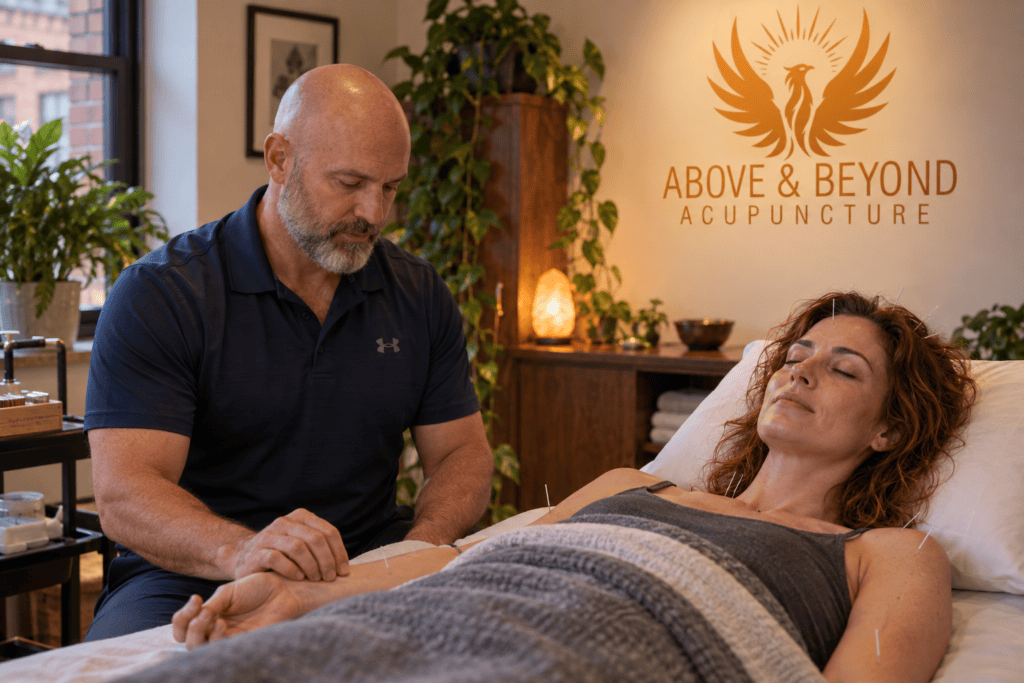
At Above & Beyond Acupuncture, we help people with stress, anxiety, emotional strain, sleep issues, and the physical effects of chronic stress. Acupuncture can’t change your core beliefs or erase difficult experiences, and it doesn’t replace the mental effort required to develop healthier thought patterns.
Acupuncture provides an alternative method to support your body during this process. If you often feel pressured, tense, overstimulated, or struggle to relax, an acupuncture session can help you stay still and take a break from constant activity and self-judgment.
Traditional Chinese Medicine views emotional and physical health as interconnected, not separate. Therefore, treatments are customized to each individual, rather than applying a generic set of acupuncture points for issues like “self-criticism.” When developing a treatment plan, practitioners consider factors such as sleep, stress, digestion, physical tension, energy, mood, and other symptoms.
If you’ve endured long periods of internal pressure, simply recognizing what it feels like to slow down can be beneficial. Acupuncture may be one part of a broader approach that also includes self-reflection, exercise, meditation, setting better boundaries, nurturing supportive relationships, and seeking professional mental health help when needed.
You Don’t Have to Become a Different Person

The goal isn’t to wake up tomorrow completely confident, constantly positive, and free of negative thoughts. That would be an unreasonable expectation.
You will make mistakes. Sometimes you’ll say things you regret. Some goals won’t be achieved, some relationships will end, you’ll miss opportunities, and some days you won’t be the person you want to be. None of this means you should turn against yourself.
You can evaluate yourself honestly while staying supportive of your own perspective. You can take responsibility for your actions while keeping your humanity in mind. You can identify behaviors that need to change without interpreting them as proof that something is inherently wrong with you.
Most importantly, you can keep working on self-improvement without viewing your current self as someone who warrants constant criticism.
Sometimes the first step is simply noticing the voice in your head and asking, “Would I ever speak this way to someone I love?”
If the answer is no, maybe it’s time to change how you talk to yourself.
Try Acupressure for Self-Esteem
Transforming a harsh inner dialogue requires patience, and engaging both the body and mind can be beneficial. Our guide, “How to Use Acupressure for Self-Esteem,” introduces various acupressure points you can easily use at home to promote self-compassion, emotional stability, and a more positive self-image.
Above and Beyond Acupuncture offers acupuncture, cupping, and lifestyle coaching at the North Frank Lloyd Wright Boulevard location in Scottsdale.
Schedule an appointment online to start your healing journey.

About the Publisher
Paul Kerzner, L.Ac., is a licensed acupuncturist and board-certified herbalist, as well as the founder of Above and Beyond Acupuncture in Scottsdale. His own journey from chronic patient to practicing acupuncturist shapes his commitment to providing honest, clinically grounded information about acupuncture and Traditional Chinese Medicine. Learn more about Paul and his clinical approach on the About Us page.