
Key Takeaways
- Nerve impingement causes sharp pain, numbness, or tingling when nerves are compressed in tight spaces.
- It may be caused by herniated discs, tight muscles, or repetitive motions, and should be treated early to prevent it from worsening.
- Western medicine diagnoses structural problems through imaging, while Eastern medicine sees them as blocked Qi and Blood flow.
- Using both approaches can yield better results by addressing compression and the surrounding conditions.
- Acupuncture, lifestyle adjustments, and mindful posture can significantly support recovery from nerve impingement.

Have you ever experienced a sudden, sharp pain in your arm or leg, persistent tingling in your hands or feet, or woken up with a numb hand? If so, you may be suffering from nerve impingement. Although it is a common cause of pain and unusual sensations, the condition is often misunderstood. Many people experience these symptoms for months or even years before receiving effective treatment.
Week after week at Above and Beyond Acupuncture in Scottsdale, we see patients dealing with these problems. Many have already undergone conventional treatments: some have been prescribed anti-inflammatory drugs or muscle relaxants, while others have been advised to rest. In many cases, however, they experienced only temporary relief before their symptoms returned. By considering nerve impingement from both Western and Eastern medical perspectives, we can understand what is happening in the body and, more importantly, how to treat it.
What is Nerve Impingement?
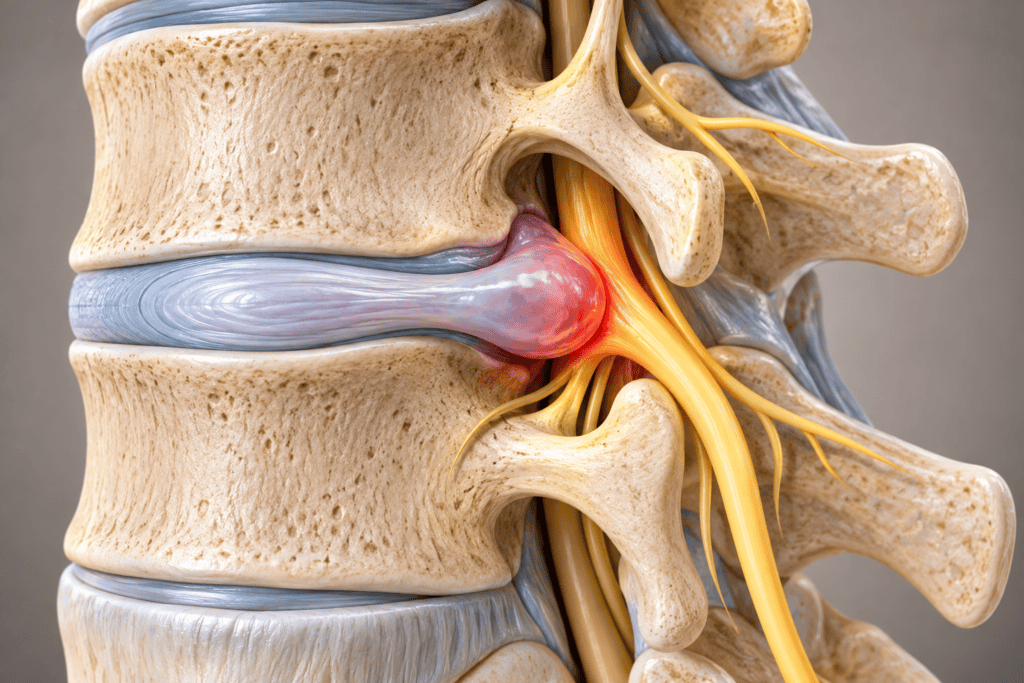
The nervous system works much like the body’s communication network, sending signals from the brain and spinal cord to the muscles and skin while carrying sensations back. Nerves pass through narrow spaces, including openings between the vertebrae, beneath ligaments, and through tunnels in the wrist and elbow. If something presses on a nerve in one of these areas, for example, a disc, bone spur, thickened ligament, swollen tissue, or tight muscle, the nerve’s signals may be disrupted. This condition is called nerve impingement.
Pressure on a nerve does more than irritate it: it can reduce the blood flow needed to keep the nerve healthy, cause inflammation, and, if it persists, begin to impair the nerve’s function. That is why it is important to seek treatment early and why a pinched nerve may not recover on its own.
What Does Nerve Impingement Feel Like?

Nerve pain differs from ordinary muscle soreness, and recognizing the difference can help you receive the appropriate treatment. A pinched nerve may cause:
- Sharp, shooting, or electric pain that travels along a line, such as down the arm into the hand or down the back of the leg
- Tingling or pins and needles, often in the hands, fingers, feet, or toes
- Numbness or a reduced sense of touch in a specific area
- Burning sensations
- Weakness in the muscles served by the nerve, such as difficulty gripping or a foot that catches when walking
- Symptoms that worsen with certain positions, such as turning the head, sitting for long periods, or bending the wrist
A key clue is that symptoms typically appear away from the site of nerve compression. For example, compression of a nerve in the neck may cause tingling in the fingers, while compression in the lower back may lead to pain in the calf or foot.
Where Nerves Get Pinched
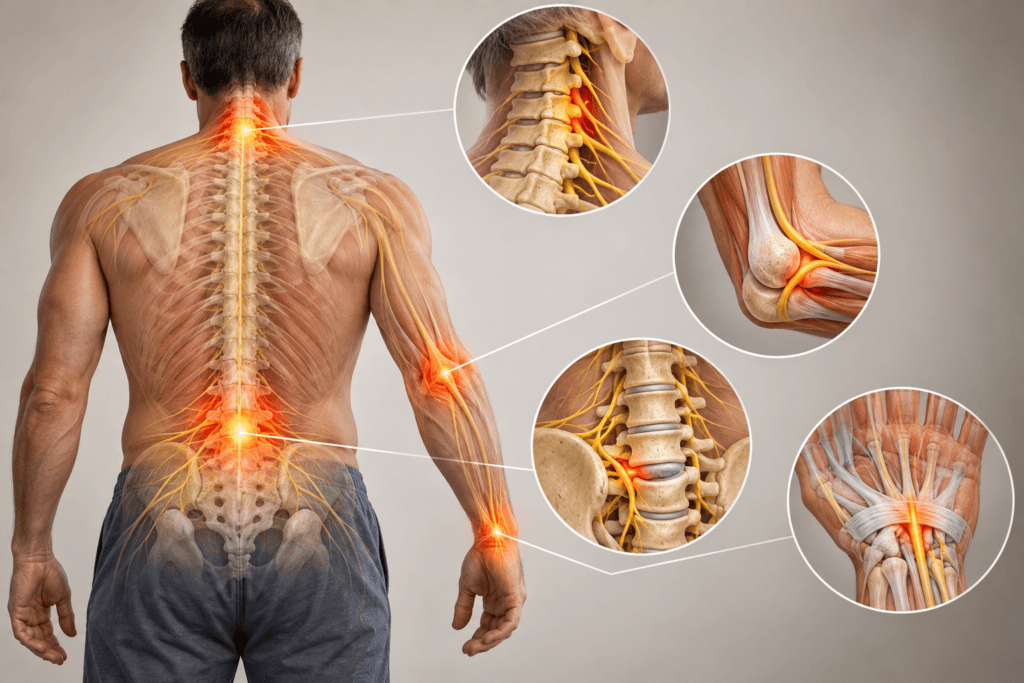
Nerve impingement can occur anywhere along the nervous system, but most cases arise in just a few locations.
- The neck. Compression of a nerve root in the cervical spine, called cervical radiculopathy, causes neck pain along with pain, tingling, or weakness down the arm and into the hand.
- The lower back. Compression in the lumbar spine is the most common cause of sciatica, the pain that radiates from the lower back or buttock down the leg.
- The wrist. Carpal tunnel syndrome is compression of the median nerve as it passes through the wrist, causing numbness and tingling in the thumb and first fingers.
- The elbow. Cubital tunnel syndrome is compression of the ulnar nerve at the inner elbow, causing tingling in the ring and little fingers.
- The upper chest and shoulder. Thoracic outlet syndrome involves compression of nerves between the collarbone and the first rib, causing pain and tingling in the arm and hand.
- The back of the head. Occipital neuralgia involves irritation of the nerves at the base of the skull, causing sharp, shooting pain up the back of the head.
What Causes Nerve Impingement?

Pressure on the nerve usually results from one or more of the following sources:
- Herniated or bulging discs in the spine
- Bone spurs and the gradual narrowing of spaces around the spine that comes with age
- Chronically tight or knotted muscles pressing on nerves
- Inflamed or thickened tendons and ligaments
- Swelling following an injury
- Repetitive motion, such as typing, gripping tools, or the same movement done thousands of times
Several factors can increase the risk, including poor posture, particularly forward head positioning and rounded shoulders caused by spending long hours in front of screens, prolonged sitting, repetitive tasks, carrying excess body weight, pregnancy, which can cause fluid retention and nerve compression at the wrist, diabetes, which can make nerves more susceptible, and previous neck or back injuries.
What is the Western Medical Perspective?

Western medicine views nerve impingement as a structural problem in which the tissue surrounding the nerve places excessive pressure on it.
The greatest advantage of this method is its ability to diagnose problems. A detailed physical examination can identify the affected nerve by assessing the symptoms, reflexes, and muscle strength. Imaging procedures, such as MRI or CT scans, can show exactly where and why the nerve is compressed. Tests such as nerve conduction studies and electromyography assess how well the nerve transmits signals, helping determine the condition’s severity.
Western medicine commonly diagnoses sciatica, cervical radiculopathy, carpal tunnel syndrome, cubital tunnel syndrome, and thoracic outlet syndrome. Treatment typically begins with conservative measures, such as anti-inflammatory drugs, activity modification, and physical therapy to strengthen and decompress the affected area. In some cases, a splint may also be used, such as a wrist brace for carpal tunnel syndrome. Corticosteroid injections can help reduce inflammation around the nerve. Surgery is reserved for serious or progressive cases, such as worsening weakness or failure to respond to conservative treatment.
The level of detail is very useful because knowing precisely where a nerve is being compressed, for example, at a specific disc in the neck or within the carpal tunnel at the wrist, helps assess the condition’s seriousness and determine whether conservative treatment is appropriate. However, the Western approach often fails to identify the underlying factors causing the compression, such as chronic muscle tension, poor circulation, inflammation, and stress, which may prevent improvement.
What is the Eastern Medical Perspective?

Although Traditional Chinese Medicine does not use the term “nerve impingement,” it has addressed these symptoms for thousands of years.
In TCM, what Western medicine calls nerve compression is viewed as a blockage in the flow of Qi (the body’s vital energy) and Blood through the body’s channels. When Qi and Blood move freely, the body has normal sensation, strength, and movement. However, if injury, long-term tension, cold, or an internal imbalance obstructs this flow, pain, numbness, and weakness may occur.
It is usually referred to as Bi syndrome, meaning roughly a painful blockage. In Traditional Chinese Medicine, it has several types, each requiring a different treatment method:
- Wind, Cold, and Damp. Pain that aches may move around and is noticeably worse in cold or damp weather and better with warmth.
- Damp-Heat. Burning, fixed pain with local swelling, heat, or inflammation.
- Blood Stagnation. Sharp, stabbing pain in one fixed location, common after injury or in long-standing cases, often worse at night.
- Qi and Blood Deficiency. Numbness, weakness, and a dull ache that worsens with fatigue, reflecting tissue that is not being adequately nourished, which is common in chronic cases and in older patients.
Traditional Chinese Medicine also considers your symptoms: tingling and a pins-and-needles sensation are associated with wind; numbness indicates that Qi and Blood are not adequately nourishing the area; burning is connected with heat; and heaviness is related to dampness. This approach views the individual as a whole, taking into account stress, sleep, digestion, and general health, which is why two people with similar MRI results may still require different treatments.
Where the Two Perspectives Meet
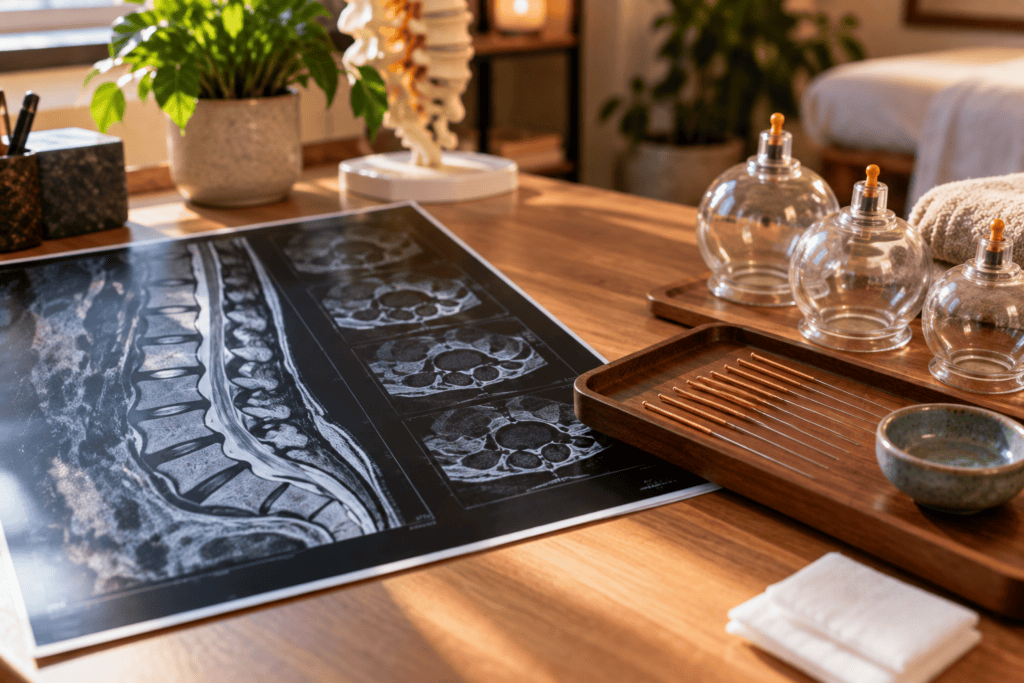
The best results often come from combining Western and Eastern approaches rather than choosing only one.
Western diagnostic methods confirm the structural reality by showing exactly where the nerve is compressed, how severe the compression is, and whether any warning signs require referral to a medical or surgical specialist. All subsequent decisions are based on this information.
Traditional Chinese Medicine focuses on improving the conditions surrounding the compressed nerve. Acupuncture achieves this by loosening tight muscles, reducing inflammation, enhancing blood flow to the nerve, and soothing the nervous system after weeks or months of pain. By treating both the site of nerve compression and the underlying patterns that led to it, this approach helps prevent the problem from recurring.
What Does the Research Show?

The role of acupuncture in treating nerve-related pain is supported by a growing body of research. A 2024 randomized trial published in JAMA Internal Medicine found that acupuncture was more effective than sham acupuncture at reducing leg pain in people with chronic sciatica caused by a herniated disc, with benefits lasting for months after treatment ended. Research on carpal tunnel syndrome, including a study published in the journal Brain, found that acupuncture improved median nerve function and was associated with changes in how the brain processes sensations from the hand. Studies of neck pain and cervical radiculopathy have similarly reported improvements in both pain and function.
Research indicates that acupuncture helps in several ways: it prompts the body to release its natural painkillers, reduces inflammation, improves blood flow to the affected area, relaxes muscles that press on the nerves, and changes how the spinal cord and brain process pain signals. These effects work together on both the tissue and nervous system, which is exactly what is needed for nerve impingement.
Nerve Impingement Treatment at Above and Beyond Acupuncture

Each treatment begins with a careful review of symptoms, including their location, what improves or worsens them, previous injuries, test results, and overall health. If findings indicate that a medical evaluation is needed before treatment, we will communicate that.
Treatment often includes acupuncture near the area where the nerve is compressed and along related pathways. For nerve issues in the spine, practitioners typically use points near the affected vertebrae. Depending on the need, practitioners may add electroacupuncture, using a gentle current through the needles to help with nerve pain. Cupping may also be used on the neck, upper back, and shoulders to ease muscle tension, along with Tui Na, a Chinese massage technique, and herbal consultations to help with inflammation and overall condition. Advice on posture, movement, and daily habits can also support continued improvement.
Most individuals with nerve impingement achieve the greatest improvement through a series of treatments, typically administered weekly at first and then less frequently as symptoms improve. Many patients experience meaningful improvement after only a few sessions. Acupuncture may be used alongside physical therapy and medical treatment, with care coordination among healthcare providers as appropriate.
What You Can Do at Home

Daily habits can play a major role in whether a pinched nerve improves or keeps coming back.
- Watch your posture. Keep screens at eye level, sit back in your chair, and avoid the forward head and rounded shoulders that load the neck.
- Move regularly. Get up from sitting at least every thirty to sixty minutes, and keep gently active rather than resting completely, since movement keeps tissue and nerves healthier than immobility.
- Use warmth. A heat pack or warm shower relaxes the tight muscles pressing on the nerve and brings circulation to the area, which is the warmth Chinese medicine favors for clearing obstruction.
- Take breaks from repetitive motions. Pause, stretch, and change positions during typing, gripping, or other repetitive work.
- Sleep in supportive positions. Keep the neck neutral on a supportive pillow, and avoid sleeping with the wrists bent if you have hand symptoms.
- Use acupressure between visits. Acupressure for carpal tunnel syndrome, acupressure for neck pain, and acupressure for low back and hip pain walk through the points for the most common sites of impingement.
When to Get Medical Help

Most pinched nerves improve with conservative treatment, though some symptoms warrant prompt medical evaluation.
Go to an emergency department immediately if you lose control of your bladder or bowels, develop numbness in the groin, inner thighs, or buttocks, or experience sudden weakness in both legs, as these symptoms may indicate serious compression of the nerves at the base of the spine. See a doctor as soon as possible if weakness is worsening, for example, if one foot drags or your grip is failing, or if symptoms affect both sides of the body, follow a fall or accident, or occur with fever, unexplained weight loss, or a history of cancer. You should also seek medical advice for severe pain that does not improve with rest or a change in position. See a doctor if your symptoms do not improve after several weeks of treatment. An accurate diagnosis is essential for determining the next steps.
Nerve impingement does not have to become a long-term problem. With a clear diagnosis and treatment focused on the area surrounding the nerve, lasting relief is possible.
Above and Beyond Acupuncture offers acupuncture, cupping, and lifestyle coaching at the North Frank Lloyd Wright Boulevard location in Scottsdale.
Schedule an appointment online to start your healing journey.

About the Publisher
Paul Kerzner, L.Ac., is a licensed acupuncturist and board-certified herbalist, as well as the founder of Above and Beyond Acupuncture in Scottsdale. His own journey from chronic patient to practicing acupuncturist shapes his commitment to providing honest, clinically grounded information about acupuncture and Traditional Chinese Medicine. Learn more about Paul and his clinical approach on the About Us page.