
Key Takeaways
- Migraine pain can be debilitating, often causing nausea and sensitivity to light and sound.
- Acupressure offers a non-medication approach to manage migraines effectively by targeting specific pressure points.
- Seven key acupressure points help reduce pain: Yintang, Taiyang, ST8, GB14, GB20, LR3, and LI4, each addressing different migraine symptoms.
- Using these points at the first sign of an attack can prevent escalation, while regular practice reduces attack frequency over time.
- It’s essential to seek professional help for sudden severe headaches or when migraines persist despite self-care.
Migraine pain is one of the most disabling experiences in modern life. The throbbing pain often affects one side of the head. Nausea and sensitivity to light, sound, and smell make it impossible to function normally. Individual attacks can last from hours to days. For patients dealing with migraines frequently, the anticipation of the next attack shapes daily life in ways that patients without migraines cannot fully understand.
The conventional approach involves acute medications taken at the onset of an attack and preventive medications taken daily to reduce attack frequency. These help many patients but produce side effects for others, and many patients still deal with substantial migraine burden despite trying multiple medications.
Acupressure is one of the strongest non-medication tools for migraines. The technique addresses the vascular reactivity, neurogenic inflammation, and muscular tension patterns that contribute to migraine attacks. The points can be used at the first sign of an attack to reduce severity, during an active attack to support recovery, or as a daily protocol to reduce attack frequency over time.
Here are seven acupressure points that work, why they work, and when to get help if they do not.
What to Press and Why
Each point addresses a different aspect of migraine dysfunction. You can use them individually when a specific region is bothering you, or work through the full protocol during an attack or as daily prevention.
1. Press on Yintang between your eyebrows for the frontal and mental component. Yintang sits in the small hollow directly between the eyebrows, above the bridge of the nose. Press gently with your index or middle finger for one to two minutes. Yintang calms the mind and reduces the mental restlessness that often accompanies migraines. The point also addresses the frontal component of the pain that many patients experience.
2. Press on Taiyang at your temple for the throbbing temple pain. Taiyang sits at the temple in the depression between the outer corner of the eye and the top of the ear. Press gently with your index or middle finger for one to two minutes on each side. Taiyang is one of the most useful points for migraine and directly addresses the throbbing pain at the temples that characterizes most attacks. Many patients naturally reach for this area during an attack. Applying deliberate pressure produces better results than the reflexive rubbing that patients often do without thinking.
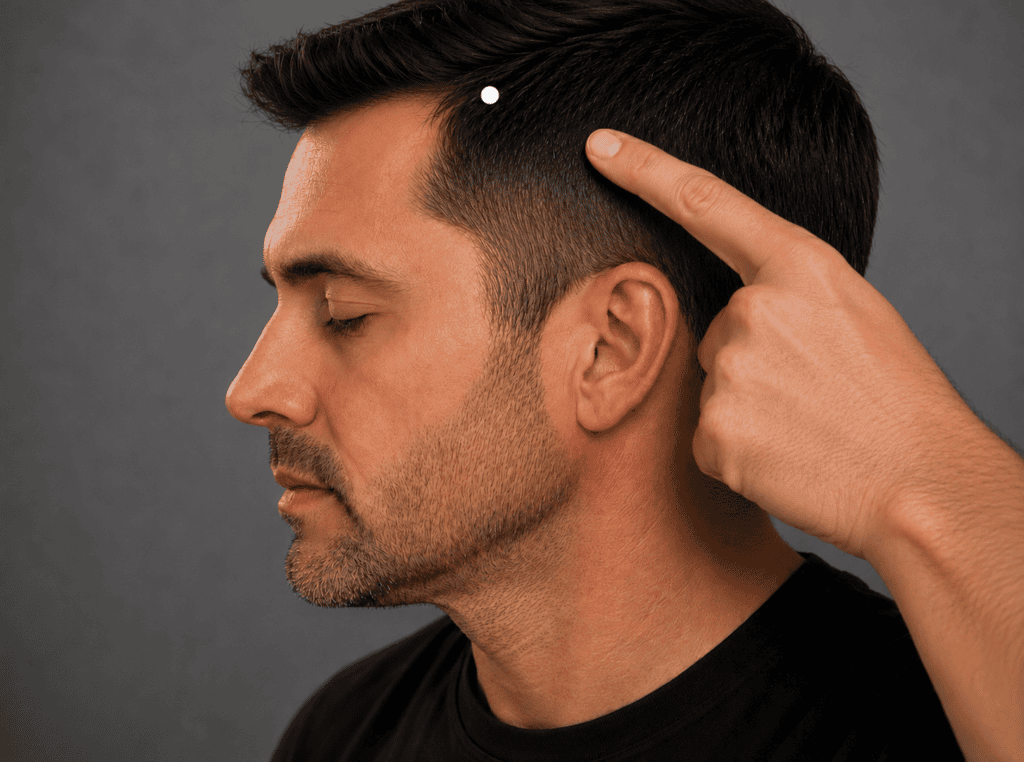
3. Press on ST8 at the corner of your hairline for the temporal migraine pattern. ST8 sits at the corner of the hairline about one-half inch above and slightly forward from the temple, in the depression at the outer edge of the forehead. Press gently with your index or middle finger for one to two minutes on each side. ST8 addresses the temporal migraine pattern that involves pain radiating up from the temple into the side of the head. The point works well in combination with Taiyang for temporal-dominant attacks.
4. Press on GB14 above your eyebrow for the frontal component. GB14 sits directly above the pupil when looking straight ahead, about one finger-width above the eyebrow. Press gently with your index or middle finger for one to two minutes on each side. GB14 addresses the frontal headache pattern that accompanies many migraines and the pressure that many patients feel behind the eyes.
5. Press on GB20 at the base of your skull for the neck tension and trigger patterns. GB20 sits in the two hollows at the base of the skull, just below the bony ridge and to either side of the spine where the neck muscles meet the skull. Press firmly with both thumbs for one to two minutes. GB20 is one of the most important points for migraine because neck tension is both a trigger for many migraine attacks and a component that maintains the pain once it starts. Regular use of GB20 as daily prevention often reduces attack frequency.
6. Press on LR3 on the top of your foot for the underlying pattern. LR3 sits on the top of the foot in the depression between the big toe and second toe, about two finger-widths back from the webbing. Press firmly with your thumb for one to two minutes on each foot. In Chinese medicine, migraines are often driven by a Liver Yang rising with Qi stagnation pattern. LR3 is the primary point for releasing that pattern and works particularly well when the migraine is stress-triggered or accompanied by irritability and neck tension.
7. Press on LI4 in the webbing between your thumb and index finger for the distal command point. LI4 sits in the soft tissue webbing between the thumb and index finger, in the muscle that bulges out when the thumb is pressed against the side of the index finger. Press firmly with the thumb of the opposite hand for one to two minutes on each hand. LI4 is the command point for the face and head in Chinese medicine, which means it directly addresses conditions affecting these regions from a distance. The point is one of the strongest for reducing migraine pain and can be used repeatedly throughout an attack. LI4 is contraindicated during pregnancy.
Why This Works
Migraines involve several overlapping mechanisms. The trigeminovascular system in the brain becomes activated, producing inflammation of the blood vessels surrounding the brain and the release of pain-signaling chemicals. Muscular tension in the neck, shoulders, and jaw contributes to the trigger patterns and maintains the pain. The autonomic nervous system dysregulation that many migraine patients experience contributes to attack frequency. Chronic stress increases sympathetic activation and worsens the underlying pattern.
Acupressure works on several of these mechanisms simultaneously.
- The local points at the head and temple directly reduce the vascular reactivity and inflammation that produce migraine pain.
- The neck point (GB20) releases the muscular tension patterns that trigger and maintain attacks.
- The distal points (LI4, LR3) address the systemic patterns that drive migraine frequency.
- The autonomic nervous system regulation shifts the underlying pattern of sympathetic activation.
The chronic stress dimension that often triggers migraines responds to consistent acupressure practice over time. What Is Cortisol and Why Do I Have So Much of It? covers this in more detail.
The clinical framework for migraine as a multi-mechanism condition is in Can Acupuncture Treat Migraines?, which is the companion piece to this one.
The Mayo Clinic overview of migraine covers the medical framework. The NCCIH summary on acupuncture describes the research base for the treatment.
How to Use the Points
- At the first sign of an attack, Taiyang, GB20, and LI4 produce the fastest response. Applying these points at the earliest warning signs can sometimes prevent a full attack from developing.
- During an active migraine, working through Yintang, Taiyang, ST8, GB14, and GB20 addresses the multiple regions where pain lands. LI4 can be used repeatedly throughout the attack.
- For prevention, working through the full seven-point protocol once or twice a day reduces the underlying patterns that produce attacks. Consistency matters. Two to three weeks of daily practice typically produces measurable reduction in attack frequency.
- For patients whose migraines are stress-triggered, LR3 and Yintang are the most important points for daily practice. These address the underlying stress and Liver Qi stagnation pattern rather than only responding to individual attacks.
Consistency matters more than intensity. A gentle sustained press for one to two minutes produces better results than a hard press held briefly. For the face and head points, lighter pressure is required than for the points on the hands and feet.
Pairing acupressure with basic migraine management practices amplifies the results. Trigger identification and management. Consistent sleep and hydration. Reduction of specific dietary triggers. Stress management practices that reduce the sympathetic activation dimension. A dark quiet environment during acute attacks.
When to Get Professional Help
The tools above work for many everyday migraine patterns. They are not the answer for sudden severe headache that is different from your usual migraines, headache with fever or stiff neck, headache with focal neurological symptoms that persist, headache following head trauma, or worst-ever headache. These require urgent medical evaluation.
If you are dealing with persistent or worsening migraines that are not responding to self-care, acupuncture treatment offers a more substantial intervention than acupressure alone.
To learn more about the stress and nervous system components that trigger many migraines, read: Anxiety, Stress, and Depression.
Acupuncture, Cupping & Lifestyle Coaching covers in depth what services this practice offers.
Reach out to Above and Beyond Acupuncture on North Frank Lloyd Wright Boulevard in Scottsdale to schedule a consultation.
Schedule an appointment online or call us today to start your healing journey.
The points above are only as effective as the technique used to apply them. Where to press, how firmly, and for how long all affect the result. For a full breakdown of how to perform acupressure properly at home, read Performing Acupressure in 3 Easy Steps.