
Key Takeaways
- Migraines are debilitating, affecting millions, particularly women, and involve complex neurological mechanisms.
- Standard medications often fail to provide sustained relief, leaving many patients seeking alternative options.
- Acupuncture may offer effective treatment by regulating blood vessels, reducing inflammation, and promoting pain relief through multiple pathways.
- Research supports acupuncture’s effectiveness in decreasing migraine frequency and severity for many patients.
- A multi-modal approach, including trigger management and lifestyle changes, enhances migraine treatment outcomes.
Migraines are one of the most debilitating pain conditions in modern medicine. The throbbing pain often affects one side of the head, can last from hours to days, and is frequently accompanied by nausea, vomiting, and extreme sensitivity to light, sound, and smell. Many patients describe migraine attacks as making it impossible to work, care for family, or engage with the world for the duration of the attack.
Migraines affect roughly 40 million Americans, and the condition is significantly more common in women than in men. Roughly 18 percent of American women and 6 percent of American men experience migraines. The condition tends to run in families, which reflects the genetic component that predisposes individuals to the underlying neurological pattern.
The conventional approach involves acute medications (triptans, NSAIDs, anti-nausea medications) taken at the onset of an attack, and preventive medications (beta blockers, anticonvulsants, antidepressants, and more recently CGRP inhibitors) taken daily to reduce attack frequency. These help many patients but leave others still dealing with substantial migraine burden, and many patients experience significant side effects from the medications themselves.
Here is what migraines actually are, why standard care often falls short, and how acupuncture treats them.
What Migraines Actually Are

Migraine is not just a bad headache. It is a complex neurological condition involving multiple mechanisms that produce the characteristic pain and associated symptoms.
The trigeminovascular system in the brain becomes activated during a migraine attack, producing inflammation of the blood vessels surrounding the brain and the release of pain-signaling chemicals. Cortical spreading depression, a wave of electrical activity across the brain, appears to trigger the visual auras that some patients experience before the pain begins. Serotonin dysregulation, dopamine imbalance, and neurogenic inflammation all contribute to the full migraine pattern.
Migraines fall into several distinct categories that shape the treatment approach.
- Migraine without aura is the most common type. Attacks develop gradually with the characteristic throbbing pain, nausea, and sensory sensitivity but without preceding neurological symptoms.
- Migraine with aura involves neurological symptoms that precede the headache. Visual disturbances (flashing lights, blind spots, zigzag patterns) are most common. Some patients experience sensory changes, speech difficulties, or motor symptoms.
- Chronic migraine is defined as fifteen or more headache days per month for at least three months, with migraine features on at least eight of those days. Chronic migraine represents a distinct clinical challenge and often requires more comprehensive treatment approaches.
- Episodic migraine is the more common presentation with fewer than fifteen headache days per month, though the individual attacks can still be severely disabling.
- Vestibular migraine produces vertigo and balance disturbances alongside or instead of the typical head pain.
- Menstrual migraine occurs in specific relationship to the menstrual cycle and reflects the hormonal triggers that affect many women.
The Mayo Clinic overview of migraine and the Cleveland Clinic summary provide the medical framework for understanding the different presentations.
Common Migraine Triggers
Understanding triggers is essential for managing migraines effectively. Common triggers include hormonal fluctuations (particularly around menstruation, pregnancy, and menopause), specific foods (aged cheeses, processed meats, chocolate, alcohol, artificial sweeteners), skipped meals, dehydration, sleep disruption (both too little and too much), stress and stress relief (the letdown migraine that appears when stress reduces), sensory triggers (bright lights, strong smells, loud sounds), weather changes, and hormonal contraceptives in some patients.
Identifying individual triggers through careful tracking supports the broader management strategy. Not every trigger produces an attack every time, but reducing exposure to identified triggers reduces overall migraine burden.
Why Standard Care Often Falls Short

The limitations of standard care for migraine reflect the complexity of the condition. Acute medications (triptans, NSAIDs) work well for some patients but produce medication overuse headaches when used more than two or three days per week. Preventive medications work for some patients but produce side effects that many patients find difficult to tolerate. The newer CGRP inhibitors are effective for many patients but are expensive and not universally covered by insurance.
Many patients cycle through multiple medications without finding sustained relief. Others experience partial relief but continue to have substantial migraine burden. Others find that the medications work but the side effects (cognitive changes, weight gain, fatigue) create their own quality of life issues.
How Acupuncture Treats Migraines
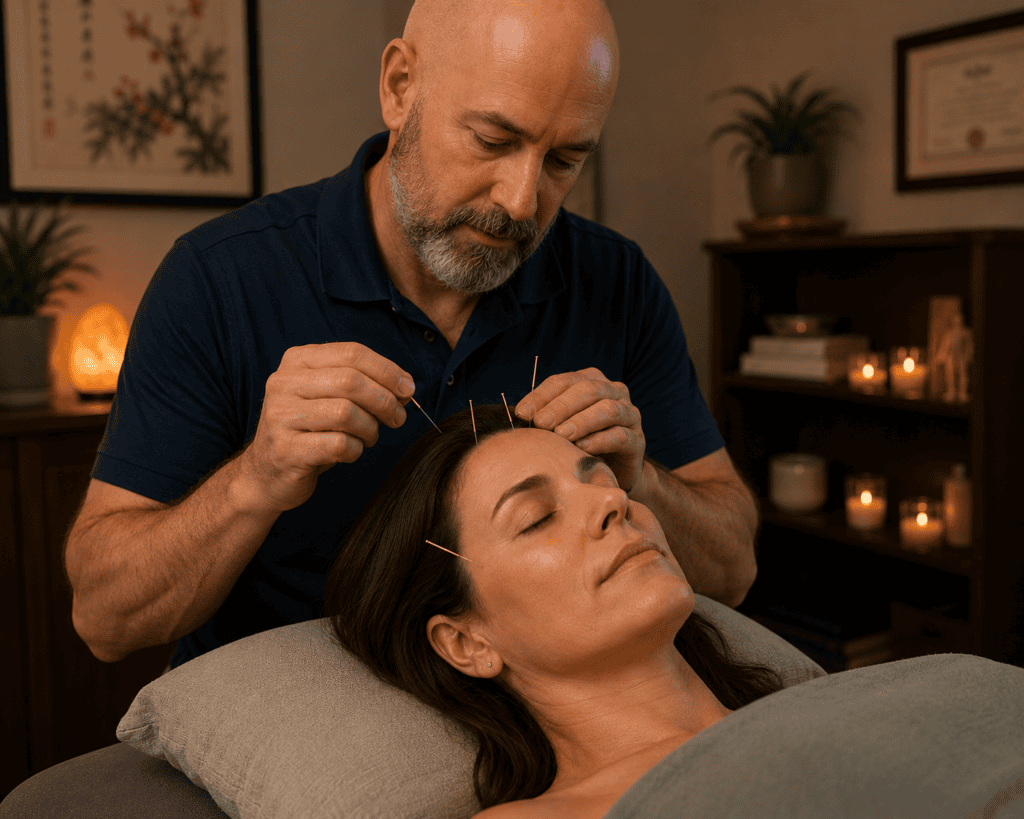
Acupuncture addresses migraines through several mechanisms that map directly onto the underlying pathophysiology.
- Vascular regulation. Migraine involves dysregulation of the blood vessels surrounding the brain. Acupuncture produces measurable effects on vascular function and reduces the vascular reactivity that contributes to migraine attacks.
- Anti-inflammatory effects. Neurogenic inflammation is a component of migraine. Acupuncture reduces inflammatory markers through documented mechanisms.
- Autonomic nervous system regulation. Migraines are often associated with autonomic dysregulation. Acupuncture shifts the autonomic balance toward parasympathetic activation, which reduces the sympathetic activation that contributes to attack frequency.
- Endogenous pain relief. Acupuncture stimulates the release of endorphins, enkephalins, and other natural pain-relieving chemicals. This produces both acute pain relief during attacks and reduces the overall pain sensitivity between attacks.
- Serotonin and dopamine modulation. These neurotransmitters play significant roles in migraine pathophysiology. Acupuncture has documented effects on both systems.
- Muscular release. Chronic muscular tension in the neck, shoulders, and jaw contributes to migraine patterns for many patients. Acupuncture directly releases this tension.
- Nervous system regulation for chronic pain. Chronic migraine involves central sensitization where the nervous system becomes hyper-reactive to pain signals. Acupuncture calms this central component. More on this in Am I Stuck in a Pain Cycle?.
- Pattern differentiation. Traditional Chinese Medicine identifies specific patterns producing migraines in each patient. Liver Yang rising with Qi stagnation is the most common pattern. Blood deficiency, Kidney depletion, and phlegm patterns can also contribute. A licensed acupuncturist identifies which patterns are dominant and treats accordingly.
The chronic stress component plays a significant role in migraine for many patients. More on this in What Is Cortisol and Why Do I Have So Much of It?.
What Does Acupuncture Actually Do to Your Body? explains the physiological responses the body has during an acupuncture treatment.
The Research Base
The research on acupuncture for migraine is one of the more robust areas of acupuncture research. Multiple Cochrane systematic reviews have examined acupuncture for migraine and have consistently found that acupuncture reduces the frequency of migraine attacks compared to no acupuncture, and that acupuncture is at least as effective as prophylactic medication for many patients.
The NCCIH summary on acupuncture covers the broader research base for the treatment as it applies to pain and headache conditions.
What to Expect From Treatment

Migraine treatment with acupuncture is a course of treatment rather than a single session. Most patients need a course of six to twelve sessions over two to three months to see meaningful sustained improvement.
The improvements often emerge in stages. The initial sessions typically produce noticeable reduction in tension and improvement in sleep. As the course of treatment progresses, attack frequency typically starts to decrease. Individual attacks may become shorter and less severe. Many patients notice improvements in areas they were not tracking including mood, energy, and digestion.
For patients with episodic migraines, treatment often reduces attack frequency substantially. For patients with chronic migraines, the shift is often more gradual but can be substantial over months of consistent treatment.
The Multi-Modality Approach

Migraines respond best to an integrated approach.
- Trigger identification and management. Careful tracking to identify individual triggers supports reduction of unnecessary exposure.
- Sleep regulation. Consistent sleep schedule with adequate hours supports the neurological patterns that reduce migraine frequency.
- Hydration and nutrition. Adequate hydration and avoiding known dietary triggers supports overall migraine management.
- Stress management. Chronic stress increases migraine burden. Direct stress reduction practices support the underlying pattern.
- Acupressure between sessions. Self-application acupressure supports the professional acupuncture treatment. A dedicated acupressure guide for migraine is being added to the resource library.
- Standard care coordination. For patients using preventive or acute medications, coordinating with the prescribing physician supports the overall treatment approach. Acupuncture complements rather than replaces appropriate medical management.
When to See a Doctor
Migraine that is new in onset (particularly in patients over 50), migraine with focal neurological symptoms that persist, migraine with fever or stiff neck, migraine following head trauma, and worst-ever headache all warrant urgent medical evaluation to rule out other conditions.
For patients dealing with persistent migraines that are not fully responding to standard care, acupuncture treatment offers a substantial intervention with strong research support.
More on what this practice offers is found in Acupuncture, Cupping & Lifestyle Coaching.
Reach out to Above and Beyond Acupuncture on North Frank Lloyd Wright Boulevard in Scottsdale to schedule a consultation.
Schedule an appointment online or call us today to start your healing journey.