
Key Takeaways
- Diarrhea can arise from various causes, such as food, stress, or gut conditions, making hydration essential to prevent dehydration.
- Acupressure provides relief via nine essential points that focus on digestion, alleviate cramps, eliminate dampness, and mitigate stress.
- For immediate relief, press on ST25 and ST37; for cramping, use SP4, and for watery stools, apply SP9.
- To strengthen digestion over time, regularly press ST36 and SP6, especially for chronic loose stools.
- Consult a healthcare professional if diarrhea persists beyond two days or if signs of dehydration appear.
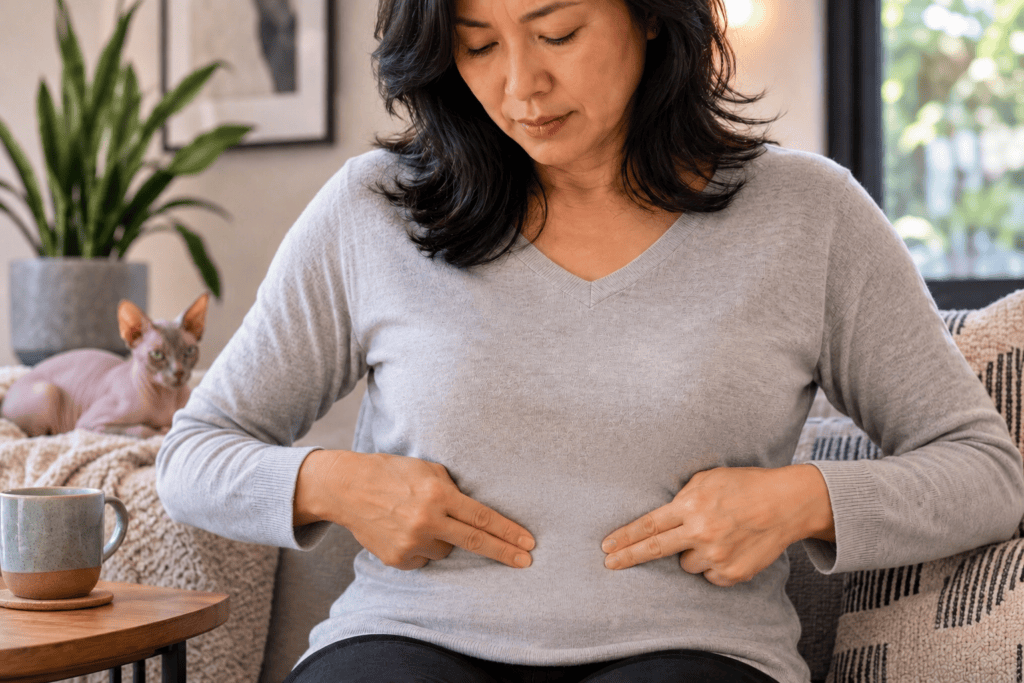
Nothing disrupts a day more quickly than an unexpected bout of diarrhea.
It might come from something you ate that didn’t agree with you, a stomach bug, stress, or an ongoing gut condition flare-up. No matter the reason, the severe cramping can make you seek anything that can relieve the pain. Acupressure can help ease cramps, calm an overactive gut, and stabilize digestion. A crucial point to remember is that diarrhea causes fluid loss, so it’s important to sip water or an electrolyte drink regularly, as dehydration poses the main danger. Once hydration is maintained, the following tips can assist in restoring balance to your upset gut.
In Traditional Chinese Medicine, the Spleen largely governs orderly digestion, transforming food and drink into usable energy and keeping everything moving in the right direction and at the right pace. Diarrhea signals that this work is faltering. When the Spleen fails to transform fluids effectively, dampness builds up and floods the intestines, resulting in loose, watery stool. Cold can impair this process and accelerate symptoms, while heat can cause inflammation. Stress is a common factor, as a tense Liver often overreacts on the Spleen and disrupts gut function. This imbalance explains why nervousness frequently leads people to rush to the bathroom. A chronic, weak digestive pattern also exists, often linked to a deficient Spleen or cold Kidneys. It typically manifests as recurrent loose stools or the classic early-morning urgency.
Acupressure is an effective way to manage common, functional, and stress-induced diarrhea and complements gut-calming approaches for conditions like IBS, especially when loose stools persist.
The points below can help resolve the acute episode of diarrhea and, with consistent use, strengthen digestion, which could be contributing to the recurring issues.
What Acupressure Points to Press and Why
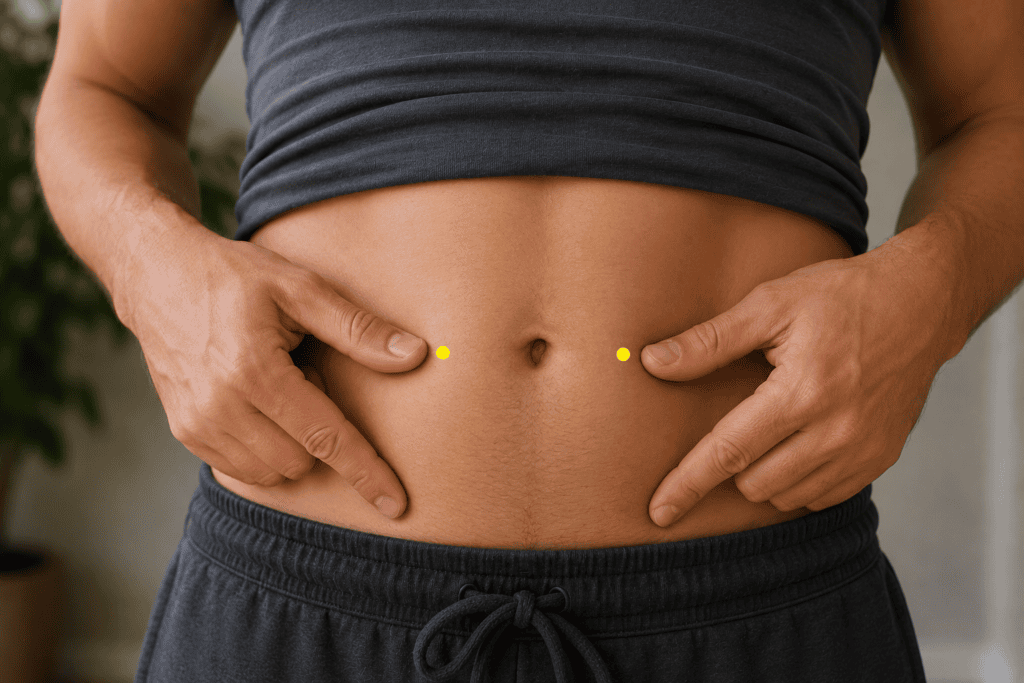
1. Press on ST25 beside the navel, the master point for the intestines. Find ST25 about three finger-widths out to either side of the belly button, level with its center. Rest your fingertips there and press with gentle, steady firmness for one to two minutes on both sides. Its name, “Tianshu,” means the Heavenly Pivot, and it is the front-mu point of the Large Intestine, the spot where that organ’s energy collects at the surface of the body.
No point addresses the intestines more directly than this one. It regulates bowel movements in whichever direction they have become irregular, controlling diarrhea by restoring order to an overactive gut, and alleviates the cramping and griping associated with it. Because it is situated directly over the intestines, maintain a comfortable pressure rather than applying deep force, and allow slow, gentle breaths to guide the focus inward. Begin with this point, as resolving it often alleviates the overall discomfort of the episode.
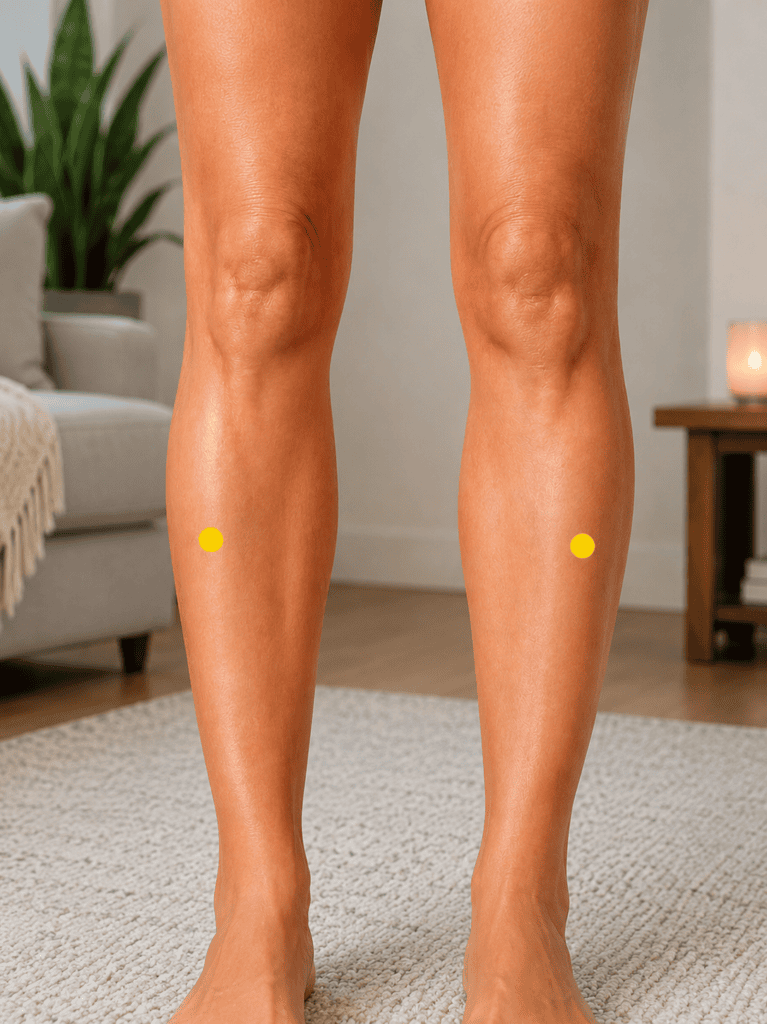
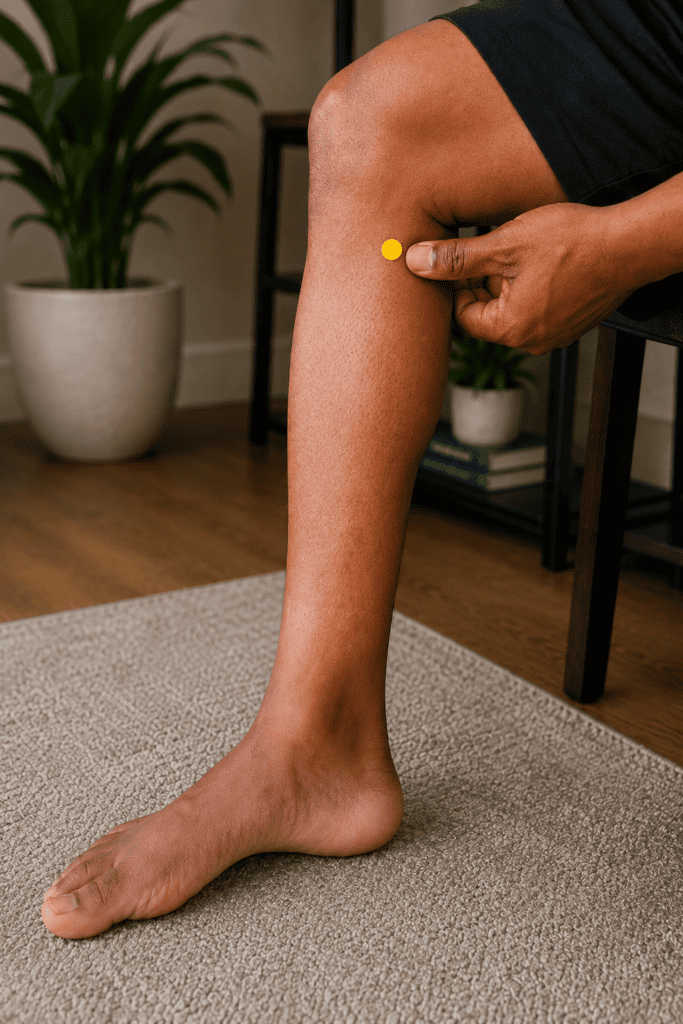
2. Press on ST37 on the shin, specific to the large intestine. ST37 lies on the outer lower leg, about a hand’s width below the outer knee, one finger-width off the shinbone toward the outside, on the muscle. Thumb into it firmly for one to two minutes on each leg. Known as “Shangjuxu,” this is the lower uniting point of the Large Intestine, a point whose job is to support the health of that organ.
While ST25 acts directly on the intestines, ST37 influences them indirectly via the channel, forming a complementary pair. ST37 is a highly dependable point for relieving diarrhea, loose stools, and abdominal pain because it specifically targets the Large Intestine. This makes it a genuinely diarrhea-focused option rather than a general digestive aid. Using it together with ST25 treats the gut comprehensively from both directions.
3. Press on ST36 below the knee to strengthen digestion. A little above ST37, ST36 sits four finger-widths below the kneecap and one finger-width outside the shinbone, in the muscle that tightens when you lift your foot. Press firmly for one to two minutes per leg. “Zusanli,” the Leg Three Miles, is the body’s foremost point for digestion and vitality.
While the first two points settle the gut, this point focuses on rebuilding the underlying engine. It strengthens the Spleen and Stomach, enabling proper digestion rather than letting food pass through incompletely as loose stool. It also helps recover the energy lost during diarrhea episodes. This point is effective both during episodes and in between them. For those with chronically weak digestion, regular stimulation here is highly beneficial. Conveniently, it sits just above ST37 on the same leg, allowing sequential treatment.

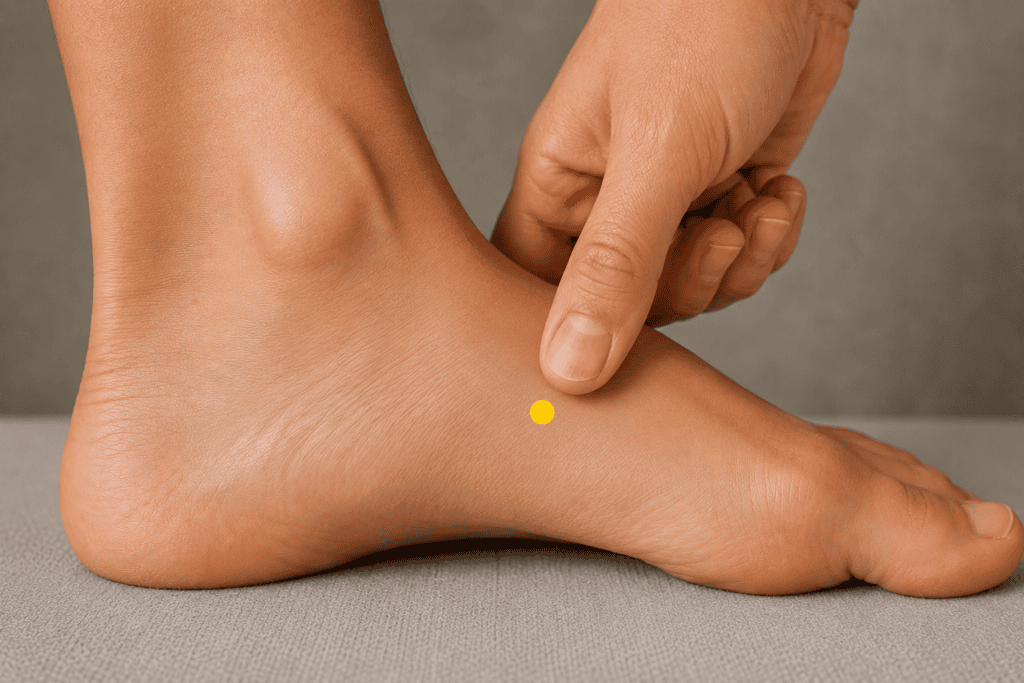
4. Press on SP4 on the arch of the foot to calm cramping. SP4 sits along the inner arch, in the depression just below and ahead of the bony bump behind the big-toe joint, where the long foot bone meets it. Press firmly with your thumb for one to two minutes on each foot. Called “Gongsun,” it is a powerful point for the whole body.
This point targets the cramping and griping sensation in the abdomen often linked to diarrhea. It helps regulate the Spleen and stabilizes irregular gut movement, making it especially effective when the stomach is knotted and painful rather than just loose. Traditionally, it is paired with PC6 on the inner forearm to soothe the digestive system, and using both points together has proven a reliable way to calm a distressed stomach and intestines. Applying firm pressure is ideal for this point.
5. Press on SP9 below the inner knee to drain watery dampness. Locate SP9 on the inner lower leg, in the hollow just below the inner knob of the knee where the bone curves inward. Press firmly for one to two minutes on each leg. “Yinlingquan” is the body’s principal point for clearing dampness.
When diarrhea is loose and watery, Traditional Chinese Medicine views this as dampness overpowering the digestive system, with SP9 serving as the key point that drains this excess. It helps eliminate fluid buildup that the Spleen cannot properly transform, as shown by the soft, watery, urgent stool typical of these cases. This point is particularly important for addressing frequently watery diarrhea, a focus that other points do not directly target. It’s especially relevant when the stool is more fluid than solid.
6. Press on CV6 below the navel to warm a weak, cold gut. Two finger-widths below the belly button, on the midline, sits CV6. Lay your fingertips or a warm palm over it and hold with gentle pressure for one to two minutes. “Qihai,” the Sea of Qi, is a gathering reservoir of the body’s energy in the lower abdomen.
Some diarrhea is accompanied by cold, chills, weakness, and loose, unformed stools instead of urgent, hot ones. This warming and strengthening point fits that condition. It boosts Qi and warms the lower abdomen, stabilizing a gut that has become slack and overly active due to depletion rather than irritation. Gentle warmth enhances its effect, so holding a warm hand or a covered heat pack here feels comforting and effective. It is particularly beneficial for the tired, rundown sensation that often follows a bout of diarrhea.

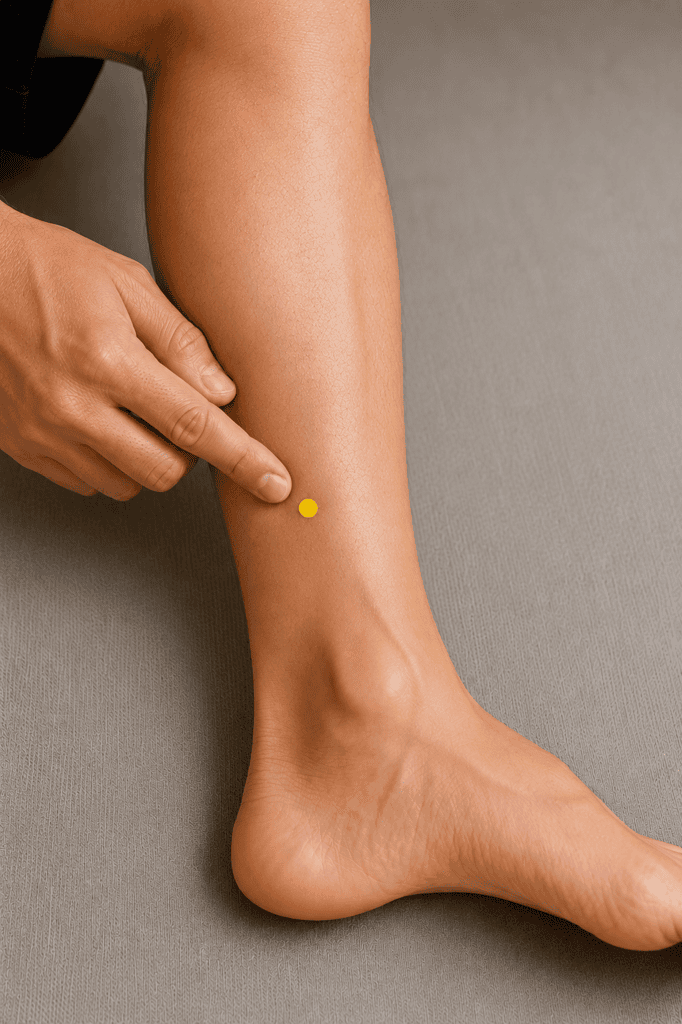
7. Press on SP6 above the inner ankle to support the spleen. Measure four finger-widths up from the peak of the inner ankle bone, then press just behind the back edge of the shinbone, firmly, for one to two minutes on each leg. “Sanyinjiao,” the meeting of three channels, is one of the body’s most nourishing points. Skip this point during pregnancy.
Since the Spleen is central to diarrhea, SP6 enhances digestion more deeply by strengthening the Spleen’s ability to transform food and fluids, helping eliminate the dampness behind loose stools. It works subtly rather than dramatically, making it better suited to supporting ongoing weak digestion than to stopping a sudden outbreak, though it can help with both. Those experiencing frequent loose stools will benefit most from regular pressure on this point rather than using it only in emergencies.
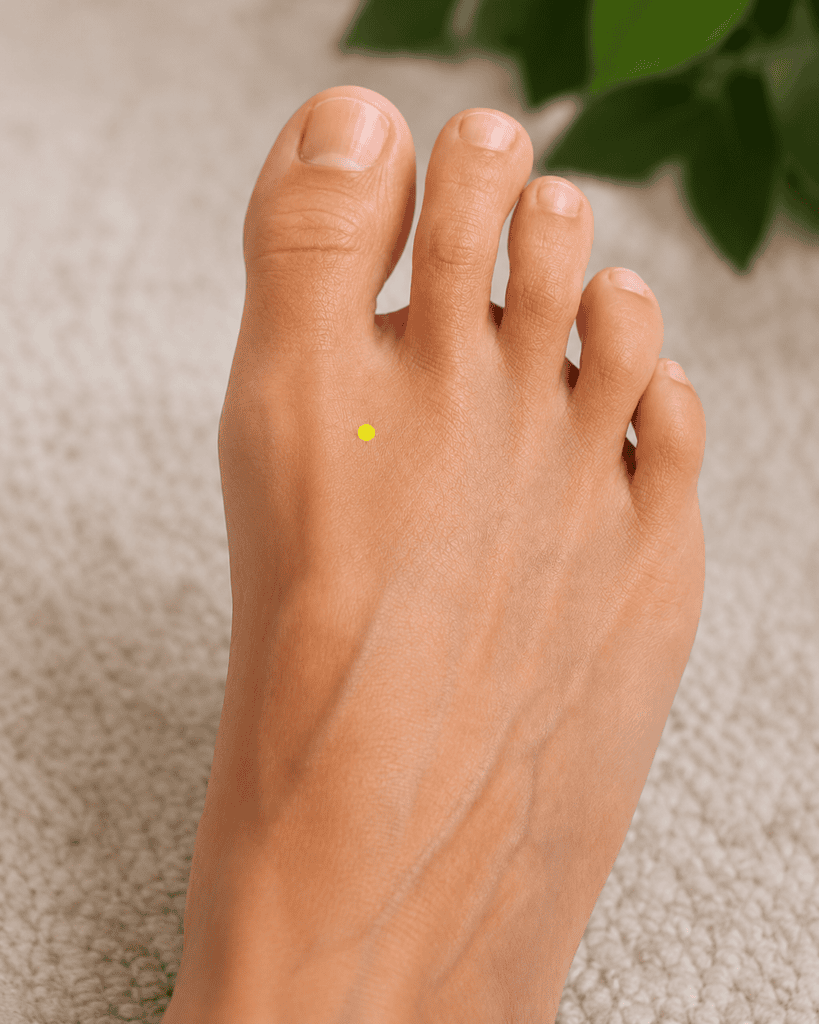
8. Press on LR3 on the top of the foot for stress-driven diarrhea. In the web between the big toe and the second toe, slide back about two finger-widths until your finger settles into the hollow where the bones meet: that is LR3. Press firmly for one to two minutes on each foot. “Taichong” is the main point for freeing a stuck Liver.
For many people, diarrhea is a response to stress, with the gut loosening when nerves are tense, like before an exam, confrontation, or a difficult morning. According to Traditional Chinese Medicine, this results from a tense Liver overstimulating the Spleen. The point LR3 helps release this tension, easing pressure on the gut. If your loose stools correlate with stress or come with a nervous, churning stomach, this point addresses the root cause better than purely digestive points. It also helps to ground an anxious system by drawing energy downward.
9. Press on CV4 low on the abdomen for chronic early-morning diarrhea. Find CV4 on the midline about four finger-widths below the navel, below CV6. Rest a warm hand there and press gently for one to two minutes. “Guanyuan,” the Gate of Origin, is a deep reservoir of the body’s foundational warmth. Use gentle care here during pregnancy.
Persistent, chronic diarrhea often occurs predictably in the early morning, accompanied by cold limbs and low energy. Traditional understanding interprets this as a depleted, cold Kidney that fails to warm digestion. Applying CV4 can help activate that deep Kidney fire at its source. For this specific pattern, CV4 is crucial and should be gently stimulated over several weeks with warmth, rather than expecting immediate results. While it is optional for occasional, acute diarrhea, those familiar with the dawn pattern should make it central to their routine.

Why These Acupressure Points Work
The central theme in Traditional Chinese Medicine is the Spleen’s inability to transform food and fluids effectively. This can cause dampness to flood the intestines, often due to cold, stress from an overactive Liver, or underlying Kidney depletion. The nine points address each of these issues.
- The intestinal points (ST25, ST37) regulate the bowel directly and rein in an overactive gut.
- The digestive builders (ST36, SP6) strengthen the Spleen and Stomach so food is transformed rather than passed as loose stool.
- The cramp-and-damp points (SP4, SP9) calm the griping abdomen and drain the watery dampness behind a fluid stool.
- The warming points (CV6, CV4) rebuild warmth for the cold, weak, and chronic early-morning patterns.
- The stress point (LR3) releases the tense Liver that loosens the gut when nerves take over.
The strong connection between the gut, stress, and emotions explains why calming the nervous system often relieves bowel issues.
How to Properly Use These Acupressure Points
Match the points to your type of diarrhea, and apply gentle pressure to the belly.
- For a sudden, ordinary bout, work ST25 and ST37 to settle the gut, SP4 for the cramping, and SP9 if the stool is watery.
- For stress-triggered diarrhea, lead with LR3, and pair it with ST25 to quiet the gut it has disturbed.
- For loose stools that keep coming back, press ST36 and SP6 regularly, not just during an episode, to rebuild the weak digestion underneath.
- For the chronic early-morning pattern with cold and fatigue, work CV4 and CV6 with warmth over a period of weeks.
- Hold each point for one to two minutes with steady pressure, keep the abdominal points gentle, and repeat through the day as needed.
The most important thing you can do is stay hydrated. Take small sips of water, an oral rehydration solution, or electrolyte drinks regularly, since replenishing fluids and electrolytes helps keep diarrhea under control. When your appetite returns, start with gentle, simple foods like rice, toast, bananas, and potatoes. Be patient and avoid dairy, greasy or sugary foods, caffeine, and alcohol until you feel better, as these can further irritate your gut. Rest and support your body through a mild, brief illness, allowing it to run its course.
When to Get Professional Help
Most diarrhea resolves on its own with fluids and rest, but some require medical attention.
Seek prompt care if diarrhea lasts more than two days, if there are signs of dehydration (dark urine, reduced urination, dizziness, dry mouth, weakness), fever, severe abdominal or rectal pain, or blood or black stools. In infants, young children, older adults, or immunocompromised individuals, dehydration occurs faster and is more serious. Recent travel, antibiotics, or dehydration can increase risk. Urgent help is needed for confusion, rapid heartbeat, or no urine.
While acupressure and hydration help with mild cases, they are not substitutes for medical intervention when necessary.
Above and Beyond Acupuncture offers acupuncture, cupping, and lifestyle coaching at the North Frank Lloyd Wright Boulevard location in Scottsdale.
Schedule an appointment online or call us today to start your healing journey.
The points above are only as effective as the technique used to apply them. Where to press, how firmly, and for how long all affect the result. For a full breakdown of how to perform acupressure properly at home, read Performing Acupressure in 3 Easy Steps.

About the Publisher
Paul Kerzner, L.Ac., is a licensed acupuncturist and board-certified herbalist, as well as the founder of Above and Beyond Acupuncture in Scottsdale. His own journey from chronic patient to practicing acupuncturist shapes his commitment to providing honest, clinically grounded information about acupuncture and Traditional Chinese Medicine. Learn more about Paul and his clinical approach on the About Us page.