
Key Takeaways
- Acupressure offers a natural method to alleviate ear pressure and congestion resulting from colds, allergies, tension, or blockage.
- Nine key acupressure points help reduce ear pressure by opening channels and promoting drainage in the Eustachian tube.
- Incorporate gentle techniques such as swallowing and yawning to enhance the effectiveness of acupressure for ear-related issues.
- See a doctor if your ear pressure continues, or if you have severe pain, discharge, or sudden hearing loss.
- Acupressure should be used alongside medical treatment, particularly for underlying sinus or ear infections.

Ear pressure or a sensation of clogged ears can make sounds seem muffled, distant, or like you’re underwater. This uncomfortable, full sensation frequently occurs following a cold, allergies, sinus congestion, or changes in altitude. Acupressure can be used at home as an easy, natural way to relieve ear discomfort and pressure during congestion or blockage.
The sensation of a clogged ear often results from improper pressure regulation or drainage by the Eustachian tube, which connects the middle ear to the back of the throat. Colds, allergies, sinus congestion, and altitude changes can impair this tube’s function, leading to a feeling of fullness or blockage in the ear. The acupressure points described below are primarily located around the ear and may be gently pressed as part of a self-care routine to address ear pressure and discomfort.
In Traditional Chinese Medicine, ear pressure and fullness are connected to the channels surrounding the ear. The Triple Burner, Small Intestine, and Gallbladder channels pass nearby, and blockages from wind, dampness, or phlegm, often due to colds or sinus issues, can cause a muffled or blocked feeling. Since the ear, nose, and throat are linked, sinus and nasal congestion can also impact ear health. Opening the nose and clearing the sinuses might help relieve ear congestion.
Here are nine acupressure points to help open channels, reduce congestion, support Eustachian tube drainage, and relieve pressure.
What Acupressure Points to Press and Why
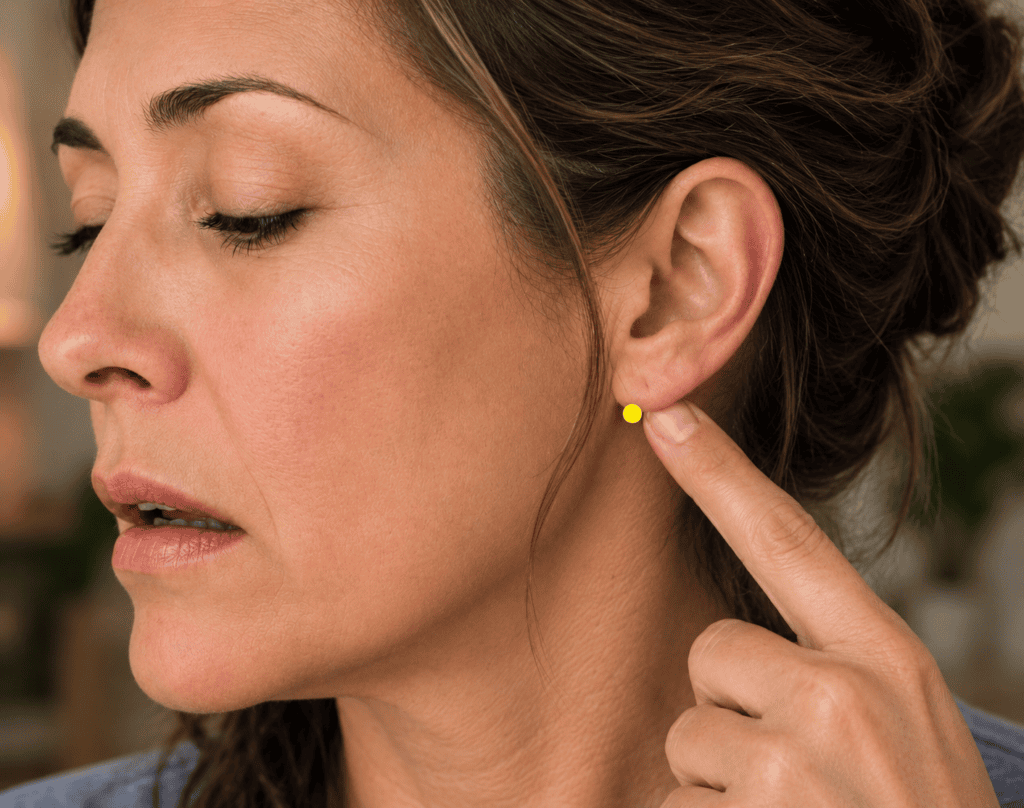
1. Press on SJ17 behind the earlobe, the key point for the ears. SJ17 sits in the hollow just behind the earlobe, in the soft depression between the back of the jaw and the bony bump behind the ear, which you can feel when you open your mouth slightly. Press gently inward for one to two minutes on both sides. SJ17 is called “Yifeng,” and it is one of the most important points for the ears.
SJ17 is a key acupoint for many ear issues because it sits just behind the ear, above the Eustachian tube area, making it effective for relieving pressure and fullness. It helps open and unblock the ear, reduces feelings of blockage and muddiness, encourages drainage through the tube, and is traditionally thought to clear the Eustachian tubes, especially during sudden blockages. Because it is in a sensitive area near the ear, press gently with your mouth slightly open to reach it. If fullness and congestion are the core problem, this should be the first acupoint to target.
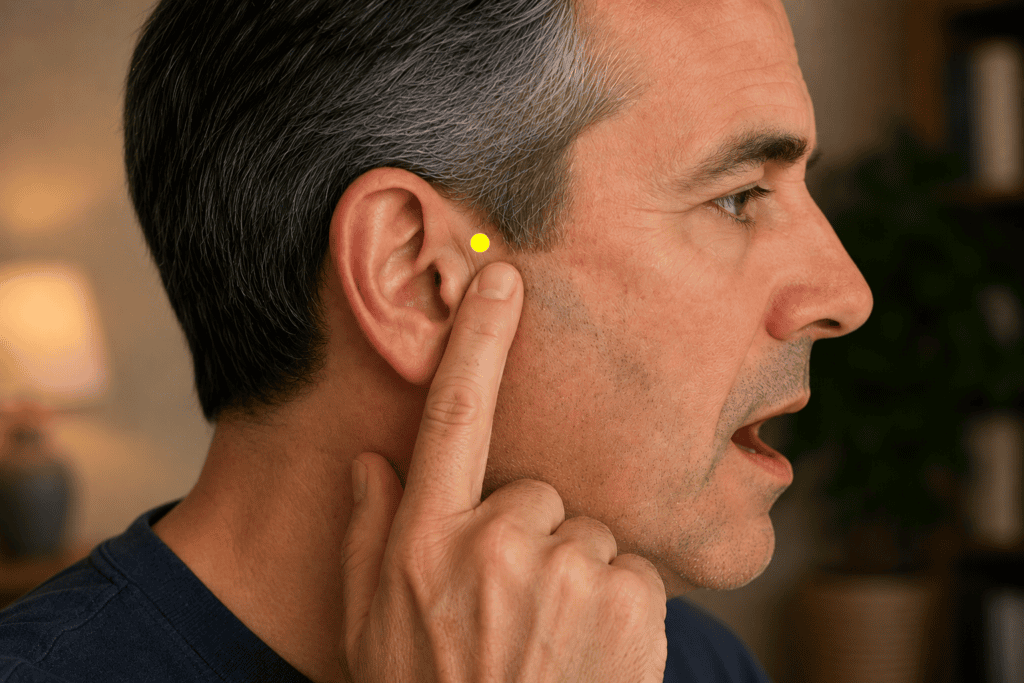
2. Press on SJ21 in front of the ear to open the ear gate. SJ21 sits in the depression just in front of the ear, near the top, at the notch above the little flap at the front of the ear, which deepens when you open your mouth. Press gently for one to two minutes on both sides, with your mouth slightly open. SJ21 is called “Ermen,” the “Ear Gate,” and it is a main local point for the ear.
SJ21, located at the front of the ear, is a traditional point used to open and unblock it, helping relieve pressure, fullness, and hearing difficulties. It directly targets the channels at the ear’s front, easing blockage sensations, while SJ17 works on the back. Slightly opening the mouth can help locate the hollow and gently move the jaw and Eustachian tube. This point addresses sensations of pressure and muddiness and is part of the ear point group that treats areas from both the front and back.
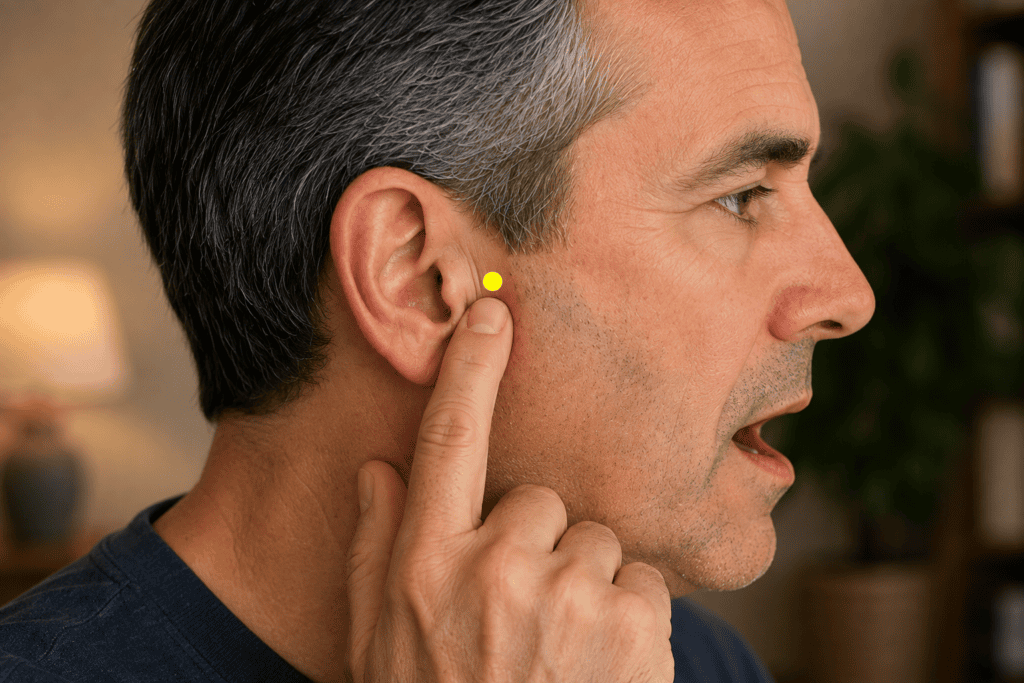
3. Press on SI19 in front of the ear to clear the ear. SI19 sits in the depression directly in front of the ear opening, in the middle, level with the ear canal, in the hollow that forms when you open your mouth. Press gently for one to two minutes on both sides, mouth slightly open. SI19 is called “Tinggong,” the “Palace of Hearing,” and it is a central point for the ear.
The SI19 point is directly above the ear canal and is a key ear point used to alleviate pressure, fullness, muffled hearing, and ringing. It lies between SJ21 above and GB2 below, forming the traditional trio of front ear points that provide comprehensive ear treatment. This point helps clear the ear and alleviates the blocked, underwater sensation at its source. To activate it, gently press on the point with your mouth open, allowing it to settle into the depression. In cases of clogged or muffled ears, this central point is essential and is often combined with the points just above and below it.
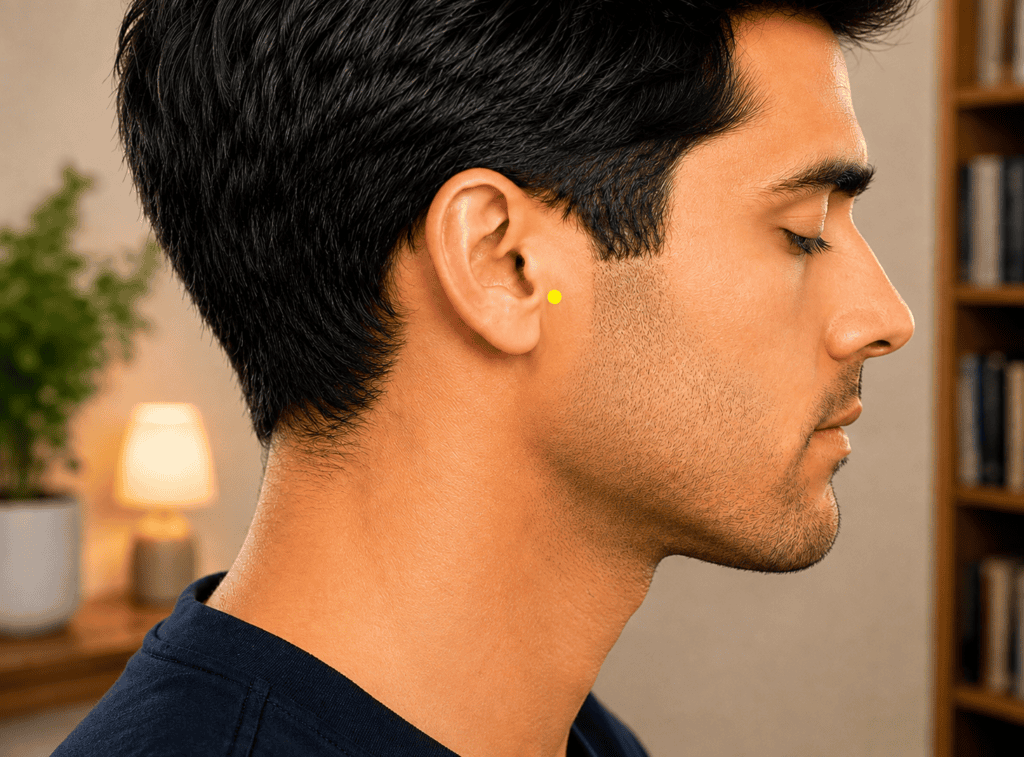
4. Press on GB2 in front of the earlobe to complete the ear trio. GB2 sits in the depression just in front of the ear, at the bottom of the trio, near the notch in front of the earlobe, deepening when you open your mouth. Press gently for one to two minutes on both sides, mouth slightly open. GB2 is called “Tinghui,” the lowest of the three front-ear points.
GB2 is one of three acupressure points at the front of the ear, located below SI19 and SJ21. It addresses ear pressure, fullness, muffled hearing, and ear pain. As the lowest point, GB2 targets the area just below the ear canal. When combined with SI19 and SJ21, pressing each in turn treats the entire front ear from bottom to top. This helps open and clear blockages along the Gallbladder meridian that encircles the ear. To fully relieve ear congestion and pressure, incorporating GB2 with the other two points ensures comprehensive coverage of the area.
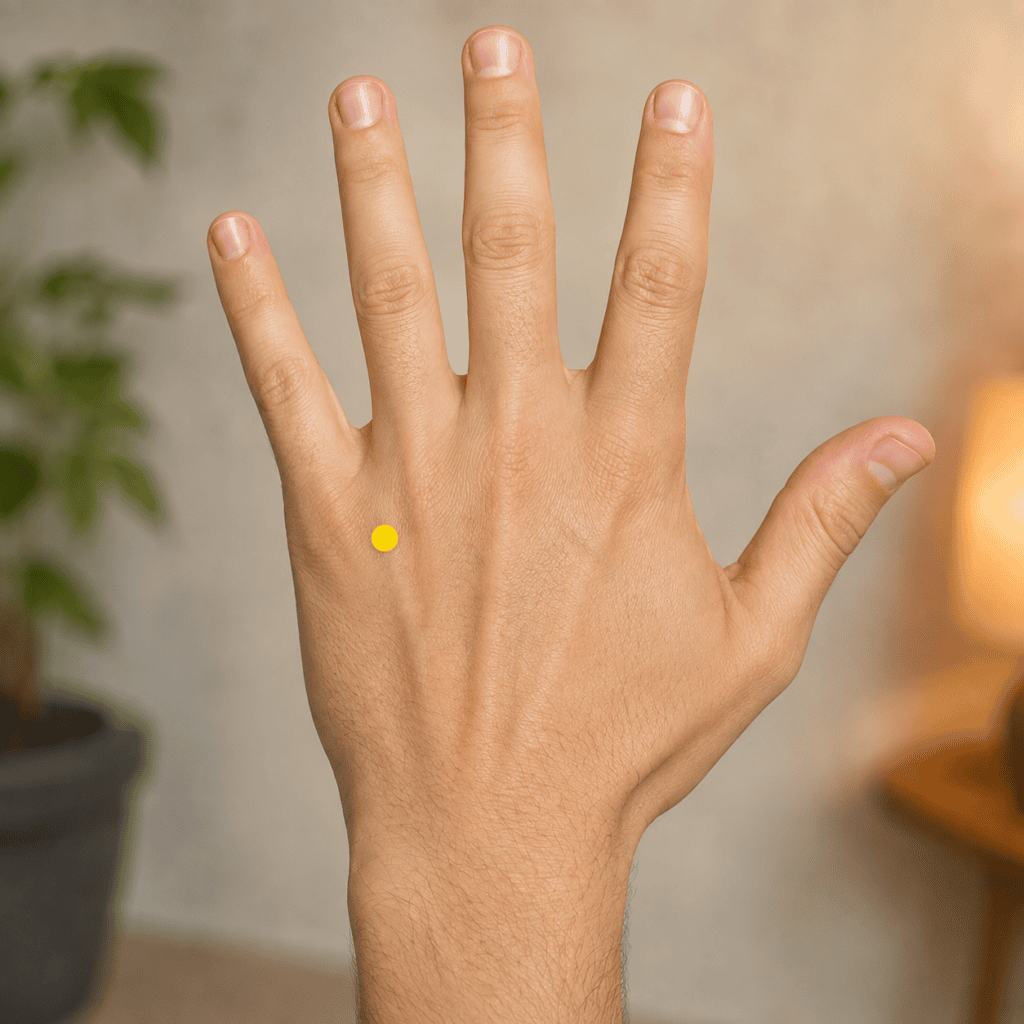
5. Press on SJ3 on the back of the hand to clear the ear from a distance. SJ3 sits on the back of the hand, in the groove between the ring and little fingers, just behind the knuckles. Press firmly with your thumb for one to two minutes on each hand. SJ3 is called “Zhongzhu,” and it is a distal point for the ears on the Triple Burner channel.
The SJ3 point influences the ear indirectly through the Triple Burner meridian, which also encircles the ear at SJ17 and SJ21. Applying pressure to SJ3 can help clear the ear and alleviate sensations of pressure, fullness, or blockage that originate from the hand. As a classic distal point for ear issues, it aids in opening the meridian supplying the ear. Located on the hand, it requires firmer pressure than the more delicate ear points and can be pressed easily during local point treatment. When used to clear a blocked ear through its meridian, this distal point complements the local ear treatment effectively.
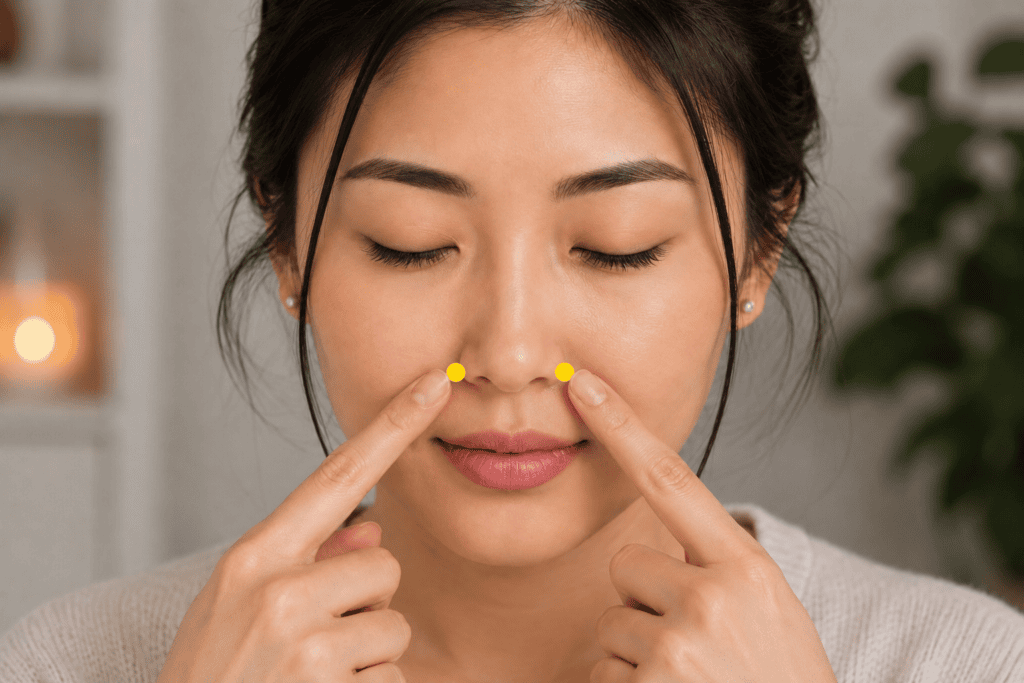
6. Press on LI20 beside the nostrils to clear the nose and sinuses. LI20 sits in the groove beside each nostril, at the outer edge where the nostril meets the cheek. Press firmly inward and slightly upward with your fingertips for one to two minutes on both sides. LI20 is called “Yingxiang,” the main point of the nose.
Since ear pressure usually comes from congestion in the nose and sinuses that travels back into the Eustachian tube, clearing the nose is crucial for ear relief. LI20, the primary point on the nose, helps by clearing a blocked, congested nose and reducing sinus congestion, which can prevent the Eustachian tube from opening at the throat end. For common cases of clogged ears related to colds, allergies, or sinus congestion, this point addresses the root cause of the blockage rather than just the symptom. Therefore, it’s beneficial to include LI20 whenever your ears are clogged due to head congestion.
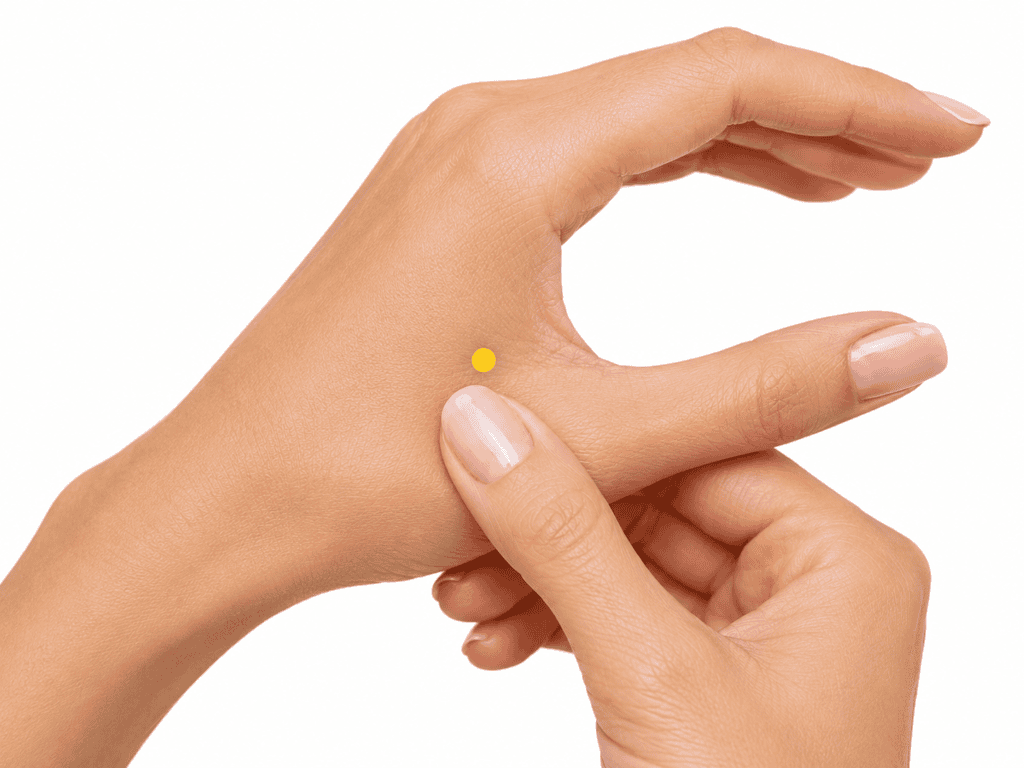
7. Press on LI4 in the hand to clear the head and face. LI4 sits in the webbing between the thumb and index finger, at the highest point of the muscle when you bring the thumb and finger together. Press firmly with the thumb of your other hand for one to two minutes on each hand. LI4 is called “Hegu,” the command point for the head and face. LI4 is avoided during pregnancy.
LI4 is a key point for the head and face, channeling Qi to relieve congestion, sinus pressure, and the feeling of blockage that causes clogged ears. It helps clear nasal passages and sinuses, reducing ear blockage and easing headaches or facial pressure associated with it. Located on the hand, it’s easy to press regularly. For head and sinus-related ear pressure, this versatile point helps clear the issue and works with LI20 to open the congested passages behind the affected ear.
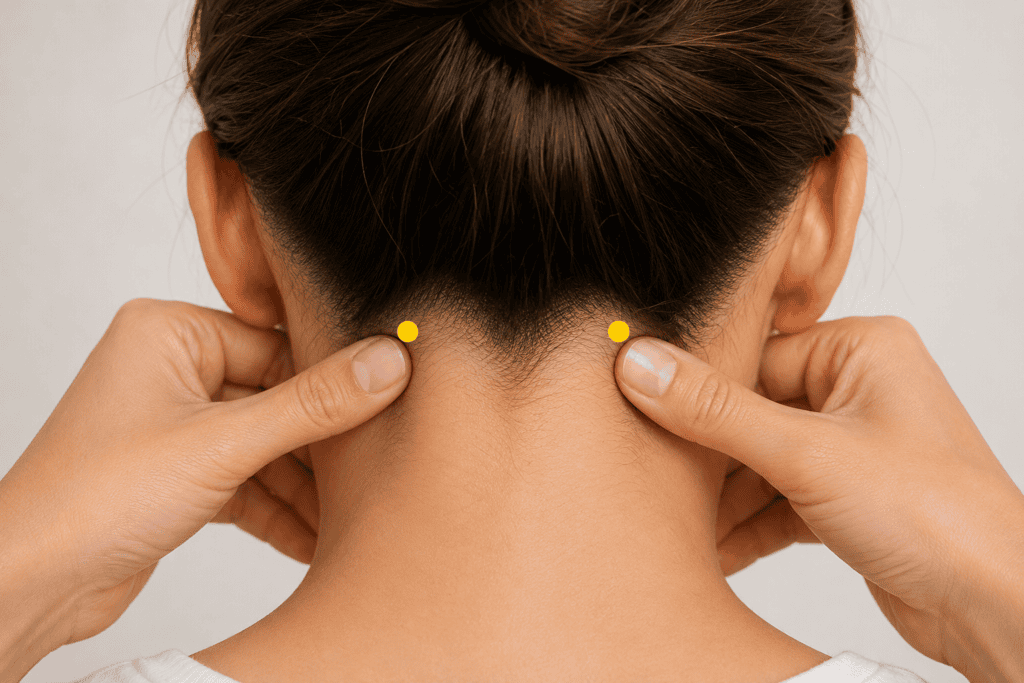
8. Press on GB20 at the base of the skull to ease pressure and congestion. GB20 sits in the two hollows at the base of the skull, between the two large vertical neck muscles and the outer edge, roughly level with the tops of the ears. Tip your head back slightly and press firmly up and inward with your thumbs for one to two minutes. GB20 is called “Fengchi,” a major point for the head, ears, and congestion.
GB20 helps clear the head and ease congestion and pressure from colds or sinus issues. Located on the Gallbladder meridian, which leads to the ear area, it reduces head heaviness, congestion, and neck tension often felt with a full or blocked ear. Traditional Chinese Medicine attributes such blockages to ‘wind’ and ‘dampness,’ which this point aims to dispel. For those with clogged ears, a heavy head, and congestion, GB20 offers a holistic approach by addressing the root cause.
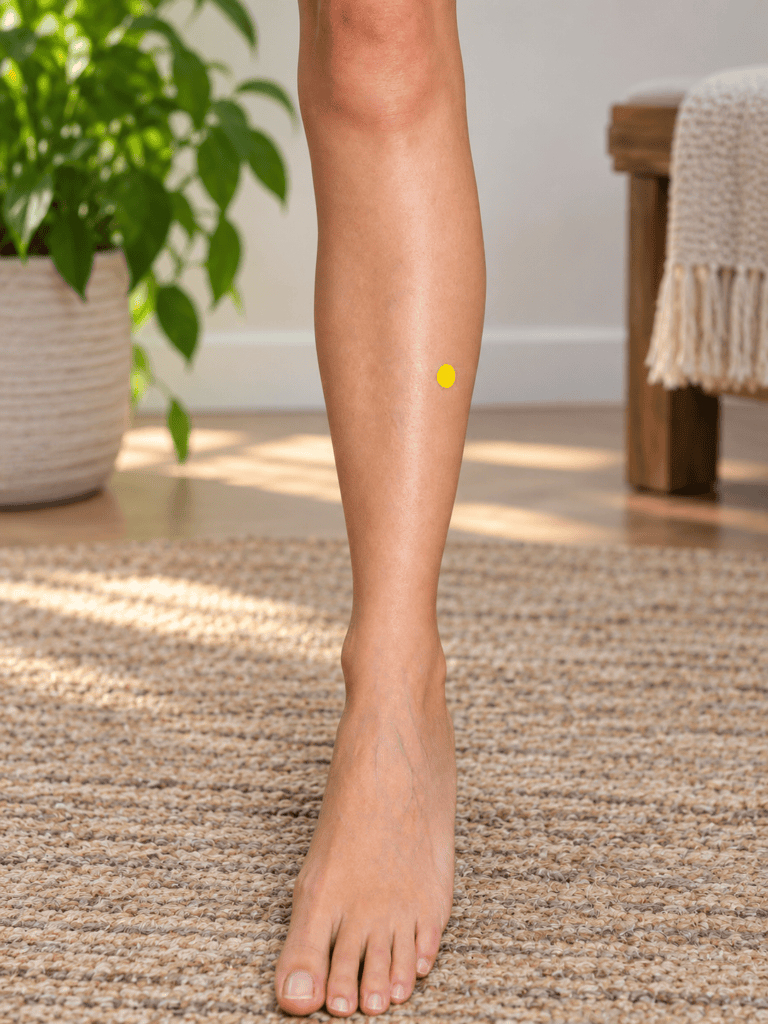
9. Press on ST40 on the lower leg to clear the phlegm and fluid. ST40 sits on the outer lower leg, midway between the knee and the outer ankle bone, about two finger-widths outside the shinbone, on the muscle. Press firmly with your thumb for one to two minutes on each leg. ST40 is called “Fenglong,” the body’s main point for clearing phlegm and dampness.
If ear fullness results from fluid and congestion, Chinese medicine relates this to phlegm and dampness, with ST40 being the primary acupoint to clear these. This point helps dissolve the phlegm and fluid in the ear and sinuses, alleviating the sensation of blocked or heavy ears. When a clogged ear is part of a persistent damp or phlegmy, congested condition that does not improve, this acupoint targets the root cause from a distance. It works alongside local ear and nose acupoints by addressing the fluid accumulation behind the blockage.
Why These Acupressure Points Work
In Traditional Chinese Medicine, ear congestion and pressure stem from blockages in the channels around the ear, specifically the Triple Burner, Small Intestine, and Gallbladder. These blockages often result from wind, dampness, or phlegm linked to cold or sinus congestion, which can obstruct the Eustachian tube. The nine points address these underlying factors.
- The ear points (SJ17, SJ21, SI19, GB2) open up the ear directly by acting from behind and around the front, thus promoting drainage of the Eustachian tube.
- The distal ear point (SJ3) clears the ear through its channel from the hand.
- The nose-and-head points (LI20, LI4, GB20) clear the sinus and nasal congestion that backs up into the ear and eases the pressure behind the blockage.
- The phlegm point (ST40) resolves the fluid and dampness behind a stubbornly congested ear.
The common theme is opening the ear and relieving congestion behind it, so treating the nose and sinuses is equally important as focusing on the ear.
How to Properly Use These Acupressure Points
Gently press on the ear points while performing the simple movements that open the Eustachian tube.
- Work the ear points, SJ17 behind the ear and the trio of SJ21, SI19, and GB2 in front, gently and with your mouth slightly open, which helps you find them and mobilizes the tube.
- Add SJ3 from the hand, and LI20, LI4, GB20, and ST40 to clear the nose, sinuses, and congestion behind the blockage.
- Pair the acupressure points with maneuvers that open the tube: swallow, yawn, or chew gum.
- Hold each point for a minute or two, apply gentle pressure around the ear, and repeat a few times a day while your ears feel blocked.
Acupressure can help ease symptoms, and a few simple steps can enhance relief. Staying well hydrated, steaming with a hot shower, or performing a saline nasal rinse can thin mucus and clear nasal blockage. Addressing underlying cold or allergy issues targets the root cause. Chewing gum, yawning, and swallowing, especially during altitude changes like flying or driving through mountains, assist in keeping the Eustachian tube open and equalizing pressure. Applying warmth, such as a warm compress to the ear, can provide comfort. However, avoid inserting anything into the ear canal, as pressure problems are due to congestion rather than earwax, which cleaning would fix.
When to Get Professional Help
Ear pressure and blocked ears from congestion or a cold often resolve naturally as the underlying issue improves; acupressure may help ease symptoms. In some cases, consult a doctor. Seek medical advice if ear pressure or fullness lasts several weeks or keeps coming back, if you have intense ear pain, or if there’s any discharge or fluid leaking from the ear, as these could signal an ear infection that needs treatment. Seek immediate medical care if you experience sudden hearing loss (a medical emergency), or if severe ear pain occurs alongside dizziness, vertigo, other ear symptoms, or a high fever. If impacted earwax is causing clogged ears, a healthcare professional should remove it safely; do not attempt to do this at home. Ongoing fullness warrants a professional medical evaluation.
While acupressure and basic home remedies may alleviate common congestion-related blockages, they should not replace essential medical care.
Because ear pressure so often comes with a cold or sinus congestion, acupressure for sinus congestion is a close companion article when both are involved; if ringing rather than fullness is the main issue, acupressure for tinnitus covers that specific condition.
Above and Beyond Acupuncture offers acupuncture, cupping, and lifestyle coaching at the North Frank Lloyd Wright Boulevard location in Scottsdale.
Schedule an appointment online to start your healing journey.
The points above are only as effective as the technique used to apply them. Where to press, how firmly, and for how long all affect the result. For a full breakdown of how to perform acupressure properly at home, read Performing Acupressure in 3 Easy Steps.

About the Publisher
Paul Kerzner, L.Ac., is a licensed acupuncturist and board-certified herbalist, as well as the founder of Above and Beyond Acupuncture in Scottsdale. His own journey from chronic patient to practicing acupuncturist shapes his commitment to providing honest, clinically grounded information about acupuncture and Traditional Chinese Medicine. Learn more about Paul and his clinical approach on the About Us page.