Key Takeaways
- Piles and anal fissures are common yet uncomfortable conditions usually associated with straining and constipation.
- Acupressure provides relief by targeting specific points to enhance Qi and Blood flow, supporting healing and improving bowel function.
- Nine effective acupressure points such as GV20, GV1, BL57, and ST36 serve specific functions in relieving symptoms.
- Using acupressure alongside maintaining good bowel habits, staying hydrated, and taking warm sitz baths can improve healing and comfort.
- Seek medical care if you experience severe or ongoing symptoms, like rectal bleeding, as these could signal more serious conditions.
Piles and anal fissures are common but uncomfortable conditions that are rarely discussed, which can make managing them more challenging than necessary.
Piles, or hemorrhoids, are swollen veins around the anus and lower rectum that can cause itching, discomfort, swelling, and sometimes bleeding. An anal fissure is a small tear in the anal lining that causes sharp pain during and after bowel movements, often with a small amount of bright blood. Both are usually linked to straining, constipation, and pressure in the area, making them very unpleasant. Acupressure can help ease discomfort, calm the area, support normal bowel function, and encourage healing. The points below can help with both conditions.
In Traditional Chinese Medicine, hemorrhoids and fissures are seen as caused by stagnation of Qi and Blood in the lower body. This stagnation often combines with descending heat and dampness, along with weak Spleen Qi that supports stability. When Qi and Blood stagnate and collect in the lower rectum, veins may enlarge, leading to hemorrhoids. Fissures can form if heat and dryness dry out or damage tissues, or if straining tears the tissue. The Governing Vessel, starting at the base of the spine, and the Bladder channel, running down the back and governing this region, are mainly involved. The key points focus on moving stagnated Qi and Blood, eliminating downward-moving heat and dampness, strengthening Spleen Qi to support tissues, and facilitating healing.
Here are nine acupressure points that can provide some relief:
What Acupressure Points to Press and Why
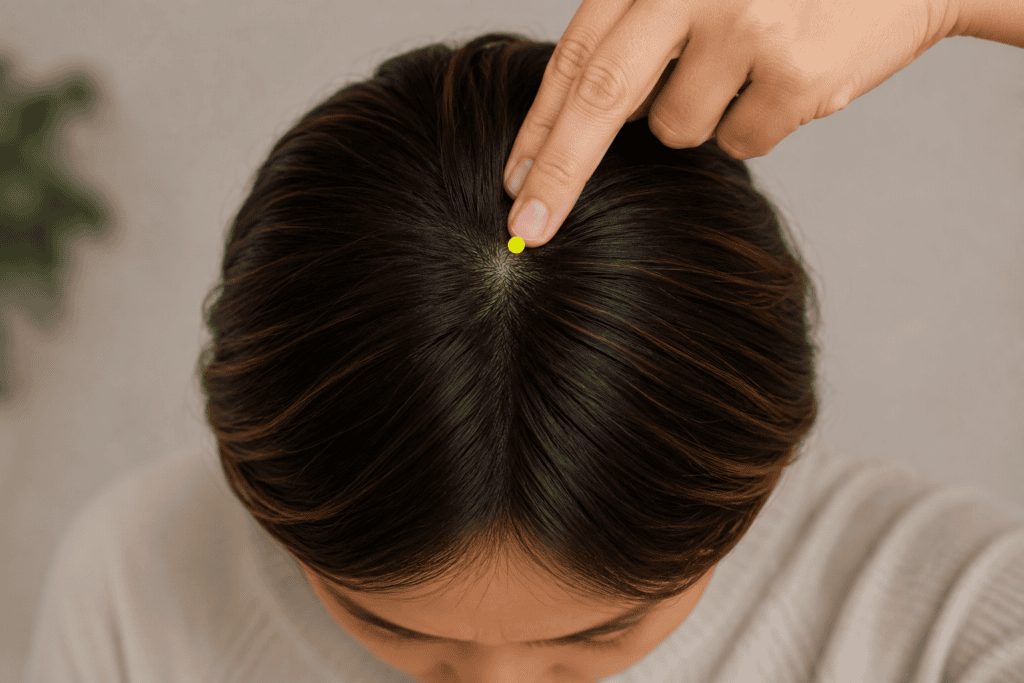
1. Press on GV20 at the top of the head to lift the sunken Qi. GV20 sits at the very top of the head, on the midline, on a line drawn up from the tops of both ears. Press straight down, or make small circles with your fingertip for one to two minutes. GV20 is called “Baihui,” the “Hundred Meetings,” where many channels converge at the crown.
It might seem surprising that a point at the very top of the head can influence a condition at the body’s lowest point, but GV20 is one of the most important acupressure points for hemorrhoids, precisely because of this connection. In Traditional Chinese Medicine, hemorrhoids and prolapse are viewed as Qi descending rather than staying upward, and because GV20 sits at the highest point along the Governing Vessel, it helps lift sinking Qi. This is why it is a classic point for hemorrhoids and conditions involving downward displacement and prolapse. It works by counteracting the downward pressure in that area, lifting what has fallen, and addressing the root cause from the opposite end of the body.
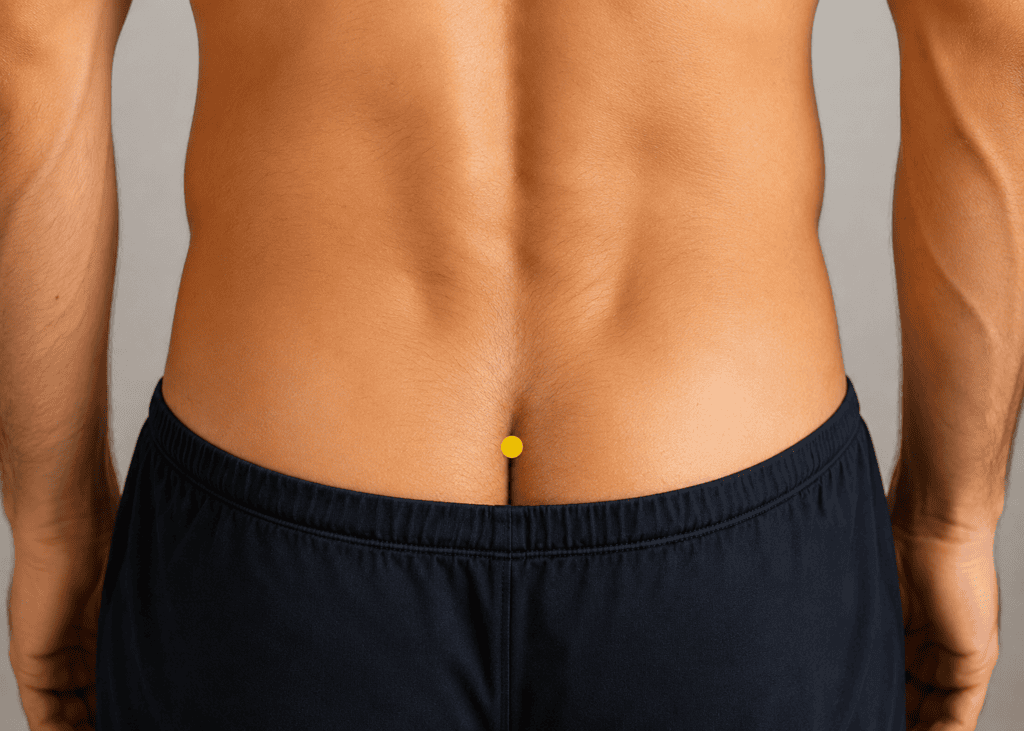
2. Press on GV1 at the base of the spine, the local point for the area. GV1 sits at the very base of the spine, in the small area midway between the tip of the tailbone and the anus. Press gently with a fingertip for about a minute, or apply gentle pressure while seated. GV1 is called “Changqiang,” the primary local point for this region.
GV1 is the main acupressure point for treating piles and fissures, situated at the base of the Governing Vessel near the affected area. It is traditionally regarded as the most specific point for hemorrhoids and anal disorders. It moves stagnant Qi and Blood from where they have accumulated, reduces local discomfort and swelling, and promotes tissue healing. Because it is sensitive and private, press it gently; this is practical when seated or during a warm sitz bath. For pain caused by piles and fissures, this acupressure point provides the most direct relief.
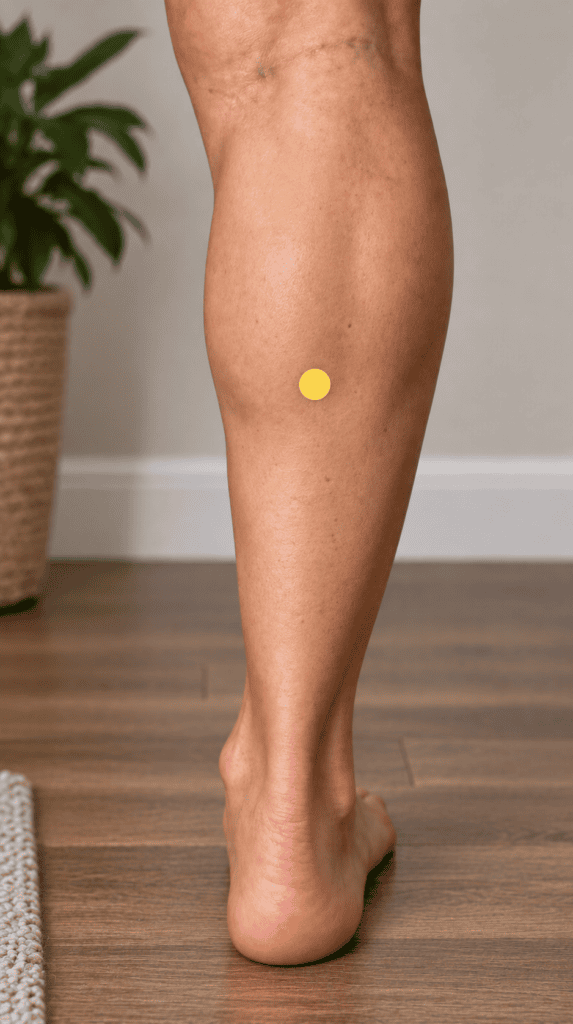
3. Press on BL57 in the calf, the classic distal point for piles. BL57 sits in the center of the back of the lower leg, in the hollow where the calf muscle bulges and meets the Achilles tendon, about midway between the back of the knee and the heel. Press firmly with your thumb for one to two minutes on each leg. BL57 is called “Chengshan,” the classic distal point for hemorrhoids.
BL57 is a widely recognized distal point used for treating hemorrhoids, with a history spanning centuries. It influences the area along the Bladder channel from the calf down the back by dispersing stagnant Qi and Blood in the lower rectum. This action alleviates swelling and discomfort associated with hemorrhoids and promotes fissure healing. Located on the calf, away from sensitive regions, BL57 allows for firm pressing without discomfort, making it a preferred choice for discreet treatment. Both hemorrhoids and fissures benefit from this essential distal point, which should be pressed firmly and regularly.
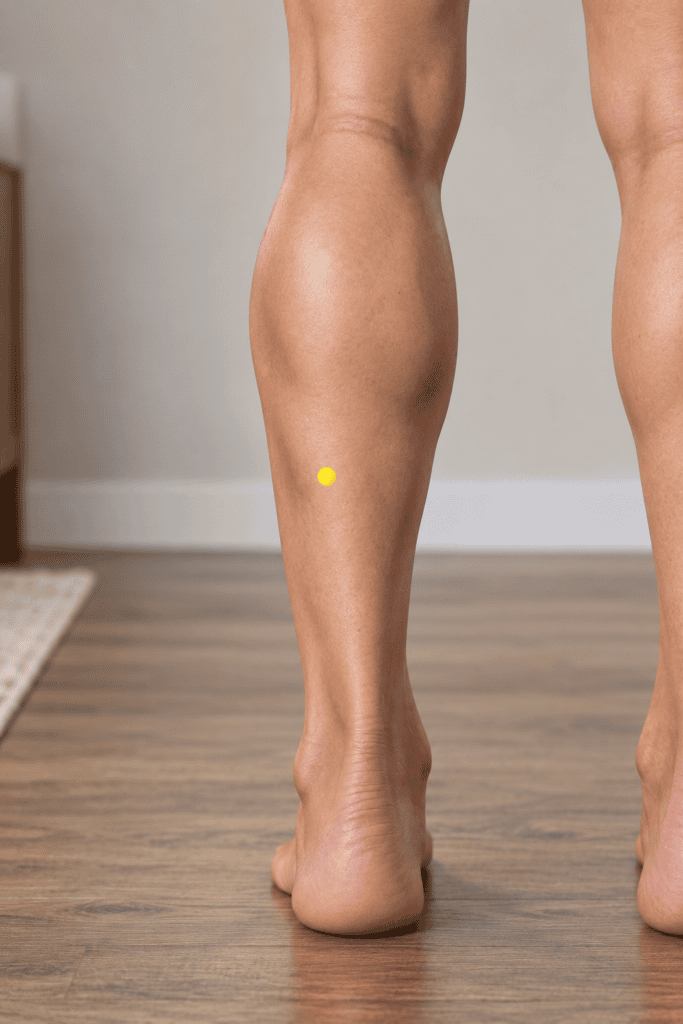
4. Press on BL58 on the lower leg to support the region. BL58 sits on the back of the lower leg, a little below and to the outer side of BL57, about a hand’s width above the outer ankle. Press firmly with your thumb for one to two minutes on each leg. BL58 is called “Feiyang,” another Bladder-channel point used for this region.
BL58, located on the Bladder channel near BL57, similarly influences the lower leg area and enhances its effects on piles and the lower rectum. It promotes the flow of Qi and Blood through this channel and is often used with BL57 for treating hemorrhoids. Because it is on the leg, it is easy to access and can be firmly manipulated. For piles and related discomfort, BL58 complements the traditional calf point and strengthens treatment at the distal end of the region.
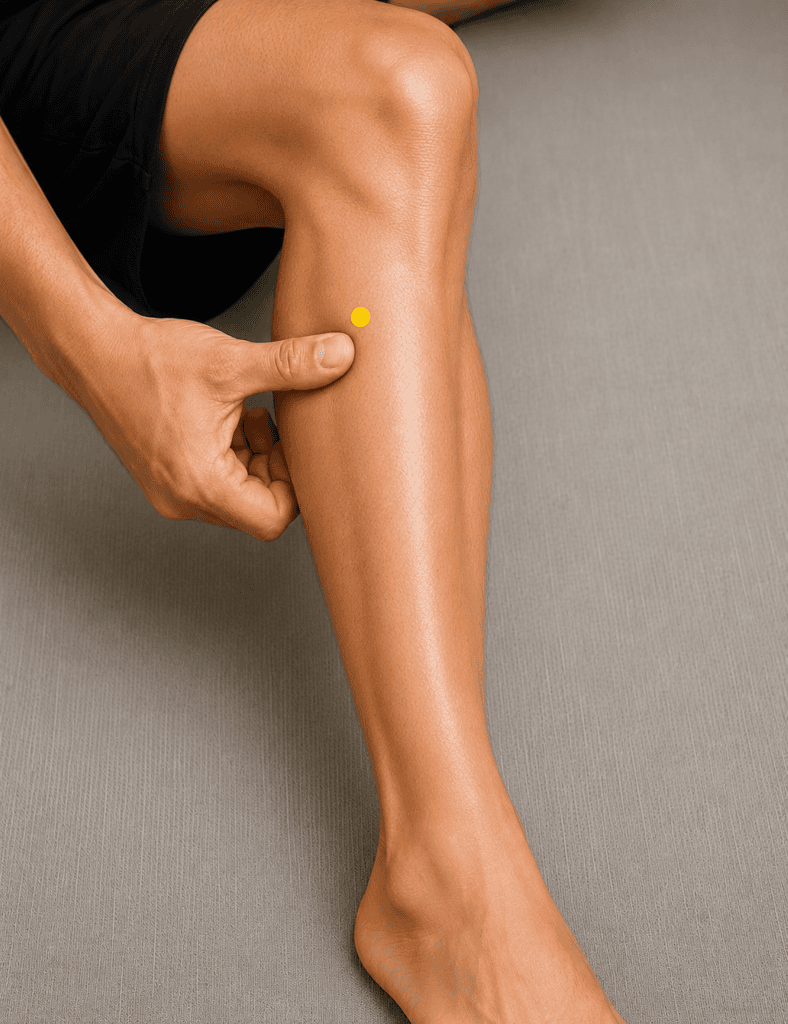
5. Press on ST36 below the knee to strengthen the Qi and digestion. ST36 sits four finger-widths below the lower edge of the kneecap and one finger-width to the outside of the shinbone, on the muscle that rises when you flex your foot. Press firmly with your thumb for one to two minutes on each leg. ST36 is called “Zusanli,” the “Leg Three Miles,” and it is the master point for energy and digestion.
The ST36 point strengthens the Spleen and Qi, which in Chinese medicine are crucial for supporting tissues. It helps address weak, sunken Qi that contributes to piles and improves digestion, making bowel movements healthier and easier. Since straining and constipation play a significant role in piles and fissures, strengthening digestion and Qi is essential. This point effectively targets both issues. Additionally, when combined with GV20, it offers lifting and reinforcing effects. For underlying weakness and digestive concerns, this point restores balance and, with regular use, supports the overall treatment.
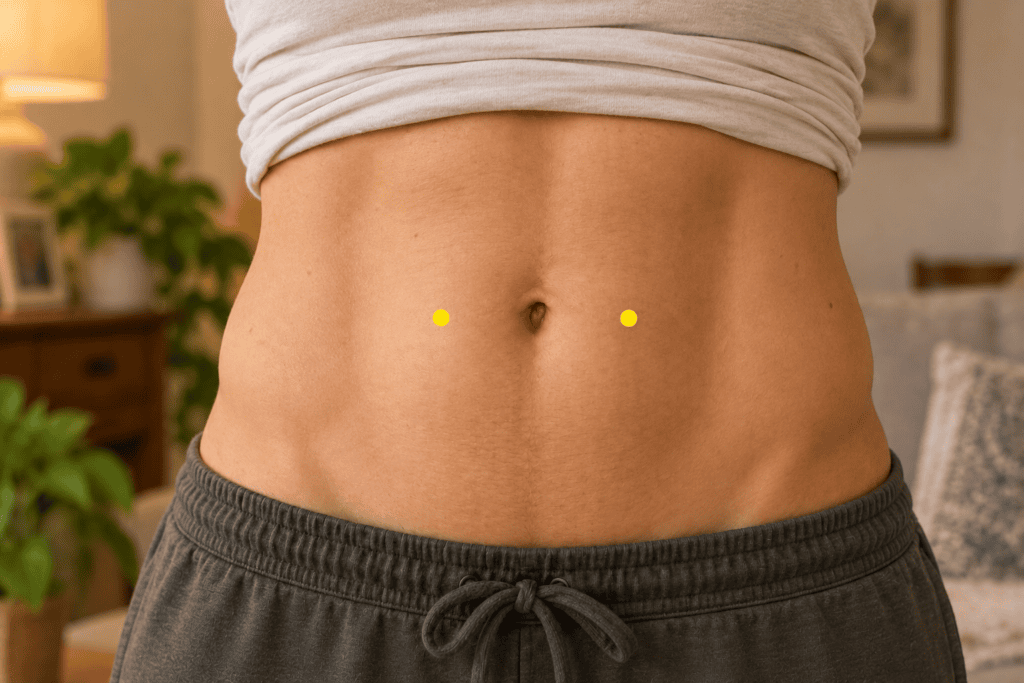
6. Press on ST25 beside the navel to regulate the bowels. ST25 sits about three finger-widths out to each side of the navel, level with its center. Press gently but firmly with your fingertips on both sides for one to two minutes. ST25 is called “Tianshu,” the “Heavenly Pivot,” and it is the front-mu point of the Large Intestine.
Because constipation and straining are leading causes of hemorrhoids and fissures, the ST25 acupressure point, which supports intestinal health, helps resolve these issues by regulating bowel function and easing constipation. It encourages smooth digestion, reducing the straining that can swell hemorrhoids and tear tissue, leading to fissures. Moreover, it helps relieve bloating and lower abdominal discomfort associated with slow bowels. By addressing constipation at its source, this point promotes softer, easier bowel movements and supports the body’s natural healing process.
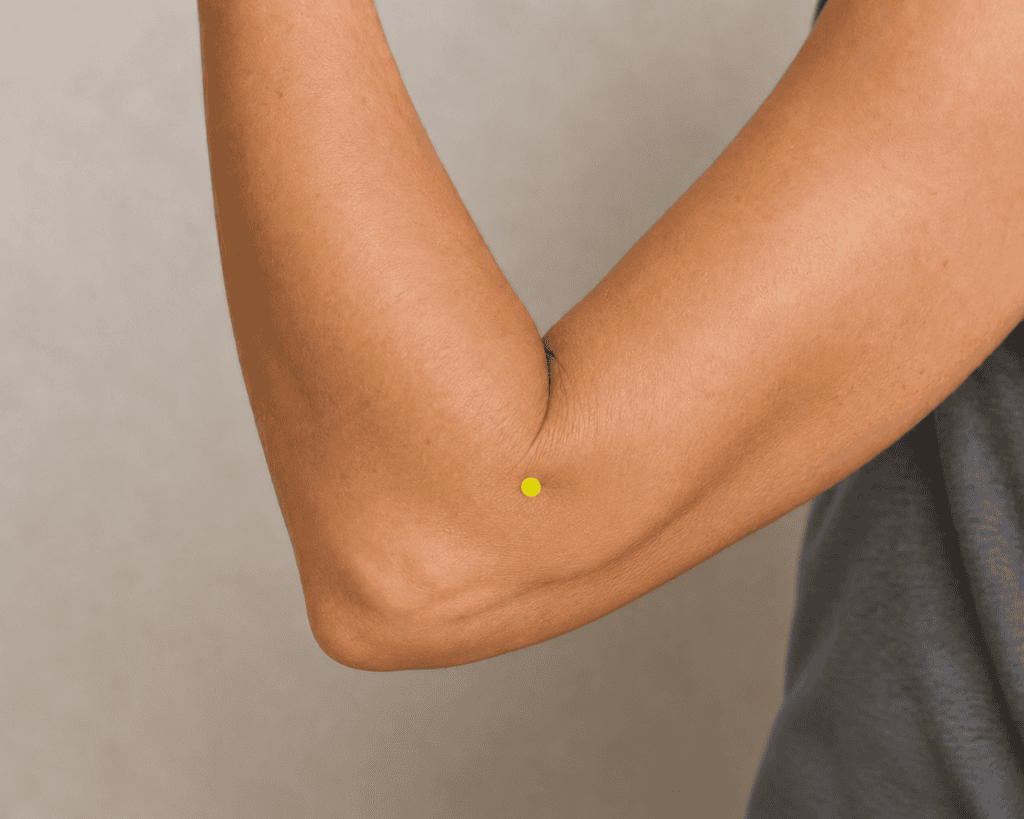
7. Press on LI11 at the elbow to clear the heat. LI11 sits at the outer end of the elbow crease, in the hollow that forms when the elbow is bent, at the top of the forearm. Press firmly with your thumb for one to two minutes on each arm. LI11 is called “Quchi,” and it is one of the strongest points for clearing heat.
When heat causes piles and fissures, Chinese medicine views this as heat accumulating in the lower body. LI11 is among the best acupressure points to clear this heat. Located on the Large Intestine meridian, which connects to this area, it helps reduce heat that can lead to pile inflammation and cause tissue drying and fissures. Because the condition is hot, burning, and inflamed, LI11 exerts a cooling effect from a distance, making it especially effective for inflamed and irritated flare-ups.
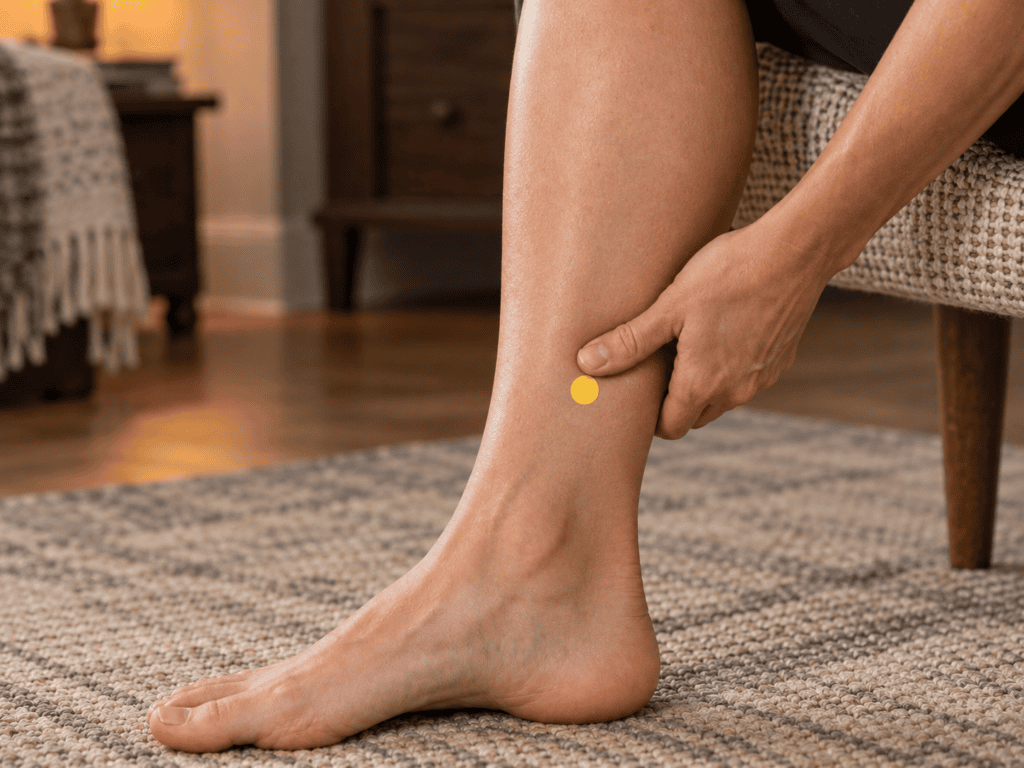
8. Press on SP6 above the inner ankle to nourish and moisten. SP6 sits four finger-widths up from the tip of the inner ankle bone, just behind the back edge of the shinbone. Press firmly for one to two minutes on each leg. SP6 is called “Sanyinjiao,” the “Three Yin Intersection,” where the Spleen, Liver, and Kidney channels meet. SP6 is avoided during pregnancy.
SP6 nourishes the Blood and Yin and moistens the body, which is crucial for addressing dryness-related constipation and tissue tears in fissures. It also supports the Spleen as part of the overall treatment. By uniting the three channels, it becomes a highly nourishing point that helps soften stool and hydrate tissues to promote healing, while broadly supporting the area. For dryness, constipation, or poor healing associated with piles and fissures, this point provides nourishment and moisture, working alongside ST25 to facilitate smoother bowel movements. However, use caution during pregnancy, as both conditions are common in pregnant women.
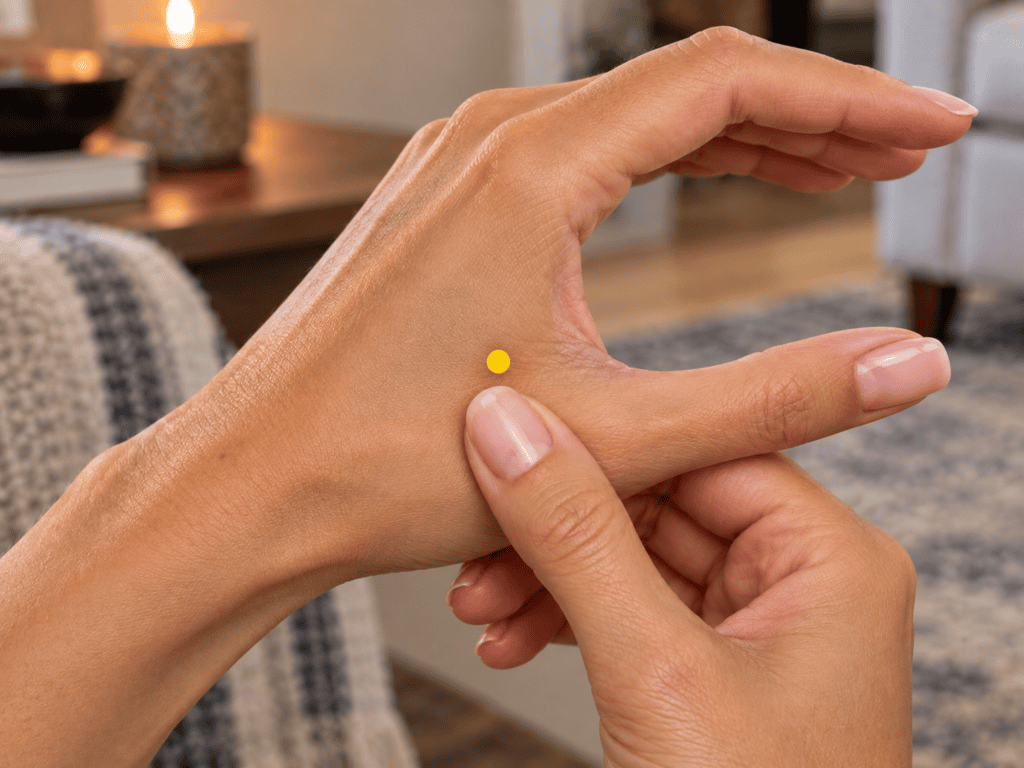
9. Press on LI4 in the hand to relieve pain and move Qi. LI4 sits in the webbing between the thumb and index finger, at the highest point of the muscle when you bring them together. Press firmly with the thumb of your other hand for one to two minutes on each hand. LI4 is called “Hegu,” and it is one of the great points for pain and for moving Qi. LI4 is avoided during pregnancy.
LI4 is one of the most effective acupressure points for general pain relief, helping ease pain from a fissure and discomfort from piles, even from afar. Located on the Large Intestine meridian, it connects directly to the affected area and promotes bowel movement. This point offers broad pain relief, diminishes sharp discomfort, and is easy to access since it is on the hand. For severe fissure pain, LI4 reduces its intensity and supports overall intestinal function along with other acupressure points. However, avoid it during pregnancy.
Why These Acupressure Points Work
In Traditional Chinese Medicine, hemorrhoids and fissures originate from stagnant Qi and Blood in the lower body, caused by downward-moving heat and dampness. This condition is intensified by Spleen Qi deficiency, which affects tissue health, and by straining due to constipation. The nine points address all these contributing factors.
- The lifting points (GV20, ST36) elevate the sunken Qi, which should support the tissue by lifting it, thereby addressing the root cause of the downward pull.
- The local and distal points (GV1, BL57, BL58) help move stuck Qi and Blood both locally and from the calf, with BL57 being the traditional point for piles.
- The bowel and nourishing points (ST25, SP6) help regulate bowel movements, moisten the stool and tissues, and relieve the straining that worsens both conditions.
- The heat and pain points (LI11, LI4) help clear heat that causes inflammation and dryness in the area, alleviating pain, especially from fissures.
The primary goal is to address stagnation, elevate descending Qi, and lessen strain. Therefore, ensuring smooth, gentle bowel movements is equally important as treating the affected local area.
How to Properly Use These Acupressure Points
Combine distal points, taking bowel habits into account.
- Press the distal points: BL57 and BL58 on the calf, ST36, ST25, LI11, SP6, and LI4 firmly and regularly. These points are easy to reach and help significantly with the affected area and the bowels.
- Use GV20 at the crown to lift the sunken Qi, and gently use GV1 at the base of the spine, or apply seated pressure to the local area.
- Press ST25 and work toward soft, easy bowel movements, since reducing straining is central to healing the area.
- Hold each point for 1-2 minutes. Combine acupressure with warm sitz baths for 10-15 minutes to soothe piles and fissures, relieve pain, and promote healing through improved circulation.
Acupressure helps relieve discomfort, but bowel habits do the real work of healing and prevention, so encourage them. Eat plenty of fiber and drink plenty of water to keep stools soft and easy to pass, since hard stools and straining cause and worsen both hemorrhoids and fissures. Don’t strain, and don’t sit on the toilet for long periods. Instead, go as soon as you feel the need, and stay physically active to keep your bowels moving. Warm sitz baths soothe the area and help promote healing. Gentle cleaning, rather than rough wiping, protects the tissue; with a fissure, it is especially important to keep the stool soft so the tear can heal. Over-the-counter creams and ointments can help relieve symptoms while the area recovers.
When to Get Professional Help
Always consult a doctor if you experience rectal bleeding instead of assuming it’s just piles or a fissure. Although these are common causes, bleeding from the bowel can also indicate other, sometimes serious, health issues that need to be ruled out, especially if the bleeding is new, persistent, or accompanied by changes in bowel habits. Seek medical help if bleeding is heavy, dark, mixed with stool, or if you notice changes in bowel habits, unexplained weight loss, or have a family history of bowel conditions. Also see a doctor if piles or a fissure are severe, don’t improve after a few weeks of self-care, or keep recurring, since effective treatments are available. Seek help immediately for severe pain, signs of infection, or a hard, very painful lump, which could indicate a clotted pile.
While acupressure and good bowel habits may reduce daily discomfort, they are not substitutes for medical assessment in cases of rectal bleeding or persistent symptoms.
Above and Beyond Acupuncture offers acupuncture, cupping, and lifestyle coaching at the North Frank Lloyd Wright Boulevard location in Scottsdale.
Schedule an appointment online to start your healing journey.
The points above are only as effective as the technique used to apply them. Where to press, how firmly, and for how long all affect the result. For a full breakdown of how to perform acupressure properly at home, read Performing Acupressure in 3 Easy Steps.
Because piles specifically are so common, acupressure for hemorrhoids covers that condition specifically, and since constipation and straining are commonly behind both piles and fissures, acupressure for constipation helps address one of their primary causes.

About the Publisher
Paul Kerzner, L.Ac., is a licensed acupuncturist and board-certified herbalist, as well as the founder of Above and Beyond Acupuncture in Scottsdale. His own journey from chronic patient to practicing acupuncturist shapes his commitment to providing honest, clinically grounded information about acupuncture and Traditional Chinese Medicine. Learn more about Paul and his clinical approach on the About Us page.