Key Takeaways
- Hemorrhoids affect roughly one in twenty American adults yet remain under-discussed due to embarrassment.
- Conventional treatments often address only symptoms, while acupressure effectively targets underlying patterns driving hemorrhoids.
- Seven specific acupressure points can alleviate symptoms and support long-term management of hemorrhoids.
- For acute episodes, prioritize TB6, BL57, and GV1; for chronic issues, follow the full seven-point protocol daily.
- Seek professional help for severe symptoms or if self-care fails; acupuncture offers additional support beyond acupressure.
Hemorrhoids are one of the most common and one of the most under-discussed conditions in adult medicine. Roughly one in twenty American adults has symptomatic hemorrhoids at any given time, and more than half of Americans will experience hemorrhoids at some point by age 50. Despite how common they are, the condition remains embarrassing enough that many patients avoid discussing it.
The conventional approach involves over-the-counter creams, sitz baths, dietary fiber, and in more severe cases office procedures like rubber band ligation. These help many patients but often address only the immediate symptoms without resolving the underlying patterns that produce recurring hemorrhoids.
Acupressure is one of the strongest non-medication tools for supporting hemorrhoid management. The technique addresses the underlying digestive dysfunction that produces the straining pattern, the Qi sinking that contributes to prolapsed hemorrhoids, and the local circulatory patterns that maintain the condition. The points can be used during flares to reduce symptoms or as a daily protocol to address the underlying patterns over time.
Here are seven acupressure points that work, why they work, and when to get help if they do not.
What to Press and Why
Each point addresses a different aspect of hemorrhoid dysfunction. You can use them individually when a specific symptom is bothering you, or work through the full protocol once or twice a day.
1. Press on GV20 at the crown of your head for the Qi sinking pattern. GV20 sits at the very top of the head, on the midline of the skull at the highest point. Press gently with your fingertip for one to two minutes. GV20 is called “Hundred Meetings” in Chinese medicine and is one of the most important points for hemorrhoids because it lifts Qi upward. In Chinese medicine, hemorrhoids often reflect a pattern of Spleen Qi sinking where the holding function of the Spleen weakens and structures descend. GV20 directly counteracts this sinking pattern and supports the tissues in their proper position.
2. Press on BL57 in the middle of your calf for the empirical hemorrhoid point. BL57 sits in the middle of the calf, at the point where the two heads of the calf muscle meet as it transitions into the Achilles tendon. Press firmly with your thumb for one to two minutes on each leg. BL57 is called “Support the Mountain” in Chinese medicine and has been used specifically for hemorrhoids across many centuries of clinical practice. The point is one of the most empirically supported for the condition and produces measurable relief when used consistently.
3. Press on ST36 below your knee for digestive support. ST36 sits about four finger-widths below the kneecap, one finger-width to the outside of the shinbone in the muscular depression there. Press firmly with your thumb for one to two minutes on each leg. ST36 is one of the most useful points in the entire acupuncture system. For hemorrhoids specifically, it supports the digestive function that reduces the constipation and straining patterns that produce the condition. Regular use of ST36 as daily prevention supports overall digestive health.
4. Press on TB6 on your forearm for the heat-type constipation and inflammatory pattern. TB6 sits about three finger-widths above the wrist crease on the back of the forearm, in the depression between the two forearm bones. Press firmly with your thumb for one to two minutes on each arm. TB6 is called “Branch Ditch” in Chinese medicine and is one of the most powerful points for heat-type constipation, which is a primary driver of hemorrhoid formation. The point clears Heat in the Large Intestine and addresses the Damp Heat pattern that produces the acute inflammatory presentation of hemorrhoids with pain, swelling, and often bleeding. TB6 is included in modern clinical protocols for hemorrhoid pain and works particularly well in combination with BL57.
5. Press on SP6 above your inner ankle for the constitutional support. SP6 sits about four finger-widths above the inside of the ankle bone, just behind the shin bone in the small depression there. Press firmly with your thumb for one to two minutes on each leg. SP6 is the meeting point of three Yin channels (Spleen, Liver, Kidney) and supports the underlying digestive, Qi, and Blood patterns that contribute to hemorrhoid formation. The point is particularly useful for chronic patterns and constitutional support. SP6 is contraindicated during pregnancy.
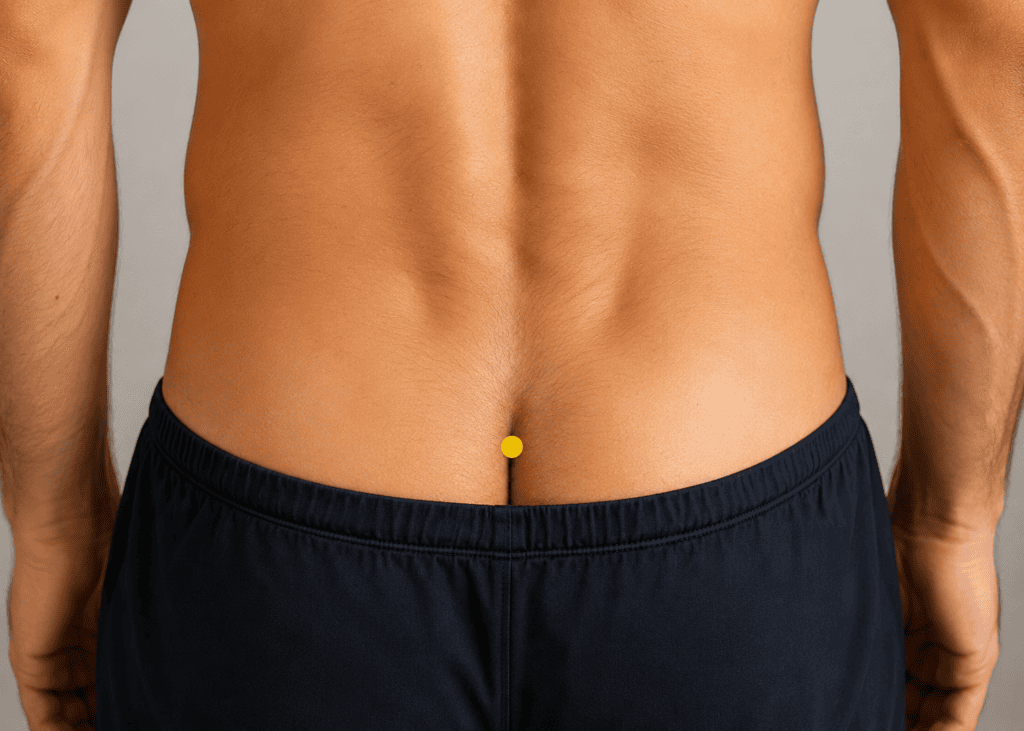
6. Press on GV1 at the tip of your tailbone for the local point. GV1 sits at the very tip of the coccyx, in the depression at the base of the spine. Press gently with your fingertip for one to two minutes. GV1 is called “Long Strength” in Chinese medicine and is the primary local point for the anal region. The point is used for hemorrhoids across the entire clinical spectrum from acute presentations to chronic recurring patterns. Access to the point requires a comfortable position where you can reach the coccyx area. Some patients find it easier to press this point while lying on their side.
7. Press on LI4 in the webbing between your thumb and index finger for the distal command point. LI4 sits in the soft tissue webbing between the thumb and index finger, in the muscle that bulges out when the thumb is pressed against the side of the index finger. Press firmly with the thumb of the opposite hand for one to two minutes on each hand. LI4 is the command point for the face and abdomen in Chinese medicine and supports digestive function and the overall Qi movement patterns. The point is one of the most useful for supporting digestive elimination that reduces the straining pattern producing hemorrhoids. LI4 is contraindicated during pregnancy.
Why This Works
Hemorrhoids have several overlapping drivers. Chronic constipation and straining produce the mechanical pressure that swells the vascular cushions. The Spleen Qi sinking pattern in Chinese medicine reflects the constitutional weakness that allows tissues to descend. The Damp Heat in the Large Intestine pattern produces the acute inflammatory presentation. Chronic stress worsens the underlying digestive dysfunction that maintains the pattern.
Acupressure works on several of these mechanisms simultaneously.
- The lifting points (GV20) counteract the Qi sinking pattern that produces prolapsed hemorrhoids.
- The empirical calf point (BL57) directly address hemorrhoids through historically documented clinical use.
- The digestive support points (ST36, SP6, LI4) address the constipation and straining patterns that drive hemorrhoid formation.
- The local point (GV1) addresses the anal region directly.
- The heat-clearing point (TB6) addresses the Damp Heat pattern that produces the acute inflammatory presentation.
The chronic stress dimension that contributes to digestive dysfunction is worth addressing directly. What Is Cortisol and Why Do I Have So Much of It? covers this in more detail.
The clinical framework for hemorrhoids as a multi-mechanism condition is in Can Acupuncture Treat Hemorrhoids?, which is the companion piece to this one.
The Mayo Clinic overview of hemorrhoids and the NIDDK summary provide the medical framework.
How to Use the Points
- For acute flares, TB6, BL57, and GV1 produce the fastest response. These points can be pressed multiple times a day during acute episodes.
- For chronic patterns, working through the full seven-point protocol once or twice a day addresses the underlying patterns over time. Consistency matters. Two to four weeks of daily practice typically produces measurable improvement in overall hemorrhoid burden.
- For prevention, GV20, ST36, and SP6 as a daily protocol support the underlying constitutional and digestive patterns that reduce the likelihood of hemorrhoid recurrence.
Consistency matters more than intensity. A gentle sustained press for one to two minutes produces better results than a hard press held briefly.
Pairing acupressure with the foundational management practices amplifies the results. Adequate fiber intake. Adequate hydration. Avoiding prolonged toilet time. Not straining during bowel movements. Regular physical activity. Warm sitz baths for acute flares.
When to Get Professional Help
The tools above work for many everyday hemorrhoid patterns. They are not the answer for rectal bleeding, sudden severe pain suggesting a thrombosed hemorrhoid, heavy bleeding, bleeding accompanied by significant weight loss, changes in bowel habits, or symptoms in patients over 40 who have not had recent colon cancer screening. Rectal bleeding always warrants medical evaluation to rule out other conditions.
If you are dealing with persistent or recurring hemorrhoids that are not responding to self-care, acupuncture treatment offers a more substantial intervention than acupressure alone.
The nervous system and stress components that may contribute to digestive dysfunction are covered in Anxiety, Stress, and Depression.
Acupuncture, Cupping & Lifestyle Coaching covers what services the clinic offers.
Reach out to Above and Beyond Acupuncture on North Frank Lloyd Wright Boulevard in Scottsdale to schedule a consultation.
Schedule an appointment online or call us today to start your healing journey.
The points above are only as effective as the technique used to apply them. Where to press, how firmly, and for how long all affect the result. For a full breakdown of how to perform acupressure properly at home, read Performing Acupressure in 3 Easy Steps.
About the Publisher
Paul Kerzner, L.Ac., is a licensed acupuncturist and board-certified herbalist, as well as the founder of Above and Beyond Acupuncture in Scottsdale. His own journey from chronic patient to practicing acupuncturist shapes his commitment to providing honest, clinically grounded information about acupuncture and Traditional Chinese Medicine. Learn more about Paul and his clinical approach on the About Us page.