Key Takeaways
- Piriformis syndrome results in pain in one buttock that may radiate down the leg because of nerve compression caused by the piriformis muscle.
- Acupressure treatment for piriformis syndrome includes applying pressure to specific points such as GB30, BL54, and others to help reduce tension and enhance blood circulation.
- Applying consistent pressure to these acupressure points may alleviate symptoms and enhance mobility.
- Accurately identifying the difference between piriformis syndrome and sciatica is crucial for effective treatment.
- Seek medical advice if symptoms are severe or pain continues despite home care.
Does sitting occasionally cause deep, lasting pain in one buttock that radiates down your leg?
This is often a sign of piriformis syndrome.
The piriformis is a small but strong muscle extending from the base of the spine to the upper thigh bone, located beneath the larger buttock muscles. The sciatic nerve runs directly underneath it, or in some cases, even passes through it. When the piriformis contracts, spasms, or swells, it can compress the nerve, causing a deep buttock ache, tenderness when you press the area, pain that worsens with sitting, climbing stairs, or crossing your legs, and sometimes tingling, numbness, or pain along the back of the thigh. Since this muscle is easily accessible through pressure, acupressure may help.
Understanding the difference between piriformis syndrome and disc-related sciatica is crucial, as they can look similar. Piriformis syndrome usually involves deep pain in the buttock, minimal or no lower back pain, and worsens with sitting on hard surfaces or when a wallet is in the back pocket. Pain often occurs when pressing on the middle of the buttock. In contrast, disc problems typically cause lower back pain, with pain radiating below the knee and reaching the foot, and activities like coughing or sneezing can intensify the discomfort. Accurate diagnosis is essential, and the warning signs at the end of this article are relevant for both conditions.
In Traditional Chinese Medicine, piriformis syndrome is called Bi syndrome, which involves painful obstruction in the buttock. It occurs when Qi and Blood are blocked in the channels running down the side and back of the leg. The main channels affected are the Gallbladder channel, which passes through the hip and buttock and down the outer leg, and the Bladder channel, which runs along the back of the thigh and calf. These channels follow a path similar to the sciatic nerve. Muscle overuse, prolonged sitting, cold exposure, or injury can tighten the sinews linked to the Liver. This can cause deep, persistent pain that radiates down the leg. In chronic cases, the Liver and Kidneys, which support the sinews and lower back, may weaken.
Here are nine acupressure points to relieve buttock tension, open the Gallbladder and Bladder channels, relax the sinews, and promote the flow of stagnant Qi and Blood.
What Acupressure Points to Press and Why
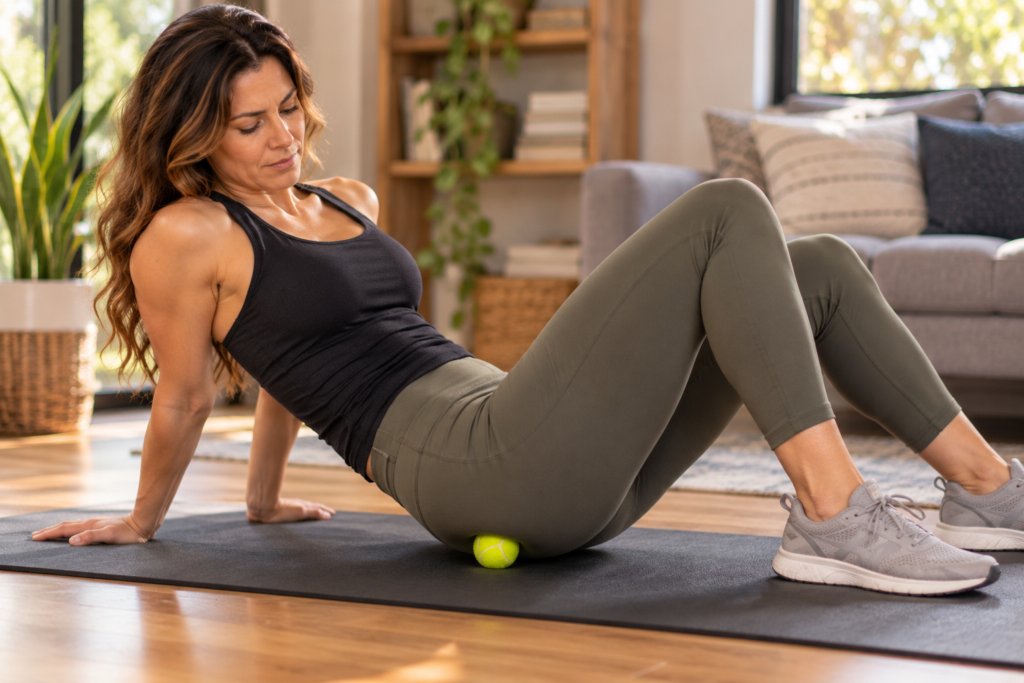
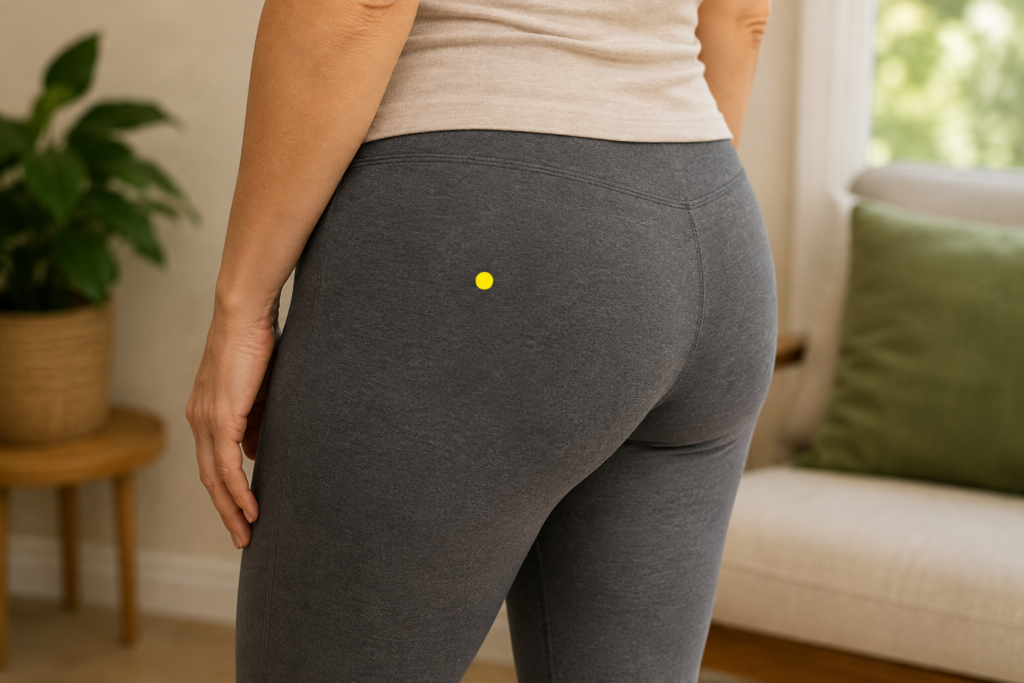
1. Press on GB30 in the buttock, the key point for piriformis syndrome. GB30 sits on the side of the buttock, about a third of the way along an imaginary line from the bony bump at the top of the outer thigh to the base of the tailbone. Lie on your back with a tennis ball under the point, or lean against a wall with the ball in place, and let your body weight press into it for one to two minutes, rolling slowly until you find the most tender spot. GB30 is called “Huantiao,” the “Jumping Circle.”
GB30 is located almost directly above the piriformis muscle, with the sciatic nerve beneath it, making it a key point for treating this condition. It’s traditionally used for buttock pain that radiates down the leg. In practice, it is one of the main points for relieving tension in the piriformis muscle. Instead of quick pressure, apply sustained pressure to allow the deep muscle to relax. The area may be tender, and pressure should be eased if a sharp pain shoots down the leg.
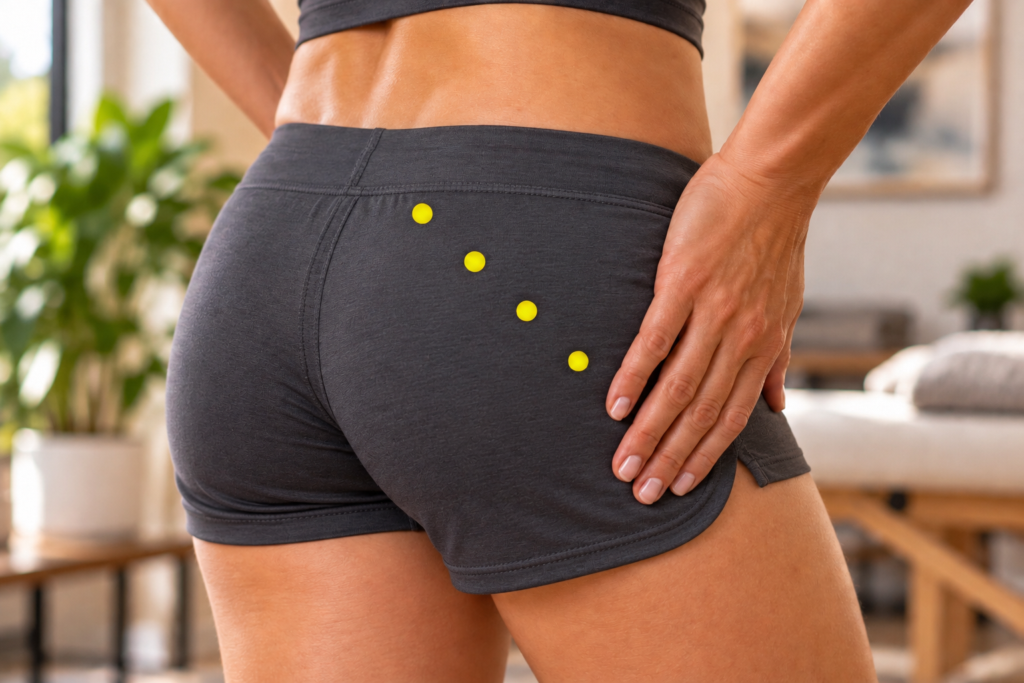
2. Press on the Ashi points deep in the buttock to release the tight muscle. The Ashi points are the tender knots you can find in the middle of the buttock, along the line of the piriformis from the side of the sacrum out toward the top of the thigh bone. Lying on a tennis ball, roll slowly across the buttock and pause on each tender spot for thirty seconds to a minute, breathing slowly. “Ashi” means “that’s it,” the sound people make when the sore point is found.
The piriformis muscle often has tight, knotted trigger points that are the main source of pain. Treating these points directly is highly effective. Your tender areas clearly show where the muscle is tense. With steady pressure, slow breathing, and patience, the knots will loosen. If pressing on a spot causes pain to radiate down the leg, move slightly away from that area.
3. Press on BL54 beside the sacrum to release the inner end of the muscle. BL54 sits on the buttock, about four finger-widths out from the midline of the sacrum, level with the lowest openings of the sacrum, roughly where the inner edge of the buttock muscle begins. Use a tennis ball or have someone press it for one to two minutes on the affected side. BL54 is called “Zhibian.”
The piriformis muscle connects to the front of the sacrum, with BL54 located near its inner part and GB30 at the outer end near the hip. Treating both points allows for addressing the muscle along its entire length. Traditionally, BL54 has been used to relieve pain in the buttock, lower back, and along the back of the leg along the Bladder channel.
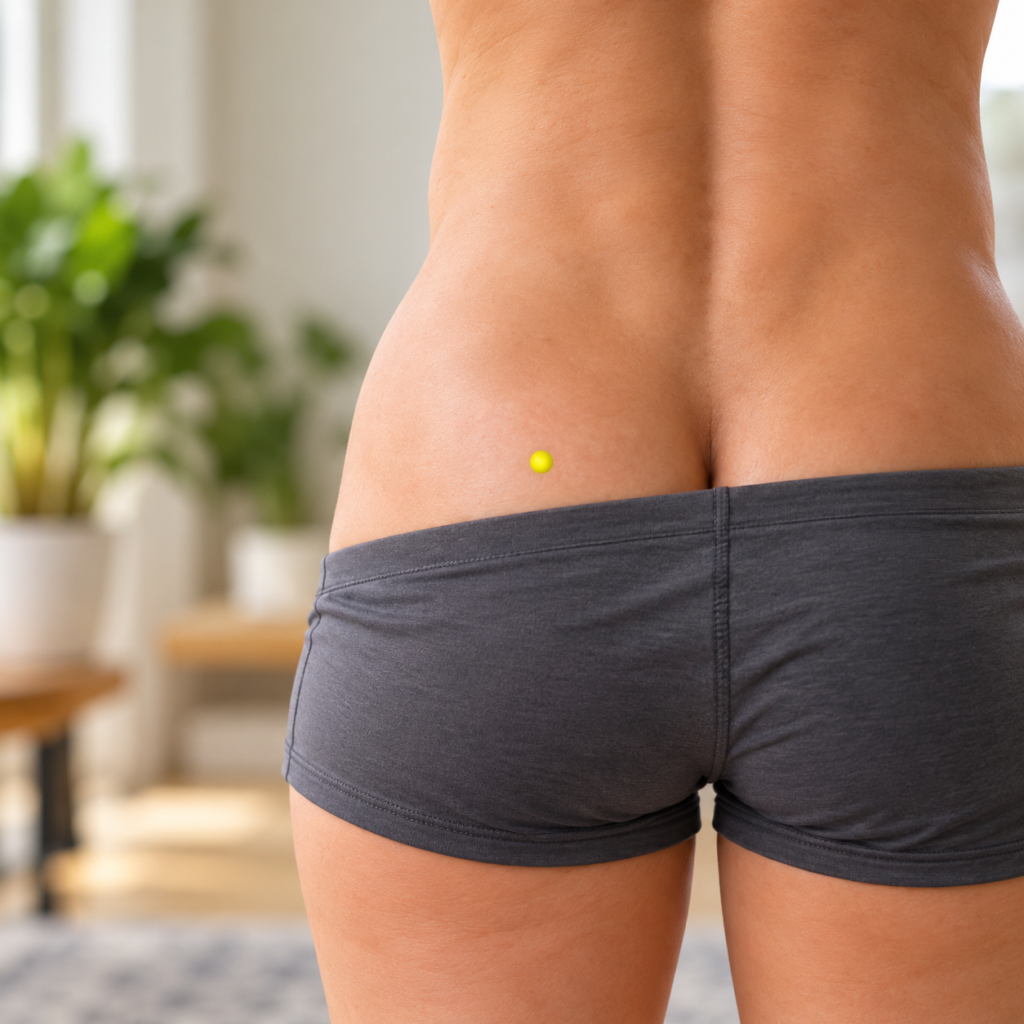
4. Press on GB29 at the side of the hip to open the hip joint. GB29 sits on the side of the hip, in the hollow midway between the front point of the hip bone and the bony bump at the top of the outer thigh. Press firmly with your thumb or fingers for one to two minutes on the affected side. GB29 is called “Juliao.”
GB29 eases hip tension and decreases stiffness often linked to piriformis syndrome, as the piriformis muscle helps rotate the hip. It works together with GB30 to reduce tension across the hip and facilitates smoother leg movement during activities like turning, climbing stairs, or entering and exiting a vehicle.
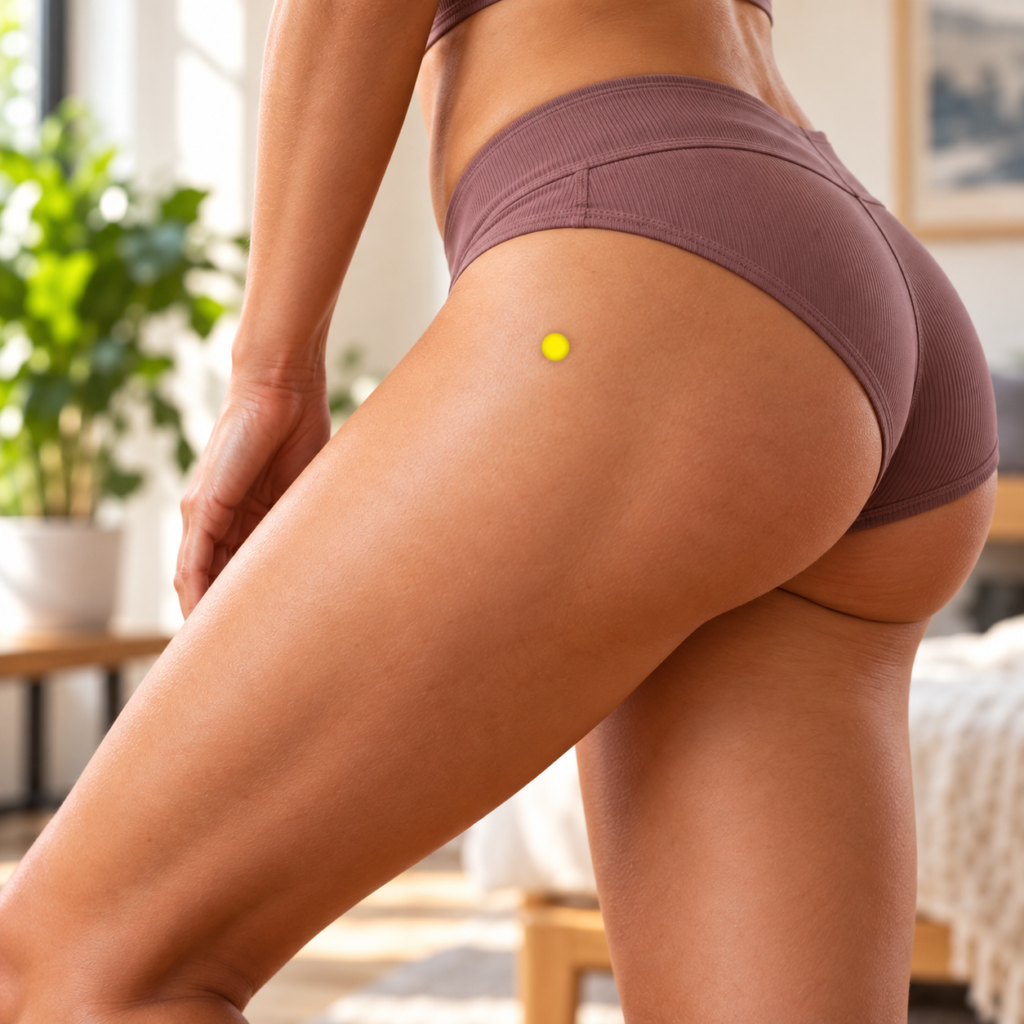
5. Press on BL36 at the buttock crease to follow the pain down the leg. BL36 sits at the center of the crease where the buttock meets the back of the thigh. Press firmly with your fingers or a tennis ball for one to two minutes on the affected side. BL36 is called “Chengfu,” the “Receiving Support.”
BL36 is the next acupressure point along the pain pathway that begins in the buttock and travels down the back of the thigh. It is effective in reducing pain and tension where the buttock and leg meet, and has been traditionally used to treat sciatic pain and discomfort in the rear thigh. Sitting on a firm ball at this location for a minute can be surprisingly calming.
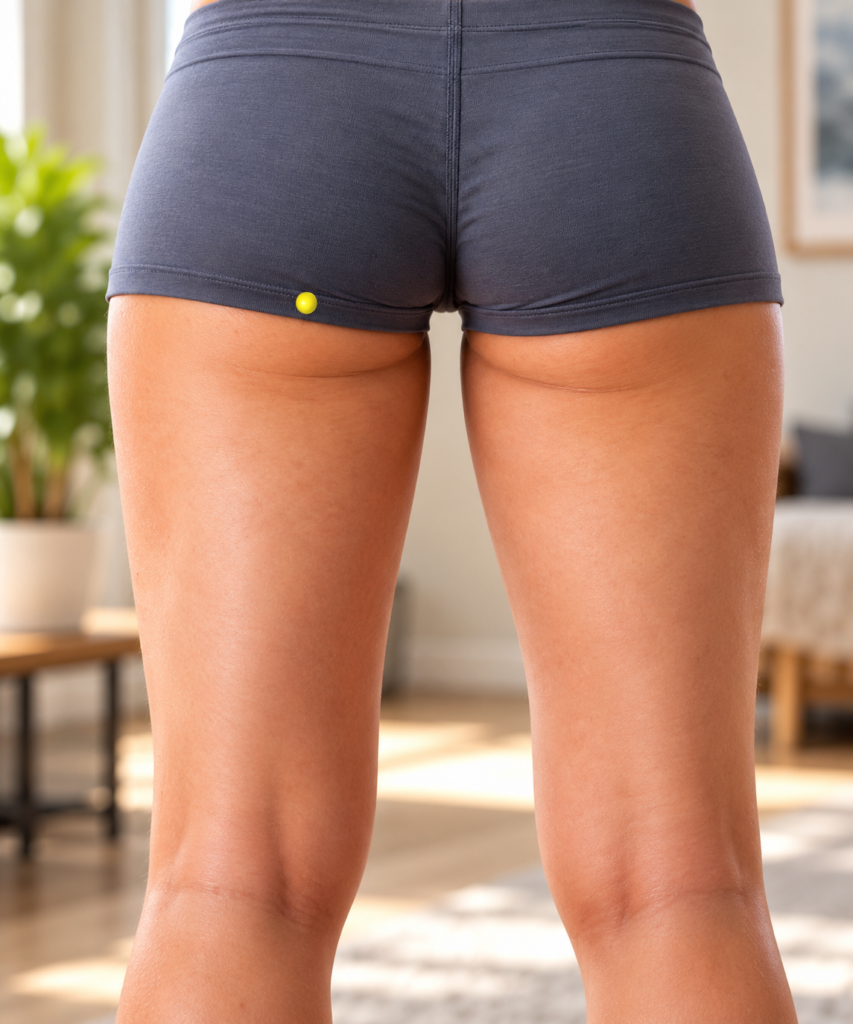
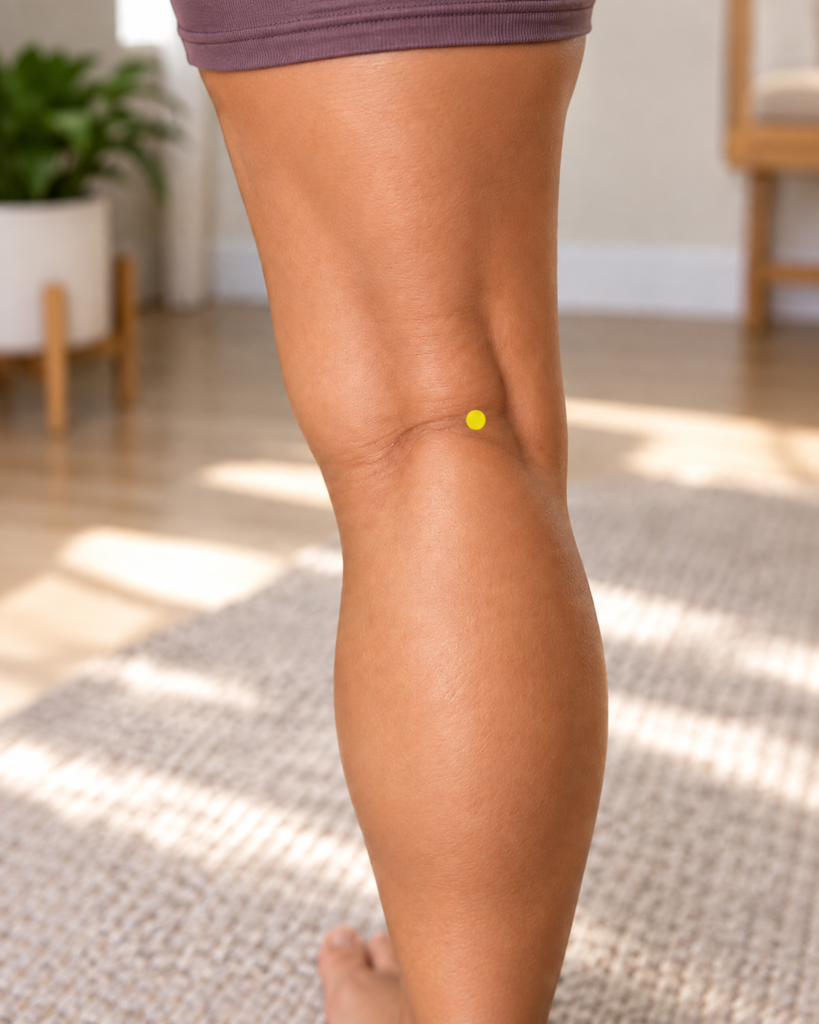
6. Press on BL40 behind the knee to relax the back of the leg. BL40 sits in the center of the crease behind the knee. Press firmly with your fingers for one to two minutes on the affected leg. BL40 is called “Weizhong,” the command point for the back and legs.
BL40 is a key acupoint for relieving back and leg pain because it relaxes the entire Bladder channel that transmits piriformis pain down the thigh. It helps reduce tension in the hamstrings and calves, which often occurs due to buttock pain, and makes the leg feel less heavy and tight.
7. Press on GB34 below the outer knee to relax the sinews. GB34 sits on the outer lower leg, in the hollow just below and in front of the head of the fibula, the bony knob below the outer side of the knee. Press firmly with your thumb for one to two minutes on each leg. GB34 is called “Yanglingquan,” and it is the influential point for the sinews and muscles.
A tight, spasm-like piriformis muscle indicates a sinew problem, and GB34 is an acupuncture point that relaxes sinews throughout the body. Located on the same Gallbladder channel as GB30 and GB29, it aids in releasing tension from the outer hip and leg, even from a distance. This point is highly effective for alleviating muscle tightness and cramps anywhere in the leg.
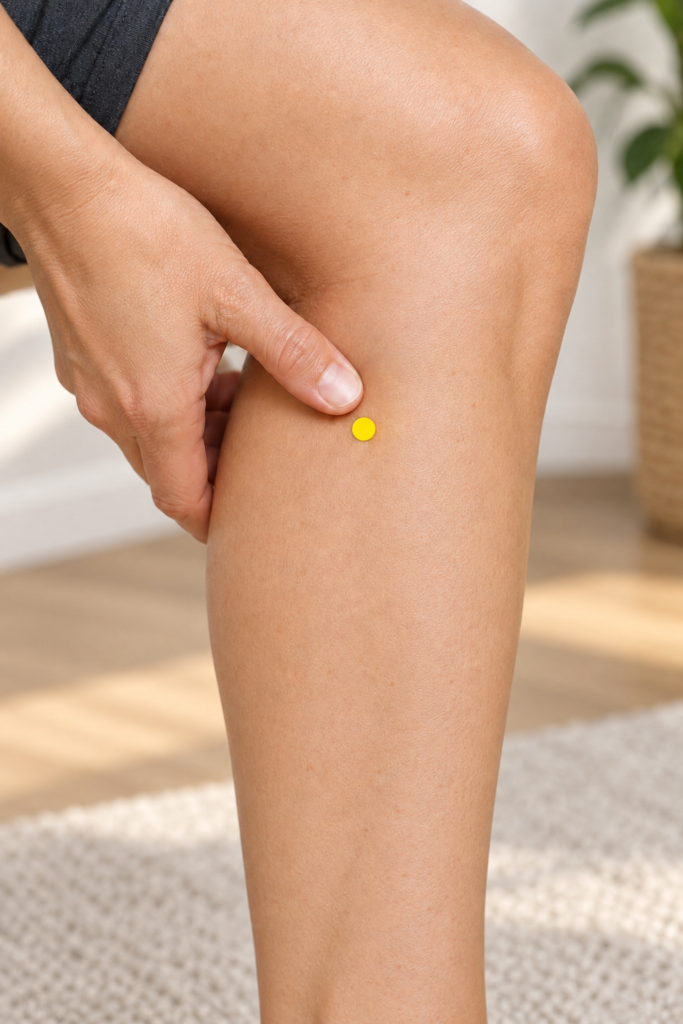
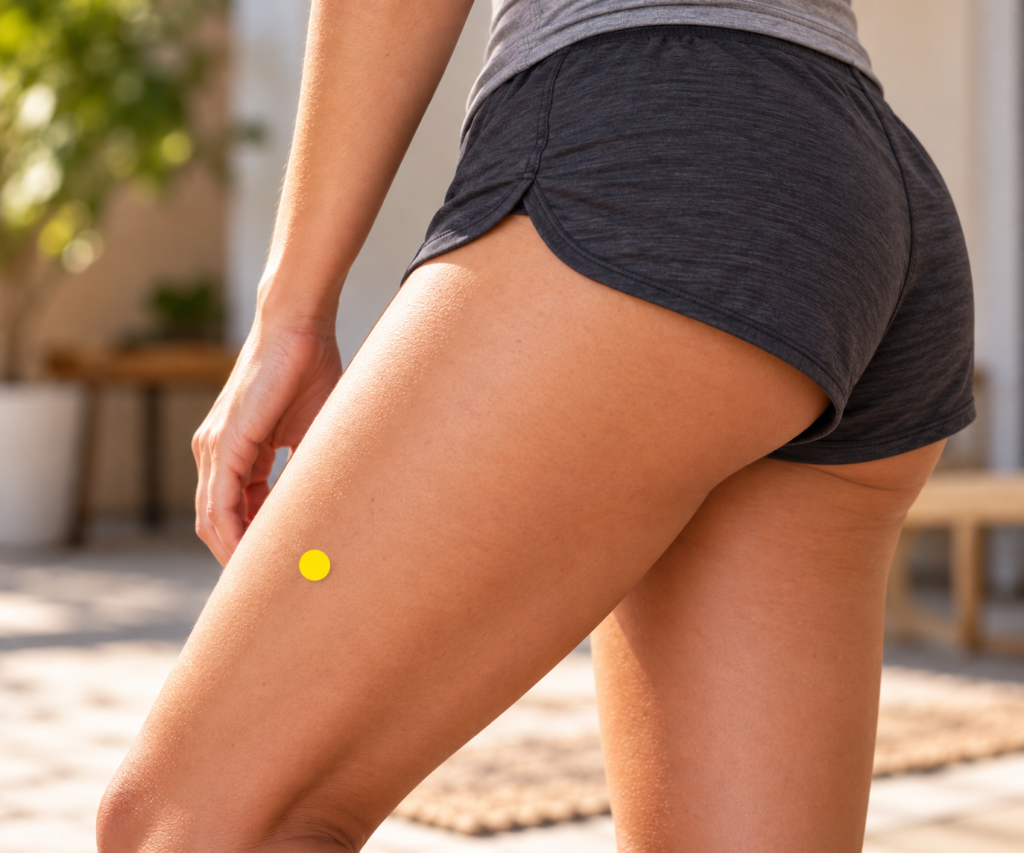
8. Press on GB31 on the outer thigh to ease pain along the side of the leg. GB31 sits on the outer thigh, where the tip of your middle finger lands when you stand with your arms hanging straight at your sides. Press firmly with your knuckles for one to two minutes on the affected leg. GB31 is called “Fengshi,” the “Wind Market.”
If you experience pain, tingling, or numbness extending down the thigh, use GB31 to target the Gallbladder channel. It helps relieve pain, numbness, and weakness in the outer leg and helps remove the ‘wind’ that causes tingling. Since it connects the points above the hip with GB34 below, it helps keep the entire channel open.
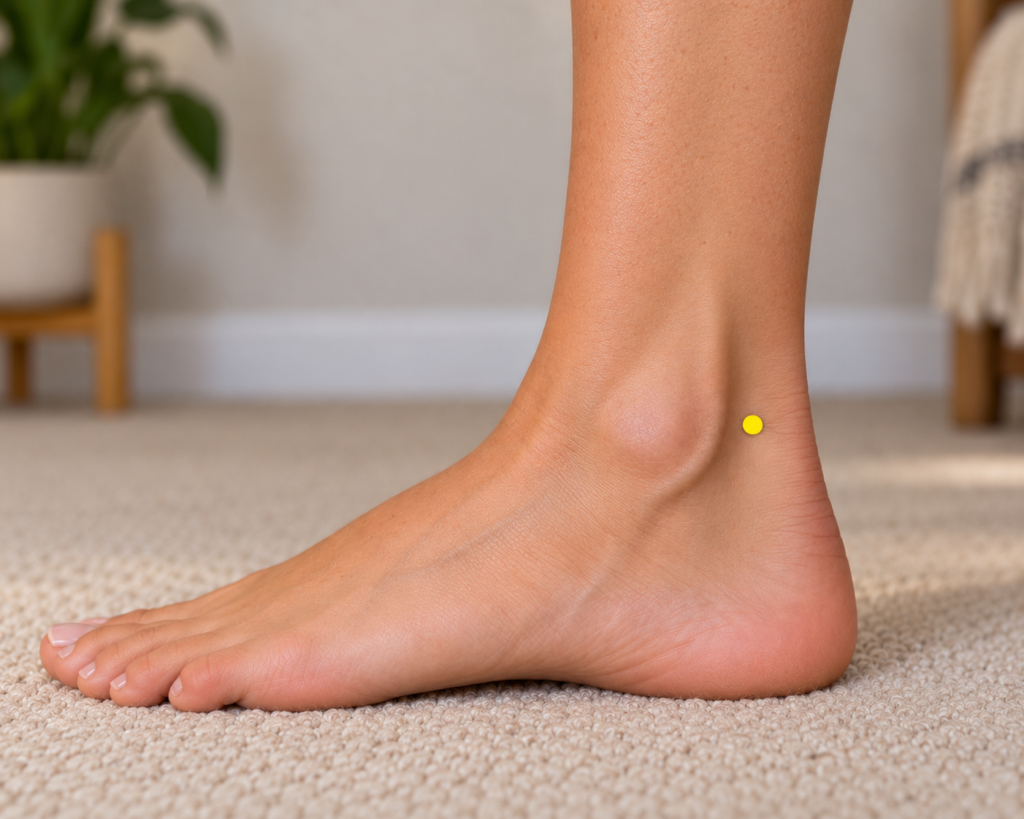
9. Press on BL60 behind the outer ankle to draw the pain down and out. BL60 sits in the hollow between the outer ankle bone and the Achilles tendon, level with the tip of the ankle bone. Press firmly with your thumb for one to two minutes on the affected leg. BL60 is called “Kunlun.”
BL60 is located at the very end of the Bladder channel. Pressing this point relieves pain along the entire pathway, including the buttock and the back of the leg. It is commonly referred to as an ‘aspirin point’ because of its frequent use for back pain relief. The treatment ends with relaxing internal and downward tension in the leg.
Why These Acupressure Points Work
In Traditional Chinese Medicine, piriformis syndrome is characterized by buttock pain caused by Qi and Blood stagnation along the Gallbladder and Bladder channels, which extend down the sides and back of the leg. It also includes tight tendons that compress the nerve, and the nine points target all these aspects.
- The buttock points (GB30, the Ashi points, BL54) release the piriformis muscle directly along its length.
- The hip point (GB29) opens the hip joint and eases restricted rotation.
- The leg points (BL36, BL40, GB31) follow the path of the pain down the back and side of the thigh.
- The distal points (GB34, BL60) relax the sinews and relieve pain along each channel from a distance.
Research on acupressure for piriformis syndrome is still emerging, but clinical trials have demonstrated that acupuncture can help alleviate sciatic pain. A key aspect of treatment is releasing the muscle that compresses the nerve.
How to Properly Use These Acupressure Points
- Sustained pressure and warmth are the keys to releasing a deep muscle.
- Warm the buttock first with a heat pack or a warm shower, which relaxes the tissue and brings circulation to the area.
- Lie on your back with a tennis ball under your buttock and work GB30, the Ashi points, and BL54, pausing on each tender spot and breathing slowly. A firmer ball can reach deeper once the area is less sensitive.
- Then work GB29 at the side of the hip, BL36 at the buttock crease, and continue down the leg with GB31, BL40, GB34, and BL60.
- Press firmly but within comfort. Tenderness is expected, but if pressing sends sharp, shooting pain down the leg, shift slightly off the spot.
- Hold each point for one to two minutes, and work the routine once or twice a day.
- Match the points with habits that reduce pressure on the muscle.
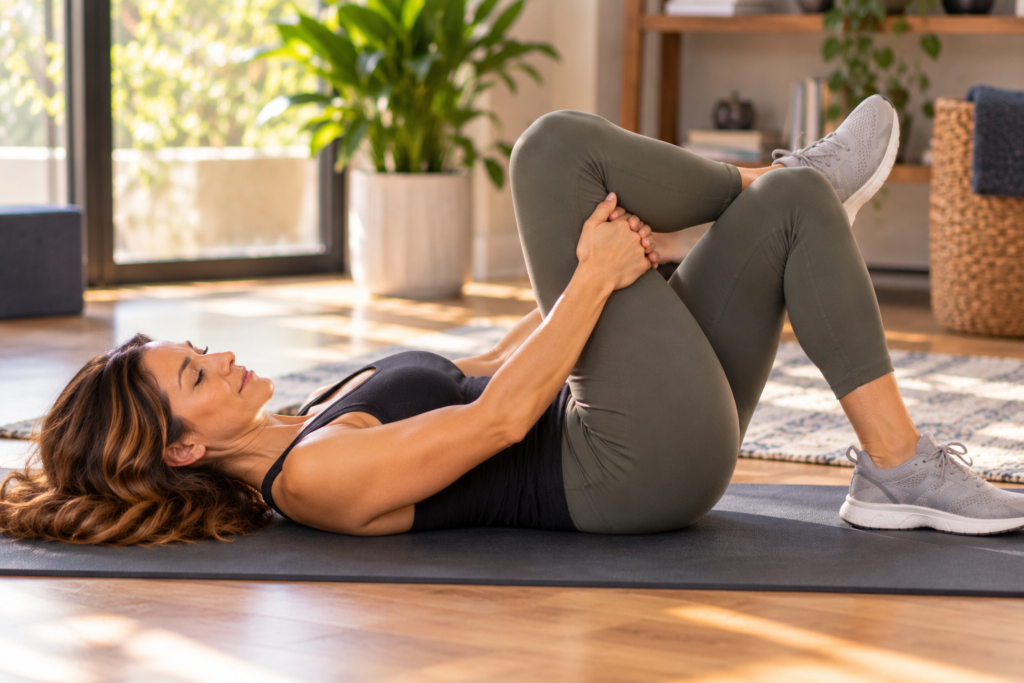
Gently stretch the piriformis daily by lying on your back, crossing the affected ankle over the opposite knee in a figure-four, then slowly pulling your thigh toward your chest until you feel a deep stretch in the buttock. Avoid sitting for extended periods; stand and move every thirty minutes. Never sit with a wallet in your back pocket; instead, sit on a cushioned surface rather than a hard one. Gradually resume running, cycling, and stair climbing, and strengthen your hip and buttock muscles over time, ideally with a physical therapist, to prevent recurrence.
When to Get Professional Help
Consult a doctor or physical therapist to confirm whether your buttock pain is related to your spine, hip issues, or other conditions, as these can cause similar symptoms but require different treatments. Emergency care should be sought immediately if you experience numbness in the groin, inner thighs, or buttocks, or if you lose bladder or bowel control, or notice sudden weakness in both legs; these could indicate severe nerve compression at the base of the spine. Also see a doctor quickly if leg or foot weakness worsens, if your foot drags or slaps when walking, following a fall or injury, or if you have pain with fever, unexplained weight loss, or severe pain that doesn’t improve with rest or position changes.
Acupressure offers a safe and effective way to relax a tight piriformis muscle and can complement other treatments suggested by your healthcare provider.
Above and Beyond Acupuncture offers acupuncture, cupping, and lifestyle coaching at the North Frank Lloyd Wright Boulevard location in Scottsdale.
Schedule an appointment online to start your healing journey.
The points above are only as effective as the technique used to apply them. Where to press, how firmly, and for how long all affect the result. For a full breakdown of how to perform acupressure properly at home, read Performing Acupressure in 3 Easy Steps.
For low back and hip pain, the companion article is acupressure for low back and hip pain; understanding nerve impingement explains how pinched nerves are diagnosed and treated in Western and Eastern Medicine.
About the Publisher
Paul Kerzner, L.Ac., is a licensed acupuncturist and board-certified herbalist, as well as the founder of Above and Beyond Acupuncture in Scottsdale. His own journey from chronic patient to practicing acupuncturist shapes his commitment to providing honest, clinically grounded information about acupuncture and Traditional Chinese Medicine. Learn more about Paul and his clinical approach on the About Us page.