Key Takeaways
- Acupressure for spinal stenosis can relieve leg and back pain, as heavy or numb legs often result from nerve irritation due to narrowed spinal spaces.
- The article discusses nine specific acupressure points to strengthen the lower back and improve circulation along the nerve pathways.
- Practicing acupressure daily enhances its effectiveness, but also combine it with physical activity and proper posture for better results.
- Seek professional medical help if pain persists or worsens, especially if accompanied by symptoms like numbness or weakness.
- Acupressure serves as a supportive, complementary treatment alongside medical care, rather than a replacement.
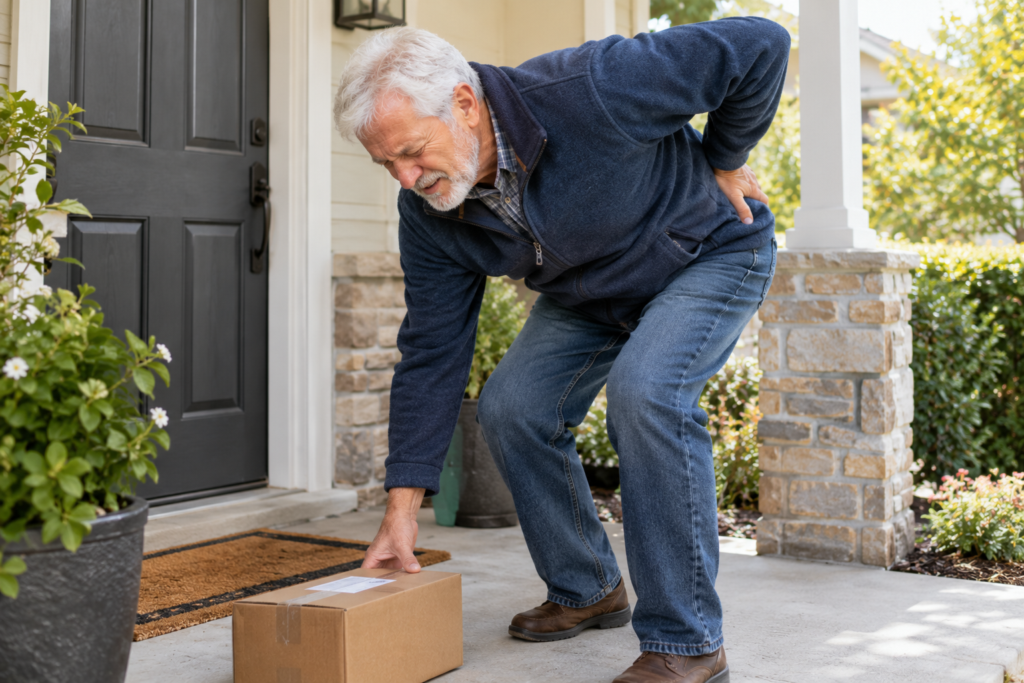
Do your legs feel heavy, numb, or achy after standing in line or walking through a store for just a few minutes? Does the discomfort ease as soon as you sit down or lean forward on a shopping cart? This pattern is characteristic of lumbar spinal stenosis, one of the most common causes of back and leg pain in adults over fifty.
Spinal stenosis results from the spinal spaces becoming narrower. As time goes on the discs lose some of their height and protrude, the ligaments within the spinal canal get thicker, and arthritis causes bone spurs to develop at the spinal joints. Each of these changes takes up a bit more space until the nerves which run from the lower back to the legs are crowded and irritated.
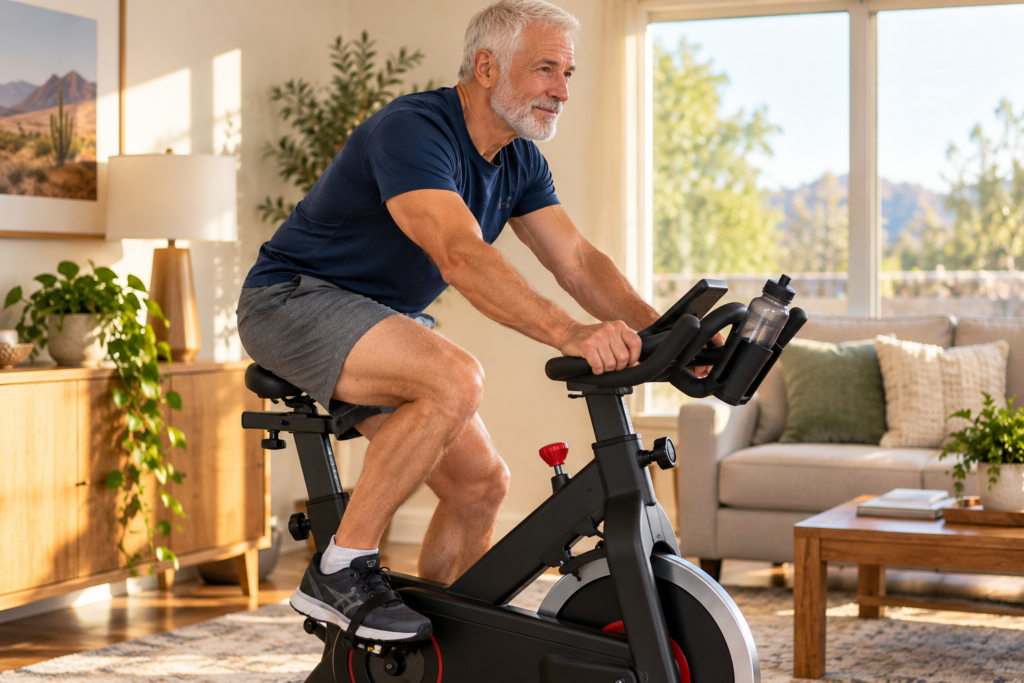
Posture plays a major role in how stenosis feels. Standing upright or walking further narrows the canal, causing the legs to tire, cramp, or tingle after a short distance. Bending forward opens the canal and gives the nerves more room, which is why sitting, leaning on a cart, or riding a stationary bike can bring relief. This simple clue often distinguishes stenosis from other causes of leg pain.
In Traditional Chinese Medicine, the Kidneys, which govern the bones and spine, are located in the lower back. As the Kidneys weaken with age and prolonged strain, the lower back provides less support, and the flow of Qi and Blood through the channels of the back and legs becomes obstructed. This causes the deep ache, stiffness, heaviness, and numbness characteristic of spinal stenosis.
The good news is that many people with spinal stenosis feel better with conservative treatment. Practicing acupressure makes it easier to incorporate this approach into your routine at home.
The nine points below help strengthen the lower back, relieve tension in the hips and legs, and maintain circulation along the nerve pathway.
What Acupressure Points to Press and Why
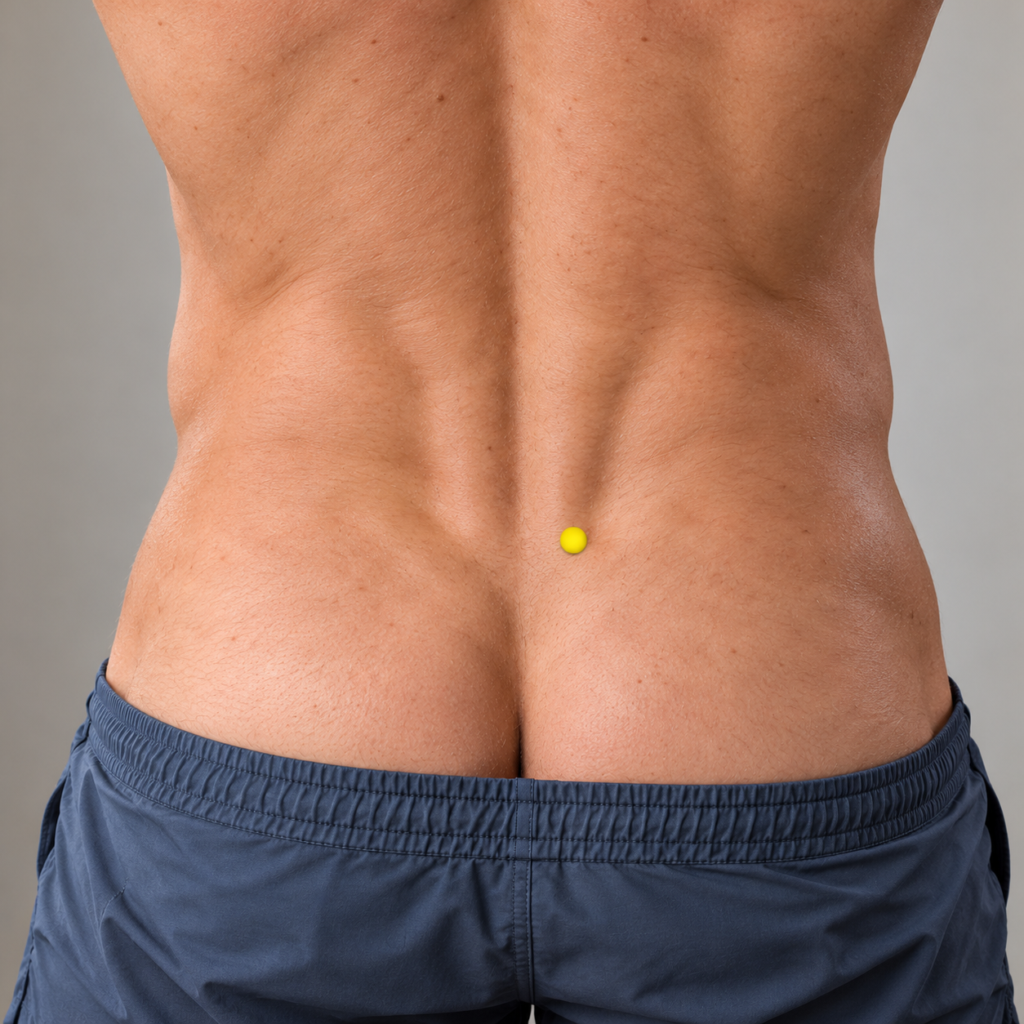
1. Press on BL23 on the lower back to strengthen the Kidney and the spine. BL23 sits on the lower back, two finger-widths on either side of the spine, at the waist, roughly level with the bottom of the rib cage. Make loose fists and press the knuckles into both points at once, or rub the area briskly with your palms until warm, for one to two minutes. BL23 is called “Shenshu,” the “Kidney Shu.”
BL23 is the back transport point where Kidney energy gathers. It is one of the most important points for chronic lower-back weakness and the deep, tired ache that builds throughout the day. Rubbing it until it feels warm each morning is a traditional practice to support the Kidney and ease early stiffness.
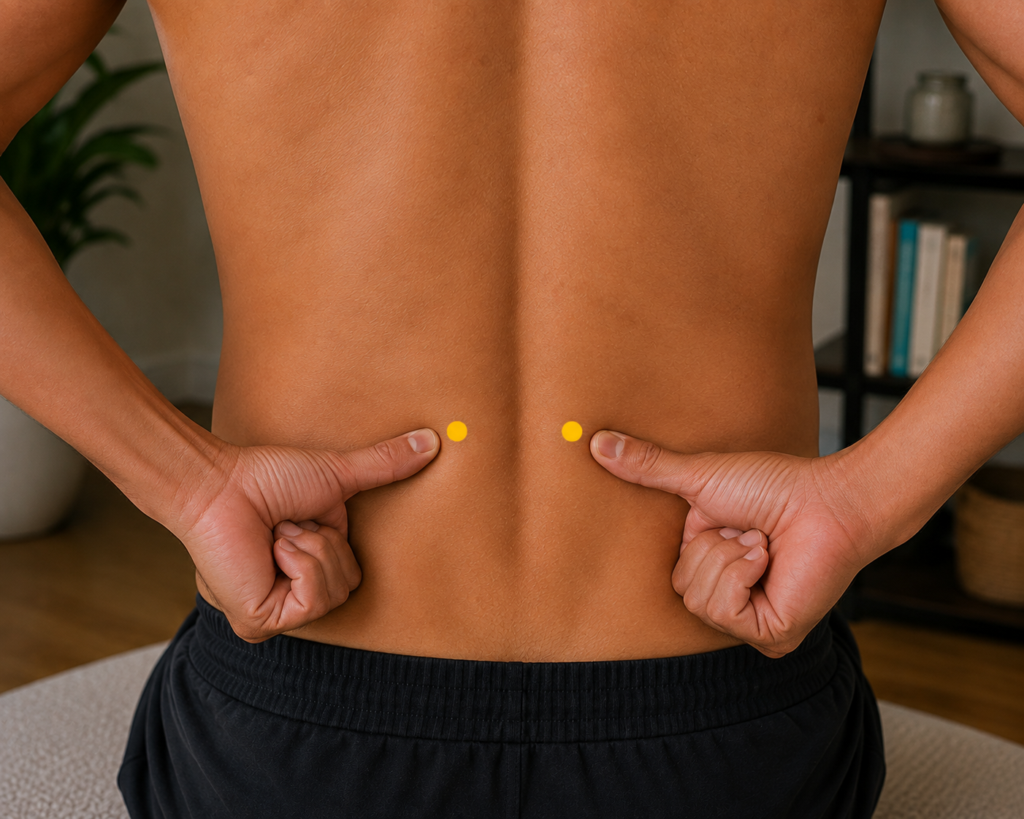
2. Press on BL25 on the lower back to ease pain and stiffness. BL25 sits on the lower back, two finger-widths to each side of the spine, level with the top of the hip bones. Press both points at once with your knuckles or thumbs for one to two minutes, or lie on two tennis balls placed in a sock, one on each side of the spine. BL25 is called “Dachangshu,” the “Large Intestine Shu.”
BL25 sits at the lowest part of the lumbar spine, where stenosis most often develops. It relaxes the thick muscles beside the spine and eases pain that spreads from the lower back into the buttocks. It is especially useful when the back feels stiff and heavy in the morning or during cold, damp weather.
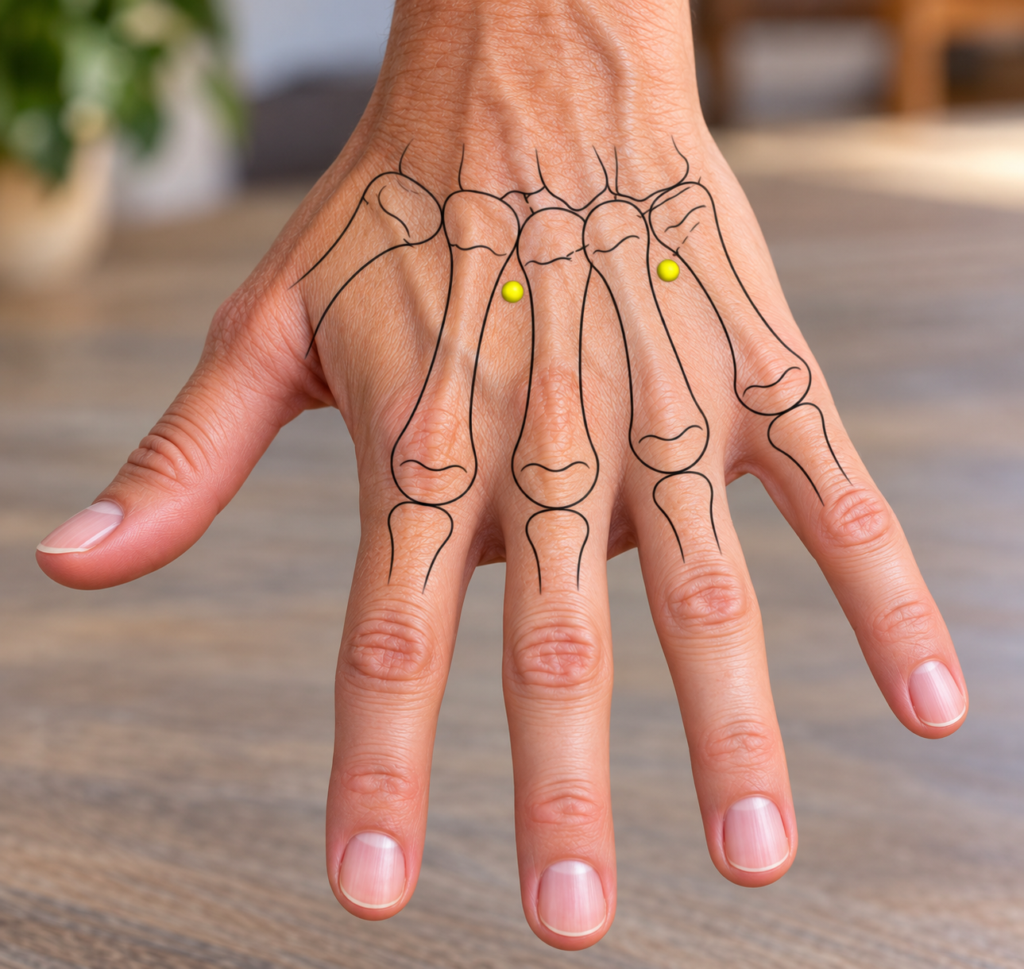
3. Press on Yaotongxue on the back of the hand to ease back pain. Yaotongxue is a pair of extra points on the back of each hand: one between the second and third hand bones and one between the fourth and fifth hand bones, each about halfway between the wrist crease and the knuckles. Press each point firmly with the thumb of the other hand for about a minute while gently moving the lower back. Yaotongxue means “Low Back Pain Points.”
Although located on the hand, these additional points are used specifically to address lower back pain. As they can be pressed while sitting, standing in line, or walking, they offer a convenient option whenever back tension arises during the day.
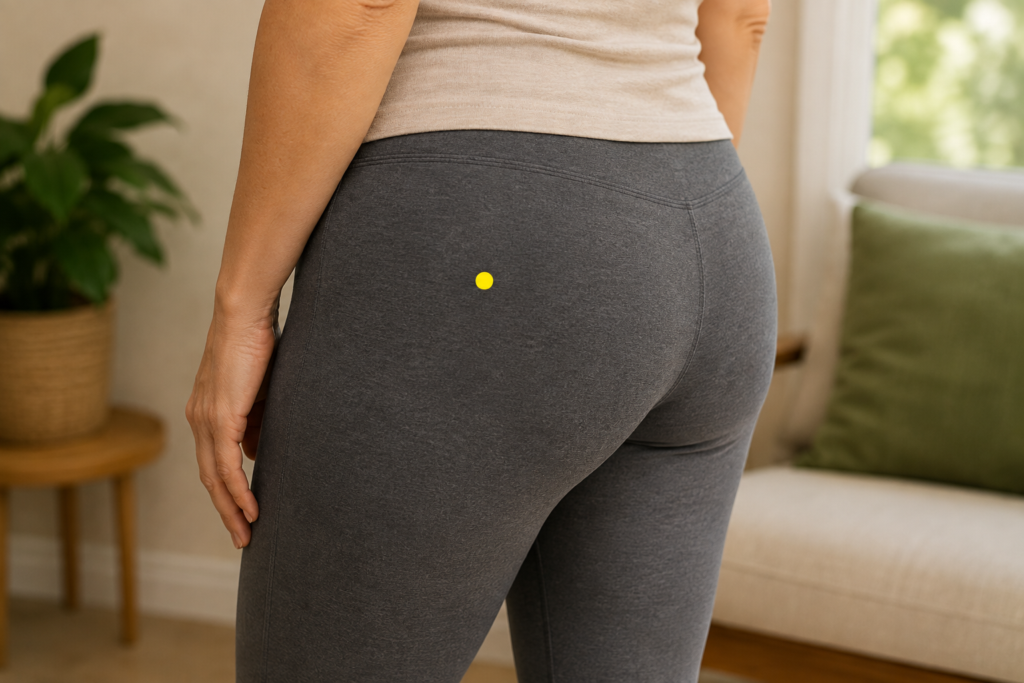
4. Press on GB30 in the buttock to release the hip and leg. GB30 sits in the buttock, about one-third of the way along a line from the bony bump at the top of the outer thigh to the base of the spine. Lie on your side and press firmly with your knuckle, or lean against a wall with a tennis ball under the point, for one to two minutes on each side. GB30 is called “Huantiao,” the “Jumping Circle.”
GB30 lies deep in the buttock muscles, close to where the sciatic nerve exits the pelvis. Tight hip and buttock muscles can put added pressure on already irritated nerves. Releasing these muscles at GB30 may ease pain, heaviness, and numbness that radiate down the leg.
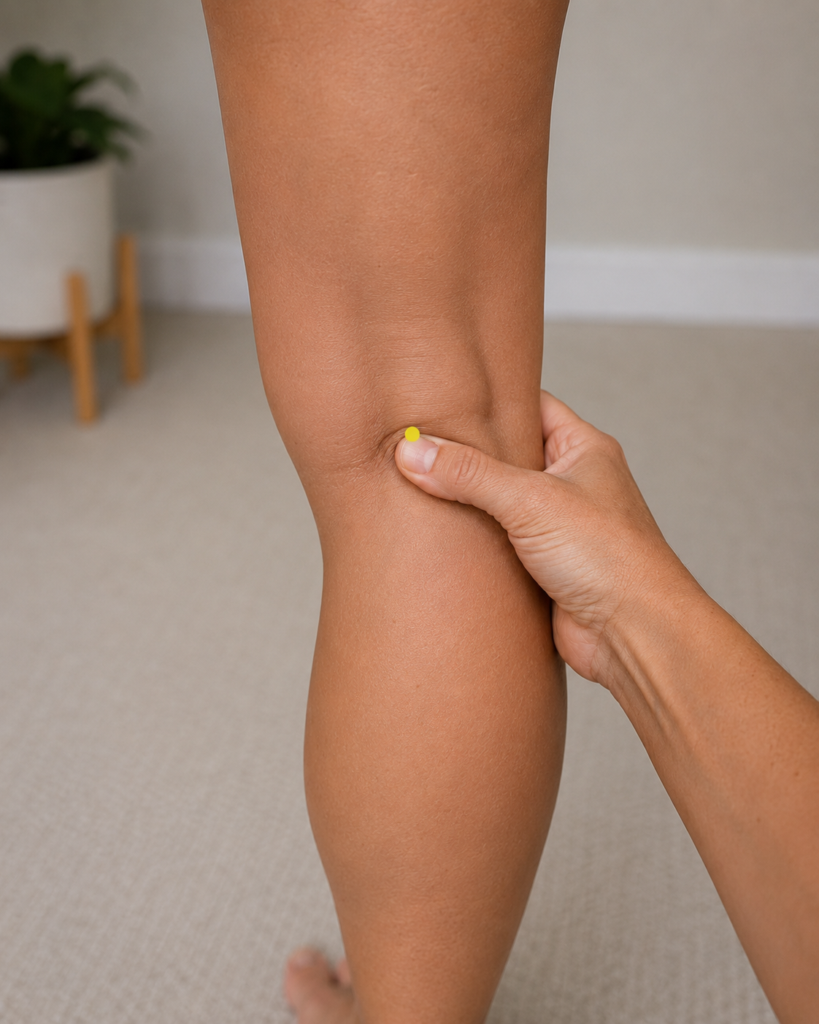
5. Press on BL40 behind the knee to relieve the lower back. BL40 sits at the midpoint of the crease behind the knee, between the two tendons. Press gently with your thumb or fingertips for one to two minutes on each leg. BL40 is called “Weizhong,” the “Middle of the Crook.”
In Traditional Chinese Medicine, BL40 is considered the command point of the back and a traditional point for lower back pain of any kind. It relaxes the muscles along the back of the leg and helps release blocked Qi and Blood along the Bladder channel. Apply only gentle pressure, and avoid this point if you have varicose veins or swelling behind the knee.
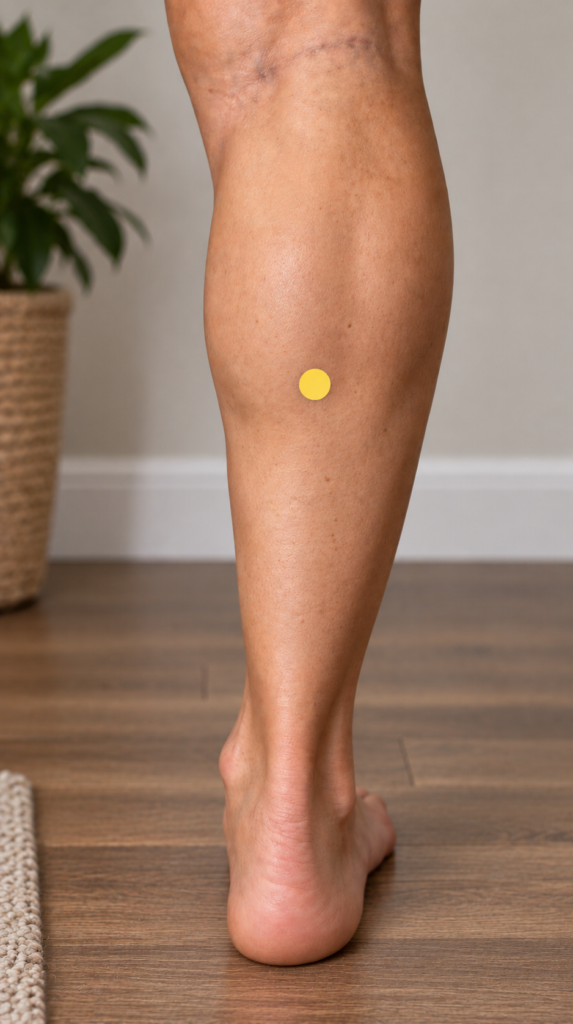
6. Press on BL57 on the back of the calf to ease cramping and heaviness. BL57 sits on the back of the lower leg, about midway between the crease behind the knee and the heel, in the hollow that forms just below the calf muscle when you rise up on your toes. Press firmly with your thumb for one to two minutes on each leg. BL57 is called “Chengshan,” the “Supporting Mountain.”
The calves are often the first place stenosis becomes noticeable, causing cramping, heaviness, or aching that worsens with walking. BL57 relaxes the calf muscles and supports circulation in the lower leg. It can be especially helpful after a walk or at night, when the legs feel heavy and restless.
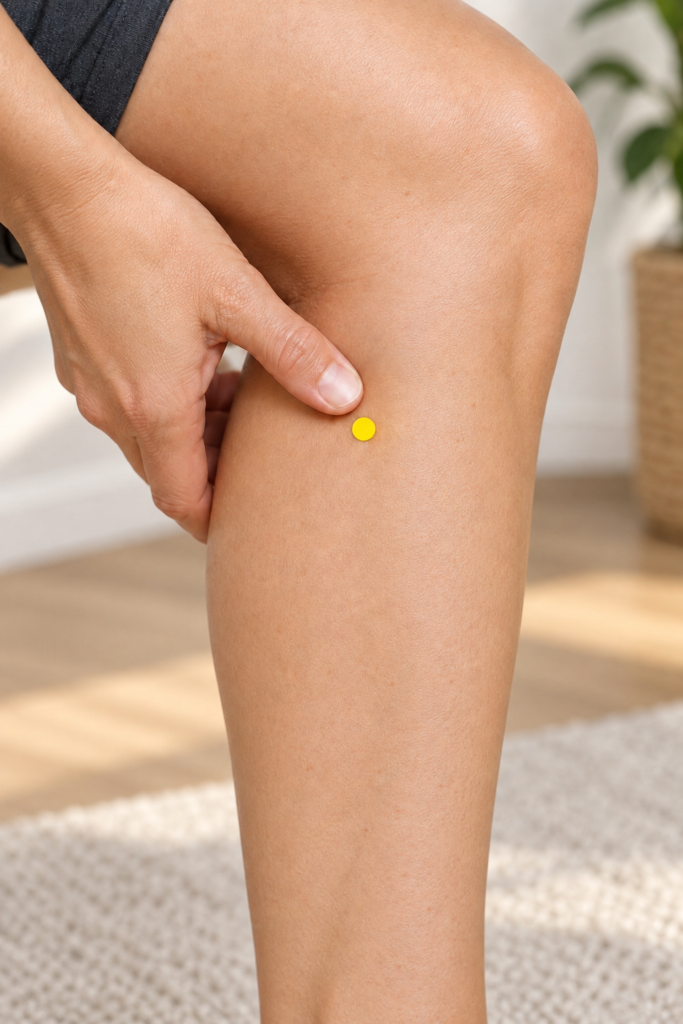
7. Press on GB34 below the outer knee to support the sinews and legs. GB34 sits on the outside of the lower leg, in the hollow just in front of and below the small bony knob below the outer knee. Press firmly with your thumb for one to two minutes on each leg. GB34 is called “Yanglingquan,” the “Yang Mound Spring.”
GB34 is the influential point for the sinews, benefiting the body’s muscles, tendons, and ligaments. It eases leg cramps and stiffness and helps improve stability when the legs feel weak or unsteady.
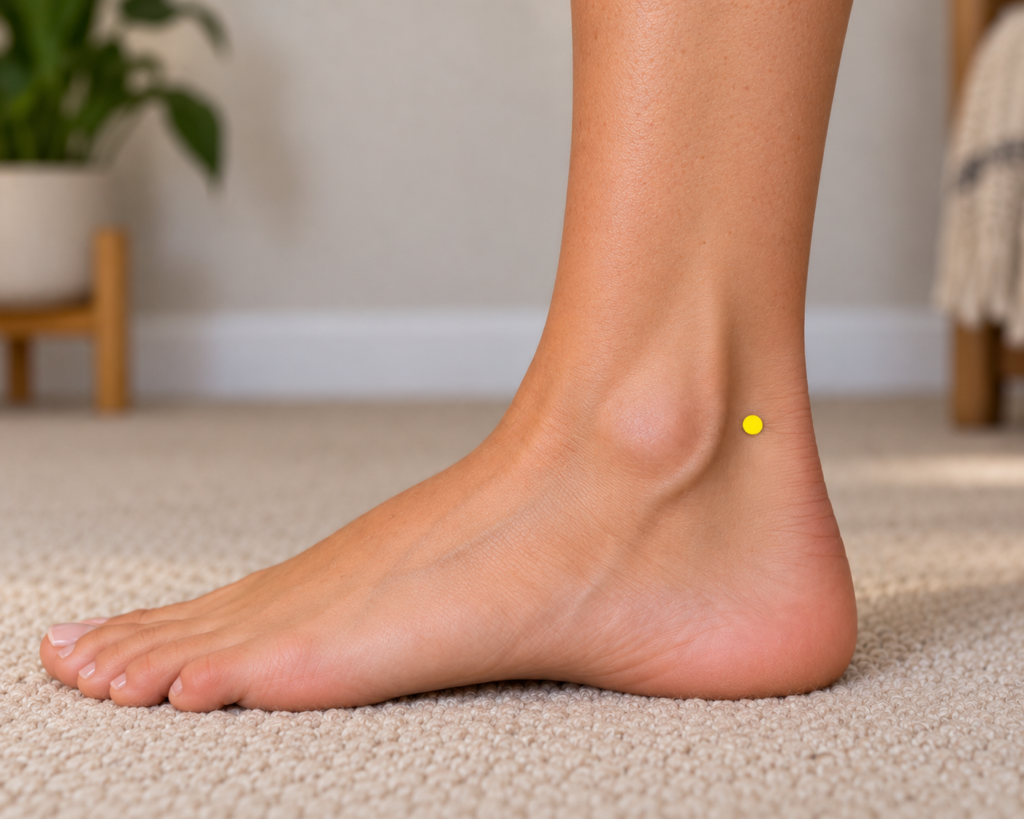
8. Press on BL60 behind the outer ankle to release the back and legs. BL60 sits in the hollow between the outer ankle bone and the Achilles tendon, level with the tip of the ankle bone. Press firmly with your thumb for one to two minutes on each ankle. BL60 is called “Kunlun,” the “Kunlun Mountains.” BL60 is avoided during pregnancy.
BL60 is a classic distal point for lower back pain. It runs along the entire Bladder channel, from the ankle to the spine, easing back stiffness, pain radiating down the back of the leg, and heaviness in the feet.
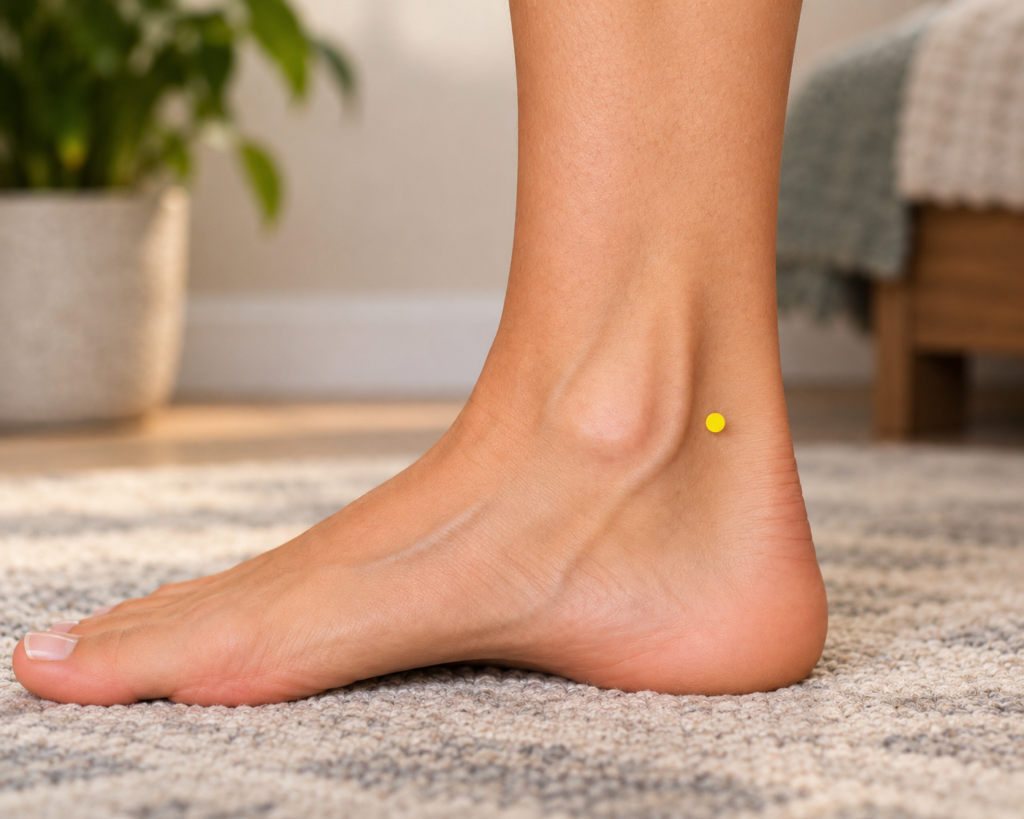
9. Press on KI3 behind the inner ankle to nourish the Kidney. KI3 sits in the hollow between the inner ankle bone and the Achilles tendon, level with the tip of the ankle bone. Press firmly with your thumb for one to two minutes on each ankle. KI3 is called “Taixi,” the “Great Stream,” and is the source point of the Kidney.
KI3 strengthens the Kidney and supports the bones, spine, and lower back from within. It’s a point to work on daily, especially when stenosis develops gradually with age. Pressing KI3 and BL60 together on the same ankle works both the Kidney and Bladder channels at once.
Why These Acupressure Points Work
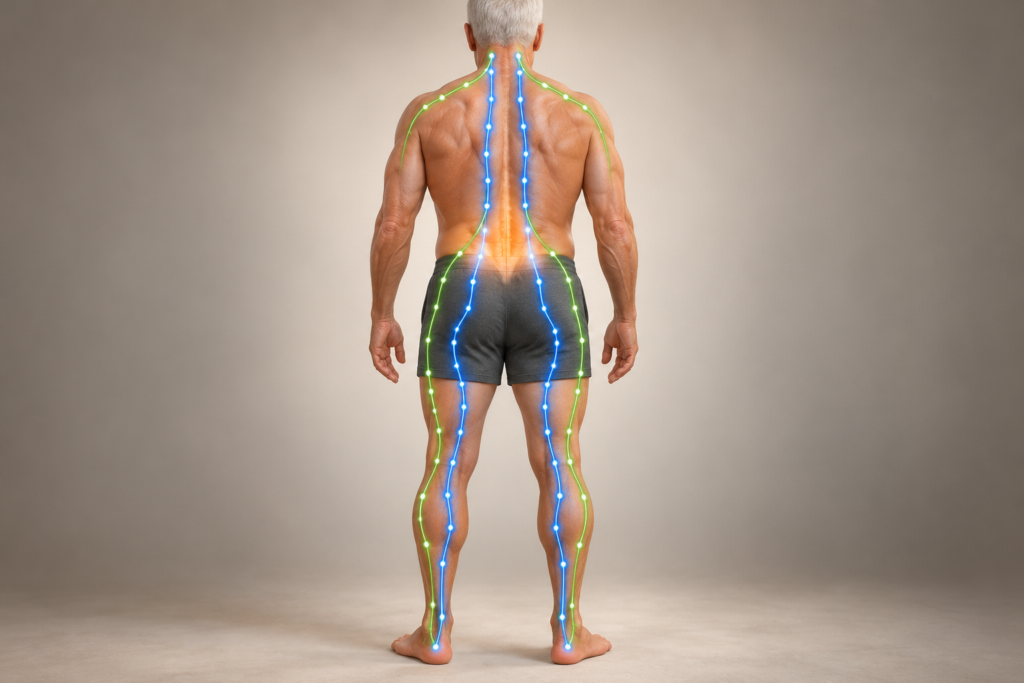
In Traditional Chinese Medicine, a healthy lower back relies on a strong Kidney, smooth Qi and Blood flow through the channels of the back and legs, and supple, well-nourished sinews. The Bladder channel runs along both sides of the spine and down the backs of the legs, while the Gallbladder channel follows the outer hips and legs. Together, these channels closely trace the paths of the nerves that emerge from the lower back.
The nine points address both the weakness and the blockage:
- The lower back points (BL23, BL25) strengthen the Kidney and relax the muscles of the lumbar spine.
- The hand points (Yaotongxue) ease lower back pain from a distance and can be used anywhere.
- The hip and leg points (GB30, BL40, BL57, GB34) release the muscles and channels that follow the nerves into the legs.
- The ankle points (BL60, KI3) work the Bladder and Kidney channels together to support the spine from below.
How to Properly Use These Acupressure Points
Acupressure for spinal stenosis is most effective when practiced consistently on a daily basis.
- Complete the entire routine once daily, holding each point for one to two minutes while breathing slowly.
- Apply firm pressure to the back, buttocks, calves, and ankles, but use gentle pressure on BL40, behind the knee.
- If your legs start to feel heavy while walking, sit down or lean forward. Then press GB34 and BL57 before continuing.
- Keep practicing consistently for several weeks, as long-standing back and leg pain takes time to improve.
Moving your body is just as important as using acupressure points. Try walking regularly, splitting your walks into shorter segments with rests in between, and gradually increasing the distance. Choose activities that keep your spine slightly bent forward, such as riding a stationary bike, walking uphill, or swimming. Strengthen your core and hip muscles, and if possible, consult a physical therapist. Avoid stretches that bend your lower back backward, as they can narrow the spinal canal. Learn more about how stretching can make back pain worse. Also, keep your lower back warm, especially in cold weather.
When to Get Professional Help
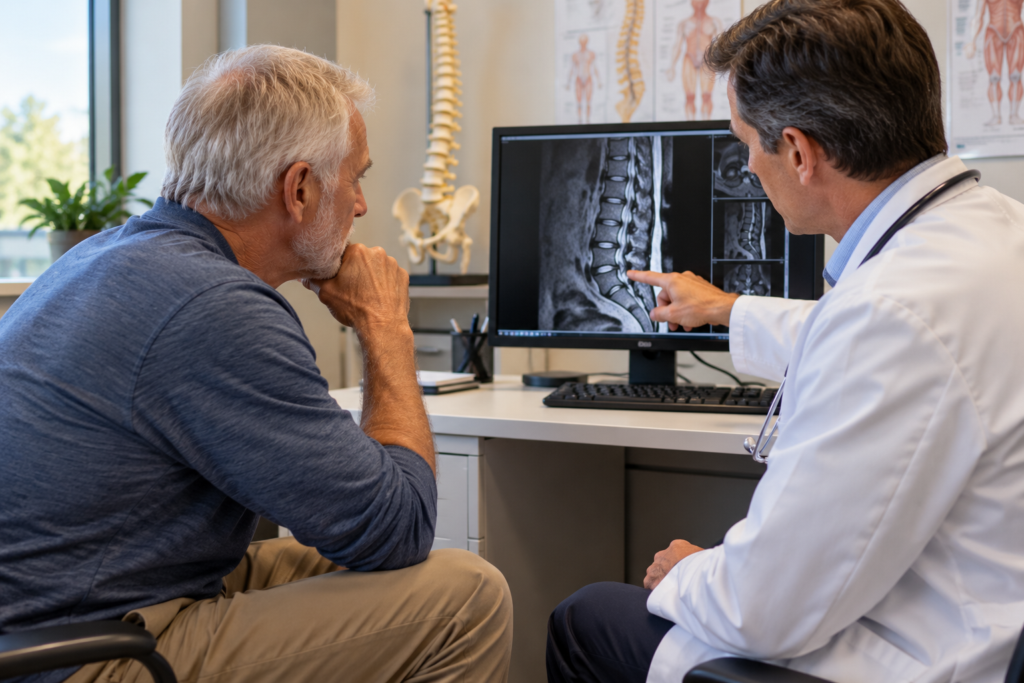
See your doctor if your back or leg pain lasts more than a few weeks, worsens, or makes it difficult to walk far. An evaluation can help identify the cause and guide treatment. If your leg pain eases when you stand still, or you have cold feet or sores that heal slowly, this may indicate a circulation problem and requires medical attention. Contact your doctor right away if numbness or weakness in your legs worsens, your foot slaps or catches as you walk, your balance worsens, or you have back pain along with a fever, unexplained weight loss, or a history of cancer. Go to the emergency room if you suddenly lose bladder or bowel control, feel numbness in your groin or inner thighs, or develop sudden weakness in both legs. These may be signs of cauda equina syndrome, which requires immediate treatment to prevent lasting damage.
Acupressure can be a gentle, supportive practice for spinal stenosis, but use it alongside medical care, not instead of it.
For related concerns, acupressure for sciatica, acupressure for low back and hip pain, and acupressure for hip bursitis are companion pieces. If numbness and tingling in the feet are part of the picture, acupressure for peripheral neuropathy can help.
Above and Beyond Acupuncture offers acupuncture, cupping, and lifestyle coaching at the North Frank Lloyd Wright Boulevard location in Scottsdale.
Schedule an appointment online to start your healing journey.
The points above are only as effective as the technique used to apply them. Where to press, how firmly, and for how long all affect the result. For a full breakdown of how to perform acupressure properly at home, read Performing Acupressure in 3 Easy Steps.

About the Publisher
Paul Kerzner, L.Ac., is a licensed acupuncturist and board-certified herbalist, as well as the founder of Above and Beyond Acupuncture in Scottsdale. His own journey from chronic patient to practicing acupuncturist shapes his commitment to providing honest, clinically grounded information about acupuncture and Traditional Chinese Medicine. Learn more about Paul and his clinical approach on the About Us page.