
Key Takeaways
- Thoracic outlet syndrome leads to numbness, tingling, and pain caused by nerve compression resulting from tight muscles or bad posture.
- Acupressure helps reduce symptoms by focusing on specific points to relax muscles and boost blood circulation.
- The article highlights nine acupressure points for thoracic outlet syndrome, such as LU1, GB21, and LI15.
- Correct application requires gentle pressure for 1-2 minutes, preferably after heat application, along with daily habits that promote good posture.
- Consult a doctor for diagnosis and treatment, and use acupressure for best results.
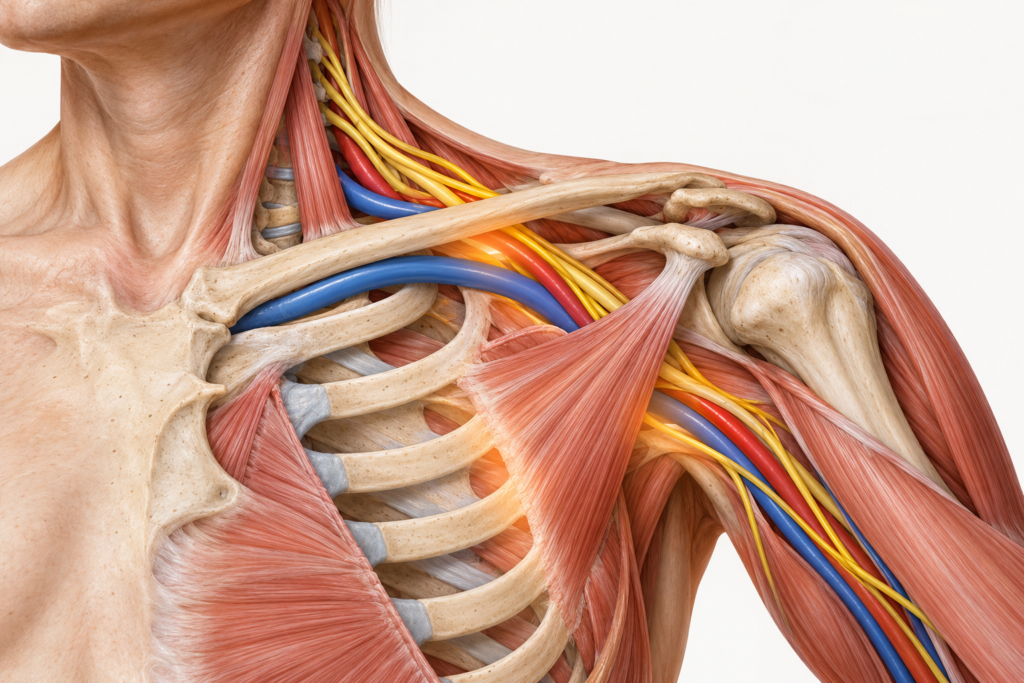
If you experience numbness or tingling in your arm when reaching overhead, carrying a heavy bag, or sitting at a desk for long periods, along with pain radiating from your neck and shoulder down to your hand, it may indicate thoracic outlet syndrome.
This syndrome occurs when the space between the collarbone and first rib, which allows nerves and blood vessels to pass through, becomes compressed. Contributing factors include tight neck or chest muscles, poor posture, repetitive arm movements, injuries like whiplash, or an extra rib. Nerve compression often results in symptoms such as neck, shoulder, and arm pain, tingling or numbness in the ring and little fingers, a weak grip, and increased symptoms when lifting the arms. Acupressure can help alleviate muscle tightness pressing on this space, reducing pain and tingling.
The main muscles in this region include the scalenes on the sides of the neck, through which the nerves pass, and the pectoralis minor, a small muscle beneath the front of the shoulder through which nerves beneath which nerves and blood vessels pass. When these muscles tighten due to poor posture, stress, or shallow chest breathing, they may block the exit pathway. Releasing these muscles, along with those that support the shoulder blades and prevent forward rounding, can help a lot.
In Traditional Chinese Medicine, thoracic outlet syndrome is viewed as a condition marked by pain caused by blockage where several channels pass through the neck, shoulder, and upper chest toward the arm. Contributing factors like strain, poor posture, injury, and cold exposure can lead to Qi and Blood stagnation at this point, hindering the flow along the arm and resulting in pain, numbness, and weakness. The Small Intestine and Heart channels run down the little finger side of the arm, which explains why tingling often occurs there. Meanwhile, the Large Intestine and Lung channels traverse the side of the thumb and extend across the chest and shoulder.
Here are nine acupressure points that help reduce congestion at the neck, chest, and shoulder-blade junctions and open the channels that transmit symptoms down the arm.
What Acupressure Points to Press and Why
1. Press on LU1 below the collarbone to release the front of the chest. LU1 sits on the upper chest, below the outer end of the collarbone, in the hollow about a thumb-width below it, roughly in line with the front of the armpit. Press gently with your fingertips, angling slightly outward toward the shoulder, for one to two minutes on the affected side. LU1 is called “Zhongfu.”
The LU1 point is near the small chest muscle beneath the front shoulder, where nerves and blood vessels pass to the arm. Gentle pressure here softens the muscle and helps the shoulder move back from its rounded, forward position. Be sure to use light pressure and stop if tingling occurs in the arm.

2. Press on GB21 on top of the shoulder to drop raised, tense shoulders. GB21 sits at the highest point of the shoulder, midway between the base of the neck and the tip of the shoulder, on the ridge of the trapezius muscle. Press down firmly or squeeze the muscle for one to two minutes on each side, then let the shoulders drop as you exhale. GB21 is called “Jianjing.” GB21 is avoided during pregnancy.
Shoulders often lift toward the ears from stress and desk work, compressing the thoracic outlet from above. Activating GB21 helps release tension in the upper shoulders, allowing them to relax and drop, which widens the nerve passageway.

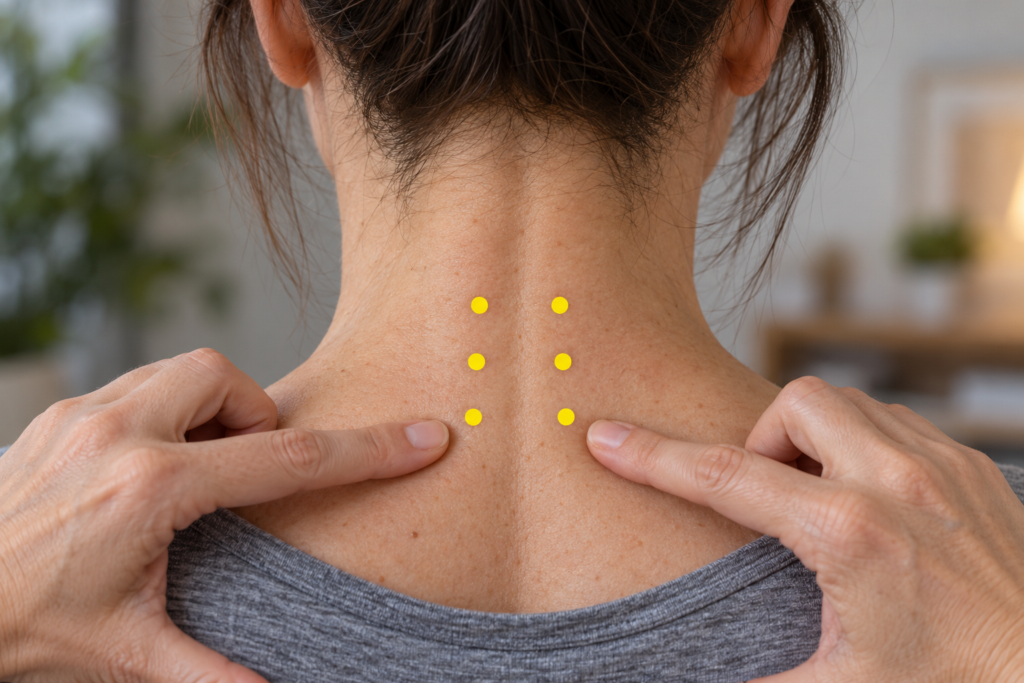
3. Press on the cervical Jiaji points along the back of the neck. The Jiaji points run along both sides of the spine, about half a thumb-width out from the bony bumps of the vertebrae, in the lower half of the neck. Press gently with your fingertips, working slowly downward, for one to two minutes, staying on the back of the neck. Jiaji is an extra point group.
The nerves passing through the thoracic outlet originate in the lower neck, with the Jiaji points situated near where these nerves exit the spine. Gentle pressure applied to this area can help relax the neck muscles that tighten around the nerves. It is important to only press on the back of the neck and avoid applying deep pressure to the sides or front of the neck.
4. Press on SI11 in the center of the shoulder blade to open the shoulders. SI11 sits in the center of the shoulder blade, in a tender hollow in the middle of the flat, triangular bone. Lean against a wall with a tennis ball over the point, and press into it for 1 to 2 minutes. SI11 is called “Tianzong.”
As the shoulder blades move forward and outward, the chest tightens, causing the opening to narrow. Relaxing the muscles on the back of the shoulder blade with SI11 helps the shoulders return to a more open position and relieves the deep ache that often extends into the upper back.
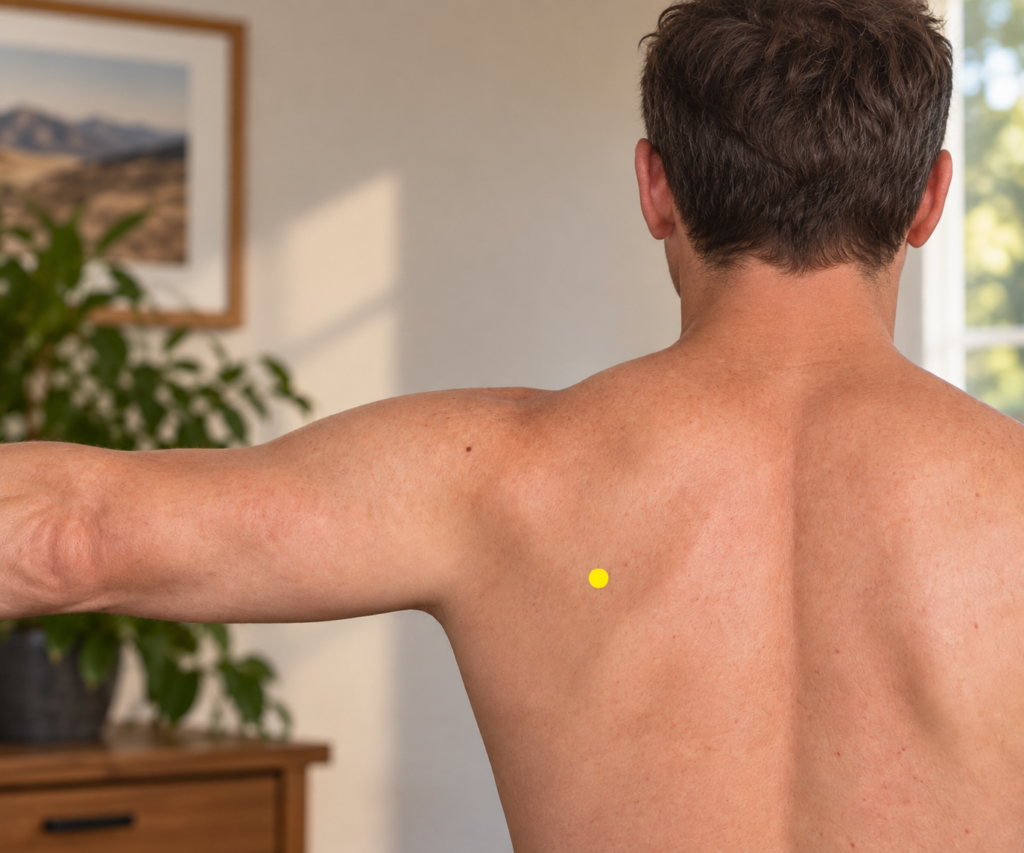
5. Press on LI15 at the front of the shoulder to open the path into the arm. LI15 sits at the front of the shoulder, in the hollow that forms at the outer edge of the shoulder when you raise your arm out to the side. Press firmly with your fingertips for one to two minutes on the affected side. LI15 is called “Jianyu.”
The shoulder is the entry point for the channels into the arm, with LI15 being the main point for opening them. It helps relieve shoulder pain, stiffness, and heaviness, and promotes the flow of Qi and Blood into the arm and hand.

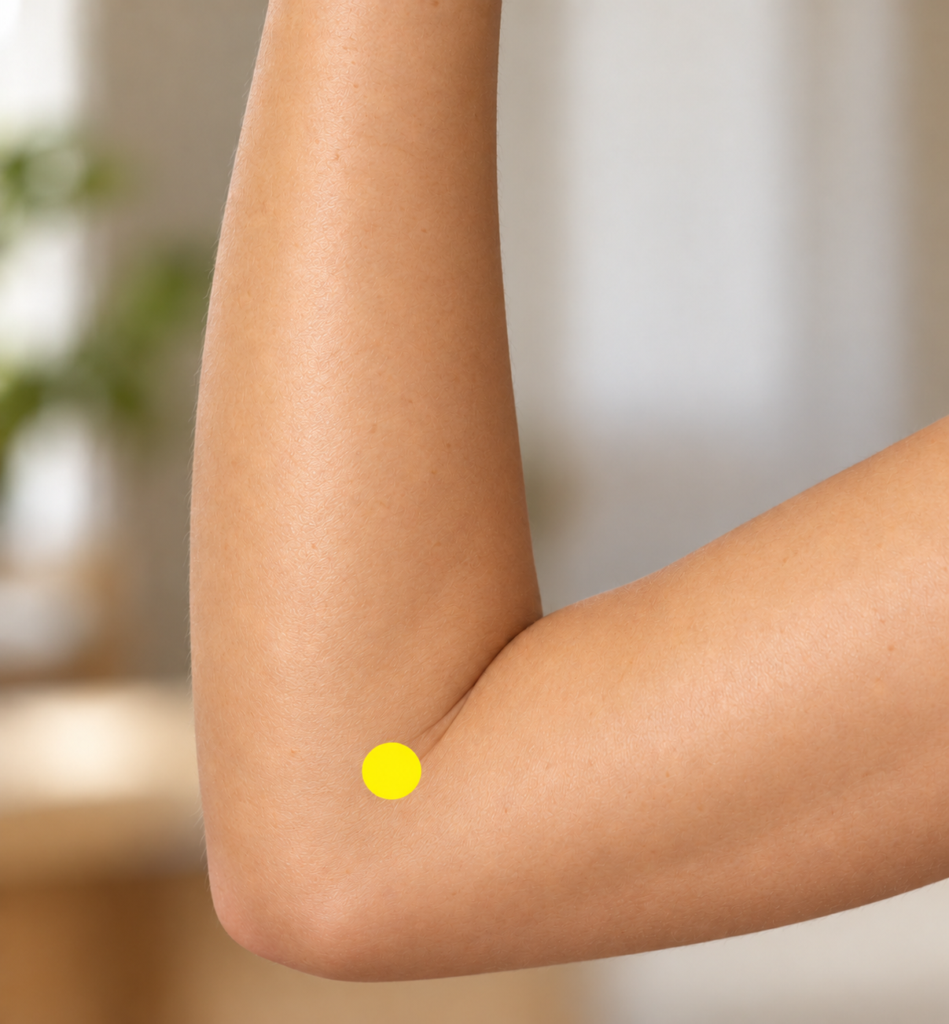
6. Press on HT3 at the inner elbow for tingling in the little finger side. HT3 sits at the inner end of the elbow crease, in the hollow between the crease and the bony bump on the inner elbow when the elbow is bent. Press gently with your thumb for one to two minutes on the affected arm. HT3 is called “Shaohai,” the “Lesser Sea.”
Thoracic outlet syndrome typically causes tingling and numbness in the ring and little fingers, along the inner forearm, along the Heart channel pathway. HT3 helps unblock this channel at the elbow. Since the nerve supplying these fingers is close by, apply gentle pressure and ease up if you feel a jolt down the arm.
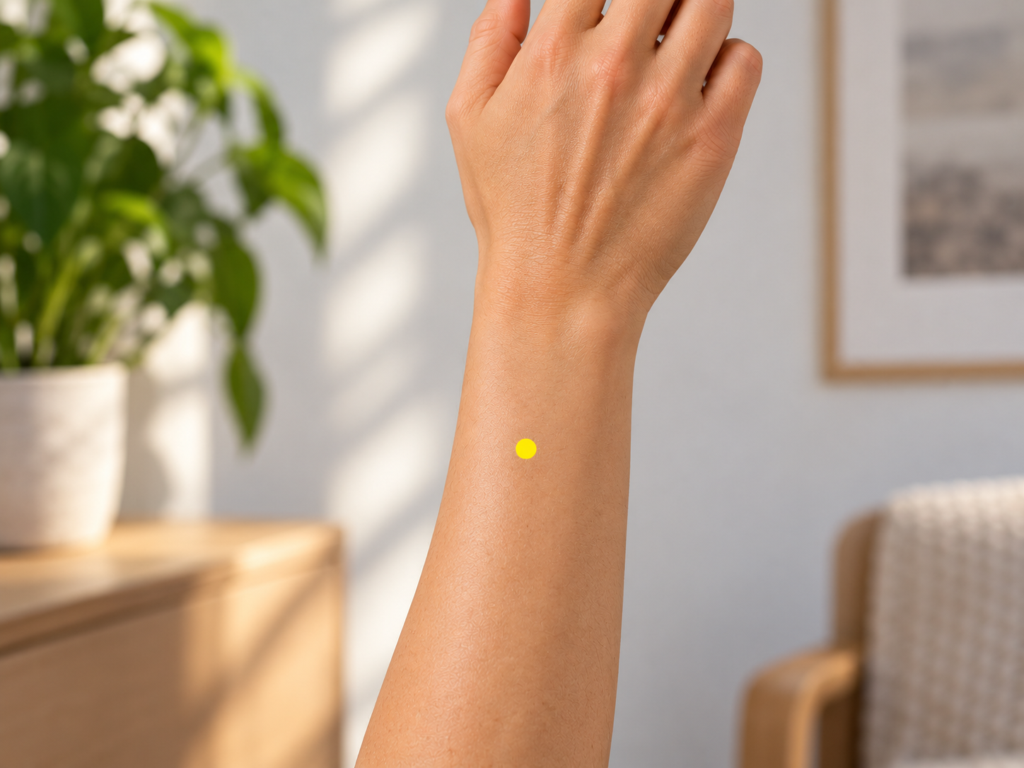
7. Press on SJ5 on the back of the forearm to move circulation into the hand. SJ5 sits on the back of the forearm, about three finger-widths above the wrist crease, in the hollow between the two forearm bones. Press firmly with your thumb for one to two minutes on the affected arm. SJ5 is called “Waiguan,” the “Outer Pass.”
SJ5 encourages the flow of Qi and Blood through the forearm into the hand, helping reduce numbness, tingling, and heaviness in the arm. It also eases forearm tension from squeezing objects more tightly because of a weak grip.
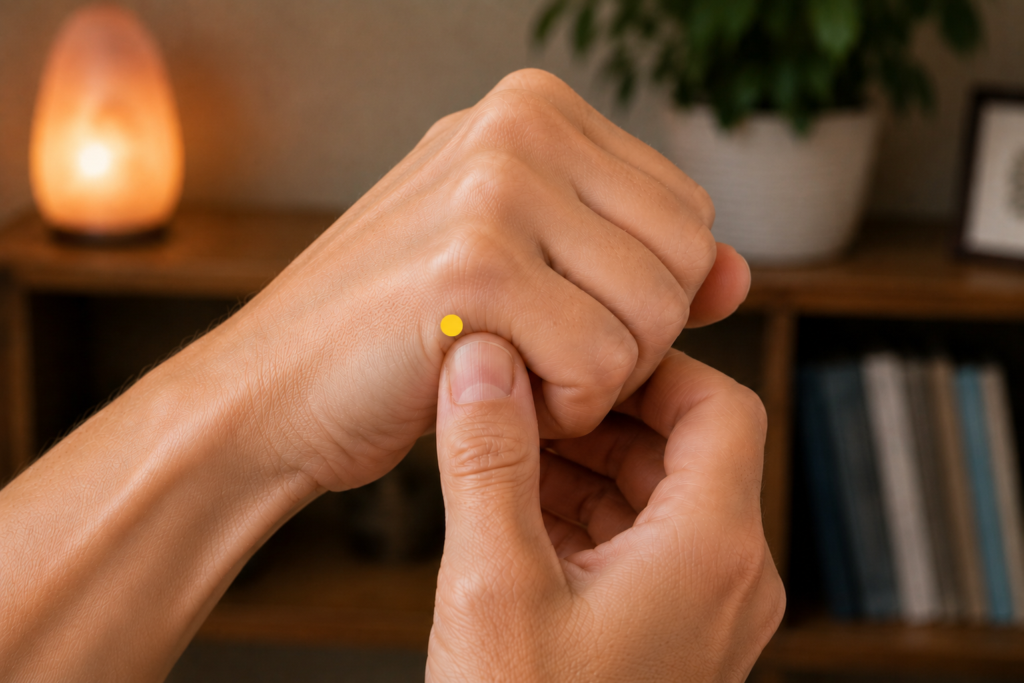
8. Press on SI3 on the side of the hand for the little finger and the neck. SI3 sits on the outer edge of the hand, on the little finger side, in the crease that forms just below the knuckle of the little finger when you make a loose fist. Press firmly with your thumb for one to two minutes on the affected hand. SI3 is called “Houxi,” the “Back Stream.”
SI3 targets the tingling sensation in the little finger and opens the channel running along the spine and neck, helping to relieve neck stiffness often associated with thoracic outlet syndrome. Because it addresses both the neck and hand issues, this point is especially effective in this situation.
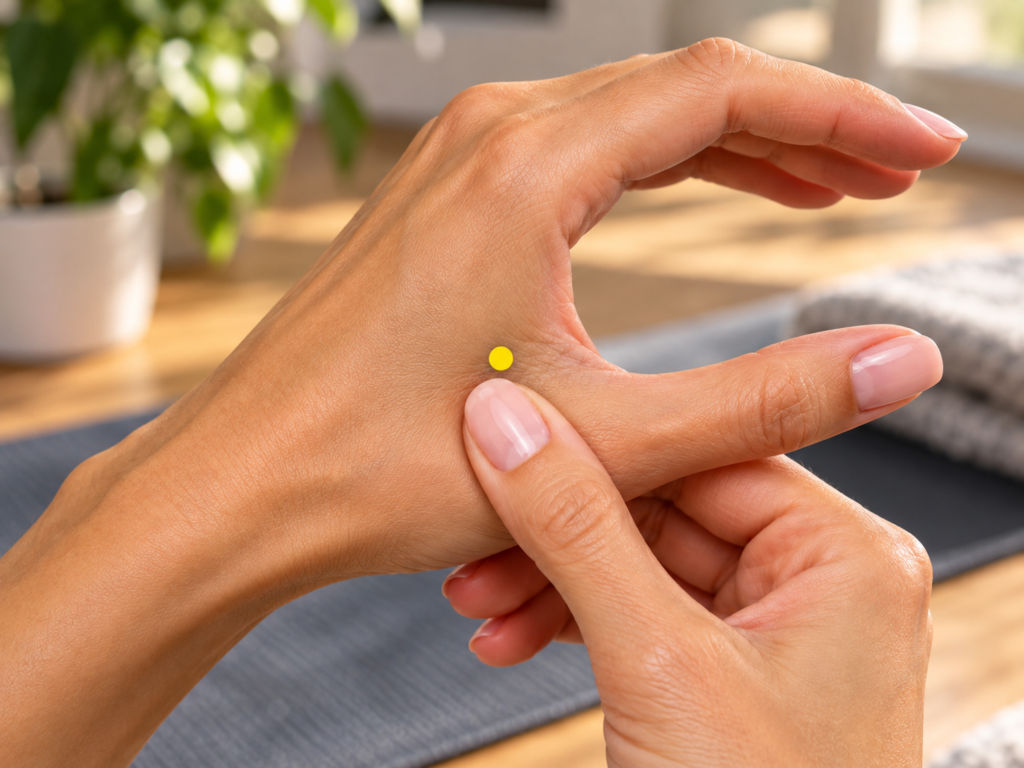
9. Press on LI4 in the hand to ease pain throughout the arm. LI4 sits in the webbing between the thumb and index finger, at the highest point of the muscle when you bring them together. Press firmly with the thumb of your other hand for one to two minutes on each hand. LI4 is called “Hegu.” LI4 is avoided during pregnancy.
LI4 is a potent point for pain relief and sits at the hand end of the same channel as LI15 at the shoulder. Applying pressure here can ease pain in the arm, shoulder, and neck and promote smooth Qi flow through the arm.
Why These Acupressure Points Work
In Traditional Chinese Medicine, thoracic outlet syndrome is viewed as stagnation of Qi and Blood at the junction of the neck, chest, and shoulder, which blocks the flow down the arm. The nine points are spread throughout this area.
- The LU1, GB21, cervical Jiaji points, and SI11 points relieve tightness in the chest, shoulders, neck, and shoulder blades, which crowd the outlet.
- The gateway point, LI15, opens up the shoulder in such a way that blood flow can enter the arm.
- The points on the arm and hand (HT3, SJ5, SI3, LI4) open the channels through which pain, tingling, and numbness are transmitted to the fingers.
How to Properly Use These Acupressure Points
First, apply heat to the neck, shoulders, and upper chest with a heat pack or a warm shower to relax the muscles.
- Start from the center and move outward: treat the GB21 and the cervical Jiaji points, then the LU1 and SI11, then LI15, and finally HT3, SJ5, SI3, and LI4 along the arm.
- Do not press too hard on the side or front of the neck or on the hollow just above the collarbone, because the nerves and blood vessels run close to the surface there.
- When applying gentle pressure to the chest and inner elbow, stop right away if these areas become more numb, tingling, or swollen.
- Hold a single point for one to two minutes and carry out the routine once or twice each day.
Daily habits truly make a difference: keep your shoulders gently pulled back and down instead of hunched forward, and ensure screens are at eye level. Take regular breaks when reaching overhead or during extended typing sessions. When carrying bags, use both hands or distribute weight across both shoulders, avoiding heavy straps on one side. Avoid sleeping with your arms raised above your head. Inhale deeply into your abdomen, not shallowly into your chest, as shallow chest breathing can strain neck muscles and compress nerves. Regular doorway chest stretches and nerve-gliding exercises, recommended by a physical therapist, are often the most effective long-term solutions.
When to Get Professional Help
Consult a doctor to confirm your diagnosis, as thoracic outlet syndrome can resemble other conditions like a pinched nerve in the neck or carpal tunnel syndrome. Seek emergency medical attention if you experience sudden arm swelling, heaviness, or a bluish color, especially after intense overhead activity, which may indicate a blood clot. Also, go to the emergency room if your hand or arm becomes cold, pale, and painful with a weak pulse, or if sores develop on your fingers, which may signal arterial blockage. See a doctor promptly if you notice worsening weakness, muscle wasting at the base of the thumb, or symptoms that persist or worsen despite treatment. Call emergency services for left arm pain or heaviness with chest pain, shortness of breath, or sweating, as these could signal heart issues.
Acupressure can be a helpful complementary practice for thoracic outlet syndrome, used alongside physical therapy and the medical care recommended by your diagnosis.
Above and Beyond Acupuncture offers acupuncture, cupping, and lifestyle coaching at the North Frank Lloyd Wright Boulevard location in Scottsdale.
Schedule an appointment online to start your healing journey.
The points above are only as effective as the technique used to apply them. Where to press, how firmly, and for how long all affect the result. For a full breakdown of how to perform acupressure properly at home, read Performing Acupressure in 3 Easy Steps.

About the Publisher
Paul Kerzner, L.Ac., is a licensed acupuncturist and board-certified herbalist, as well as the founder of Above and Beyond Acupuncture in Scottsdale. His own journey from chronic patient to practicing acupuncturist shapes his commitment to providing honest, clinically grounded information about acupuncture and Traditional Chinese Medicine. Learn more about Paul and his clinical approach on the About Us page.