Key Takeaways
- Upper back pain often results from poor posture, stress, and muscular tension caused by desk work.
- Acupressure effectively alleviates tension by targeting nine specific points that help unblock Qi and Blood.
- Key points include GB21 for shoulder tension, SI11 for shoulder blade pain, and GB20 to relieve neck pressure.
- Proper technique improves acupressure: press a ball against a wall and incorporate gentle movements.
- See a doctor if pain continues, occurs after an injury, or includes symptoms such as numbness or chest pain.

That aching, tight feeling across your upper back and between your shoulder blades, along with the stiffness that builds up after a day at your desk, often comes from our modern habits. We spend a lot of time hunched over screens, phones, and keyboards, holding tension in our shoulders and not moving enough. Most upper back pain is muscular, which is good news because it usually responds well to the pressure and release that acupressure offers.
In Traditional Chinese Medicine, upper back pain is viewed as a blockage of Qi and Blood in the muscles and channels of the upper back, a condition known as Bi syndrome. Factors such as poor posture, prolonged sitting, stress, overuse, or exposure to cold and dampness can cause Qi and Blood stagnation, resulting in tightness, soreness, and knots. The upper back contains vital channels, including the Bladder channel along the spine, and the Small Intestine and Gallbladder channels over the shoulder blades and shoulders. Stress particularly tightens the muscles at the tops of the shoulders and between the shoulder blades. The following points help move stagnant Qi and Blood, relax tight muscles and knots, unblock the channels, and ease pain and stiffness.
Here are nine acupressure points that release tension, ease knots, and loosen a tight, aching upper back.
What Acupressure Points to Press and Why
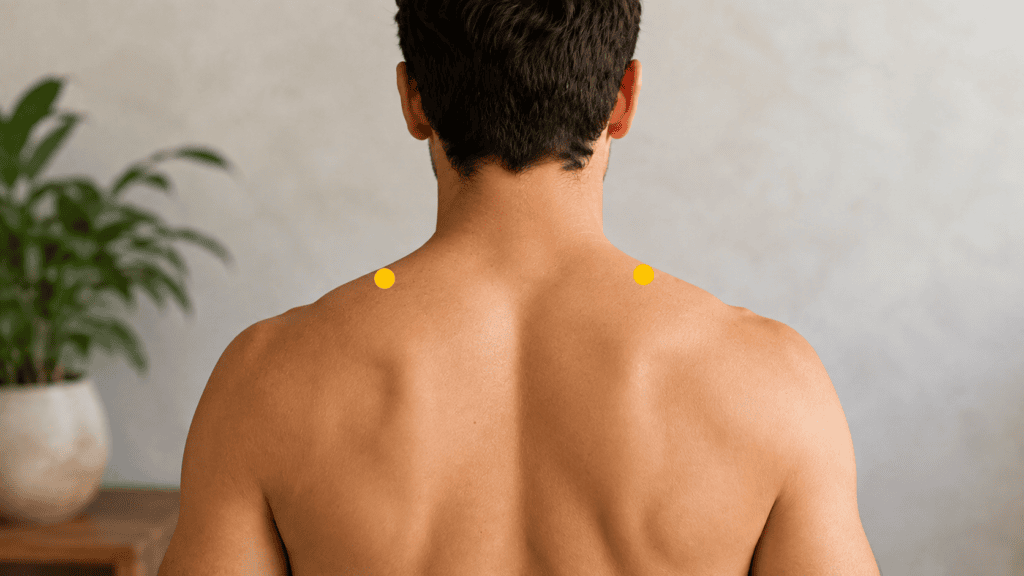
1. Press on GB21 on top of the shoulder, the key point for upper tension. GB21 sits at the highest point of the shoulder, midway between the base of the neck and the tip of the shoulder, on the ridge of the trapezius muscle. Press down firmly with your fingertips, or pinch the muscle, for one to two minutes on each side. GB21 is called “Jianjing.” GB21 is avoided during pregnancy.
This point is crucial for relieving upper back and shoulder tension. The trapezius muscle, located across the tops of the shoulders, often holds stress, causing tightness, hunched posture, and aches from desk work. GB21 effectively releases this tension. Applying pressure or squeezing it provides significant relief after a long day. It’s the first point to try and is easy to press yourself or have someone assist. However, avoid this point during pregnancy.
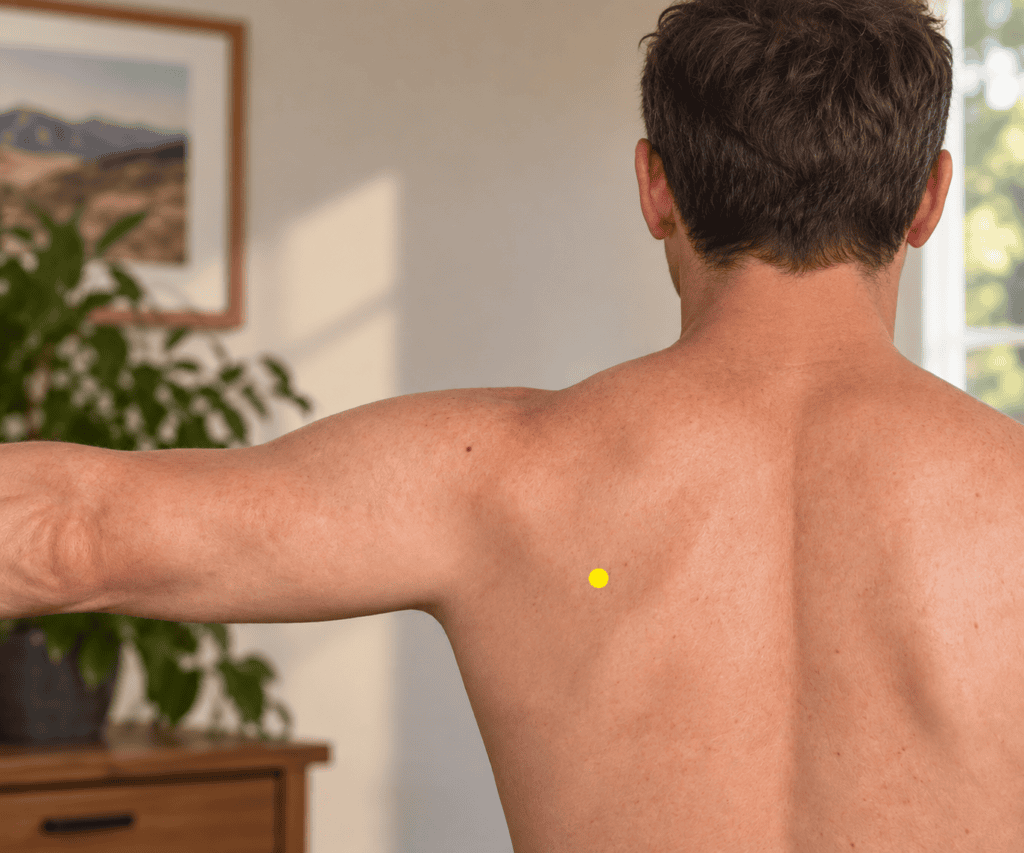
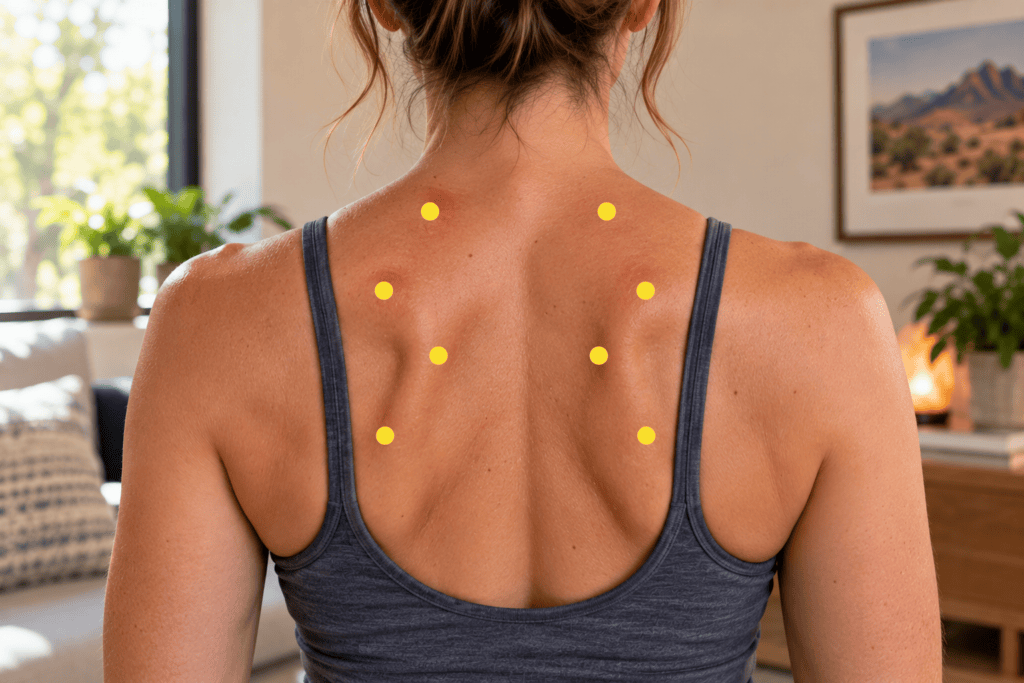
2. Press on SI11 in the center of the shoulder blade for deep aching. SI11 sits in the center of the shoulder blade, in the middle of the flat triangular bone on the upper back, in a hollow that you can often feel is tender. Reach across your body or use a ball against a wall, and press firmly for 1 to 2 minutes on each side. SI11 is called “Tianzong,” a major point for the shoulder blade and upper back.
SI11 is a key point for relieving upper back pain. Located in the middle of the shoulder blade, it sits over muscles that often become knotted and sore. Applying pressure here can help ease deep, aching pain and tightness in the shoulder blade and upper back, a common tension area. This spot is often very tender; pressing on it or leaning against a tennis ball on a wall can help release knots. For persistent deep pain in the upper back and shoulder blade, this point provides direct relief.
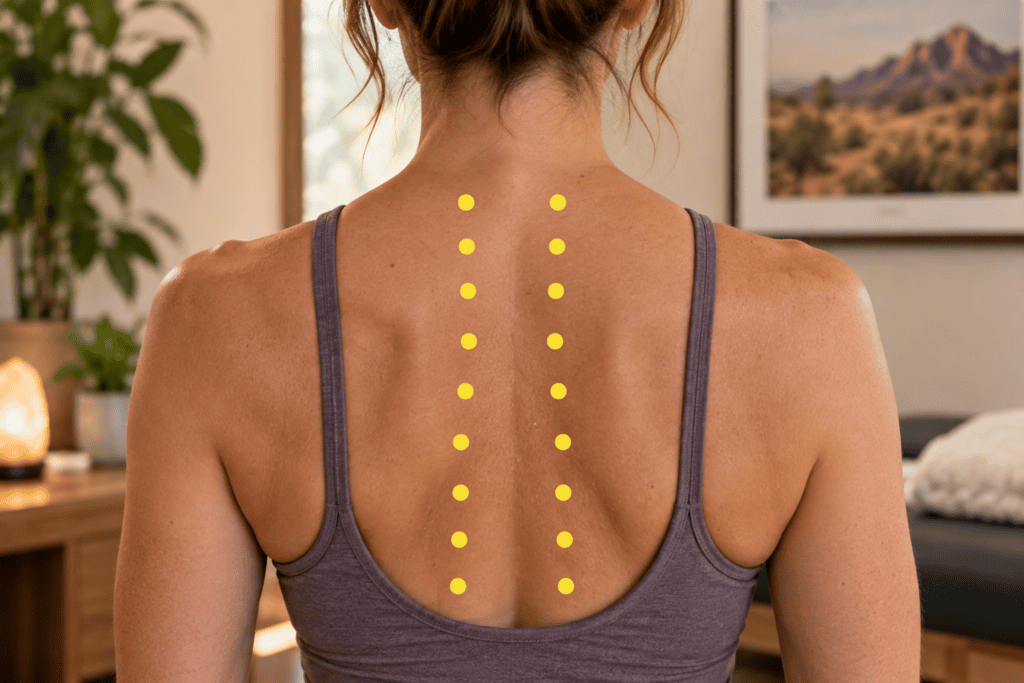
3. Press on the Bladder channel points beside the spine. These points run down either side of the spine, about one and a half to two thumb-widths out, through the upper back between and below the shoulder blades. Because they are hard to reach yourself, use a ball against a wall, or have someone press, working down the muscles on either side of the spine for a minute or so on each spot. These are the Bladder channel points, including BL13 through BL17, that run down the muscles beside the spine.
The thick muscle bands on either side of the spine, following the Bladder channel, are common areas for upper back tension and stiffness. Applying pressure along these muscles helps alleviate tightness throughout the upper back. Instead of targeting just one spot, scan the entire line of muscles beside the spine to treat the paraspinal muscles that often become sore from posture and sitting. Using a ball against the wall provides an effective way to reach and massage these points. Working along this entire line can effectively release tension and stiffness in the upper back muscles.
4. Press on the Ashi points at the knots and sorest spots. The Ashi points are wherever the tightness and tenderness are greatest: the specific knots and taut, sore bands in your upper back. Feel around, or use a ball against a wall, and press each knot firmly but tolerably for about a minute, letting it slowly release. “Ashi” means “that’s it,” the sound of finding the exact sore point.
In Traditional Chinese Medicine, Ashi points are tender spots treated directly because they show where Qi and Blood are most blocked. The upper back often has muscle knots and trigger points, including your own sore spots; tight, rope-like bands are prime targets. Since the upper back can be hard to reach, using a tennis or massage ball against a wall and rolling it slowly over these knots is very effective. These knots reflect your unique upper-back tension pattern, and applying steady pressure until the knot softens can provide considerable relief.
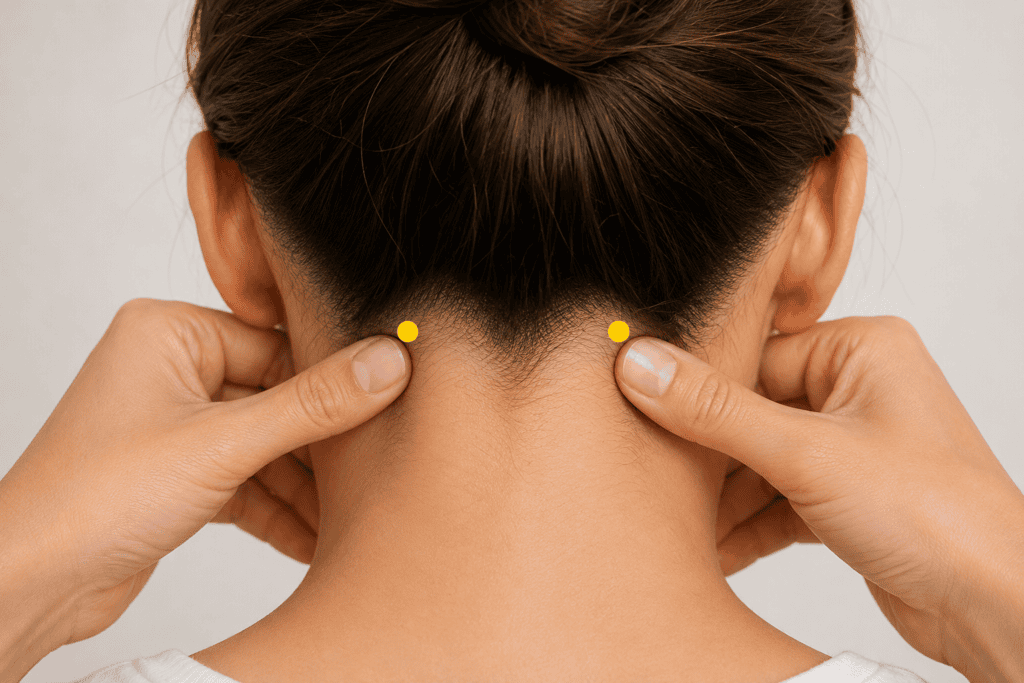
5. Press on GB20 at the base of the skull to release the top of the chain. GB20 sits in the two hollows at the base of the skull, between the two large vertical neck muscles and the outer edge, roughly level with the tops of the ears. Tip your head back slightly and press firmly up and inward with your thumbs for one to two minutes. GB20 is called “Fengchi,” a major point for the neck and upper back.
Upper back tension often extends upward into the neck and the base of the skull. GB20 assists in relaxing the top part of this chain, easing tightness where the neck meets the head and potentially alleviating headaches caused by upper back and neck strain. Because the muscles of the neck and upper back are interconnected, releasing this point can help relax the entire area. If tension in the upper back causes stiffness or headaches, this point can be beneficial, especially when combined with GB21 to target the neck and shoulders.
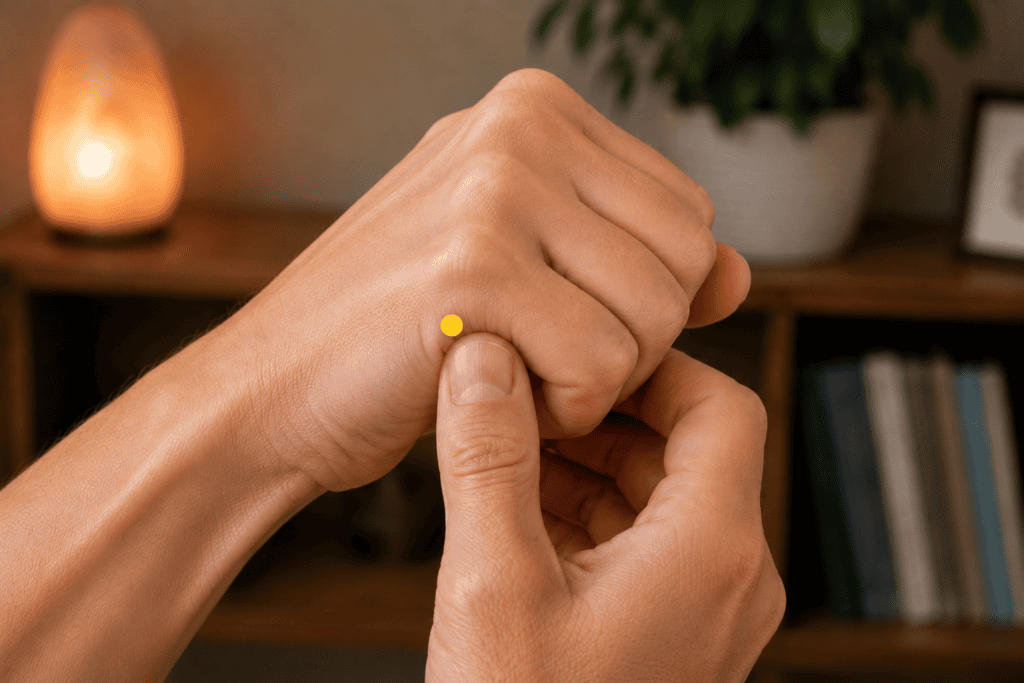
6. Press on SI3 on the side of the hand to open the upper back and spine. SI3 sits on the side of the hand, on the pinky edge, in the crease that forms just below the knuckle of the little finger when you make a loose fist. Press firmly with the thumb of your other hand for one to two minutes on each hand. SI3 is called “Houxi,” a distal point that opens the channel governing the spine and upper back.
SI3 supports the upper back and spine from afar by targeting the Small Intestine channel, which passes over the shoulder blade and up to the neck. It also opens the Governing Vessel, the channel running along the spine. Pressing this point can ease pain and stiffness in the upper back, neck, and spine, making it effective when combined with local points. Since it’s located on the hand, you can press it firmly and discreetly at your desk. For stiffness in the upper back and spine, this point works through the channels and enhances local pressure treatments.
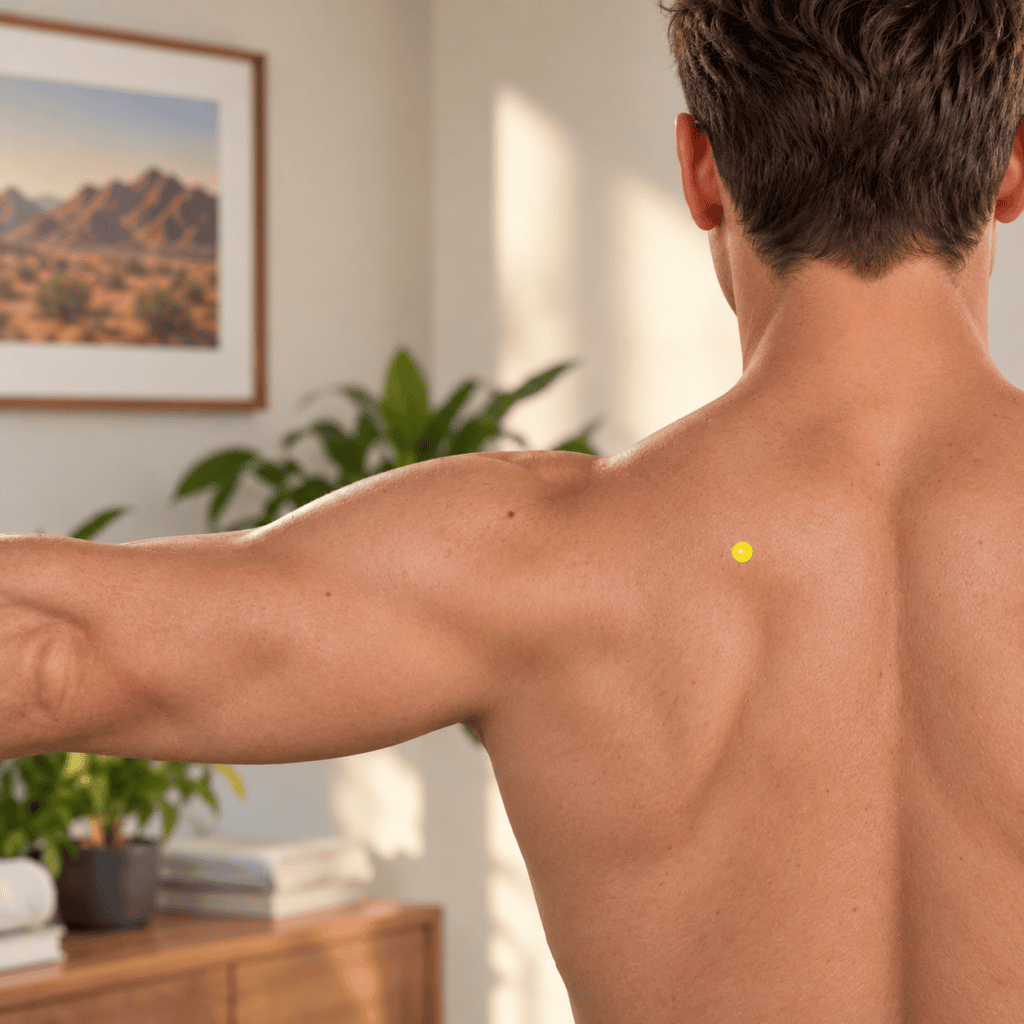
7. Press on SI14 on the upper back for the shoulder-blade region. SI14 sits on the upper back, about three thumb-widths out from the spine, level with the upper edge of the shoulder blade, in the muscle there. Use a ball against a wall or have someone press for one to two minutes on each side. SI14 is called “Jianwaishu,” a point in the upper inner shoulder-blade area.
SI14 targets the muscles in the upper inner shoulder-blade region, located between the spine and the top of the shoulder blade. This area often becomes sore from hunching over a desk. Applying pressure here can help alleviate pain and stiffness that accumulate in this region, which isn’t directly covered by the central shoulder-blade or spinal points. If your upper back pain is concentrated near the shoulder blade’s upper inner corner, this point can be especially effective. Like other back points, it’s easiest to access with a ball pressed against a wall.
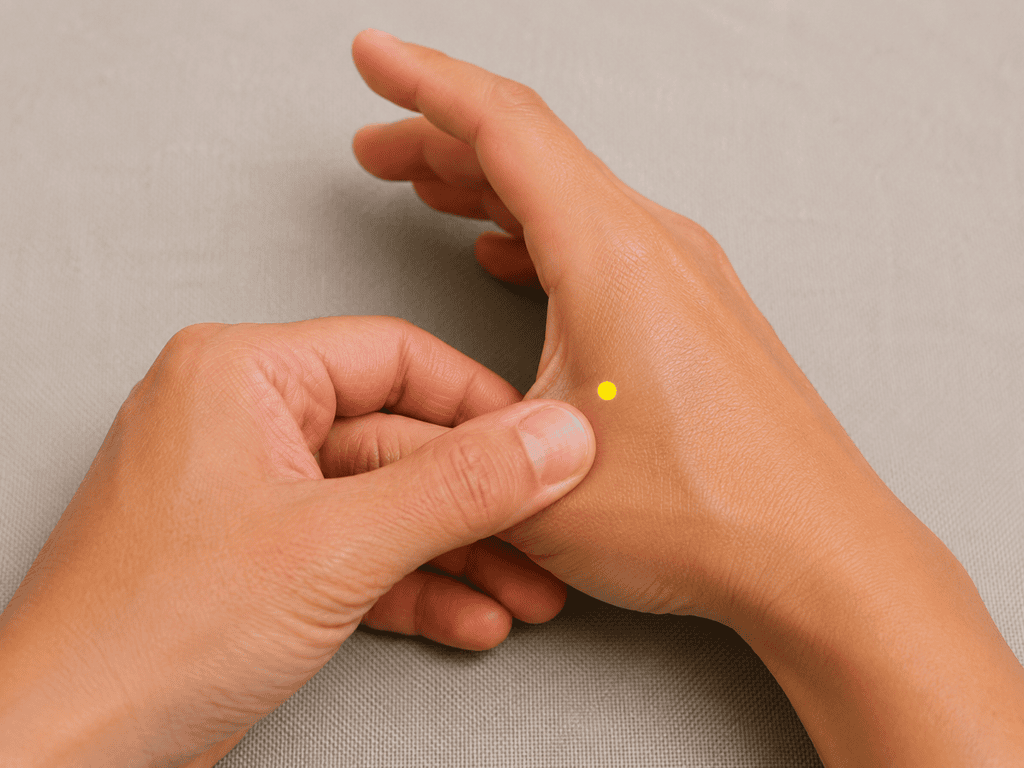
8. Press on LI4 in the hand to relieve pain and tension. LI4 sits in the webbing between the thumb and index finger, at the highest point of the muscle when you bring the thumb and index finger together. Press firmly with the thumb of your other hand for one to two minutes on each hand. LI4 is called “Hegu,” and it is one of the great general points for pain and tension. LI4 is avoided during pregnancy.
LI4 is one of the body’s most potent points for general pain relief and helps move stuck Qi throughout the body. It can help alleviate upper back pain and tension remotely by relaxing broader areas and supporting local knot and muscle release. Located on the hand, it allows for firm, frequent presses, even while at your desk, making it a dependable option for overall pain reduction and tension relief during upper back work. However, avoid using this point during pregnancy.
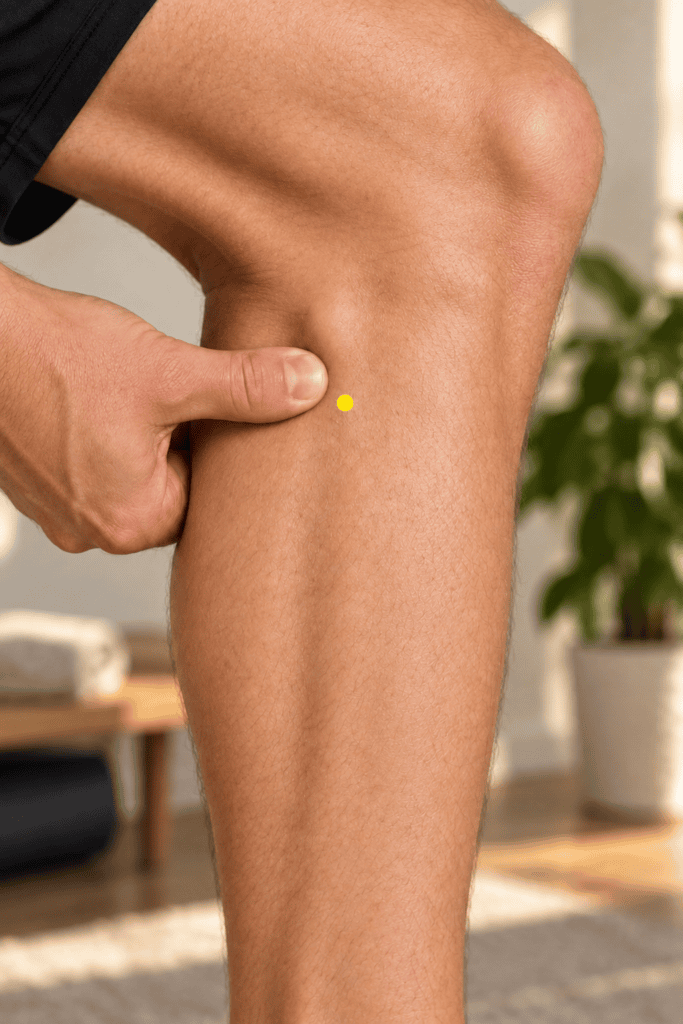
9. Press on GB34 below the outer knee to relax the muscles. GB34 sits on the outer lower leg, in the hollow just below and in front of the head of the fibula, the bony knob below the outer side of the knee. Press firmly with your thumb for one to two minutes on each leg. GB34 is called “Yanglingquan,” and it is the influential point for the sinews and muscles of the whole body.
GB34 is the body’s main point for the sinews and muscles, making it effective for relieving muscular tension and tightness in upper back pain despite its location on the leg. It helps relax muscles throughout the body, supporting the release of tight, knotted upper back muscles from a distance and aiding overall relaxation. For upper back pain primarily caused by muscle tension, which is most cases, this point provides comprehensive muscle relaxation for the entire body and complements local treatment. It is easy to activate by pressing from the leg while the back relaxes.
Why These Acupressure Points Work
In Traditional Chinese Medicine, upper back pain is considered a blockage of Qi and Blood in the muscles and channels of the upper back, often resulting from poor posture, prolonged sitting, stress, and overuse. The nine points listed above target these specific issues.
- The tension-release points (GB21, SI11, SI14, and the Bladder channel points) help relax tight muscles across the tops of the shoulders, shoulder blades, and along the spine where upper back tension accumulates.
- The Ashi points work your own knots and tight bands directly.
- The neck point (GB20) relieves tension at the top of the chain, where upper back tightness extends into the neck and head.
- The distal points (SI3, LI4, GB34) help alleviate pain along the channels, open the spine, and relax muscles from afar.
The main goal is to relax tight, knotted muscles and restore the flow of Qi and Blood. That’s why applying these points, combined with using a ball against a wall, gentle movements, and warmth, proves to be very effective.
How to Properly Use These Acupressure Points
Since the upper back is difficult to reach, employing proper technique can significantly improve results. Use the bladder channel line and Ashi knots, leaning into the ball and gently rolling it over tense, sore areas until they relax.
- Work GB21 on the shoulders and GB20 at the base of the skull with your own hands, and use SI3, LI4, and GB34 from the hand and leg for pain relief and muscle release from a distance.
- Combine gentle movements with pressure, such as shoulder rolls, squeezing shoulder blades, and simple stretches for the neck and upper back. These steps help maintain muscle looseness after relieving tension.
- Hold each point or knot for one to two minutes, breathe slowly, and stretch the upper back several times daily, particularly after long desk sessions.
Acupressure can reduce tension, but a few adjustments can prevent it from returning. Proper posture is essential, as most upper back pain results from slouching over screens and phones. Arrange your workspace so your monitor is at eye level, sit upright instead of leaning forward, and take frequent breaks to stand, move around, and reset your posture. Applying heat, such as a heat pack, warm shower, or warm compress, can relax tight, sore upper back muscles and boost circulation. Consistent movement and targeted exercises to strengthen your upper back and postural muscles can help maintain pain relief. Additionally, managing stress is crucial, since much of the upper back tension stems from stress stored in the shoulders.
When to Get Professional Help
Most upper back pain is muscular and tends to improve with pressure, movement, and posture adjustments mentioned above. Acupressure can be very effective. However, some cases may need a doctor’s evaluation. Seek medical help if your pain is severe, lasts a few weeks, follows a major injury or fall, or if you notice numbness, tingling, or weakness in your arms or hands, as these could indicate nerve issues. Certain symptoms require urgent care: upper back pain with chest pain, shortness of breath, sweating, or pain radiating to your arm or jaw may suggest a heart problem and need emergency attention. Sudden, severe upper back pain, especially with a fever or unexplained weight loss, also calls for immediate medical assessment.
While acupressure and good posture can help relieve everyday upper back tension and discomfort, they should not replace medical treatment when needed.
Above and Beyond Acupuncture offers acupuncture, cupping, and lifestyle coaching at the North Frank Lloyd Wright Boulevard location in Scottsdale.
Schedule an appointment online to start your healing journey.
The points above are only as effective as the technique used to apply them. Where to press, how firmly, and for how long all affect the result. For a full breakdown of how to perform acupressure properly at home, read Performing Acupressure in 3 Easy Steps.
Because the upper back, neck, and shoulders are interconnected and often hurt together, acupressure for neck pain and acupressure for shoulder pain are closely related to this post.

About the Publisher
Paul Kerzner, L.Ac., is a licensed acupuncturist and board-certified herbalist, as well as the founder of Above and Beyond Acupuncture in Scottsdale. His own journey from chronic patient to practicing acupuncturist shapes his commitment to providing honest, clinically grounded information about acupuncture and Traditional Chinese Medicine. Learn more about Paul and his clinical approach on the About Us page.