
Key Takeaways
- Vestibular migraine causes dizziness, nausea, and can occur with or without headache due to a disrupted balance system.
- Acupressure can help alleviate symptoms by targeting specific points to calm wind, relieve pain, and settle nausea.
- Press GB20 to calm head pain, PC6 for nausea, and LI4 to ease head discomfort, among other recommended points.
- Between episodes, perform daily routines on acupressure points to help lower the frequency and severity of attacks.
- Consult a healthcare professional immediately if you experience sudden, severe symptoms, as they may signal a serious health issue.

Have you ever experienced dizziness, where the room seems to spin, rock, or sway? These episodes can sometimes be accompanied by a headache or occur without one. You might also feel nauseous or be sensitive to light, sound, or movement.
This pattern might be vestibular migraine, a frequent cause of recurring vertigo. In this condition, the brain’s balance system is disrupted, leading to dizziness that may occur with or without head pain. Episodes can last from minutes to days and may involve spinning sensations, feelings of the room moving, unsteadiness, motion sickness, difficulty in busy visual environments, nausea, light and sound sensitivity, and sometimes a throbbing headache before, during, or after dizziness. Many affected individuals have a history of migraine or motion sickness. Common triggers include poor sleep, stress, hormonal fluctuations, skipping meals, dehydration, certain foods, screen use, and weather changes. Acupressure offers a gentle way to help reduce these episodes and address the underlying patterns, complementing your regular medical treatment. The following points may assist.
In Traditional Chinese Medicine, vestibular migraine is considered a pattern of energy rising to the head. Stress and frustration often cause Liver Yang to rise, stirring internal wind and resulting in spinning vertigo, pounding temple pain, and light sensitivity. Phlegm and dampness can make the head feel heavy, foggy, and induce nausea. When Blood deficiency occurs, the head lacks nourishment, and attacks may happen after fatigue, poor sleep, or during menstruation.
Here are nine acupressure points to help reduce internal wind, clear the head, relieve nausea, and alleviate head pain.
What Acupressure Points to Press and Why
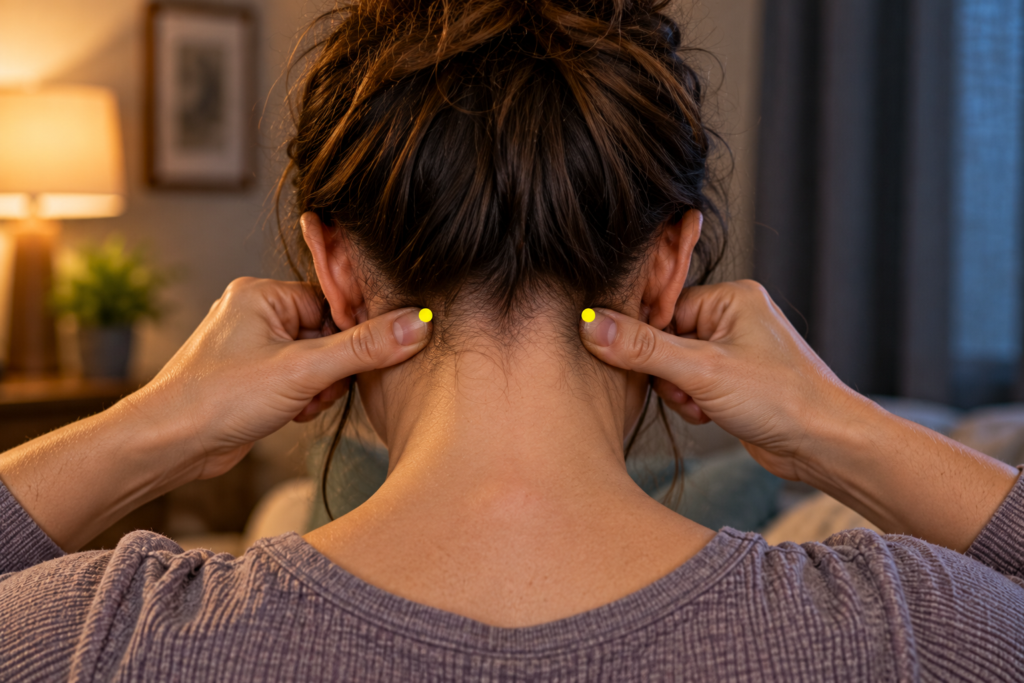
1. Press on GB20 at the base of the skull to calm wind and ease head pain. GB20 sits in the two hollows at the base of the skull, between the two large vertical neck muscles and the outer edge, roughly level with the tops of the ears. Press gently up and inward with your thumbs for one to two minutes, keeping your head still and supported. GB20 is called “Fengchi,” the “Wind Pool.”
GB20 is a crucial point for managing migraines and dizziness. It helps soothe the internal wind responsible for vertigo, alleviates headaches at the back of the head and behind the eyes, and reduces neck tension commonly linked to migraines. This point forms the basis of the routine.
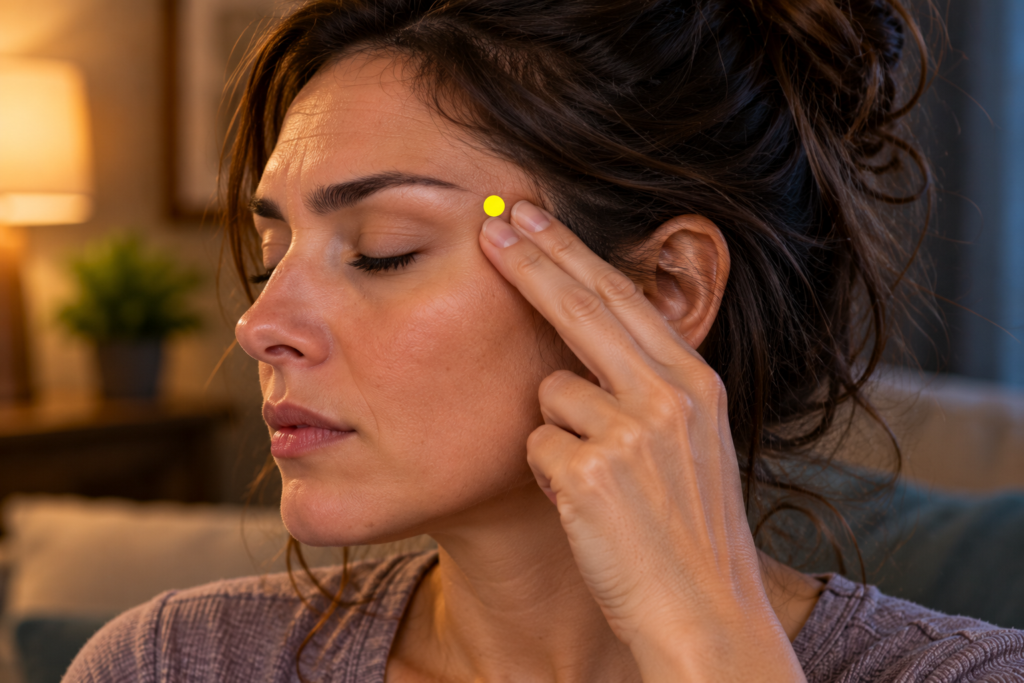
2. Press on Taiyang at the temples to ease throbbing pain. Taiyang sits in the soft hollow at the temple, about a thumb’s width behind the outer end of the eyebrow. Press gently with your fingertips, or make slow circles, for one to two minutes on both sides. Taiyang is an extra point whose name means “Greatest Yang.”
Taiyang is often used to alleviate migraine pain located at the temples and around the eyes. It helps reduce throbbing and pressure and may assist in clearing rising heat. Apply gentle pressure, particularly during an attack.
3. Press on Yintang between the eyebrows to calm light sensitivity and the mind. Yintang sits in the small hollow directly between the two eyebrows. Press gently, or make slow circles, for one to two minutes with your eyes closed. Yintang is an extra point.
Yintang calms the nervous system and eases tension in the forehead and around the eyes. Applying gentle pressure to this point with your eyes closed in a dim environment can help reduce light sensitivity and overstimulation during a migraine or headache.

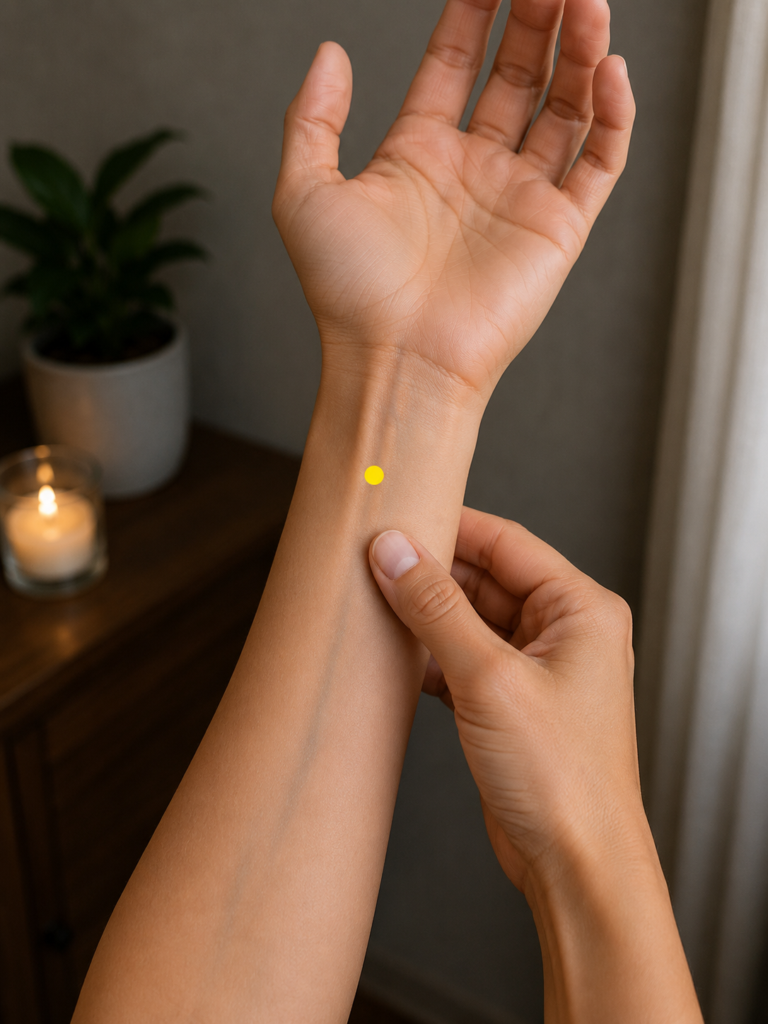
4. Press on PC6 on the inner forearm to settle nausea and motion sickness. PC6 sits three finger-widths above the inner wrist crease, in the center of the forearm between the two tendons. Press firmly with your thumb for one to three minutes on each arm. PC6 is called “Neiguan,” the “Inner Pass.”
PC6 is the most studied point for nausea and motion sickness, which are common symptoms of vestibular migraine. Located above the wrist, it can be pressed while lying still with your eyes closed, making it a convenient first point to try during an attack. Anti-nausea wristbands also provide continuous pressure on this point.
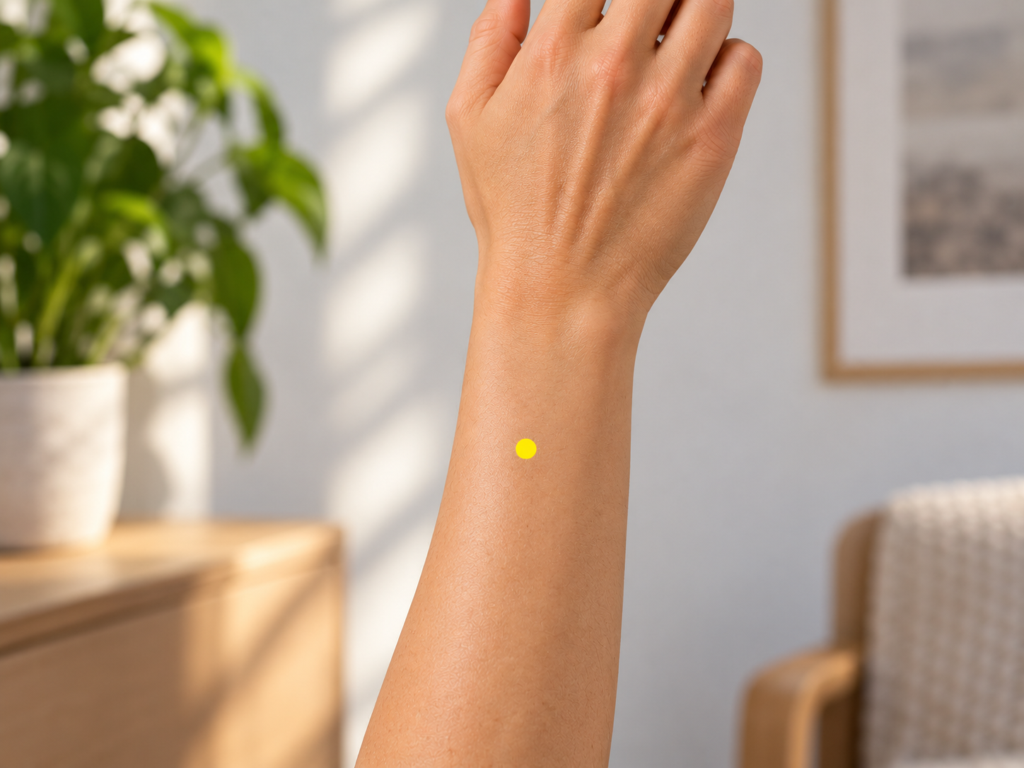
5. Press on SJ5 on the back of the forearm for the sides of the head. SJ5 sits on the back of the forearm, about three finger-widths above the wrist crease, in the hollow between the two forearm bones. Press firmly with your thumb for one to two minutes on each arm. SJ5 is called “Waiguan,” the “Outer Pass.”
SJ5 activates the channel running up the neck, around the ear, and to the temple. It is commonly combined with GB41 on the foot to address migraines and head-side pain, with both points working in tandem from the hand and foot. Since SJ5 is directly opposite PC6, you can press both points on the forearm simultaneously.
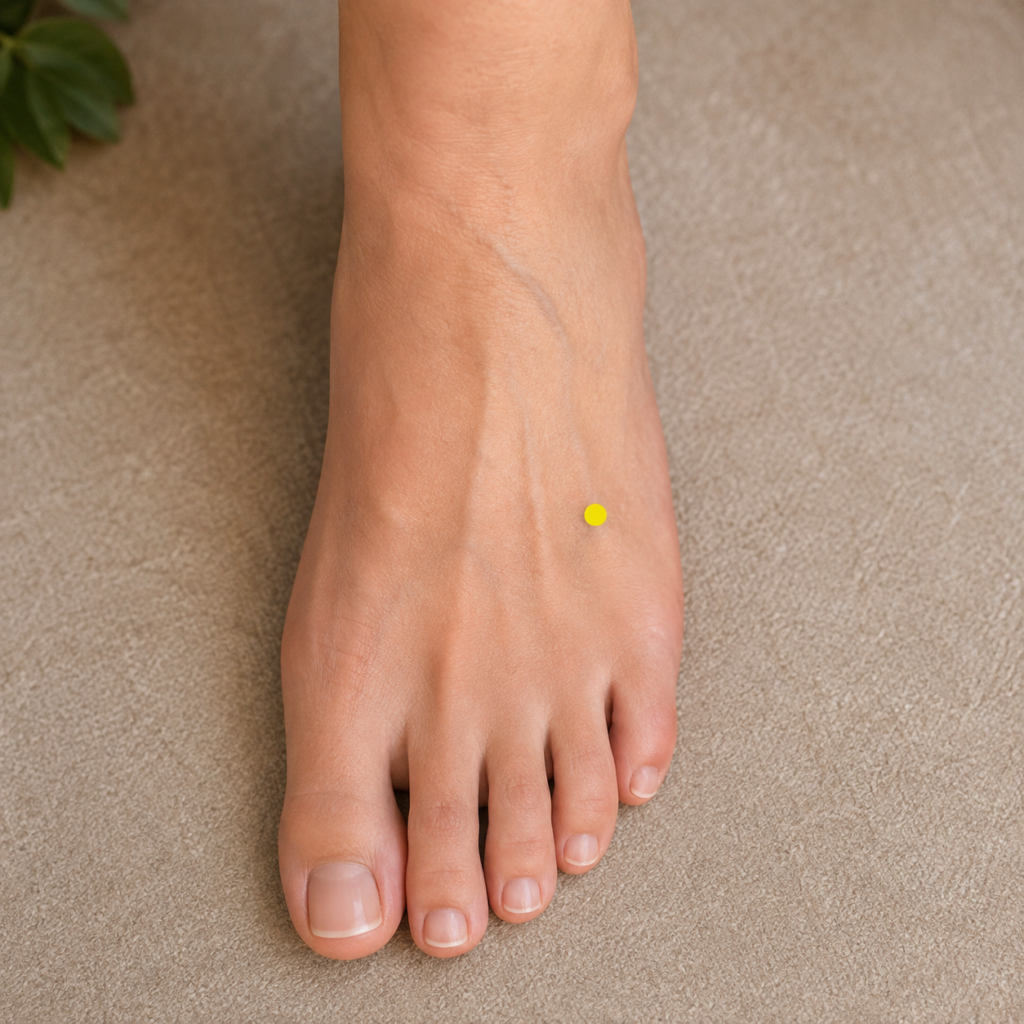
6. Press on GB41 on the top of the foot to draw migraine down. GB41 sits on the top of the foot, in the hollow between the bones leading to the fourth and fifth toes, just in front of where those bones meet. Press firmly with your thumb for one to two minutes on each foot. GB41 is called “Zulinqi.”
GB41 lies on the Gallbladder channel, running along the side of the head where migraines often occur. It is a well-known point for treating one-sided headaches and migraines. When combined with SJ5, these points collaborate from above and below to help direct rising energy down toward the feet.
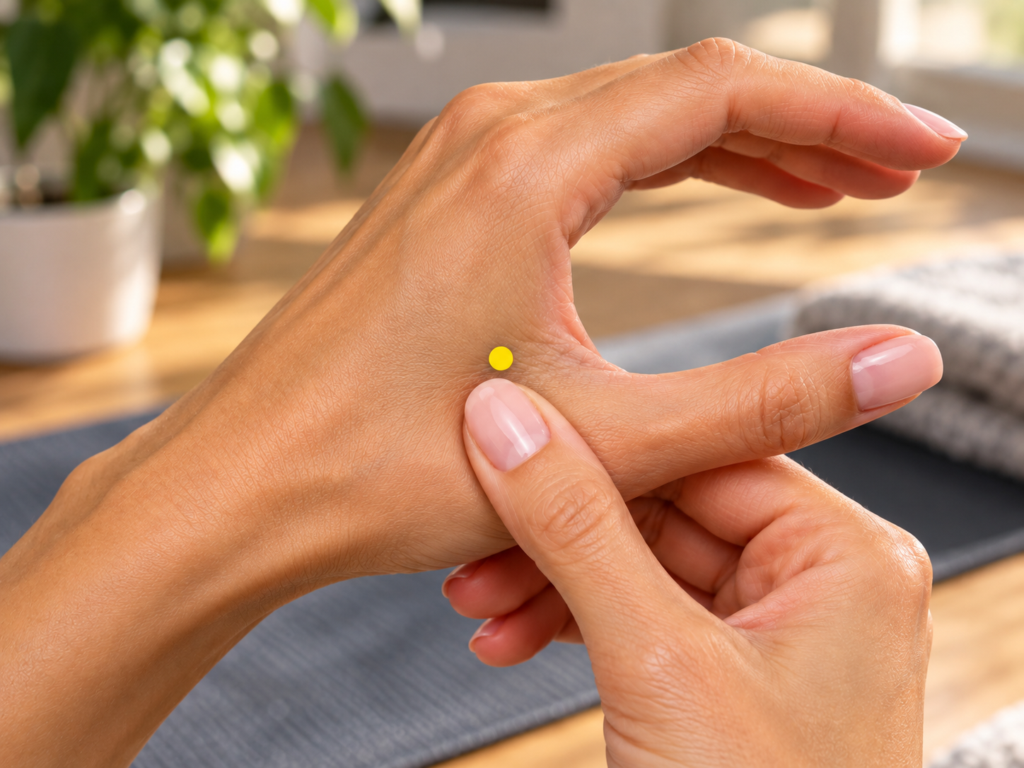
7. Press on LI4 in the hand to ease head pain. LI4 sits in the webbing between the thumb and index finger, at the highest point of the muscle when you bring the thumb and index finger together. Press firmly with the thumb of your other hand for one to two minutes on each hand. LI4 is called “Hegu.” LI4 is avoided during pregnancy.
LI4 is a key acupoint for the head and face, known as one of the most potent points for pain relief in the body. When combined with LR3, it creates the Four Gates, a traditional pairing that calms the entire system and alleviates pain.
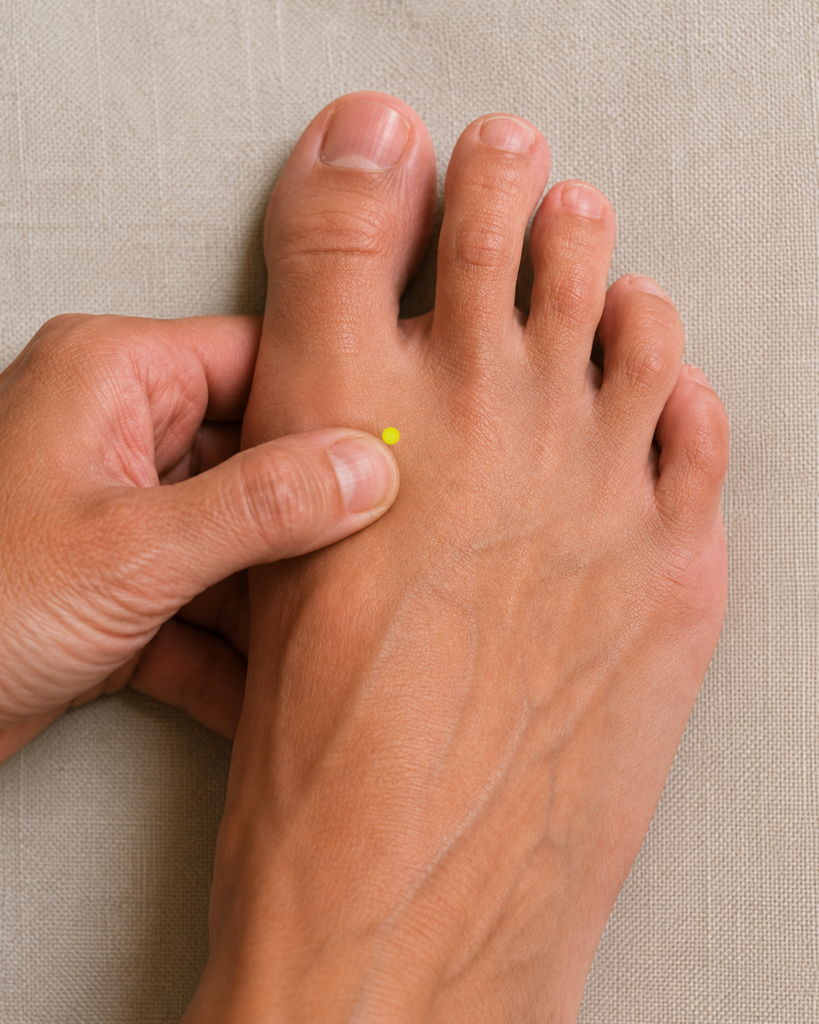
8. Press on LR3 on the top of the foot to bring rising Yang down. LR3 sits on the top of the foot, in the webbing between the big toe and second toe, about two finger-widths back where the bones meet in a small hollow. Press firmly with your thumb for one to two minutes on each foot. LR3 is called “Taichong.”
LR3 is key for calming the Liver Yang rising pattern, which often causes migraines. It helps channel energy downward from the head and relieves stress that can trigger attacks. When combined with LI4, it completes the Four Gates,
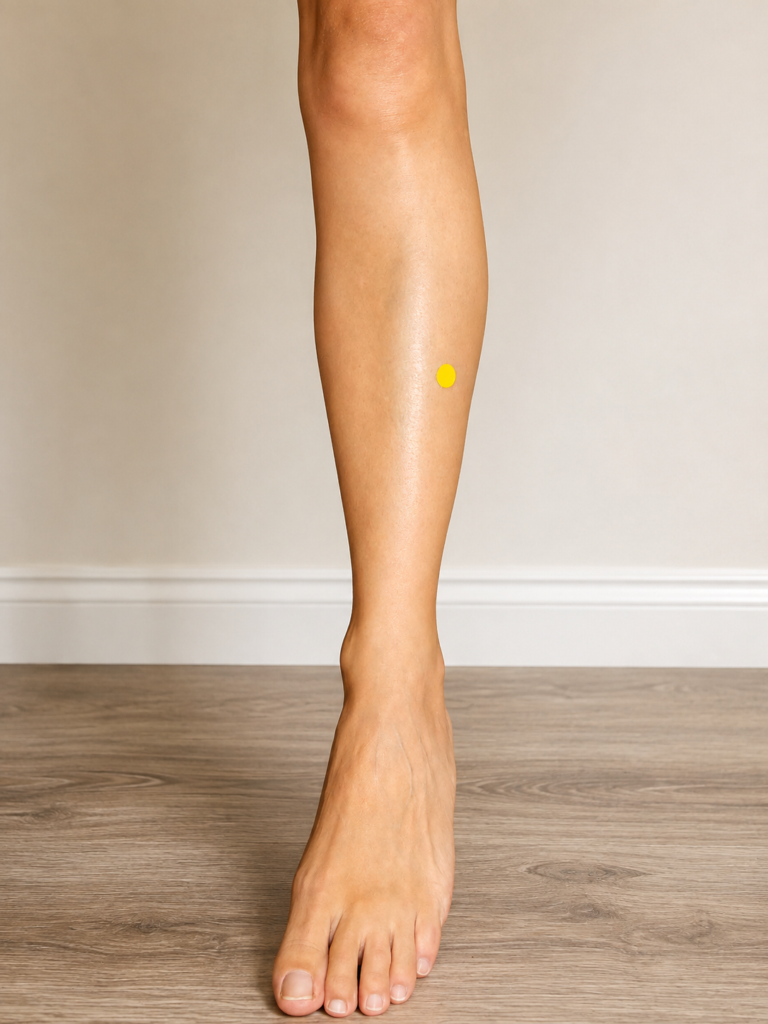
9. Press on ST40 on the lower leg to clear a foggy, heavy head. ST40 sits on the outer lower leg, midway between the knee and the outer ankle bone, about two finger-widths to the outside of the shinbone. Press firmly with your thumb for one to two minutes on each leg. ST40 is called “Fenglong.”
When attacks lead to a heavy, foggy head and nausea, Chinese medicine interprets this as phlegm clouding the mind. ST40 is the key point for clearing this and is recommended for daily use between attacks.
Why These Acupressure Points Work
In Traditional Chinese Medicine, vestibular migraine is associated with rising Liver Yang and wind, phlegm clouding the head, and low Blood. The nine points are used to treat these patterns.
- The head points (GB20, Taiyang, Yintang) help calm wind, relieve head pain, and soothe light sensitivity.
- The channel pair (SJ5, GB41) influences the sides of the head from both the hand and the foot.
- The Four Gates (LI4, LR3) help reduce pain and direct rising energy downward.
- The stomach point and clearing points (PC6, ST40) help alleviate nausea and clear the mind.
A Cochrane review shows that acupuncture can decrease the frequency of migraines, producing results comparable to certain preventive medications. However, due to limited research on vestibular migraine specifically, acupressure should be used as a complementary approach alongside medical treatment.
How to Properly Use These Acupressure Points
During an attack:
- Lie down in a quiet, dark room, keeping your head still and well-supported.
- Press PC6 on both wrists to alleviate nausea, then apply LI4 and LR3.
- If possible, press GB20 and Taiyang gently without moving your head.
- Take slow breaths and wait until the dizziness fully subsides before standing, walking, or driving.
Between attacks:
- Perform the entire routine once daily, maintaining each point for one to two minutes.
- Press together the pairs SJ5 and GB41, and LI4 and LR3.
- Practice this routine consistently over several weeks to reduce the frequency and severity of attacks.
Managing triggers is one of the most effective ways to treat vestibular migraine. Keep a diary recording attacks, sleep patterns, meals, stress levels, menstrual cycle, and foods to identify patterns. Maintain a consistent sleep schedule, even on weekends, and avoid skipping meals. Stay well-hydrated with plenty of water. Common food triggers include aged cheese, red wine, other alcohol, chocolate, processed meats, and foods containing MSG, though triggers vary per individual. Limit screen time, take breaks from visually busy environments, manage stress with slow breathing and regular movement, and wear sunglasses in bright light. Vestibular rehabilitation with a trained physical therapist can further help decrease motion sensitivity between attacks.
When to Get Professional Help
A doctor must diagnose vestibular migraine, as other serious issues can also lead to dizziness and headache. Seek emergency help if you experience sudden, intense vertigo or a headache unlike your usual, especially with symptoms like slurred speech, weakness or numbness on one side, double vision, trouble walking, facial drooping or confusion. These may indicate a stroke. Immediate medical attention is vital if you have a headache with fever and stiff neck, dizziness or headache after a head injury, sudden hearing loss in one ear, fainting or aura symptoms lasting over an hour. Consult your doctor if your attacks become more frequent or severe, if they started or changed after age fifty or if they interfere with daily life. Preventive treatments can be beneficial.
Acupressure can aid in managing vestibular migraines and should be used alongside your medical treatment.
Above and Beyond Acupuncture offers acupuncture, cupping, and lifestyle coaching at the North Frank Lloyd Wright Boulevard location in Scottsdale.
Schedule an appointment online to start your healing journey.
The points above are only as effective as the technique used to apply them. Where to press, how firmly, and for how long all affect the result. For a full breakdown of how to perform acupressure properly at home, read Performing Acupressure in 3 Easy Steps.
For migraine without dizziness, acupressure for migraines is the companion post, and for dizziness from other causes, acupressure for vertigo and acupressure for dizziness address these conditions specifically.

About the Publisher
Paul Kerzner, L.Ac., is a licensed acupuncturist and board-certified herbalist, as well as the founder of Above and Beyond Acupuncture in Scottsdale. His own journey from chronic patient to practicing acupuncturist shapes his commitment to providing honest, clinically grounded information about acupuncture and Traditional Chinese Medicine. Learn more about Paul and his clinical approach on the About Us page.