Key Takeaways
- Tennis elbow is caused by repetitive activities, leading to pain in the outer elbow and forearm.
- Acupressure can relieve this pain by using specific points to improve Qi and Blood flow.
- Key points include LI11 at the elbow, LI10 on the forearm, and the Ashi points on tender spots.
- Utilize channel points like SJ5 and LI4 for systemic pain relief and GB34 for tendon support.
- Combine acupressure with rest and rehabilitation for optimal recovery from tennis elbow.
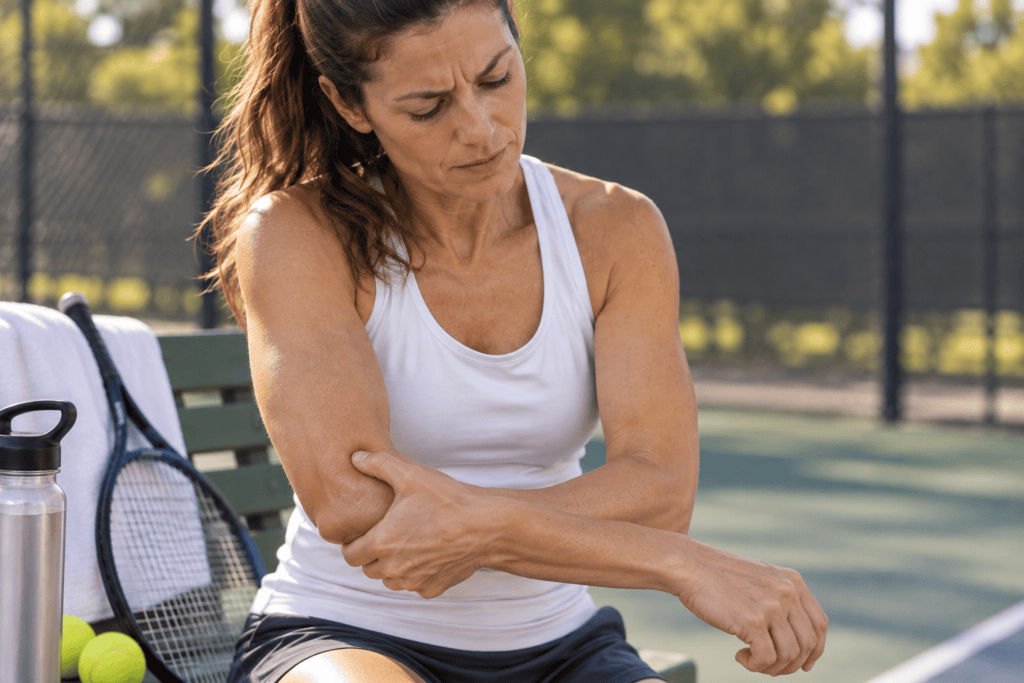
Tennis elbow can cause pain during daily activities like holding a mug, turning a doorknob, shaking hands, or lifting a bag, resulting in discomfort on the outer elbow and forearm.
Although commonly called tennis elbow, this condition often results from repetitive activities such as gripping, twisting, typing, or lifting, rather than just playing tennis. It occurs when the tendons that connect your forearm muscles to the outer elbow become strained and inflamed. The pain may persist for weeks or months, causing frustration. Acupressure provides a method to reduce this pain, relax the forearm, and aid healing by using your own hands. The following arm points can help relieve tennis elbow.
In Traditional Chinese Medicine, tennis elbow is understood as a blockage of Qi and Blood in the channels passing through the elbow, known as Bi syndrome or painful obstruction. Repetitive use and strain can cause Qi and Blood to stagnate in muscles and tendons, leading to pain, stiffness, and tenderness. Because the Large Intestine channel runs along the outer arm, where tennis elbow pain occurs, several treatment points are located in this region. The nearby Triple Burner and Lung channels may also be involved. Cold and dampness in the joint can sometimes worsen symptoms. The points listed below are intended to stimulate Qi and Blood flow, clear the channels, relax tense muscles and tendons, reduce pain, and support tendon healing.
For the clinical side of this, acupuncture for tennis elbow covers how it is approached in the treatment room.
Here are nine acupressure points that can help:
What Acupressure Points to Press and Why
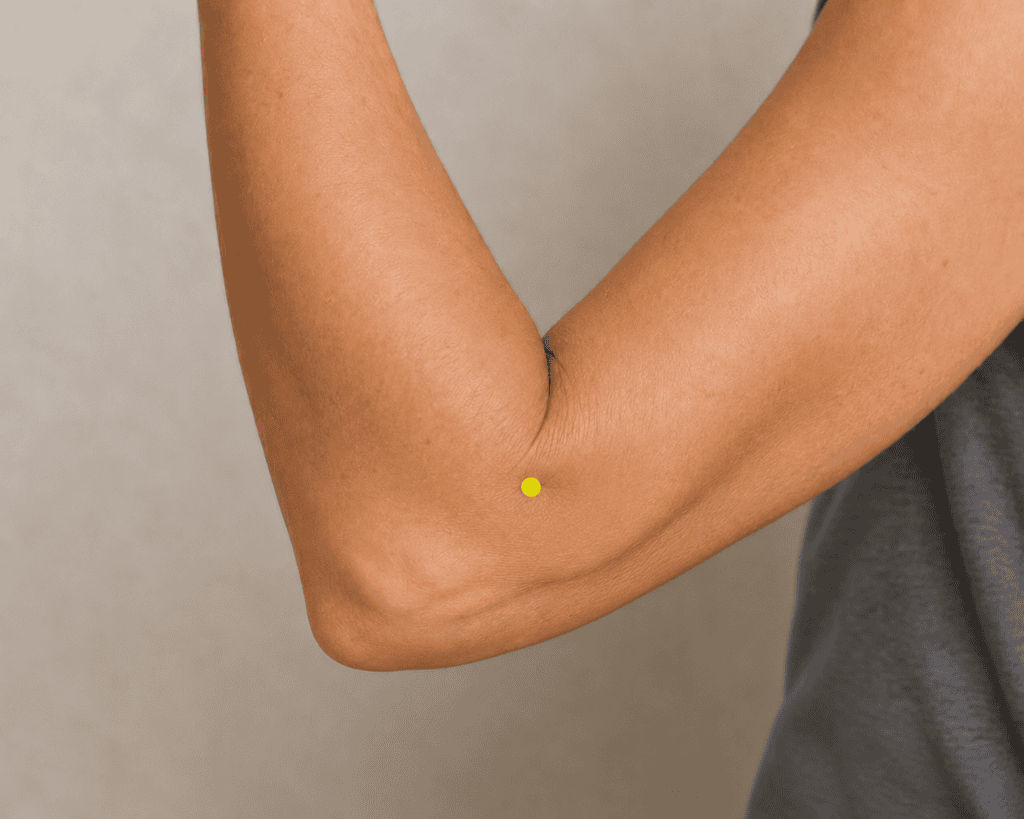
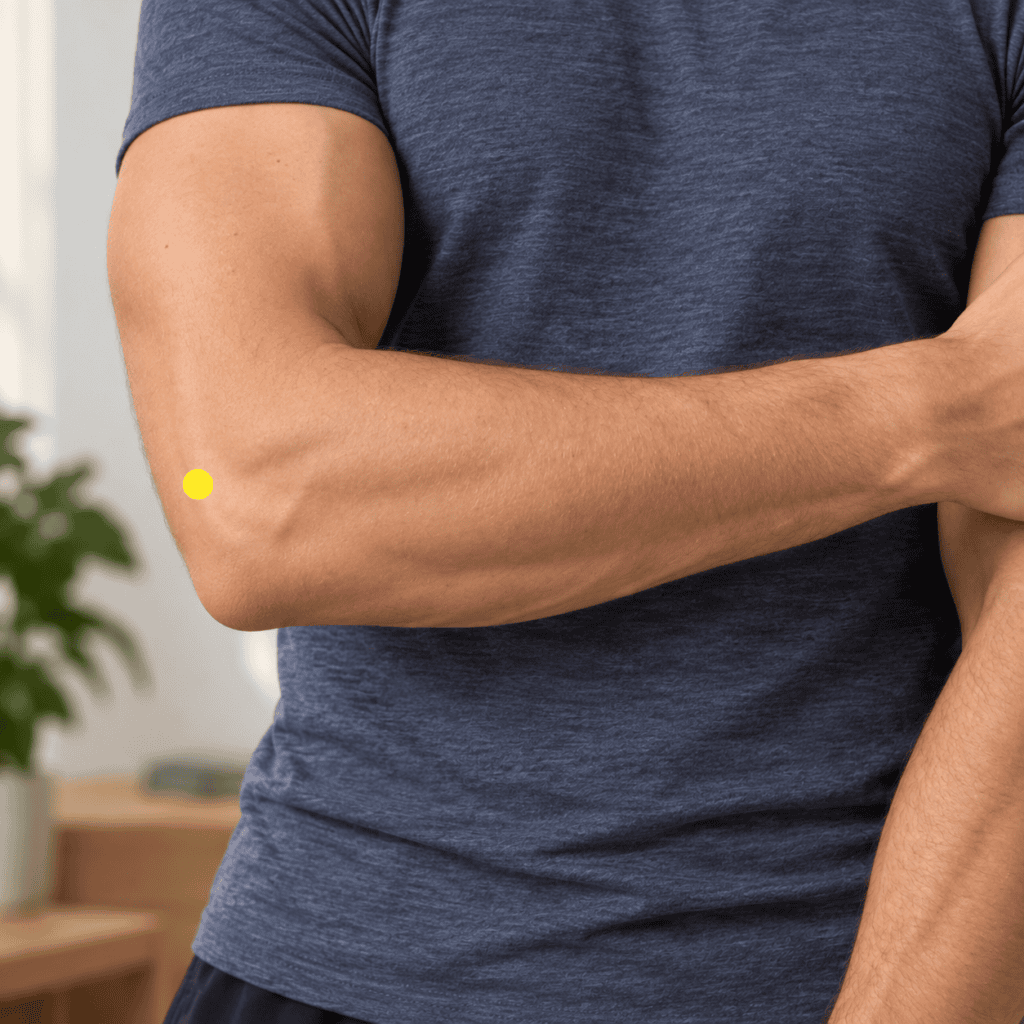
1. Press on LI11 at the elbow crease, the primary point for tennis elbow. LI11 sits at the outer end of the elbow crease, in the hollow that forms when you bend your elbow, right where the crease ends on the thumb side. Press firmly with your thumb for one to two minutes on the affected arm. LI11 is called “Quchi,” and it is the single most important point for the elbow.
The most important point for treating tennis elbow is located on the outer elbow, along the Large Intestine meridian, near the attachment of the damaged tendons. It is the primary point for all types of elbow pain, as it helps move stagnant Qi and Blood, reducing pain and inflammation directly at the site. Additionally, it dispels heat, which is beneficial for an inflamed and irritated elbow. This point should be treated first; given its proximity to the painful tendon, apply steady, moderate pressure instead of pressing too hard on tender areas. For the pain at the outer elbow characteristic of tennis elbow, this point is vital.
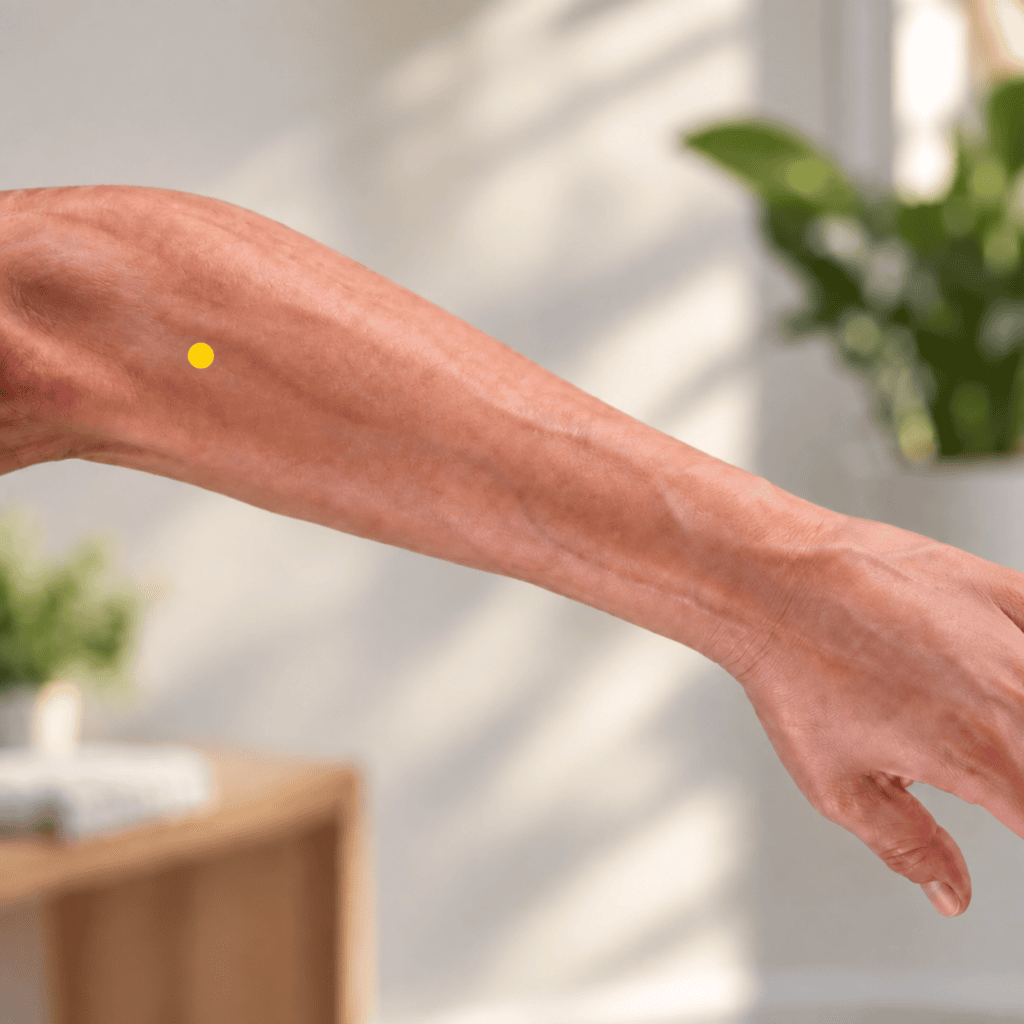
2. Press on LI10 on the forearm for pain and tight extensors. LI10 sits on the top of the forearm, about three finger-widths below LI11, in the muscle that bulges when you make a fist, on the Large Intestine channel. Press firmly with your thumb for one to two minutes on the affected arm. LI10 is called “Shousanli,” a key point for the arm and elbow.
The LI10 point is located within the forearm extensor muscles, which are also affected by tennis elbow, making it a precise and effective treatment option. It helps reduce pain and relieve tension and tightness in the overused forearm muscles that strain the injured tendon and can worsen the condition. Applying pressure and massage to this point, along with the surrounding tight muscles, can alleviate discomfort throughout the entire forearm. Because this point directly targets the pain and tightness associated with tennis elbow, regular stimulation is advised.
3. Press on the Ashi points right at the sorest spot. The Ashi points are wherever the tenderness is greatest, usually the bony bump on the outer elbow and the taut, sore bands in the forearm just below it. Feel for the most tender spots and press each with your thumb, firmly but tolerably, for a minute or so. “Ashi” means “that’s it,” the sound of finding the exact sore point.
In Traditional Chinese Medicine, Ashi points, tender spots indicating congestion of Qi and Blood, are targeted directly. For tennis elbow, these include the outer elbow and the rope-like muscles in the upper forearm. Applying firm but tolerable pressure to these points helps alleviate localized stagnation. If any spot becomes sharply inflamed, reduce the pressure. Using gentle massage on the sore forearm along with stimulating these tender points is a highly effective method to alleviate the condition.
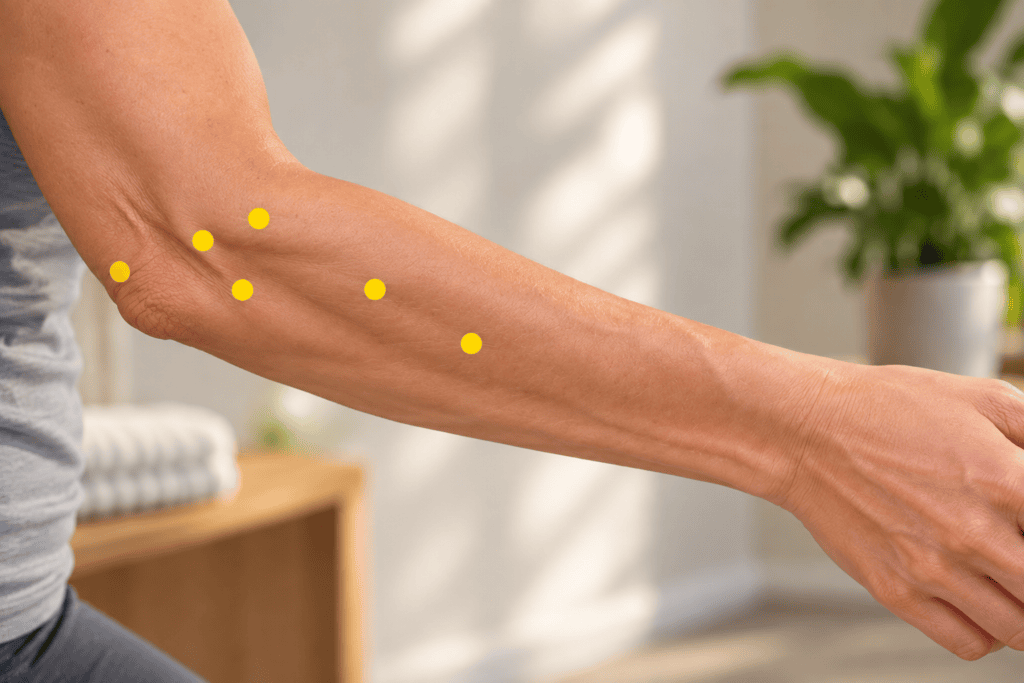
4. Press on SJ5 on the outer forearm to open the channel. SJ5 sits on the outer forearm, about three finger-widths above the wrist crease, in the hollow between the two forearm bones, on the back of the arm. Press firmly with your thumb for one to two minutes on the affected arm. SJ5 is called “Waiguan,” the “Outer Pass,” and it is a major point for the outer arm.
SJ5 is a crucial point for the arm and elbow, activating the meridian that runs along the back of the forearm and extends past the elbow to the area affected by tennis elbow. It promotes the flow of Qi and Blood in the outer arm, helping to alleviate pain and stiffness in this region. It works effectively with nearby Large Intestine points from the adjacent meridian. When tennis elbow pain radiates down the back of the forearm, this point assists in releasing the entire outer arm, making it a valuable addition to local elbow points.
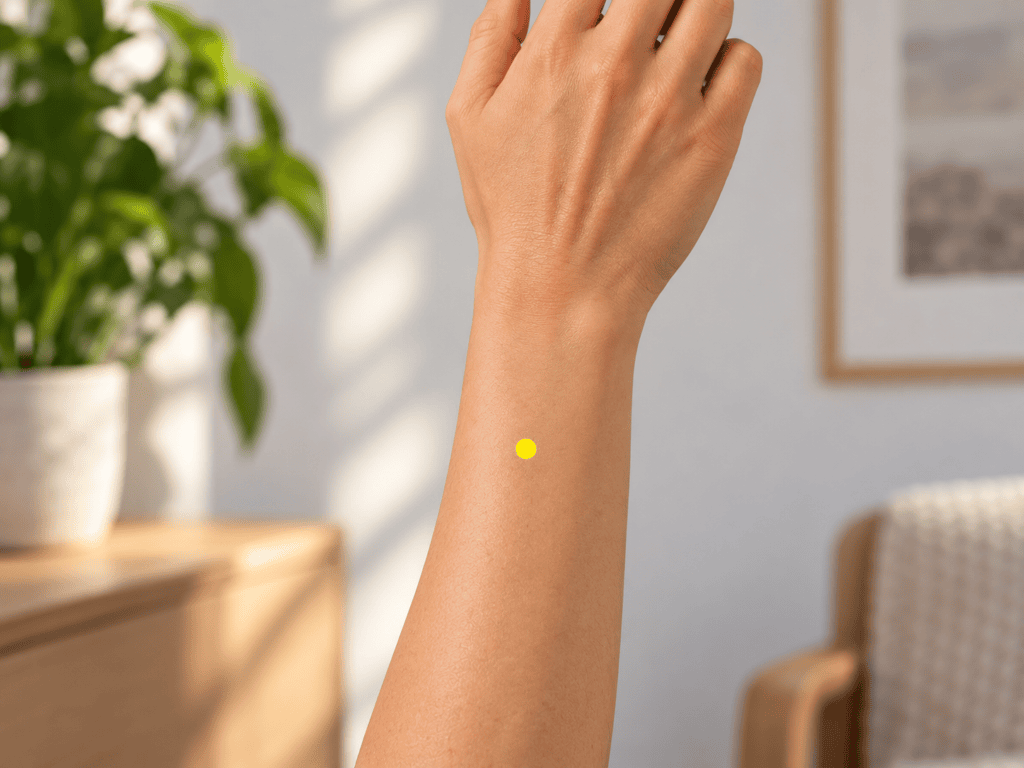
5. Press on SJ10 behind the elbow for the joint itself. SJ10 sits just behind the elbow, in the hollow directly above the tip of the elbow, the bony point of the olecranon, when the elbow is bent. Press firmly with your thumb or finger for one to two minutes on the affected arm. SJ10 is called “Tianjing,” a local point for the elbow.
SJ10 is situated at the elbow joint on the Triple Burner meridian and is an important local point for alleviating pain, stiffness, and tendon and sinew problems around the joint. It affects the posterior aspect of the elbow, working alongside LI11 on the front and side, providing treatment from different perspectives. For deep aching, stiffness, or conditions like tennis elbow, SJ10 penetrates to the affected area and should be used whenever the outer bump of the elbow is stiff, sore, or tender.
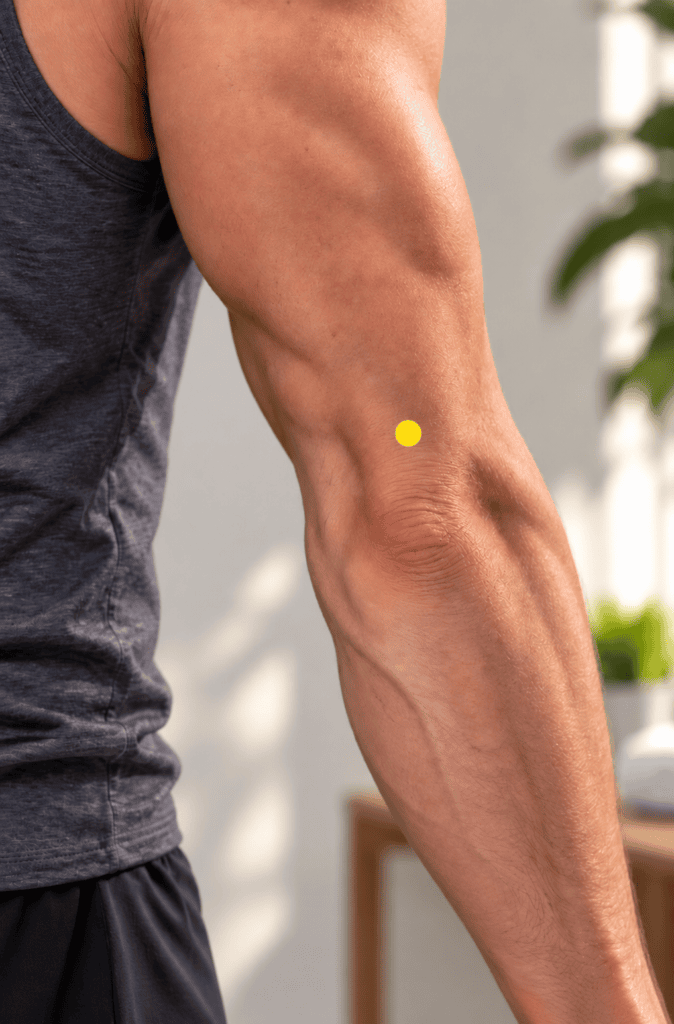
6. Press on LU5 at the elbow crease for the joint and the arm. LU5 sits on the inner elbow crease, on the thumb side, just outside the big tendon you can feel in the middle when you bend your elbow. Press firmly with your thumb for one to two minutes on the affected arm. LU5 is called “Chize,” and it is a point for the elbow and the arm.
LU5 is situated at the front of the elbow crease. While it aligns with the Lung channel near the thumb side, it is especially useful for easing elbow pain and relaxing the arm. It supports the outer-elbow points by focusing on the front of the elbow, helping to relieve tension in the elbow and forearm, and reducing joint discomfort. This point is particularly beneficial for those with tennis elbow that affects the entire elbow rather than just the bony outer part, as it completes the local treatment. Combining LU5 with LI11, located just across the crease, offers a comprehensive approach to elbow relief.
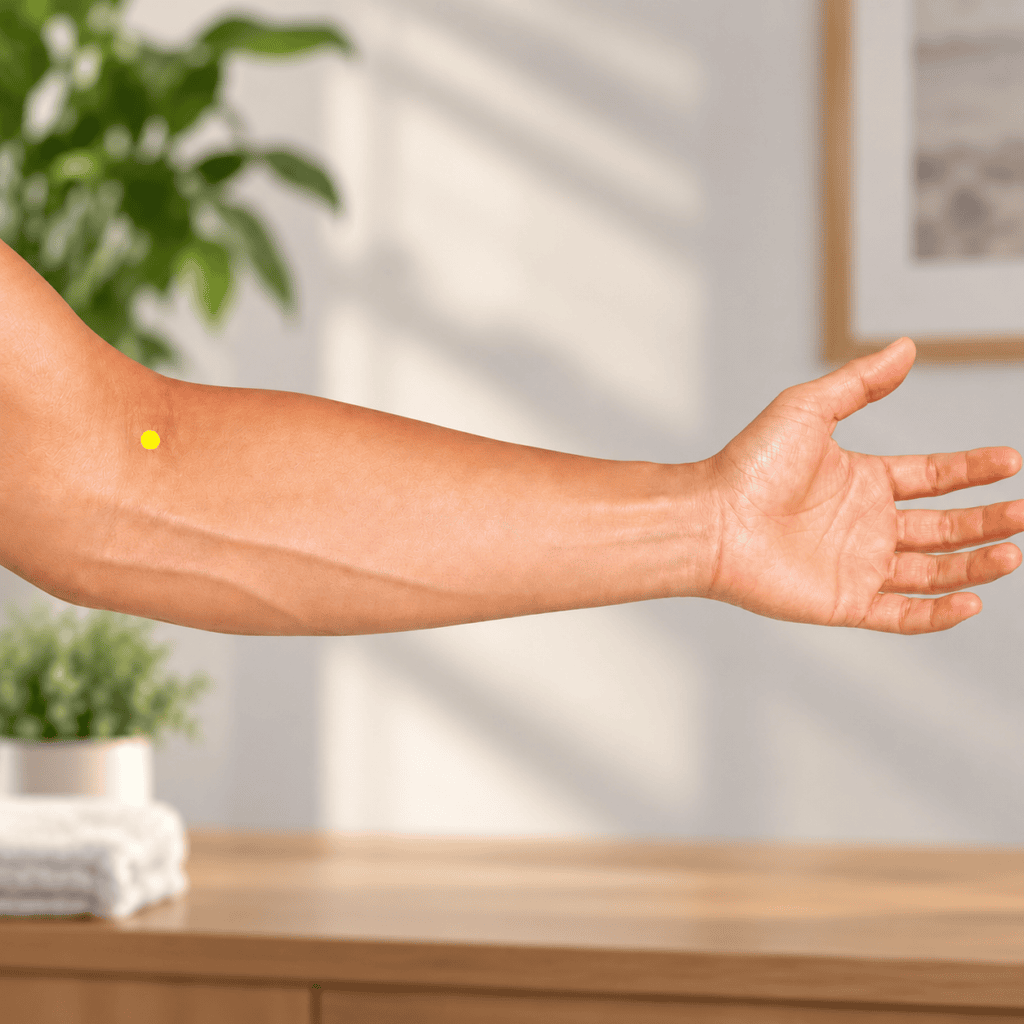
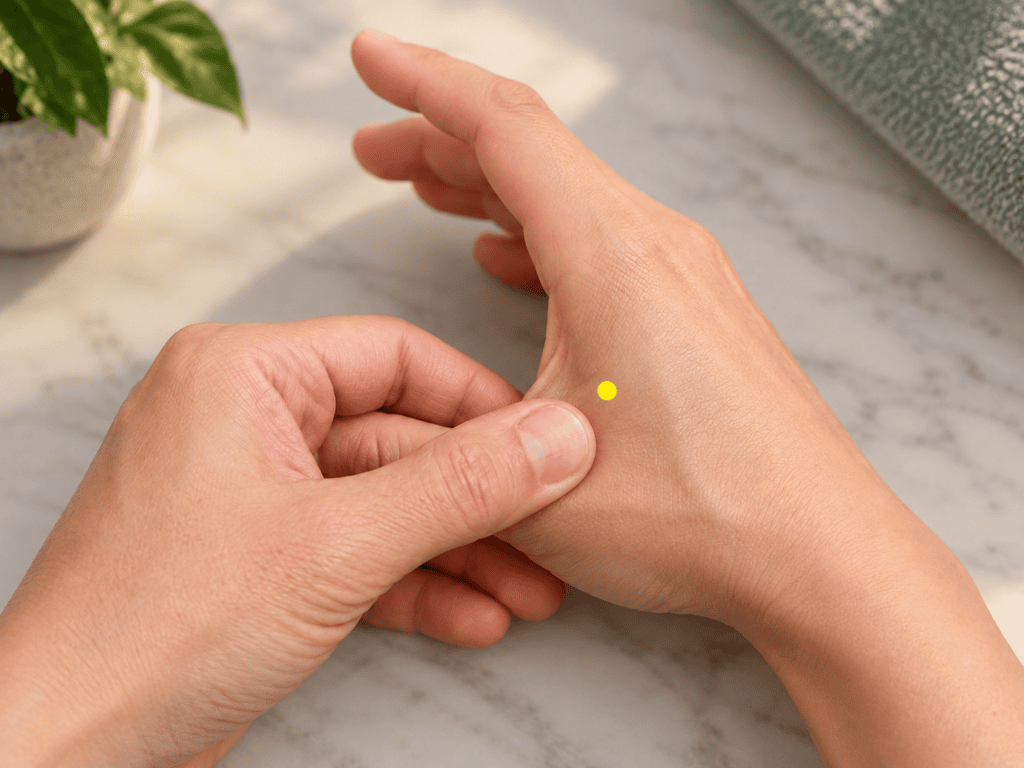
7. Press on LI4 in the hand to relieve pain along the channel. LI4 sits in the webbing between the thumb and index finger, at the highest point of the muscle when you bring the thumb and finger together. Press firmly with the thumb of your other hand for one to two minutes on the affected side. LI4 is called “Hegu,” the command point of the Large Intestine channel and one of the great pain-relieving points. LI4 is avoided during pregnancy.
LI4 is a crucial point on the Large Intestine meridian, passing through the arm and associated with tennis elbow. Applying pressure here stimulates Qi flow and alleviates pain along the meridian from the hand to the elbow. It’s particularly effective for general pain relief and can even ease elbow pain from a distance. Since LI4 is on the hand, away from the painful area, it can be pressed firmly without worsening the injury, making it ideal for frequent use. For pain along the entire meridian, this distal point provides a dependable option.
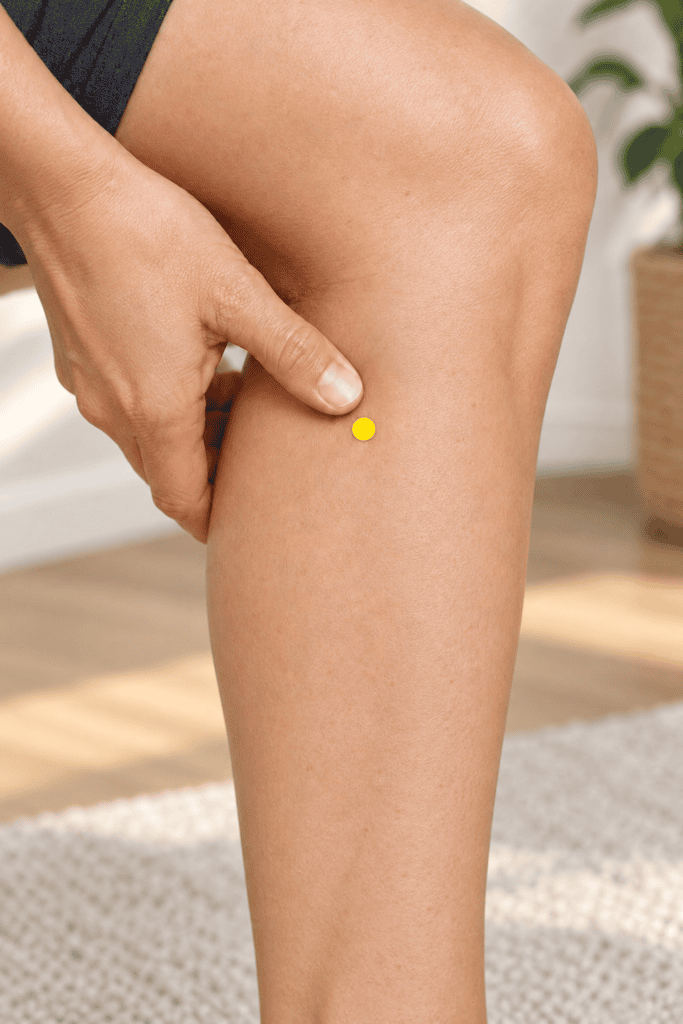
8. Press on GB34 below the outer knee to support the tendons. GB34 sits on the outer lower leg, in the hollow just below and in front of the head of the fibula, the bony knob below the outer side of the knee. Press firmly with your thumb for one to two minutes on each leg. GB34 is called “Yanglingquan,” and it is the influential point for the sinews and tendons of the whole body.
Tennis elbow mainly involves the tendons. GB34, situated on the leg and far from the elbow, is significant due to its effect on sinews and tendons across the body. It is frequently employed in treating tendon or sinew injuries, helping to promote healing and relaxation. In cases like tennis elbow, this point directly influences the tendon tissue, offering focused support for the elbow tendons.
9. Press on LI12 near the outer elbow for the local tendon attachment. LI12 sits just above and to the outer side of LI11, near the bony bump of the lateral epicondyle where the injured tendons attach, on the outer elbow. Press gently to firmly with your fingertip for about a minute on the affected arm. LI12 is called “Zhouliao,” a local point for the outer elbow.
LI12 is located right next to the lateral epicondyle, exactly where the forearm extensor tendons attach and where tennis elbow pain occurs. This makes it a precise point for targeted treatment. It addresses both pain and local stagnation at the tendon insertion, the root of the issue. Because this area is often tender and inflamed, use gentle, steady pressure and lessen it if sharp pain arises, avoiding forceful pressure. For pain at the outer elbow bump, this point directly targets it and completes the local treatment around the injured tendon.
Why These Acupressure Points Work
In Traditional Chinese Medicine, tennis elbow is seen as a painful blockage resulting from stagnant Qi and Blood in the elbow’s channels and tendons, usually caused by overuse. The main involvement is the Large Intestine channel, which runs along the outer elbow. The nine points aim to address these factors.
- The local elbow points (LI11, LI12, SJ10, LU5) move the stagnant Qi and Blood right at the injured elbow, treating it from multiple angles.
- The forearm and Ashi points (LI10, the tender spots) release the tight, overworked extensor muscles and the sorest points where the blockage is worst.
- Channel points SJ5 and LI4 stimulate the outer-arm channels and help reduce pain along the entire affected area. LI4 serves as the command point for the Large Intestine channel, which passes directly through the tennis elbow region.
- The tendon point (GB34) supports the healing of the sinews and tendons throughout the body.
The main focus is on relieving tension at the elbow and relaxing the overworked forearm, which explains why combining targeted point work with gentle massage of the sore muscles is highly effective.
How to Properly Use These Acupressure Points
Apply pressure to the affected side and gently massage the sore forearm.
- Start with LI11 at the elbow and LI10 on the forearm, then work the Ashi points at the sorest spots, pressing firmly but within your tolerance, and easing off any acutely inflamed spot.
- Add SJ5, SJ10, LU5, and LI12 to treat the elbow and outer arm from several angles, and LI4 and GB34 from a distance for pain relief and tendon support.
- Massage the tight forearm muscles and pressure points, since releasing the overworked muscles takes strain off the injured tendon.
- Hold each point for one to two minutes, press gently on acutely inflamed areas, and work the points a few times a day.
While acupressure can ease pain and support recovery, tennis elbow heals most effectively with rest and proper rehab. It’s important to give your arm a break from activities that caused the injury and to monitor your use, but avoid keeping it completely immobilized for too long. The tendon needs gradual, appropriate movement to recover. The best treatment includes targeted strengthening exercises, especially slow, controlled eccentric movements, ideally learned from a physical therapist. Applying ice can help reduce sharp pain and inflammation. A forearm strap or brace can reduce strain during activity, and gentle forearm stretching is beneficial.
Acupressure offers pain relief and support, but should complement other treatments rather than replace them.
When to Get Professional Help
Most cases of tennis elbow improve with rest, rehabilitation, and time, though recovery may be slow and take several months. During this period, acupressure can help manage symptoms. Consult a doctor or physical therapist if the pain is severe, persists after several weeks of self-care, or keeps recurring. A physical therapist can recommend effective strengthening exercises, while a doctor can confirm the diagnosis and discuss other treatment options if necessary.
Seek immediate medical attention if your pain follows a specific injury or fall, if you notice significant swelling, bruising, or deformity, if you’re unable to move or use your arm, or if you experience numbness, tingling, or weakness in your hand or fingers.
Above and Beyond Acupuncture offers acupuncture, cupping, and lifestyle coaching at the North Frank Lloyd Wright Boulevard location in Scottsdale.
Schedule an appointment online to start your healing journey.
The points above are only as effective as the technique used to apply them. Where to press, how firmly, and for how long all affect the result. For a full breakdown of how to perform acupressure properly at home, read Performing Acupressure in 3 Easy Steps.

About the Publisher
Paul Kerzner, L.Ac., is a licensed acupuncturist and board-certified herbalist, as well as the founder of Above and Beyond Acupuncture in Scottsdale. His own journey from chronic patient to practicing acupuncturist shapes his commitment to providing honest, clinically grounded information about acupuncture and Traditional Chinese Medicine. Learn more about Paul and his clinical approach on the About Us page.