
Key Takeaways
- Dental anxiety is very common, and putting off visits because of it increases the risk of dental problems, which can make the next visit even harder.
- Telling the dentist about the anxiety, agreeing on a stop signal, slow breathing, and music or an audiobook all help make appointments easier.
- In Traditional Chinese Medicine, fear unsettles the Kidney and scatters the Qi, the unsettled Heart lets the mind race, and the channels of the Stomach and Large Intestine run directly through the gums and jaw.
- Nine acupressure points on the head, face, wrists, hands, and feet help calm the mind, quiet the gag reflex, relax a clenched jaw, and ease discomfort, and most can be pressed in the waiting room or the chair.
- Acupressure for dental anxiety works best alongside open communication with the dental team, and facial swelling, fever, or trouble swallowing or breathing needs urgent care.

Dental anxiety can become a self-fulfilling prophecy. A cleaning gets put off, then delayed again. A little sensitivity turns into a toothache, and the visit that eventually happens is far more involved than a routine checkup. That longer appointment can make the next visit feel like an even bigger hurdle. For some people, the anxiety starts with a single painful visit years ago. For others, it’s the noise, the smell of the office, lying in the chair, or being unable to speak or swallow.
The American Dental Association’s MouthHealthy site says that if you get nervous just thinking about the dentist, you’re not alone. Delaying or skipping visits raises the risk of dental problems, but regular checkups make things easier over time. The ADA recommends telling your dentist about your anxiety, mentioning it when you book, agreeing on a signal like raising your hand for a break, counting slow breaths, and bringing headphones for music or an audiobook.
When you feel anxious in the dental chair, your body may react before you notice. Your jaw can clench, your shoulders may tense, your hands may grip the armrests, and your breathing may become shallow or stop briefly. Some people also have a strong gag reflex, which can make impressions, X-rays, or work on the back teeth more difficult. Worrying about gagging can create even more tension.
In Traditional Chinese Medicine, fear is connected to the Kidney, which is also associated with bones and teeth. Fear can cause Qi to descend and scatter, leaving the Heart, which houses the mind, without an anchor. This can lead to racing thoughts and physical tension. The Stomach and Large Intestine channels pass through the gums and jaw, so points along these channels are used to address mouth tension and discomfort. Tight Liver Qi can cause jaw clenching and a strong need for control.
The nine points below may help calm your mind, ease your gag reflex, relax your jaw, and reduce discomfort. You can press most of them discreetly while waiting or sitting in the dental chair.
What Acupressure Points to Press and Why
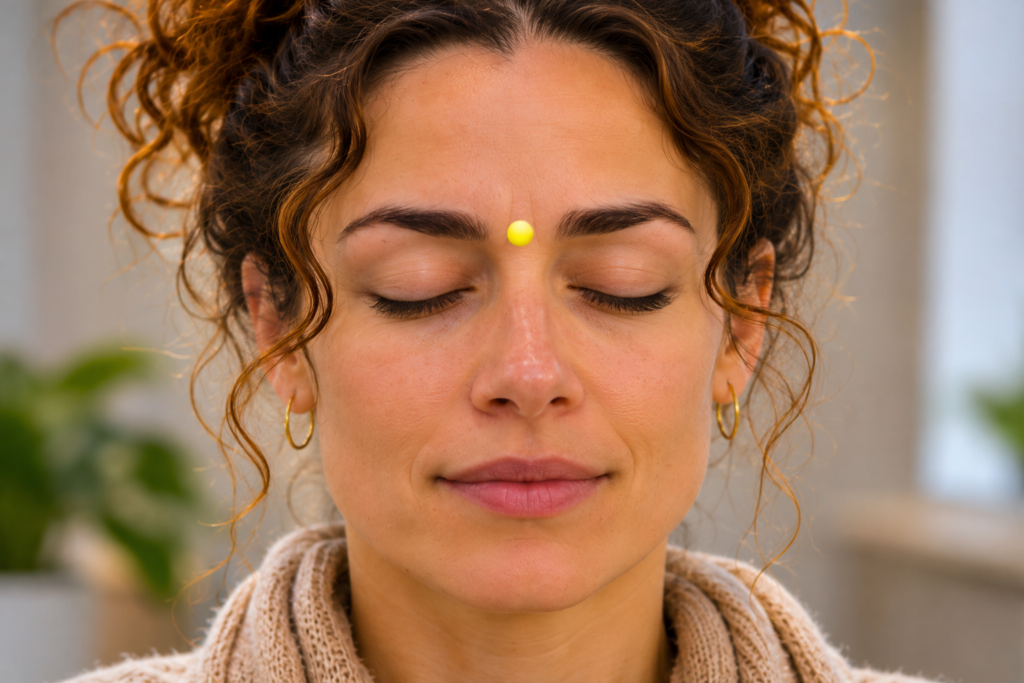
1. Press on Yintang between the eyebrows to calm the mind. Yintang sits on the midline of the forehead, directly between the inner ends of the eyebrows. Press gently with your fingertip, or make slow, small circles, for one to two minutes with the eyes closed. Yintang is called the “Hall of Impression.”
Yintang is an extra point traditionally used to calm the mind and ease anxiety. It’s especially practical for dental anxiety because you can press it in the waiting room or just before your appointment begins.
2. Press on GV20 on the top of the head to settle the spirit. GV20 sits on the midline at the very top of the head, where a line drawn from the tops of the ears meets the center of the skull. Press gently with your fingertip, or make slow, small circles, for one to two minutes. GV20 is called “Baihui,” the “Hundred Meetings.”
GV20, located at the top of the head, is where many channels meet. Traditionally, it is used to calm the mind, ease anxiety, and counter the scattered, overwhelmed feeling that fear can bring.

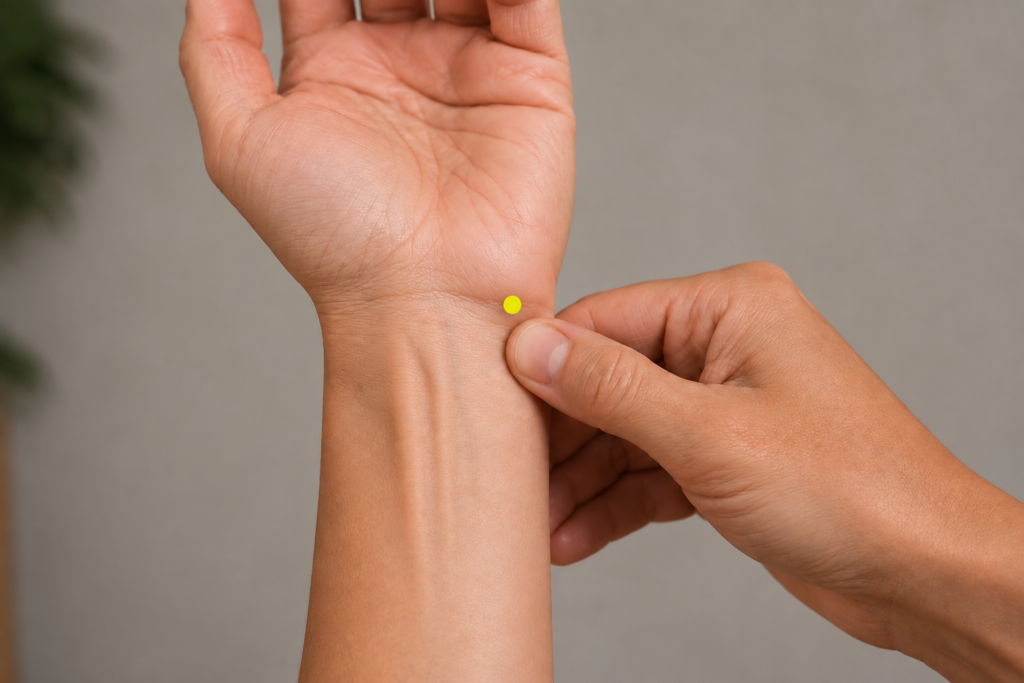
3. Press on HT7 on the wrist crease to settle a racing heart. HT7 sits on the inner wrist crease, on the pinky side, in the small hollow just to the thumb side of the tendon that runs along the edge of the wrist. Press gently with the thumb of your other hand for one to two minutes on each wrist. HT7 is called “Shenmen,” the “Spirit Gate.”
In Traditional Chinese Medicine, HT7 is the Heart’s source point, and the Heart houses the mind. It is one of the most important points for anxiety, fear, and a pounding heart. You can press it while seated, with your hands resting in your lap.
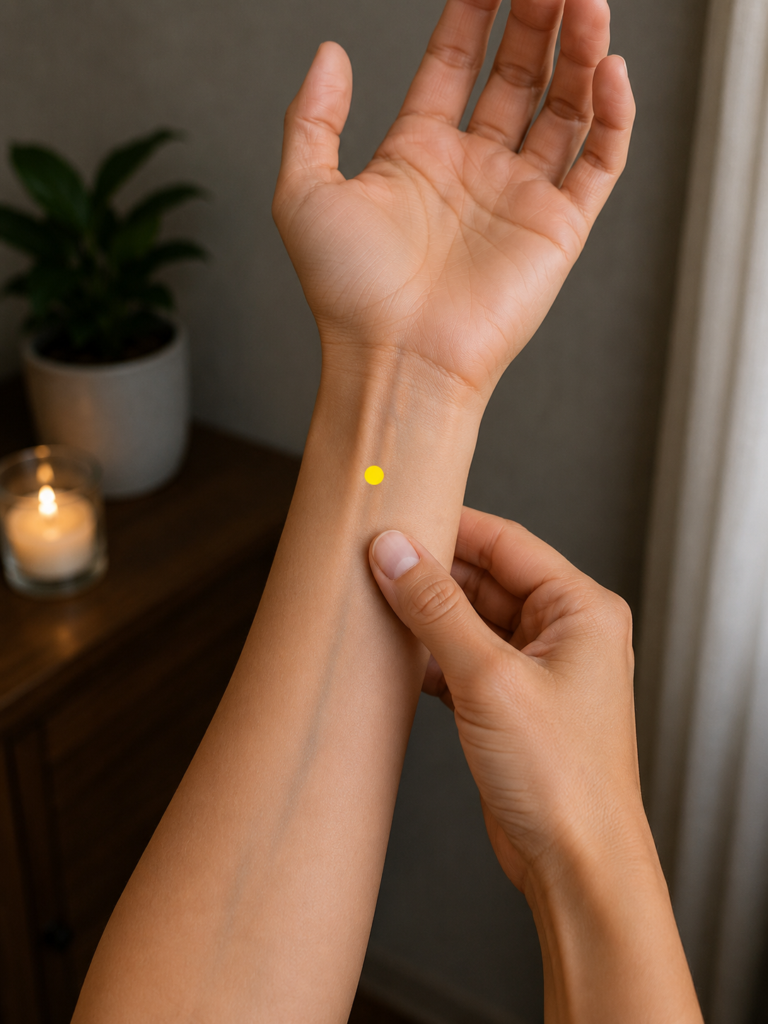
4. Press on PC6 on the inner forearm to calm the nerves and the gag reflex. PC6 sits on the inner forearm, three finger-widths above the wrist crease, between the two tendons. Press firmly with the thumb of your other hand for one to two minutes on each arm while breathing slowly. PC6 is called “Neiguan,” the “Inner Pass.”
In Traditional Chinese Medicine, PC6 is one of the most widely used points for calming the mind and easing nausea. It can soothe a nervous stomach before an appointment and help quiet the urge to gag during impressions, X-rays, or work on the back teeth.
5. Press on CV24 below the lower lip to quiet the gag reflex. CV24 sits in the small hollow in the center of the chin, just below the lower lip. Press firmly with your fingertip for about one minute before impressions, X-rays, or any step that tends to trigger gagging. CV24 is called “Chengjiang,” the “Container of Fluids.”
CV24 is a traditional point used for mouth, gum, and facial concerns, and is among the best-known acupressure points for easing a strong gag reflex. Pressing it for a minute before the step that triggers gagging can be a simple, practical way to make that step easier.

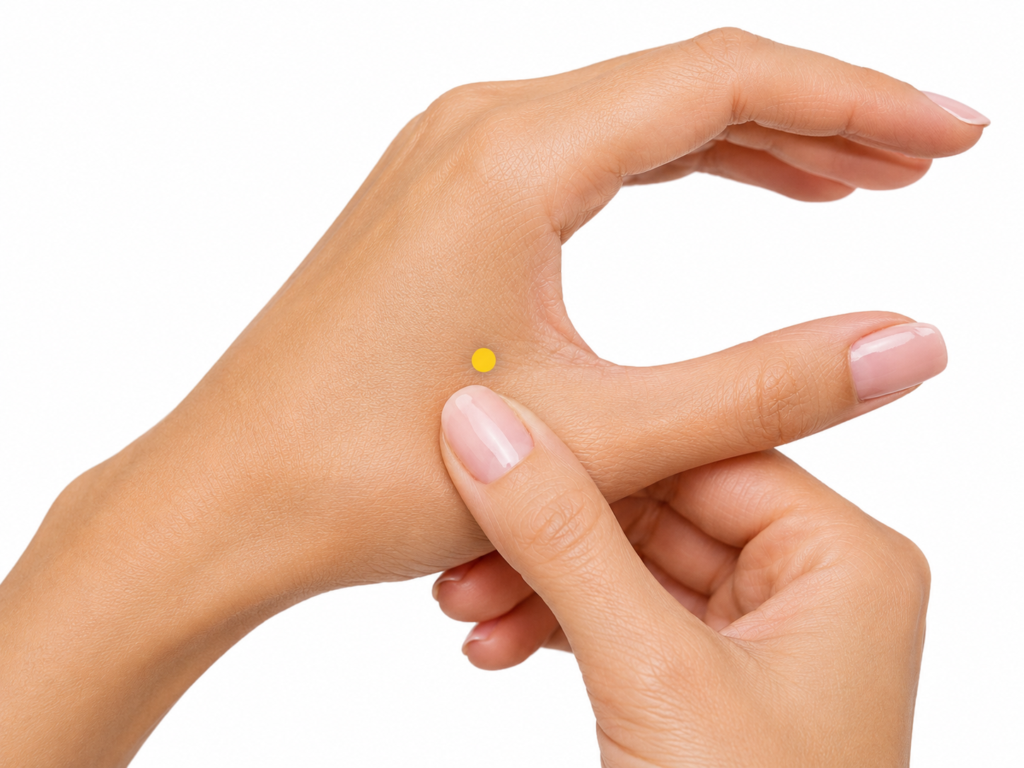
6. Press on LI4 on the back of the hand to ease tension and discomfort. LI4 sits in the webbing between the thumb and index finger, at the highest point of the muscle when the two are pressed together. Press firmly with the thumb of your other hand for one to two minutes on each hand. LI4 is called “Hegu,” the “Joining Valley.” LI4 is avoided during pregnancy.
LI4 is one of the most important points in Traditional Chinese Medicine for the face and mouth. The Large Intestine channel extends to the lower gums, and LI4 is traditionally used to ease tooth and jaw discomfort, as well as tension throughout the body. Paired with LR3, it forms the Four Gates, a classic combination used to calm the whole body.
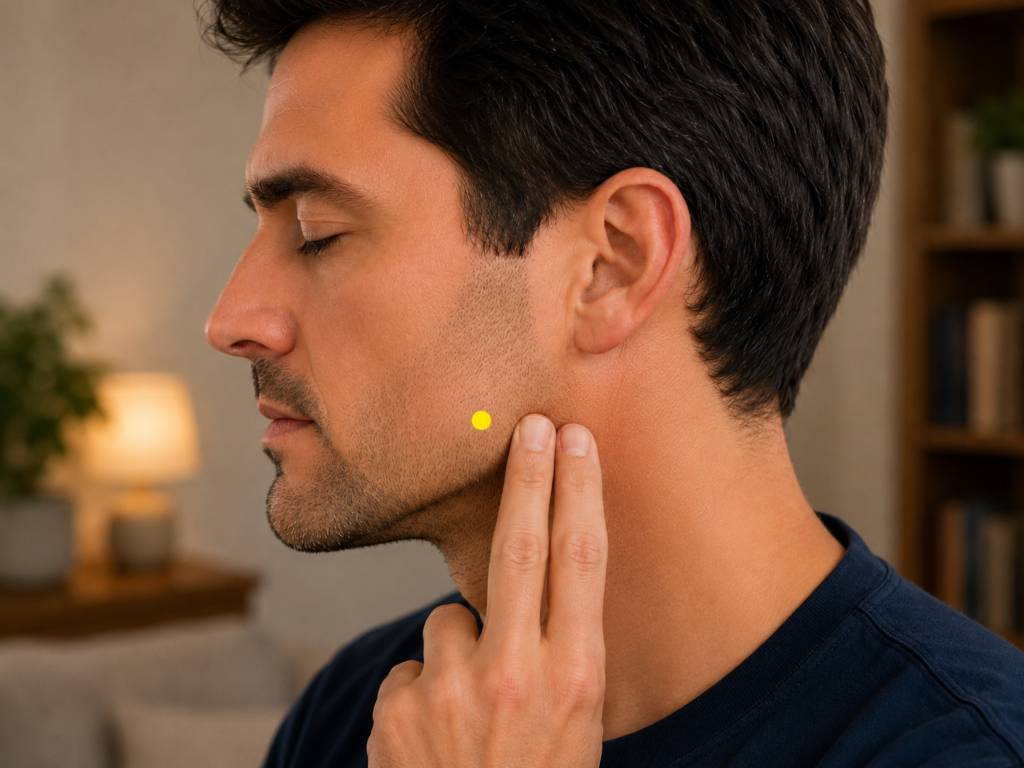
7. Press on ST6 at the angle of the jaw to relax clenching. ST6 sits about one finger-width forward and up from the angle of the jaw, on the muscle that bulges when the teeth are clenched. Press gently with your fingertips for one to two minutes on each side, before and after the appointment, while letting the jaw hang slightly open. ST6 is called “Jiache,” the “Jaw Bone.”
ST6 lies directly over the large chewing muscle that tightens when the jaw braces against fear. It is traditionally used to ease jaw tension, toothache, and stiffness, helping the jaw relax before a long appointment and recover afterward.
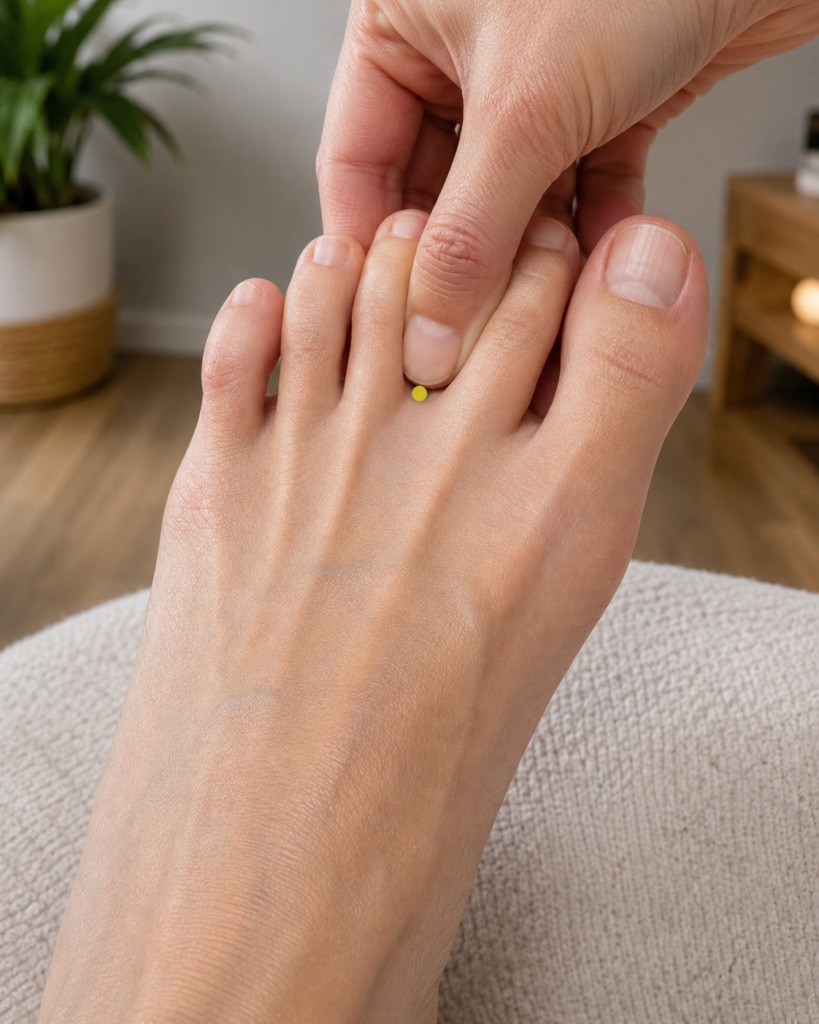
8. Press on ST44 on the top of the foot to calm discomfort in the gums and teeth. ST44 sits on the top of the foot, at the end of the web between the second and third toes. Press firmly with your thumb for one to two minutes on each foot. ST44 is called “Neiting,” the “Inner Courtyard.”
ST44 is a distal point on the Stomach channel, which extends to the upper gums. Traditionally used to relieve toothache, gum pain, and swelling in the mouth, it may be helpful both before an appointment and during recovery.
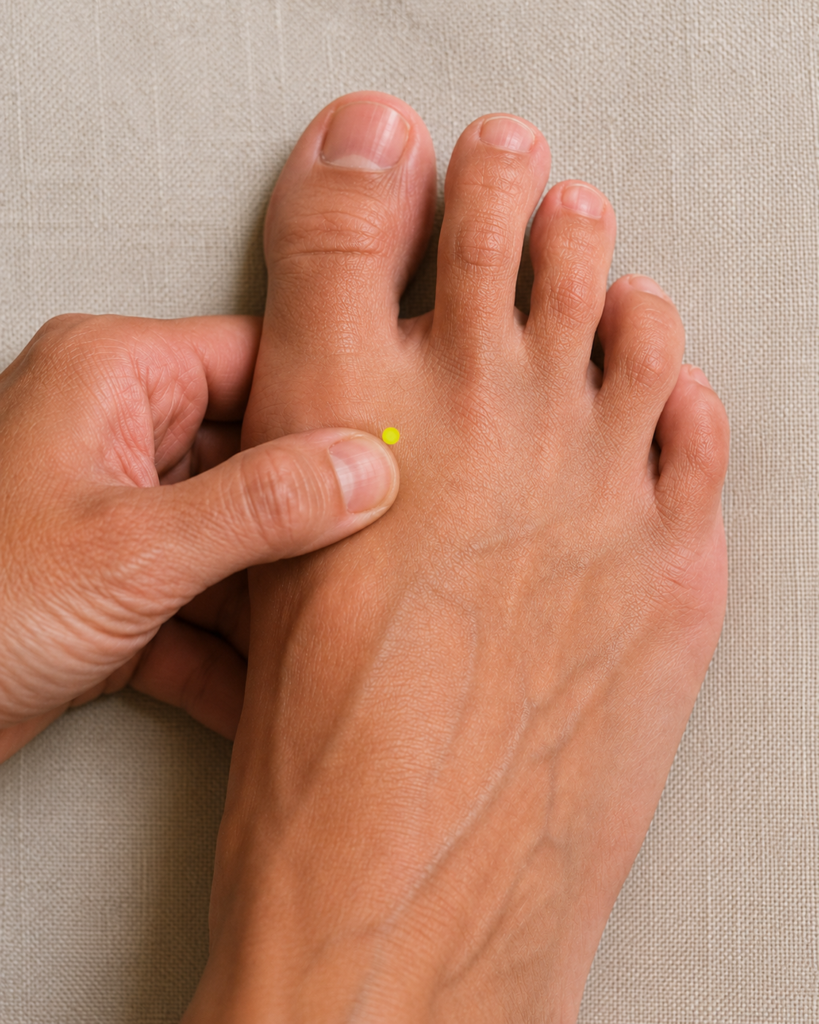
9. Press on LR3 on the top of the foot to release tension and the need for control. LR3 sits on the top of the foot, in the hollow where the bones of the big toe and second toe meet, about two finger-widths above the web between the toes. Press firmly with your thumb for one to two minutes on each foot. LR3 is called “Taichong,” the “Great Surge.”
LR3 is the Liver’s source point, helping Qi flow smoothly. Lying back while someone works in your mouth can feel like a complete loss of control. LR3 helps release the resulting tension and clenching, completing the Four Gates with LI4.
Why These Acupressure Points Work
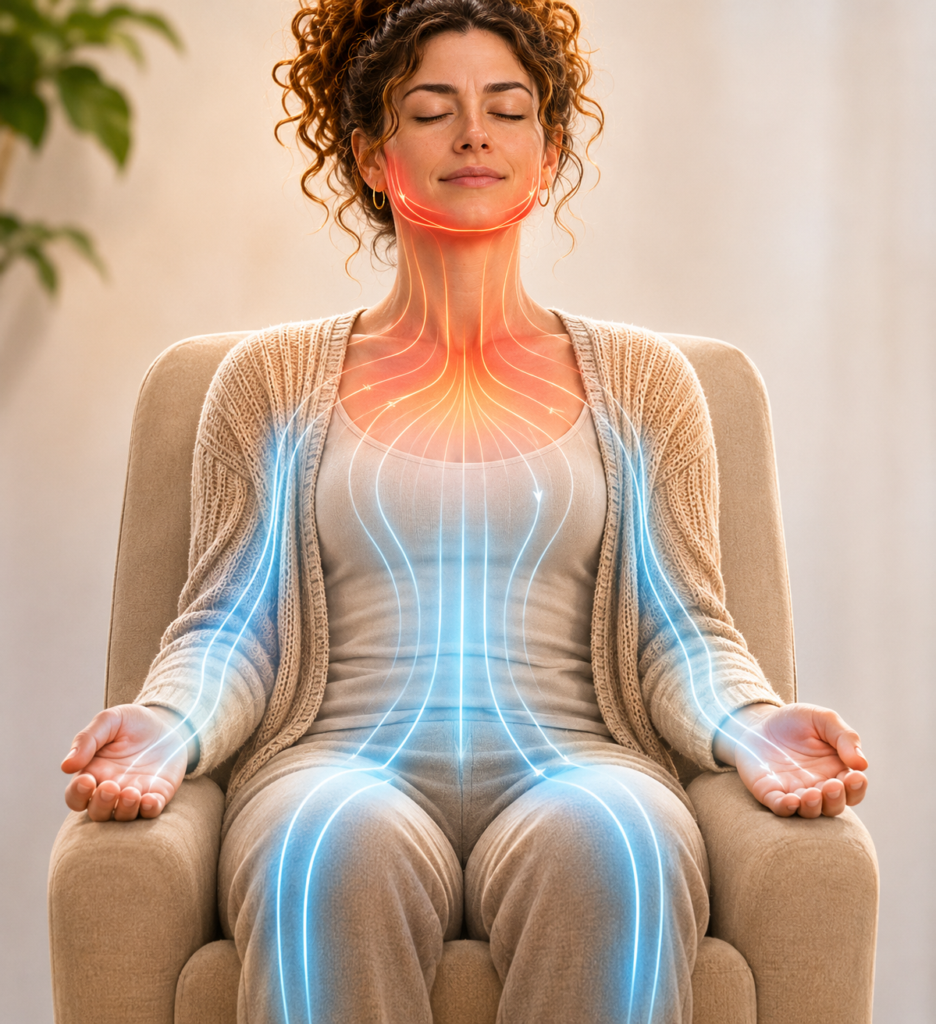
In Traditional Chinese Medicine, dental anxiety is seen as fear scattering the Qi and disturbing the Heart, while constrained Liver Qi tightens the jaw and leaves the body braced. The approach is to calm the mind, quiet the gag reflex, relax the jaw, and use the channels running through the gums and teeth to ease discomfort.
The nine points work together to alleviate fear and relax the mouth and jaw:
- The calming points (Yintang, GV20, HT7) settle the mind and a racing heart.
- The gag reflex points (PC6, CV24) quiet the urge to gag and settle a nervous stomach.
- The jaw and mouth points (ST6, ST44) relax clenching and ease discomfort in the gums and teeth.
- The Four Gates (LI4, LR3) release tension throughout the body and the need to stay in control.
How to Properly Use These Acupressure Points

Acupressure for dental anxiety works best when practiced at home before the appointment and then used as a quiet routine in the waiting room and in the chair.
- Practice all nine points once daily for several days before the appointment, holding each point for one to two minutes to ensure the routine feels familiar.
- In the waiting room, press Yintang, GV20, and ST6 while breathing in slowly and breathing out for the same count.
- While seated, press HT7 or PC6 on one wrist with your hands resting in your lap, then press CV24 for one minute before impressions or X-rays.
- Apply gentle pressure to the face, head, and wrist crease, and firmer pressure to the forearms, hands, and feet.
Building daily habits can help calm your nerves before and during dental visits. Try to schedule your appointment for a time of day when you feel least rushed. Let the receptionist and dentist know about your anxiety so they can help. Agree on a signal, such as raising your hand, if you need a break. Eat a light meal beforehand and avoid extra coffee, which can make your heart race. Bring headphones to listen to music or an audiobook, and focus on slow, steady breathing. Regular checkups and cleanings help keep visits shorter and simpler, making each one easier than the last.
Learn more about why your jaw might clench all the time.
When to Get Professional Help

If dental visits make you anxious, ask your dentist about options such as longer appointments, breaks, or sedation. If fear keeps you from getting dental care, consider talking with a therapist; cognitive behavioral therapy helps many people overcome dental phobia. Be sure to tell your dental team about any medical conditions or medications before a procedure. Seek urgent dental care for severe tooth pain, swelling in your gums or face, or a fever with mouth pain. If swelling spreads toward your eye or neck, or you have trouble swallowing or breathing, call 911 or go to the emergency room immediately.
Acupressure can be a gentle way to help with dental anxiety, but it should be used alongside, not instead of, professional diagnosis and medical care.
For related health concerns, acupressure for a toothache, acupressure for preoperative anxiety, and acupressure for TMJ pain are companion posts.
Above and Beyond Acupuncture offers acupuncture, cupping, and lifestyle coaching at the North Frank Lloyd Wright Boulevard location in Scottsdale.
Schedule an appointment online to start your healing journey.
The points above are only as effective as the technique used to apply them. Where to press, how firmly, and for how long all affect the result. For a full breakdown of how to perform acupressure properly at home, read Performing Acupressure in 3 Easy Steps.

About the Publisher
Paul Kerzner, L.Ac., is a licensed acupuncturist and board-certified herbalist, as well as the founder of Above and Beyond Acupuncture in Scottsdale. His own journey from chronic patient to practicing acupuncturist shapes his commitment to providing honest, clinically grounded information about acupuncture and Traditional Chinese Medicine. Learn more about Paul and his clinical approach on the About Us page.