Key Takeaways
- More than half of all babies experience reflux. It typically begins around two weeks of age, peaks at four to five months, and resolves by 12 to 18 months.
- Most babies with reflux are healthy “happy spitters.” But if reflux leads to poor weight gain, feeding refusal, or breathing problems, a pediatrician should evaluate them.
- In Traditional Chinese Medicine, reflux is understood as Stomach Qi rising instead of descending, often alongside a delicate Spleen or mild excess Heat in the Stomach.
- Nine gentle acupressure points on the hands, arms, chest, belly, legs, and feet may help settle the stomach and reduce spitting up.
- Smaller, more frequent feedings, regular burping, and keeping the baby upright after feedings can help. Babies with reflux should always sleep flat on their backs.

After a feeding, your baby may let out a happy little burp, then bring some of the milk right back up onto your shoulder. Some babies spit up after almost every feeding and remain perfectly content. Others arch their backs, fuss, or pull away from the breast or bottle, leaving parents wondering if something more might be going on. Reflux is a common concern in the early months, and a few gentle strategies may help your baby feel more comfortable.
According to Children’s National Hospital, reflux occurs when stomach contents flow back into the esophagus during or after a feeding, and it affects more than half of all babies. It usually begins around two weeks of age, peaks at four to five months, and resolves in most babies by 12 to 18 months. Most babies with reflux are healthy “happy spitters.” Reflux is called GERD when it causes troublesome symptoms, including coughing, choking, or gagging; fussiness during or after feedings; arching away from the bottle or breast; trouble sleeping; or noisy breathing around feedings. Children’s National Hospital recommends keeping babies upright during feedings and for up to an hour afterward, offering smaller amounts more frequently, burping often, and avoiding tight clothing around the belly.
A baby’s esophagus and stomach are still developing. The muscle ring at the top of the stomach that keeps milk down isn’t fully developed yet. Because babies spend much of the day lying down and consume only liquids, milk can easily come back up. As their muscles strengthen, they start sitting up, and solid foods are introduced, reflux gradually eases on its own.
Traditional Chinese Medicine views healthy Stomach Qi as moving downward and carrying food through digestion. Babies naturally have delicate Spleen and Stomach systems, so when a feeding is too large or too fast, Stomach Qi may rebel upward, bringing milk back up. A baby who spits up sour-smelling, curdled milk, has a red face, and is fussy after feeding is thought to have a little extra Heat in the Stomach. A baby who spits up easily, feeds slowly, and seems tired is thought to have a weak Spleen. Gentle points that encourage Stomach Qi to move downward, settle the Stomach, and strengthen the Spleen may help ease reflux.
The points below begin on the hands and arms, continue to the chest and belly, and end on the legs and feet. For a baby, measure all distances using the baby’s own finger-widths, not an adult’s.
What Acupressure Points to Press and Why
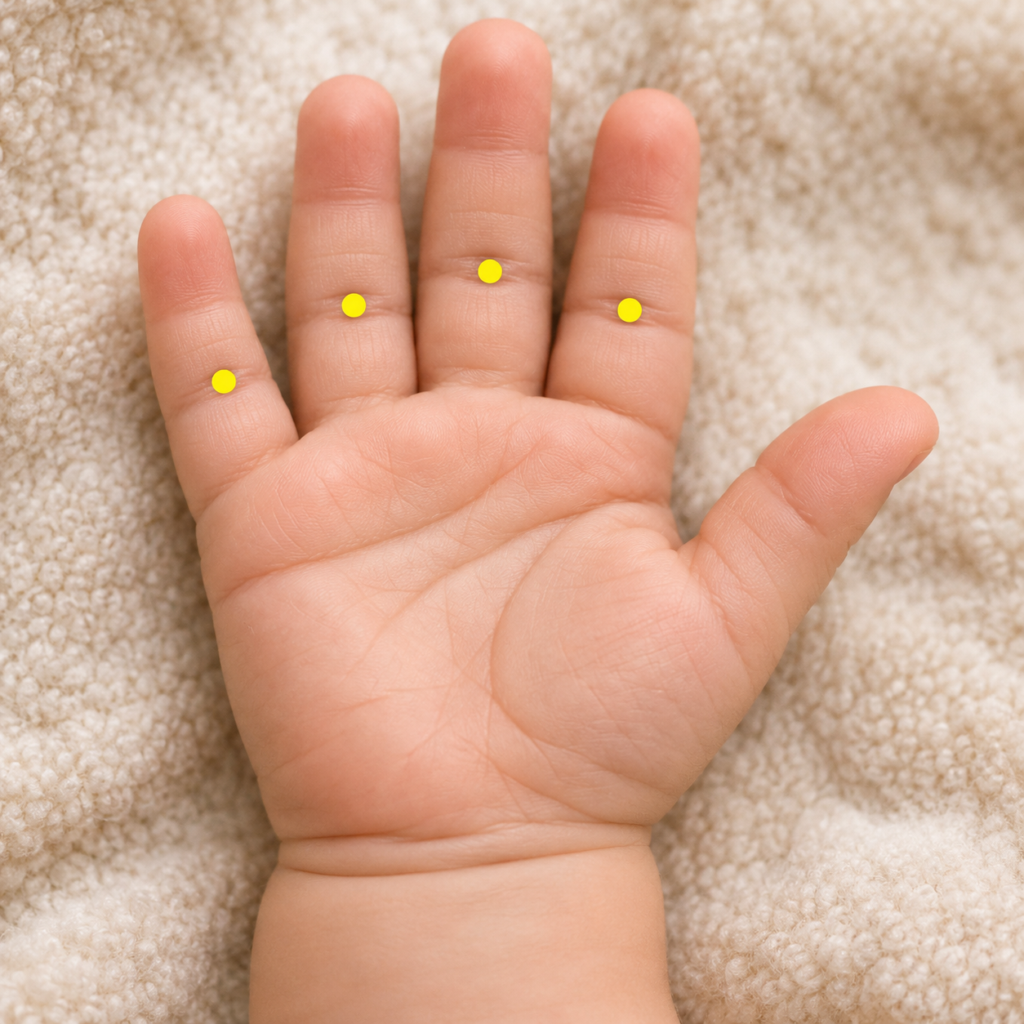
1. Press Sifeng on the fingers to ease digestion. Sifeng is a group of four points on the palm side of the index, middle, ring, and little fingers, at the center of the crease closest to the middle of each finger. Gently press or stroke each crease with your fingertip for a few seconds, moving from finger to finger, for 30 seconds on each hand. Sifeng means the “Four Seams.”
Sifeng is an extra point traditionally used to address poor digestion, spitting up, and food stagnation in children.
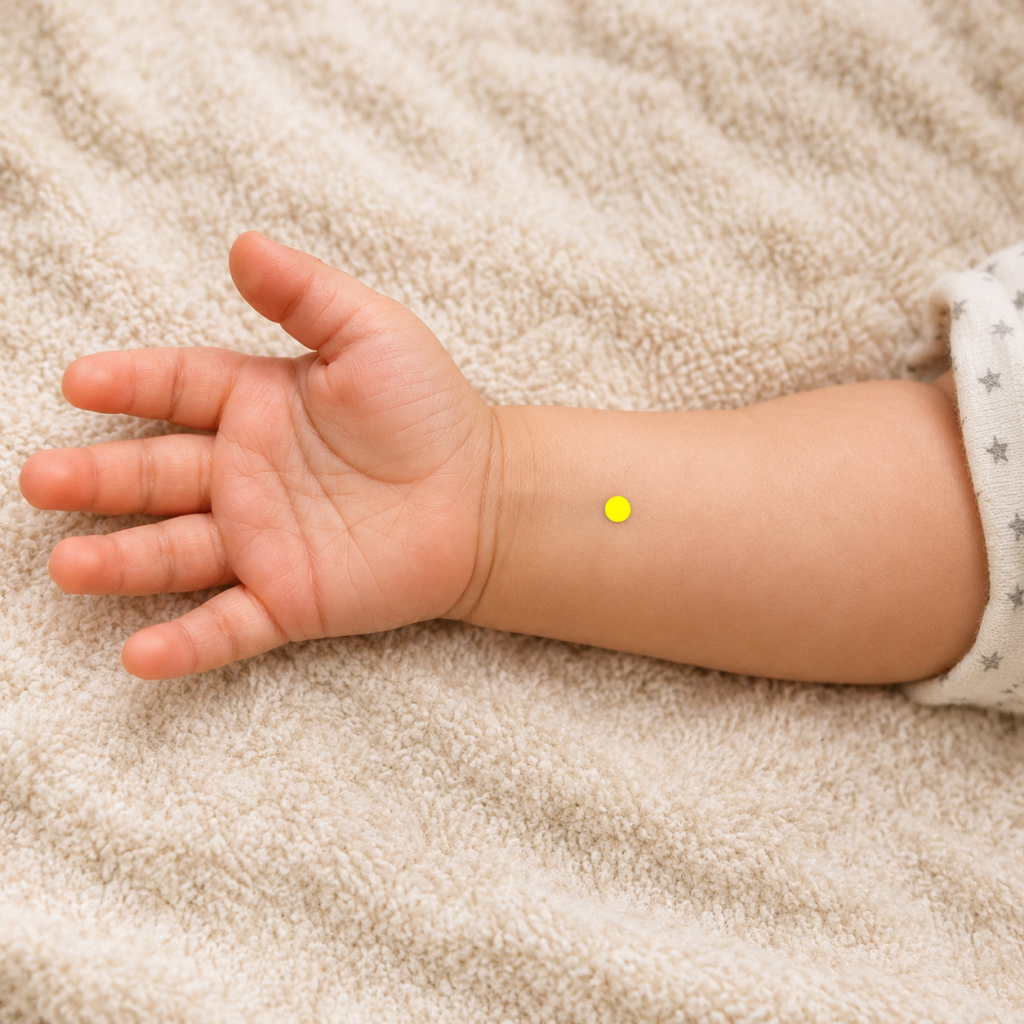
2. Press PC6 on the inner forearm to settle the stomach. PC6 sits on the inner forearm, about two of the baby’s finger-widths above the wrist crease, between the two tendons in the middle of the forearm. Make tiny, light circles with your fingertip for 30 seconds on each arm. PC6 is called “Neiguan,” the “Inner Gate.”
PC6 is the connecting point of the Pericardium and one of the most important points in Traditional Chinese Medicine for nausea and spitting up. It calms the Stomach and helps rebellious Stomach Qi move downward.
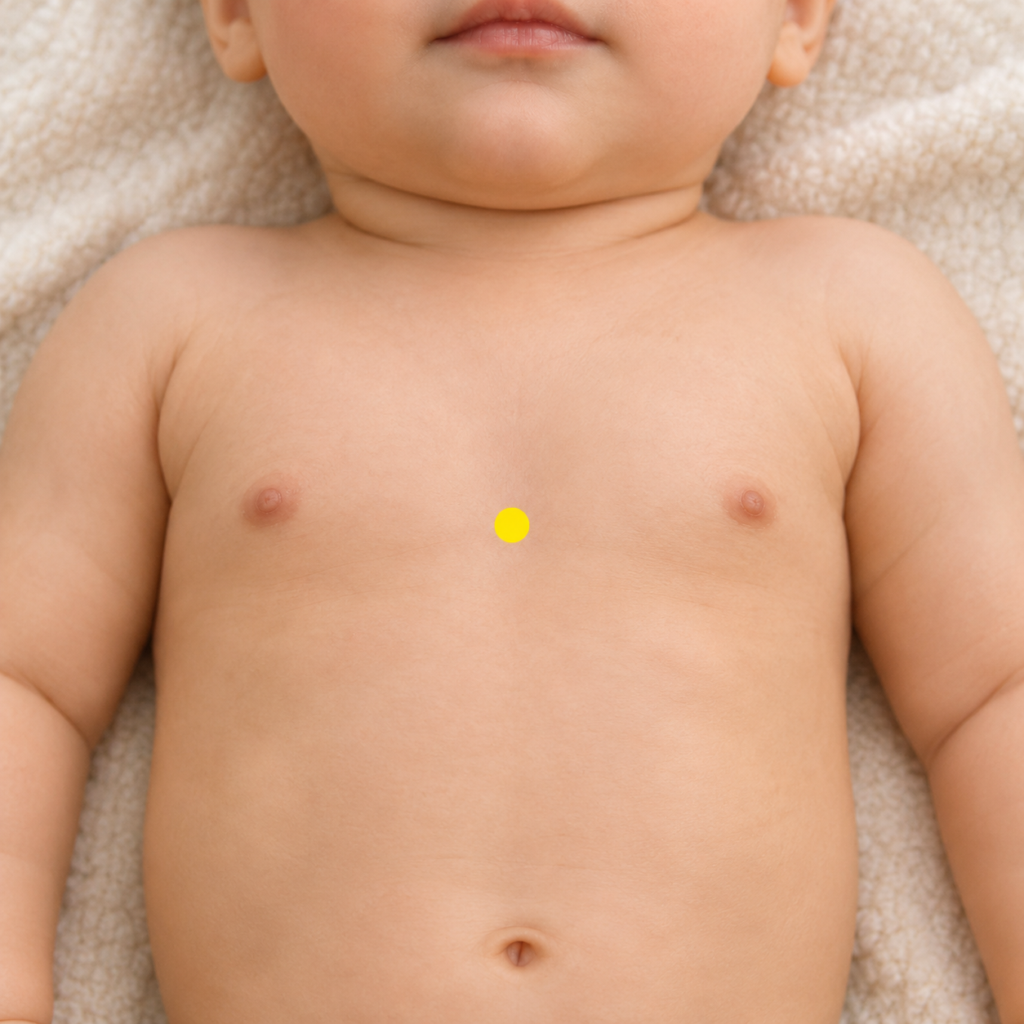
3. Press CV17 in the center of the chest to ease discomfort. CV17 sits on the midline of the breastbone, level with the nipples. Rest your fingertip on the point with very light pressure, or make tiny circles, for 30 seconds. CV17 is called “Shanzhong,” the “Chest Center.”
CV17 is the influential point of Qi. It opens the chest and helps rising Qi settle back down, easing discomfort behind the breastbone.
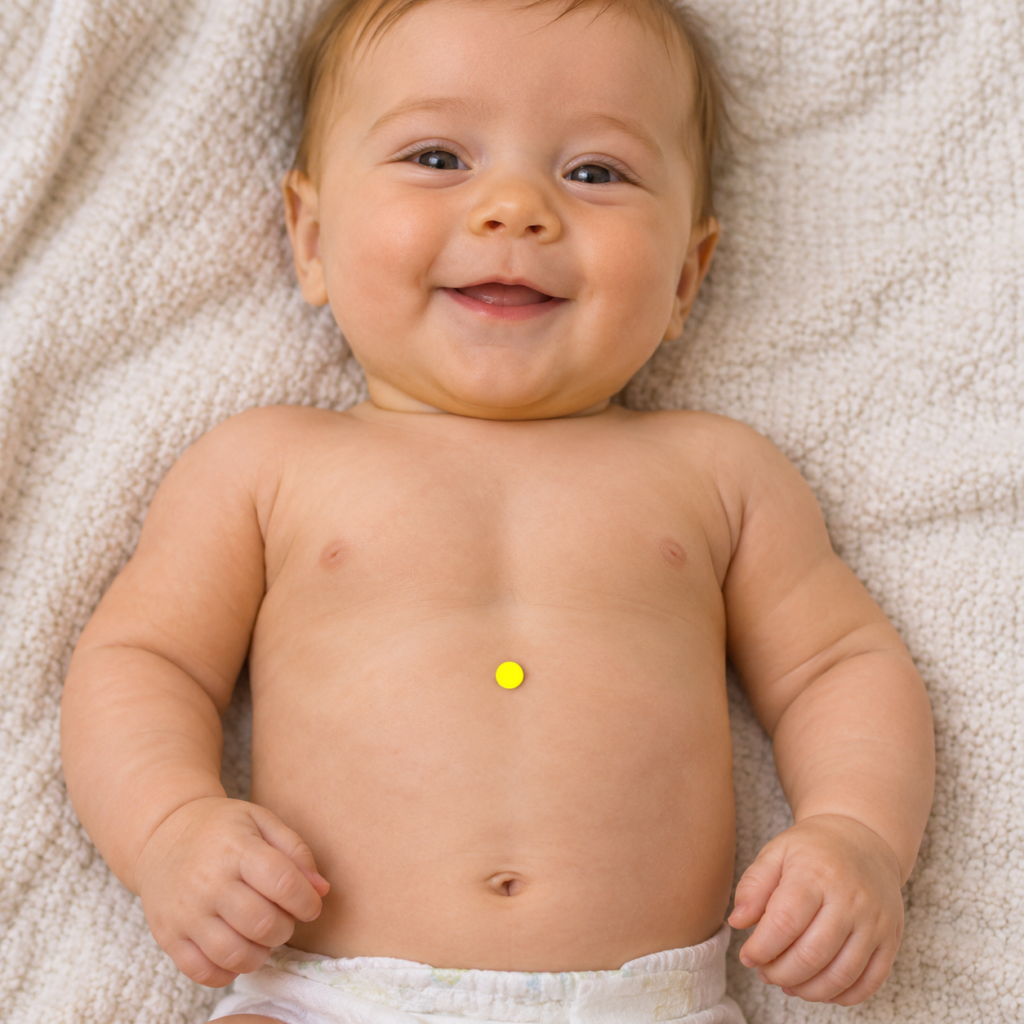
4. Press CV13 on the upper belly to direct Qi downward. CV13 sits on the midline of the upper belly, about one of the baby’s finger-widths above CV12, a little below the bottom of the breastbone. Rest your fingertip on the point with very light pressure for 30 seconds. CV13 is called “Shangwan,” the “Upper Cavity.”
CV13 is the meeting point of the Conception Vessel with the Stomach and Small Intestine channels. It is located at the top of the stomach and is traditionally used to treat spitting up and vomiting.
5. Circle CV12 on the belly to settle digestion. CV12 sits on the midline of the belly, halfway between the navel and the bottom of the breastbone. Rest your whole palm lightly on the belly and make slow clockwise circles around the navel, passing over CV12, for one to two minutes. CV12 is called “Zhongwan,” the “Middle Cavity.”
CV12 is the alarm point of the Stomach. Gentle circles help Stomach Qi move downward and ease fullness after feeding.
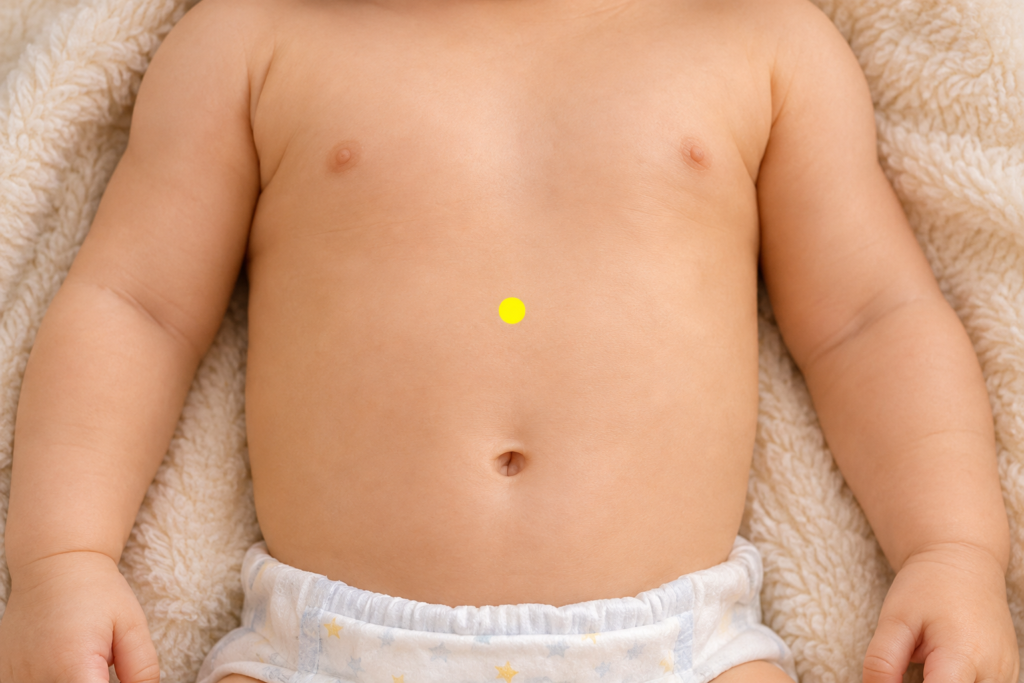
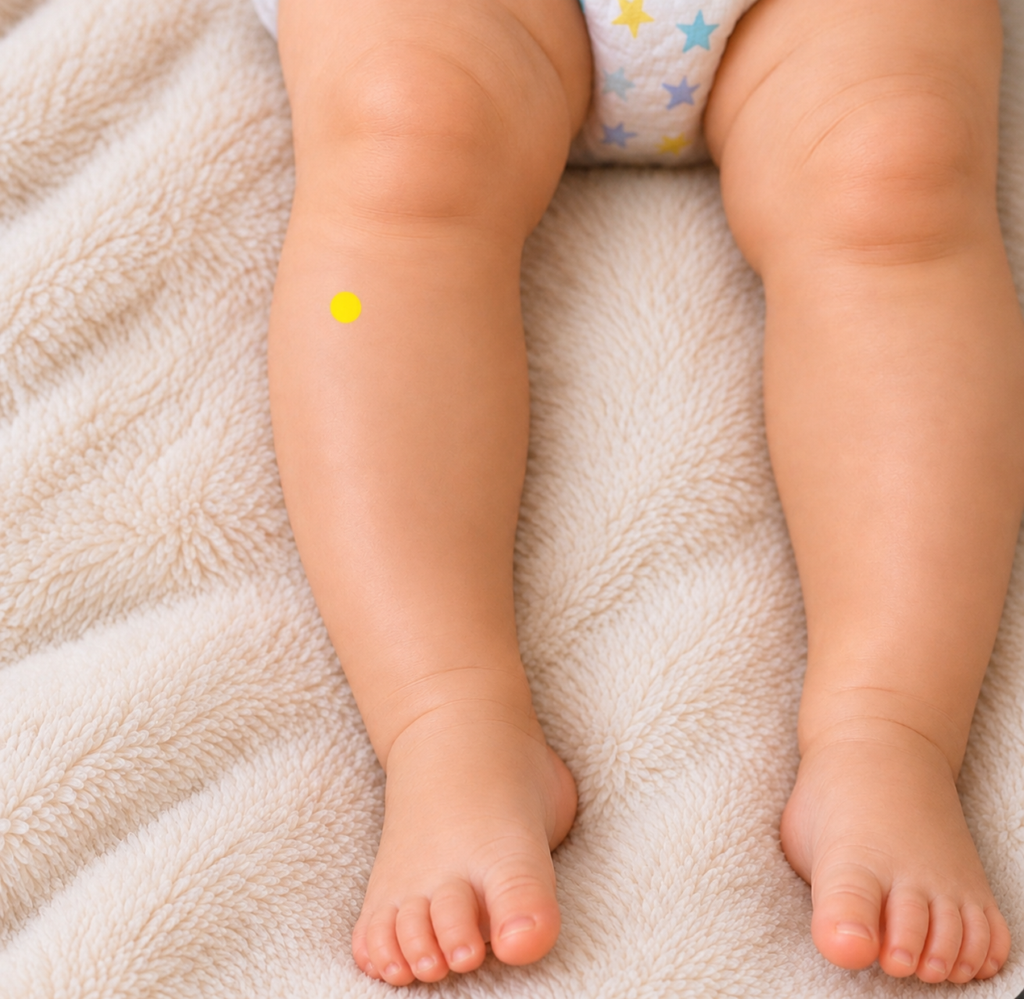
6. Press ST36 below the knee to strengthen digestion. ST36 sits on the front of the lower leg, about four of the baby’s finger-widths below the bottom of the kneecap and one of the baby’s finger-widths out from the edge of the shinbone. Make tiny, light circles with your fingertip for 30 seconds on each leg. ST36 is called “Zusanli,” the “Leg Three Miles.”
ST36 is the sea point of the Stomach. It strengthens the Spleen and Stomach and helps Stomach Qi move in the right direction.
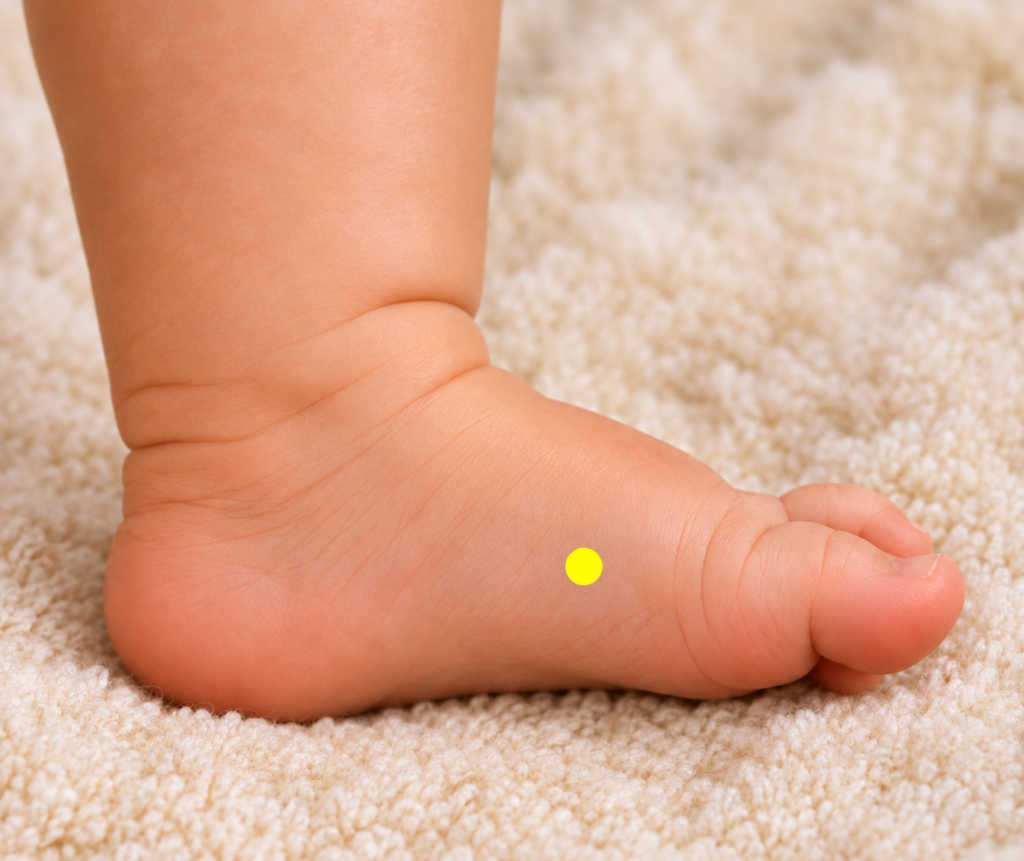
7. Press SP4 on the inner foot to settle the Stomach. SP4 sits on the inner edge of the foot, in the hollow just behind and below the bony bump at the base of the big toe, where the top of the foot meets the sole. Make tiny, light circles with your fingertip for 30 seconds on each foot. SP4 is called “Gongsun,” the “Grandfather Grandson.”
SP4 is the connecting point of the Spleen. It harmonizes the Spleen and Stomach and pairs well with PC6 for rising Stomach Qi.
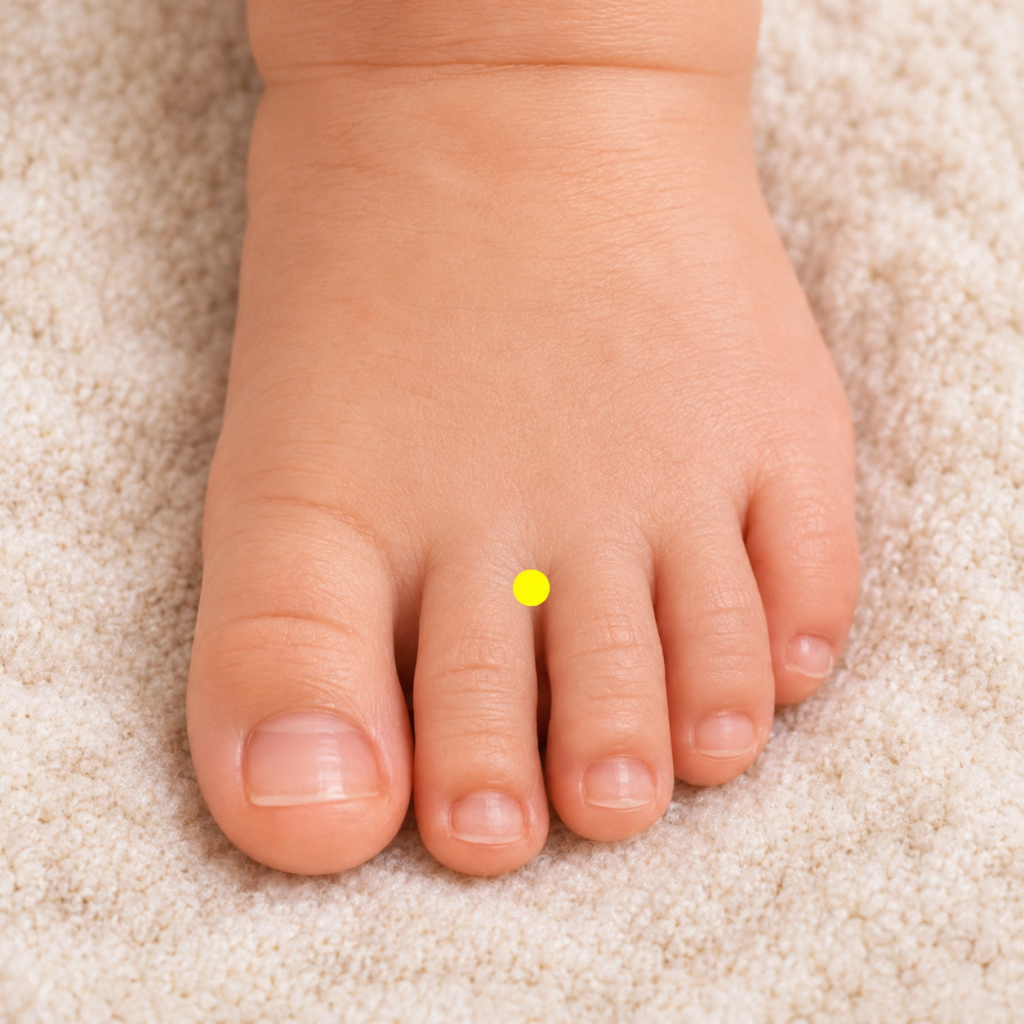
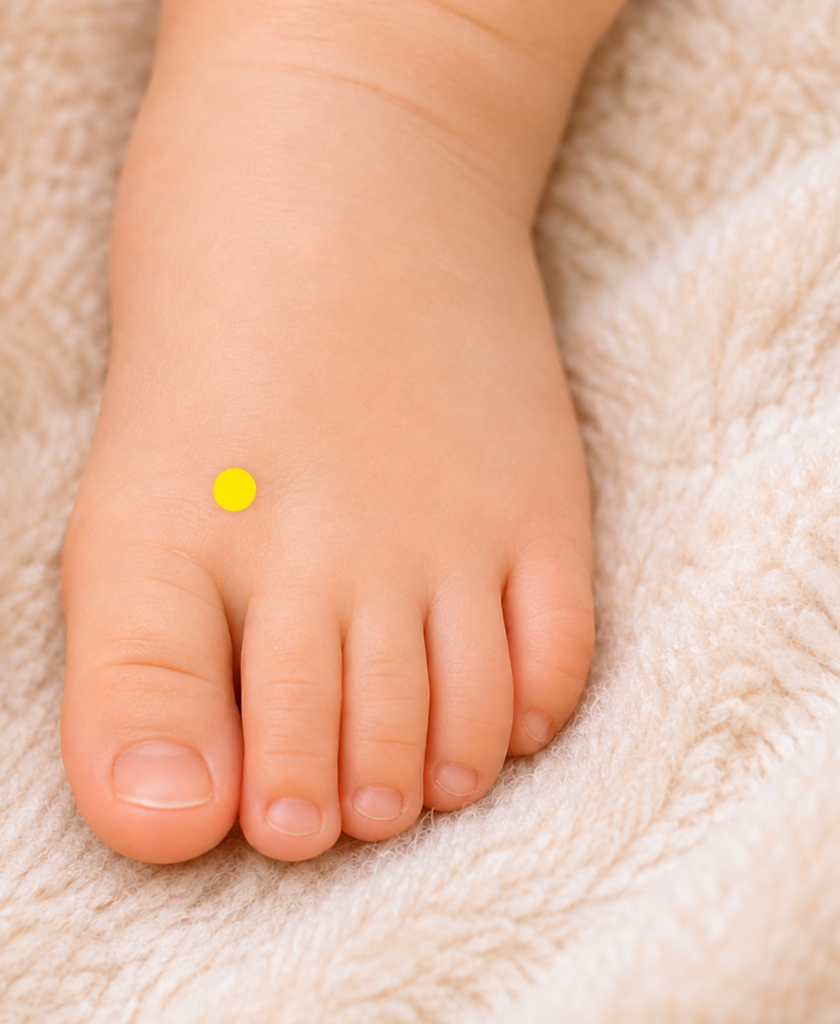
8. Press ST44 on the top of the foot to clear Heat. ST44 sits on the top of the foot, at the edge of the web between the second and third toes. Make tiny, light circles with your fingertip for 30 seconds on each foot. ST44 is called “Neiting,” the “Inner Courtyard.”
ST44 is the spring point of the Stomach. It clears Heat from the Stomach and helps a baby who spits up sour milk and fusses after feeding.
9. Press LV3 on the top of the foot to smooth the flow of Qi. LV3 sits on the top of the foot, in the hollow where the bones of the big toe and second toe meet. Rest your fingertip on the point with very light pressure for 30 seconds on each foot. LV3 is called “Taichong,” the “Great Rushing.”
LV3 is the source point of the Liver. It helps Qi move smoothly downward and calms a baby who arches and stiffens during or after feeding.
Why These Acupressure Points Work

From the perspective of Traditional Chinese Medicine, infant reflux is understood to occur when Stomach Qi ascends rather than descends, often in association with a delicate Spleen or excess Heat in the Stomach. Points on the arms and chest are used to calm the Stomach and settle ascending Qi; abdominal points are intended to direct Qi downward; and points on the legs and feet are used to support digestion, clear Heat, and promote the smooth flow of Qi.
The nine points work together to help alleviate infant reflux:
- PC6, CV17, and CV13 calm the Stomach and settle rising Qi.
- Sifeng, CV12, and ST36 strengthen digestion.
- SP4 and LV3 harmonize the Stomach and smooth the flow of Qi.
- ST44 clears Heat from the Stomach.
How to Properly Use These Acupressure Points

Acupressure for infant reflux is most effective before a feeding or at least one hour afterward, when the infant’s stomach is not full and the infant is calm.
- With the baby lying on their back or reclined in your arms, begin with gentle strokes across Sifeng and small circular motions on PC6.
- Place a fingertip gently on CV17 and CV13, then move your hand in slow, clockwise circles over the abdomen, centered on CV12.
- Continue applying gentle circular motions to ST36 on both legs.
- Conclude by applying small circular motions to SP4, ST44, and LV3 on both feet.
- Use only light, slow fingertip pressure, much lighter than you would use on an adult. Stop if the baby fusses, spits up, or seems uncomfortable. Skip the chest and belly points right after a feeding, avoid the soft spots on the top of the head, and do not use these points on broken, irritated, or rashy skin.
Simple habits can help reduce reflux. Children’s National recommends keeping the baby upright during feedings and for up to an hour afterward, offering smaller, more frequent feedings, burping the baby often during feedings, and avoiding tight clothing around the belly. For about an hour after feeding, handle the baby gently and, when possible, avoid bouncing, baths, and diaper changes to help keep milk down. Babies with reflux should always be placed flat on their backs to sleep, without inclined sleepers, wedges, positioners, or a raised crib mattress. Try thickened feedings, formula changes, or medicine only with the pediatrician’s guidance. Traditional Chinese Medicine also recommends feeding the baby in a calm, quiet setting and keeping the baby’s belly comfortably warm.
Learn more about whether acupressure is safe for kids.
When to Get Professional Help

Call 911 if a baby has trouble breathing, turns blue or gray around the lips, stops breathing during or after a feeding, or is limp or very difficult to wake. Seek care right away if vomiting is forceful or projectile, green, or contains blood or material that looks like coffee grounds; if there is blood in the stool or fewer wet diapers than usual; or if a baby under three months old has a temperature of 100.4°F or higher. Contact your pediatrician if your baby is gaining weight poorly, refusing feedings, coughing frequently, choking or gagging during feedings, wheezing or breathing noisily, constantly fussy or arching during feedings, or spitting up that begins after six months of age or continues past 18 months.
Acupressure is a gentle, supportive practice for baby reflux. It complements, and does not replace, diagnosis and medical care.
For related concerns, acupressure for acid reflux, acupressure for colic, and acupuncture for kids are companion pieces.
Above and Beyond Acupuncture offers acupuncture, cupping, and lifestyle coaching at the North Frank Lloyd Wright Boulevard location in Scottsdale.
Schedule an appointment online to start your healing journey.
The points above are only as effective as the technique used to apply them. Where to press, how firmly, and for how long all affect the result. For a full breakdown of how to perform acupressure properly at home, read Performing Acupressure in 3 Easy Steps.

About the Publisher
Paul Kerzner, L.Ac., is a licensed acupuncturist and board-certified herbalist, as well as the founder of Above and Beyond Acupuncture in Scottsdale. His own journey from chronic patient to practicing acupuncturist shapes his commitment to providing honest, clinically grounded information about acupuncture and Traditional Chinese Medicine. Learn more about Paul and his clinical approach on the About Us page.