
Key Takeaways
- Acupressure is safe for kids as it uses gentle fingertip pressure without any needles or medications.
- Many parents find acupressure effective and enjoyable for children dealing with common issues such as colds, stomachaches, and sleep troubles.
- Research shows acupressure is well tolerated by children, from surgery and cancer treatment to everyday ailments like diarrhea and headaches.
- For different ages, adjust the acupressure technique: use lighter pressure for younger kids and steady pressure for teens.
- Always consult a doctor for persistent symptoms; while acupressure is safe, it doesn’t replace medical care.

Is acupressure safe for kids? Yes, it is.
When performed gently, acupressure is one of the safest natural care options for children. It uses only light, steady fingertip pressure on specific points of the body, with no needles, medication, or anything that breaks the skin.
Many parents seek holistic, drug-free ways to help their children feel better, especially when they’re sick. Acupressure is often used to relieve colds, stuffy noses, coughs, fevers, stomachaches, vomiting, car sickness, trouble sleeping, and pre-test nerves. It can be a natural option in these situations. A session takes only a few minutes and can be done anywhere, including at a sick child’s bedside. Many children enjoy it. This article explains why acupressure is considered safe for children, what research says, how to adapt it for different ages, and which simple points parents can use when their child is sick.
Why Acupressure Is a Safe Choice for Children

Acupressure uses the same points and channels as acupuncture, but applies gentle pressure with your fingers or thumbs instead of needles. This simple difference eliminates most of the risks people worry about.
- It is noninvasive. Nothing enters the body, so there is no risk of infection, bleeding, or needle-related injury.
- It is drug-free. There are no medication side effects, no doses to figure out, and no worries about mixing with other treatments.
- The child stays in control. They can ask for a softer touch or to stop at any time, and you can adjust the pressure right away.
- It builds connection. Acupressure creates a calming, hands-on moment between parent and child, and many children find it soothing even without other treatments.
What the Research Shows
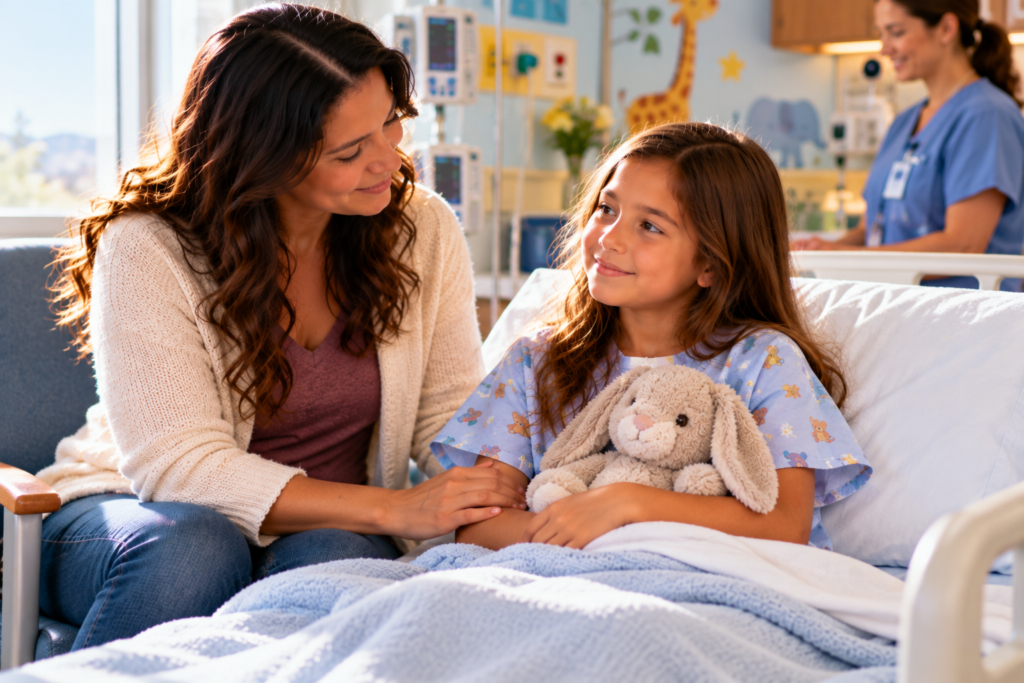
Researchers have examined acupressure use in children, including in sensitive situations such as before surgery and during cancer treatment.
One of the best-known studies examined children undergoing eye muscle surgery, a procedure that often causes postoperative vomiting. In a double-blind, randomized, placebo-controlled trial published in the British Journal of Anaesthesia, children received either acupressure at a point on the hand or a placebo before anesthesia. After surgery, 20 percent of the children in the acupressure group vomited, compared with 68 percent in the placebo group.
In a randomized trial published in Anesthesia and Analgesia, children awaiting an endoscopic procedure received acupressure at either Yintang, the point between the eyebrows, or a sham point. Those who received acupressure at Yintang felt calmer before the procedure, while anxiety rose slightly among children in the sham group.
Children undergoing cancer treatment have also been studied. In a pilot study published in the Journal of Alternative and Complementary Medicine, children receiving chemotherapy received ear acupressure in addition to their usual care. Nausea and vomiting were significantly less common with ear acupressure than with standard care alone, and researchers found the approach acceptable to both the children and their parents.
Safety research on acupuncture, which uses the same points, is reassuring as well. A systematic review in Pediatrics gathered thirty-seven reports on acupuncture in children and found that most side effects were mild, such as brief soreness, bruising, or minor bleeding at needle sites. The authors concluded that acupuncture is safe for children when performed by trained practitioners. Because acupressure involves no needles, those needle-related effects do not apply, which makes it gentler still.
Some of the largest studies come from pediatric tuina, a gentle form of massage and point pressure that Traditional Chinese Medicine has used for children for centuries. A systematic review of twenty-six randomized trials involving 2,410 children under five with acute diarrhea, published in Complementary Therapies in Medicine, found that pediatric tuina improved recovery rates, shortened the illness, and reduced the number of stools each day. No side effects related to tuina were reported in any of the trials.
Another review, published in Medicine, pooled fifteen randomized trials involving 1,420 children who caught colds, coughs, and other respiratory infections again and again. Children who received pediatric tuina had fewer infections, recovered about a day sooner when they did get sick, and showed improvements in markers of immune function, again with no side effects linked to the treatment.
Together, these studies show that children tolerate gentle point stimulation well and parents accept it, whether the child is undergoing surgery, receiving cancer treatment, or coping with a common illness.
How Acupressure Is Different for Children

Children are more sensitive to touch than adults and tend to respond quickly, so use a lighter touch. The appropriate acupressure technique depends on the child’s age.
- Babies and toddlers: Use only very light touch, about the pressure you would use to test a ripe peach. Gentle circular rubbing or light stroking over an area often works better than holding a single point. Keep sessions to a few minutes, and stop if your child becomes fussy.
- Young children: Use light, steady fingertip pressure for about thirty seconds to one minute per point. Turn it into a game, such as pressing a “magic button” for calm or a happy tummy.
- School-age children: Use gentle to moderate pressure for about one minute per point. Many children this age can learn to press a few simple points themselves, such as the wrist point for car sickness.
- Teens: Teens can use acupressure much as adults do, with steady pressure for one to two minutes per point.
Regardless of age, acupressure should always feel comfortable. A child may experience slight tenderness at a pressure point, but it should never be painful.
Using Acupressure When Your Child Is Sick

When your child is sick, it’s normal to feel helpless. Acupressure can offer gentle comfort as your child rests and recovers. In Traditional Chinese Medicine, pediatric tuina has long been used for everyday illnesses like these. Use the points below alongside rest, fluids, and advice from your child’s doctor.
- Colds and a stuffy nose. Press lightly on LI20 (Yingxiang), in the small groove beside the widest part of each nostril, to help open the nose. Add gentle circles at Yintang, between the eyebrows, and at GB20 (Fengchi), at the base of the skull in the hollows on either side of the neck muscles, roughly level with the earlobes. In Traditional Chinese Medicine, GB20 is a classic point for colds that come with a headache or a stiff neck.
- Coughs and chest congestion. Rest a warm palm on CV17 (Danzhong), in the center of the breastbone level with the nipples, and make slow, gentle circles. Then rub gently between the shoulder blades on the upper back, an area traditionally used to support the Lungs and ease coughing. Many children find this soothing at bedtime, when coughs tend to be worst.
- Fever. Press lightly on LI11 (Quchi), at the outer end of the elbow crease when the elbow is bent, a traditional point for clearing heat. Pediatric tuina also uses a cooling stroke called Clearing the Heavenly River: with two fingers, stroke lightly along the middle of the inner forearm from the wrist crease toward the elbow crease for one to two minutes. Acupressure can help a feverish child feel more comfortable, but it does not replace checking the temperature and calling the doctor when needed.
- Stomach aches. Make slow, gentle clockwise circles with a warm palm around the navel, then press lightly on ST36 (Zusanli), four of the child’s finger-widths below the lower edge of the kneecap and one finger-width to the outside of the shinbone. Learn more about acupressure for a stomach ache.
- Vomiting and nausea. Press PC6 (Neiguan), on the inner forearm three of the child’s finger-widths above the wrist crease, between the two tendons. PC6 is the most widely studied point for nausea. Offer small, frequent sips of fluid as well, since children who are vomiting can become dehydrated quickly.
Other Everyday Reasons Parents Turn to Acupressure

Acupressure can also help ease many common childhood complaints:
- Car sickness. PC6 works here too, and older children can learn to press it on their own. Learn more about acupressure for motion sickness.
- Constipation. Learn more about acupressure for constipation.
- Trouble falling asleep. Gentle pressure on HT7 (Shenmen), on the inner wrist crease on the pinky side, helps a child settle. Learn more about acupressure for trouble falling asleep.
- Worry and nerves before tests, appointments, or performances. Learn more about acupressure for test anxiety.
- Tension headaches in older children and teens. Learn more about acupressure for a tension headache.
- Period cramps in teens. Learn more about acupressure for menstrual cramps.
How to Safely Use Acupressure With Your Child

- First ask and make it clear to your child that they can say “softer” or “stop” at any time.
- Apply a gentle pressure and do not press so hard as to cause pain.
- Make the sessions short: a few minutes for young children and up to 10 minutes for older children and teenagers.
- Pick a peaceful time and combine the pressure with slow breathing, a story, or some quiet music.
- Measure the positions using the child’s own finger widths since their hands are smaller than yours.
- Watch how your child responds, and stop if they seem uncomfortable or upset.
When Acupressure Is Not the Right Choice

Acupressure is generally safe; however, there may be circumstances in which it should be avoided or practiced with additional caution:
- Do not press over cuts, rashes, bruises, burns, swelling, or recent injuries.
- Do not use acupressure in place of medical care for a high or lasting fever, an injury, or a child who seems very unwell.
- Use extra care with children who have a bleeding disorder or take blood thinners, and check with their doctor first.
- If a teen is pregnant or could be pregnant, some points should be avoided. Learn which acupressure points to avoid during pregnancy.
Frequently Asked Questions

At what age can children start acupressure?
You can use gentle, touch-based acupressure at any age, even with babies, as long as the pressure is very light and the session is short. Most children can start learning to press simple points themselves by the time they reach school age.
Can you do acupressure on a baby?
Yes, you can, as long as you use a very light touch. Gentle circular rubbing on the belly or the soles of the feet can be soothing for many babies. Always check with your pediatrician about any symptoms that worry you, and get care right away if a young baby has a fever.
How often can children use acupressure?
Short sessions once or twice a day are enough for most issues. Points like PC6 can be pressed whenever car sickness or nausea begins. Learn more about how often you can use acupressure.
When to See a Doctor

Acupressure may offer gentle relief from everyday discomfort, but it is not a substitute for medical care. Contact your child’s doctor if a symptom lasts more than a few days, returns, or concerns you. Seek prompt medical attention for a fever in an infant under three months old; a high or persistent fever at any age; vomiting or diarrhea with signs of dehydration, such as a dry mouth, fewer wet diapers, or unusual sleepiness; or a headache with a stiff neck, confusion, or vomiting. Go to the emergency department if your child has trouble breathing, severe or sudden abdominal pain, is difficult to wake, or has sustained an injury to the head, neck, or back.
Acupressure is a gentle, natural, supportive practice for children. It may be used alongside medical diagnosis and care, but it does not replace them.
If you are new to acupressure, please read what is acupressure and does acupressure really work.
Above and Beyond Acupuncture offers acupuncture, cupping, and lifestyle coaching at the North Frank Lloyd Wright Boulevard location in Scottsdale.
Schedule an appointment online to start your healing journey.
The points above are only as effective as the technique used to apply them. Where to press, how firmly, and for how long all affect the result. For a full breakdown of how to perform acupressure properly at home, read Performing Acupressure in 3 Easy Steps.

About the Publisher
Paul Kerzner, L.Ac., is a licensed acupuncturist and board-certified herbalist, as well as the founder of Above and Beyond Acupuncture in Scottsdale. His own journey from chronic patient to practicing acupuncturist shapes his commitment to providing honest, clinically grounded information about acupuncture and Traditional Chinese Medicine. Learn more about Paul and his clinical approach on the About Us page.