
Key Takeaways
- Acupressure alleviates coughs by stimulating specific points that soothe the throat, reduce congestion, and support healthy Lung Qi flow.
- Key acupressure points include CV22 for calming coughs, LU7 for coughs from colds, and LU5 for hot, productive coughs.
- Acupressure techniques involve applying gentle pressure to specific points for one to two minutes while breathing slowly.
- Home remedies like staying hydrated, using warm drinks, and inhaling steam also help manage coughs effectively.
- Seek professional help if a cough persists, causes significant breathing difficulties, or is accompanied by severe symptoms.

A lingering cough can be exhausting. It irritates your throat, disturbs your sleep, and strains your chest, often remaining even after the cold has gone. Whether it’s dry and tickly or wet and rattling, acupressure provides a way to soothe the cough, calm the throat, ease congestion, and lessen the urge to cough. While it won’t remove the cold or the infection causing the cough, and a clearing cough is sometimes needed, the points listed below can help quiet the persistent, irritating cough that lingers too long.
In Traditional Chinese Medicine, the Lung governs breathing, and healthy Lung energy moves downward with each breath. A cough reverses that downward flow, with Lung Qi rebelling upward instead of settling. The body tries to expel something. What triggers it shapes the type of cough you get. An external invasion, essentially a cold, brings an acute cough. Depending on whether it runs cold or hot, it brings either clear phlegm and chills or yellow phlegm and a sore throat. From the inside, weak digestion can generate phlegm that clogs the Lung, producing a wet, productive, rattling cough, while dryness or a depleted Lung leaves a dry, tickly, unproductive cough that will not bring anything up.
Because most coughs begin with a cold, easing the illness itself helps the cough settle, and acupuncture for colds and the flu covers that side of things.
Here are nine acupressure points that can help. These points target various aspects such as calming the cough reflex, guiding Lung Qi downward, soothing the throat, loosening phlegm, and moisturizing a dry Lung. To use them effectively, match the points to the specific type of cough you experience.
What Acupressure Points to Press and Why
1. Pressing on CV22 at the throat’s base can help soothe a cough. CV22 is situated in the hollow at the front of the neck, just above the sternum where a necklace might rest. Gently press downward behind the bone, avoiding the throat, with your fingertip for about a minute. Known as “Tiantu,” meaning ‘Heavenly Chimney,’ this point is highly effective for calming a cough.
This acupressure point directly addresses the cough by suppressing the cough reflex, easing the tickling and irritation that trigger coughing, and helping direct rebellious Lung Qi downward to counter the cough. Due to its location over a sensitive area, it’s important to use gentle pressure and angle it downward toward the chest, not into the throat. Use this point at the first sign of the urge to cough and a tickling sensation.

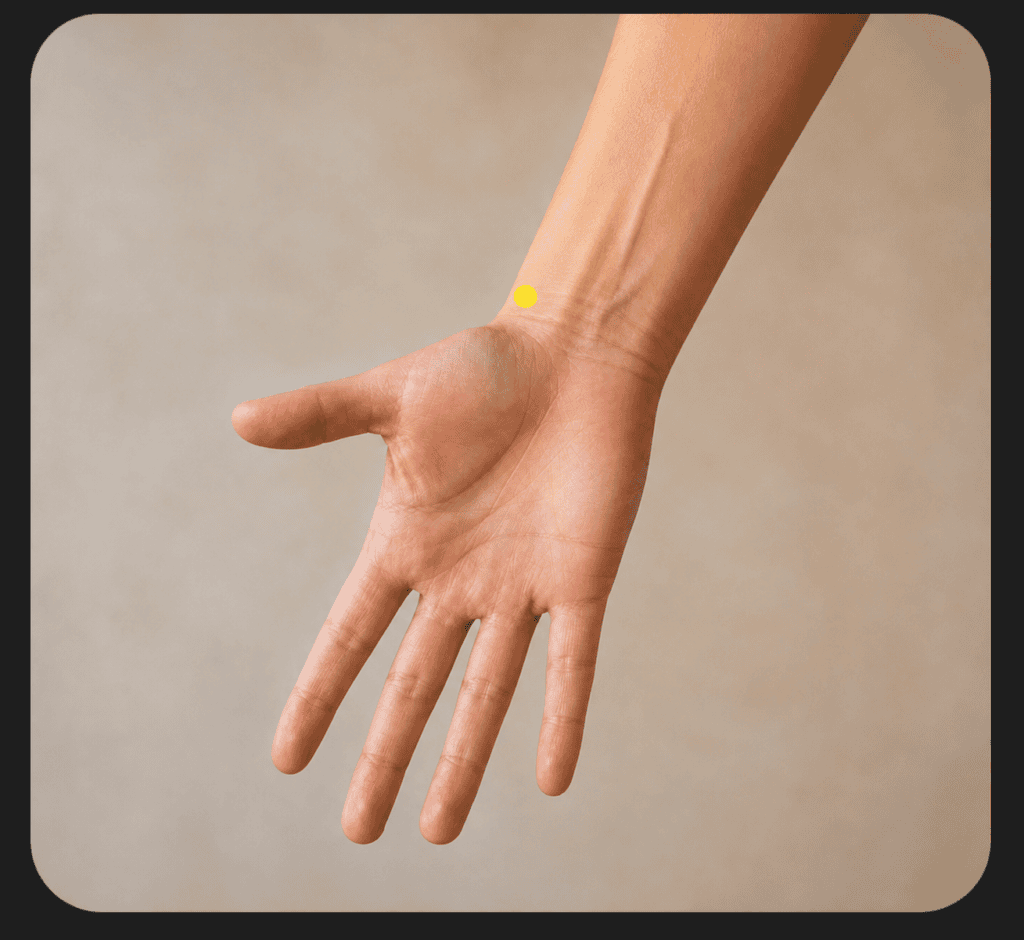
2. Press on LU7 above the wrist for a cough from a cold. LU7 sits on the thumb side of the inner forearm, about two finger-widths above the wrist crease, just above the bony bump of the wrist in a small hollow. Press firmly with your thumb for one to two minutes on each arm. “Lieque,” the Broken Sequence, is the command point for the head and neck and one of the most important points for the Lung.
When a cough accompanies a cold, LU7 is the go-to point. It helps expel the external pathogen that triggered the illness and restores the Lung’s downward energy flow. This makes it especially effective for acute coughs associated with symptoms like a stuffy head, chills, and a runny nose. As the command point for everything above the neck, LU7 also alleviates congestion and the tickle that can provoke a cold-induced cough. For coughs that follow your recent cold, this point addresses the underlying cause.
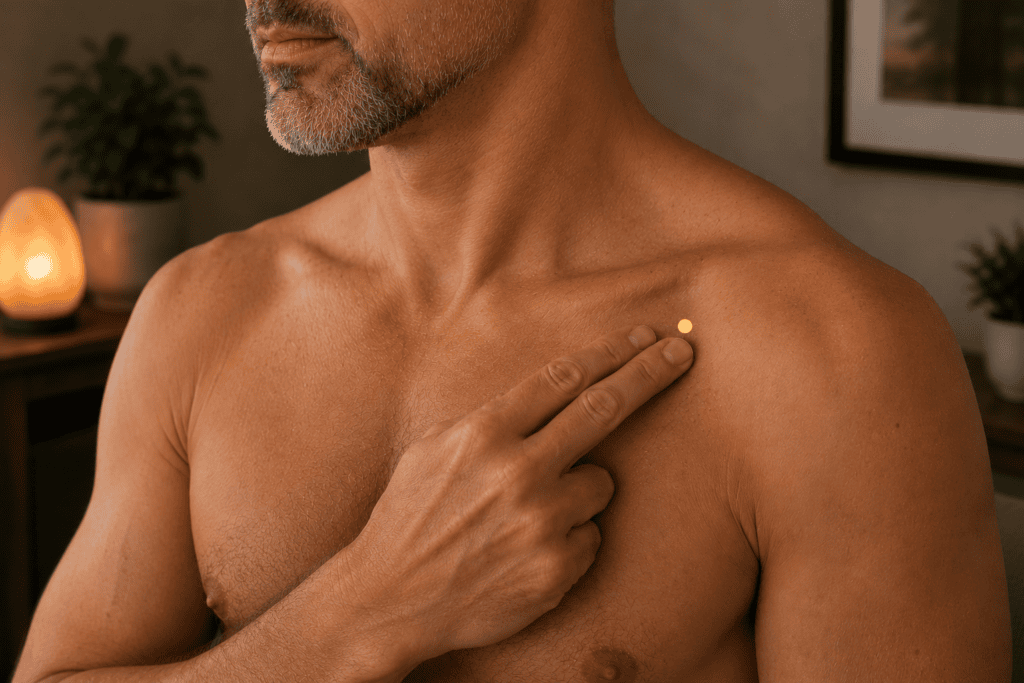
3. Press on LU1 on the upper chest for cough and chest fullness. LU1 sits high on the chest, just below the outer end of the collarbone, in the hollow near the shoulder, about one hand’s width out from the center of the chest. Press gently but firmly with your fingertips for one to two minutes on both sides. “Zhongfu” is the front-collecting point of the Lung, where the Lung’s energy gathers at the surface.
LU1 is the point where Lung energy gathers at the front of the body. It directly supports the Lung by easing cough and relieving the tight, full, and congested sensations in the upper chest often associated with it. This point helps to settle Lung Qi, descend, and open a chest that feels blocked or oppressed. For coughs accompanied by a heavy, full chest, LU1 targets the exact area where these symptoms are felt and works well with the throat point above and the chest point below.
4. Press on CV17 at the center of the chest to open a tight chest. CV17 sits on the midline of the breastbone, level with the space between the nipples, in the center of the chest. Press gently but steadily with your fingertip for one to two minutes, breathing slowly. “Shanzhong” is the gathering point of Qi in the chest.
CV17 opens the chest, calms the breath, and is especially useful for coughs accompanied by tightness, congestion, or a wheezy, oppressive sensation in the middle of the chest. It helps regulate the chest’s Qi and supports the Lung Qi in moving smoothly downward instead of backing up as a cough. For those experiencing chest tightness and shallow breathing, this point helps loosen and open the chest, while deep, slow breathing during pressing enhances the effect.

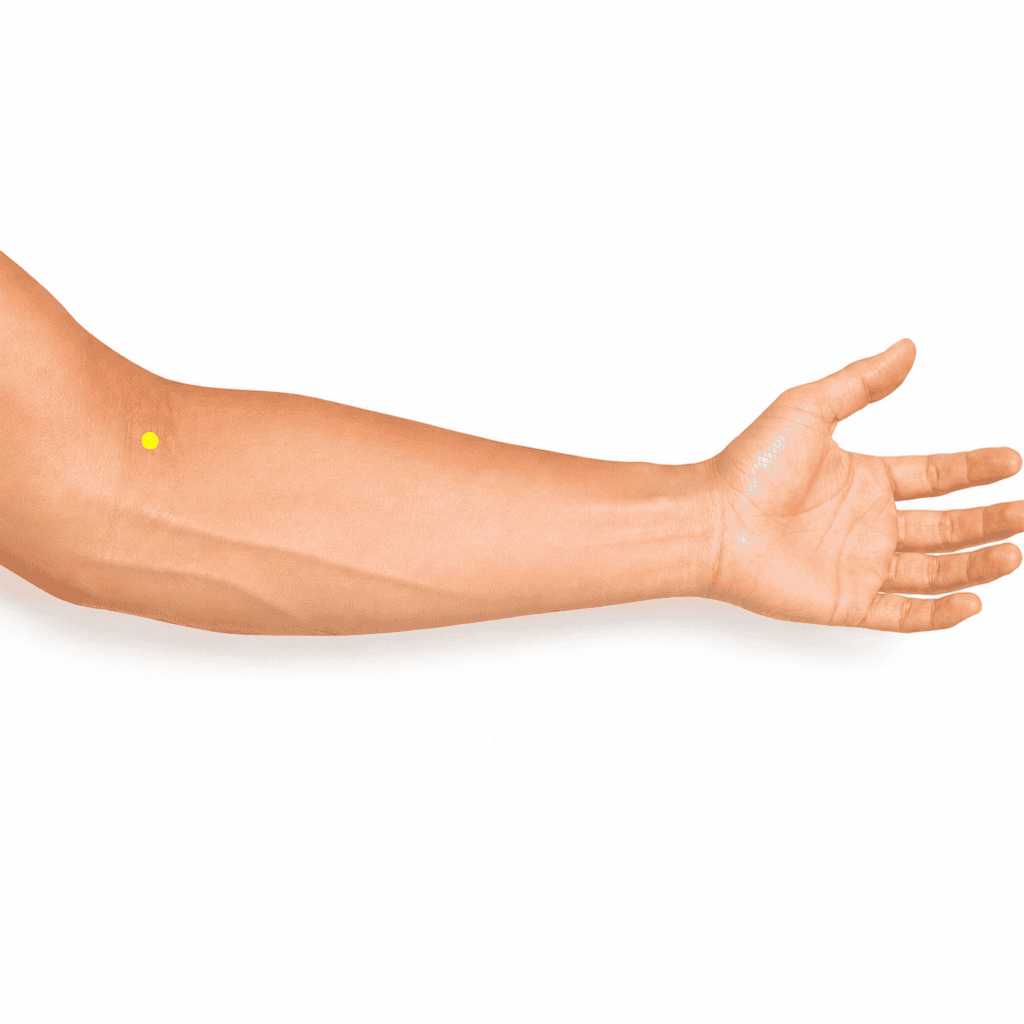
5. Press on LU5 at the elbow for a hot, productive cough. LU5 sits on the inner elbow crease, on the thumb side, just outside the big tendon you can feel in the middle when you bend your elbow. Press firmly with your thumb for one to two minutes on each arm. “Chize,” the Cubit Marsh, is the point for clearing heat from the Lung.
When a cough produces hot, thick yellow or green phlegm, along with a sore throat and a burning sensation in the chest, Chinese medicine recognizes this as heat in the Lung. The point LU5 helps clear this heat. It cools the Lung and helps expel hot phlegm, soothing the harsh, heat-driven cough associated with chest colds or bronchitis. For a productive cough that feels hot and inflamed rather than cold and clear, this point specifically targets that pattern. It is among the most effective points for treating a chesty, phlegmy cough.
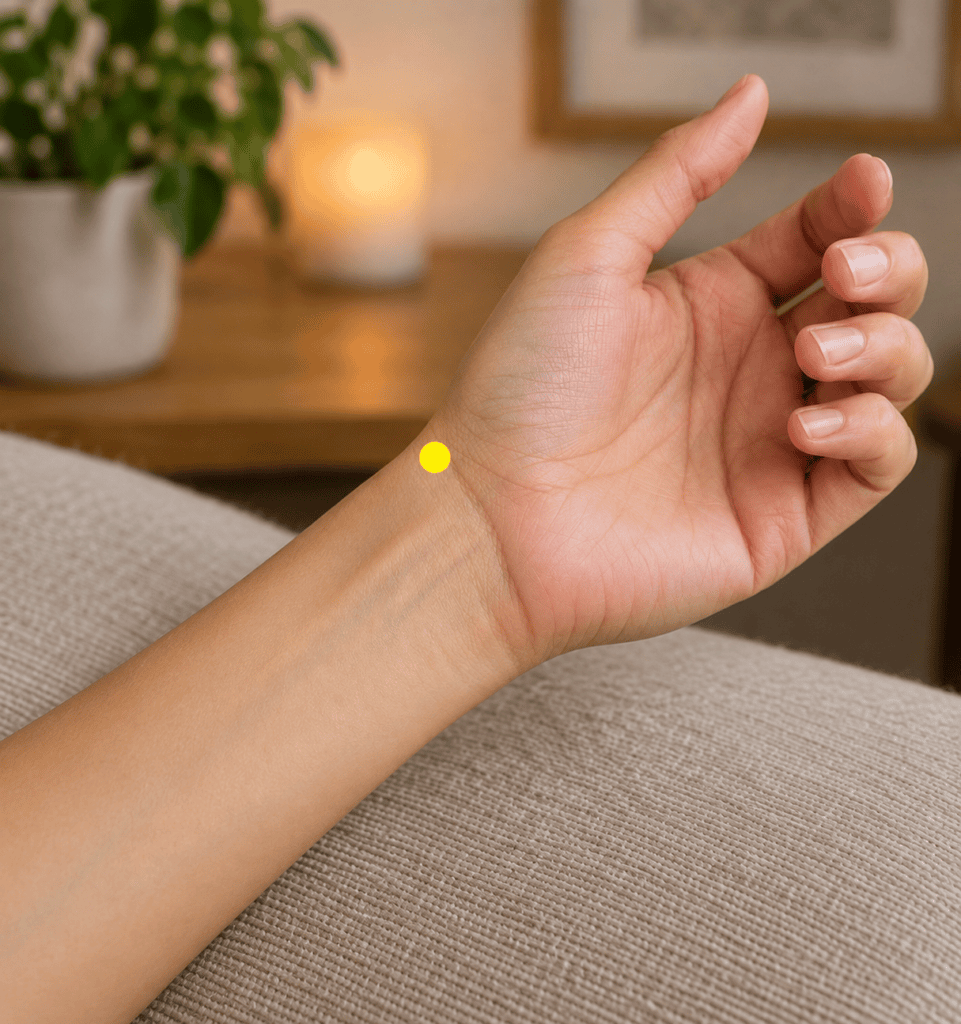
6. Press on LU9 at the wrist for a dry, lingering cough. LU9 sits on the inner wrist crease, on the thumb side, in the hollow where you can feel the pulse. Press firmly with your thumb for one to two minutes on each wrist. “Taiyuan,” the Great Abyss, is the source point of the Lung, the point that strengthens it at its root.
When acupressure points are used to relieve excess, LU9 restores deficiency, making it ideal for dry, persistent coughs that last for weeks after a cold or weakened Lungs. As the source point, it strengthens the Lungs and nourishes their moisture, calming a dry, scratchy throat and a non-productive cough. For relentless dry coughs lingering beyond recovery, this point helps support the Lungs so they can finally settle.
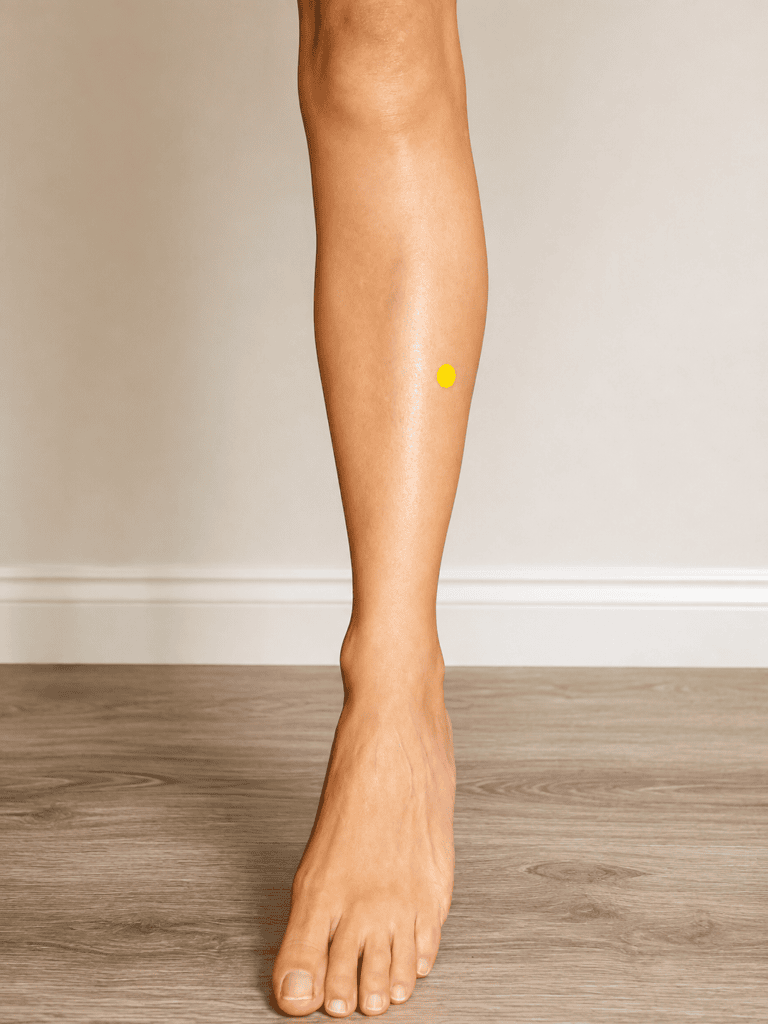
7. Press on ST40 on the lower leg to loosen phlegm. ST40 sits on the outer lower leg, midway between the knee and the outer ankle bone, about two finger-widths outside the shinbone, on the muscle. Press firmly with your thumb for one to two minutes on each leg. “Fenglong,” the Abundant Bulge, is the body’s main point for clearing phlegm.
For a wet, rattling, productive cough with phlegm, ST40 is the key point because it is the body’s primary location for resolving phlegm wherever it accumulates. It helps clear phlegm that blocks the Lung and drains the dampness responsible for ongoing production, which is essential for a chesty, mucus-heavy cough. When the cough is primarily about excess phlegm, loose, rattling, and persistent, this point addresses the cause more effectively than local chest points and works well in conjunction with them.
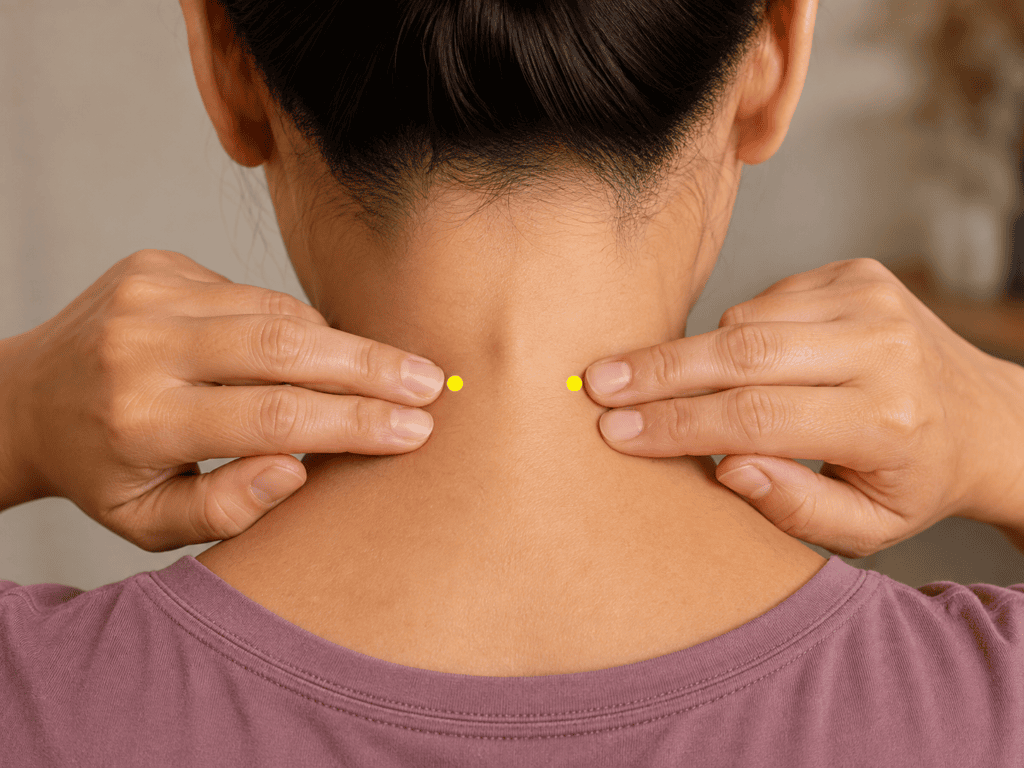
8. Press on Dingchuan at the base of the neck to ease a wheezy cough. Dingchuan sits at the base of the back of the neck, about half a thumb-width out to each side of the bump of the lowest neck vertebra, the one that sticks out most when you bow your head. Reach back and press firmly with your fingertips for one to two minutes on both sides. Dingchuan is an extra point whose name literally means “Calm Wheezing.”
This point, named for its specific function, calms coughing, eases wheezing, and relieves labored, tight breathing. It is a natural choice when a cough is accompanied by a wheeze or a feeling of breathlessness and constriction. Located at the base of the neck near the top of the Lung, it helps suppress the cough reflex and open the airways. While it is effective for rattling and wheezing coughs, a cough that causes significant difficulty breathing requires medical attention rather than pressure point stimulation, as discussed in the closing section.
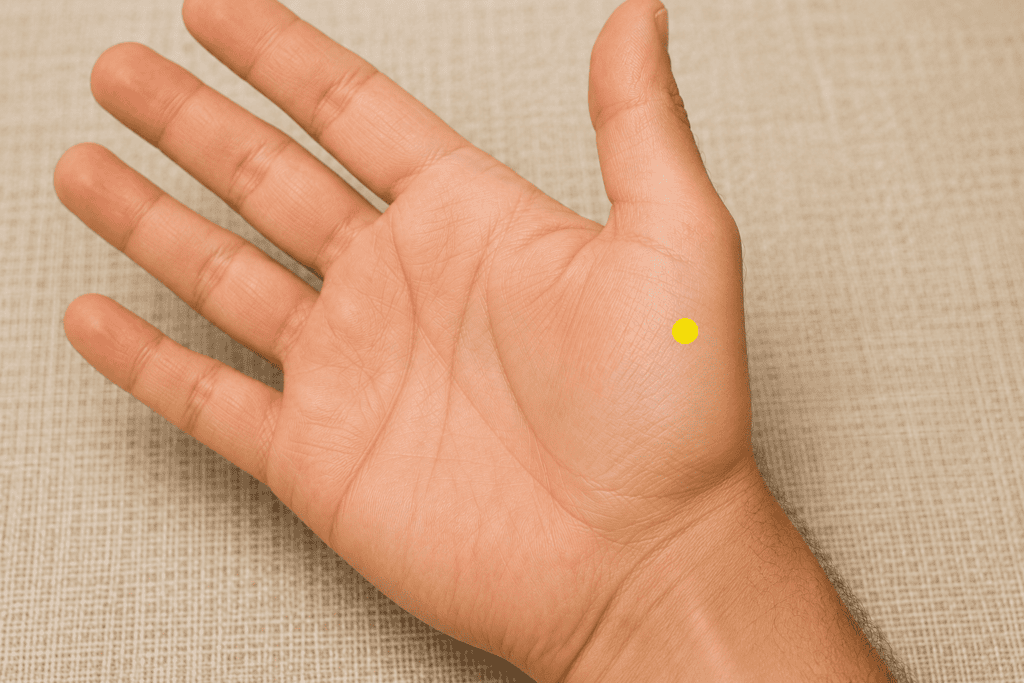
9. Press on LU10 on the thumb pad for a raw, sore throat. LU10 sits on the palm side of the hand, in the middle of the fleshy mound at the base of the thumb, where the red and white skin of the palm’s edge meet. Press firmly with the thumb of your other hand for about a minute on each hand. “Yuji,” the Fish Border, clears heat from the Lung and throat.
When experiencing a cough accompanied by a raw, sore, and burning throat, LU10 helps soothe it by cooling heat in the Lung and throat affected by irritation. It calms the hot, scratchy throat that both triggers coughing and worsens from it, effectively breaking the cycle. For coughs related to a sore, inflamed throat, this point provides direct relief and can be pressed discreetly whenever the tickle intensifies.
Why These Acupressure Points Work
In Traditional Chinese Medicine, a cough occurs when Lung Qi rebels upward instead of descending. This can be caused by external cold invading the Lung, internal issues like phlegm buildup, or dryness exhausting it. The nine points help resolve the cough and target each underlying pattern.
- The throat-and-chest points (CV22, LU1, CV17) calm the cough reflex directly, soothe the throat, and open a tight, congested chest.
- The cold-cough point (LU7) releases the external invasion behind a cough that came with a cold.
- The heat points (LU5, LU10) cool a hot, inflamed Lung and throat and clear hot phlegm.
- The dry-cough point (LU9) rebuilds and moistens a depleted Lung behind a lingering dry cough.
- The phlegm point (ST40) clears the phlegm behind a wet, productive cough.
- The wheeze point (Dingchuan) calms coughing and eases tight, wheezy breathing.
The main focus is assisting Lung Qi to settle and descend, which addresses the root cause of a cough.
How to Properly Use These Acupressure Points
Match the points to the type of cough you have, and start with the throat and chest.
- For almost any cough, begin with CV22 at the throat to calm it and CV17 and LU1 on the chest to open and settle it.
- For a cough from a cold, add LU7. For a dry, tickly, lingering cough, add LU9. For a wet, phlegmy cough, add ST40. For a hot cough with a sore throat, add LU5 and LU10. For a wheezy cough, add Dingchuan.
- Press CV22 gently and angled downward behind the breastbone, never firmly into the throat, and keep the chest points comfortable rather than deep.
- Hold each point for a minute or two with steady pressure, breathing slowly, and repeat through the day as the cough flares.
Simple home remedies can be very effective for a cough.
- Stay well hydrated, as fluids help thin mucus and soothe the throat.
- Warm drinks are especially beneficial, with honey being a proven cough reliever for anyone over one year old.
- Inhale steam from a hot shower or a bowl of hot water to loosen congestion, and avoid dry air.
- Rest is essential because your lungs recover more quickly when you do.
- Opt for warm, simple foods instead of cold or heavy meals during coughing episodes.
- Reducing cold drinks may also help a persistent cough improve.
The same acupressure points work for children, but use much lighter, briefer pressure and a gentle, reassuring touch. However, press the throat point only very lightly on a child, or skip it in favor of the wrist and chest points.
When to Get Professional Help
Most coughs linked to colds usually clear up on their own within a few weeks. These guidelines assist in managing that common situation. However, some coughs need medical care, so it’s important to identify those cases.
Seek immediate medical help if you have a new or severe cough with significant difficulty breathing, shortness of breath, wheezing, blood in sputum, or a cough with high fever, chest pain, or thick, discolored phlegm, which may suggest pneumonia. Consult a healthcare professional if a cough lasts over three weeks, recurs frequently, or worsens, especially if accompanied by unexplained weight loss or night sweats. A cough with wheezing and breathlessness could indicate asthma, requiring proper treatment. For children, seek medical attention for any breathing issues, barking or whooping cough, cough in a baby, or a cough with high fever or poor feeding. Always have a young infant’s cough evaluated. Emergency care is vital for sudden severe breathing problems or choking on inhaled objects.
Acupressure and basic home care can manage everyday coughs, but they do not replace professional medical treatment when needed.
Above and Beyond Acupuncture offers acupuncture, cupping, and lifestyle coaching at the North Frank Lloyd Wright Boulevard location in Scottsdale.
Schedule an appointment online or call us today to start your healing journey.
The points above are only as effective as the technique used to apply them. Where to press, how firmly, and for how long all affect the result. For a full breakdown of how to perform acupressure properly at home, read Performing Acupressure in 3 Easy Steps.

About the Publisher
Paul Kerzner, L.Ac., is a licensed acupuncturist and board-certified herbalist, as well as the founder of Above and Beyond Acupuncture in Scottsdale. His own journey from chronic patient to practicing acupuncturist shapes his commitment to providing honest, clinically grounded information about acupuncture and Traditional Chinese Medicine. Learn more about Paul and his clinical approach on the About Us page.