
Key Takeaways
- A tension headache involves a tight band-like pain around the head and often relates to neck and shoulder tension.
- Acupressure offers relief by stimulating key points, notably GB20 and GB21 for neck and shoulder tension, and additional points such as Taiyang and Yintang for head pain.
- Start acupressure with the neck and shoulder points, then move to the head, and finish with hand and foot points like LI4 and LR3 for stress relief.
- Regular breaks from screens, hydration, and good posture can help prevent tension headaches.
- Seek professional help for severe headaches or if symptoms worsen; acupressure serves as a complementary approach, not a replacement.

A tension headache feels like a dull, tight band around the head, with squeezing pain in the temples and forehead, often linked to neck and shoulder tightness. It’s the most common headache, typically developing after a day of stress, screen time, poor posture, or clenching, and can last for hours. Acupressure provides a targeted way to relieve it by stimulating muscles and points where tension concentrates. Applying pressure at the base of the skull, temples, shoulders, and specific points on the hands and feet can help release the tension.
Chinese medicine views a tension headache primarily as a blockage of Qi and Blood in the channels that run through the head and neck, often caused by tight, knotted muscles obstructing the flow. The Gallbladder channel travels along the side of the neck and over the head, which explains why these headaches frequently manifest in the neck and temples. When stress is involved, the Liver also plays a role, as stress constricts Liver Qi, causing it to rise toward the head and increase pressure. This leads to the well-known sensation of a tight band around the head, with tension radiating from the shoulders into the skull, along with the typical stress-induced ache. The points listed below help release this blocked flow, relax tight neck and shoulder muscles, and calm the Liver when stress worsens the pattern.
Acupressure may alleviate common tension headaches but is not a cure for migraines or more serious headache symptoms.
Here are nine acupressure points that can help:
What Acupressure Points to Press and Why
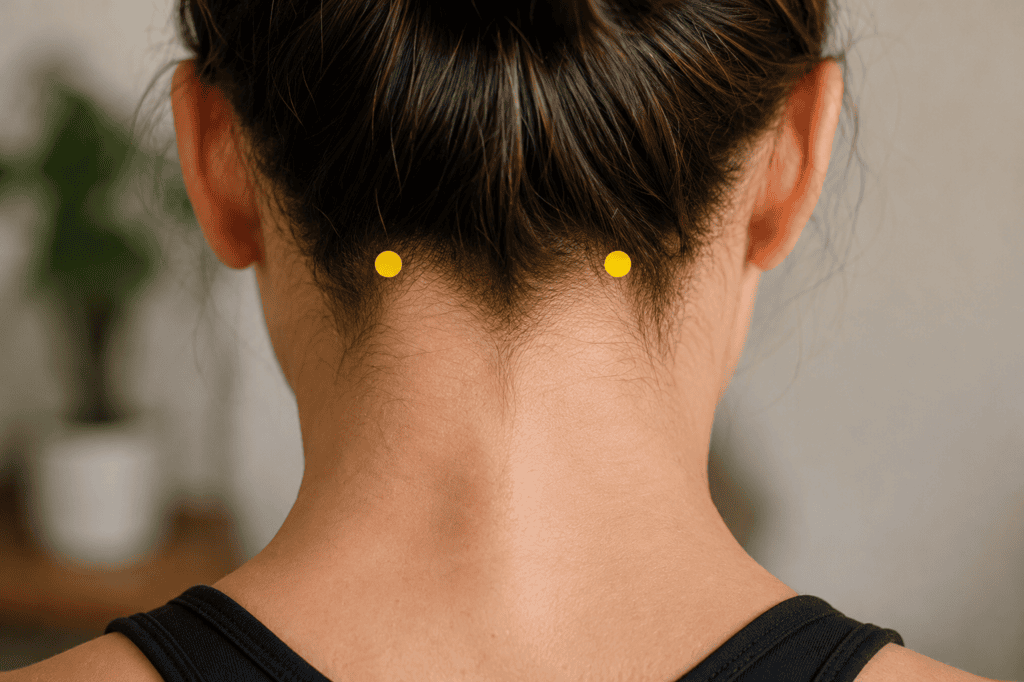
1. Press on GB20 at the base of the skull to release the tight band. GB20 sits in the two hollows at the base of the skull, between the two large vertical neck muscles and the outer edge, roughly level with the tops of the ears. Tip your head back slightly and press firmly up and inward toward the opposite eye with your thumbs for one to two minutes. GB20 is called “Fengchi,” and it is the single most important point for a tension headache.
GB20 releases the tight, aching tension at the base of the skull where so much of a tension headache is anchored, and it clears the stuck Qi that travels up the Gallbladder channel into the head. This is the meeting point of the neck and the head, the place where shoulder and neck tightness turns into a headache, and freeing it often loosens the whole band at once. For nearly every tension headache, this is the first point to work and the one that gives the most relief, which is why it is worth spending a full two minutes here.
2. Press on GB21 on the top of the shoulder to release shoulder tension. GB21 sits at the highest point of the shoulder, midway between the base of the neck and the tip of the shoulder, on the ridge of the trapezius muscle. Press down firmly with your fingertips or pinch the muscle for one to two minutes on each side. GB21 is called “Jianjing,” and it is the primary point for the shoulder tension that feeds a headache. GB21 is avoided during pregnancy.
Tension headaches rarely begin in the head. They begin in the shoulders and neck, in the tight, hunched trapezius muscles that hold stress all day, and GB21 releases exactly that knot. On the same Gallbladder channel that carries the tension up into the skull, this point frees the stagnation at its source, which is why loosening the shoulders so often eases the head. For the person whose headache sits on top of rock-hard shoulders, this point addresses the root of the pattern rather than only the pain at the top.

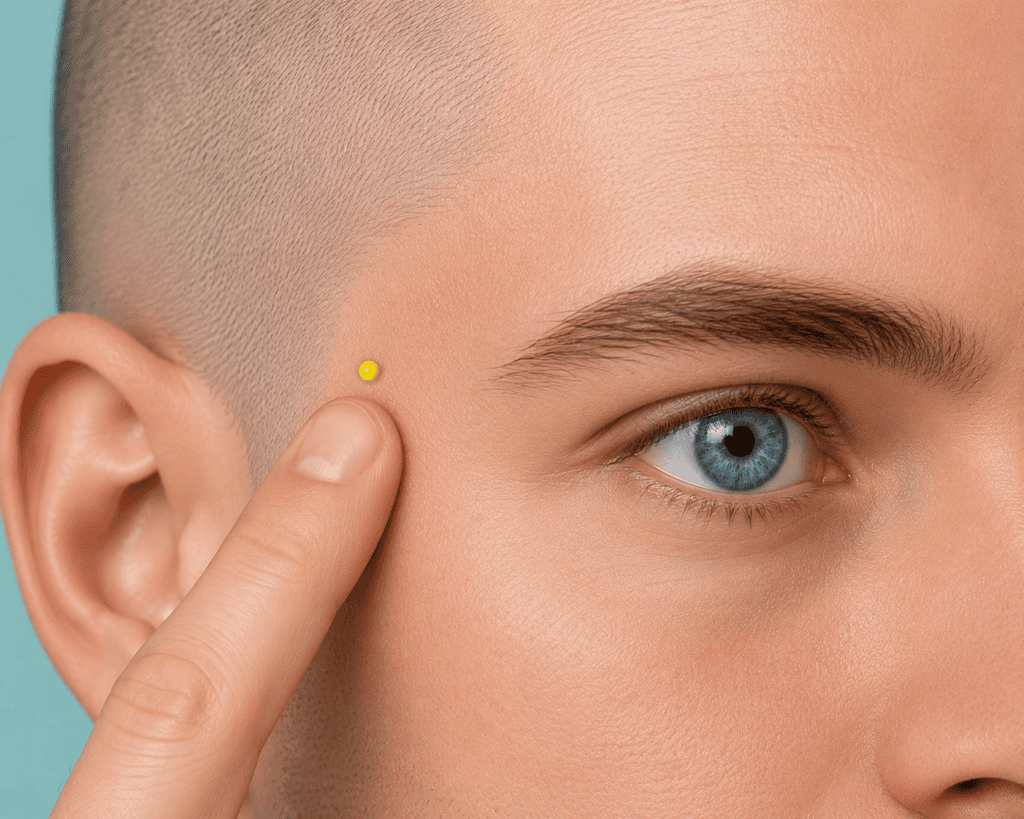
3. Press on Taiyang at the temple to ease the squeezing ache. Taiyang sits in the soft hollow of the temple, about a finger-width back from the midpoint between the outer end of the eyebrow and the outer corner of the eye. Press firmly and make small slow circles with your fingertips for one to two minutes on both sides. Taiyang is an extra point, and it is one of the most used points anywhere for headaches.
Taiyang directly relieves the squeezing, throbbing tension that gathers at the temples, one of the classic locations of a tension headache. It moves the stuck Qi and Blood in the temporal region where the band of pressure is felt most sharply, and working it is deeply relieving when the sides of the head are aching. For the headache that presses in at both temples, this point reaches it head-on, and it pairs naturally with GB20 at the back and the forehead points that follow.
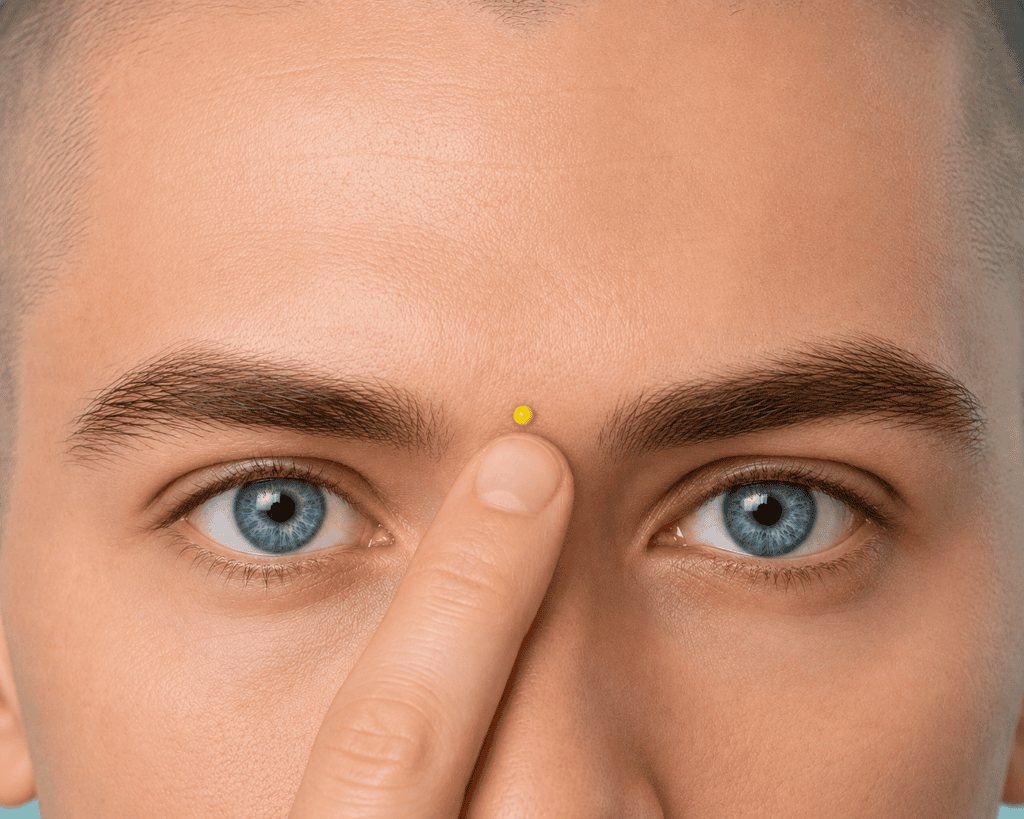
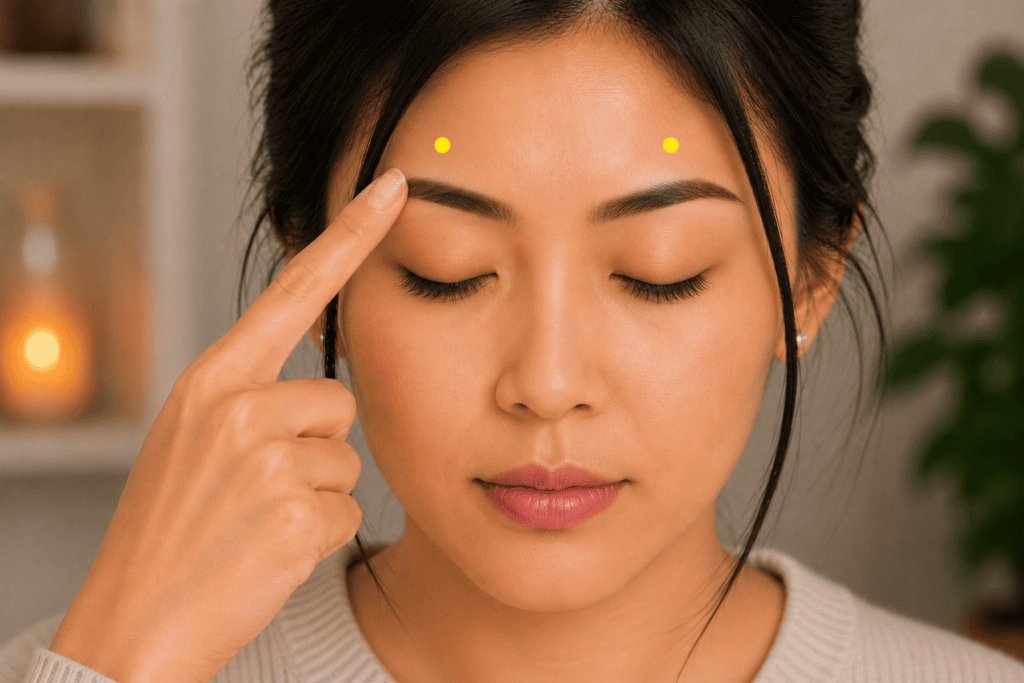
4. Press on Yintang between the eyebrows for frontal pressure. Yintang sits in the center of the forehead, in the small hollow directly between the two eyebrows. Press steadily and hold, or make small circles, with your fingertip for one to two minutes. Yintang is an extra point, and it is one of the most calming points in the body.
Yintang eases the pressure that builds across the forehead and between the eyes during a tension headache, and it calms the stress and mental tension that so often drive the whole thing. It settles the front of the head and the nervous system together, releasing the furrow held between the brows through hours of concentration or strain. Because a great many tension headaches are stress headaches, this point does double duty, easing the frontal ache while quieting the tension underneath it, and it is worth pressing slowly with a few deep breaths.
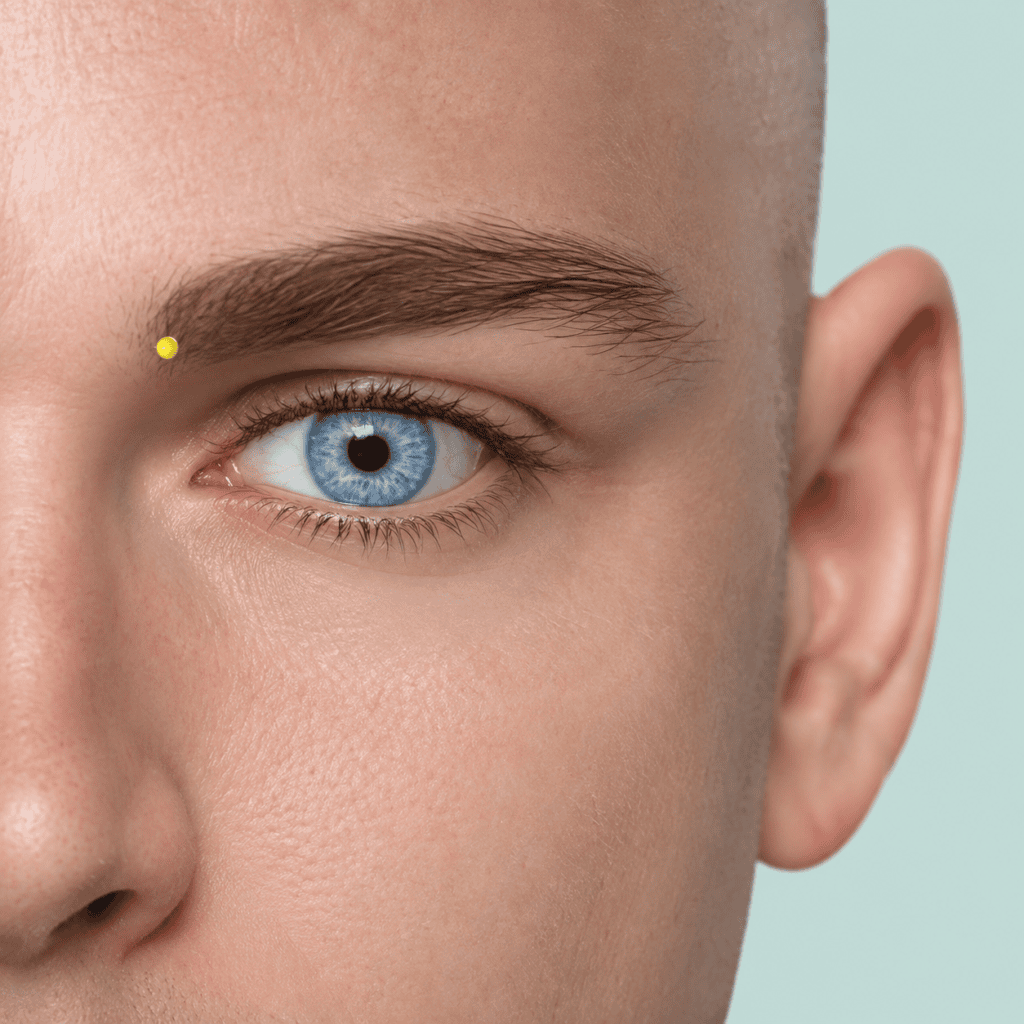
5. Press on BL2 at the inner eyebrow for forehead pain. BL2 sits in the small notch at the inner end of the eyebrow, right where it meets the bridge of the nose. Press gently but firmly up into the notch with your thumbs or fingertips for about a minute on both sides at once. BL2 is called “Zanzhu,” and it is a reliable point for frontal headaches.
BL2 relieves the tension and ache that settle across the brow and the front of the head, a common site for tension headache pain. It moves the stuck Qi right where the forehead tightens, and it works well for the headache that concentrates above the eyes and across the eyebrows. Sitting at the inner end of the brow, it complements Taiyang at the temple and Yintang between the eyes, so the three together treat the entire front of the head in one pass.
6. Press on GB14 on the forehead for pain above the eyes. GB14 sits on the forehead, about one finger-width above the midpoint of the eyebrow, in line with the pupil when you look straight ahead. Press gently with your fingertip for about a minute on both sides. GB14 is called “Yangbai,” and it addresses tension across the forehead.
GB14 eases the aching pressure that spreads across the forehead above the eyes, and as a Gallbladder channel point on the front of the head it connects the frontal pain to the same pattern running through the temples and neck. It releases the stagnation in the forehead where the muscles tense during strain and concentration. For the tension headache felt as a broad ache across the whole forehead rather than a single spot, this point widens the relief that BL2 and Yintang begin.
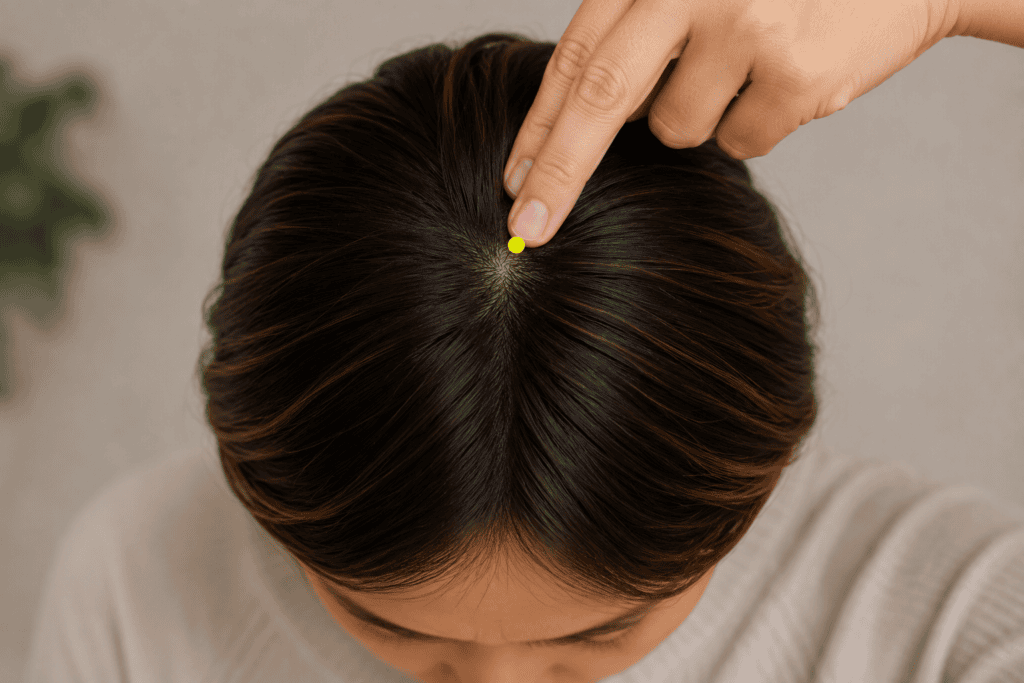
7. Press on GV20 at the top of the head to clear the head. GV20 sits at the very top of the head, on the midline, on a line drawn up from the tops of both ears. Press straight down with your fingertip, or make small circles, for one to two minutes. GV20 is called “Baihui,” the “Hundred Meetings,” where many channels converge at the crown.
GV20 clears the head and lifts the heavy, foggy pressure that a tension headache can bring, and it has a settling, centering effect that eases the tension behind the pain. As the meeting point of many channels at the crown, it regulates the flow through the whole head, which is why it helps a headache no matter where in the head it sits. It is also quietly calming, which suits the stress-driven nature of most tension headaches, and it makes a fitting counterpart to GB20 at the base of the skull, the two bracketing the head from crown to nape.
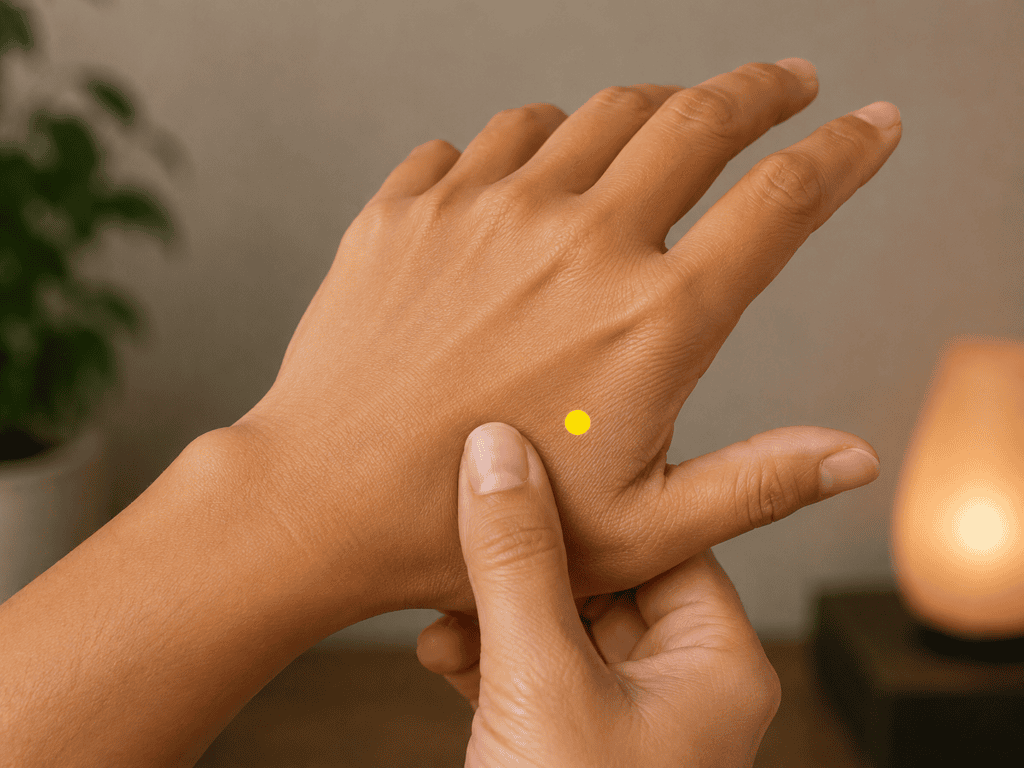
8. Press on LI4 in the hand to relieve head and face pain. LI4 sits in the webbing between the thumb and index finger, at the highest point of the muscle when the thumb and finger are brought together. Press firmly with the thumb of your other hand for one to two minutes on each hand. LI4 is called “Hegu,” and it is the single most important point in the body for pain in the head and face. LI4 is avoided during pregnancy.
LI4 is the command point for the head and face, meaning it draws stuck Qi through the whole region and relieves pain anywhere in the head, which makes it one of the most effective points for any headache. Though it sits far away on the hand, it reaches up to clear the channels of the head and is a mainstay for headache relief in both acupressure and acupuncture. Pressed alongside the local points on the head, it strengthens the whole effect, and it is discreet enough to work under a desk when a headache builds during the day.
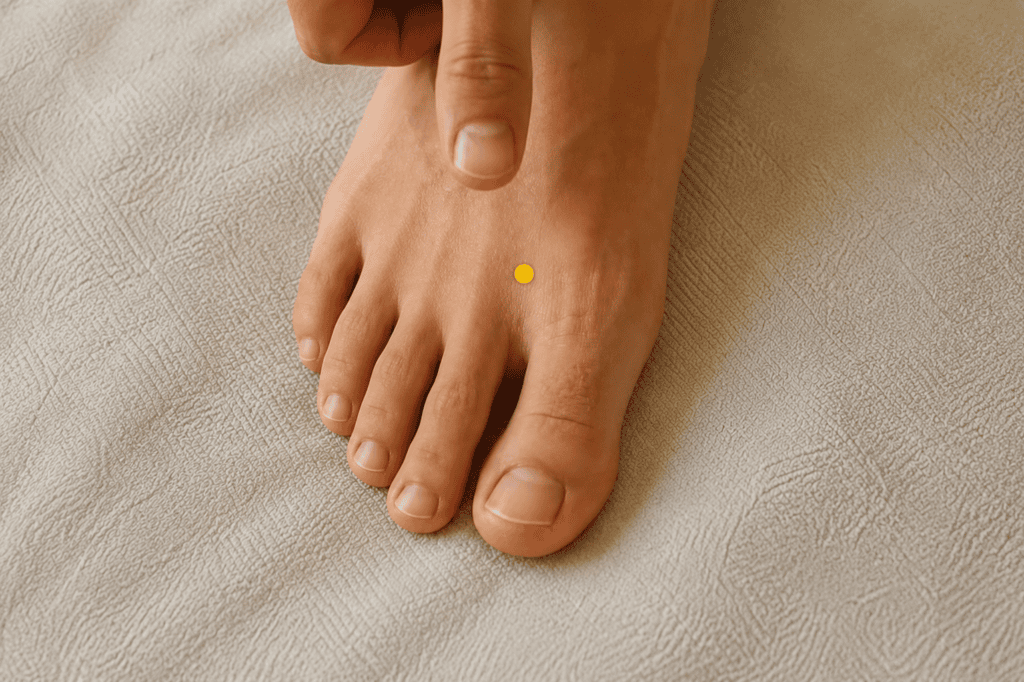
9. Press on LR3 on the top of the foot for stress-driven headaches. LR3 sits on the top of the foot, in the webbing between the big toe and second toe, about two finger-widths back where the bones meet in a small hollow. Press firmly with the thumb for one to two minutes on each foot. LR3 is called “Taichong,” and it is the primary point for settling the Liver.
When stress is the engine behind a headache, Chinese medicine reads it as bound Liver Qi rising up to the head, and LR3 is the point that brings it back down. It releases the tension, irritability, and wound-tight feeling that stress creates and that so often triggers a tension headache in the first place. Pressed together with LI4 in the hand, the two form the classic combination known as the Four Gates, one of the most powerful pairings in all of acupressure for moving stuck Qi through the whole body and relieving a stress-driven headache at the root.
Why These Acupressure Points Work
In Chinese medicine, a tension headache results from Qi and Blood being stuck in the channels crossing the head and neck, with tense, knotted muscles obstructing the flow. When stress is involved, bound Liver Qi rises, increasing the pressure. The nine points target all aspects of this pattern.
- The neck and shoulder points (GB20, GB21) release the tight muscles at the base of the skull and across the shoulders where a tension headache is anchored, and free the Gallbladder channel that carries the tension into the head.
- The head points (Taiyang, Yintang, BL2, GB14, GV20) move the stuck Qi and Blood across the temples, forehead, and crown where the pain is felt, and calm the tension underneath it.
- The command point (LI4) draws stuck Qi through the entire head and face and relieves pain wherever it sits.
- The Liver point (LR3) settles the bound Liver Qi that stress sends up to the head, treating the trigger behind the pain.
The connection between stress and headaches is well established. Anxiety, stress, and depression commonly lead to tightened neck and shoulder muscles and can impact the Liver, causing numerous tension headaches. Fortunately, these headaches usually respond effectively to treatment.
How to Properly Use These Acupressure Points
Begin at the tension points, specifically the neck and shoulders, then proceed to the head, and conclude with the hand and foot points.
- Begin with GB20 and GB21 to release the neck and shoulders, since loosening the foundation often eases the head before you have touched it.
- Work the head points next, Taiyang, Yintang, BL2, GB14, and GV20, matching them to where your headache sits, whether that is the temples, the forehead, or all over.
- Finish with LI4 in the hand and LR3 on the foot, pressing them together as the Four Gates when stress is part of the picture.
- Hold each point for one to two minutes with firm, steady pressure, breathing slowly, and repeat the whole routine as needed through the day.
Combining acupressure with healthy habits that prevent tension headaches helps stop them from forming early. Take regular breaks from screens and desk work, and reset your posture often, since forward-head posture contributes significantly. Stay hydrated, as dehydration is a common trigger, and don’t skip meals. Throughout the day, gently stretch your neck and shoulders, manage stress when possible, and watch for jaw clenching, which can directly cause these headaches.
When to Get Professional Help
Ordinary tension headaches are common and usually improve with the points mentioned above and rest. However, some headaches may require additional treatment.
See a doctor if you experience frequent, severe, worsening headaches, a headache that’s different or more intense than usual, or if headaches don’t improve with common treatments. Seek emergency care immediately for a sudden, extremely intense headache that strikes like a thunderclap, or if you have a headache with fever, stiff neck, confusion, weakness, numbness, speech difficulties, vision loss, or head injury, as these could indicate serious issues. Migraines, which typically cause one-sided throbbing pain along with nausea or light and sound sensitivity, are a distinct condition and need their own assessment.
Acupressure is beneficial in alleviating common tension headaches; however, it should not be considered a replacement for professional medical care when warning signs are evident.
Above and Beyond Acupuncture offers acupuncture, cupping, and lifestyle coaching at the North Frank Lloyd Wright Boulevard location in Scottsdale.
Schedule an appointment online or call us today to start your healing journey.
The points above are only as effective as the technique used to apply them. Where to press, how firmly, and for how long all affect the result. For a full breakdown of how to perform acupressure properly at home, read Performing Acupressure in 3 Easy Steps.

About the Publisher
Paul Kerzner, L.Ac., is a licensed acupuncturist and board-certified herbalist, as well as the founder of Above and Beyond Acupuncture in Scottsdale. His own journey from chronic patient to practicing acupuncturist shapes his commitment to providing honest, clinically grounded information about acupuncture and Traditional Chinese Medicine. Learn more about Paul and his clinical approach on the About Us page.