
Key Takeaways
- Occipital headaches cause pain at the back of the head and often result from tight neck muscles or stress.
- Acupressure effectively alleviates occipital headaches by targeting specific points that relieve muscle tension and improve Qi flow.
- Key acupressure points include GB20, GV16, BL10, and others, each addressing different aspects of neck and head tension.
- To use acupressure properly, press each point for one to two minutes with steady pressure and combine the practice with good posture and hydration.
- Consult a healthcare provider for severe or persistent headaches, as they may require medical attention beyond acupressure.

An occipital headache causes a pressing or aching sensation at the back of the head, near the base of the skull and upper neck, which may radiate up the back of the head or behind the ears. It typically originates from tight, knotted muscles around where the neck meets the skull, often caused by long hours at a desk, poor posture, clenching, or stress. Acupressure is particularly effective for this type of headache since it primarily involves muscular tension in accessible areas. Applying pressure at the base of the skull, along the neck, and on specific points on the hands and feet can help relieve the tension associated with occipital headaches.
Traditional Chinese Medicine views pain at the back of the head as related to blockages along the channels crossing that area. The Bladder channel and the Governing Vessel travel straight up the back of the neck and over the occiput, while the Gallbladder channel encircles the sides and back of the head. Pain here is seen as stagnation of Qi and Blood in these posterior channels, often caused by tight muscles obstructing the flow. The nape of the neck is traditionally considered a key entry point for external wind and cold, which explains why the clusters of points near the skull base are associated with wind. An occipital headache commonly follows drafts, chills, or exposure to cold rooms. When stress is a factor, the Liver also plays a role by transmitting tension to the neck and head. The points below help restore the flow along these back channels, dispel wind and cold lodged at the nape, and relax the muscles at the base of the skull.
Occipital headaches often closely resemble tension headaches experienced at the back of the head. If your pain extends around the entire head, “How to Use Acupressure for a Tension Headache” is a helpful resource to review.
Acupressure can alleviate typical muscular occipital headaches; it is not effective for occipital neuralgia or headaches caused by more serious underlying conditions.
Here are nine acupressure points that can help:
What Acupressure Points to Press and Why
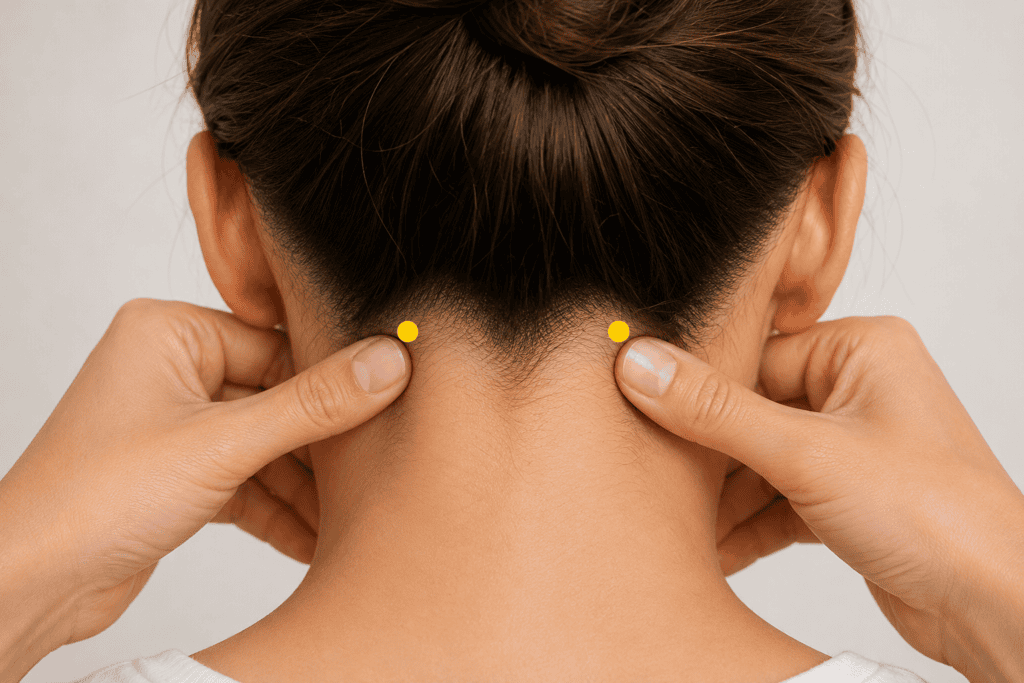
1. Press on GB20 at the base of the skull to release the occiput. GB20 sits in the two hollows at the base of the skull, between the two large vertical neck muscles and the outer edge, roughly level with the tops of the ears. Tip your head back slightly and press firmly up and inward toward the opposite eye with your thumbs for one to two minutes. GB20 is called “Fengchi,” the “Wind Pool,” and it is the single most important point for an occipital headache.
GB20 sits right at the heart of where an occipital headache lives, releasing the tight, aching tension at the base of the skull and clearing the stuck Qi that gathers there. Its name marks it as a wind point, one of the main places to release the wind and cold that lodge in the nape and bring on this kind of headache. This is the junction where the neck turns into the head, and freeing it loosens the whole occiput at once, which is why it is the first point to work and the one that gives the most relief for pain at the back of the head.
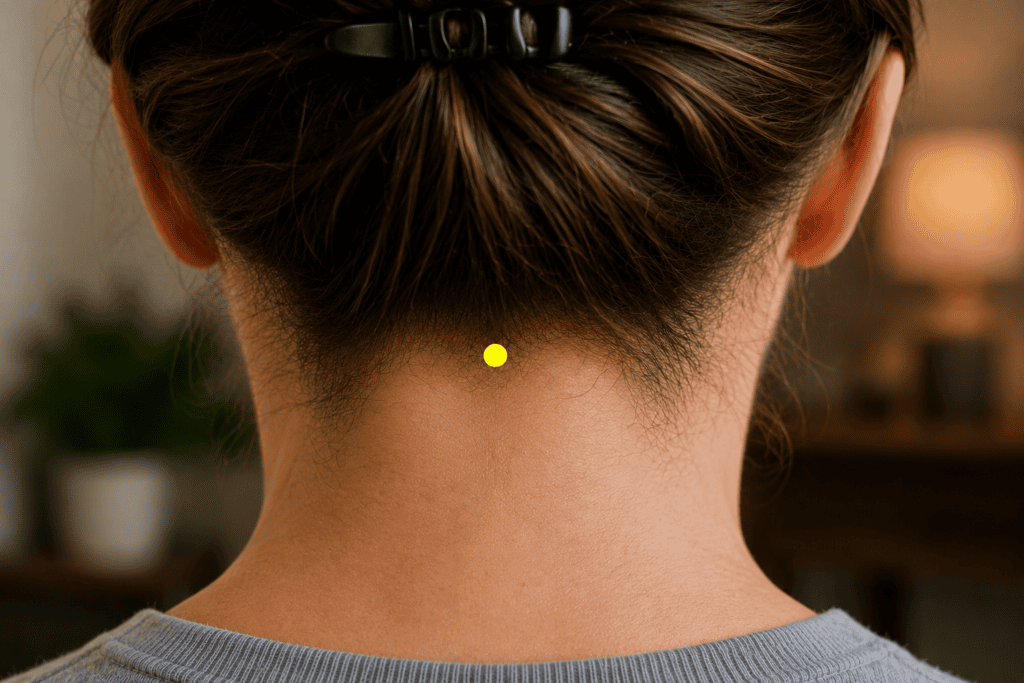
2. Press on GV16 in the center of the base of the skull for midline pain. GV16 sits on the midline at the base of the skull, in the hollow directly below the external bump of the occiput, where the head meets the neck. Press gently but firmly straight in and slightly upward with your thumb or fingertip for about a minute. GV16 is called “Fengfu,” the “Wind Mansion,” and it is a key point for headaches at the back of the head.
GV16 addresses the occipital headache that runs up the center of the back of the head, along the Governing Vessel that climbs the midline of the neck and skull. Like GB20 beside it, it is a wind point, used to release the wind that enters at the nape and settles into a headache and stiff neck. It clears the head and eases the pressure at the very base of the skull on the midline, a spot the side points cannot quite reach. Keep the pressure steady and controlled here, since this is a sensitive area, and let slow breathing carry it in.
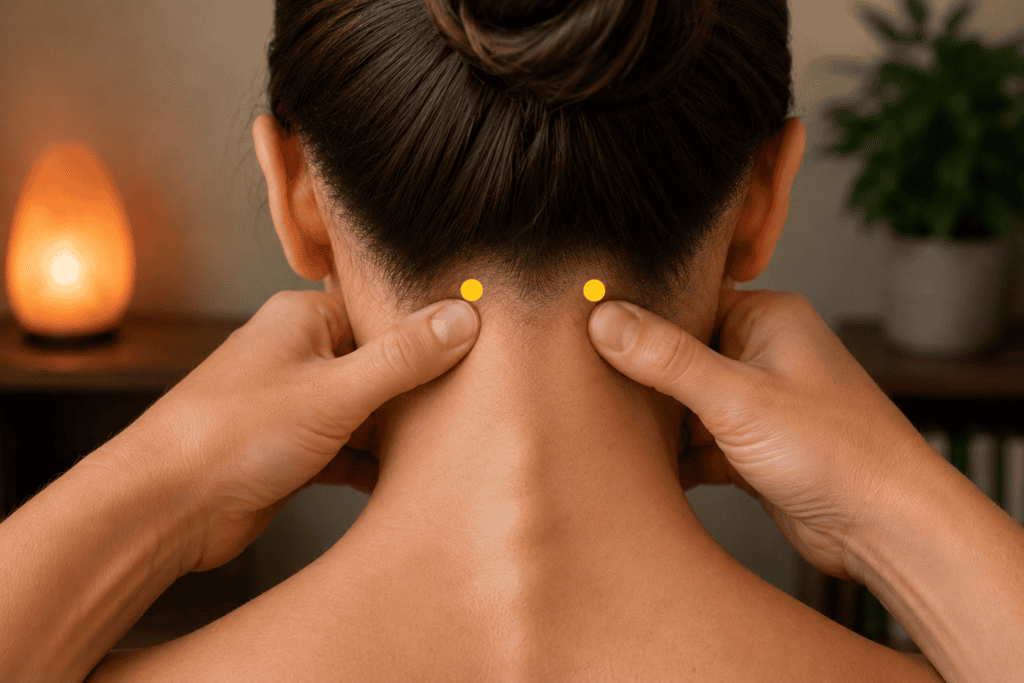
3. Press on BL10 on the neck for a stiff, aching occiput. BL10 sits on the back of the neck, about a thumb-width out to each side of the midline, on the thick band of muscle roughly level with the base of the skull. Press firmly with your thumbs or fingertips for one to two minutes on both sides. BL10 is called “Tianzhu,” the “Celestial Pillar,” and it is one of the best points for occipital pain and a stiff neck.
BL10 works the tight upper neck muscles that so often drive an occipital headache, sitting on the Bladder channel that runs straight up the back of the neck and over the head. It releases stiffness and pain in the neck and at the base of the skull and clears the head along with it. For the occipital headache that is bound up with a tight, sore neck, and most of them are, this point reaches the muscular root just below GB20 and GV16. Working these three together across the base of the skull treats the whole occipital region in one pass.
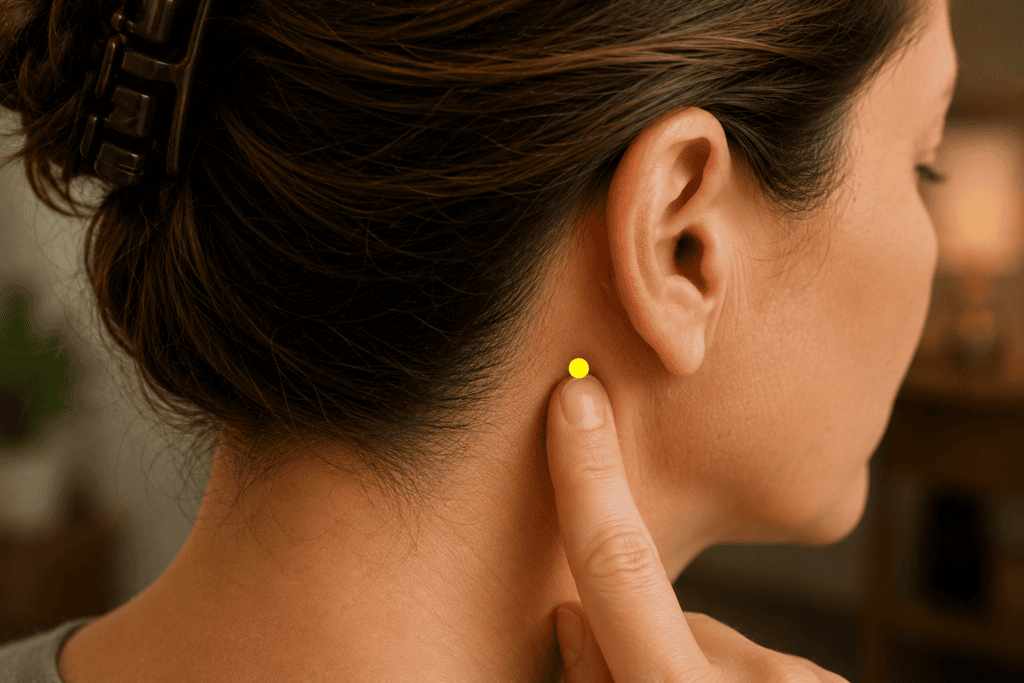
4. Press on GB12 behind the ear for pain behind and above the ear. GB12 sits in the hollow just behind and below the bony bump behind the ear, the mastoid process, where the neck muscle attaches. Press firmly with your fingertip for about a minute on both sides. GB12 is called “Wangu,” and it eases tension at the sides of the back of the head.
GB12 addresses the part of an occipital headache that spreads behind the ears and up the sides of the back of the head, following the Gallbladder channel as it wraps around the skull. It releases the tension in the muscles that anchor behind the ear and often tie into a tight neck. For the headache that is felt not just at the center of the occiput but off to the sides behind the ears, this point covers the ground between the base of the skull and the temples, and it has a calming quality that suits a stress-driven headache.
5. Press on GV14 at the base of the neck to release the whole neck. GV14 sits on the midline at the base of the neck, in the hollow just below the large bump of the seventh cervical vertebra, the one that sticks out most when you bow your head. Press firmly with your fingertip for one to two minutes. GV14 is called “Dazhui,” the “Great Vertebra,” and it is a major point for the neck and for releasing wind.
GV14 sits at the base of the same Governing Vessel that carries occipital pain, and releasing it frees the whole length of the neck below the headache. It is one of the main points used to expel the wind and cold that invade at the neck and shoulders and rise into an occipital headache, which makes it especially useful when the headache came on after a chill or a draft. By loosening the base of the neck, it takes tension off the muscles all the way up to the skull, addressing the foundation that the occipital points sit on top of.
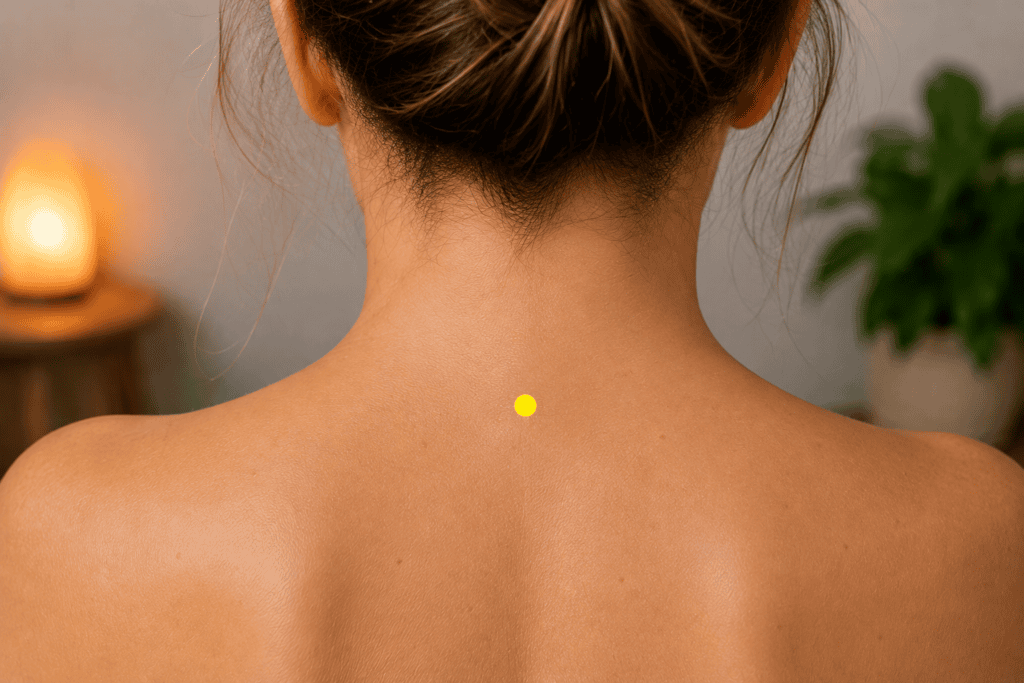
6. Press on GB21 on the top of the shoulder to release shoulder tension. GB21 sits at the highest point of the shoulder, midway between the base of the neck and the tip of the shoulder, on the ridge of the trapezius muscle. Press down firmly with your fingertips or pinch the muscle for one to two minutes on each side. GB21 is called “Jianjing.” GB21 is avoided during pregnancy.
An occipital headache almost always sits on top of tight shoulders, since the trapezius muscle runs from the shoulder straight up to the base of the skull, and GB21 releases that muscle at its lower end. Freeing the shoulders takes the pull off the occiput, which is why loosening them so often eases the headache above. On the Gallbladder channel that carries tension up into the head, this point treats the pattern at its source rather than only where it hurts. For anyone whose back-of-head pain comes with hunched, hard shoulders, this point is essential.

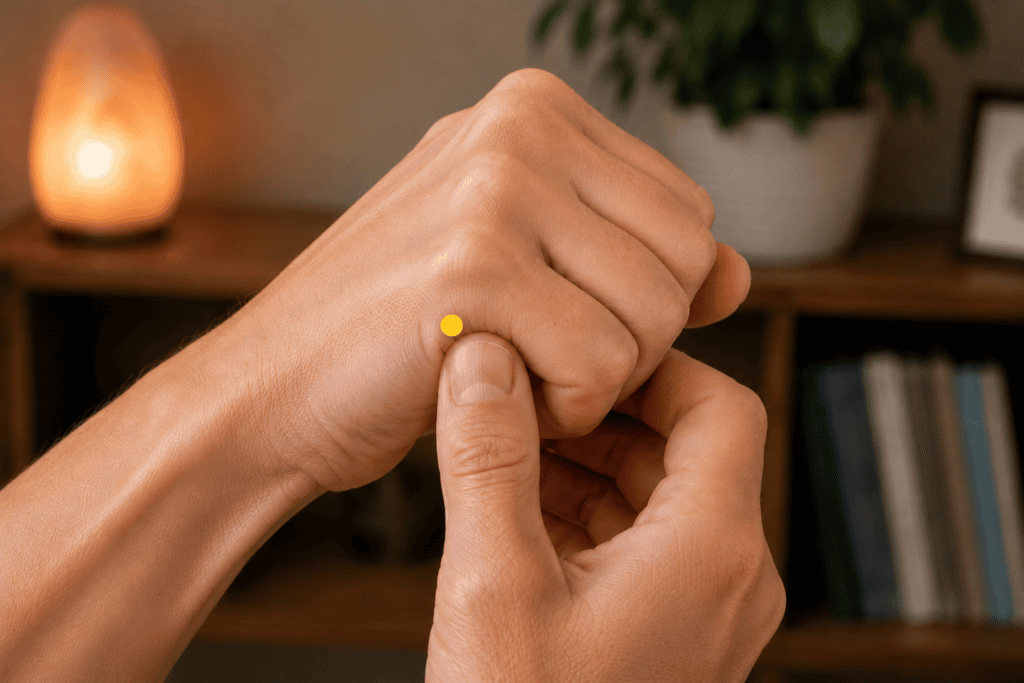
7. Press on SI3 on the side of the hand for pain along the back channels. SI3 sits on the side of the hand, just below the knuckle of the little finger, at the end of the crease that forms when you make a loose fist. Press firmly with the thumb of your other hand for one to two minutes on each hand. SI3 is called “Houxi,” and it is the point that opens the Governing Vessel.
SI3 reaches the back of the head from far away by opening the Governing Vessel, the channel that runs up the spine, the back of the neck, and over the occiput, which is exactly the path of an occipital headache. Because of that connection, it is one of the most useful distal points for pain along the spine, neck, and back of the head, and it is a classic choice for a stiff, painful neck. Pressed while you work the local points at the base of the skull, it strengthens the whole effect from the other end of the channel, and it is discreet enough to use anywhere.
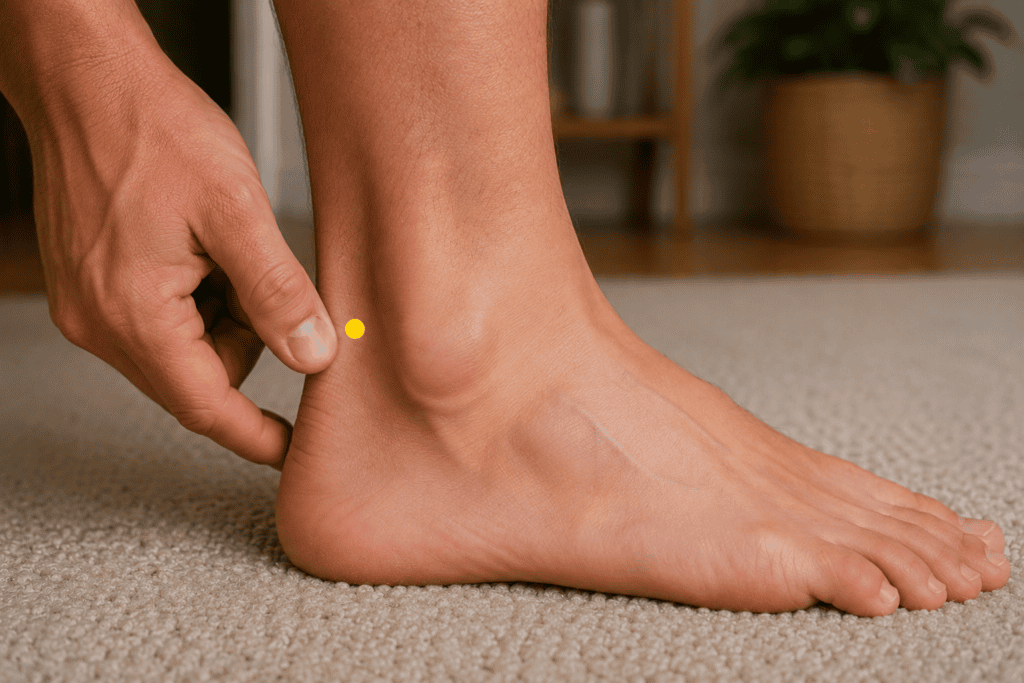
8. Press on BL60 at the ankle to draw the pain down the back channel. BL60 sits in the hollow between the outer ankle bone and the Achilles tendon, level with the tip of the ankle bone. Press firmly with your thumb for one to two minutes on each ankle. BL60 is called “Kunlun,” and it is a major distal point for the whole back of the body. BL60 is avoided during pregnancy.
BL60 sits on the Bladder channel far down at the ankle, the same channel that runs all the way up the back of the neck and over the head, and pressing it moves the stuck Qi along that entire line to relieve pain at the top of it. It is a long-trusted point for headaches at the back of the head and for neck and upper back stiffness, working by drawing the congested energy downward and away from the head. As a distal partner to the local occipital points, it is one of the most fitting choices for pain that sits squarely at the back of the skull.
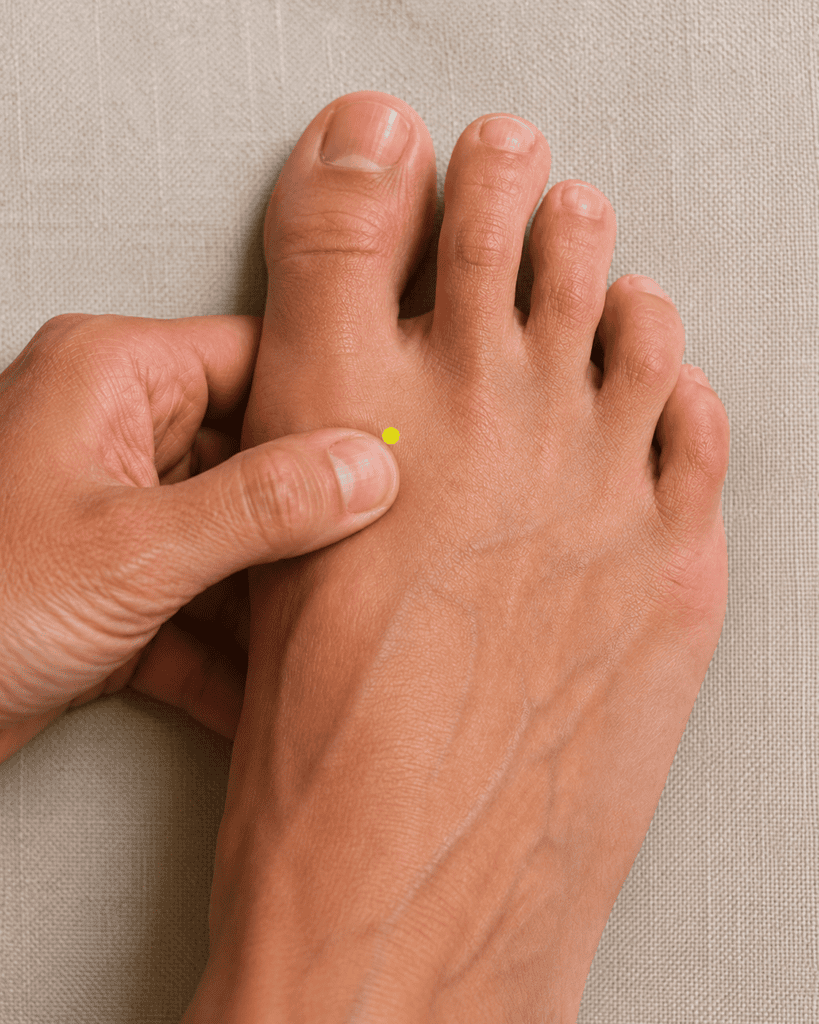
9. Press on LR3 on the top of the foot for stress-driven headaches. LR3 sits on the top of the foot, in the webbing between the big toe and second toe, about two finger-widths back where the bones meet in a small hollow. Press firmly with the thumb for one to two minutes on each foot. LR3 is called “Taichong,” and it is the primary point for settling the Liver.
When stress is behind an occipital headache, Chinese medicine reads it as bound Liver Qi rising up and tightening the neck and the back of the head, and LR3 brings that stuck energy back down. It releases the tension, irritability, and wound-tight feeling that stress creates and that so often sets off a headache in the first place. For the person whose back-of-head pain flares on the hardest, most stressful days, this point reaches the trigger the local muscle points cannot, and it settles the whole system while the neck points release the muscles.
Why These Acupressure Points Work
In Chinese medicine, an occipital headache results from Qi and Blood stagnation in the channels at the back of the head, including the Bladder channel, the Governing Vessel running up the middle, and the Gallbladder channel along the sides. Tight neck muscles block the flow, often accompanied by wind and cold lodged at the nape. Stress can cause Liver Qi to rise, heightening tension. The nine points target all aspects of this pattern.
- The base-of-skull points (GB20, GV16, BL10) release the tight muscles and stuck Qi right where the occipital headache sits, and clear the wind that enters at the nape.
- The surrounding points (GB12, GV14, GB21) free the tension behind the ears, at the base of the neck, and across the shoulders that all pull on the occiput.
- The distal channel points (SI3, BL60) reach the back of the head through the Governing and Bladder channels and draw the congested Qi away from it.
- The Liver point (LR3) settles the stress and bound Qi that tighten the neck and set off the headache.
Beneath it all, there’s often anxiety, stress, and depression that can tighten the neck and shoulders, affecting the Liver. These feelings are often at the root of many occipital headaches and tend to respond well to treatment. Recognizing and addressing these connections can help you find relief.
How to Properly Use These Acupressure Points
Start at the base of the skull where the pain resides, work down the neck and shoulders, and finish with the hands, ankles, and feet.
- Begin with GB20, GV16, and BL10 across the base of the skull, since this is where an occipital headache is anchored and where you will feel the most immediate relief.
- Move to GB12 behind the ears, then down to GV14 at the base of the neck and GB21 on the shoulders to release everything that pulls on the occiput.
- Finish with SI3 on the hand, BL60 at the ankle, and LR3 on the foot to work the back channels from a distance and settle the stress behind the pain.
- Hold each point for one to two minutes with firm, steady pressure, breathing slowly, and repeat the routine as needed through the day.
Combining acupressure with healthy habits can help prevent recurrence. Pay attention to your posture at your desk and in front of screens, as forward-head positions strain the muscles that contribute to occipital headaches. Take regular breaks to move and reset your neck. Keep the back of your neck warm and protected from cold drafts, since Chinese medicine and experience suggest this can trigger headaches. Stay hydrated, do gentle neck and shoulder stretches throughout the day, and watch for jaw clenching and stress, as both can directly contribute to the headache pattern.
When to Get Professional Help
The typical occipital headache is muscular and improves with rest and the points mentioned above. However, some pain at the back of the head may require additional intervention.
See a doctor if you experience frequent or severe headaches, especially if they worsen over time. Also, consult a doctor for sharp, shooting, electric, or stabbing pain at the back of the head, or if there is scalp tenderness, as these may indicate occipital neuralgia—a nerve condition that needs proper diagnosis and treatment, not just acupressure. Seek emergency care immediately if you have a sudden, intense headache that hits like a thunderclap, or if a headache at the back of the head is accompanied by a stiff neck, fever, confusion, weakness, numbness, speech difficulties, vision changes, or recent head or neck injury, as these could be serious signs. A headache that worsens at the back of the head first thing in the morning should also be discussed with a healthcare provider.
Acupressure can help with common occipital muscle headaches but is not a substitute for addressing these warning signs.
Above and Beyond Acupuncture offers acupuncture, cupping, and lifestyle coaching at the North Frank Lloyd Wright Boulevard location in Scottsdale.
Schedule an appointment online or call us today to start your healing journey.
The points above are only as effective as the technique used to apply them. Where to press, how firmly, and for how long all affect the result. For a full breakdown of how to perform acupressure properly at home, read Performing Acupressure in 3 Easy Steps.

About the Publisher
Paul Kerzner, L.Ac., is a licensed acupuncturist and board-certified herbalist, as well as the founder of Above and Beyond Acupuncture in Scottsdale. His own journey from chronic patient to practicing acupuncturist shapes his commitment to providing honest, clinically grounded information about acupuncture and Traditional Chinese Medicine. Learn more about Paul and his clinical approach on the About Us page.