Key Takeaways
- Arm pain is usually caused by muscle strain, overuse, shoulder problems, arthritis, or a pinched nerve in the neck. However, it can also be a warning sign of a heart attack.
- Call 911 for arm pain with chest pressure, shortness of breath, nausea, cold sweat, lightheadedness, or pain in the jaw, neck, or back, as well as for sudden arm weakness.
- In Traditional Chinese Medicine, arm pain reflects Qi and Blood blocked in the channels that run through the arm, often from overuse, strain, or Wind and Cold settling in the shoulder and neck.
- Nine acupressure points on the shoulders, arms, hands, and one leg help release tight muscles, move Qi and Blood through the arm, and ease aching from the shoulder to the fingers.
- Taking breaks from repetitive tasks, setting up your workstation properly, keeping your neck and shoulders warm, and doing gentle stretches can help prevent arm pain from returning.

Many people search for information about arm pain because they worry it could signal a heart problem. That concern is valid, and the warning signs are listed below. In most cases, though, arm pain is musculoskeletal and linked to everyday activities. Painting, starting a new exercise routine, spending long hours at a computer, carrying a child, or sleeping on one side can cause upper-arm soreness, forearm tightness, or a dull ache that runs from the shoulder to the hand.
According to Norton Healthcare, arm pain often results from muscle strain, shoulder problems, arthritis, pinched nerves, or other non-heart-related conditions. Soreness after lifting is usually less concerning than arm pain accompanied by heart symptoms. Norton notes that arm discomfort can signal a heart attack, especially when it occurs with chest pressure, shortness of breath, nausea, a cold sweat, lightheadedness, or pain in the jaw, neck, shoulder, or upper back. Women may experience pain in either arm, along with pain between the shoulder blades, nausea, or unusual fatigue. Norton recommends prompt evaluation if arm pain is new, persistent, worsening, or brought on by exertion, especially for people with heart disease risk factors.
The arm consists of muscles, tendons, and joints that extend from the neck to the fingertips. Pain in one area can often spread to nearby structures. For instance, a shoulder strain may cause discomfort in the upper arm. Repetitive gripping or typing can strain the forearm muscles and tendons around the elbow. A pinched nerve in the cervical spine may cause aching, tingling, or numbness that travels down the arm and into the hand, even when there is no direct arm injury.
Traditional Chinese Medicine views the arm as a network of channels, each with its own pathway. The Large Intestine channel runs along the outer front of the arm, the Triple Energizer channel follows the back midline, and the Small Intestine channel travels along the outer back edge toward the little finger. Repetitive strain may obstruct Qi and Blood flow in these channels, causing fixed, sharp pain. Cold air around the shoulders can allow Wind and Cold to build up, leading to stiffness and aching that improves with warmth. Prolonged neck tension from desk work may restrict flow throughout the arm.
The points start at the top of the shoulder, move down the arm to the hand, and end with one point on the lower leg.
What Acupressure Points to Press and Why
1. Press on GB21 on the top of the shoulder to release the neck and shoulder. GB21 sits on the top of the shoulder, halfway between the base of the neck and the outer tip of the shoulder, on the highest point of the muscle. Press with moderate pressure using the fingers of the opposite hand for one to two minutes on each side. GB21 is called “Jianjing,” the “Shoulder Well.”
GB21 helps release tight muscles across the shoulder’s upper edge and at the base of the neck, where tension that can contribute to arm pain often starts. GB21 is avoided during pregnancy.

2. Press on LI15 at the front of the shoulder to free the shoulder joint. LI15 sits at the front of the shoulder, in the hollow that appears just below the bony tip of the shoulder when the arm is raised out to the side. Press firmly with the fingers of the opposite hand for one to two minutes on each side. LI15 is called “Jianyu,” the “Shoulder Bone.”
In Traditional Chinese Medicine, LI15 is a key point for shoulder and upper-arm pain. It helps relax the shoulder joint and relieve aching that extends down the outer arm.
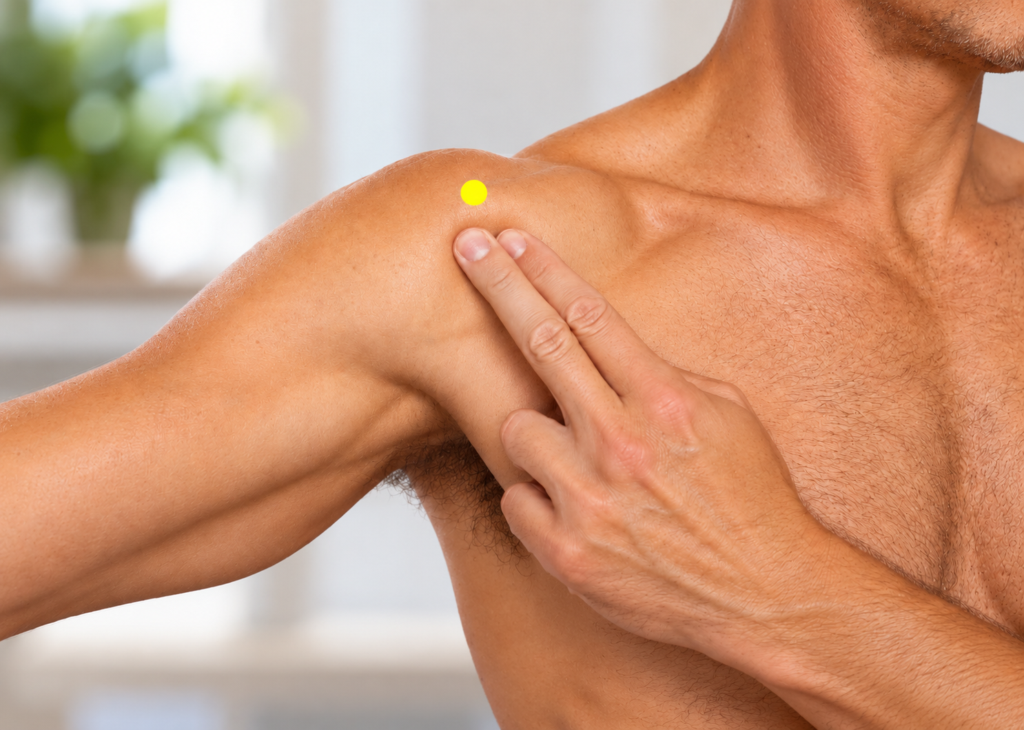
3. Press on LI14 on the outer upper arm to ease upper arm pain. LI14 sits on the outer side of the upper arm, at the lower tip of the rounded shoulder muscle where it narrows into the arm. Press firmly with the thumb of your other hand for one to two minutes on each arm. LI14 is called “Binao,” the “Upper Arm.”
LI14 is a classic local point for aching, heavy, or tired upper arms. It helps move Qi and Blood through the upper-arm muscles, especially after lifting, carrying, or working overhead.
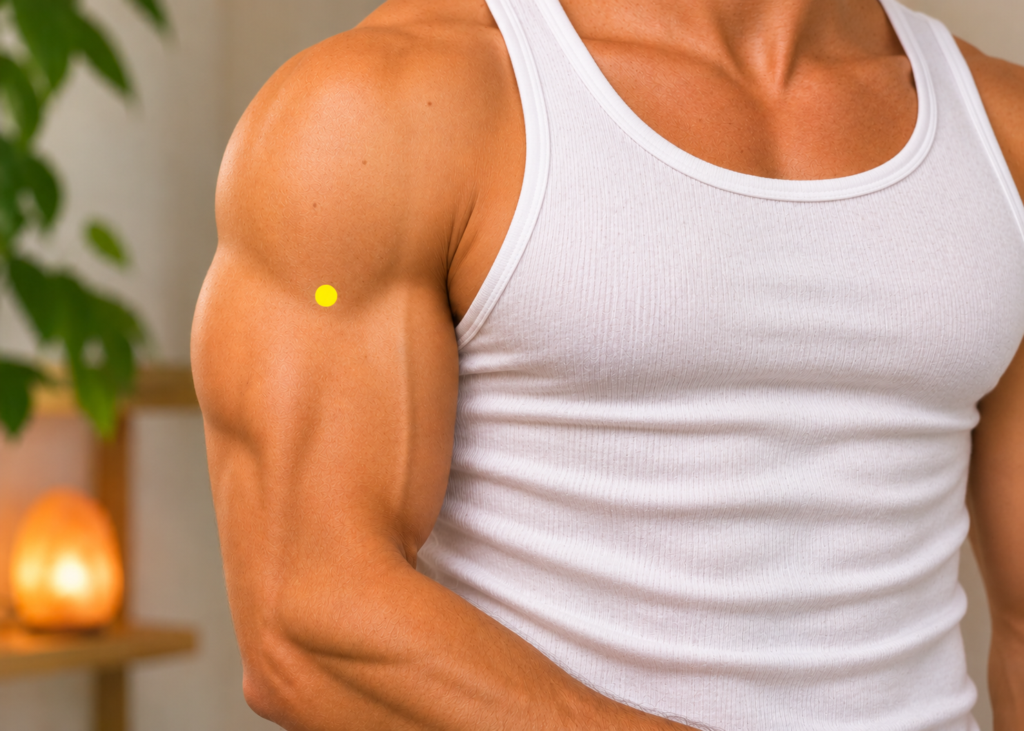
4. Press on LI11 at the outer elbow to relax the elbow. LI11 sits at the outer end of the elbow crease when the elbow is bent, in the hollow between the end of the crease and the bony point of the elbow. Press firmly with the thumb of your other hand for one to two minutes on each arm. LI11 is called “Quchi,” the “Pool at the Crook.”
LI11 is the Large Intestine’s sea point. It relieves elbow pain and stiffness and clears Heat when the arm feels warm, achy, or inflamed from overuse.
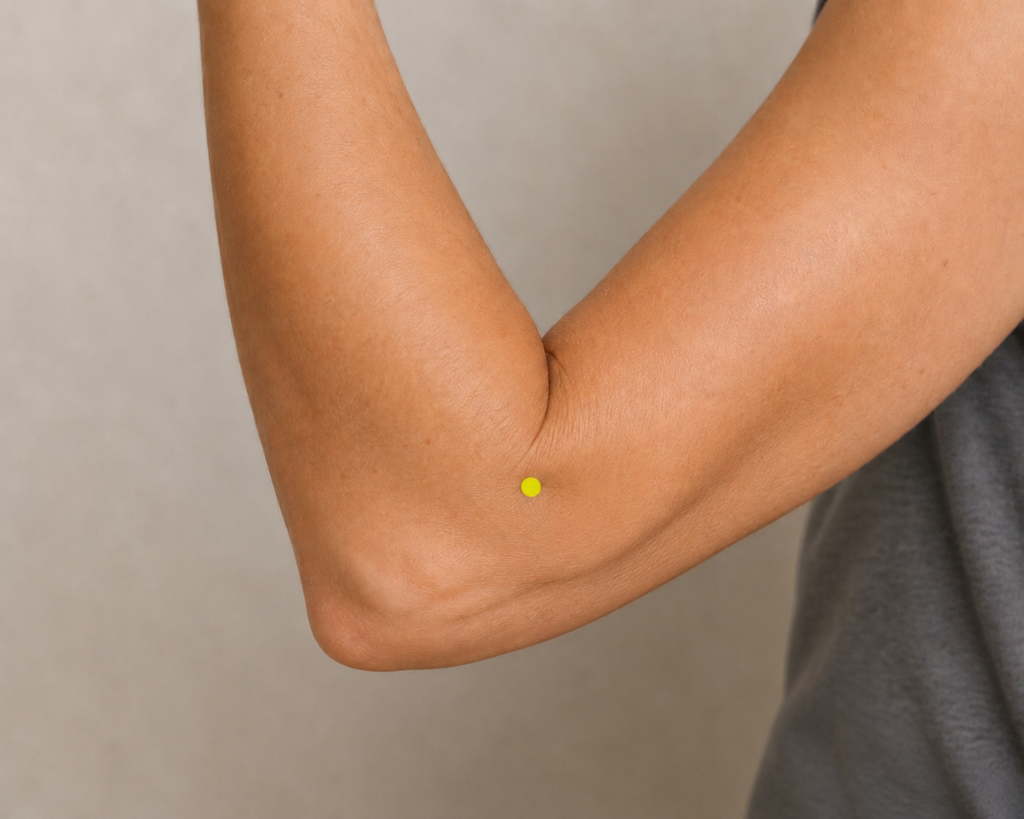
5. Press on LI10 on the forearm to relieve tired forearm muscles. LI10 sits on the thumb side of the forearm, three finger-widths below the outer end of the elbow crease when the elbow is bent. Press firmly with the thumb of your other hand for one to two minutes on each arm. LI10 is called “Shousanli,” the “Arm Three Miles.”
LI10 lies directly over the forearm muscles that work hardest during gripping, typing, and lifting. It eases aching, weakness, and overworked forearms, helping the arm recover after a long day.
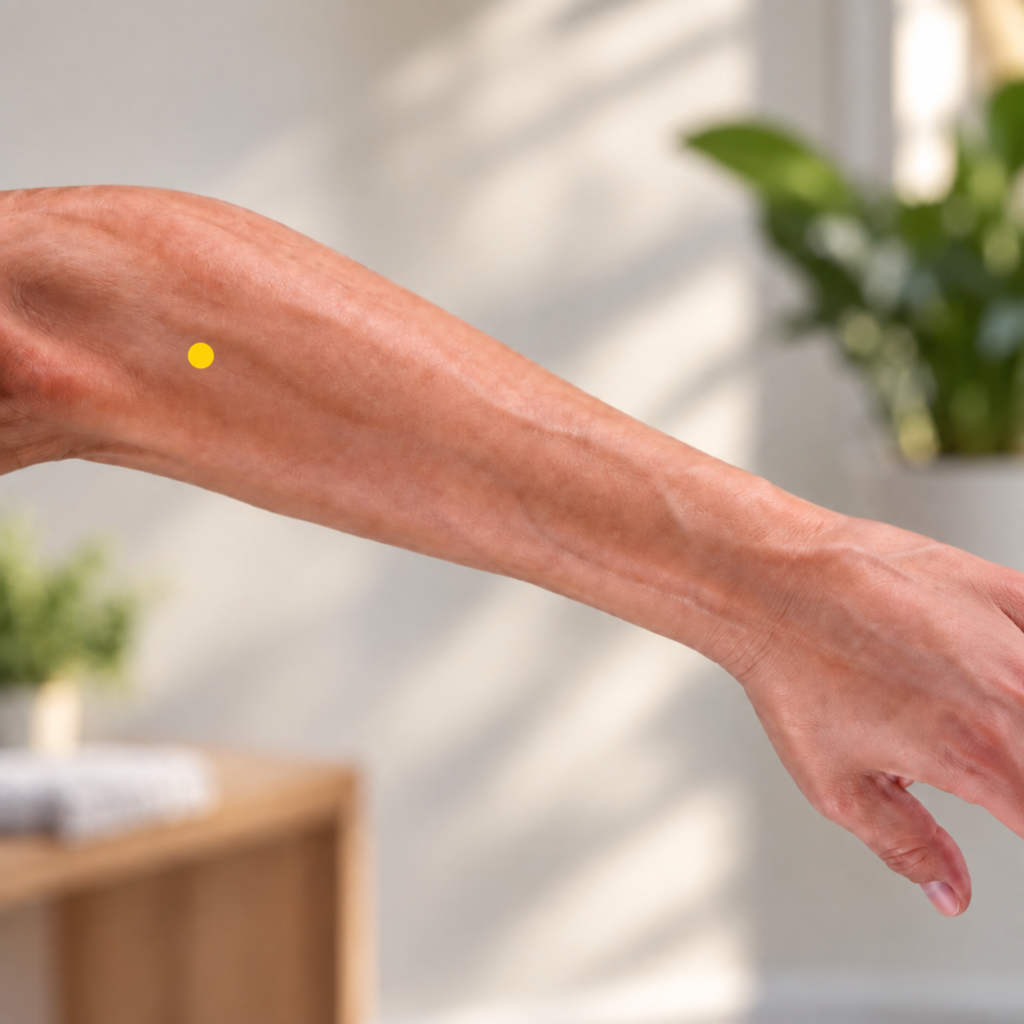
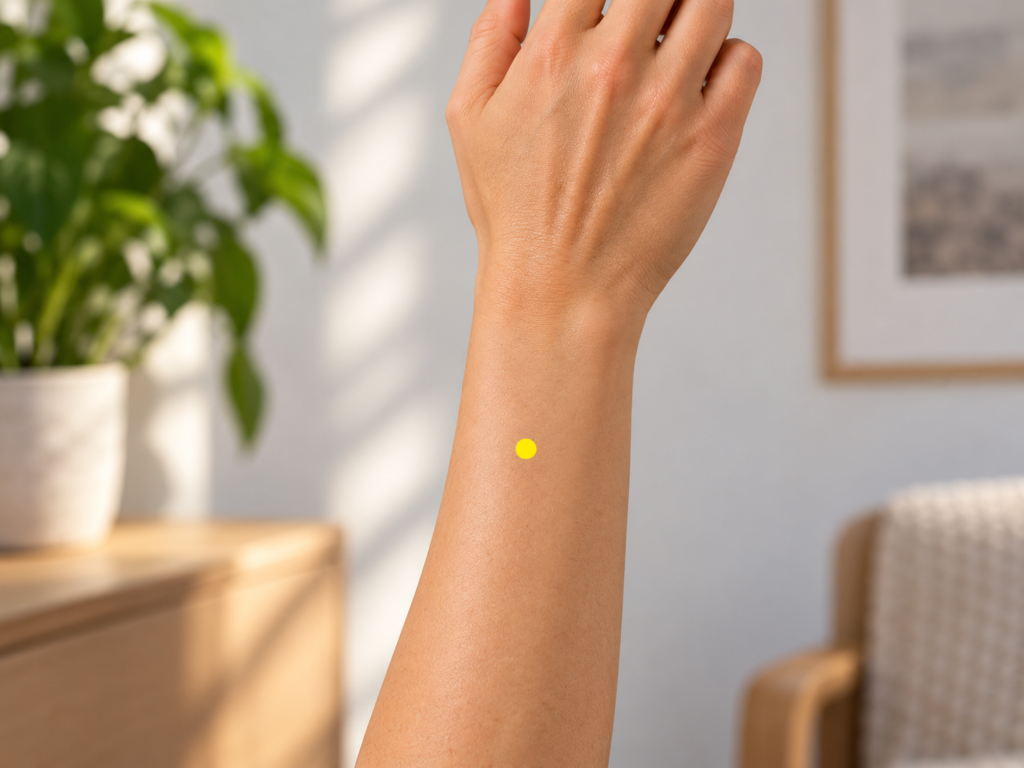
6. Press on TE5 on the back of the forearm to release the whole arm. TE5 sits on the back of the forearm, three finger-widths above the wrist crease, between the two forearm bones. Press firmly with the thumb of your other hand for one to two minutes on each arm. TE5 is called “Waiguan,” the “Outer Pass.”
TE5 is the connecting point of the Triple Energizer, a channel that runs from the ring finger along the back of the arm to the shoulder. It eases pain along the back of the arm and helps relieve stiffness caused by Wind and Cold.
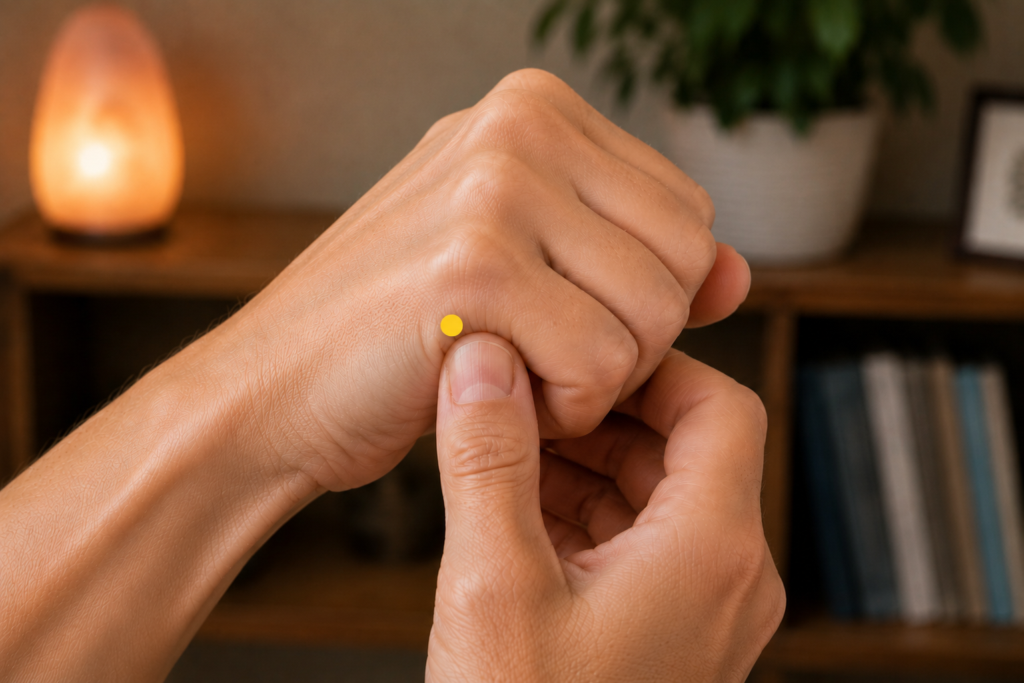
7. Press on SI3 on the outer edge of the hand to relax the neck and arm. SI3 sits on the outer edge of the hand, just below the knuckle of the little finger, at the end of the crease that forms when the hand makes a loose fist. Press firmly with the thumb of your other hand for one to two minutes on each hand. SI3 is called “Houxi,” the “Back Stream.”
SI3 opens the Governing Vessel, which runs up the spine to the neck. It relieves neck and shoulder stiffness and eases pain along the outer edge of the back of the arm.
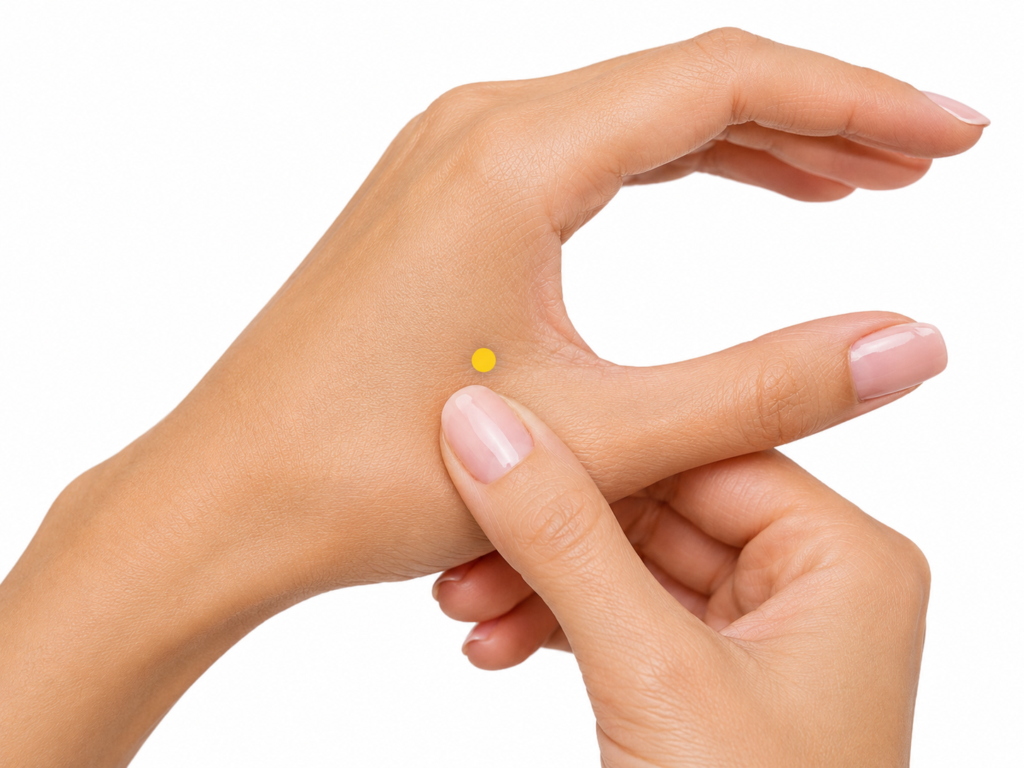
8. Press on LI4 on the back of the hand to ease pain. LI4 sits on the back of the hand, in the web between the thumb and index finger, at the highest point of the muscle when the thumb is pressed against the index finger. Press firmly with the thumb of your other hand for one to two minutes on each hand. LI4 is called “Hegu,” the “Joining Valley.”
LI4 is the source point of the Large Intestine and a classic point for pain anywhere in the body. It moves Qi along the Large Intestine channel, from the hand to the shoulder. LI4 is avoided during pregnancy.
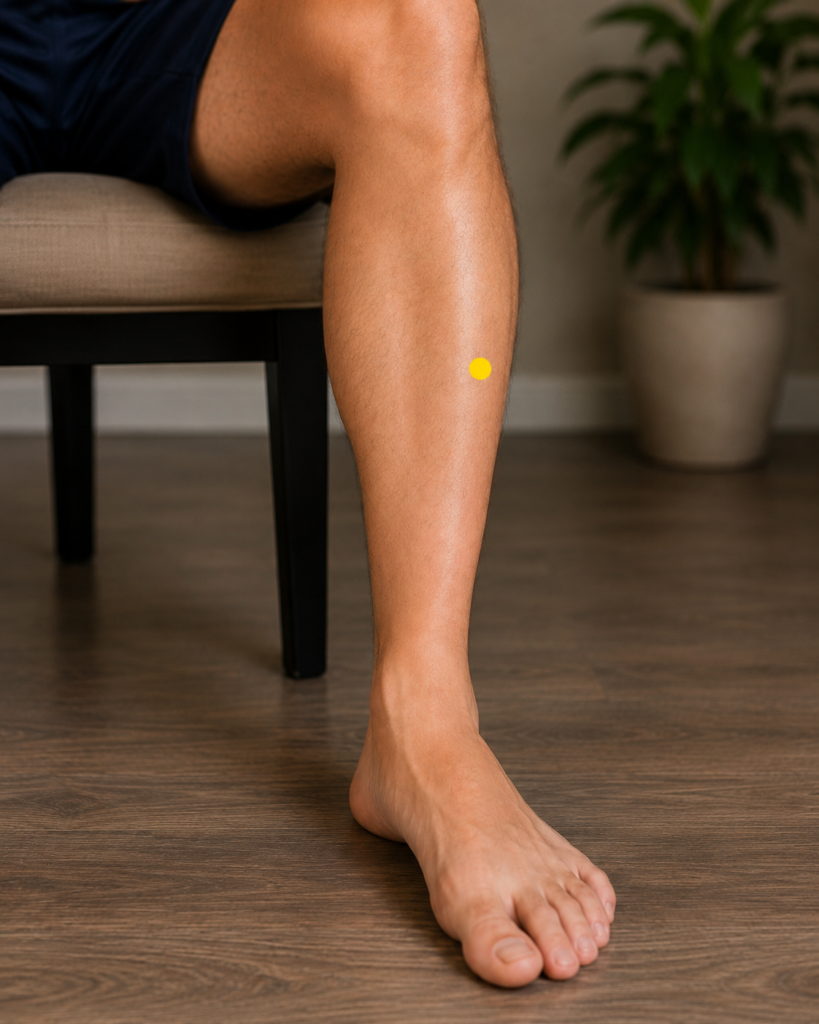
9. Press on ST38 on the lower leg to release the shoulder and arm from a distance. ST38 sits on the front of the lower leg, halfway between the bottom of the kneecap and the crease at the front of the ankle, one finger-width out from the edge of the shinbone. Press firmly with your thumb for one to two minutes on the leg opposite the painful arm, while slowly moving the sore arm and shoulder. ST38 is called “Tiaokou,” the “Ribbon Opening.”
ST38 is a classic distance point for stiff, painful shoulders and upper arms. Pressing it while gently moving the arm is a traditional technique for loosening pain that has settled in the shoulder.
Why These Acupressure Points Work
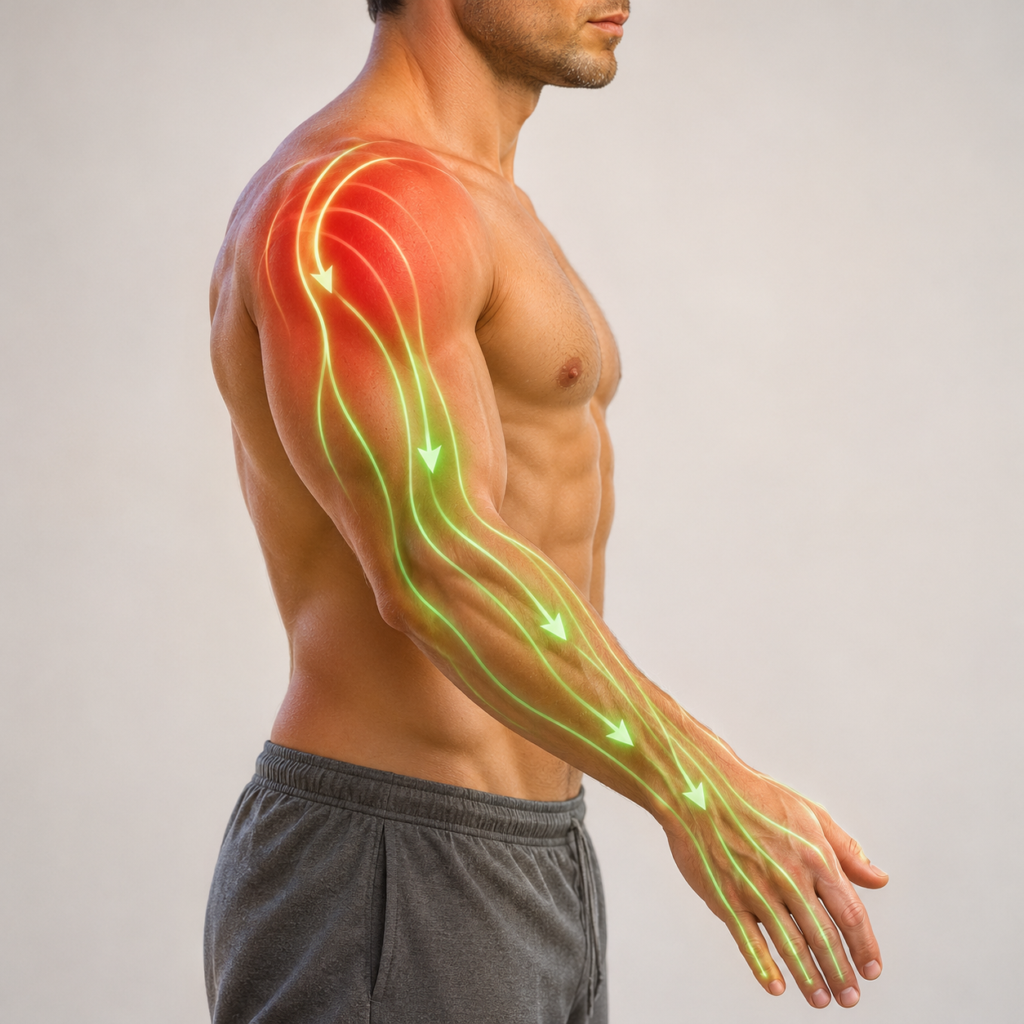
From a Traditional Chinese Medicine perspective, arm pain means Qi and Blood are blocked somewhere along the channels that run through the arm. Points on the shoulder and upper arm release areas where many arm problems begin; elbow and forearm points target the muscles used most for gripping; and hand points move Qi along each channel’s full length. ST38 works from below, loosening the shoulder from a distance.
The nine points work together to alleviate arm pain:
- GB21 and LI15 release the neck and shoulder.
- LI14, LI11, and LI10 ease the upper arm, elbow, and forearm.
- TE5, SI3, and LI4 move Qi along the full length of the arm.
- ST38 loosens the shoulder and arm from a distance.
How to Properly Use These Acupressure Points

Acupressure can help relieve arm pain during breaks from repetitive tasks and at the end of the day, after heart-related causes have been ruled out.
- For pain originating in the shoulder, apply pressure to GB21, LI15, and LI14 on the affected side. Then apply pressure to ST38 on the opposite leg while slowly rotating the shoulder in a circular motion.
- For a fatigued, aching forearm after typing, gripping, or lifting, apply pressure to LI10, LI11, and TE5 on the affected arm.
- For pain radiating from the neck down the arm, apply pressure to SI3 and LI4 on both hands, followed by GB21 on both shoulders.
- During the workday, apply pressure to LI4 and SI3 every one to two hours while stretching your wrists and fingers.
- Apply firm pressure to the arms, hands, and legs, and moderate pressure to the shoulders. Reduce the pressure if any area feels bruised. GB21 and LI4 are avoided during pregnancy.
Small daily changes can help reduce strain on your arms. During repetitive tasks, take a short break every 30 to 45 minutes to shake out your hands and roll your shoulders. Adjust your keyboard and mouse so your elbows stay close to your body and your wrists remain straight. Hold your phone at eye level rather than looking down. Switch arms when carrying bags or children, and avoid sleeping with your arm tucked under your head or body. If you’ve just strained your arm, apply ice on the first day to reduce swelling, then switch to warmth to keep Qi and Blood moving. Traditional Chinese Medicine also recommends keeping your neck and shoulders covered, avoiding direct airflow from fans or air conditioning, and stretching gently each morning.
When to Get Professional Help

Call 911 if you have arm pain along with chest pressure or squeezing, shortness of breath, nausea, vomiting, cold sweat, lightheadedness or fainting, or pain in your jaw, neck, or back. These symptoms can be signs of a heart attack. Also call 911 if you suddenly feel weak in one arm or have trouble raising both arms evenly, especially if you notice facial drooping or slurred speech. These can be signs of a stroke. Get medical help right away if arm pain starts with activity and goes away with rest, if your arm looks deformed or you can’t move it after a fall, or if your arm becomes swollen, warm, and red, which could mean a blood clot. See a doctor if you have arm pain with numbness, tingling, or weakness in your hand, or if you have any new, ongoing, or worsening arm pain, particularly with high blood pressure, diabetes, high cholesterol, smoking, or a family history of heart disease.
Acupressure is a gentle, supportive practice for arm pain. It complements, and does not replace, diagnosis and medical care.
For related health concerns, acupressure for shoulder pain, acupressure for tennis elbow, and acupressure for cervical radiculopathy are companion articles.
Above and Beyond Acupuncture offers acupuncture, cupping, and lifestyle coaching at the North Frank Lloyd Wright Boulevard location in Scottsdale.
Schedule an appointment online to start your healing journey.
The points above are only as effective as the technique used to apply them. Where to press, how firmly, and for how long all affect the result. For a full breakdown of how to perform acupressure properly at home, read Performing Acupressure in 3 Easy Steps.

About the Publisher
Paul Kerzner, L.Ac., is a licensed acupuncturist and board-certified herbalist, as well as the founder of Above and Beyond Acupuncture in Scottsdale. His own journey from chronic patient to practicing acupuncturist shapes his commitment to providing honest, clinically grounded information about acupuncture and Traditional Chinese Medicine. Learn more about Paul and his clinical approach on the About Us page.