
Key Takeaways
- Dry eye occurs when tears are insufficient or evaporate too quickly, leading to discomfort such as burning and sensitivity.
- Acupressure for dry eyes provides relief by targeting specific points that enhance blood flow and help restore eye moisture.
- Activate nine specific acupressure points, such as BL1 and ST1, to enhance tear flow and alleviate irritation.
- Combine acupressure, warm compresses, and healthy habits to effectively reduce dry eye symptoms.
- See an eye doctor if symptoms continue despite using home remedies, as professional treatment might be needed.
Do your eyes feel gritty, burn, or become tired as the day goes on?
Dry eye is a common issue that happens when your eyes don’t produce enough tears or lose them too quickly, often because small oil glands along your eyelids malfunction. This condition can cause a sandy, scratchy sensation, burning, redness, blurry vision that improves with blinking, sensitivity to light and wind, and sometimes watery eyes as your eyes compensate for dryness. Factors like screen use, dry air, air conditioning, aging, hormonal shifts, contact lenses, and certain medications contribute to this problem. Acupressure offers a gentle way to relieve discomfort and support eye moisture. Combining it with warm compresses and other daily techniques can be effective. The following points may help.
In Traditional Chinese Medicine, it is believed that the Liver connects to the eyes, which depend on Liver Blood and Yin, the body’s cooling and moistening fluids, for good health. When these fluids diminish, the eyes may become dry, much like a stream drying up during a drought. This decline often occurs with age, menopause, prolonged overexertion, late nights, or extensive screen time, all of which are thought to deplete Liver Blood. The Kidney also influences eye health by storing the body’s deepest Yin reserves and fluids, with one of its channels linked to the inner corner of the eye. Excess heat worsens the situation by increasing dryness, redness, and burning sensations.
Here are nine acupressure points that can enhance circulation around the eyes, benefiting the tear and oil glands. Points located farther from the eyes support Liver and Kidney Yin, helping to keep the eyes moist internally.
What Acupressure Points to Press and Why
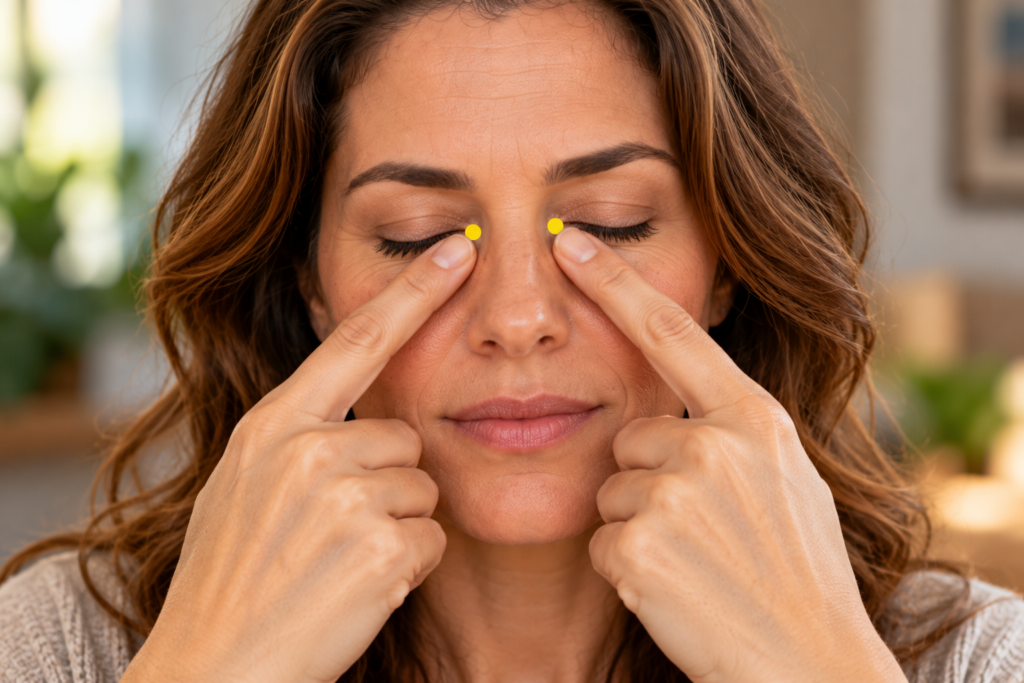
1. Press on BL1 at the inner corner of the eye to support tear flow. BL1 sits in the small hollow just above and inside the inner corner of the eye, beside the bridge of the nose. With clean hands and your eyes closed, press gently against the bone toward the bridge of the nose, never into the eye itself, for about thirty seconds to a minute on both sides. BL1 is called “Jingming,” the “Bright Eyes,” and it is one of the most important points for the eyes.
BL1 sits near the tear drainage system at the inner eye corner and is a key point for relieving dry, irritated, or tired eyes. Stimulating this point increases blood flow, alleviates scratchy or burning sensations, and helps maintain eye moisture. Multiple channels converge here, including one linked to the Kidney. Always apply gentle, brief pressure on the nasal bone rather than the eye itself.
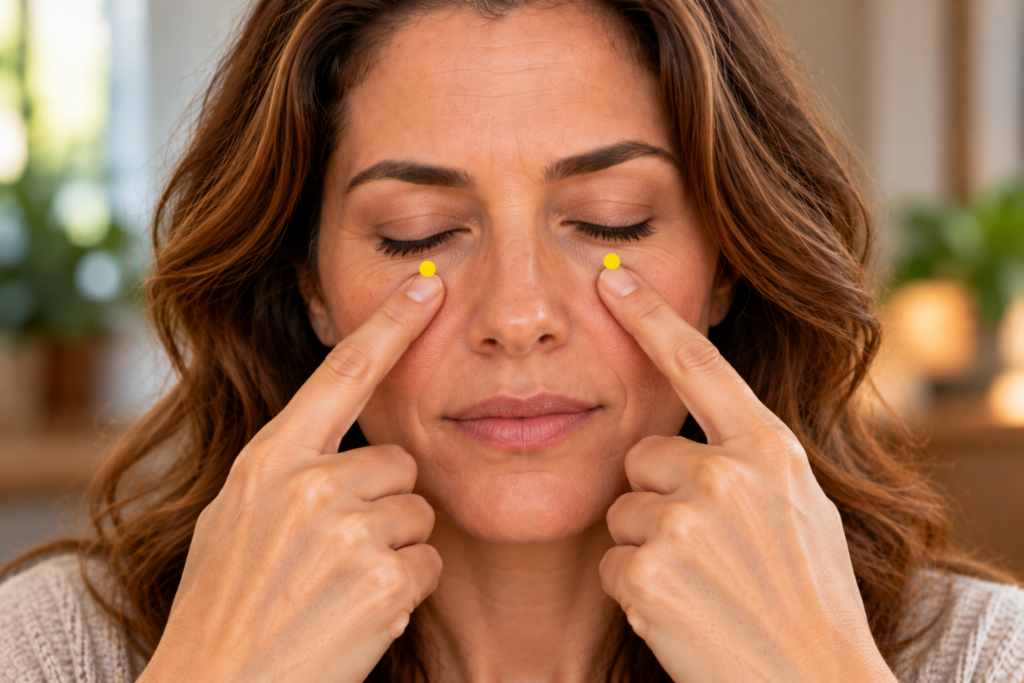
2. Press on ST1 below the eye to moisten and soothe. ST1 sits on the bony ridge directly below the pupil, at the lower edge of the eye socket, when you look straight ahead. With your eyes closed, press gently upward against the bone with a fingertip for about a minute on both sides, avoiding pressure on the eyeball. ST1 is called “Chengqi,” the “Container of Tears.”
ST1 sits where tears gather and is a common point for dry, irritated eyes, redness, and irritation-related tearing. It promotes circulation in the lower eyelid, where many oil glands work to prevent tear evaporation. Gently pressing along the lower rim of the eye socket, from the inner corner outward, can provide additional relief.
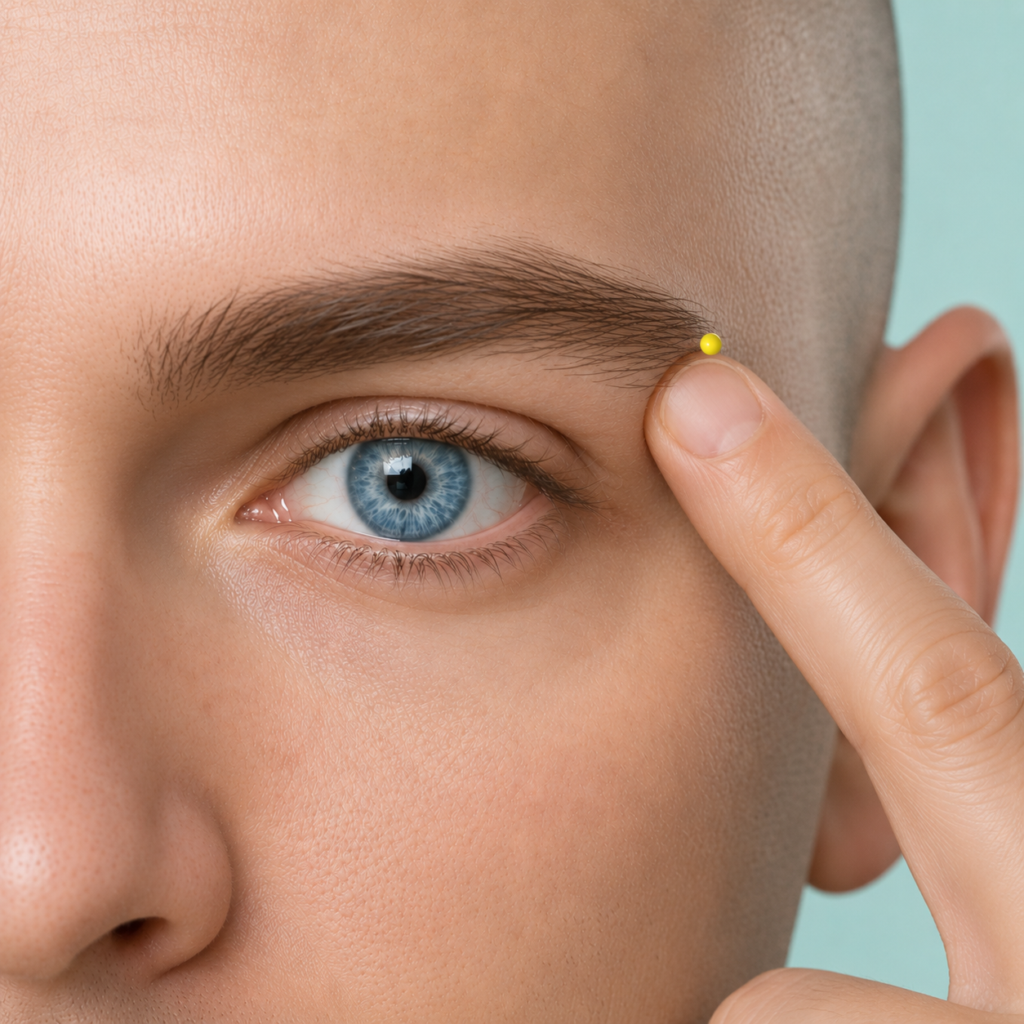
3. Press on SJ23 at the outer end of the eyebrow to ease burning and redness. SJ23 sits in the small hollow at the outer end of the eyebrow. Press gently with your fingertips, or make small slow circles, for about a minute on both sides. SJ23 is called “Sizhukong,” the “Silk Bamboo Hollow.”
SJ23 alleviates burning, redness, and irritation in dry eyes while reducing tension around the outer edge. It is particularly effective when dryness is accompanied by redness or a hot, stinging sensation. Applying pressure to BL1 at the inner corner, ST1 along the lower eye rim, and SJ23 at the outer brow targets the entire eye area.
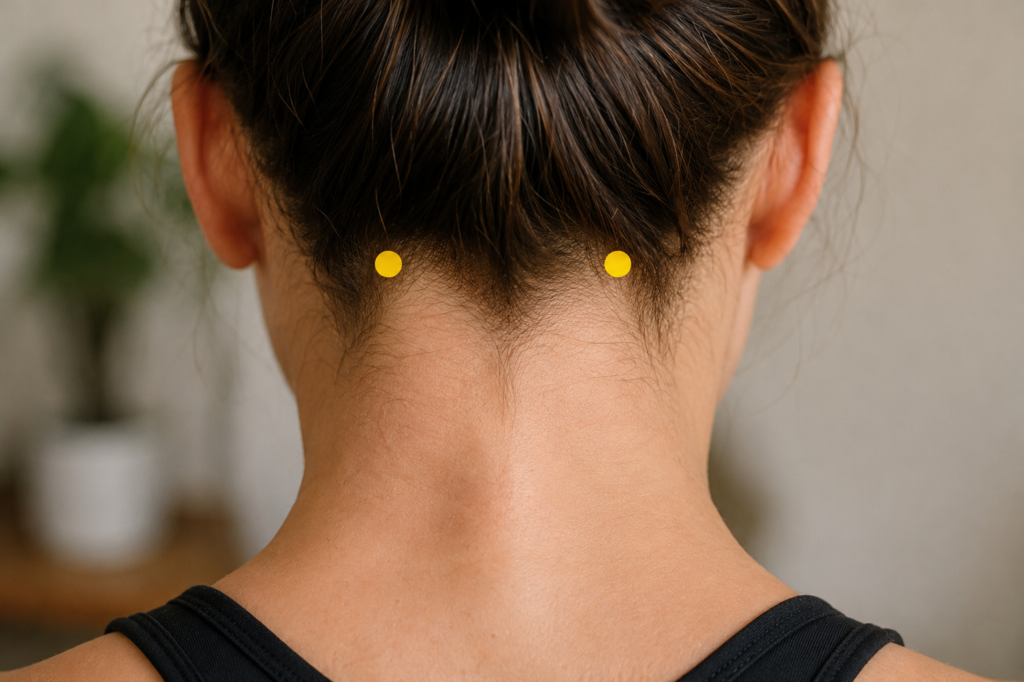
4. Press on GB20 at the base of the skull to bring circulation to the eyes. GB20 sits in the two hollows at the base of the skull, between the two large vertical neck muscles and the outer edge, roughly level with the tops of the ears. Tip your head back slightly and press firmly up and inward with your thumbs for one to two minutes. GB20 is called “Fengchi,” the “Wind Pool.”
GB20 is an important point for helping the eyes from a distance. It clears the head and improves circulation to the eyes. It also helps ease neck and shoulder tension that can build up during long hours in front of a screen. In Chinese medicine, its name refers to wind, which includes the effects of wind and dry air that can make dry eyes worse outdoors.
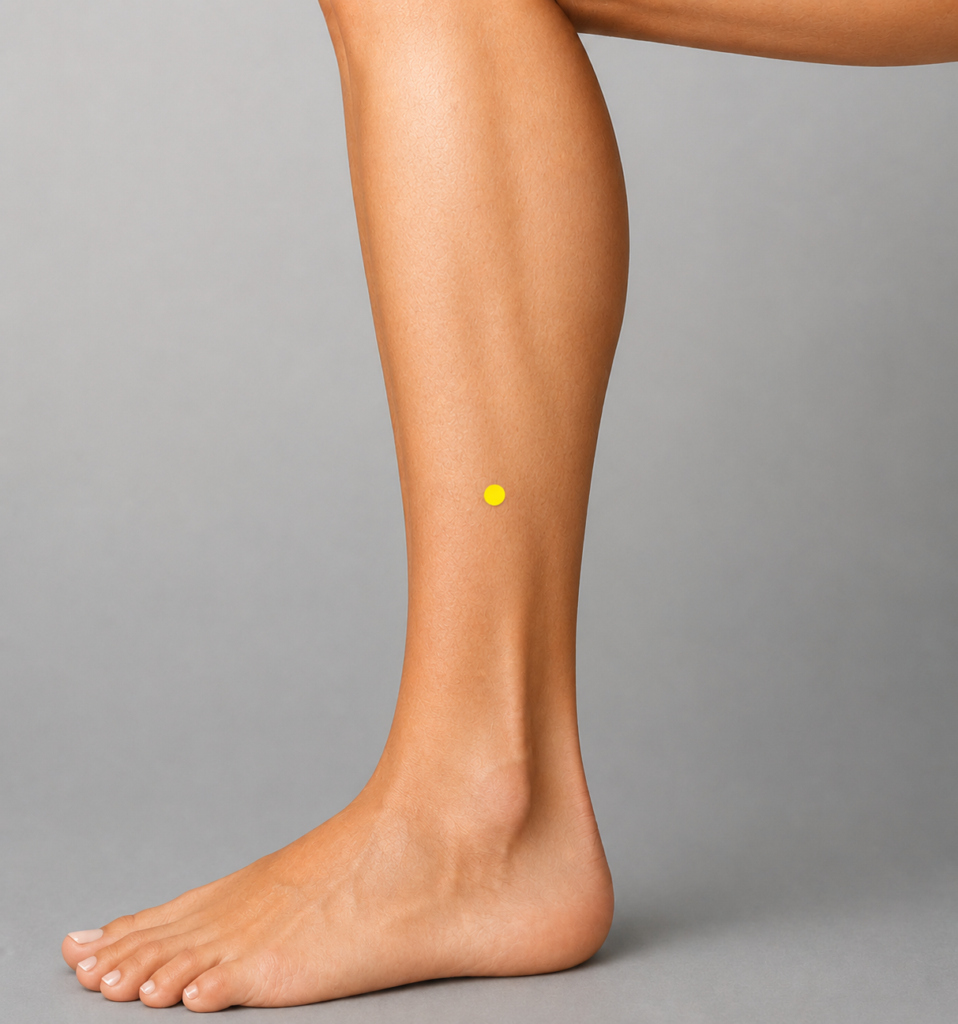
5. Press on GB37 on the lower leg, the Bright Light point. GB37 sits on the outer lower leg, about a hand’s width above the tip of the outer ankle bone, just in front of the fibula. Press firmly with your thumb for one to two minutes on each leg. GB37 is called “Guangming,” which means “Bright Light.”
GB37 is a traditional point that supports clearer, brighter vision. It connects the Gallbladder channel to the Liver, which in Traditional Chinese Medicine is associated with the eyes. Located on the leg, it can be pressed firmly and comfortably, serving as a useful complement to the more delicate eye points.
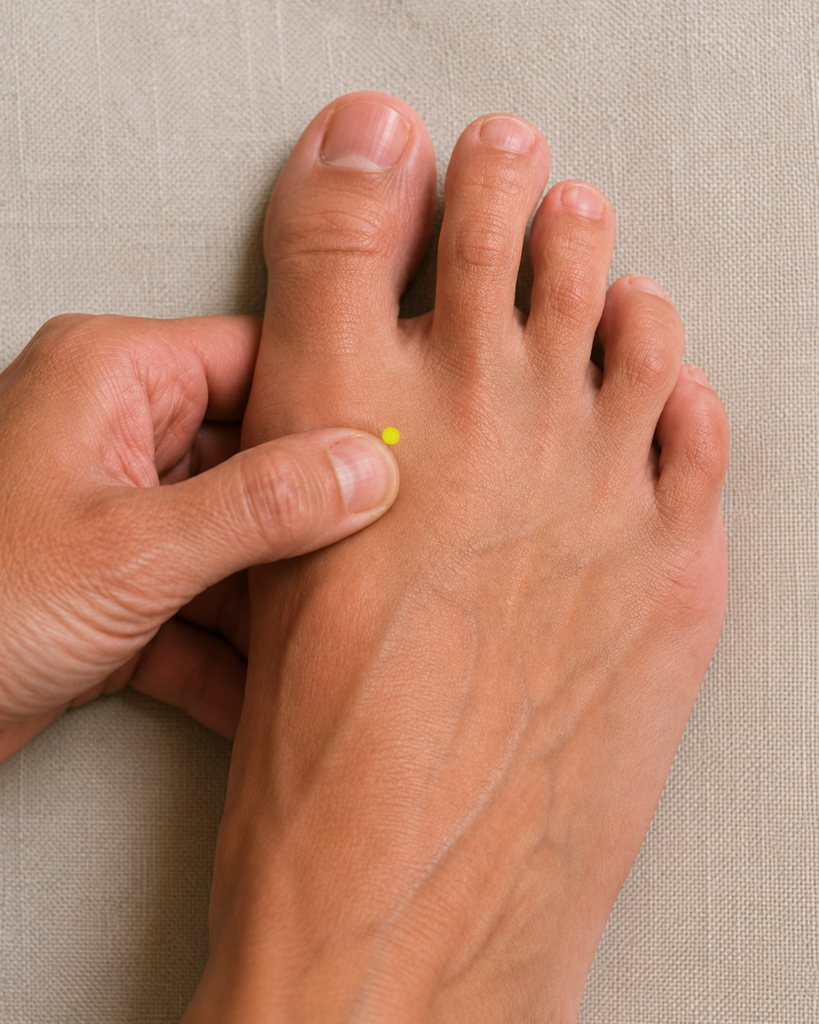
6. Press on LR3 on the top of the foot to support the Liver, which opens into the eyes. LR3 sits on the top of the foot, in the webbing between the big toe and second toe, about two finger-widths back where the bones meet in a small hollow. Press firmly with your thumb for one to two minutes on each foot. LR3 is called “Taichong,” the Liver’s source point.
Since the Liver is connected to the eyes, LR3 is a key point for maintaining eye health. It supports Liver regulation, reduces tension and stress that can cause eye discomfort, and clears heat that may lead to redness and burning. Since stress and poor sleep can worsen dry eyes, LR3 can help address these issues.
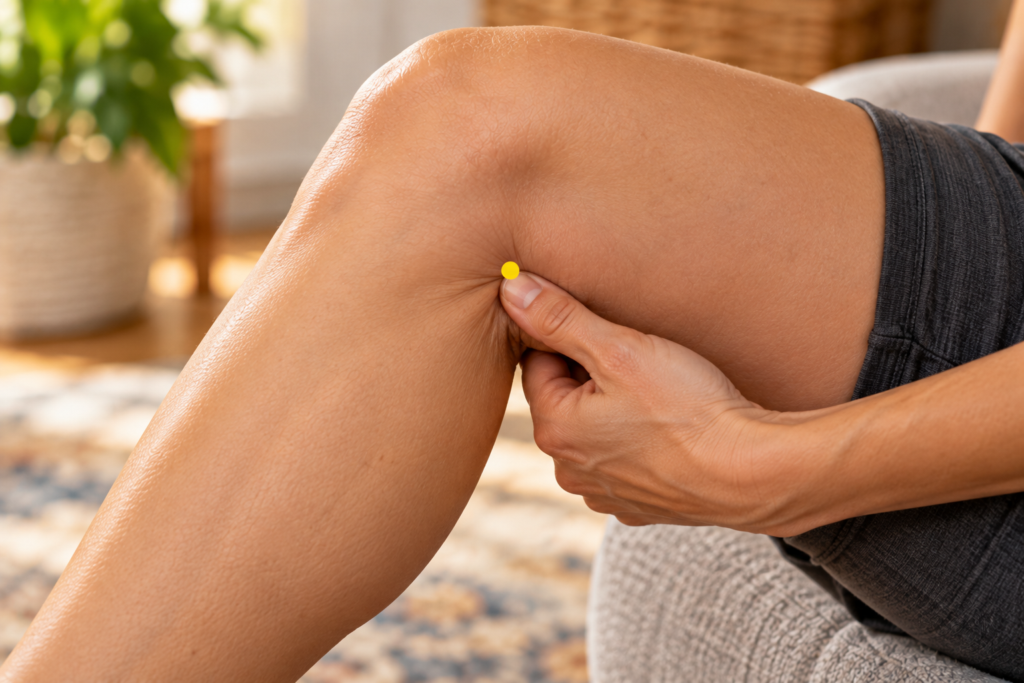
7. Press on LR8 at the inner knee to nourish the Liver Blood and Yin. LR8 sits at the inner end of the knee crease, in the hollow just above the crease when the knee is bent, in front of the tendons. Press firmly with your thumb for one to two minutes on each leg. LR8 is called “Ququan,” the “Spring at the Crook.”
While LR3 helps regulate the Liver, LR8 nourishes it by strengthening Liver Blood and Yin, supporting moist eyes. Its name, meaning ‘spring,’ reflects its role in replenishing fluids. LR8 is particularly beneficial for dry eyes associated with general dryness, dry skin, poor sleep, or dryness during midlife and menopause.
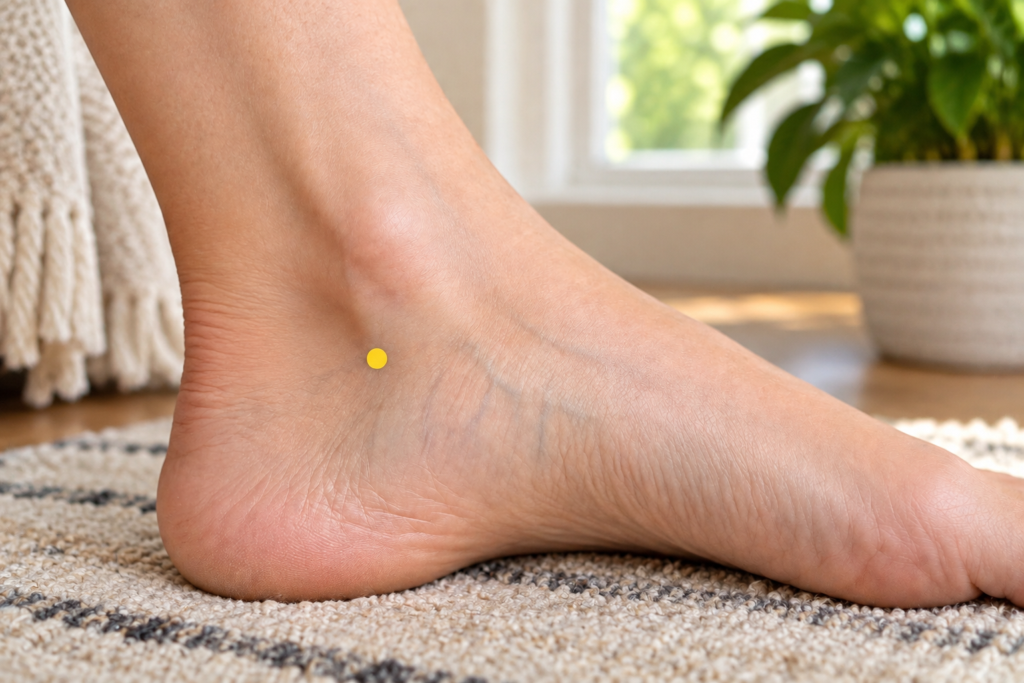
8. Press on KI6 below the inner ankle to moisten the eyes from within. KI6 sits in the hollow just below the tip of the inner ankle bone. Press firmly on each ankle with your thumb for one to two minutes. KI6 is called “Zhaohai,” the “Shining Sea.”
KI6 is a key point for addressing dryness throughout the body. It supports Kidney Yin and bodily fluids and is commonly used for dry eyes and throat. Additionally, KI6 opens a channel connecting directly to the inner eye corner at BL1, creating a special link to the eyes. For chronic dry eye conditions, particularly with aging or menopause, this point helps reestablish moisture at its origin.
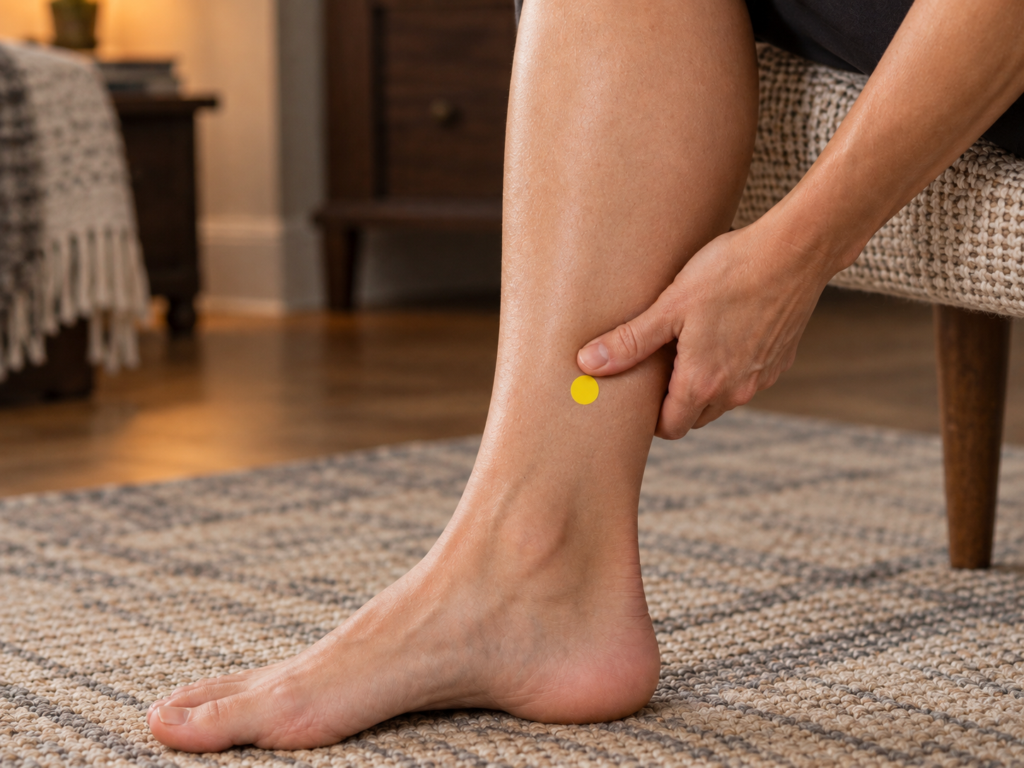
9. Press on SP6 above the inner ankle to nourish the Yin and Blood. SP6 sits four finger-widths up from the tip of the inner ankle bone, just behind the back edge of the shinbone. Press firmly for one to two minutes on each leg. SP6 is called “Sanyinjiao,” the “Three Yin Intersection,” where the Spleen, Liver, and Kidney channels meet. SP6 is contraindicated during pregnancy.
SP6 nourishes the Yin and Blood of the Spleen, Liver, and Kidney, supporting the bodily fluids that keep the eyes and body moist. It also calms the mind and promotes better sleep, which is crucial because poor sleep can worsen dry eye. Along with KI6 and LR8, SP6 is an essential component of this routine.
Why These Acupressure Points Work
In Traditional Chinese Medicine, dry eye is viewed as a deficiency of Yin and fluids that maintain eye moisture. It is associated with the Liver, which relates to the eyes, and the Kidney, which stores essential body fluids. Heat can sometimes exacerbate the dryness. The nine points assist primarily in two ways.
- The local eye points (BL1, ST1, SJ23) promote circulation to the tear and oil glands of the lids, helping to relieve burning and gritty sensations in the eye.
- The channel points (GB20, GB37, LR3) enhance blood flow to the eyes and help regulate the Liver, which connects to them.
- The nourishing points (LR8, KI6, SP6) help restore Liver and Kidney Yin, which moistens the eyes from the inside.
A 2021 meta-analysis of 21 randomized trials published in Acta Ophthalmologica found that acupuncture-based therapies improved dry eye symptoms and tear production more than artificial tears alone.
How to Properly Use These Acupressure Points
Apply a gentle touch around the eyes; press more firmly on the leg and foot points.
- Start by washing your hands, removing your contact lenses, and closing your eyes before stimulating the points around the eyes. Gently press on the bony rim of the eye socket, avoiding the eyeball itself, and apply only light pressure.
- Begin by applying a warm compress over closed eyes for five to ten minutes, then target BL1, ST1, and SJ23. The warmth loosens the oil in the lid glands, and the gentle pressure afterward aids its flow.
- Work on GB20, GB37, and LR3 first, then finish with LR8, KI6, and SP6 to promote internal nourishment. Use these nourishing points daily, as replenishing moisture requires consistent effort.
- Skip the eye points completely if you are dealing with an eye infection, recent eye injury, or recent eye surgery, and instead focus on the distal points.
- Hold the leg and foot points for 1-2 minutes each, and the eye points for 30 seconds to a minute.
Adopting a few simple daily habits can significantly improve dry eye symptoms. Applying warm compresses once or twice a day is one of the most effective home remedies, especially for the common evaporative dry eye. Remember to blink fully and frequently when using screens, and follow the 20-20-20 rule: every twenty minutes, focus on an object twenty feet away for twenty seconds. Using a humidifier, avoiding direct air from fans or vents, wearing wraparound sunglasses in windy conditions, and staying well-hydrated can also help. Preservative-free artificial tears may soothe symptoms, and some individuals find omega-3 fatty acids beneficial, although research results are mixed. Prioritizing good sleep is essential, as tired eyes tend to be drier.
When to Get Professional Help
See an eye doctor if your dry eyes persist despite home remedies, as prescription treatments and in-office procedures may help. Seek urgent medical attention if you experience eye pain, significant redness, discharge, light sensitivity, or vision changes. Emergency care is needed for sudden vision loss, intense pain, or halos around lights along with headache or nausea. If you wear contact lenses and notice pain or redness, remove them immediately and see an eye specialist promptly, since infections can escalate quickly. Mention to your doctor if you also have dry mouth or joint pain, which might suggest Sjögren’s syndrome. Also, ask if medications like antihistamines, some antidepressants, or blood pressure medications could be contributing to dry eyes.
Acupressure offers a gentle, low-risk way to promote eye health, but it should complement other essential eye care practices.
Above and Beyond Acupuncture offers acupuncture, cupping, and lifestyle coaching at the North Frank Lloyd Wright Boulevard location in Scottsdale.
Schedule an appointment online to start your healing journey.
The points above are only as effective as the technique used to apply them. Where to press, how firmly, and for how long all affect the result. For a full breakdown of how to perform acupressure properly at home, read Performing Acupressure in 3 Easy Steps.
If your eyes feel more tired and strained than dry, acupressure for eye strain is the companion article to this one.

About the Publisher
Paul Kerzner, L.Ac., is a licensed acupuncturist and board-certified herbalist, as well as the founder of Above and Beyond Acupuncture in Scottsdale. His own journey from chronic patient to practicing acupuncturist shapes his commitment to providing honest, clinically grounded information about acupuncture and Traditional Chinese Medicine. Learn more about Paul and his clinical approach on the About Us page.