
Key Takeaways
- Many people experience persistent fatigue, which can stem from factors such as stress and insufficient sleep.
- Acupressure can help restore energy by stimulating key points that support Qi production and storage in the body.
- Nine specific acupressure points target different energy systems: ST36, CV6, CV4, BL23, KI3, SP6, LU9, GV20, and ST40, each addressing unique aspects of tiredness.
- For effective use, practice daily, pressing each point for one to two minutes, ideally with warmth and steady pressure.
- Persistent fatigue may signal underlying health issues; consult a doctor if symptoms are severe or unexplained.

Many people say they feel tired all the time.
This isn’t just normal tiredness that fades after a good night’s sleep. Instead, it’s a heavy, dragging fatigue that lingers all day, making tasks harder and leaving you completely drained. This type of exhaustion can come from stress, insufficient sleep, overwork, or pushing yourself too hard, and it can affect your overall health. Acupressure may help restore your energy by stimulating the body systems that generate and store it. The points listed below can help clear your mind, boost your energy, and alleviate feelings of exhaustion.
In Traditional Chinese Medicine, fatigue reflects a deficiency of Qi, the essential energy that sustains your body. Various organs help produce and store this energy, and feeling exhausted often suggests some are depleted. The Spleen and Stomach generate Qi from the food you consume; when weak, they can cause tiredness, heaviness, and mental fog, especially after eating. The Kidney holds your deepest energy reserves, which can be exhausted by prolonged stress or overwork, leading to exhaustion or burnout. The Lung draws Qi from your breathing, so weak Lung energy may cause fatigue and shortness of breath. Body dampness can create a heavy, sluggish tiredness.
Acupressure can help you feel more energized and less tired each day. For best results, pair it with the basics of good energy, which we explain at the end of this article. If you’re dealing with persistent exhaustion, acupuncture might also be a helpful option, and it’s used in many clinics.
Here are nine acupressure points to help restore Qi in these areas by aiding digestion, replenishing reserves, boosting energy, and alleviating heaviness.
What Acupressure Points to Press and Why
1. Press on ST36 below the knee, the master point for energy. ST36 sits four finger-widths below the lower edge of the kneecap and one finger-width to the outside of the shinbone, on the muscle that rises when you flex your foot. Press firmly with your thumb for one to two minutes on each leg. ST36 is called “Zusanli,” the “Leg Three Miles,” and it is the single most important point in the body for energy and vitality.
No point addresses fatigue more effectively than this one. It boosts the Spleen and Stomach, which generate the body’s Qi, by replenishing energy at its source rather than just covering up tiredness. Traditionally, it’s said to restore your strength to walk another three miles even when you’re exhausted. This point alleviates fatigue, clears mental fog, and enhances overall resilience, making it essential for anyone with low energy. Start here, revisit often, and with consistent practice, it becomes one of the most valuable self-care routines for those who are chronically tired.

2. Press on CV6 below the navel to rebuild your core energy. CV6 sits on the midline of the lower abdomen, about two finger-widths below the navel. Rest your fingertips or a warm palm there and press gently but steadily for one to two minutes. CV6 is called “Qihai,” which means the “Sea of Qi,” the body’s reservoir of energy in the lower abdomen.
As the name indicates, this point is a gathering reservoir of the body’s Qi. Applying pressure here taps into and replenishes your energy reserve when it’s running low. It acts as a warming, strengthening point that rebuilds vitality from the center, helping you feel fueled rather than exhausted. For feelings of fatigue and depletion, this point targets the body’s core energy and is especially soothing when held with warmth or covered with a heat pack.

3. Press on CV4 lower on the abdomen for deep exhaustion. CV4 sits on the midline of the lower abdomen, about four finger-widths below the navel, below CV6. Rest a warm hand there and press gently for one to two minutes. CV4 is called “Guanyuan,” the “Gate of Origin,” and it is one of the main points for the body’s deepest reserves. Use CV4 with caution during pregnancy.
While CV6 rebuilds everyday energy, CV4 targets the deeper reserves stored in the Kidney. This point addresses profound, bone-deep exhaustion from burnout and long-term depletion. It helps warm and rebuild this deep energy source, which is often drained by years of overwork and stress. For those who are not just tired but truly worn out at their core, CV4 works on the deepest level. It’s most effective when warmed over several weeks rather than in a single session.

4. Press on BL23 on the low back to strengthen the deep reserves. BL23 sits on the lower back, at about waist level, roughly two finger-widths out to each side of the spine. Reach behind and press firmly with your thumbs or knuckles, or rub the area briskly, for one to two minutes. BL23 is called “Shenshu,” the Kidney’s back point, where you can reach the Kidney’s energy directly at the back of the body.
BL23 is a traditional point linked to fatigue caused by a weakened Kidney. This deep tiredness often manifests as a dull ache in the lower back and a general sense of exhaustion. Stimulating this point helps strengthen and warm the Kidney reserves by massaging the back area, making it a well-known method to quickly boost energy levels. For those experiencing exhaustion along with lower back weakness or feeling drained after overexertion, this point helps restore deep energy, and the warming massage is simple to do on your own.

5. Press on KI3 above the inner ankle to replenish the Kidney. KI3 sits in the hollow between the inner ankle bone and the Achilles tendon, level with the tip of the ankle bone. Press firmly with your thumb for one to two minutes on each ankle. KI3 is called “Taixi,” the source point of the Kidney.
As the main point related to the Kidney, KI3 nourishes and revitalizes the deep reserves exhausted by fatigue. It shares the same energetic connection as CV4 and BL23 but is located at the ankle level. KI3 helps restore core energy, alleviating chronic exhaustion and supporting the underlying vitality essential for daily energy. For those with deep-seated fatigue rather than temporary tiredness, pressing this point can strengthen the foundational energy and is conveniently accessible along with other leg points.
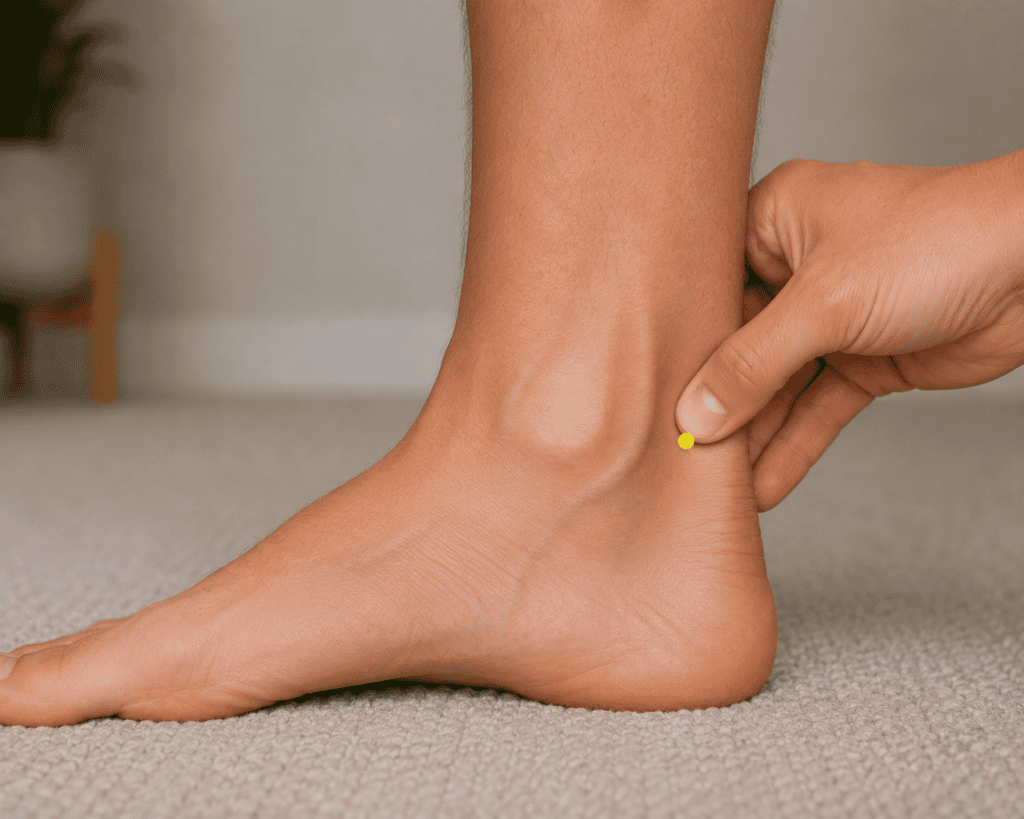
6. Press on SP6 above the inner ankle to nourish and rebuild energy. SP6 sits four finger-widths up from the tip of the inner ankle bone, just behind the back edge of the shinbone. SP6 is called “Sanyinjiao,” the “Three Yin Intersection,” where the Spleen, Liver, and Kidney channels meet. Press firmly for one to two minutes on each leg. SP6 should be avoided during pregnancy.
Because it gathers three channels at once, SP6 is one of the most nourishing points in the body. For fatigue, it strengthens the Spleen, which makes energy, and nourishes the Blood, which fatigue so often depletes. Tiredness that comes with feeling depleted, run down, and poorly nourished responds to this deeply restorative point, which rebuilds rather than merely stimulates. For the drained, worn-thin quality of ongoing fatigue, SP6 replenishes the system, and it works naturally alongside ST36 to strengthen the Spleen from two directions.
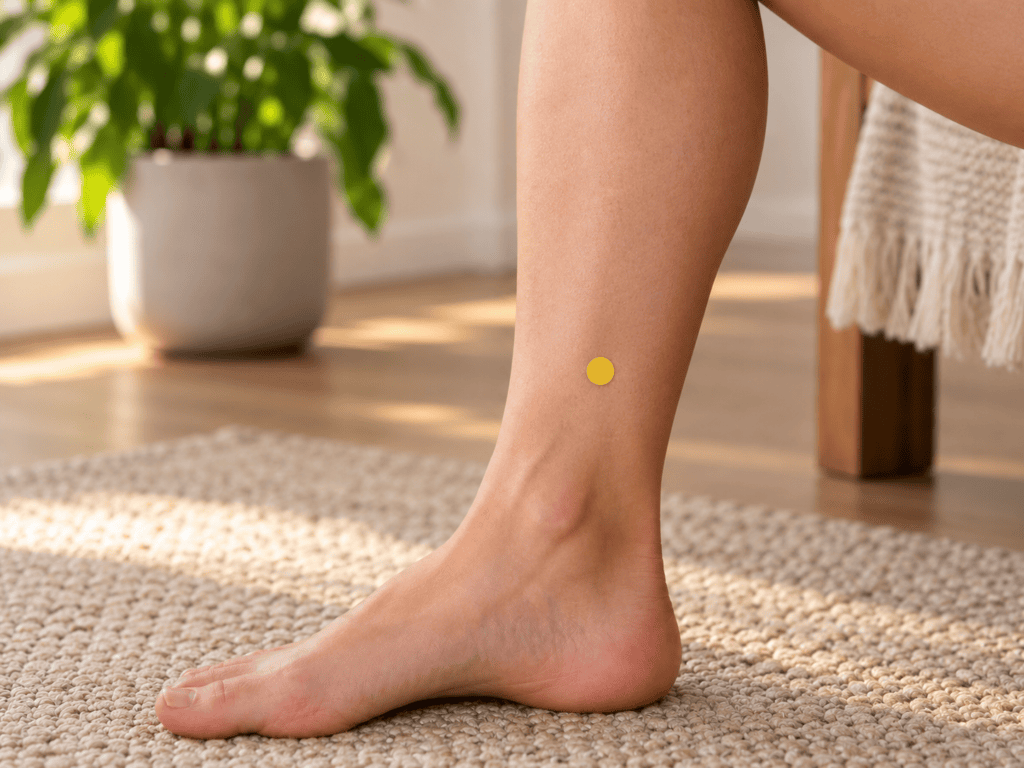
7. Press on LU9 at the wrist for tired, breathless energy. LU9 sits on the inner wrist crease, on the thumb side, in the hollow where you can feel the pulse. Press firmly with your thumb for one to two minutes on each wrist. LU9 is called “Taiyuan,” the “Great Abyss,” and it is the source point of the Lung.
The Lung gathers Qi from the breath, so when Lung energy is weak, fatigue takes on a tired, easily winded, low-voiced quality. LU9, as the Lung’s source point, strengthens it directly. It rebuilds the Lung Qi that feeds the body’s overall energy, which is part of the fatigue picture that the digestive and Kidney points do not reach. For the person whose tiredness comes with breathlessness on mild exertion or shortness of stamina, this point supports the energy the breath provides, and deeper, slower breathing while pressing it adds to the effect.
8. Press on GV20 at the top of the head to lift the energy and clear the fog. GV20 sits at the very top of the head, on the midline, on a line drawn up from the tops of both ears. Press straight down, or make small circles, with your fingertip for one to two minutes. GV20 is called “Baihui,” the “Hundred Meetings,” where many channels converge at the crown.
Unlike other points that regenerate energy from below, GV20 elevates it, alleviating the sinking, heavy sensation of fatigue and clearing the dull, foggy mind associated with tiredness. It brightens and energizes the entire system, combating low energy and sharpening mental clarity. For the sluggish, foggy side of fatigue, this point helps lift you back up and works well with energy-boosting points to elevate and restore at the same time.

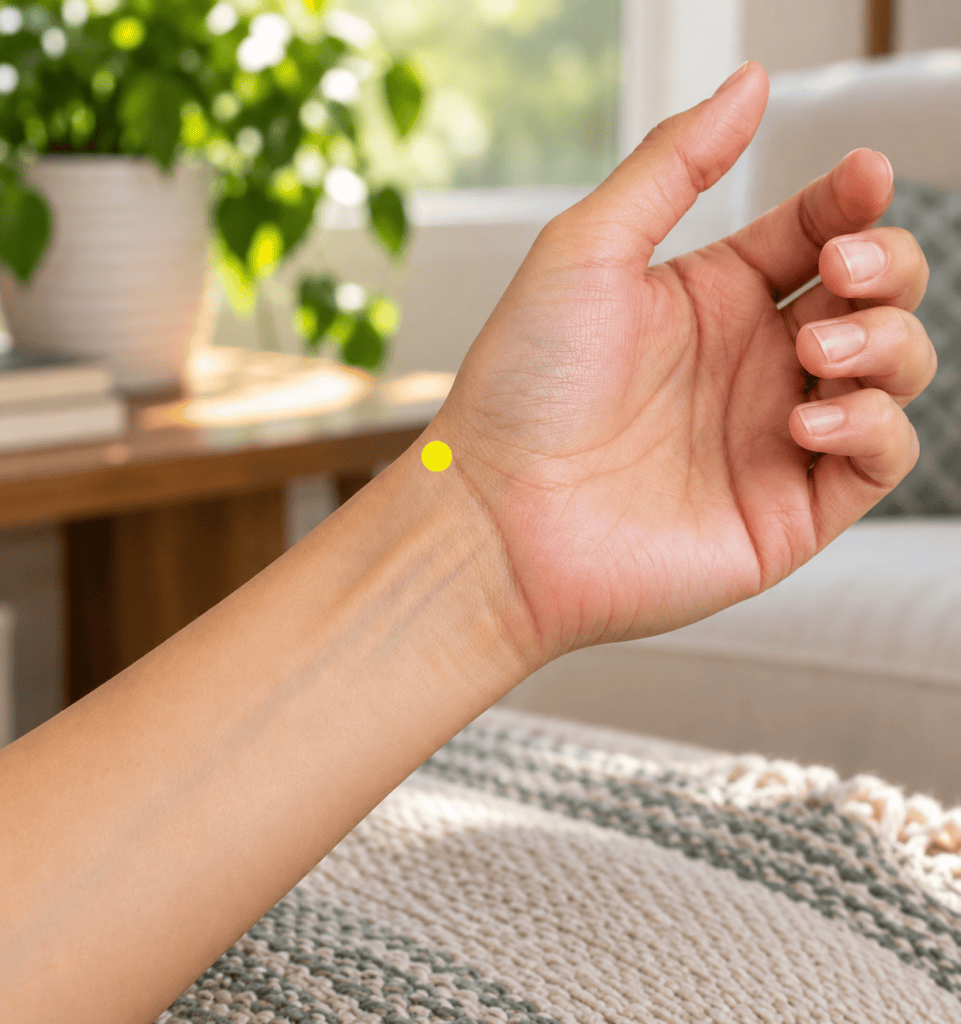
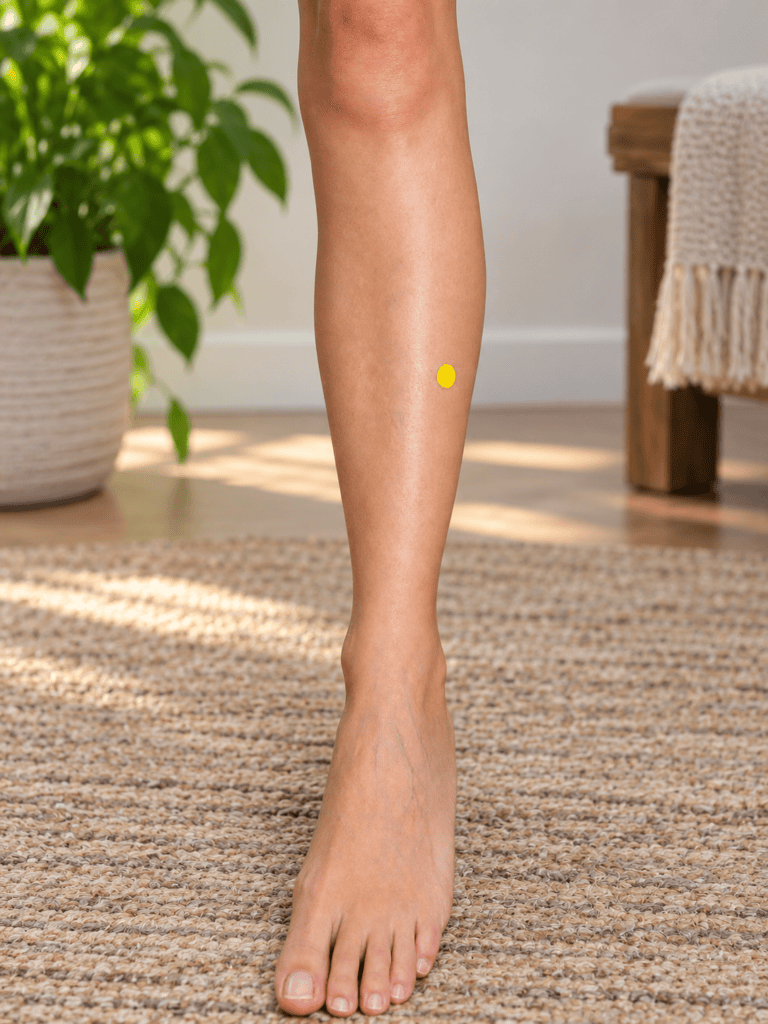
9. Press on ST40 on the lower leg to clear a heavy, sluggish tiredness. ST40 sits on the outer lower leg, midway between the knee and the outer ankle bone, about two finger-widths outside the shinbone, on the muscle. Press firmly with your thumb for one to two minutes on each leg. ST40 is called “Fenglong,” and it is the body’s main point for clearing dampness and phlegm.
Not all fatigue is simple exhaustion; some takes the form of a heavy, sluggish, waterlogged tiredness with foggy thinking and heavy limbs. Traditional Chinese Medicine interprets this as dampness weighing down the system, and ST40 is the key point to clear it. It helps drain the heaviness that makes the body and mind feel thick and slow, easing fatigue that feels more blocked than exhausted. For those experiencing sluggish, foggy tiredness rather than complete emptiness, this point directly targets that cause. It also complements the routine by eliminating blockages that other rebuilding points may not address.
Why These Acupressure Points Work
In Traditional Chinese Medicine, fatigue is seen as a deficiency of Qi, originating from the organs responsible for producing and storing the body’s energy: the Spleen and Stomach, which generate Qi from food; the Kidney, which preserves the deep reserve; and the Lung, which draws Qi from the breath, sometimes hindered by dampness that drags down the entire system. The nine points work to restore Qi across all these organs.
- The energy-building points (ST36, SP6) strengthen the Spleen and Stomach that produce the body’s Qi.
- The deep-reserve points (CV6, CV4, BL23, KI3) rebuild the core and Kidney reserves behind bone-deep exhaustion and burnout.
- The Lung point (LU9) strengthens the energy drawn from the breath.
- The lifting point (GV20) raises the sunken energy and clears the foggy head.
- The damp-clearing point (ST40) lightens a heavy, sluggish, waterlogged tiredness.
The underlying principle is to restore the body’s core energy rather than forcing a fatigued system to work harder, which is why the benefits build with consistent use.
How to Properly Use These Acupressure Points
Use these acupressure points to boost your energy and, more importantly, restore it consistently over time, since fatigue requires ongoing effort rather than a single treatment.
- For a general energy lift, work ST36, CV6, and GV20, the core of rebuilding and lifting energy.
- For deep, worn-out exhaustion or burnout, focus on CV4, BL23, and KI3 with warmth, worked steadily over weeks.
- For a heavy, foggy, sluggish tiredness, add ST40, and for tiredness with breathlessness, add LU9.
- Warm the abdominal and low-back points with a warm hand or heat pack, since warmth strengthens their rebuilding effect, and rub BL23 briskly until the low back feels warm.
- Hold each point for one to two minutes with firm, steady pressure, breathing slowly, and make it a daily practice rather than an occasional one.
While acupressure can boost your energy, the basics matter even more. Prioritize getting adequate sleep, as rest is essential for restoring energy. Regular movement builds vitality, while inactivity can increase fatigue. Maintain a balanced diet and stay hydrated, as your body relies on proper fuel and water to generate energy. Limit caffeine and sugar, since they provide only short-term energy spikes. Also, managing stress is vital, as ongoing stress quickly depletes your energy reserves. Acupressure works best when combined with these essential lifestyle modifications and practices.
When to Get Professional Help
Fatigue is a symptom, not a diagnosis.
While common fatigue isn’t serious, ongoing or unexplained exhaustion should be checked by a doctor, as it could signal a treatable condition. See your doctor if your fatigue is severe, lasts more than a couple of weeks, or cannot be explained by a busy period or poor sleep. Ongoing fatigue can be caused by issues such as anemia, thyroid problems, diabetes, sleep apnea, depression, or other conditions that need medical attention. Get help right away if your fatigue starts suddenly and is severe, or if it comes with chest pain, trouble breathing, unexplained weight loss, a fever that won’t go away, or fainting, as these could signal something serious. If your tiredness comes with a low mood or loss of interest, talk to your doctor, since this can be linked to anxiety, stress, or depression, which can be treated.
Acupressure can help with everyday tiredness and support other treatments, but it is not a replacement for finding the real cause if your fatigue is chronic, significant, or doesn’t go away.
Above and Beyond Acupuncture offers acupuncture, cupping, and lifestyle coaching at the North Frank Lloyd Wright Boulevard location in Scottsdale.
Schedule an appointment online or call us today to start your healing journey.
The points above are only as effective as the technique used to apply them. Where to press, how firmly, and for how long all affect the result. For a full breakdown of how to perform acupressure properly at home, read Performing Acupressure in 3 Easy Steps.

About the Publisher
Paul Kerzner, L.Ac., is a licensed acupuncturist and board-certified herbalist, as well as the founder of Above and Beyond Acupuncture in Scottsdale. His own journey from chronic patient to practicing acupuncturist shapes his commitment to providing honest, clinically grounded information about acupuncture and Traditional Chinese Medicine. Learn more about Paul and his clinical approach on the About Us page.