
Key Takeaways
- Motion sickness causes nausea, dizziness, and discomfort because of conflicting sensory signals.
- Acupressure effectively relieves these symptoms by stimulating specific points such as PC6 and CV12.
- Use PC6 on the wrist as the primary acupressure point for immediate alleviation of nausea during travel.
- Combine PC6 with additional points such as LI4 and GB20 to effectively address headaches and dizziness.
- See a doctor if severe symptoms continue or happen at rest, as there could be other underlying issues.

Motion sickness can spoil any adventure, causing queasiness, cold sweats, dizziness, headaches, and anxiety about getting sick, whether in a car, plane, boat, or train. This happens because conflicting signals from the senses confuse the brain and trigger nausea. Acupressure is a proven method to alleviate these symptoms by reducing nausea, dizziness, and stomach discomfort. Wristbands made for motion sickness operate on the same principle.
In Traditional Chinese Medicine, motion sickness occurs when bodily movement disrupts the Stomach and its central position, causing Stomach Qi, which should move downward, to rise instead, resulting in nausea and a desire to vomit. The disturbance may also affect the head and spirit, causing dizziness and a heavy, unsettled sensation. Treatment aims to calm the Stomach, restore the downward flow of Qi, relieve nausea, stabilize the head, and calm the mind. One acupressure point in particular is well known for this purpose, while other points help as well. The points listed below are selected to ease nausea, reduce dizziness, and help you feel steadier when traveling.
Here are nine acupressure points to help you feel more comfortable during travel.
What Acupressure Points to Press and Why
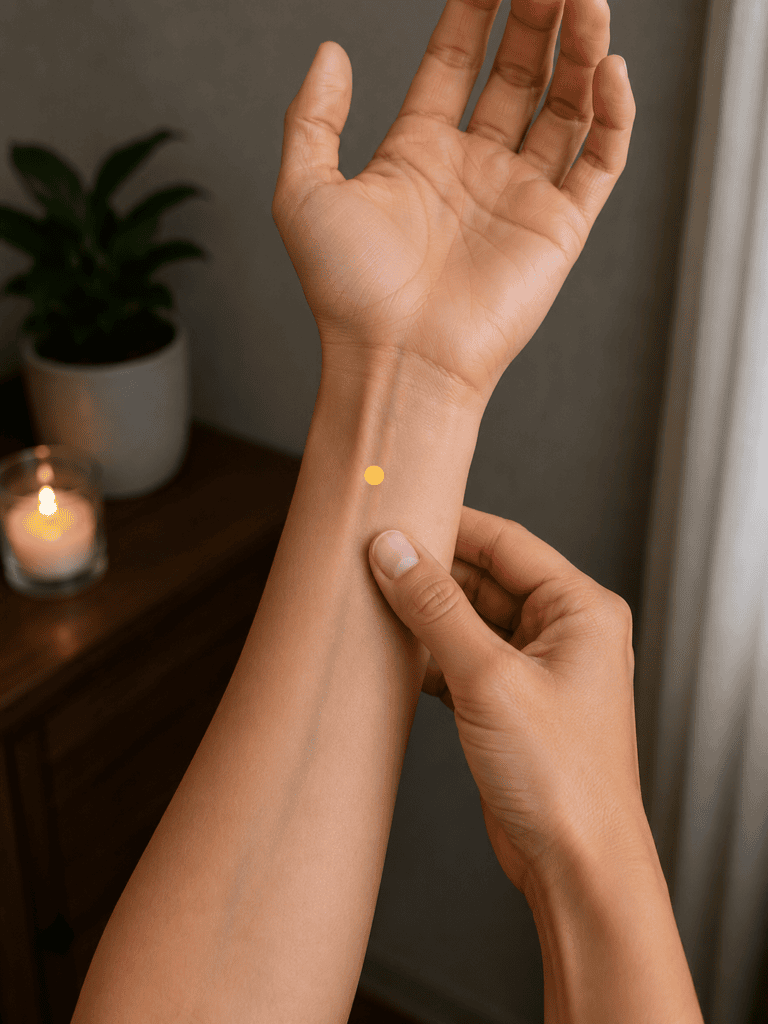
1. Press on PC6 on the inner forearm, the famous point for motion sickness. PC6 sits three finger-widths above the inner wrist crease, in the center of the forearm between the two tendons. Press firmly with your thumb for one to two minutes on each arm, and keep coming back to it. PC6 is called “Neiguan,” the “Inner Pass,” and it is the single most important and best-known point for nausea and motion sickness.
This is the key acupressure point for motion sickness, identical to where anti-nausea wristbands target, and it is highly effective in relieving almost any kind of nausea. Pressing this point helps calm your stomach and reduce the unpleasant feeling, which is especially important with motion sickness. It also has a calming effect on your nerves. It’s advisable to apply pressure to this point before and during your trip. Because it’s on your wrist, you can easily access it discreetly. If using only one acupressure point for motion sickness, choose this one on either wrist.
2. Press on CV12 above the navel to settle the stomach. CV12 sits on the midline of the abdomen, halfway between the navel and the lower end of the breastbone, about four finger-widths above the belly button. Press gently but steadily with your fingertips for one to two minutes. CV12 is called “Zhongwan,” the gathering point of the Stomach at the front of the body.
CV12 is the main point for the stomach, located directly above it, making it a useful companion to PC6 for motion sickness. It helps soothe nausea and unease in the midsection, easing a disturbed stomach from motion. If your main issue is an unsettled stomach, this point can offer direct relief. Press gently, especially if you already feel queasy, and breathe slowly.

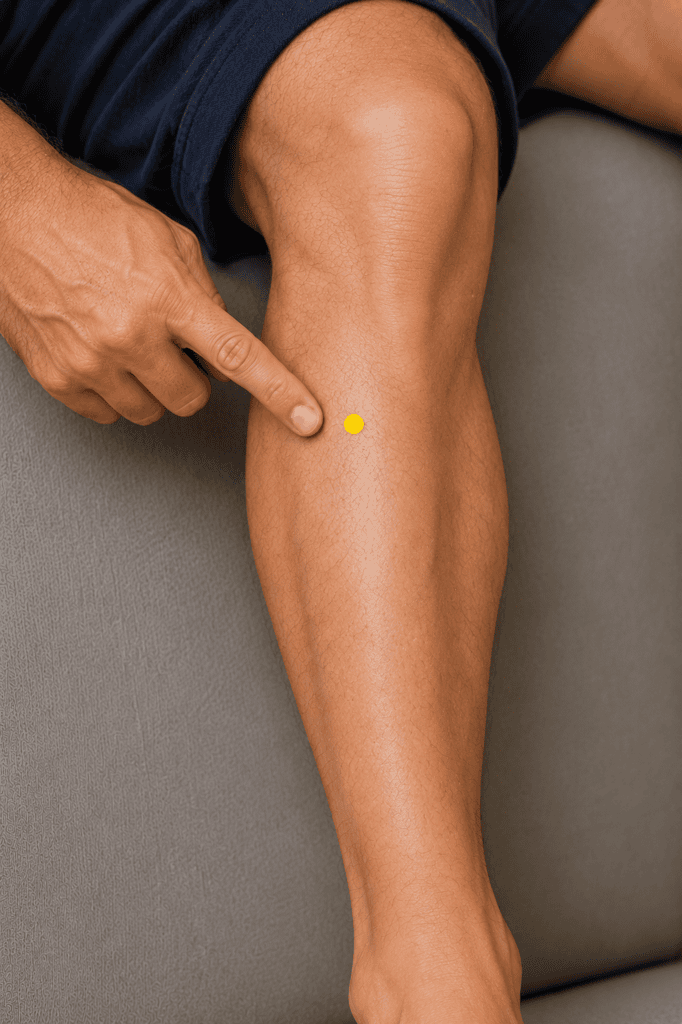
3. Press on ST36 below the knee to settle and ground. ST36 sits four finger-widths below the lower edge of the kneecap and one finger-width to the outside of the shinbone, on the muscle that rises when you flex your foot. Press firmly with your thumb for one to two minutes on each leg. ST36 is called “Zusanli,” the “Leg Three Miles,” and it is the master point for the stomach and digestion.
ST36 helps balance the stomach and reduce nausea, with a grounding effect that makes it useful for motion sickness by calming the stomach and promoting stability when it feels unbalanced. As a key point for digestion, it keeps the stomach calm, and its grounding nature can reduce dizziness. It relieves both queasiness and unsteadiness, especially when combined with PC6 and CV12.
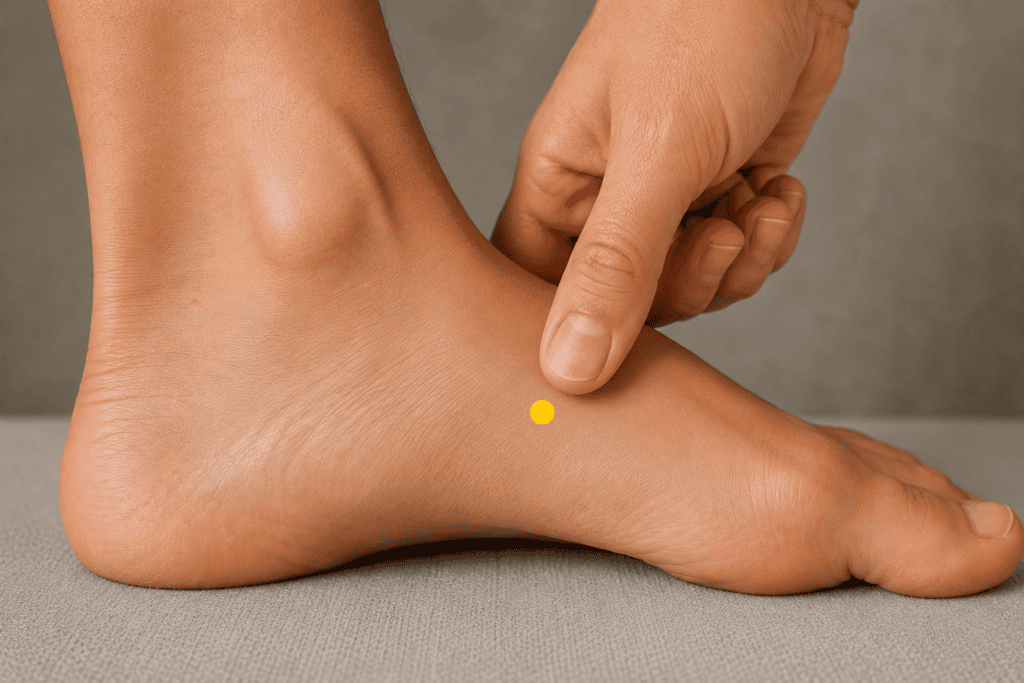
4. Press on SP4 on the arch of the foot to calm the distressed stomach. SP4 sits on the inner arch of the foot, in the depression just below and ahead of the bony bump behind the big-toe joint, where the long foot bone meets it. Press firmly with your thumb for one to two minutes on each foot. SP4 is called “Gongsun,” and it is the classic partner to PC6 for the stomach.
SP4 is often combined with PC6, making it highly effective for calming upset stomachs. Applying pressure to one point on the wrist and another on the foot influences the body’s core from both ends. This duo can ease nausea, cramps, and motion-sickness-related queasiness. For severe nausea, press both SP4 and PC6 simultaneously.
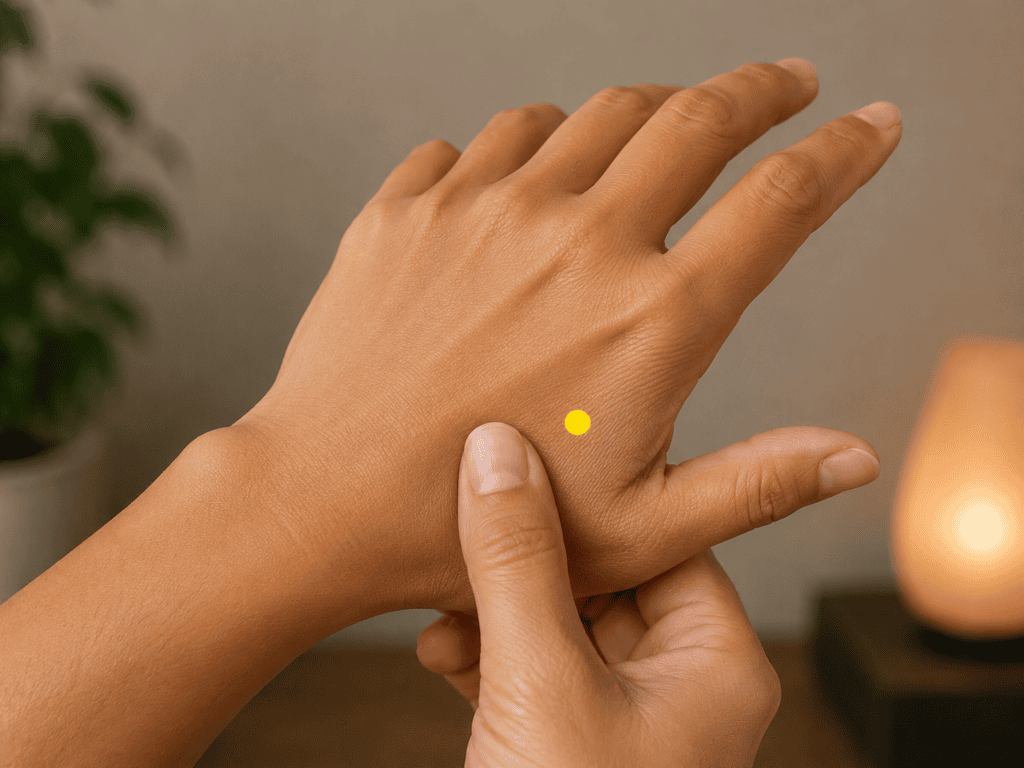
5. Press on LI4 in the hand to ease the nausea and headache. LI4 sits in the webbing between the thumb and index finger, at the highest point of the muscle when you bring them together. Press firmly with the thumb of your other hand for one to two minutes on each hand. LI4 is called “Hegu,” and it is one of the great general points for the head and for pain. LI4 is avoided during pregnancy.
LI4 is a versatile acupoint that helps relieve headaches and nausea from motion sickness. It also offers a calming effect that can lessen anxiety when feeling unwell. Located on the hand, it can be easily pressed discreetly during travel, similar to PC6. This makes it a practical and useful point for managing travel-related headaches and discomfort.
6. Press on Yintang between the eyebrows to calm and steady. Yintang sits in the small hollow directly between the two eyebrows. Press steadily and hold, or make small, slow circles with your fingertip for one to two minutes. Yintang is an extra point and one of the most calming points in the body.
Yintang helps calm the mind and body, easing anxiety and restlessness from motion sickness. It may also reduce mental discomfort like dread or mental fog and relieve forehead pressure. When motion sickness makes you feel panicked or unbalanced, this point can help you feel more stable. For additional relief, press it gently while you breathe deeply and gaze at the horizon.

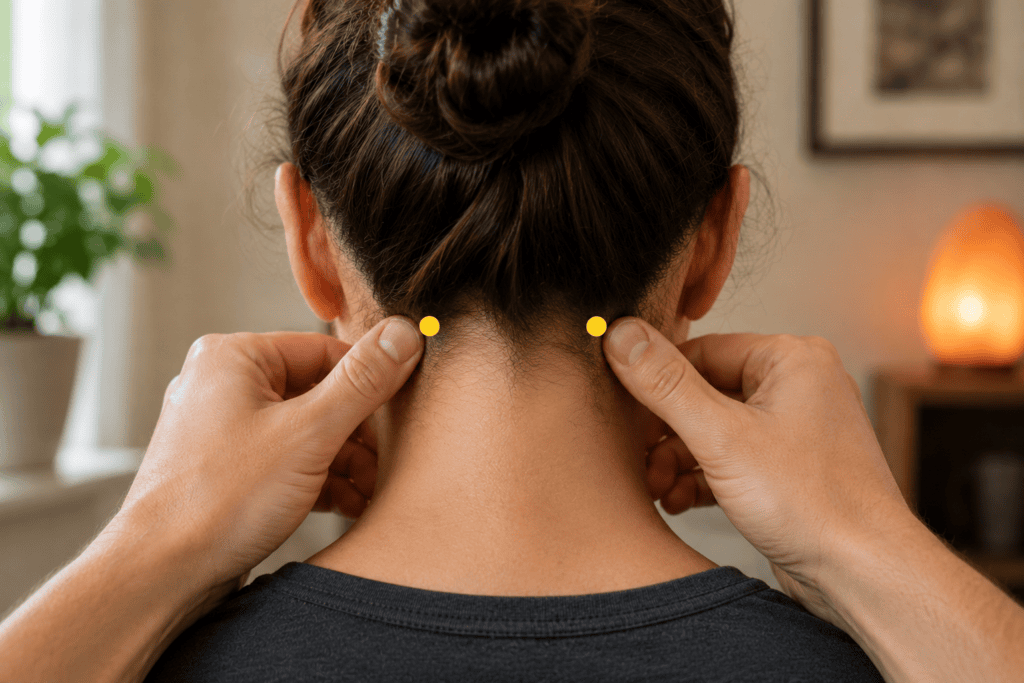
7. Press on GB20 at the base of the skull to ease the dizziness. GB20 sits in the two hollows at the base of the skull, between the two large vertical neck muscles and the outer edge, roughly level with the tops of the ears. Tip your head back slightly and press firmly up and inward with your thumbs for one to two minutes. GB20 is called “Fengchi,” and it is a major point for the head and for dizziness.
Motion sickness affects not just the stomach but also the head and inner ear. GB20 is crucial for reducing dizziness and the spinning sensation, helping to clear the head, lessen dizziness and headaches, and support the inner ear area responsible for balance. If dizziness is the primary symptom rather than nausea, this point could help. It also works with GV20 and Yintang to stabilize the head, while PC6 targets the stomach.
8. Press on GV20 at the top of the head to clear a swimming head. GV20 sits at the very top of the head, on the midline, on a line drawn up from the tops of both ears. Press straight down, or make small circles, with your fingertip for one to two minutes. GV20 is called “Baihui,” the “Hundred Meetings,” where many channels converge at the crown.
GV20 helps clear your mind and reduces dizziness or foggy feelings caused by motion sickness. It alleviates heavy, unclear sensations, making your head feel more relaxed. In Chinese medicine, this point clears and calms the head, helping relieve disorientation from movement. It may be helpful if you feel light-headed or as if your head is spinning. Located on the top of your head, it’s easy to touch while in a moving vehicle. When combined with GB20, it effectively clears and stabilizes the head.

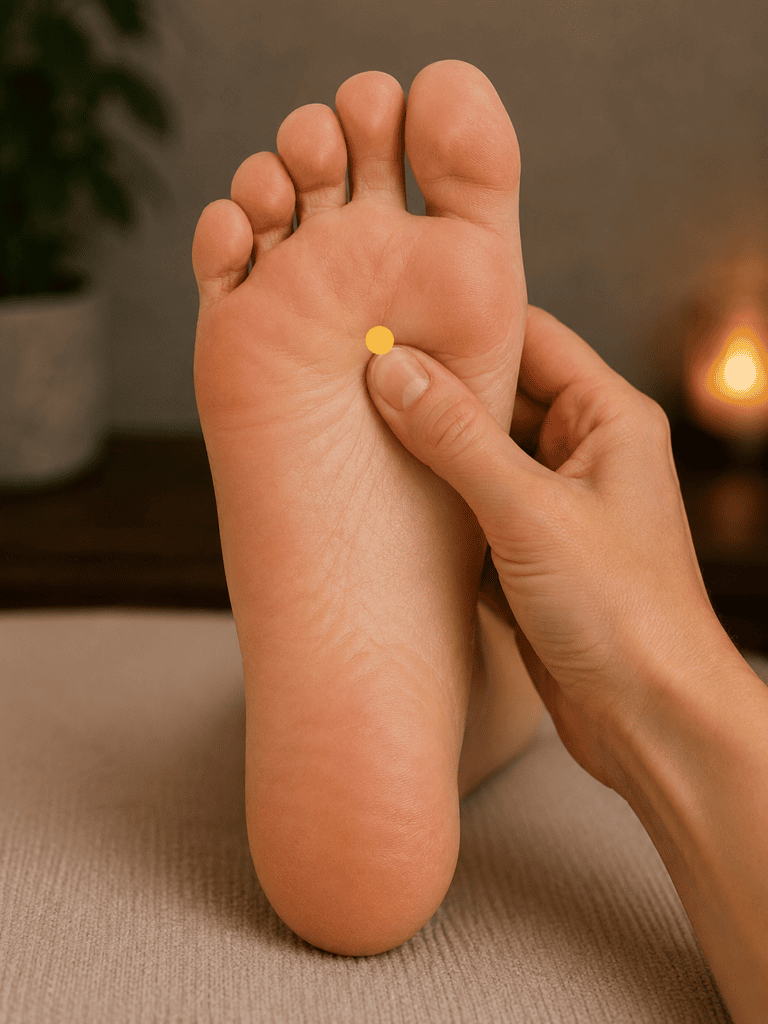
9. Press on KI1 on the sole of the foot to ground the off feeling. KI1 sits on the sole of the foot, in the hollow that forms in the center of the ball of the foot when you curl the toes, about a third of the way down from the toes to the heel. Press firmly with your thumb for one to two minutes on each foot. KI1 is called “Yongquan,” the “Bubbling Spring,” and it is the lowest point on the body.
KI1 effectively eases the dizzy, unsettled feelings linked to motion sickness, enhancing your sense of stability. Located at the lowest point of the body, it can stabilize you better than points on the stomach or head. When you feel unsteady or as if you’re floating, pressing this point can help you feel more grounded. For added stability, press it while your feet are on the ground or before starting your journey. This point completes the routine by making your entire system feel more balanced and steady.
Why These Acupressure Points Work
In Traditional Chinese Medicine, motion sickness happens when movement disrupts the Stomach, causing its Qi to ascend and leading to nausea. It also affects the head and mind, resulting in dizziness and a general feeling of discomfort. The nine points effectively address all these symptoms.
- The acupressure points linked to nausea, PC6, CV12, ST36, and SP4, help calm the stomach and direct disrupted Qi downward, with PC6 serving as the main point and SP4 as its traditional partner.
- Acupressure points GB20, GV20, and Yintang can help alleviate dizziness and head-related symptoms, clearing your mind and restoring stability during episodes of dizziness or disorientation.
- LI4 is an acupressure point that helps relieve headaches and nausea.
- KI1 serves as the anchor point that helps you stay stable when you feel unbalanced or off-center.
The main goal is to soothe your stomach and steady your head when you’re feeling confused or nauseous from motion. PC6 is the most reliable point for both effects, which is why you should use it more often.
How to Properly Use These Acupressure Points
The most effective way to handle motion sickness is to apply these strategies early, since preventing symptoms is much easier than treating them after they appear.
- Before starting your journey, press PC6 on both wrists and keep pressing it throughout your trip, as this is the most crucial action you can take. Motion-sickness wristbands work by stimulating this point, so wearing a pair can provide relief without using your hands.
- When traveling, focus on accessible points like PC6 and LI4 on your arms and hands, and Yintang and GV20 on your head. You don’t need to pause what you’re doing to press them.
- Before traveling or during a break, try pressing the CV12, ST36, SP4, and KI1 points, as they help calm your stomach and stabilize your body, especially if you are prone to motion sickness.
- Take your time with each point, holding it for one or two minutes while taking slow, calming breaths. Remember to press PC6 as often as needed.
Acupressure works best when paired with simple motion-sickness prevention measures. Instead of reading or looking at screens, focus on the horizon or a distant, fixed point to synchronize your eyes and inner-ear movements. Sit in the area with the least motion, such as the front seat of a car, the wing of an airplane, or the middle of a boat, and if possible, get some fresh air. Avoid heavy, fatty meals and alcohol before traveling, opting for light snacks instead of traveling on an empty stomach. Ginger, available as tea, chews, or capsules, can also help reduce nausea naturally. Resting your head, closing your eyes, and using wristbands alongside these tips can improve comfort.
When to Get Professional Help
Motion sickness is common, usually harmless, and resolves after the motion stops. Acupressure and the tips above can help most people. However, see a doctor if your motion sickness is so severe that it prevents travel when needed, because effective medications can help in difficult cases. Additionally, if you experience dizziness, nausea, or spinning sensations without motion, or if they last long after travel, it could indicate another issue and warrants medical evaluation. Seek immediate medical help if you have severe or ongoing vomiting that prevents fluid intake, or if you experience dizziness along with symptoms like severe headache, weakness, numbness, speech difficulties, or vision changes.
Acupressure is a safe, effective way to manage regular motion sickness, but it should not replace medical treatment if your symptoms stem from other issues.
Since sea sickness is a specific type of motion sickness related to boats, “Acupressure for Sea Sickness” focuses more specifically on that. In contrast, “Acupressure for Nausea” addresses a wider range of causes beyond just sea sickness.
Above and Beyond Acupuncture offers acupuncture, cupping, and lifestyle coaching at the North Frank Lloyd Wright Boulevard location in Scottsdale.
Schedule an appointment online to start your healing journey.
The points above are only as effective as the technique used to apply them. Where to press, how firmly, and for how long all affect the result. For a full breakdown of how to perform acupressure properly at home, read Performing Acupressure in 3 Easy Steps.

About the Publisher
Paul Kerzner, L.Ac., is a licensed acupuncturist and board-certified herbalist, as well as the founder of Above and Beyond Acupuncture in Scottsdale. His own journey from chronic patient to practicing acupuncturist shapes his commitment to providing honest, clinically grounded information about acupuncture and Traditional Chinese Medicine. Learn more about Paul and his clinical approach on the About Us page.