
Key Takeaways
- The rotator cuff comprises four muscles that support shoulder movement, but they can become irritated by injury, overuse, or poor posture.
- Acupressure provides a method to alleviate pain and enhance mobility by stimulating specific points on the shoulder muscles and channels.
- Nine effective acupressure points can alleviate rotator cuff pain and stiffness, each serving a unique purpose in muscle relaxation.
- In Traditional Chinese Medicine, rotator cuff pain is viewed as a blockage of Qi and Blood, which acupressure can help resolve.
- Seek medical care if you experience severe pain or weakness, or if shoulder pain persists beyond a few weeks, as these may signal a serious injury.

The rotator cuff consists of four muscles and their tendons encircling the shoulder joint. They support the upper arm bone and enable lifting and rotation of the arm. Due to the shoulder’s high mobility, these tendons are prone to irritation or wear and tear, especially from repeated overhead activities, poor posture, heavy lifting, or aging. Rotator cuff discomfort typically presents as a deep ache on the outside of the upper arm, discomfort when lifting the arm sideways, pain when lying on the shoulder at night, along with possible weakness or a catching sensation. Acupressure may help relax these tense muscles, alleviate pain, and enhance shoulder mobility.
Visualizing the four muscles can be useful, as this routine targets each one. One muscle runs across the top of the shoulder blade and lifts your arm to the side, and it’s the most commonly irritated. Two muscles are located on the back of the shoulder blade and assist with rotating your arm outward. The fourth muscle is at the front of the shoulder blade, near the ribs, and helps rotate your arm inward. All their tendons converge at the top of the upper arm, which is why pain often manifests on the outside of the arm just below the shoulder.
In Traditional Chinese Medicine, rotator cuff pain is viewed as a blockage called Bi syndrome within the shoulder channels. Repetitive activity, overuse, injury, or cold exposure can slow Qi and Blood in the shoulder area, causing pain, stiffness, and limited movement. The key channels involved include the Small Intestine channel, which passes through the shoulder blade where most cuff muscles are located; the Triple Burner channel, crossing the back of the shoulder; and the Large Intestine channel, running over the front and top. With age, the tissues supporting the joint tend to weaken and become more prone to wear.
Here are nine acupressure points to improve movement, relax cuff muscles, and support tissues.
What Acupressure Points to Press and Why
1. Press on ST38 on the lower leg while moving the shoulder. ST38 sits on the front of the lower leg, midway between the knee and the ankle, about one finger-width to the outside of the shinbone. Press firmly with your thumb, or have someone press it, for one to two minutes on the same side as the sore shoulder, while slowly and gently moving the shoulder through whatever range is comfortable. ST38 is called “Tiaokou,” the “Ribbon Opening.”
Pressing a point on the shin to treat shoulder issues may seem unusual, yet ST38 is a recognized point for alleviating shoulder pain and stiffness. Traditionally, you press it while moving the shoulder, and many notice their shoulder loosen and their pain reduce within a minute or two. Move gradually and stay within a comfortable range, avoiding any force on the joint.
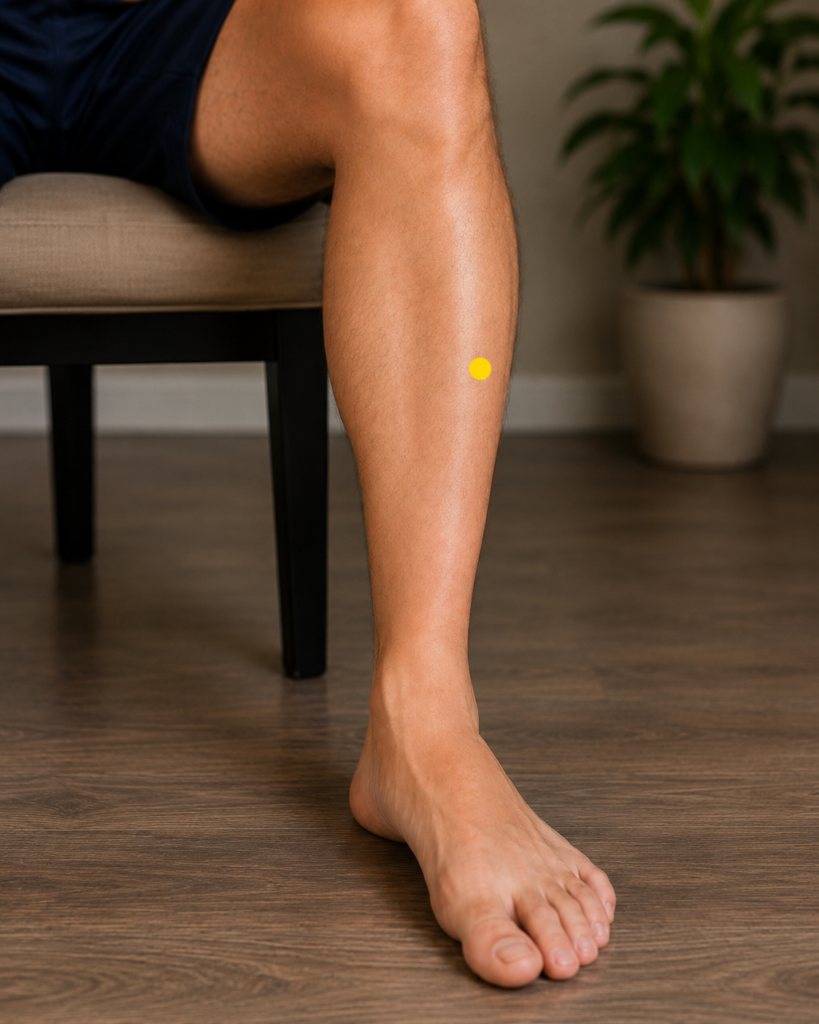
2. Press on SI12 above the shoulder blade for the top cuff muscle. SI12 sits on the upper back, in the hollow just above the ridge that runs across the top of the shoulder blade, roughly in the middle of that ridge. Reach across with your opposite hand and press firmly with your fingertips for 1 to 2 minutes, or have someone else press it for you. SI12 is called “Bingfeng,” the “Grasping the Wind.”
SI12 sits directly above the rotator cuff muscle that lifts your arm sideways, a muscle that is often irritated. Applying pressure to this point can help relax the muscle and alleviate the deep ache and pain associated with raising your arm. Since this area is often tender, start with gentle pressure and gradually press more firmly as it becomes less sensitive.

3. Press on SI11 in the center of the shoulder blade for the back cuff muscles. SI11 sits in the center of the shoulder blade, in a tender hollow in the middle of the flat, triangular bone. Lean against a wall with a tennis ball over the point, and press into it for 1-2 minutes. SI11 is called “Tianzong,” the “Heavenly Gathering.”
SI11 is located on the cuff muscle at the back of the shoulder blade, aiding in outward arm rotation. It is one of the most effective points for alleviating deep shoulder and shoulder blade pain. Applying pressure to this point can often relieve joint-related pain. Using a tennis ball against a wall can help you access this spot more easily on your own.
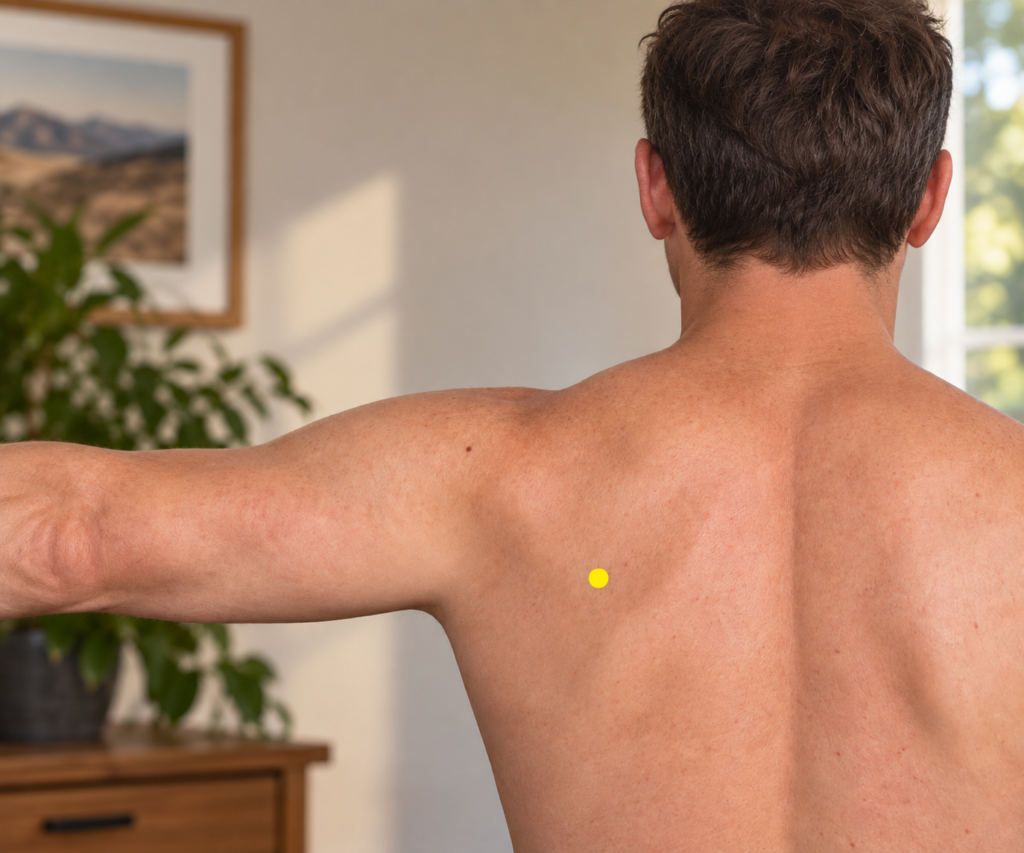
4. Press on SI10 at the back of the shoulder for the lower back cuff. SI10 sits on the back of the shoulder, just above the crease at the back of the armpit, in the hollow below the bony ridge of the shoulder blade. Press firmly with the fingers of the opposite hand, or use a tennis ball against a wall, for one to two minutes. SI10 is called “Naoshu.”
SI10 focuses on the back of the shoulder, where the smaller muscle that rotates the arm outward connects. Applying pressure here can relieve pain and stiffness at the back of the joint, particularly during movements like reaching behind to tuck in a shirt or fasten a seatbelt.

5. Press on SJ14 at the back of the shoulder to open the joint. SJ14 sits at the back of the shoulder, in the hollow that forms behind the bony point of the shoulder when you raise your arm out to the side. Press firmly with your fingertips for one to two minutes on the affected side. SJ14 is called “Jianliao.”
SJ14 releases tension in the back of the shoulder, easing pain and stiffness and facilitating arm movement. When combined with LI15 at the front of the shoulder and pressed together, these points can treat the joint from both sides.
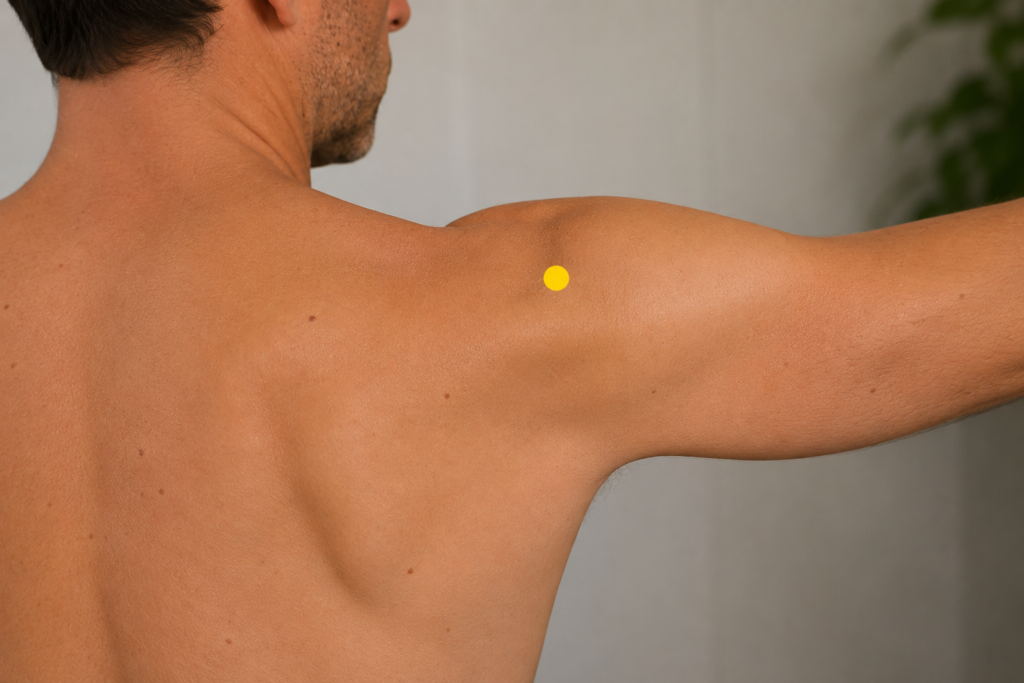
6. Press on LI15 at the front of the shoulder where the tendons converge. LI15 sits at the front of the shoulder, in the hollow that forms at the outer edge of the shoulder when you raise your arm out to the side. Press firmly with your fingertips for one to two minutes on the affected side. LI15 is called “Jianyu.”
LI15 is located where the rotator cuff tendons meet at the top of the arm, making it a key point for rotator cuff pain and discomfort during arm lifting. Along with SJ14, which targets the joint from the front and back, pressing on both points and gently rotating your arm in circles can provide considerable relief.

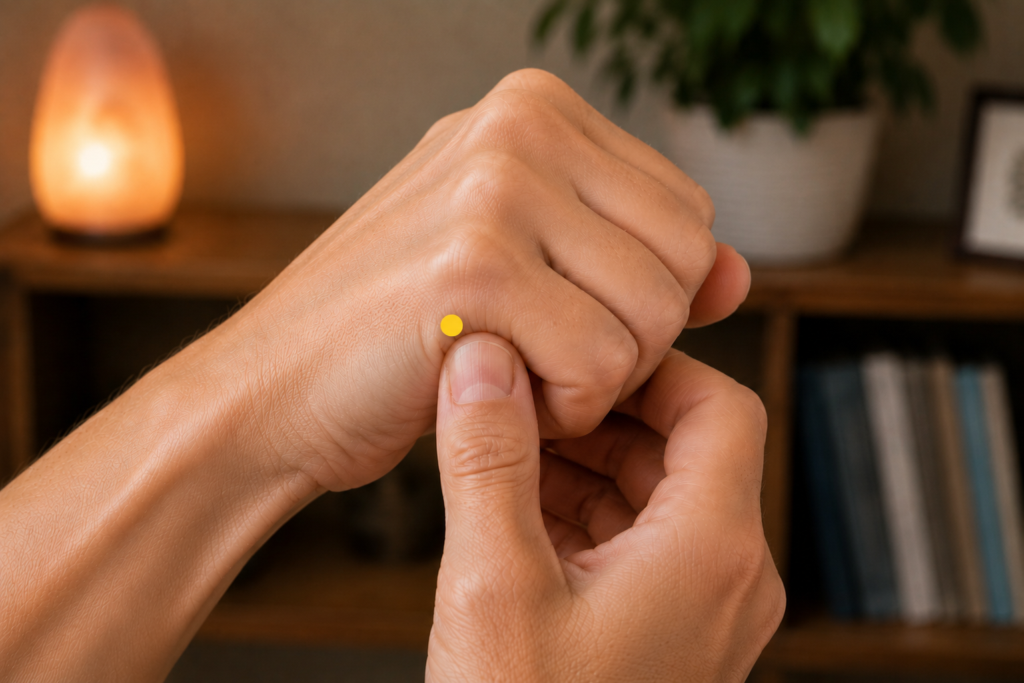
7. Press on SI3 on the side of the hand to open the channel from a distance. SI3 sits on the outer edge of the hand, on the little finger side, in the crease that forms just below the knuckle of the little finger when you make a loose fist. Press firmly with your thumb for one to two minutes on the affected side. SI3 is called “Houxi,” the “Back Stream.”
The Small Intestine channel runs over the shoulder blade and affects three of the four cuff muscles. SI3 helps open this channel from the hand. Applying pressure to SI3 can relieve pain in the shoulder blade and upper shoulder area while promoting relaxation in the neck and upper back, reducing shoulder strain.
8. Press on GB34 below the outer knee to nourish the sinews. GB34 sits on the outer lower leg, in the hollow just below and in front of the head of the fibula, the bony knob below the outer side of the knee. Press firmly with your thumb for one to two minutes on each leg. GB34 is called “Yanglingquan,” the influential point for the sinews.
Tendon issues, or sinew problems, are mainly addressed at GB34, the key acupressure point for tendons, ligaments, and sinews. Pressing this point helps heal irritated cuff tendons and relax tense muscles around the joint, which is especially useful for ongoing or recurring rotator cuff pain.

9. Press on LI4 in the hand to ease pain. LI4 sits in the webbing between the thumb and index finger, at the highest point of the muscle when you bring them together. Press firmly with the thumb of your other hand for one to two minutes on each hand. LI4 is called “Hegu.” LI4 is avoided during pregnancy.
LI4 is one of the body’s strongest points for relieving pain. It is located at the end of the Large Intestine channel, which runs up to LI15 at the front of the shoulder. Pressing LI4 can help ease shoulder pain from a distance, which is useful at night if your shoulder is too sore to touch.

Why These Acupressure Points Work
In Traditional Chinese Medicine, rotator cuff pain is seen as a blockage of Qi and Blood flow in the shoulder channels. Prolonged issues can lead to tissue tightness and weakening. The nine points mentioned earlier are designed to help resolve these problems.
- The shoulder blade point (SI12, SI11, SI10) helps relax the shoulder blade cuff muscles.
- The joint points (LI15, SJ14) release the shoulder at the front and back where the tendons meet.
- The distal points (ST38, SI3, LI4) help relieve pain and stiffness remotely, with ST38 being pressed while moving the shoulder.
- The sinew point (GB34) helps heal irritated tendons.
A large German trial showed that acupuncture is more effective than standard orthopedic treatment for chronic shoulder pain. Additionally, acupressure provides a method to target related points at home.
How to Properly Use These Acupressure Points
- Begin with ST38 on the same side of the leg, applying pressure while smoothly moving the shoulder through a comfortable range for a minute or two.
- Next, work the shoulder blade points SI12, SI11, and SI10 using a tennis ball against a wall for the ones you can’t reach. Then, proceed to LI15 and SJ14.
- Finish with SI3, GB34, and LI4. Press LI4 and SI3 at bedtime if nighttime pain keeps you awake.
- Start by warming the shoulder with a heat pack or warm shower to relax the muscles and promote blood flow to the joint.
- Apply steady pressure, stay within a comfortable range, and avoid forcing the shoulder into painful movements.
- Maintain each point for 1-2 minutes, and perform the routine once or twice daily.
Your daily habits play a crucial role in healing a rotator cuff injury. Avoid overhead reaching or lifting heavy weights when your shoulder is painful, and keep commonly used items at waist or chest level. Sleep on your unaffected side or on your back with a pillow supporting the sore arm. Keep your shoulder gently mobile rather than remaining still, as immobility can cause stiffness. Simple pendulum swings, letting your arm hang and move in small circles, can be helpful. Maintain good posture by sitting and standing straight, since slouching may pinch the rotator cuff. A physical therapist can guide you through strengthening exercises essential for long-term recovery. If the injury is recent, apply ice initially to reduce swelling, then switch to warmth, which Traditional Chinese Medicine suggests promotes healing.
When to Get Professional Help
Seek immediate medical attention if you experience a sudden pop or tear in your shoulder accompanied by weakness, or if you’re unable to lift your arm, as this could indicate a serious rotator cuff tear requiring prompt treatment. Consult a doctor if shoulder pain follows a fall or injury, if the shoulder appears deformed or dislocated, if you feel numbness or weakness radiating down your arm, or if the shoulder is hot, red, swollen, and possibly feverish. Additionally, see a healthcare professional if pain persists beyond two to four weeks, if night pain worsens, or if you begin to lose arm mobility, which might suggest a frozen shoulder. Contact emergency services if left shoulder or arm pain occurs with chest pain, pressure, shortness of breath, or sweating, which may indicate a heart issue.
Acupressure can be a helpful, low-risk method to alleviate rotator cuff pain, but it should be used in conjunction with physical therapy and medical care when necessary.
Above and Beyond Acupuncture offers acupuncture, cupping, and lifestyle coaching at the North Frank Lloyd Wright Boulevard location in Scottsdale.
Schedule an appointment online to start your healing journey.
The points above are only as effective as the technique used to apply them. Where to press, how firmly, and for how long all affect the result. For a full breakdown of how to perform acupressure properly at home, read Performing Acupressure in 3 Easy Steps.
For general shoulder pain, acupressure for shoulder pain is the companion article.

About the Publisher
Paul Kerzner, L.Ac., is a licensed acupuncturist and board-certified herbalist, as well as the founder of Above and Beyond Acupuncture in Scottsdale. His own journey from chronic patient to practicing acupuncturist shapes his commitment to providing honest, clinically grounded information about acupuncture and Traditional Chinese Medicine. Learn more about Paul and his clinical approach on the About Us page.