Key Takeaways
- Delayed onset muscle soreness reaches its peak after workouts and can be reduced with acupressure to help recovery.
- Research indicates that acupressure can lessen muscle soreness and enhance recovery by focusing on specific pressure points.
- Key acupressure points include ST36 for recovery, GB34 for relaxation, and KI1 to transition into rest and recovery.
- Perform acupressure after workouts by targeting relevant points, and enhance the effect with techniques like gentle kneading for optimal results.
- Consult a healthcare professional if you experience intense pain or unusual symptoms, since acupressure is intended to support, not replace, medical treatment.
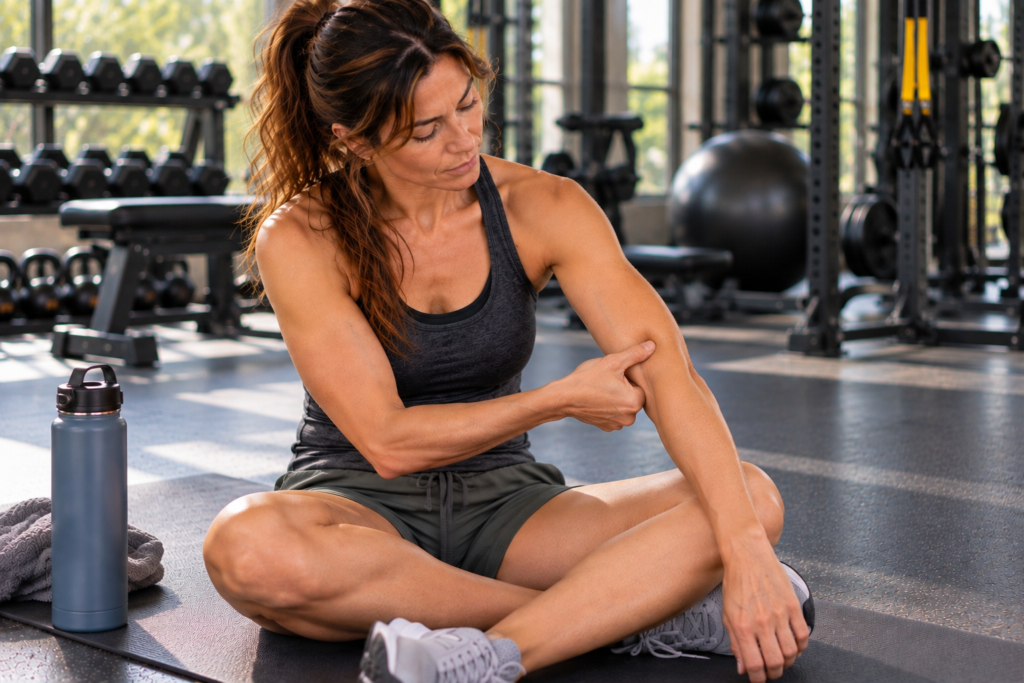
Do you still feel sore from yesterday’s workout when you go up the stairs?
Delayed onset muscle soreness is the deep ache that appears a day or two after a challenging or unfamiliar workout. It typically begins within 24 hours, reaches its peak after two or three days, and subsides within a week. During this period, you might experience stiffness, tenderness, reduced range of motion, and heavy, weak limbs. Whether you lift weights, run, cycle, hike, attend classes, or play sports on weekends, how quickly you recover impacts your next training session and overall feeling. Acupressure offers a simple method to alleviate soreness, loosen stiff joints, and support your recovery.
What the Research Shows
Research on acupressure massage following exercise is ongoing, but early results are promising. One study with twenty healthy male athletes compared acupressure massage to light exercise after intense jumping workouts. The findings showed that acupressure was more effective in decreasing joint stiffness and inflammation and also improved joint mobility. Another study on foot reflexology in college football players found it helped speed up recovery after sprinting. Overall, reviews indicate that massage after strenuous exercise can lessen muscle soreness and boost performance. Acupressure combines these benefits with specific points aimed at muscles and recovery, and it can be done on your own.
Traditional Chinese Medicine interprets post-exercise recovery uniquely. It suggests that physical activity helps move Qi and Blood, but intense or unfamiliar workouts can trap them in the muscles, causing stiffness, tenderness, and soreness. In this framework, the Spleen is linked to muscles, while the Liver is connected to tendons and ligaments. Both organs depend on healthy Blood for proper repair. A common saying highlights that rest allows Blood to return to the Liver, underscoring that recovery happens during rest. Overtraining without adequate rest can deplete Qi and Blood, leading to ongoing fatigue and soreness.
Here are nine acupressure points to help move Qi and Blood out of sore muscles, relax tendons, nourish Blood to support repair, and soothe the system to support recovery.
What Acupressure Points to Press and Why
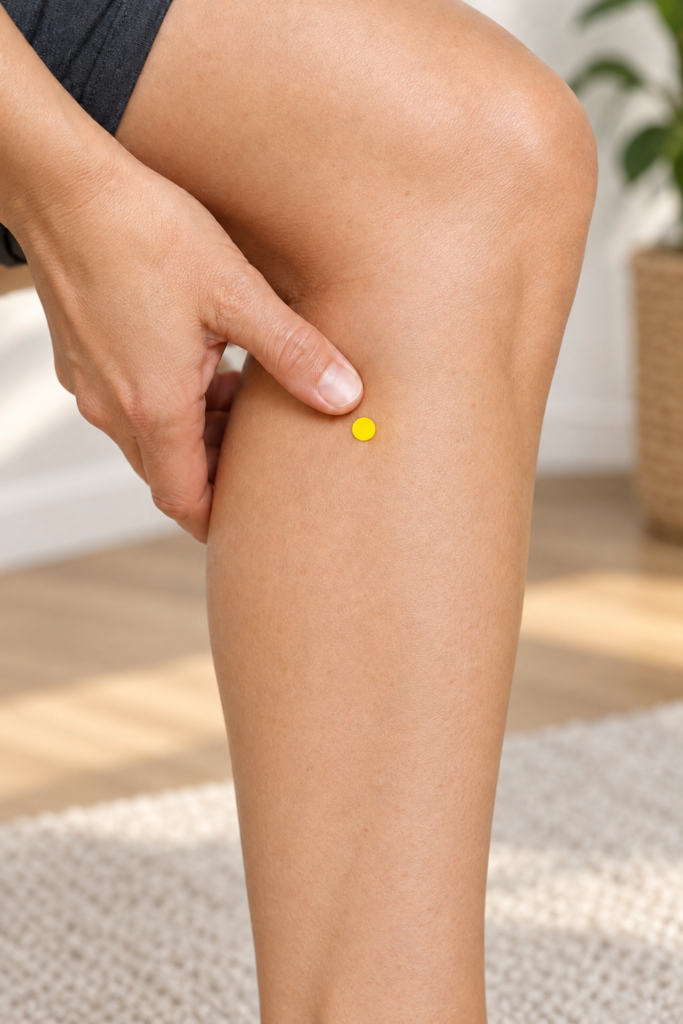
1. Press on ST36 below the knee, the master point for recovery. ST36 sits four finger-widths below the lower edge of the kneecap and one finger-width to the outside of the shinbone, on the muscle that rises when you flex your foot. Press firmly with your thumb for one to two minutes on each leg. ST36 is called “Zusanli,” the “Leg Three Miles.”
The name originates from the idea that applying pressure to this point provided exhausted travelers with enough energy to walk an additional three miles. ST36 remains regarded as the primary point for rejuvenating energy after physical activity. It helps replenish Qi and Blood depleted during exercise, supports the Spleen for muscle health, and helps recover tired, heavy legs. This point forms the basis of the routine.
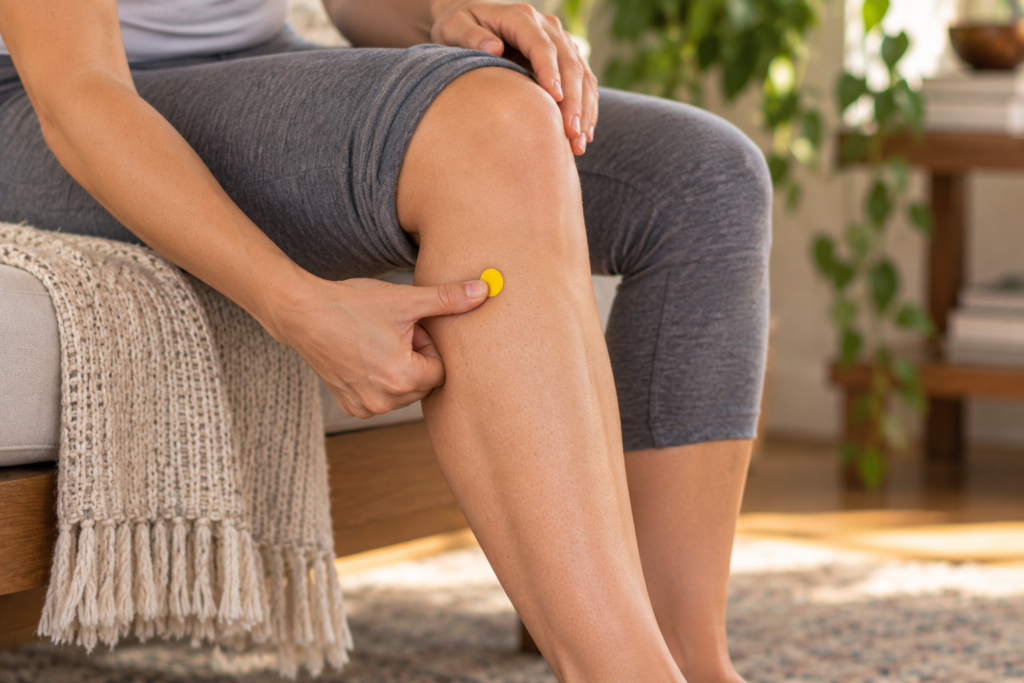
2. Press on GB34 below the outer knee to relax the sinews. GB34 sits on the outer lower leg, in the hollow just below and in front of the head of the fibula, the bony knob below the outer side of the knee. Press firmly with your thumb for one to two minutes on each leg. GB34 is called “Yanglingquan,” the influential point for the sinews.
After intense exercise, tendons and connective tissues may tighten, which can restrict movement and increase stiffness. GB34 is the primary acupressure point used to relax these tissues and improve mobility. Research indicates that acupressure massage can support the recovery of joint movement.
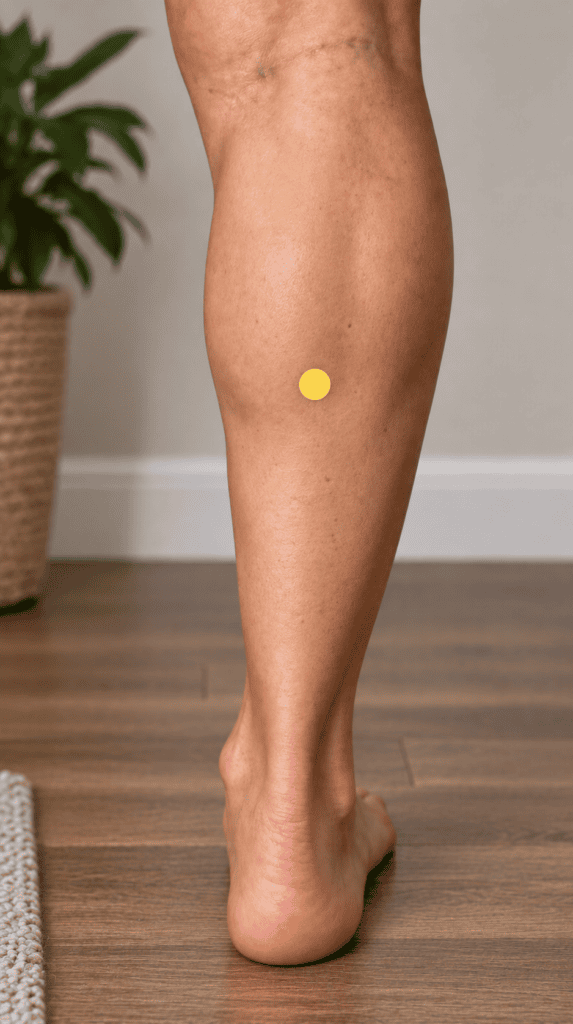
3. Press on BL57 in the calf to release tight, sore calves. BL57 sits in the center of the back of the lower leg, in the hollow where the bulge of the calf muscle meets the Achilles tendon, about midway between the back of the knee and the heel. Press firmly with your thumb for one to two minutes on each leg. BL57 is called “Chengshan.”
Activities such as running, jumping, hiking, and leg exercises put significant stress on your calves. BL57 is key to relieving this tension. It can reduce calf soreness and tightness and help prevent cramps. It also relieves pressure on the Achilles tendon and heel. For optimal relief, combine this point with gentle kneading along the calf in an up-and-down motion.
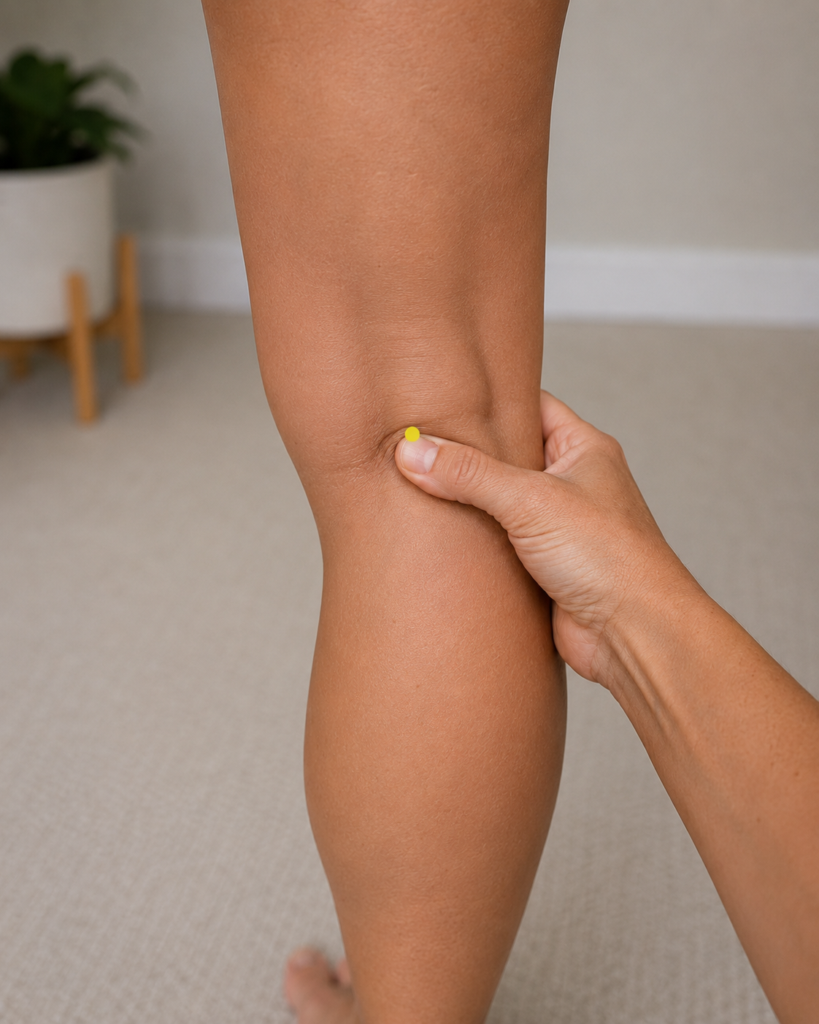
4. Press on BL40 behind the knee to release the back of the legs. BL40 sits in the center of the crease behind the knee. Press moderately with your fingers for one to two minutes on each leg. BL40 is called “Weizhong,” the command point for the back and legs.
BL40 helps release tension along the entire back of your legs, easing sore hamstrings and calves. As the main point for the lower back, it is also helpful after exercises like deadlifts, squats, and long runs that work the back hard. Use moderate pressure here because the back of the knee is sensitive.
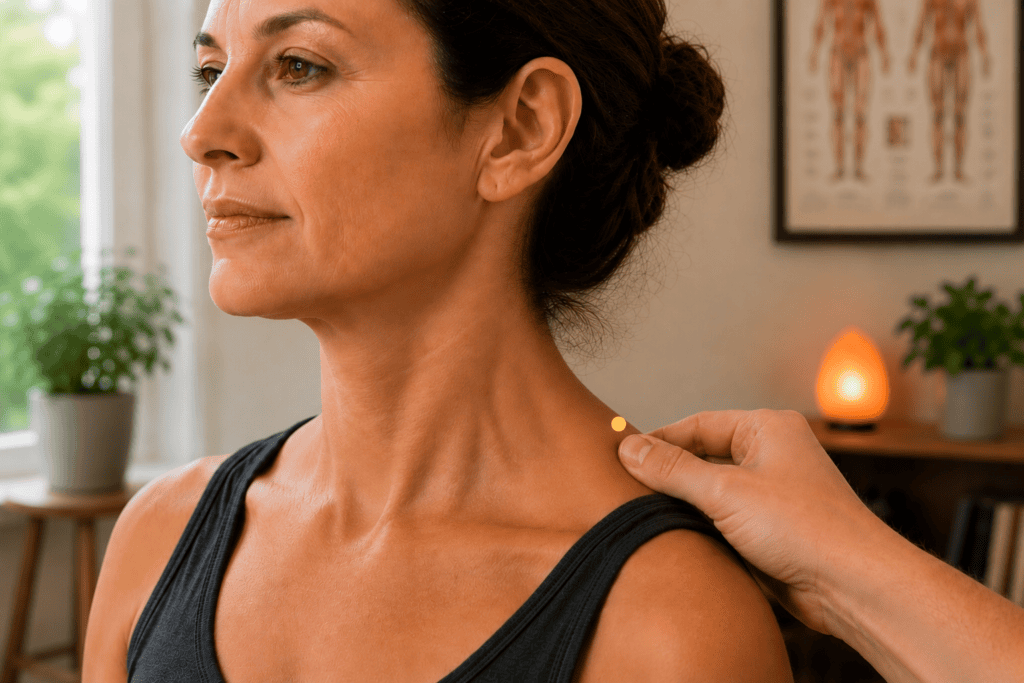
5. Press on GB21 on top of the shoulders to release the upper body. GB21 sits at the highest point of the shoulder, midway between the base of the neck and the tip of the shoulder, on the ridge of the trapezius muscle. Press down firmly or squeeze the muscle for one to two minutes on each side. GB21 is called “Jianjing.” GB21 is avoided during pregnancy.
Upper-body exercises like rowing, swimming, and even running with tense shoulders can make your trapezius muscles tight and sore. GB21 effectively relieves tension in the shoulders and neck. It is especially useful to target this point after a workout for relief.
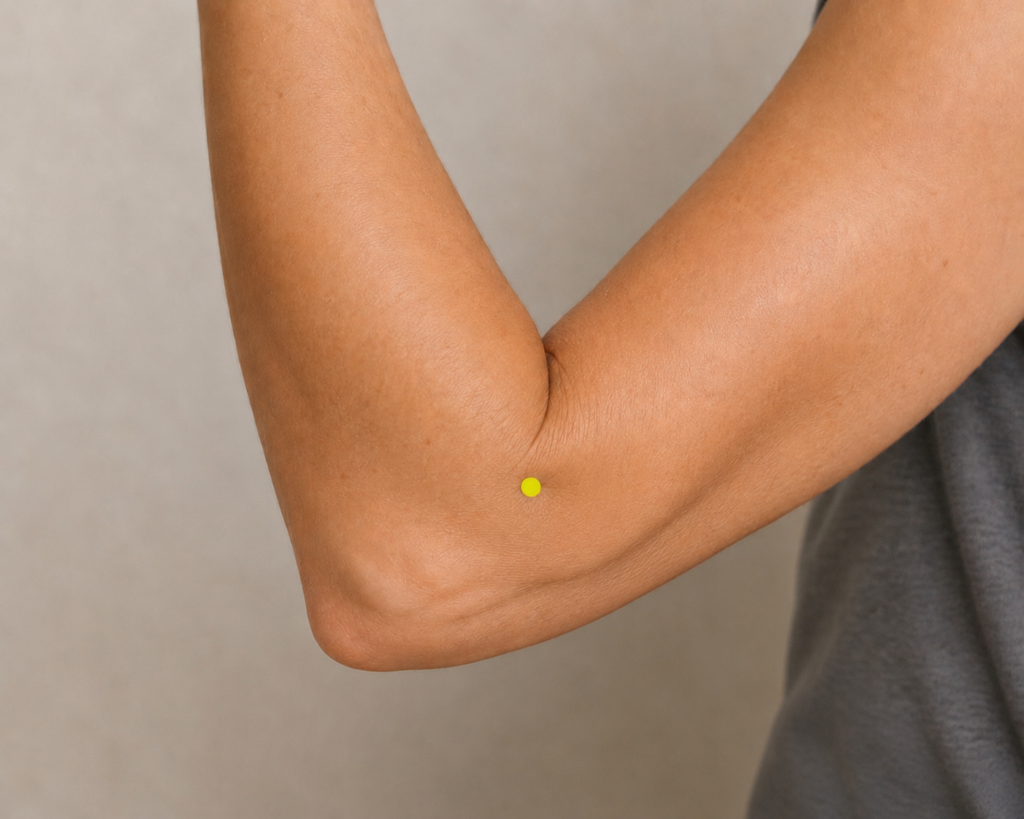
6. Press on LI11 at the elbow for sore arms. LI11 sits at the outer end of the elbow crease, in the hollow that forms when you bend your elbow. Press firmly with your thumb for one to two minutes on each arm. LI11 is called “Quchi,” the “Pool at the Crook.”
LI11 alleviates soreness, stiffness, and fatigue in the arms following activities such as pressing, pulling, gripping, or throwing. In Traditional Chinese Medicine, it also helps dispel heat associated with inflamed or overworked tissues. This point is especially important for those who use their arms and elbows heavily during training.
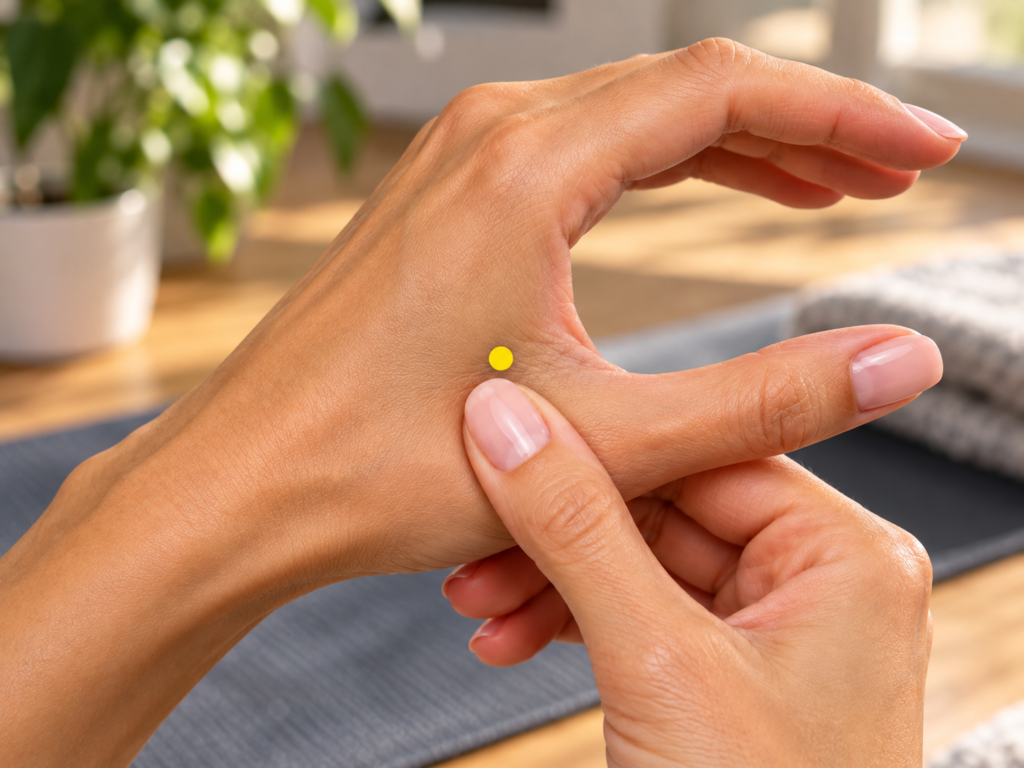
7. Press on LI4 in the hand to relieve soreness throughout the body. LI4 sits in the webbing between the thumb and index finger, at the highest point of the muscle when you bring the thumb and index finger together. Press firmly with the thumb of your other hand for one to two minutes on each hand. LI4 is called “Hegu.” LI4 is contraindicated during pregnancy.
LI4 is a highly effective point for relieving pain. It promotes the flow of Qi and alleviates soreness in various areas. Since LI4 shares the same channel as LI11, applying pressure to both can help treat the arm from the elbow to the hand. LI4 is easily accessible for relief whenever soreness occurs.
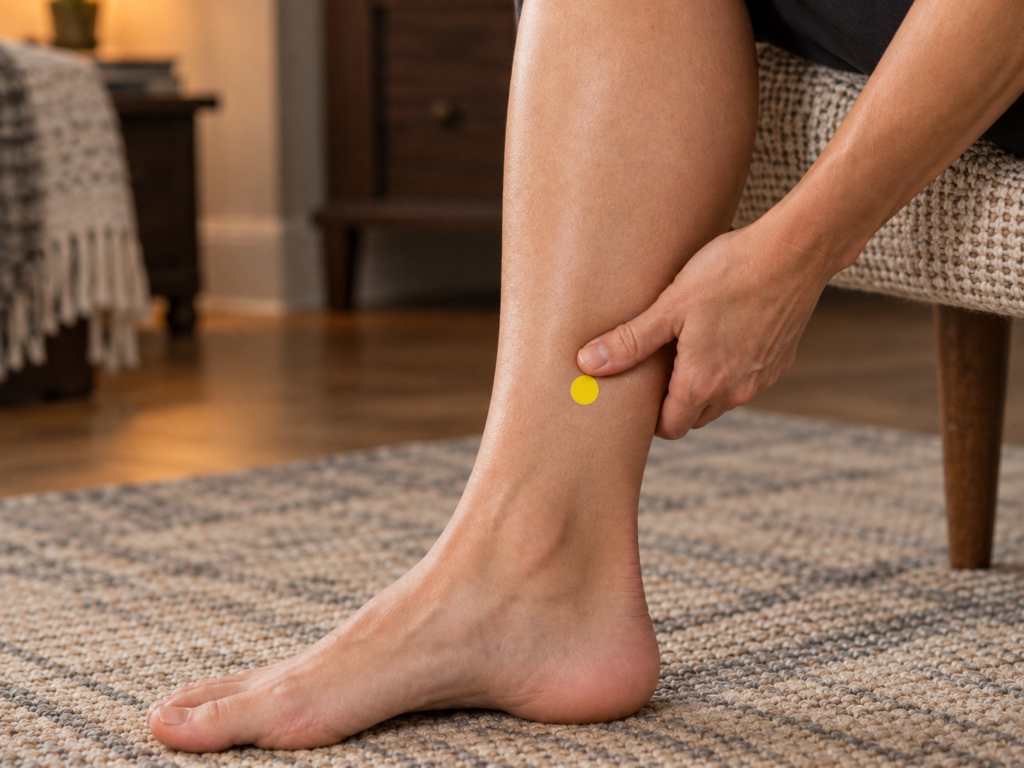
8. Press on SP6 above the inner ankle to nourish the Blood for repair. SP6 sits four finger-widths up from the tip of the inner ankle bone, just behind the back edge of the shinbone. Press firmly for one to two minutes on each leg. SP6 is called “Sanyinjiao,” the “Three Yin Intersection.” SP6 is avoided during pregnancy.
Muscles and tendons heal through Blood, and SP6 helps nourish and move it. This point benefits the Spleen, associated with muscles, and the Liver, linked to tendons. SP6 is particularly useful for those who train frequently and experience slow recovery. It also promotes better sleep, during which most healing occurs.
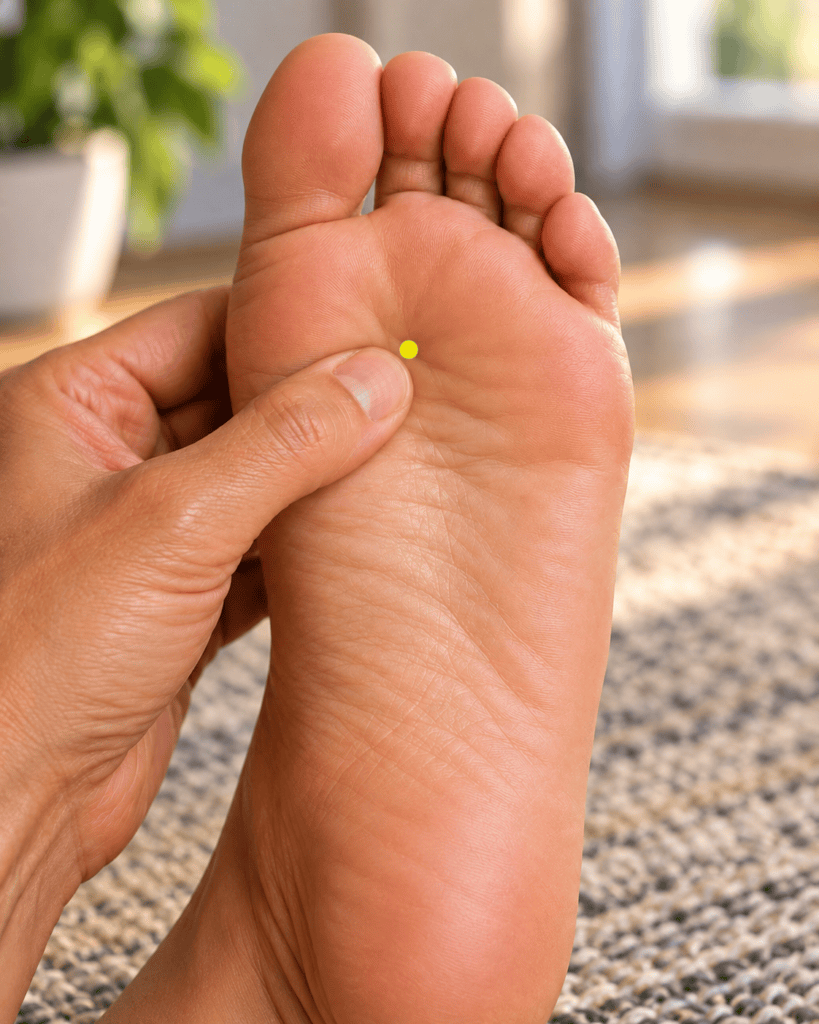
9. Press on KI1 on the sole of the foot to shift into recovery mode. KI1 sits on the sole of the foot, in the hollow that forms in the center of the ball of the foot when you curl the toes, about a third of the way down from the toes to the heel. Press firmly with your thumb, or roll the sole over a ball, for one to two minutes on each foot. KI1 is called “Yongquan,” the “Bubbling Spring.”
After a workout, your body needs to move from a high-energy state into rest and repair. KI1 helps ground and calm your system. Massaging the soles of your feet, where KI1 is located, is also an area where reflexology research has shown a shift toward recovery. This point also soothes tired feet after running or standing.
Why These Acupressure Points Work
In Traditional Chinese Medicine, post-workout soreness occurs when Qi and Blood stagnate in the muscles and the tendons tighten. Intense training can also deplete Qi and Blood, which then need replenishing. The nine points are designed to target all these problems.
- The recovery points (ST36, SP6) help restore the Qi and Blood necessary for muscle repair.
- The sinew and leg points (GB34, BL57, BL40) help relax tense tissues and improve mobility in the legs and back.
- The upper-body points (GB21, LI11, LI4) help relieve sore shoulders, arms, and hands.
- The grounding point (KI1) transitions the body into a state of rest and recovery.
How to Properly Use These Acupressure Points
Perform this routine after your workout once you’ve cooled down, and repeat it over the next two days when soreness peaks. Focus on points relevant to your workout.
- Use BL57, BL40, GB34, and ST36 after leg days, running, or hiking. Use GB21, LI11, and LI4 after upper-body workouts, swimming, or racket sports. ST36, SP6, and KI1 are helpful after any tough session.
- Combine the points with acupressure massage: after holding each point, knead and glide firmly along the sore muscle for another minute, working along its length rather than just one spot.
- Press around muscles that are very tender rather than digging directly into the sorest spot, and never press on a joint that is swollen or on an area you think you may have injured.
- Taking a warm shower or bath before this routine helps relax your muscles and improves circulation. For everyday soreness, Traditional Chinese Medicine recommends warmth instead of ice baths.
- Hold each point for one to two minutes with firm, comfortable pressure.
Acupressure is most effective when combined with solid recovery fundamentals. Prioritize sleep, as most tissue repair occurs during rest. Eat enough protein and stay well hydrated, especially if you sweat heavily, to support rebuilding after workouts. On recovery days, engage in light activities such as walking or cycling. When starting new or more intense workouts, ease into them gradually, since sudden increases can lead to significant soreness. Incorporate rest days into your weekly routine and monitor for overtraining symptoms like persistent soreness, decreased performance, poor sleep, or low mood.
When to Get Professional Help
Seek emergency assistance if you experience severe muscle pain and swelling after intense exercise, especially if you feel unusually weak or observe dark, tea- or cola-colored urine. These symptoms could indicate serious muscle breakdown needing urgent medical attention. Stop exercising and seek emergency care if you have chest pain, pressure, unexpected shortness of breath, or fainting during or after workouts. Consult a doctor for sharp pain, a popping sound, sudden pain during movement, joint swelling or instability, severe or localized pain, calf pain with swelling, warmth, or redness, or if soreness lasts beyond a week.
Acupressure can support recovery, but it should be used alongside proper training practices and, when needed, medical care.
Above and Beyond Acupuncture offers acupuncture, cupping, and lifestyle coaching at the North Frank Lloyd Wright Boulevard location in Scottsdale.
Schedule an appointment online to start your healing journey.
The points above are only as effective as the technique used to apply them. Where to press, how firmly, and for how long all affect the result. For a full breakdown of how to perform acupressure properly at home, read Performing Acupressure in 3 Easy Steps.
For deep, lingering calf tightness, acupressure for calf pain goes into more detail, and if a leg muscle cramps during or after exercise, acupressure for leg cramps covers that specific condition.
About the Publisher
Paul Kerzner, L.Ac., is a licensed acupuncturist and board-certified herbalist, as well as the founder of Above and Beyond Acupuncture in Scottsdale. His own journey from chronic patient to practicing acupuncturist shapes his commitment to providing honest, clinically grounded information about acupuncture and Traditional Chinese Medicine. Learn more about Paul and his clinical approach on the About Us page.