
Key Takeaways
- Golfer’s elbow results in pain on the inside of the elbow caused by overused tendons and repetitive strain from everyday activities.
- Acupressure helps reduce discomfort by pressing on specific points like HT3, PC3, and Ashi points near the elbow and forearm.
- Pressing points such as LI4 and HT7 on the hand and wrist help reduce pain and promote tendon healing.
- Apply gentle massage to the inner forearm while pressing the points to boost relief and support healing.
- If pain continues or gets worse despite self-care, consult a healthcare professional to ensure proper rehabilitation and support recovery.
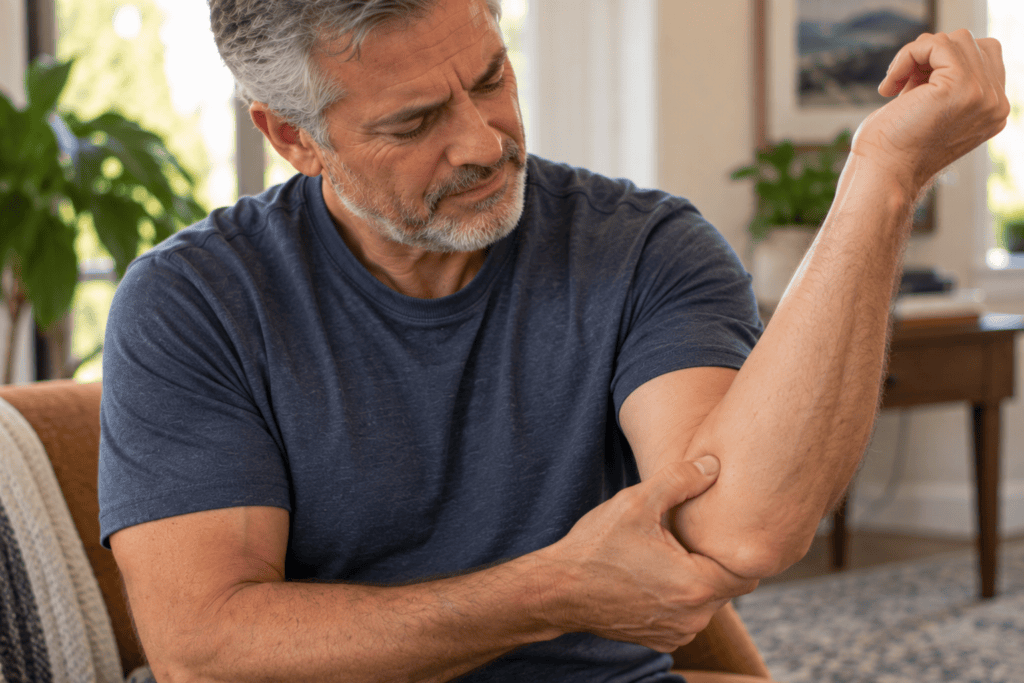
Golfer’s elbow presents as soreness or an ache along the inside of the elbow, especially over the bony bump. This discomfort often worsens with gripping, twisting, lifting, or wrist flexion. Despite its name, it frequently results from daily activities involving repetitive gripping, lifting, or twisting rather than golf. The condition arises when the tendons connecting the forearm muscles to the inner elbow become overused and irritated. Similar to tennis elbow, but on the inside instead of the outside, it can persist for weeks or months. Acupressure can help manage pain, relax the forearm, and promote healing.
In Traditional Chinese Medicine, golfer’s elbow is seen as a blockage of Qi and Blood in the channels crossing the elbow, known as a painful obstruction or Bi syndrome. Repetitive strain causes Qi and Blood to stagnate in the inner elbow muscles and tendons, leading to pain, stiffness, and tenderness. Unlike tennis elbow, which affects the outer elbow, golfer’s elbow involves the inner area where the Heart, Pericardium, and Small Intestine channels are situated. That’s why treatment points are located on the inner arm. Cold and damp conditions can sometimes worsen the condition. The points listed below help move Qi and Blood, open the channels in the inner arm, relax the tight muscles and tendons, relieve pain, and support tendon healing.
Regarding the clinical management of this condition, acupuncture for golfer’s elbow illustrates its application within the Traditional Chinese Medicine treatment setting.
Here are nine acupressure points, mainly on the inner arm, that can help alleviate golfer’s elbow.
What Acupressure Points to Press and Why
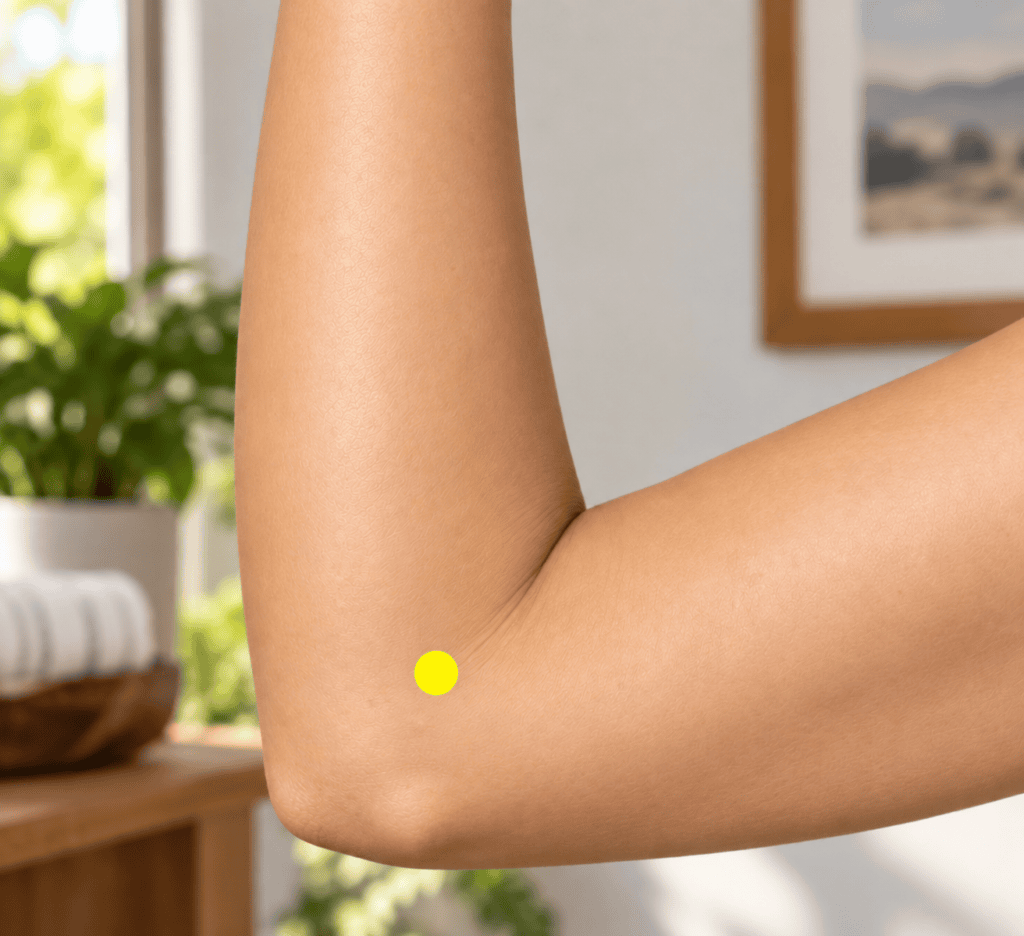
1. Press on HT3 at the inner elbow, the primary point for golfer’s elbow. HT3 sits at the inner end of the elbow crease, in the hollow on the pinky side of the crease when you bend your elbow, near the inner bony bump. Press firmly with your thumb for one to two minutes on the affected arm. HT3 is called “Shaohai,” a key point right at the inner elbow.
This point is nearest to where golfer’s elbow pain begins, located at the inner end of the elbow crease near the inner bony bump where the tendons are sore. HT3 is the key point for inner elbow discomfort, facilitating the flow of Qi and Blood and alleviating pain directly at the source. Because it is close to the tender tendon, apply steady, moderate pressure rather than pressing too hard on painful spots. For inner elbow pain, this is the most essential point to treat first.
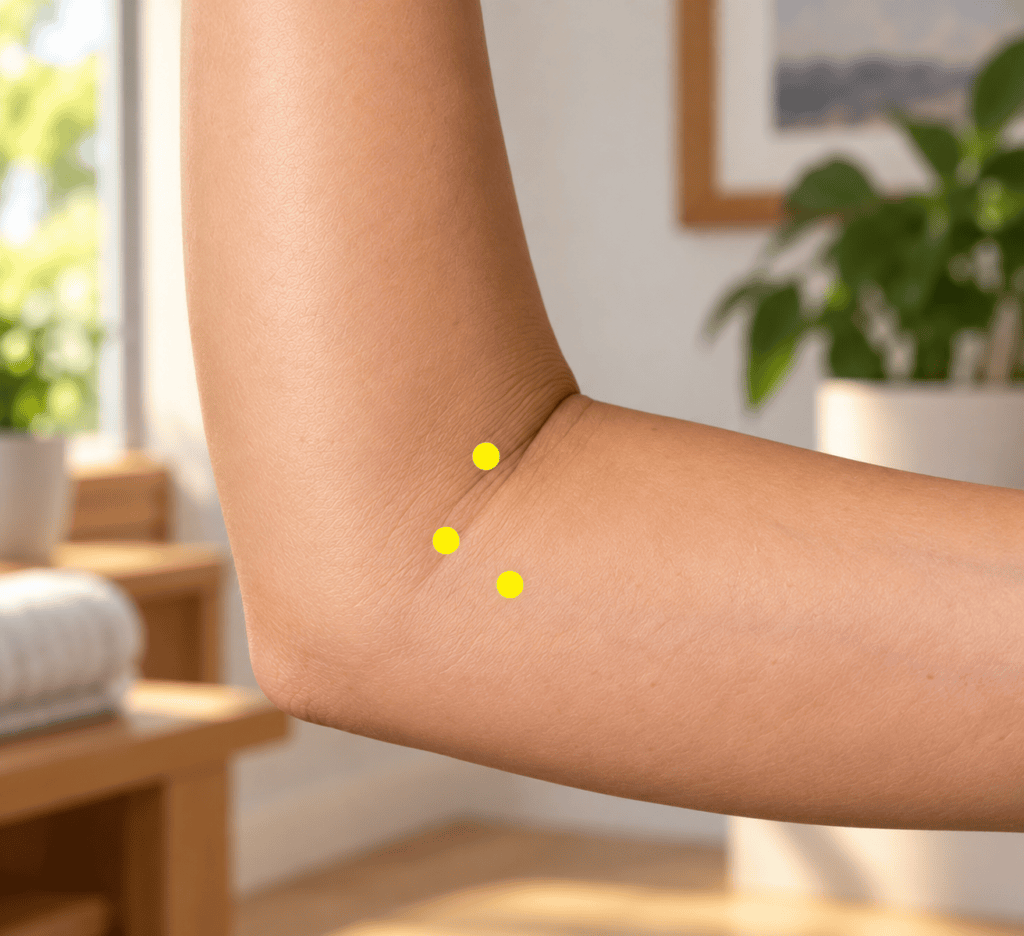
2. Press on the Ashi points right at the sorest spot. The Ashi points are wherever the tenderness is greatest, usually the inner bony bump of the elbow and the taut, sore bands in the inner forearm just below it. Feel for the most tender spots and press each with your thumb, firmly but tolerably, for a minute or so. “Ashi” means “that’s it,” the sound of finding the exact sore point.
In Traditional Chinese Medicine, practitioners treat Ashi points directly because pain indicates where Qi and Blood are significantly blocked. For golfer’s elbow, the affected areas include the inner elbow bump and the tense, sore muscles in the upper inner forearm. Applying pressure to these points helps unblock energy precisely where it’s most obstructed. Keep the pressure steady but comfortable, avoiding excessive force on inflamed areas. Massaging these sensitive points, along with the sore inner forearm, is one of the most effective methods for relief.
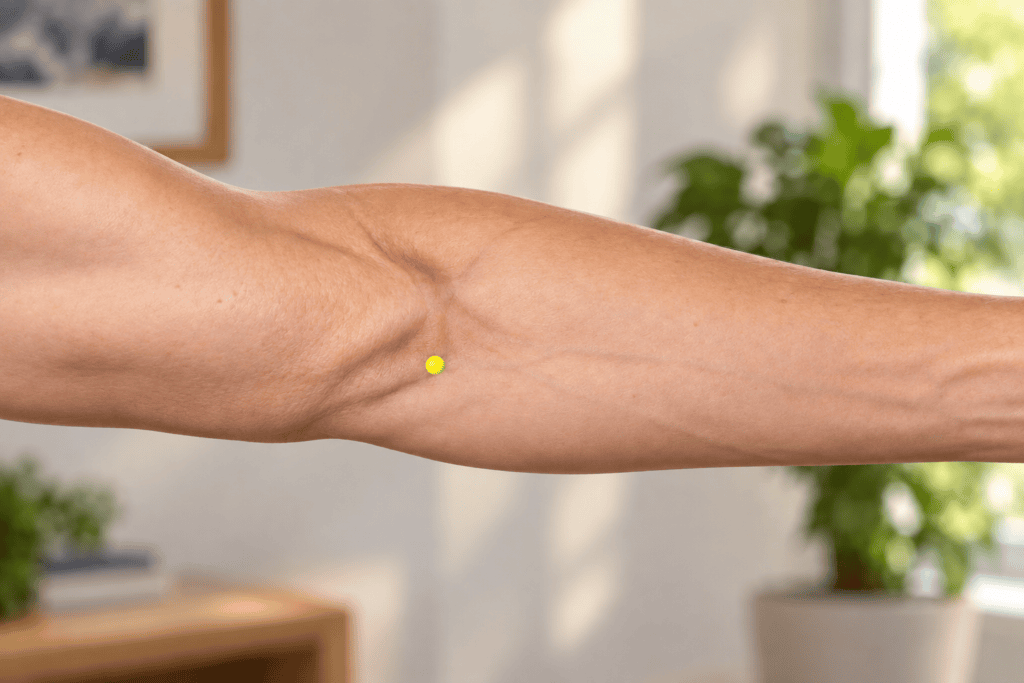
3. Press on PC3 at the elbow crease for the inner elbow and arm. PC3 sits in the inner elbow crease, in the middle, just to the pinky side of the big tendon you feel when you bend your elbow. Press firmly with your thumb for one to two minutes on the affected arm. PC3 is called “Quze,” and it is a point for the elbow and forearm.
PC3 is situated in the center of the inner elbow fold along the Pericardium channel, which runs down the middle of the inner arm, where golfer’s elbow pain frequently appears. This point facilitates the flow of Qi and Blood in the inner elbow, alleviating pain and tension in the joint and forearm. It pairs well with HT3, especially if your discomfort extends across the entire inner elbow and middle forearm, offering multiple angles of relief.
4. Press on PC6 on the inner forearm to open the channel and relax the arm. PC6 sits three finger-widths above the inner wrist crease, in the center of the forearm between the two tendons. Press firmly with your thumb for one to two minutes on the affected arm. PC6 is called “Neiguan,” the “Inner Pass,” and it is a major point for the inner forearm.
PC6 activates the Pericardium channel along the inner forearm’s center, targeting the overused flexor muscles common in golfer’s elbow. This point alleviates pain and tension in the inner arm and promotes relaxation of tight forearm muscles. It helps move Qi and Blood through the flexors, reducing strain on the injured tendon. For inner forearm soreness and tightness, applying pressure and massaging this point and the surrounding flexor muscles can help relieve discomfort throughout the arm.
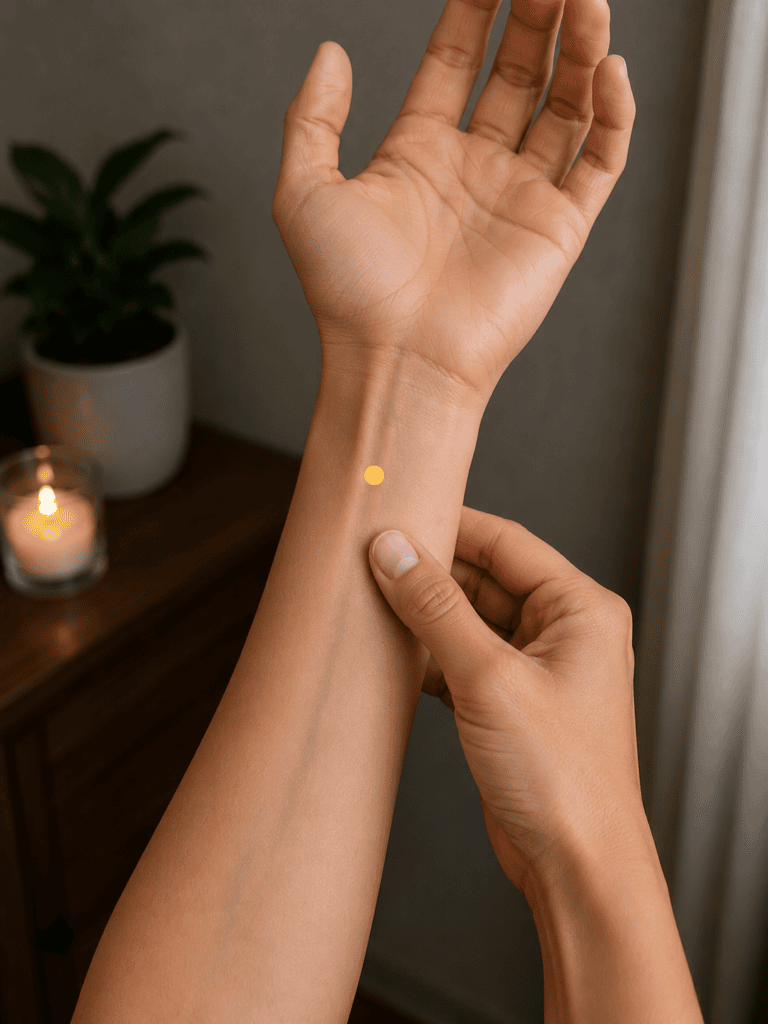
5. Press on HT4 on the inner forearm for the pinky-side inner arm. HT4 sits on the inner forearm, on the pinky side, about a thumb-width above the wrist crease, just off the tendon there, on the Heart channel. Press firmly with your thumb for one to two minutes on the affected arm. HT4 is called “Lingdao,” and it is a Heart-channel point on the inner forearm.
HT4 is located on the Heart channel along the inner forearm, on the pinky side, aligned with HT3 at the elbow. This point alleviates pain and tension on that side of the arm, such as in golfer’s elbow. It enhances the flow of Qi and Blood through the Heart channel, reducing pain and stiffness in the forearm and elbow. When pain extends down the pinky side, HT4 offers relief, particularly when used together with PC6 in the center, to cover the entire inner forearm.
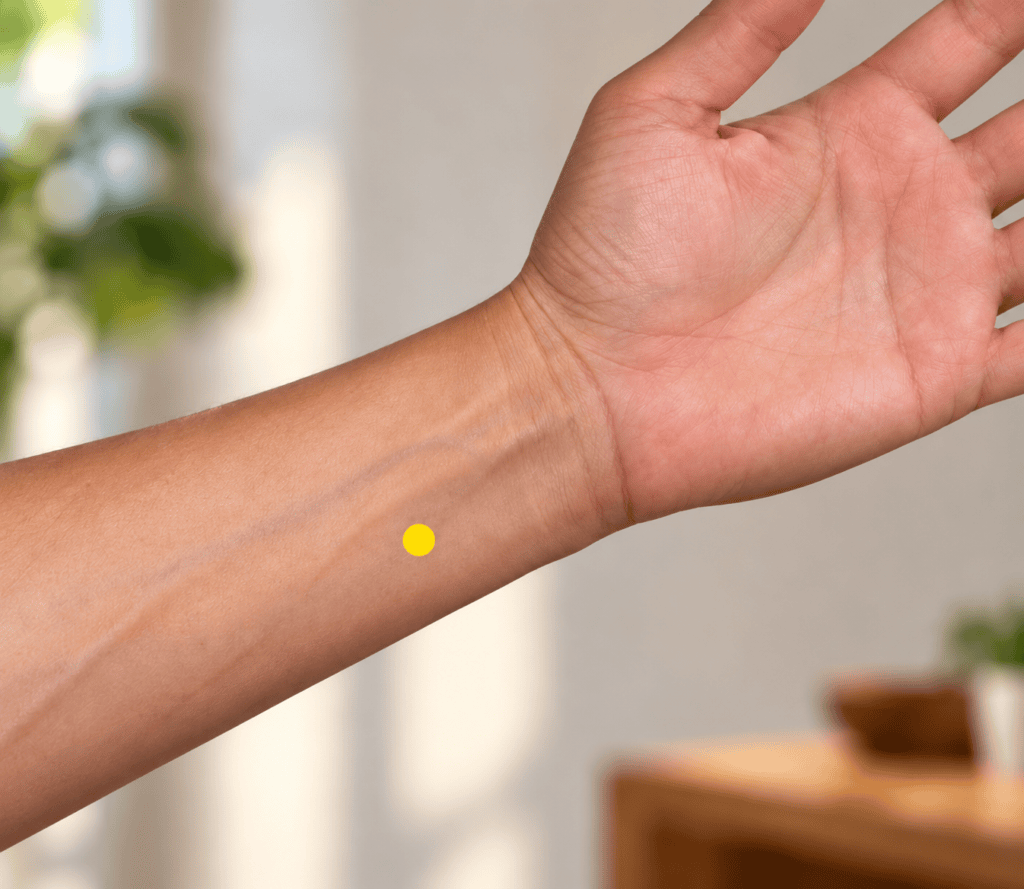
6. Press on SI8 at the inner elbow tip, the joint. SI8 sits at the inner elbow, in the groove between the tip of the elbow and the inner bony bump, the funny-bone spot, when the elbow is bent. Press gently and carefully with your fingertip on the affected arm for about a minute, avoiding hard pressure on the nerve there. SI8 is called “Xiaohai,” a local point at the inner elbow.
SI8 is located at the inner elbow along the Small Intestine meridian, near the bony prominence where golfer’s elbow pain occurs. It is a helpful local point for reducing pain and stiffness in the inner elbow joint, offering an alternative to the Heart and Pericardium points. Because this area lies directly above the ulnar nerve, apply gentle pressure and stop if you feel tingling or electric sensations. When used carefully, this point can effectively relieve golfer’s elbow joint pain.
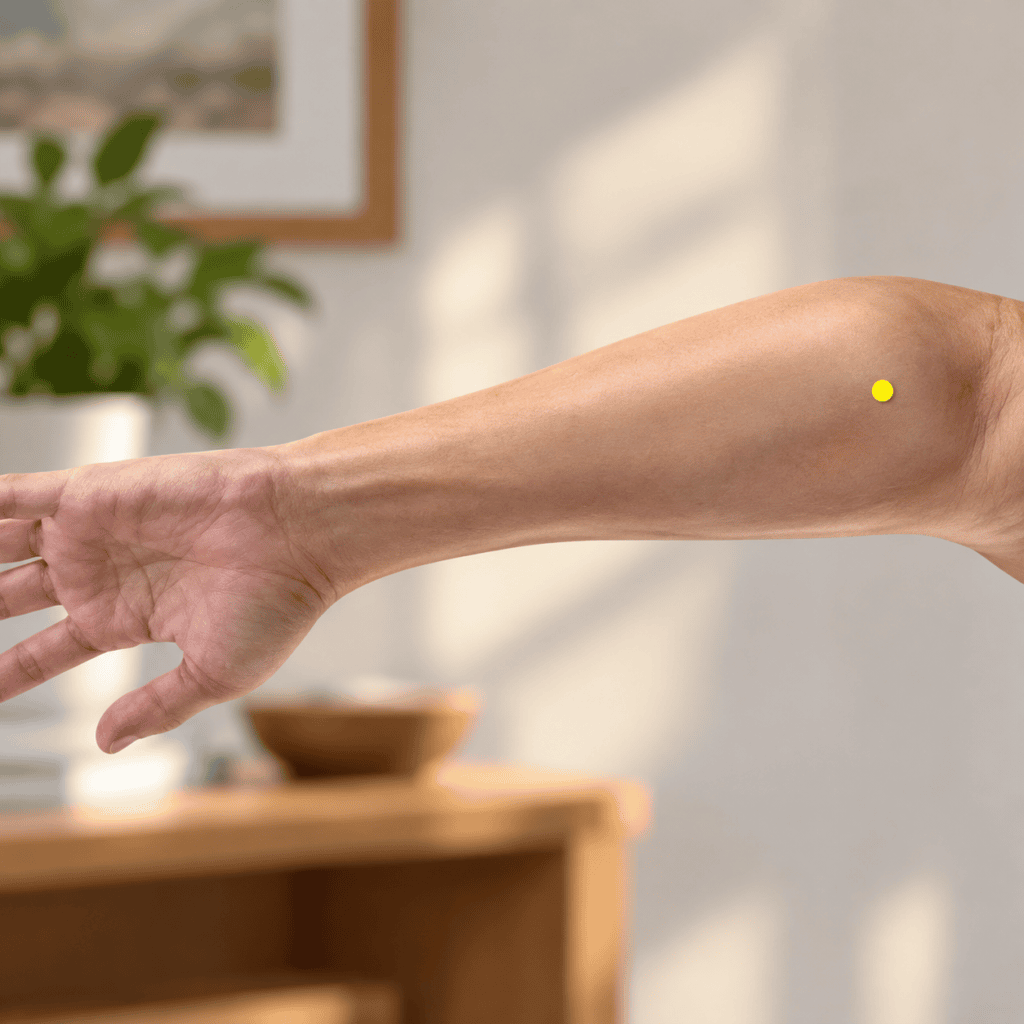
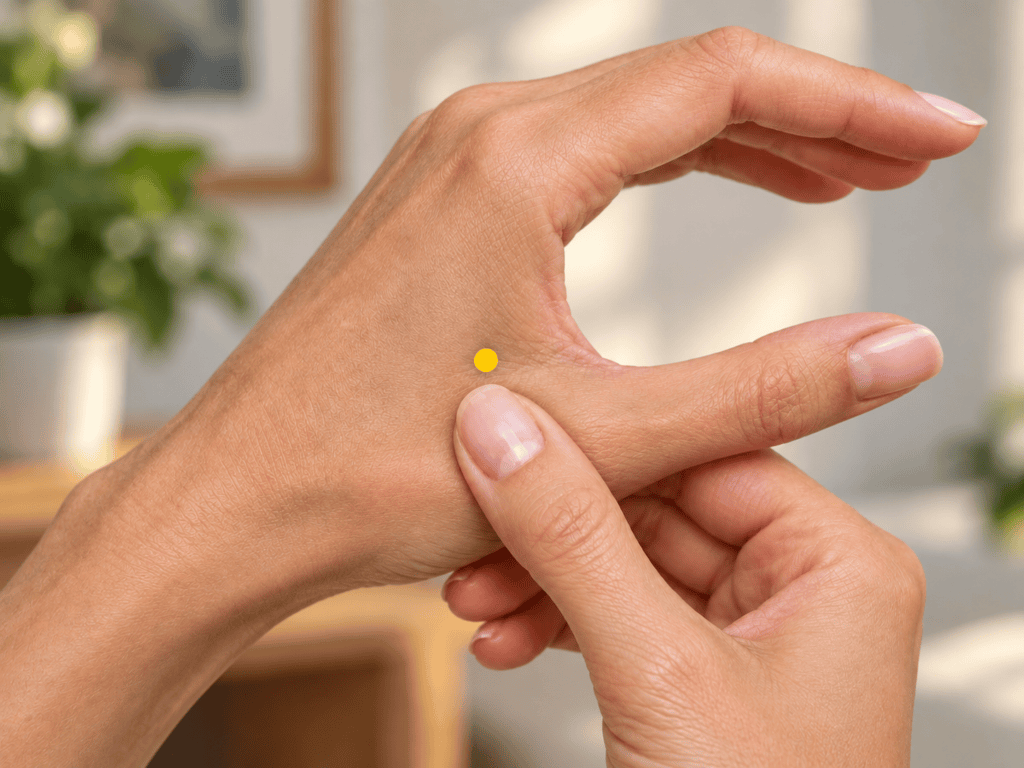
7. Press on LI4 in the hand to relieve pain and move stagnation. LI4 sits in the webbing between the thumb and index finger, at the highest point of the muscle when you bring the thumb and finger together. Press firmly with the thumb of your other hand for one to two minutes on the affected side. LI4, called “Hegu,” is a key point for moving Qi and relieving pain. LI4 is avoided during pregnancy.
LI4 promotes the flow of Qi across the arm and body, making it highly effective for reducing overall pain. Despite being on the hand, it can indirectly relieve elbow discomfort. It is a reliable point for pain anywhere in the arm, and its location away from a sore elbow allows for firm pressure without risking additional injury. For general pain relief, particularly in cases like golfer’s elbow, LI4 is a useful choice and can be used several times a day.
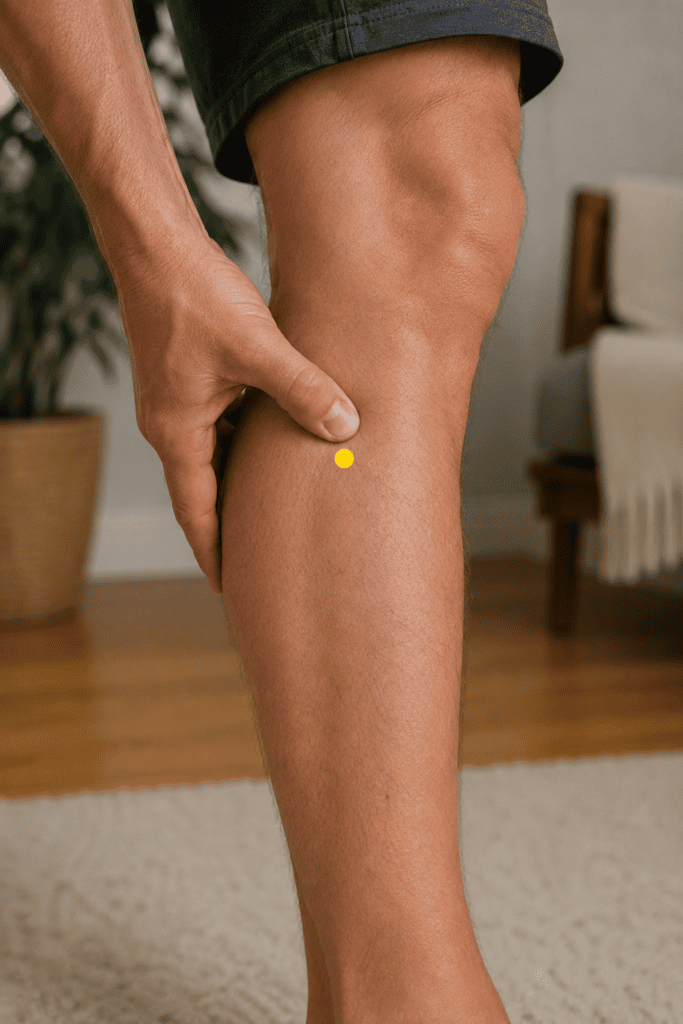
8. Press on GB34 below the outer knee to support the tendons. GB34 sits on the outer lower leg, in the hollow just below and in front of the head of the fibula, the bony knob below the outer side of the knee. Press firmly with your thumb for one to two minutes on each leg. GB34 is called “Yanglingquan,” and it is the influential point for the sinews and tendons of the whole body.
Golfer’s elbow mainly affects tendons, and GB34, located on the leg, is a crucial point for tendons and sinews overall. It supports tendons throughout the body, making it helpful for different tendon or sinew injuries by promoting healing and relaxation. For golfer’s elbow, this point offers overall tendon support to complement localized treatment at the inner elbow.
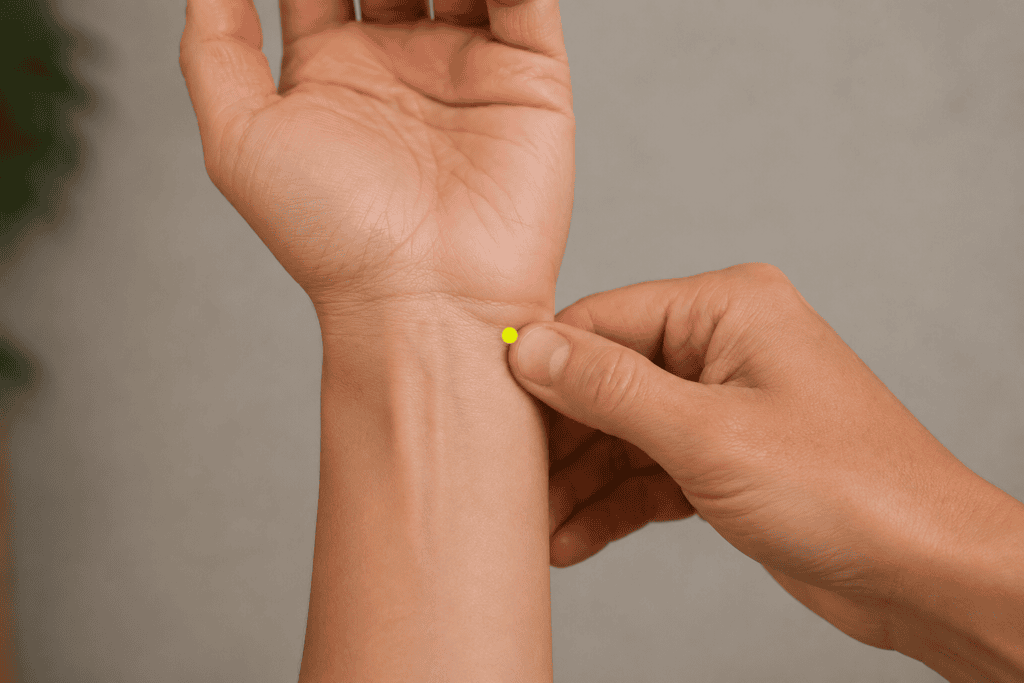
9. Press on HT7 at the wrist to relieve the channel and ease the tension. HT7 sits on the inner wrist crease, on the pinky side, in the small hollow just inside the tendon. Press firmly with your thumb for one to two minutes on the affected wrist. HT7 is called “Shenmen,” the “Spirit Gate,” and it is the source point of the Heart channel.
HT7 is the starting point of the Heart channel, running along the pinky side of the inner arm up to the elbow, where golfer’s elbow pain occurs. Applying pressure here stimulates Qi flow along the entire channel and can alleviate elbow pain originating from the wrist. Additionally, HT7 has a calming influence, helping to reduce tension and frustration associated with ongoing injuries. For easing pain along the Heart channel, HT7 serves as an effective final point, calming both the arm and the mind after addressing elbow discomfort.
Why These Acupressure Points Work
In Traditional Chinese Medicine, golfer’s elbow is seen as a painful blockage caused by Qi and Blood stagnation in the tendons at the inner elbow from overuse. This issue affects the Heart, Pericardium, and Small Intestine channels of the inner arm. The nine points mentioned above target all these aspects.
- The local points at the inner elbow (HT3, PC3, SI8) help move Qi and Blood right at the injured area, treating it through the Heart, Pericardium, and Small Intestine channels.
- The forearm and Ashi points (PC6, HT4, and the tender spots) help release the tight, overworked flexor muscles of the inner forearm and target the sorest spots where the blockage is worst.
- The distal points (LI4, HT7) help relieve pain along the affected arm, with HT7 working along the same Heart channel as golfer’s elbow.
- The tendon point, GB34, supports the healing of the body’s sinews and tendons.
The primary goal is to alleviate tension in the inner elbow and soothe the overworked flexor muscles. Therefore, incorporating these points and gently massaging the sore inner forearm can be beneficial.
How to Properly Use These Acupressure Points
Focus on the inner-arm points on the affected side, and gently press these while lightly massaging your sore forearm.
- Begin with HT3 at the inner elbow and the Ashi points at the sorest spots. Press firmly, but only as much as you can tolerate, and ease off if a spot is very inflamed.
- Add PC3, PC6, HT4, and SI8 to treat the inner elbow and forearm from different angles. Press SI8 gently because it’s over the funny-bone nerve. Use LI4, GB34, and HT7 as distant points for pain relief and tendon support.
- Massage the tight inner forearm flexor muscles along with pressing the points. Releasing these overworked muscles helps take strain off the injured tendon.
- Hold each point for one to two minutes. Press gently on very inflamed areas and over the nerve at SI8. Work these points a few times a day.
Remember that, like any elbow tendon injury, acupressure can help reduce pain and support healing. However, golfer’s elbow recovers best with rest and proper rehabilitation.
Avoid using the affected arm for activities that cause pain, and use it cautiously. Do not immobilize the arm completely for extended periods, as the tendon needs gentle, controlled movement to heal properly. The most effective treatment includes targeted exercises, especially slow, controlled eccentric movements that lower the wrist, ideally guided by a physical therapist. Ice can help reduce pain and inflammation immediately after injury. (Note: Traditional Chinese Medicine generally advises against ice; see this article for details: “Why Traditional Chinese Medicine Doesn’t Like Ice“) A forearm strap or brace can reduce strain during activity, and gentle stretching of the forearm flexor muscles can also help.
Acupressure may help alleviate pain and provide support, but it should not replace the exercises and tendon loading needed for full recovery.
When to Get Professional Help
Rest, rehabilitation, and patience usually improve most cases of golfer’s elbow, although recovery can be slow and may take several months. Acupressure might help manage pain during this process. If the pain is intense, persists despite weeks of self-care, or keeps coming back, consult a doctor or physical therapist. A therapist can guide you through effective strengthening exercises. Seek medical attention if the pain follows an injury or fall, if there is significant swelling, bruising, deformity, or if you cannot move or use your arm. Pay special attention to numbness, tingling, or weakness in the ring and little fingers, or a weak grip, as the ulnar nerve near the inner elbow may be affected. In such cases, a professional assessment is essential rather than relying solely on self-treatment.
While acupressure and self-care can provide daily relief, they should not replace proper rehabilitation or medical treatment in more serious situations.
Above and Beyond Acupuncture offers acupuncture, cupping, and lifestyle coaching at the North Frank Lloyd Wright Boulevard location in Scottsdale.
Schedule an appointment online to start your healing journey.
The points above are only as effective as the technique used to apply them. Where to press, how firmly, and for how long all affect the result. For a full breakdown of how to perform acupressure properly at home, read Performing Acupressure in 3 Easy Steps.

About the Publisher
Paul Kerzner, L.Ac., is a licensed acupuncturist and board-certified herbalist, as well as the founder of Above and Beyond Acupuncture in Scottsdale. His own journey from chronic patient to practicing acupuncturist shapes his commitment to providing honest, clinically grounded information about acupuncture and Traditional Chinese Medicine. Learn more about Paul and his clinical approach on the About Us page.