Key Takeaways
- Hip bursitis causes pain on the outer side of the hip that is often worst when lying on that side, climbing stairs, or getting up from a chair.
- Most outer hip pain involves both the bursa and the tendons of the buttock muscles, which is why doctors often call it greater trochanteric pain syndrome.
- Traditional Chinese medicine attributes hip bursitis to stagnation in the Gallbladder channel, often with cold and dampness or, in chronic cases, Liver and Kidney weakness.
- Nine acupressure points ease pain along the outer hip and thigh, relax the surrounding muscles, and strengthen the body so the area can heal.
- If the pain continues, consult a healthcare professional for an accurate diagnosis and appropriate treatment.
Does your hip hurt when you lie on it at night, making you switch sides? Is it painful to climb stairs, get out of a car, or stand up after sitting? Is the bony area on the side of your hip tender to the touch? These are classic signs of hip bursitis, a common cause of outer hip pain, particularly in midlife.
Hip bursitis can last for months if you continue activities that irritate and inflame the area. The good news is that it often improves with gentle strengthening, adjustments to how you sleep and sit, and treatments that increase blood flow. Acupressure offers a simple way to relieve pain and stiffness at home. The acupressure points in this article help relieve pain.
What is Hip Bursitis?
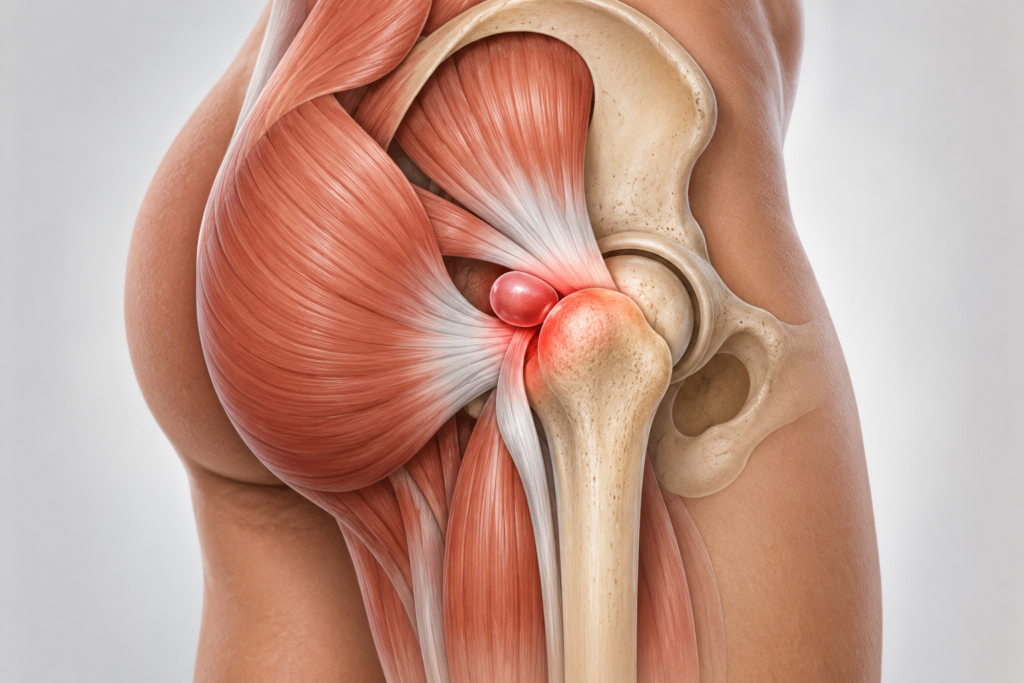
A bursa is a small, fluid-filled sac that cushions the space between a bone and the muscles and tendons that move over it. The largest bursa near the hip lies over the greater trochanter, the bony spot you can feel on the outside of your hip. When this bursa becomes irritated and inflamed, it causes pain in the outer hip. This condition is called trochanteric bursitis, which is what most people mean by hip bursitis.
Recent research shows that outer hip pain often involves more than just the bursa. The gluteus medius and gluteus minimus tendons are often irritated too. These buttock muscles attach to the greater trochanter and help keep your pelvis level when you walk. Because of this, doctors often call outer hip pain greater trochanteric pain syndrome, whether it stems from the bursa, the tendons, or both.
A second, less common type, called iliopsoas bursitis, affects a bursa on the front of the hip and causes pain in the groin rather than the outer hip.
Common symptoms of hip bursitis include:
- Pain on the outer side of the hip, often directly over the bony point
- Tenderness when pressing on the outer hip
- Pain when lying on the affected side, which often disrupts sleep
- Pain that may spread down the outer thigh toward the knee
- Pain when climbing stairs, walking uphill, or standing on one leg
- Pain when getting up from a chair or out of a car after sitting
- Pain when crossing the legs or sitting in low chairs
- Aching that is often worse at night and after activity
What Causes Hip Bursitis and Who Gets it?

Hip bursitis often develops gradually from repeated pressure and friction on the outer hip, especially when the muscles supporting the hip are weak. It can also begin after a single event, such as a fall onto the hip.
Common risk factors include:
- Being a woman between forty and sixty, especially around menopause, when tendons become less resilient
- Weak gluteal muscles that cannot keep the pelvis level, which increases the load on the outer hip
- Sleeping on one side for long periods, especially on a firm mattress
- Standing with your weight shifted onto one hip, or habitually crossing your legs
- Running, especially on sloped surfaces, and sudden increases in walking, hiking, or stair climbing
- A difference in leg length, flat feet, or other changes in how you walk
- Low back problems, hip arthritis, or previous hip surgery
- Excess body weight
- A fall or direct blow to the side of the hip
- Rarely, an infection or an inflammatory condition such as rheumatoid arthritis or gout
How Hip Bursitis Differs From Other Causes of Hip Pain
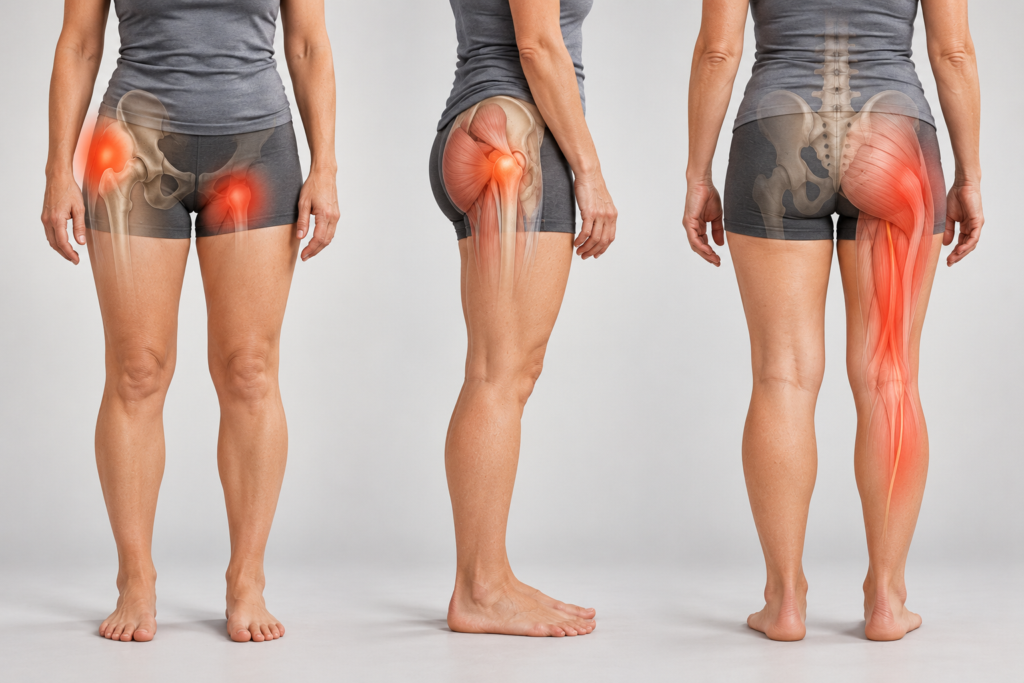
Hip pain can have many causes, and identifying the underlying condition matters because each may need a different treatment.
- Hip arthritis usually causes pain deep in the groin or front of the hip, along with stiffness and difficulty putting on shoes and socks, rather than tenderness over the outer hip. Acupressure for osteoarthritis covers that condition.
- Sciatica causes pain that travels from the low back or buttock down the back of the leg, often with numbness or tingling. Learn more about how to relieve sciatica with acupressure.
- Piriformis syndrome causes deep pain in the buttock that can spread down the back of the thigh, often worse with sitting. Acupressure for piriformis syndrome covers that condition.
- Low back problems can send pain into the outer hip and thigh, often with back stiffness and pain that changes with spinal movement.
- A stress fracture of the hip causes groin pain that worsens with weight-bearing, especially in runners and people with low bone density, and needs prompt medical care.
- Meralgia paresthetica causes burning, tingling, or numbness on the outer thigh from a pinched nerve, rather than tenderness over the bony point of the hip.
Signs of hip bursitis include pain and tenderness over the outer hip, pain when lying on that side, and discomfort when climbing stairs, standing up, or standing on one leg.
How Traditional Chinese Medicine Views Hip Bursitis
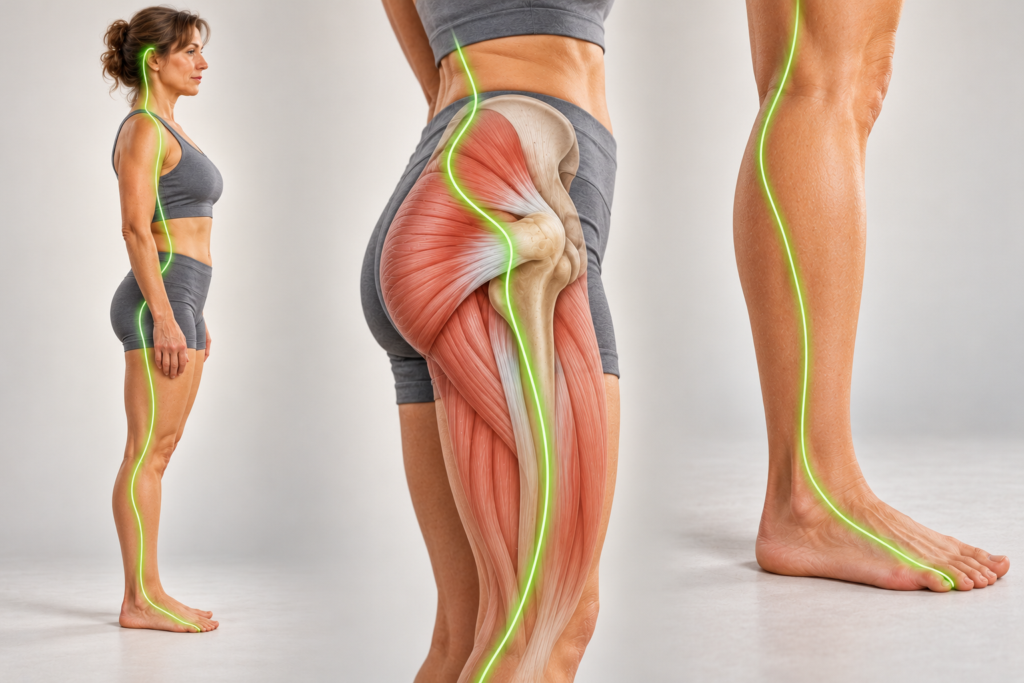
In Traditional Chinese Medicine, the outer hip lies along the Gallbladder meridian, which runs down the side of the body from the head to the hip, then along the outer thigh and leg to the fourth toe. Pain in this area is considered an obstruction to the flow of Qi and Blood through the meridian, a condition known in Chinese medicine as Bi syndrome. Because the Liver governs the sinews, including the tendons and ligaments that support the hip, and the Kidney governs the bones and lower body, most people with hip bursitis exhibit one or more of the following patterns. The points in this treatment are selected to address each pattern.
- Qi and Blood stagnation: sharp, fixed pain over the outer hip; tenderness to touch; and pain after overuse, a fall, or prolonged pressure on the hip. GB30, GB29, and GB31 move the Qi and Blood locally, and GB34 and LR3 keep the channel flowing.
- Cold and dampness in the channels: aching and stiffness that are worse in cold weather, in the morning, or after sitting still; a heavy feeling in the hip and leg; and relief with warmth and movement. GB30, GB31, ST36, and SP6 warm and open the channels and help clear dampness.
- Damp heat from acute irritation: a hot, swollen, very tender hip during a flare. GB34 and SP6 help clear heat and dampness, and the flare is best calmed before deeper work.
- Liver Blood failing to nourish the sinews: tight, weak tendons that are slow to heal, especially around menopause, often with muscle cramps or dry skin and nails. GB34, LR3, and SP6 nourish and relax the sinews.
- Liver and Kidney deficiency: long-standing pain in older adults, weakness in the hips and knees, low back aching, and fatigue. KI3 and GB39 strengthen the Kidney, bones, and lower body.
The main goal is to get Qi and Blood moving along the side of the hip, clear out cold and dampness, nourish the tendons, and strengthen the Liver and Kidney to support hip healing.
What the Research Shows
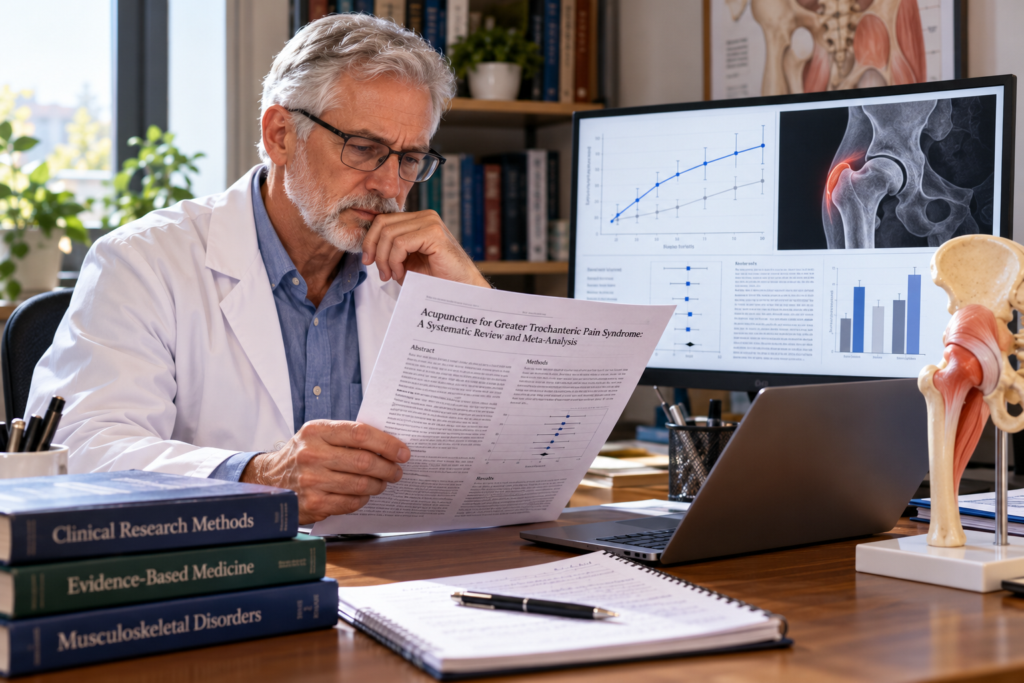
Acupuncture has shown benefits for hip pain in clinical research.
A 2023 systematic review and meta-analysis in Healthcare gathered twelve randomized trials involving 806 people with hip pain, including a trial focused on outer hip pain from bursitis and irritated tendons. When acupuncture was added to conventional care, people experienced significantly less pain than with conventional care alone. In the trial focused on outer hip pain, needling the muscles around the hip was as effective as a cortisone injection for easing pain and improving function, and no serious side effects were reported across the studies. The authors concluded that acupuncture shows promise for managing hip pain and called for larger trials to build on these results.
Research on acupressure for hip bursitis is growing; it targets many of the same Traditional Chinese Medicine acupuncture points and meridians, making it a practical way to support patients between treatments. It works best alongside gentle hip-strengthening exercises and changes to habits that irritate the outer hip.
Here are nine acupressure points that can help:
What Acupressure Points to Press and Why
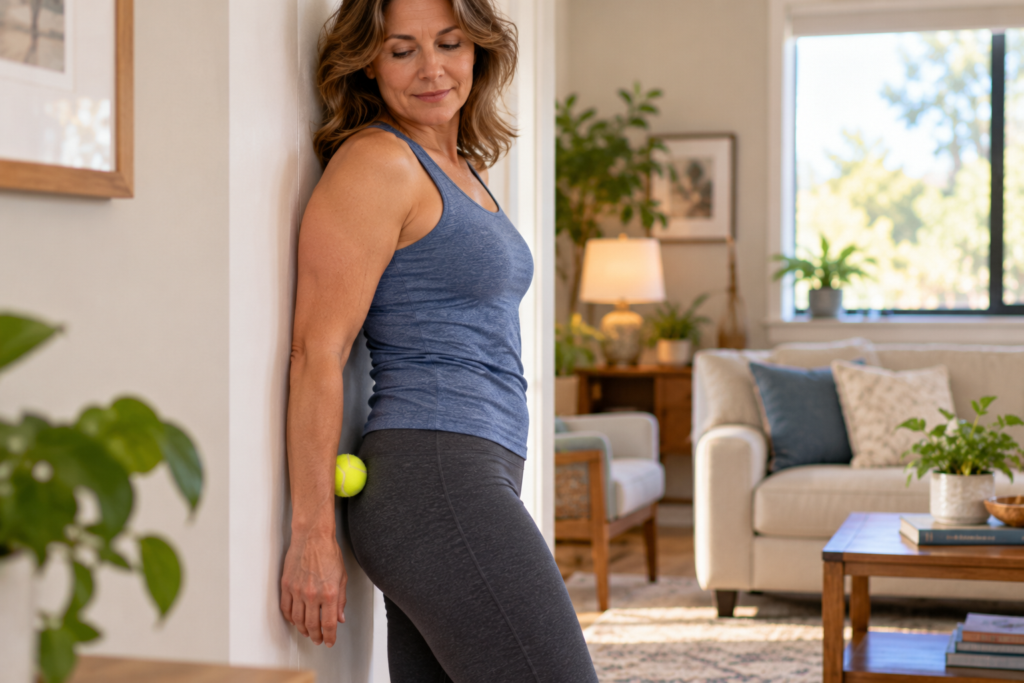
1. Press on GB30 on the side of the buttock to ease hip pain. GB30 sits on the side of the buttock, about one-third of the way from the bony point on the outer hip toward the base of the spine, in the hollow that forms when you squeeze the buttock muscles. Lean against a wall with a tennis ball between the wall and the point, or press firmly with your knuckles, for one to two minutes on the affected side. GB30 is called “Huantiao,” the “Jumping Circle.”
GB30 is a key point for relieving hip pain because it lies above the deep buttock muscles, including the gluteal muscles whose tendons attach to the outer hip. It also helps move Qi and Blood throughout the hip joint. Releasing tension here reduces pressure on the outer hip and often eases pain radiating down the thigh. This point forms the foundation of the routine.
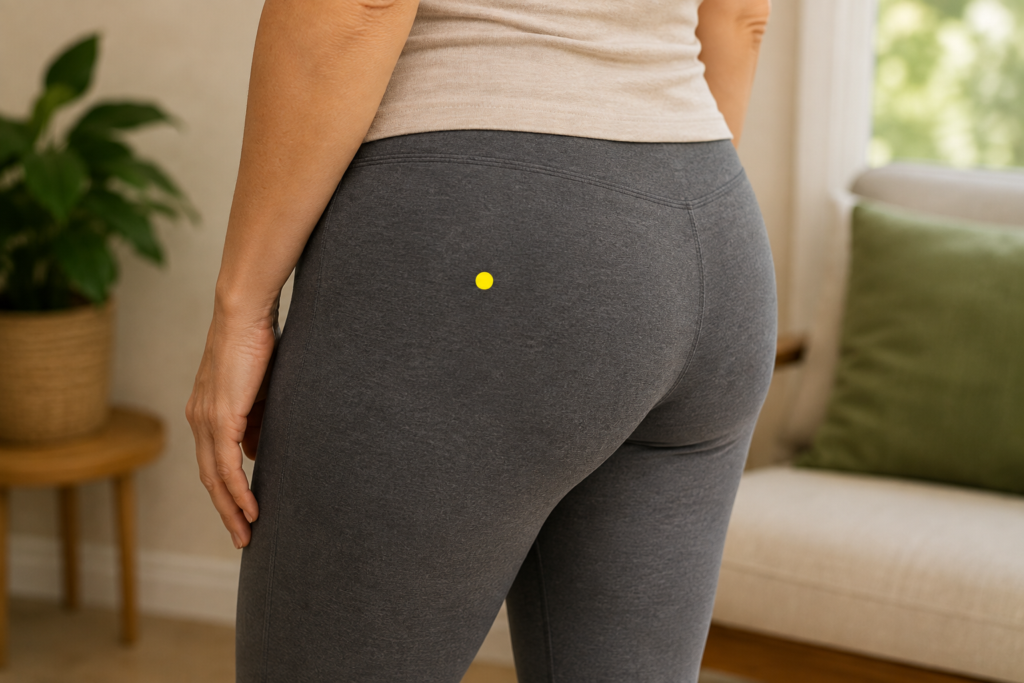
2. Press gently on GB29 at the side of the hip to ease local pain. GB29 sits on the side of the hip, in the hollow midway between the bony point at the front of the hip and the bony point on the outer hip. Press gently with your fingertips for about a minute on the affected side, moving slightly off the most tender spot if needed. GB29 is called “Juliao,” the “Squatting Crevice.”
GB29 is located near the irritated area and helps improve blood flow to the front and side of the hip joint. It can ease local pain and stiffness, helping the hip move more freely when walking or climbing stairs. Because it is close to the inflamed area, use light pressure around the most sensitive point rather than pressing directly on it.
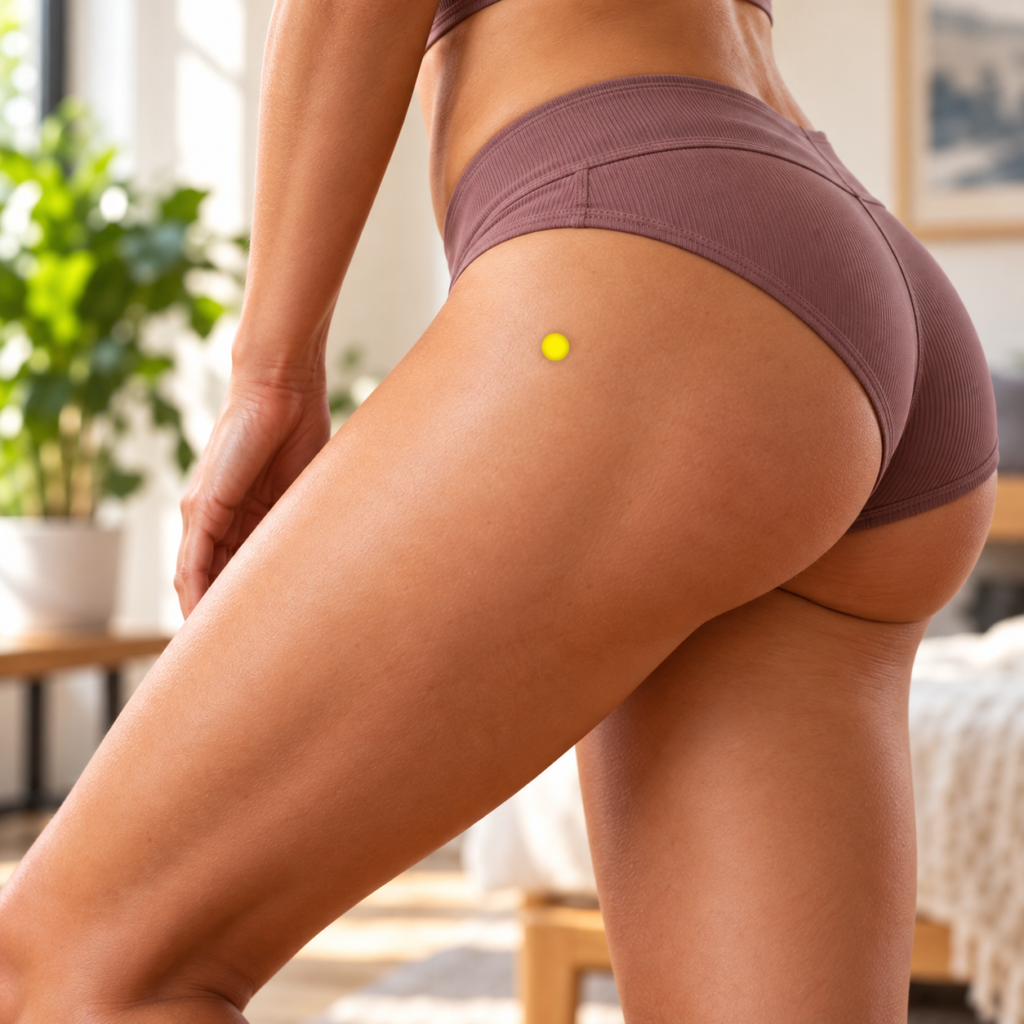
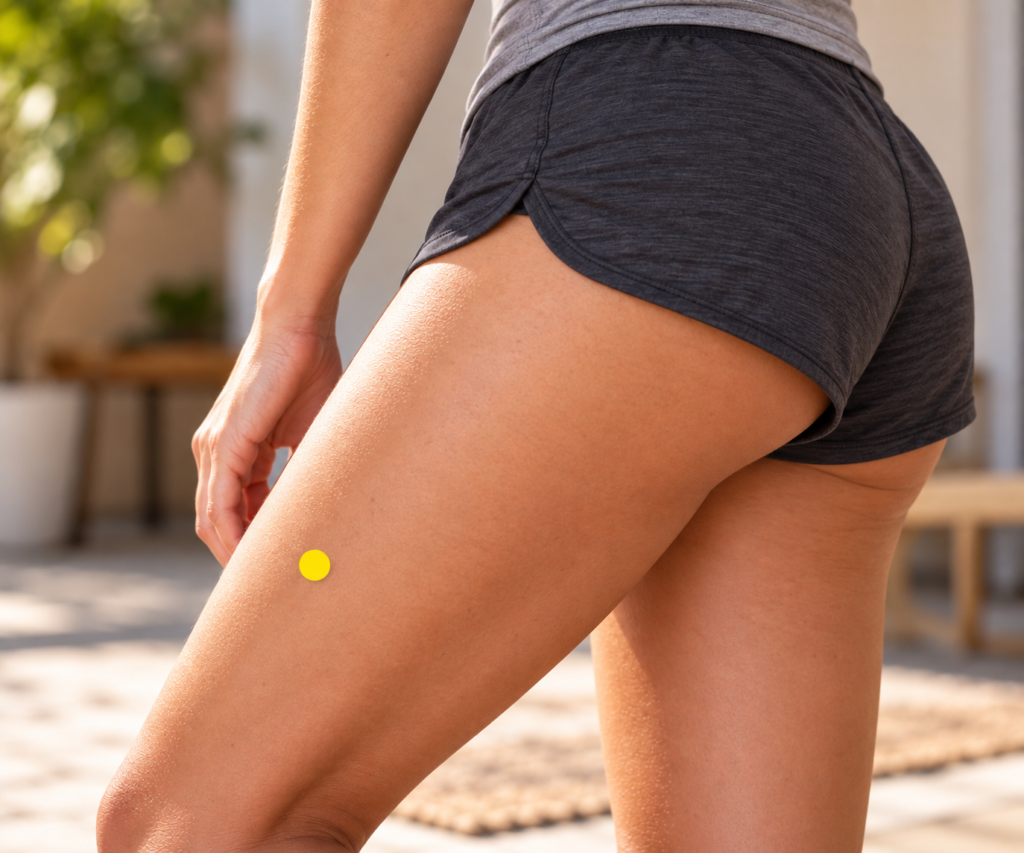
3. Press on GB31 on the outer thigh to ease pain that spreads down the leg. GB31 sits on the outer side of the thigh, where the tip of your middle finger touches when you stand with your arms relaxed at your sides. Press firmly with your thumb or knuckles for one to two minutes on the affected side. GB31 is called “Fengshi,” the “Wind Market.”
Outer hip pain often extends down the side of the thigh. GB31 is the standard point for pain, stiffness, and numbness in the outer thigh. It relaxes the tight band of tissue there, which can increase pressure on the outer hip, and helps remove wind and dampness from the channel.
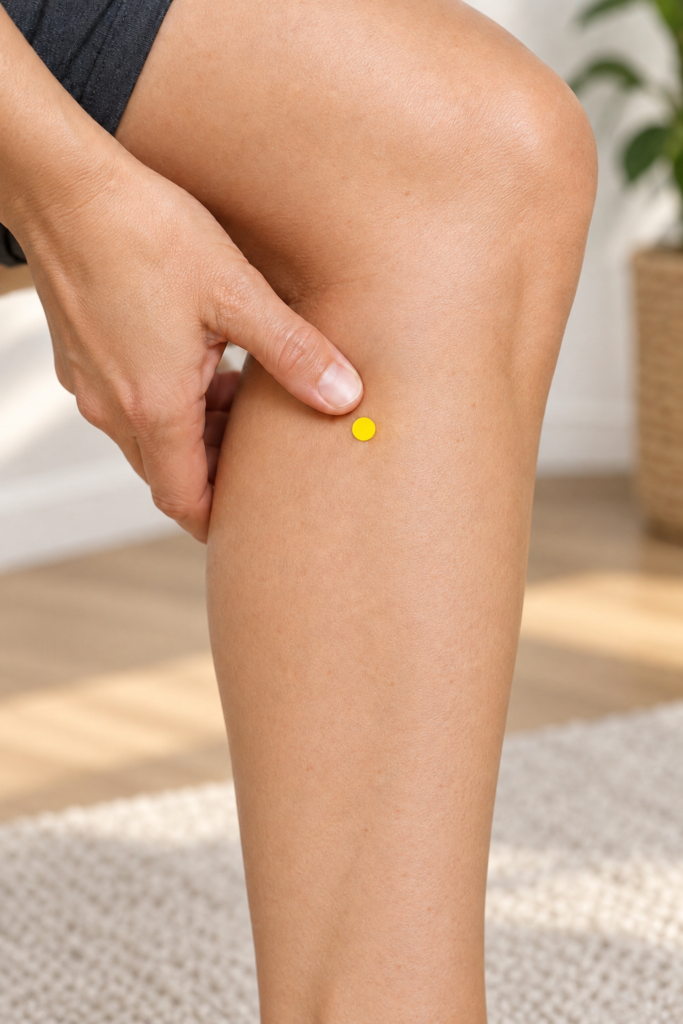
4. Press on GB34 below the outer knee to relax the tendons. GB34 sits on the outer side of the lower leg, in the hollow just in front of and below the bony bump at the top of the outer leg bone, just below the knee. Press firmly with your thumb for one to two minutes on each leg. GB34 is called “Yanglingquan,” the “Yang Mound Spring.”
GB34 is a significant point for the sinews, giving it a particular influence on the tendons and ligaments throughout the body. Because outer hip pain often involves irritated tendons as well as inflammation of the bursa, GB34 is one of the most useful points in this sequence. It also lies on the Gallbladder channel, helping move Qi and Blood along the same route that passes through the outer hip.
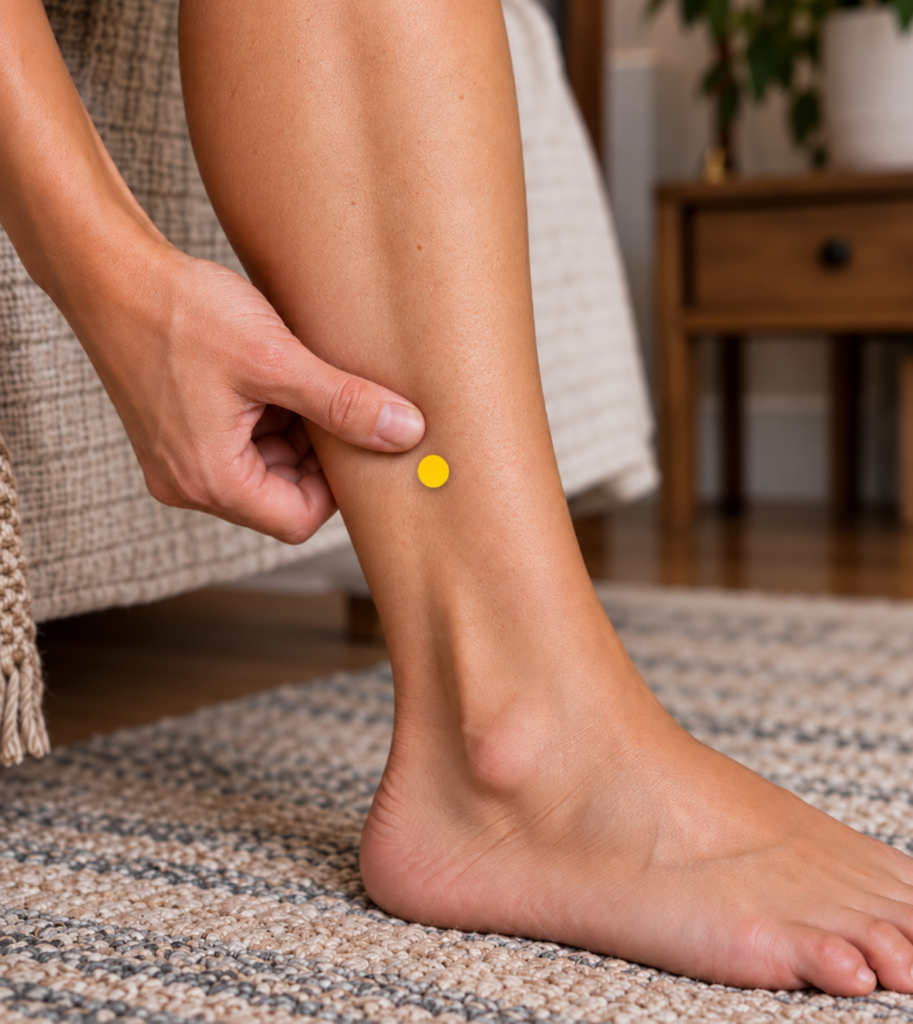
5. Press on GB39 above the outer ankle to strengthen the lower body. GB39 sits on the outer side of the lower leg, four finger-widths above the tip of the outer ankle bone, just in front of the outer leg bone. Press firmly with your thumb for one to two minutes on each leg. GB39 is called “Xuanzhong,” the “Suspended Bell.”
GB39 is the key point for the marrow, supporting the bones and lower-body strength. It helps Qi flow along the lower section of the Gallbladder channel and clear hip stagnation, making it particularly useful for long-standing hip pain, leg weakness, and age-related pain.
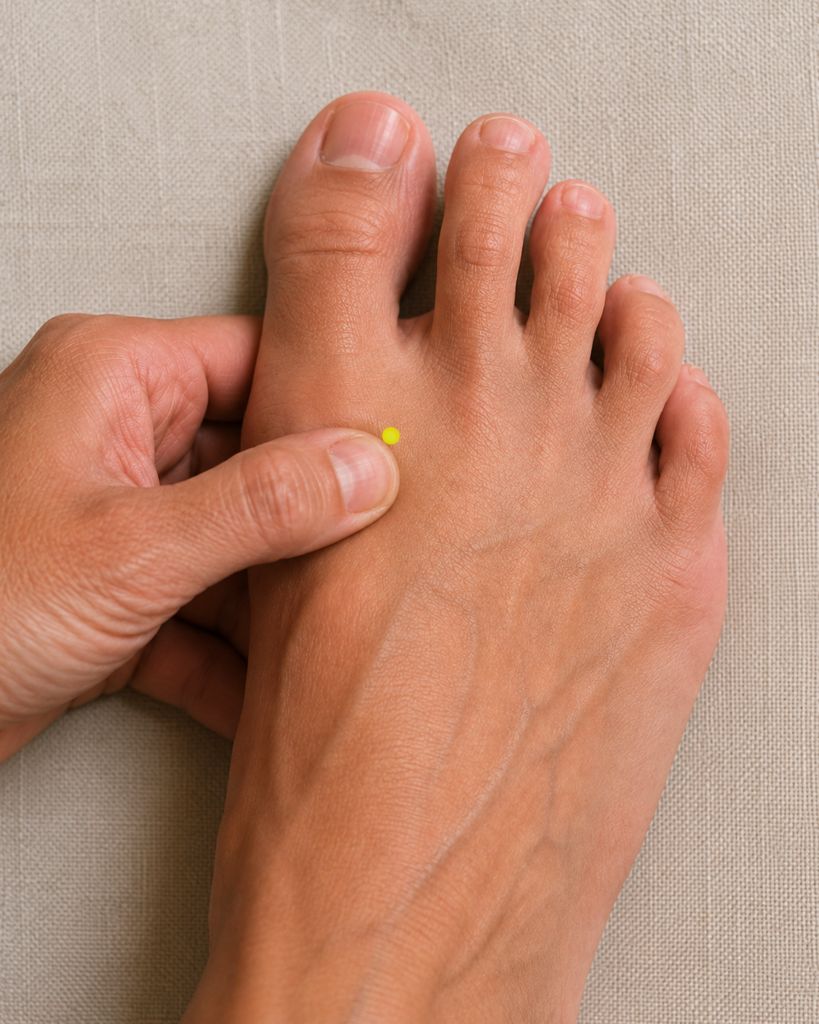
6. Press on LR3 on the top of the foot to relax the sinews. LR3 sits on the top of the foot, in the webbing between the big toe and second toe, about two finger-widths back from the webbing, in the hollow just before the two bones meet. Press firmly with your thumb for one to two minutes on each foot. LR3 is called “Taichong,” the “Great Surge.”
The organ known as the Liver governs the sinews, and LR3 is the primary acupressure point for nourishing and relaxing them. It eases tension in muscles and tendons throughout the body and is traditionally paired with GB34 to address tendon problems. LR3 may also help relieve the stress and insomnia that often accompany nights spent suffering from hip pain.
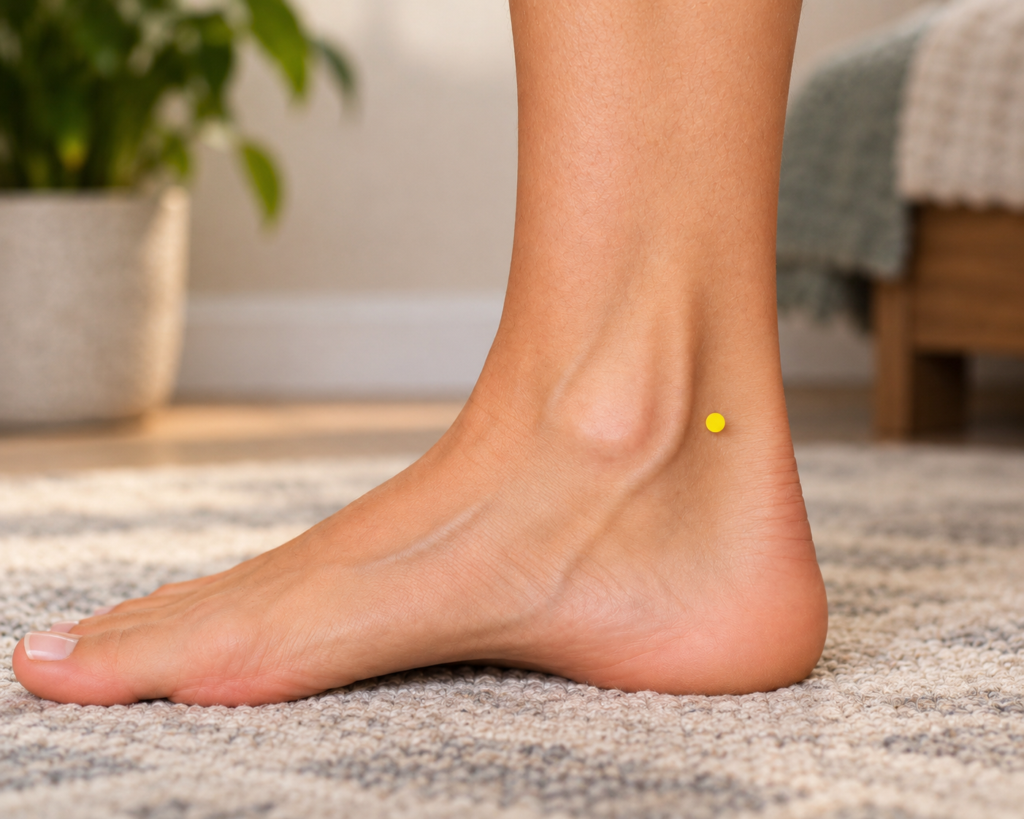
7. Press on KI3 behind the inner ankle to strengthen the Kidney. KI3 sits in the hollow between the inner ankle bone and the Achilles tendon, level with the tip of the ankle bone. Press firmly with your thumb for one to two minutes on each ankle. KI3 is called “Taixi,” the “Great Stream,” and is the source point of the Kidney.
In Traditional Chinese Medicine, the Kidney regulates the bones and lower body, and KI3 helps strengthen it. KI3 is particularly effective for chronic hip pain, pain accompanied by lower-back aching or weak knees, and pain that begins around menopause, when the body’s reserves are changing.
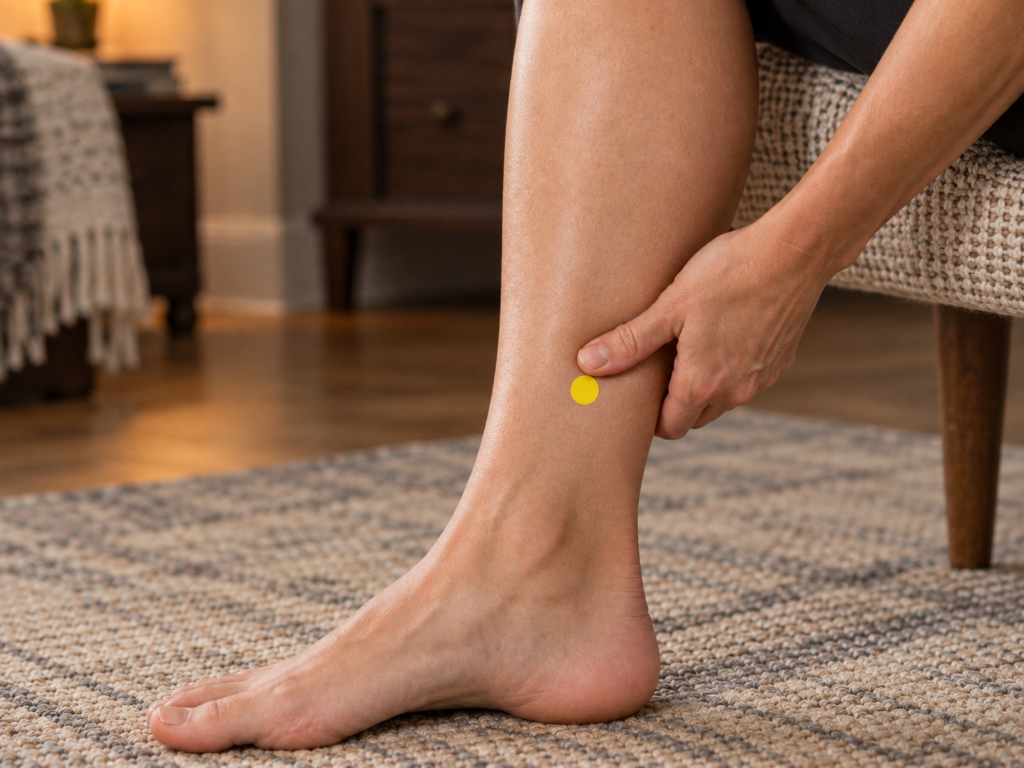
8. Press on SP6 above the inner ankle to nourish the Blood and clear dampness. SP6 sits four finger-widths up from the tip of the inner ankle bone, just behind the back edge of the shinbone. Press firmly with your thumb for one to two minutes on each leg. SP6 is called “Sanyinjiao,” the “Three Yin Intersection.” SP6 is avoided during pregnancy.
SP6 is where the Spleen, Liver, and Kidney channels meet. It nourishes the blood that keeps the tendons supple, promotes circulation to relieve pain from stagnant blood, and helps remove dampness that causes heaviness and stiffness in the hip. It is especially useful for hip pain that begins or worsens around menopause.
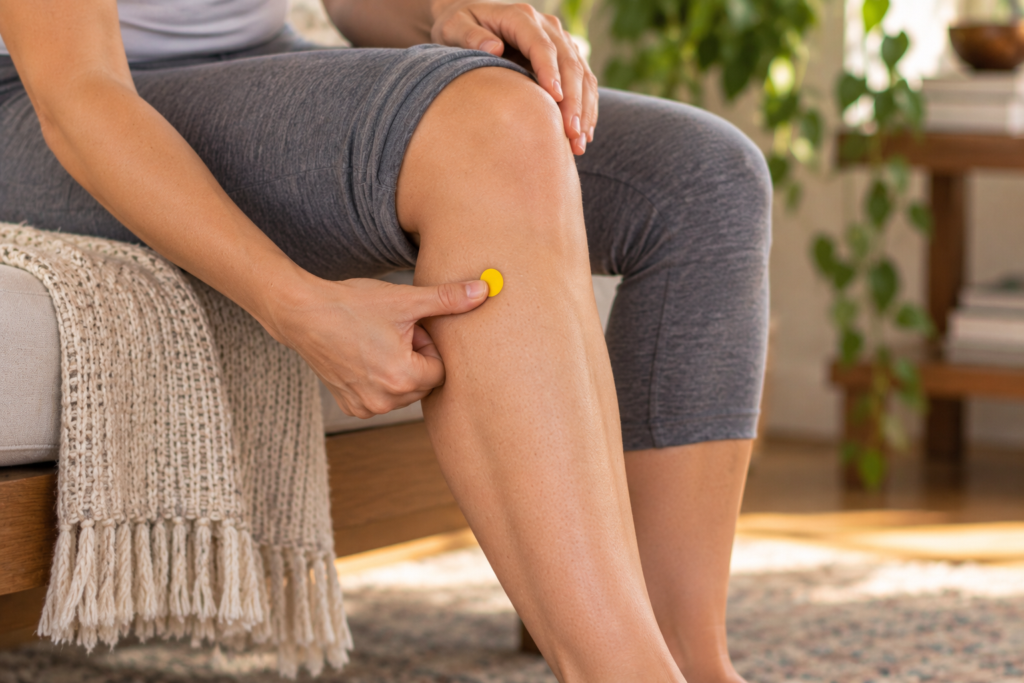
9. Press on ST36 below the knee to build strength and clear dampness. ST36 sits four finger-widths below the lower edge of the kneecap and one finger-width to the outside of the shinbone, on the muscle that rises when you flex your foot. Press firmly with your thumb for one to two minutes on each leg. ST36 is called “Zusanli,” the “Leg Three Miles.”
ST36 helps strengthen Qi and Blood, reinforce the leg muscles, and clear dampness that causes heaviness and morning stiffness. Strong hip muscles are important for recovering from hip bursitis, and ST36 provides the energy and strength needed for the gentle exercises that help rebuild them.
Why These Acupressure Points Work
In Traditional Chinese Medicine, hip bursitis is understood to result from stagnation of Qi and Blood in the Gallbladder channel on the affected side, usually accompanied by cold and dampness, irritated sinews, or Liver and Kidney deficiency. The nine points are based on this pattern.
- The hip and thigh points (GB30, GB29, GB31) move the Qi and Blood around the hip and outer thigh and relax the surrounding muscles.
- The channel points (GB34, GB39) keep the Gallbladder channel flowing, relax the tendons, and strengthen the lower body.
- The nourishing points (LR3, KI3, SP6) nourish the sinews and strengthen the Liver and Kidney that support the hip.
- The strengthening point (ST36) builds the Qi and Blood and clears dampness from the legs.
How to Properly Use These Acupressure Points
- Complete the full routine once or twice daily, holding each point for one to two minutes, except for GB29, which should be held for approximately one minute.
- Apply pressure around the most tender area of the outer hip, rather than directly on it.
- For GB30, lean against a wall with a tennis ball positioned between the wall and the point, or lie on your back with the ball beneath the point. Allow your body weight to provide the pressure.
- Apply firm pressure to the points on the buttock, thigh, and leg, and gentle pressure to GB29.
- During a flare-up, briefly applying ice to the outer hip may soothe the area. For chronic aching and stiffness, applying warmth before acupressure may help relax the tissues.
- Follow the routine consistently for several weeks, as tendons and bursae heal gradually.
Sample routines:
- Morning (five minutes): GB30 with a tennis ball against the wall, then GB31 and GB34 to ease morning stiffness.
- Before a walk (three minutes): GB30, GB31, and ST36 to warm up the hip and leg.
- During the workday (two minutes): stand up, then press GB31 and LR3 to break up long periods of sitting.
- Evening (ten to fifteen minutes): the full routine, finishing with KI3 and SP6 before bed.
Home Care and Lifestyle Support for Hip Bursitis
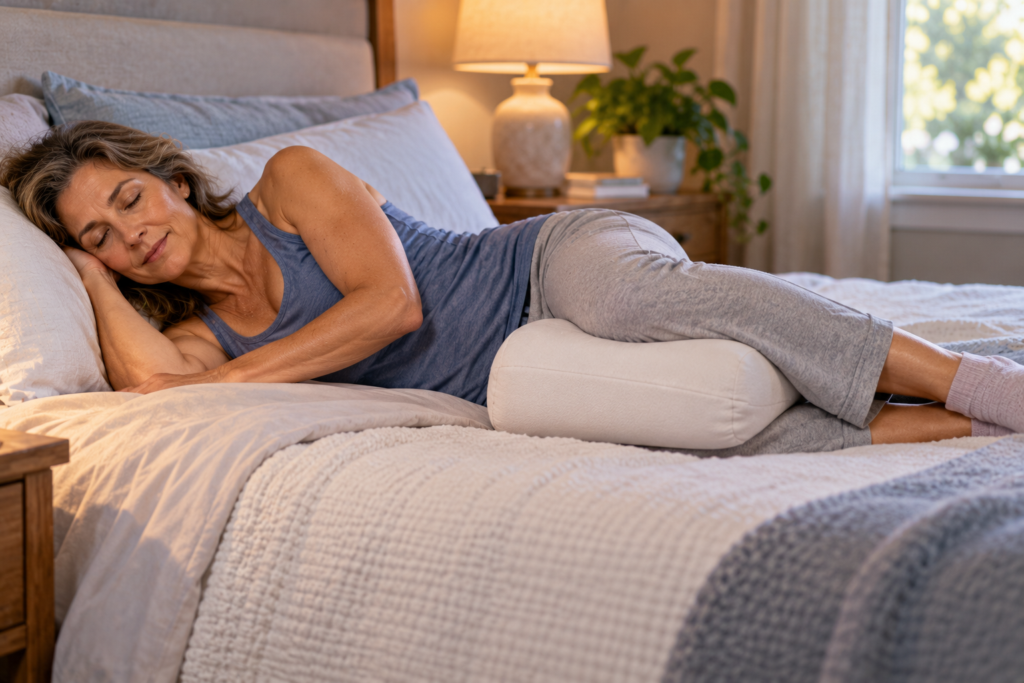
Changing habits that put pressure on and irritate the outer hip is one of the most important parts of recovery.
- Avoid lying on the painful side. If you sleep on your side, lie on the other side with a pillow between your knees so the top leg does not drop across your body.
- Avoid crossing your legs, sitting in low chairs, and standing with your weight shifted onto one hip.
- Strengthen the gluteal muscles gradually with exercises guided by a physical therapist, since weak hip muscles are one of the main drivers of outer hip pain.
- Avoid aggressive stretches that pull the leg across the body, since they can compress the irritated tendons against the bone.
- Reduce stairs, hills, and long walks during a flare, and build back up gradually.
- Low-impact activities such as swimming, water walking, and stationary cycling keep you moving without irritating the hip.
- Wear supportive shoes, and ask about a shoe lift if one leg is shorter than the other.
- Reach and maintain a healthy weight to reduce the load on the hips.
- Use a cushioned mattress topper if your mattress is very firm.
Traditional Chinese Medicine provides its own guiding principles. Keeping the hips and lower back warm is important, as cold can tighten the sinews and slow healing. Avoid sitting on cold surfaces or in cold air. Warm, cooked foods, soups, and stews support Qi and Blood, while bone broth, dark leafy greens, and black sesame seeds are traditionally used to nourish the sinews and bones. Limit cold, raw, heavy, and fatty foods, as they can cause dampness and heaviness in the lower body. Gentle exercises such as tai chi and qigong, with their slow weight shifts and steady balance, help keep Qi and Blood flowing through the hips while building strength.
When to Get Professional Help
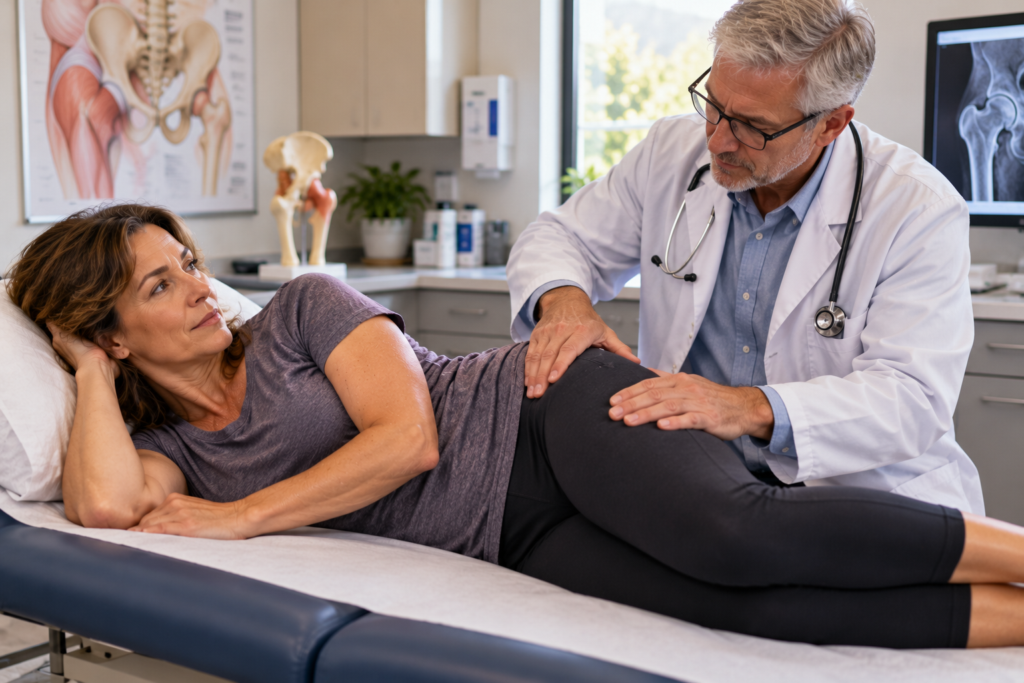
If hip pain does not improve after a few weeks of self-care, keeps you awake most nights, or worsens, see a doctor or physical therapist. An accurate diagnosis can help guide treatment. Seek urgent care if the hip becomes red, hot, and swollen, or if you have a fever or chills along with the pain, as these may indicate an infected bursa. Seek emergency care if you cannot bear weight after a fall or injury, or if the leg appears shortened or turned outward; these may be signs of a fracture. See your doctor as soon as possible if you have groin pain that worsens with weight-bearing; numbness, tingling, or weakness in the leg; back pain that spreads down the leg; pain that wakes you at night along with unexplained weight loss or a fever; or pain in both hips with morning stiffness lasting more than an hour.
Acupressure is a gentle, supportive approach to managing hip bursitis. It can complement, but does not replace, a medical diagnosis or treatment.
For other hip, back, and leg conditions, acupressure for low back and hip pain, acupressure for piriformis syndrome, acupressure for osteoarthritis, and acupressure for knee pain are companion pieces. If your hip pain travels down the back of your leg, how to relieve sciatica with acupressure covers that pattern.
Above and Beyond Acupuncture offers acupuncture, cupping, and lifestyle coaching at the North Frank Lloyd Wright Boulevard location in Scottsdale.
Schedule an appointment online to start your healing journey.
The points above are only as effective as the technique used to apply them. Where to press, how firmly, and for how long all affect the result. For a full breakdown of how to perform acupressure properly at home, read Performing Acupressure in 3 Easy Steps.

About the Publisher
Paul Kerzner, L.Ac., is a licensed acupuncturist and board-certified herbalist, as well as the founder of Above and Beyond Acupuncture in Scottsdale. His own journey from chronic patient to practicing acupuncturist shapes his commitment to providing honest, clinically grounded information about acupuncture and Traditional Chinese Medicine. Learn more about Paul and his clinical approach on the About Us page.