Key Takeaways
- Endometriosis causes severe pelvic pain and other symptoms, but often gets misdiagnosed.
- It occurs when tissue grows outside the uterus, leading to inflammation and possibly scar tissue.
- Traditional Chinese Medicine views endometriosis as a condition of Blood stasis, focusing on improving blood flow.
- Acupressure for endometriosis includes nine key points that can alleviate pain and support overall health.
- Daily habits and medical consultation can enhance treatment, but acupressure serves as a supportive practice.
Do your periods cause so much pain that you have to plan your month around them? Does pelvic pain persist between cycles, worsen with intimacy, or come with bloating that makes you look several months pregnant? Many women with endometriosis have these symptoms dismissed for years as “just bad periods” before anyone investigates further.
Endometriosis is much more than painful periods. It is a long-term inflammatory condition that can affect your energy, digestion, mood, relationships, and fertility. Understanding what is happening in your body through both medical and Traditional Chinese Medicine perspectives is the first step toward managing it well.
What Is Endometriosis?
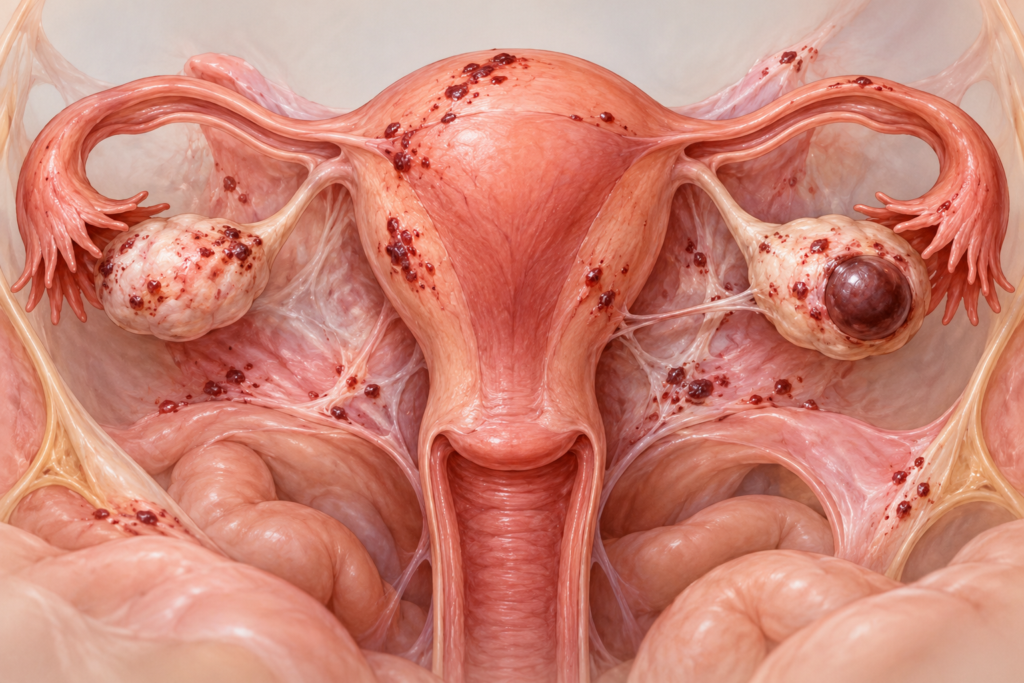
Endometriosis occurs when tissue similar to the lining of the uterus grows outside the uterus. These growths, known as lesions or implants, typically develop on the ovaries, fallopian tubes, the outer surface of the uterus, and the lining of the pelvis. In some cases, they may also occur on the bowel, bladder, or other organs.
This tissue responds to menstrual hormones in a manner similar to the uterine lining. Each month, it becomes inflamed and may bleed; however, unlike menstrual blood, the blood and tissue cannot exit the body. Over time, this persistent inflammation can lead to scar tissue and adhesions, which are bands of tissue that cause organs to adhere to one another. On the ovaries, endometriosis may also result in fluid-filled cysts known as endometriomas.
Common symptoms of endometriosis include:
- Severe menstrual cramps that worsen over time
- Pelvic pain between periods
- Pain during or after sex
- Pain with bowel movements or urination, especially during a period
- Lower back pain that rises and falls with the cycle
- Heavy periods or bleeding between periods
- Bloating, nausea, constipation, or diarrhea, especially around the period
- Fatigue
- Difficulty getting pregnant
Approximately one in ten women of reproductive age has endometriosis. Because its symptoms resemble those of other conditions, and painful periods are often considered normal, diagnosis may be delayed for years. A physician may suspect endometriosis based on symptoms, a pelvic examination, and imaging; however, surgery remains the only definitive method of confirmation. The extent of endometriosis does not always correspond to the severity of pain. Some individuals with small lesions experience severe pain, while others with more extensive disease have few symptoms.
A related condition, known as adenomyosis, occurs when similar tissue grows into the muscular wall of the uterus, resulting in heavy, painful periods. The two conditions often occur together.
How Traditional Chinese Medicine Views Endometriosis
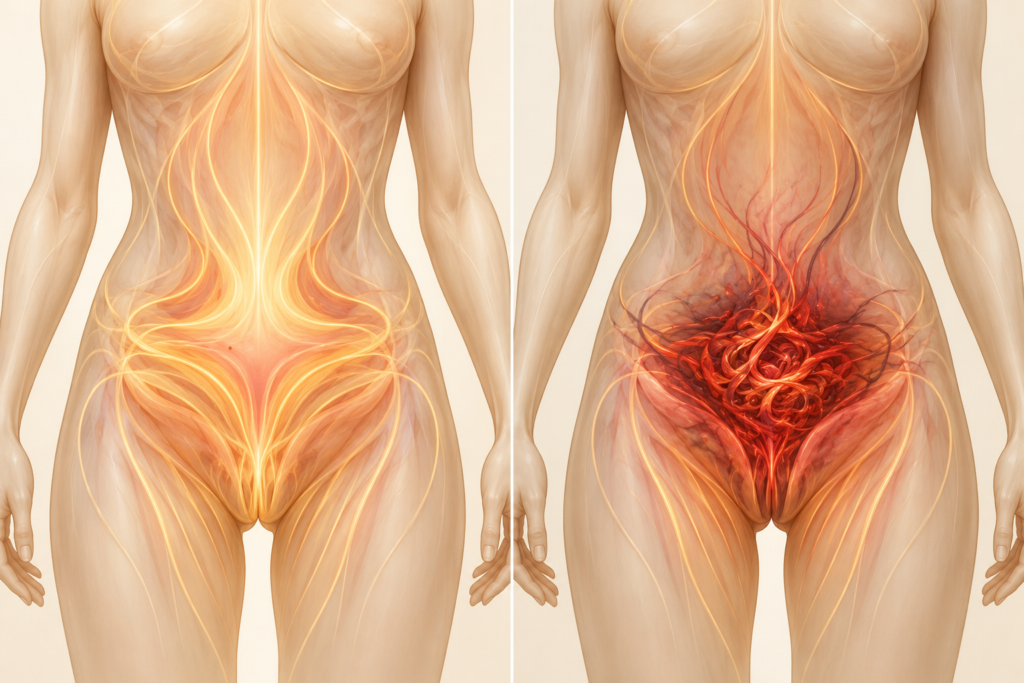
Traditional Chinese Medicine does not use the term endometriosis, but it has described and treated its symptoms for centuries. At its core is the concept of Blood stasis. In Traditional Chinese Medicine, Blood that does not flow freely accumulates and congeals, causing fixed, stabbing pain, dark, clotted menstrual blood, and, over time, masses. Endometriosis, with its lesions, adhesions, cysts, and deep pelvic pain, is understood as Blood stasis in the lower abdomen and uterus.
Blood rarely stagnates without a cause. Identifying the underlying pattern helps tailor treatment, and most people with endometriosis show more than one of the following patterns.
- Qi stagnation with Blood stasis: pain and breast tenderness that build before the period, irritability, and dark clots, often worse with stress. In Traditional Chinese Medicine, Qi moves Blood; when stress keeps Liver Qi tight, Blood slows and pools. LR3, LI4, and SP8 move the Qi and Blood.
- Cold congealing the Blood: deep, cramping pain that improves with a heating pad, cold hands and feet, and dark blood with clots. Cold contracts and slows the Blood. CV4 and BL32 warm the lower abdomen and sacrum.
- Qi deficiency with Blood stasis: dragging pelvic pain, fatigue, heavy periods, and a tendency to feel worn out after the period. When the Qi is too weak to move the Blood, the Blood lingers. ST36 and CV4 build the Qi.
- Kidney deficiency with Blood stasis: lower back aching, difficulty conceiving, and long-standing symptoms. The Kidney governs reproduction in Traditional Chinese Medicine. KI3 supports the Kidney.
- Damp heat with Blood stasis: pelvic pain with a feeling of heat or heaviness, thick discharge, and pain that flares with inflammation. SP6 and SP10 clear heat and move the Blood.
The objective is to promote Blood circulation and alleviate pain while addressing stress, cold, or weakness that may impede Blood flow. As endometriosis is a chronic condition, consistent support throughout the menstrual cycle is as important as symptom relief during menstruation.
Here are nine acupressure points that can help.
What Acupressure Points to Press and Why
1. Press on SP6 above the inner ankle to move the Blood in the lower abdomen. SP6 sits four finger-widths up from the tip of the inner ankle bone, just behind the back edge of the shinbone. Press firmly with your thumb for one to two minutes on each leg. SP6 is called “Sanyinjiao,” the “Three Yin Intersection.” SP6 is avoided during pregnancy.
SP6 is where the Spleen, Liver, and Kidney channels meet. All three pass through the lower abdomen and uterus. In Traditional Chinese Medicine, it’s one of the most important points for menstrual pain and gynecological conditions. It moves the Blood, eases cramping, and helps regulate the cycle over time.
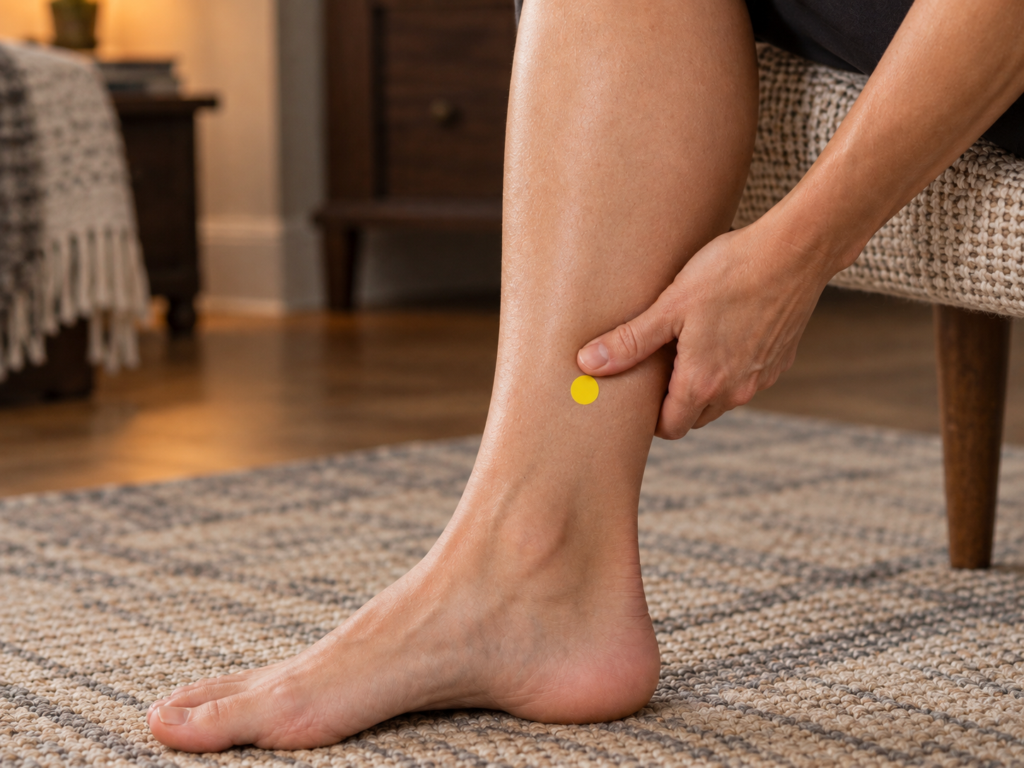
2. Press on SP8 on the inner lower leg to ease acute pelvic pain. SP8 sits on the inner side of the lower leg, just behind the edge of the shinbone, about four finger-widths below the hollow under the inner knee. Press firmly with your thumb for one to two minutes on each leg. SP8 is called “Diji,” the “Earth Pivot.”
SP8 is the Spleen channel’s cleft point, a type of point used in Traditional Chinese Medicine to address acute pain and Blood stasis. It can be especially useful during a painful period or a pelvic pain flare. The point is often tender for people with endometriosis, so apply steady pressure and breathe into it.
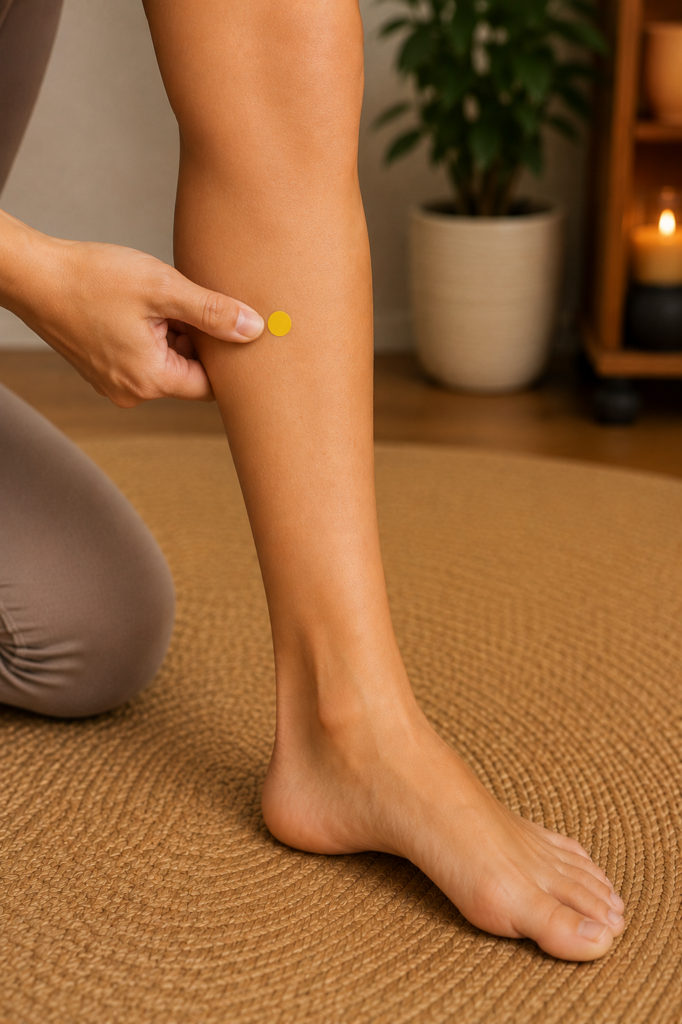
3. Press on SP10 on the inner thigh to move and cool the Blood. SP10 sits on the inner thigh, about three finger-widths above the upper inner corner of the kneecap, on the bulge of the inner thigh muscle. Press firmly with your thumb for one to two minutes on each leg. SP10 is called “Xuehai,” the “Sea of Blood.” SP10 is contraindicated during pregnancy.
As its name suggests, SP10 is an important point for the Blood. It moves stagnant Blood, clears heat, and helps regulate heavy or irregular bleeding. It pairs well with SP6 for pelvic pain accompanied by dark, clotted menstrual blood.
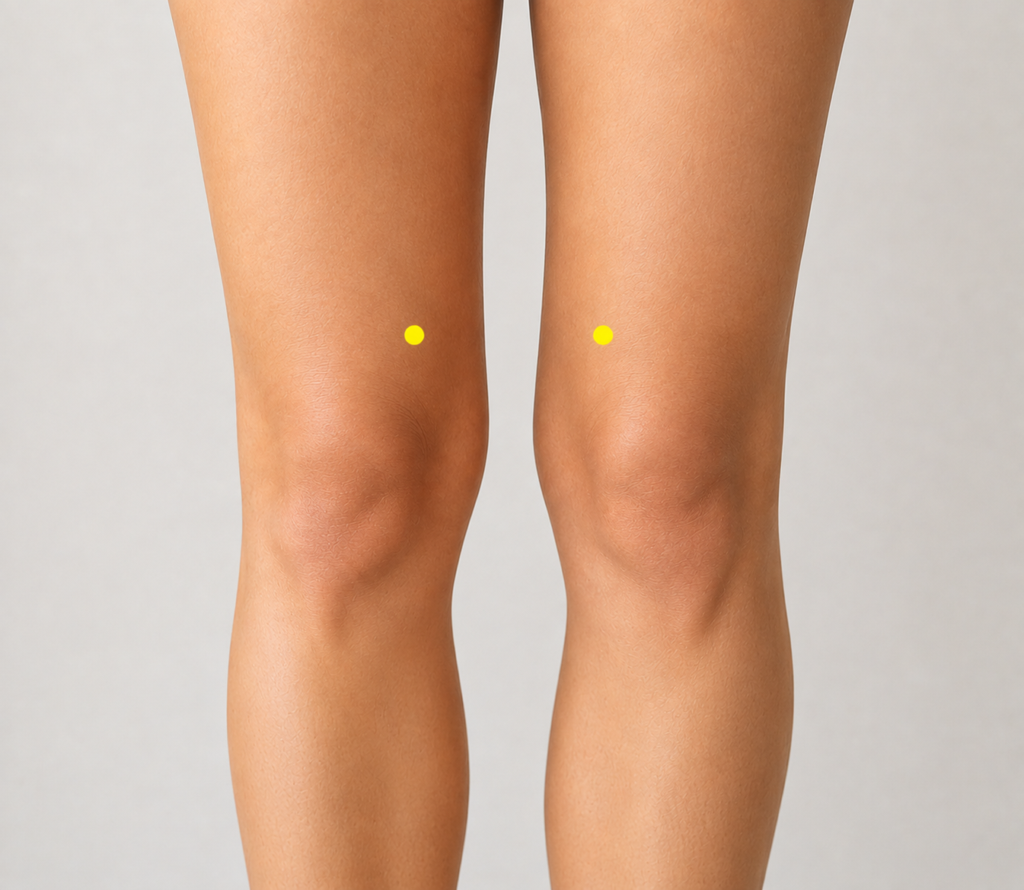
4. Press gently on CV4 below the navel to warm and strengthen the lower abdomen. CV4 sits on the midline of the lower abdomen, four finger-widths below the navel. Lie on your back and press gently with two or three fingertips for one to two minutes, or rest a warm palm over the area while breathing slowly into the lower belly. CV4 is called “Guanyuan,” the “Gate of Origin.”
CV4 sits directly over the uterus, which Traditional Chinese Medicine regards as the root of reproductive health. It strengthens Qi and warms the lower abdomen, making it especially helpful for cramping that eases with heat. Keep the pressure gentle. If your abdomen is too tender during a flare, simply rest a warm hand over the area instead.
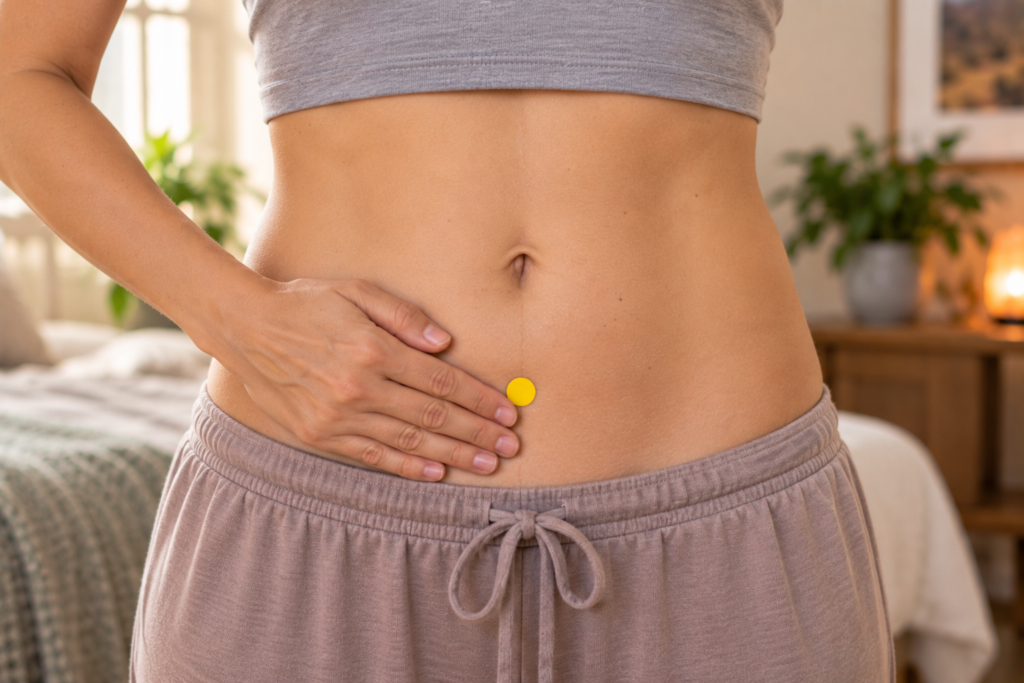
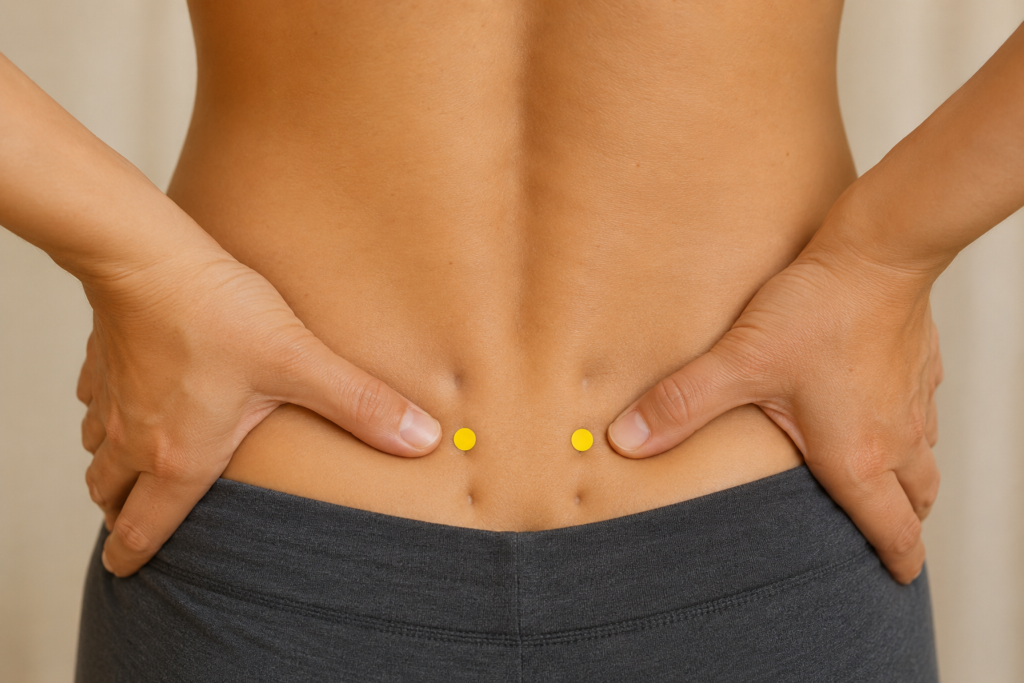
5. Press on BL32 on the sacrum to ease pelvic and lower back pain. BL32 sits on the sacrum, the flat, triangular bone at the base of the spine, in the second of the small hollows that run down each side of the center. Press with your knuckles or fingertips for one to two minutes, or rub the area briskly with your palms until warm. BL32 is called “Ciliao,” the “Second Crevice.” BL32 is avoided during pregnancy.
BL32 lies over the nerves that serve the pelvic organs and is a classic point for menstrual pain and pain radiating into the lower back. Warming the sacrum with your palms or a heating pad is one of the simplest ways to ease cramps.
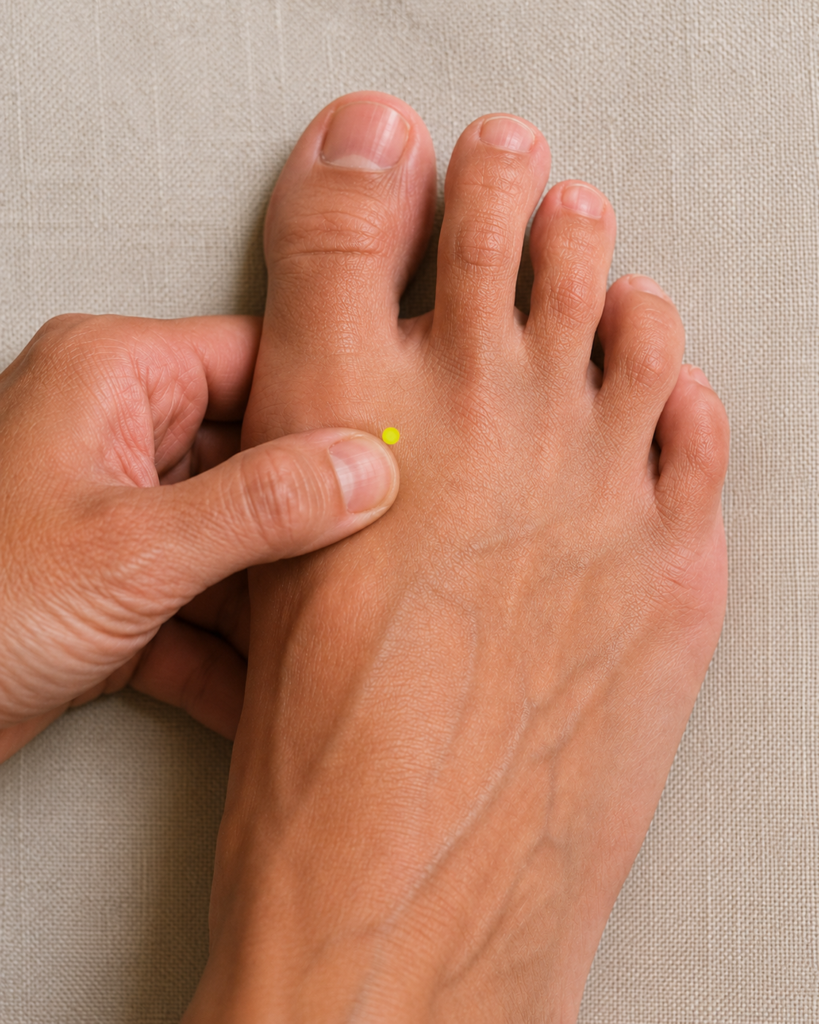
6. Press on LR3 on the top of the foot to move the Qi and ease pain. LR3 sits on the top of the foot, in the webbing between the big toe and second toe, about two finger-widths back from the webbing, in the hollow just before the two bones meet. Press firmly with your thumb for one to two minutes on each foot. LR3 is called “Taichong,” the “Great Surge.”
The Liver channel circles the genitals and runs through the lower abdomen. The Liver helps Qi and Blood flow smoothly, and LR3 is the primary point for relieving Liver Qi stagnation. It can ease pain that worsens with stress and breast tenderness before a period.
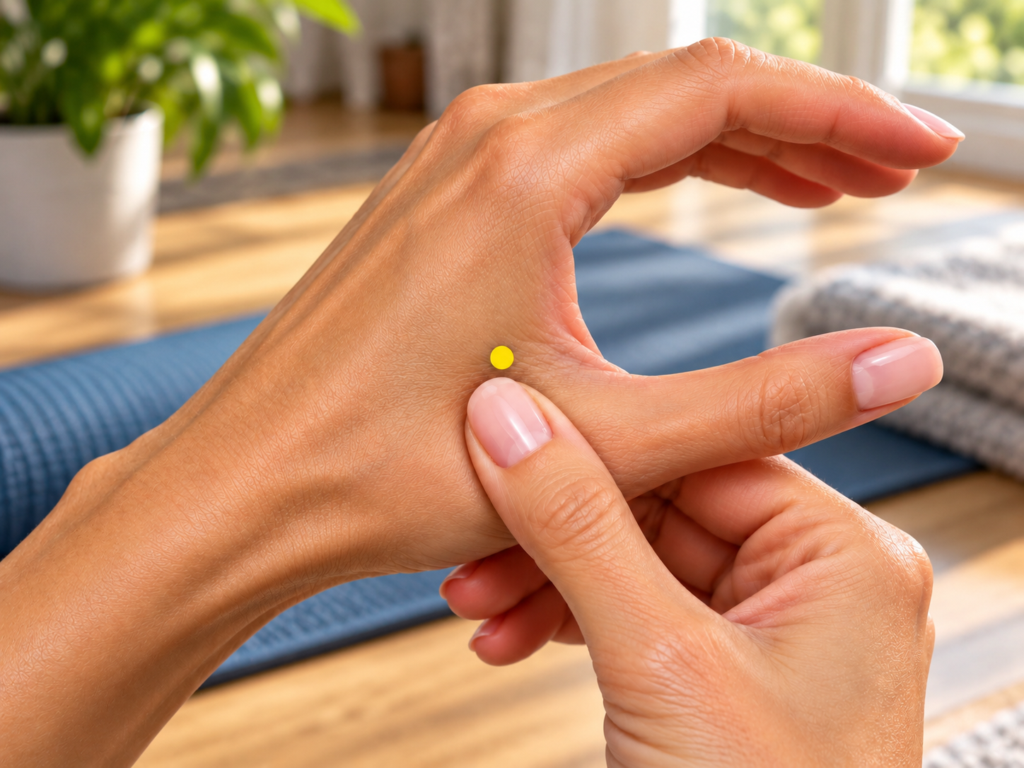
7. Press on LI4 in the hand to relieve pain. LI4 sits in the webbing between the thumb and index finger, at the highest point of the muscle when you bring the thumb and index finger together. Press firmly with the thumb of your other hand for one to two minutes on each hand. LI4 is called “Hegu,” the “Joining Valley.” LI4 is contraindicated during pregnancy.
LI4 is one of the body’s most important points for pain. When pressed together with LR3, it forms the Four Gates, a classic combination that moves Qi and Blood throughout the body. It’s a simple point to use whenever pain flares.
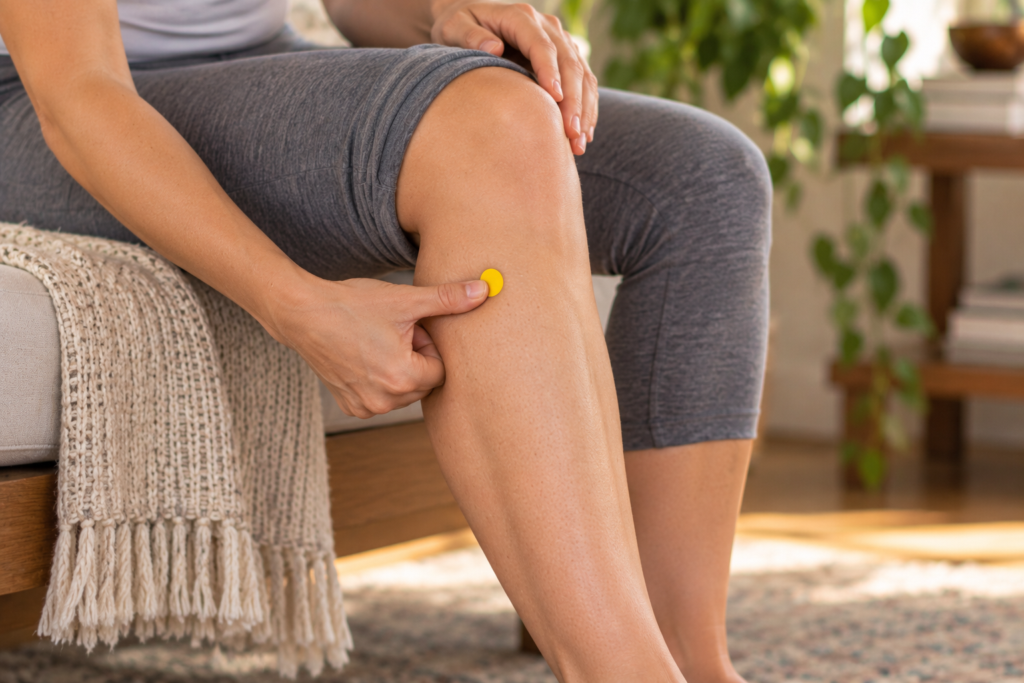
8. Press on ST36 below the knee to restore energy. ST36 sits four finger-widths below the lower edge of the kneecap and one finger-width to the outside of the shinbone, on the muscle that rises when you flex your foot. Press firmly with your thumb for one to two minutes on each leg. ST36 is called “Zusanli,” the “Leg Three Miles.”
Endometriosis often causes fatigue, heavy periods, and digestive upset. ST36 builds Qi and Blood, strengthens digestion, and helps replenish energy depleted by months of pain and inflammation. Strong Qi also helps keep Blood moving.
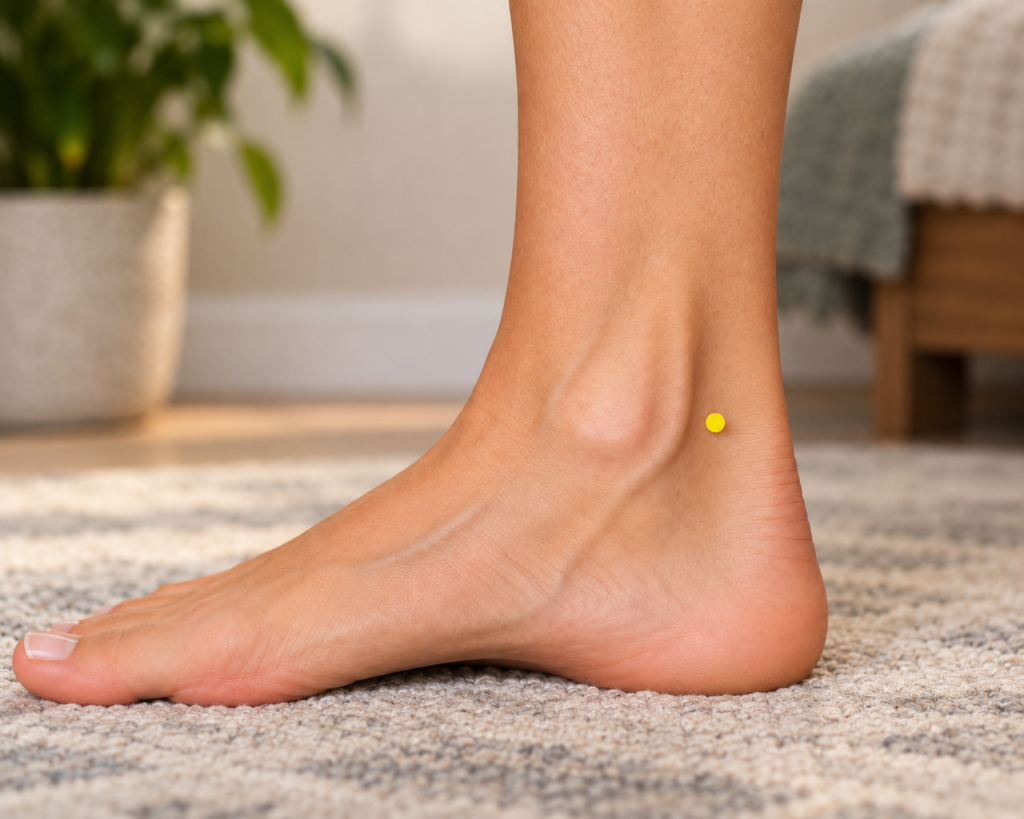
9. Press on KI3 behind the inner ankle to support the Kidney. KI3 sits in the hollow between the inner ankle bone and the Achilles tendon, level with the tip of the ankle bone. Press firmly with your thumb for one to two minutes on each ankle. KI3 is called “Taixi,” the “Great Stream,” and is the source point of the Kidney.
In Traditional Chinese Medicine, the Kidney governs reproduction. KI3 strengthens the Kidney, relieves lower back pain, and supports long-term fertility and reproductive health. It may be especially useful for people with long-standing endometriosis or those trying to conceive.
Why These Acupressure Points Work
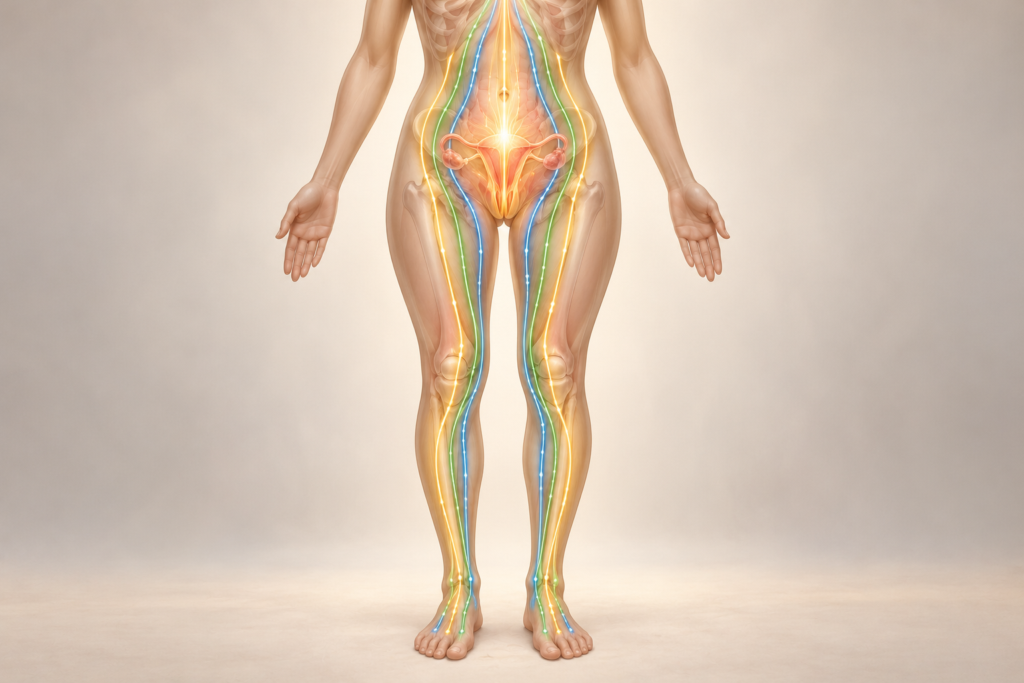
In Traditional Chinese Medicine, a healthy cycle relies on Qi and Blood flowing freely through the lower abdomen, warmth in the uterus, and strong Spleen and Kidney energy to build and maintain Blood. Endometriosis is understood as Blood becoming stuck, often due to stress, cold, or depletion.
The nine acupressure points address both the stasis and its causes:
- The Blood-moving points (SP6, SP8, SP10) ease pelvic pain and help break up stagnant Blood in the lower abdomen.
- The warming points (CV4, BL32) warm the uterus and sacrum and ease cramping that improves with heat.
- The pain-relieving points (LR3, LI4) release Qi stagnation and calm pain throughout the body.
- The strengthening points (ST36, KI3) build the Qi and support the Kidney for long-term balance.
How to Properly Use These Acupressure Points

Acupressure for endometriosis is most effective when practiced throughout the menstrual cycle, rather than only when pain occurs.
- Work the full routine once a day, holding each point for one to two minutes and breathing slowly into the lower belly.
- During a painful period or flare, focus on SP8, LI4, LR3, and gentle warmth over CV4 and BL32.
- Keep pressure on the abdomen gentle, and skip it if the area is too tender.
- If you are trying to conceive and could be pregnant, skip SP6, SP10, BL32, and LI4 and avoid pressing on the abdomen during the second half of the cycle.
Daily habits can support your body between cycles. On painful days, use a heating pad on your lower abdomen or back and keep your lower body warm, as Traditional Chinese Medicine teaches that cold slows the Blood. Choose warm, cooked meals with plenty of vegetables, whole grains, legumes, and fish, and try to limit alcohol, iced drinks, and processed foods. Gentle movement, such as walking, yoga, and stretching, helps keep the Blood moving, while stress management supports the smooth flow of Liver Qi. Keeping a symptom diary for several cycles can help you and your doctor identify patterns.
For more help on painful days, see our article on acupressure for menstrual cramps.
When to Get Professional Help
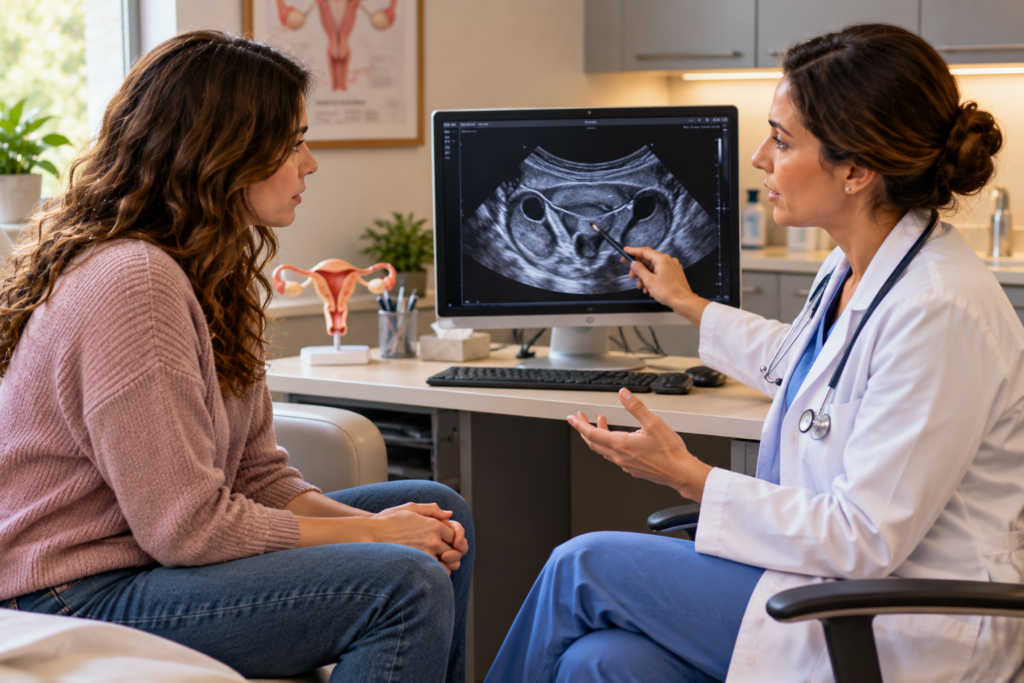
See a gynecologist if period pain disrupts work, school, or daily life; pain relievers do not help; you have pain during sex or when having a bowel movement or urinating around your period; or you have been trying to conceive without success. These can be signs of endometriosis and warrant an evaluation. See your doctor promptly if pelvic pain is worsening, bleeding is very heavy (soaking through a pad or tampon every hour), or you have bleeding between periods or after sex. Seek emergency care for sudden, severe pelvic pain; pelvic pain with fever; fainting or dizziness with pelvic pain; or pain on one side of the pelvis with a missed period or positive pregnancy test. These can signal a ruptured or twisted ovarian cyst, an infection, or an ectopic pregnancy.
Acupressure is a gentle, supportive practice for endometriosis. It complements, but does not replace, diagnosis and medical care.
For related health concerns, acupressure for PMS, acupressure for PCOS, and acupressure for bloating and gas are the companion posts.
Above and Beyond Acupuncture offers acupuncture, cupping, and lifestyle coaching at the North Frank Lloyd Wright Boulevard location in Scottsdale.
Schedule an appointment online to start your healing journey.
The points above are only as effective as the technique used to apply them. Where to press, how firmly, and for how long all affect the result. For a full breakdown of how to perform acupressure properly at home, read Performing Acupressure in 3 Easy Steps.

About the Publisher
Paul Kerzner, L.Ac., is a licensed acupuncturist and board-certified herbalist, as well as the founder of Above and Beyond Acupuncture in Scottsdale. His own journey from chronic patient to practicing acupuncturist shapes his commitment to providing honest, clinically grounded information about acupuncture and Traditional Chinese Medicine. Learn more about Paul and his clinical approach on the About Us page.