Key Takeaways
- Hiccups occur when the diaphragm spasms. In infants, they are common after feeding, particularly when a baby eats too much or too quickly, or swallows air.
- Most infant hiccups are harmless and resolve spontaneously within a few minutes. Many infants are not bothered by them.
- In Traditional Chinese Medicine, hiccups are understood as a manifestation of Stomach Qi ascending rather than descending, often because an infant’s delicate digestive system is overwhelmed by a large or rapid feeding.
- Nine gentle acupressure points located behind the ears and on the arms, chest, abdomen, back, legs, and feet may help relax the diaphragm and alleviate hiccups.
- Frequent episodes of spit-up, forceful vomiting, fussiness after feedings, poor weight gain, or difficulty breathing warrant contacting the pediatrician.

Feeding is over, your baby seems content, and then suddenly you hear a little “hic” every few seconds, making their whole body jump. Some babies smile or even fall asleep during hiccups, while others become fussy or frustrated. Hiccups are very common, especially for new parents to notice. They’re usually harmless, but it helps to know a few gentle ways to make them pass.
According to Baptist Health, hiccups occur when the diaphragm spasms, pushing air through closed vocal cords. In babies, common triggers include eating too much or too quickly and swallowing air while feeding. Reflux can also irritate the nerve that controls the diaphragm. Some babies find hiccups upsetting, but many don’t notice them or sleep through them; they usually go away on their own within a few minutes. Baptist Health recommends burping bottle-fed babies every two to three ounces and breastfed babies when switching sides, offering a pacifier, feeding before the baby gets very hungry, and keeping the baby upright for about 30 minutes after feeding.
The diaphragm is a dome-shaped muscle beneath the lungs that moves with each breath. The stomach sits just below it, so a large feeding, swallowed air, or mild reflux can irritate the diaphragm and trigger spasms. Because babies eat often and have small stomachs, hiccups are a normal part of early life.
In Traditional Chinese Medicine, healthy Stomach Qi flows downward to support digestion. When a baby’s Spleen and Stomach are overwhelmed by a large, fast, or air-filled feeding, Stomach Qi may rise instead, leading to hiccups, spit-up, or burping. Some babies are more prone to hiccups when they’re cold, while others get them when overstimulated or excited after eating. Gentle acupressure can help calm the diaphragm and guide Stomach Qi downward, easing hiccups.
The points begin behind the ears, move to the arms, chest, and belly, then continue to the upper back before finishing on the legs and feet. For a baby, measure all distances using the baby’s own finger-widths, not an adult’s.
What Acupressure Points to Press and Why
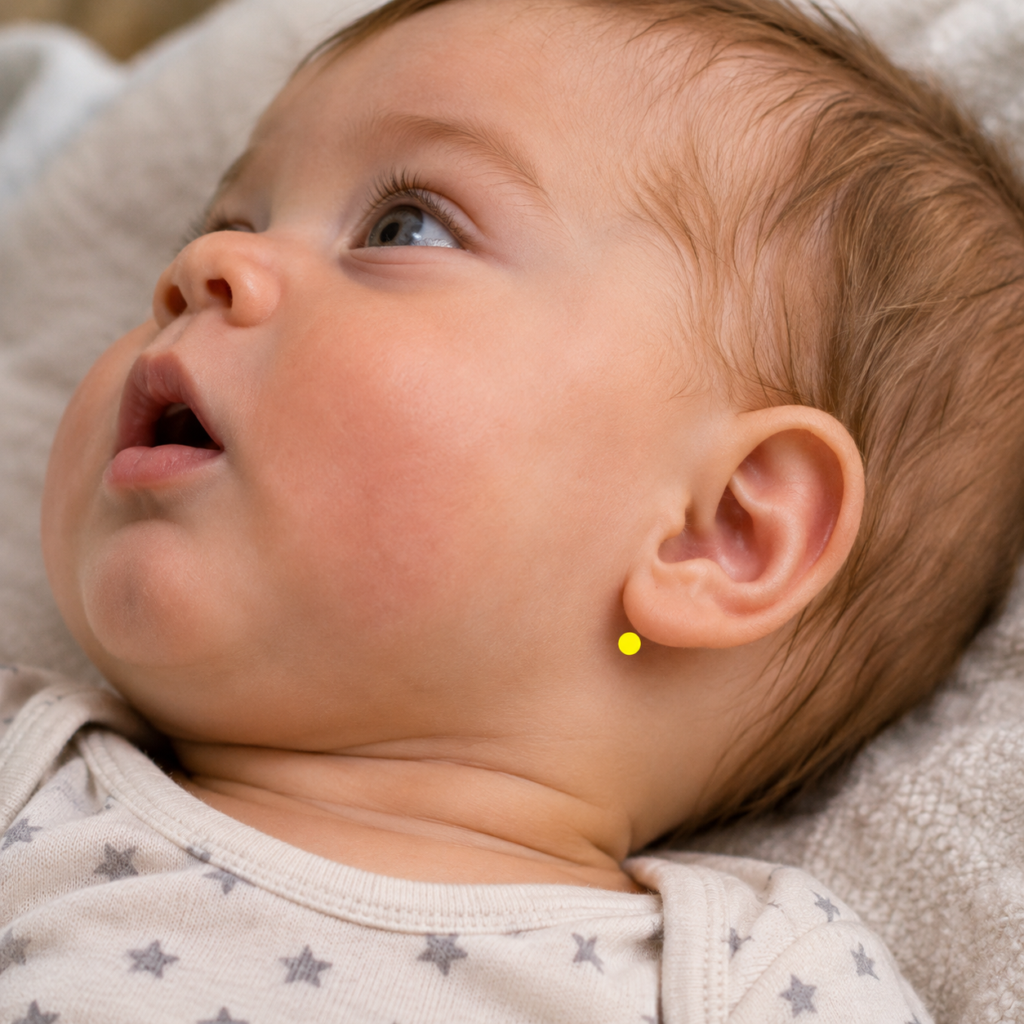
1. Press TE17 behind the earlobe to settle hiccups. TE17 sits just behind each earlobe, in the small hollow between the bottom of the ear and the jawbone. Rest your fingertips on both points at the same time with very light pressure for 30 seconds. TE17 is called “Yifeng,” the “Wind Screen.”
TE17 is the meeting point of the Triple Burner and Gallbladder channels. It is a classic point for hiccups and gently calms the spasm of the diaphragm.
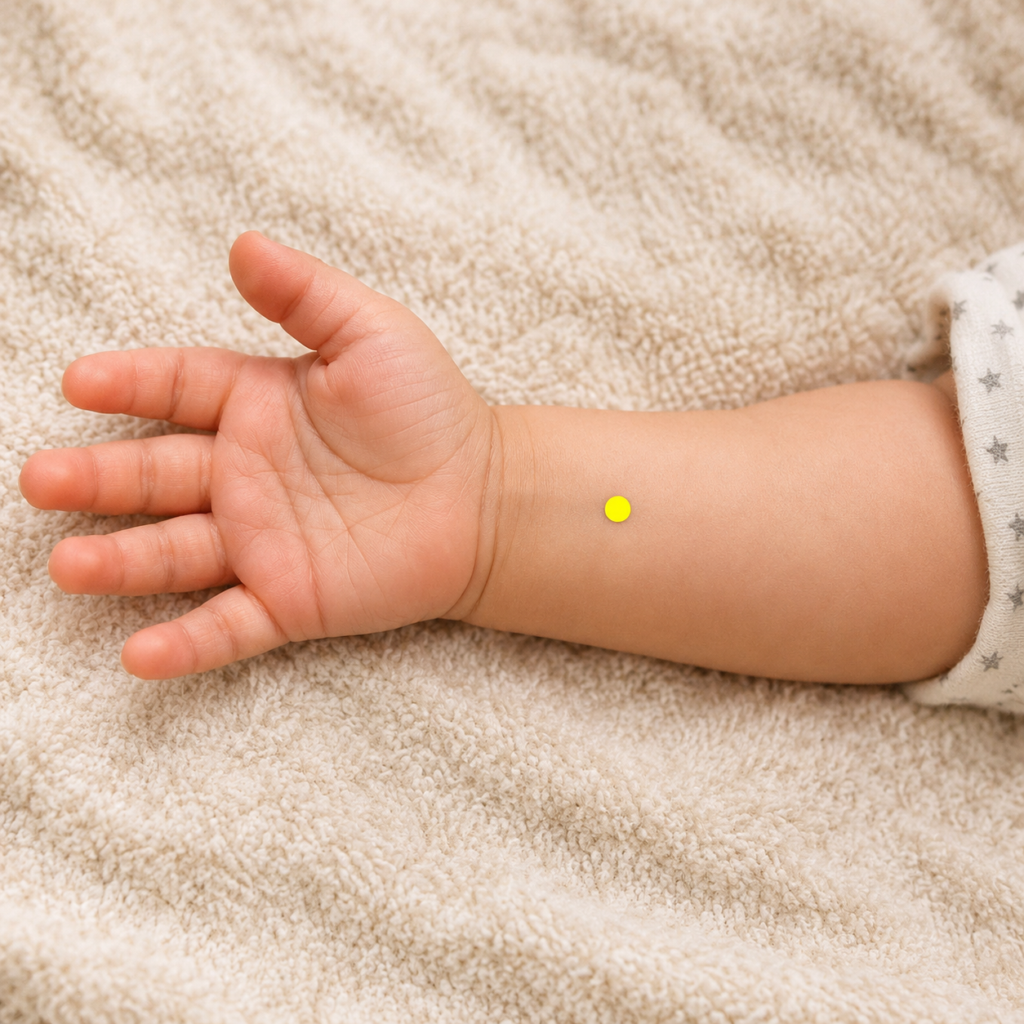
2. Press PC6 on the inner forearm to calm the stomach. PC6 sits on the inner forearm, about two of the baby’s finger-widths above the wrist crease, between the two tendons in the middle of the forearm. Make tiny, light circles with your fingertip for 30 seconds on each arm. PC6 is called “Neiguan,” the “Inner Gate.”
PC6 is the connecting point of the Pericardium. It calms the Stomach, helps rebellious Stomach Qi move downward, and is traditionally used for hiccups, spitting up, and nausea.
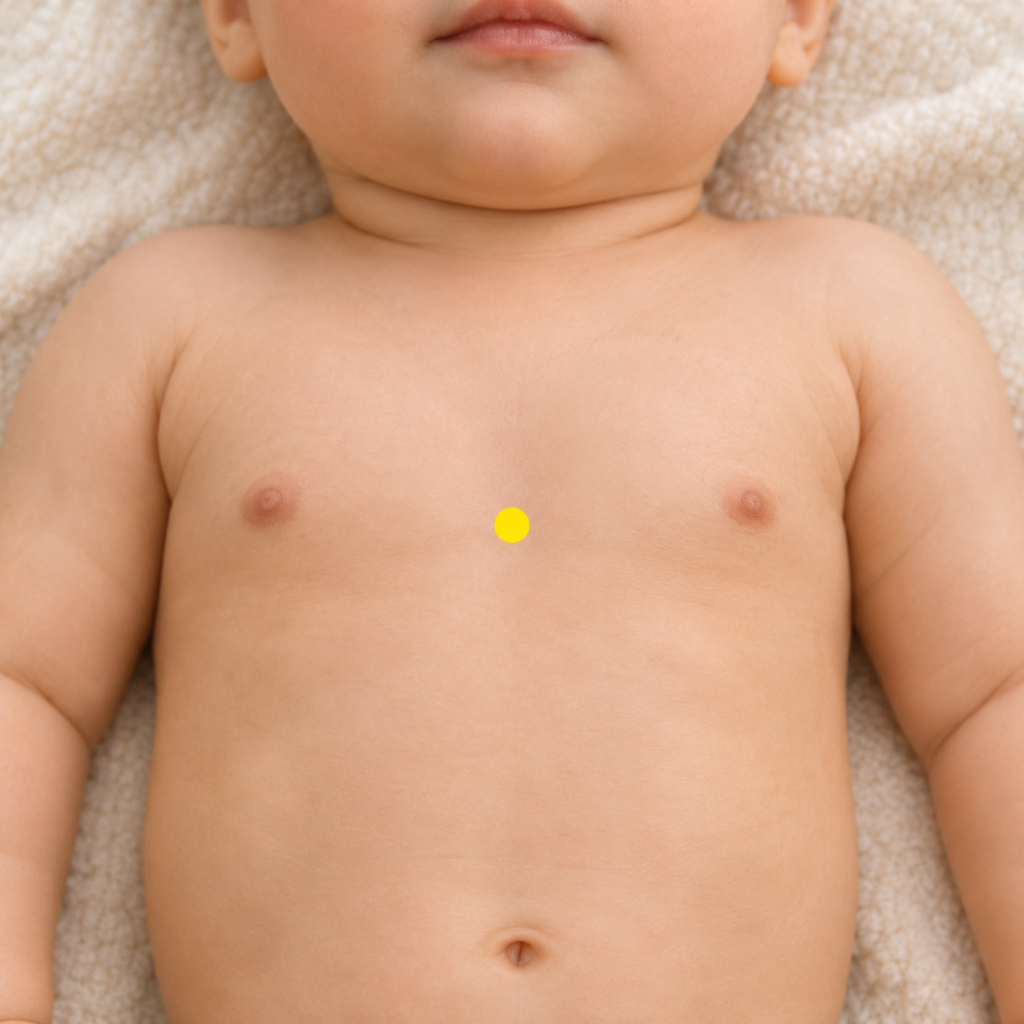
3. Press CV17 in the center of the chest to ease the diaphragm. CV17 sits on the midline of the breastbone, level with the nipples. Rest your fingertip on the point with very light pressure, or make tiny circles, for 30 seconds. CV17 is called “Shanzhong,” the “Chest Center.”
CV17 is the influential point of Qi. It opens the chest and helps rising Qi settle back down.
4. Circle CV12 on the belly to settle digestion. CV12 sits on the midline of the belly, halfway between the navel and the bottom of the breastbone. Rest your whole palm lightly on the belly and make slow clockwise circles around the navel, passing over CV12, for one to two minutes. CV12 is called “Zhongwan,” the “Middle Cavity.”
CV12 is the alarm point of the Stomach. Gentle circular motions help Stomach Qi move downward and ease fullness that may trigger hiccups.
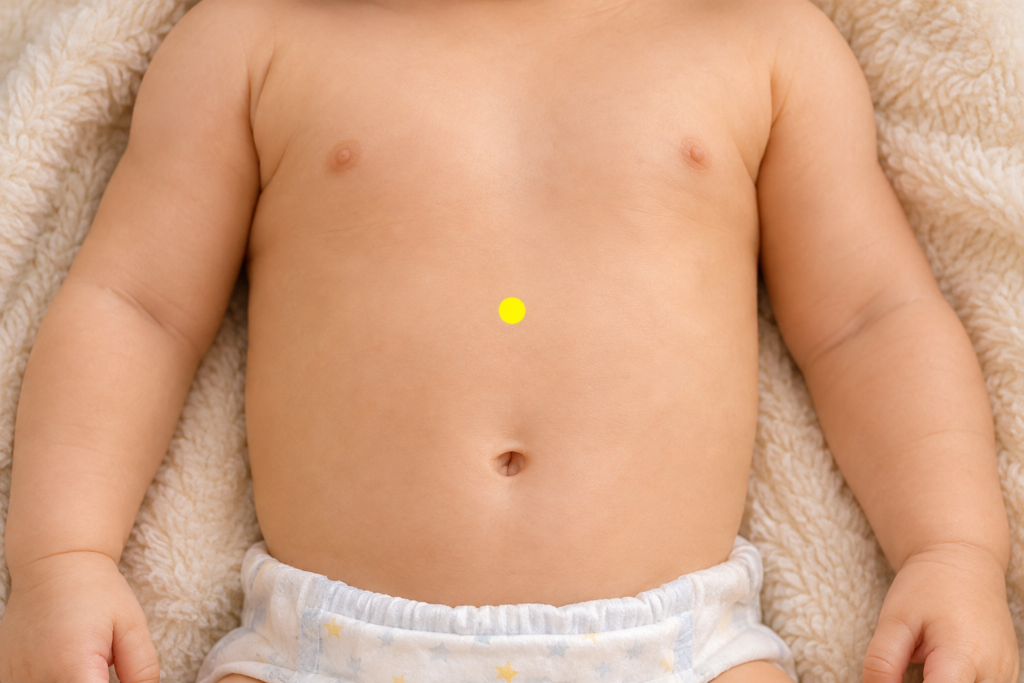
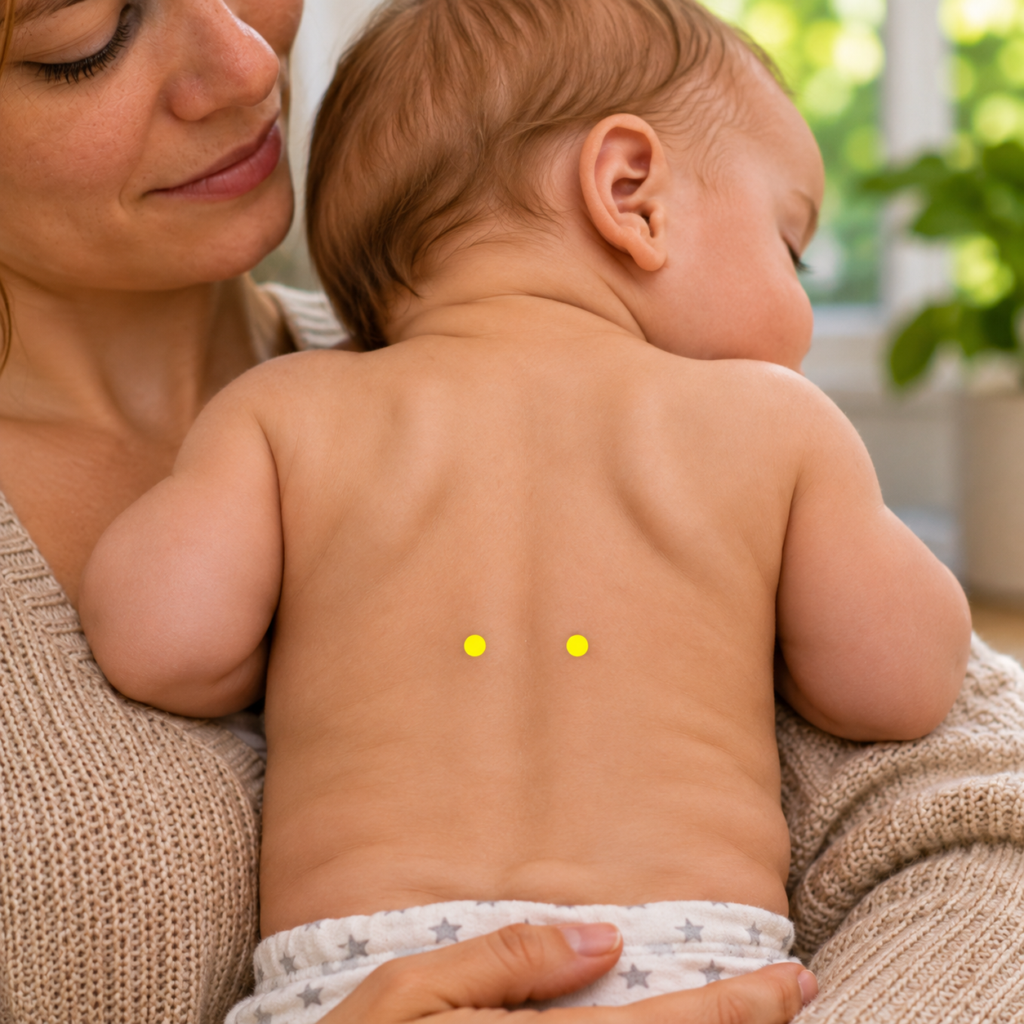
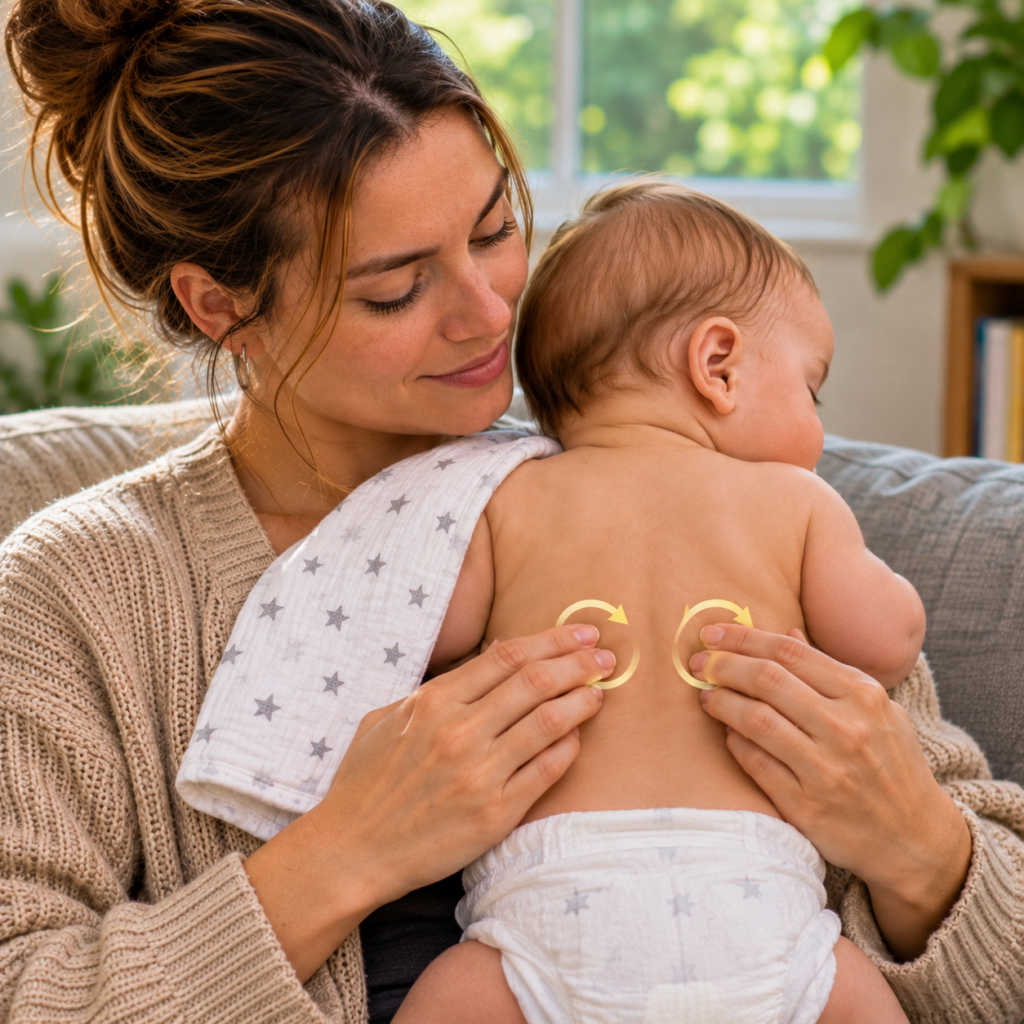
5. Rub BL17 on the back to relax the diaphragm. BL17 sits on the mid back, on both sides of the spine, about one of the baby’s finger-widths out from the spine, level with the bottom tips of the shoulder blades. With the baby held upright against your shoulder, make slow, light circles on both sides with your fingertips for 30 seconds. BL17 is called “Geshu,” the “Diaphragm Shu.”
BL17 is the back-transporting point of the diaphragm and one of the most important points in Traditional Chinese Medicine for hiccups. Gentle circles here help relax the diaphragm while a baby is burped.
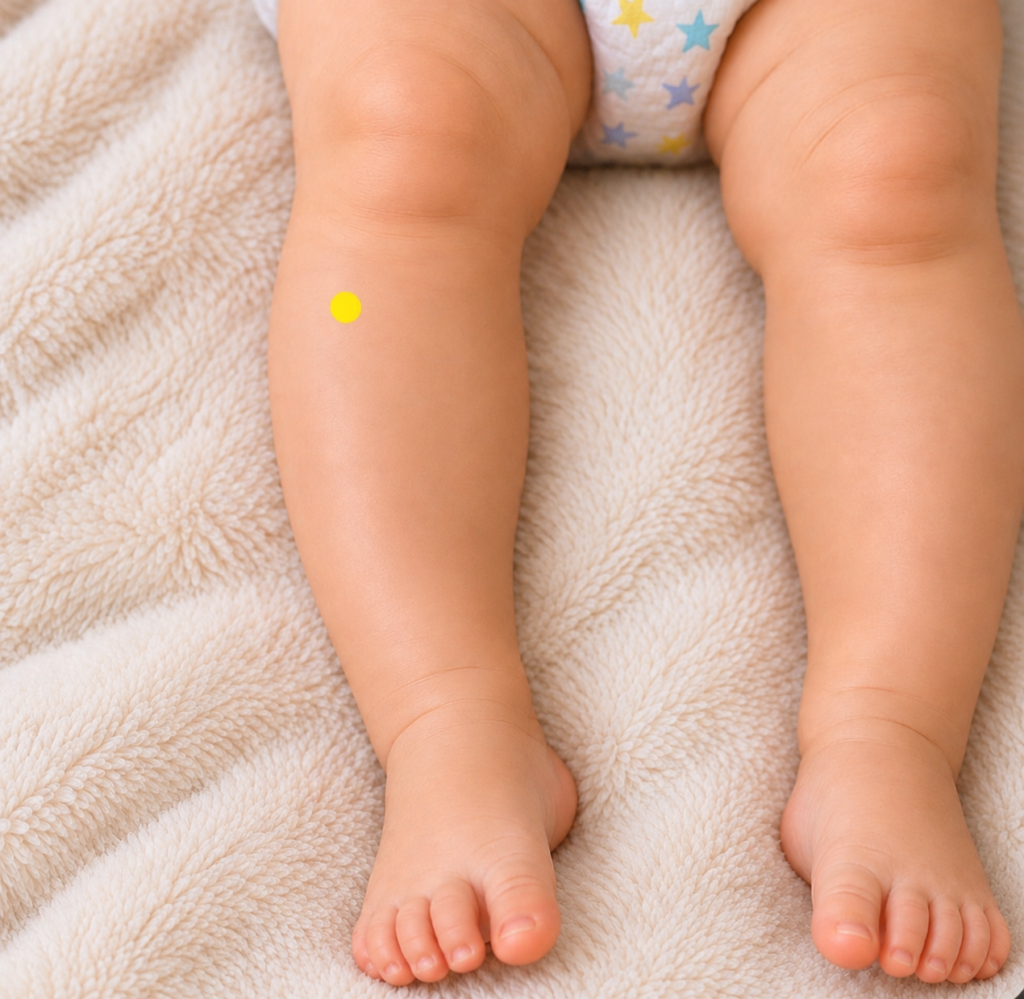
6. Press ST36 below the knee to strengthen digestion. ST36 sits on the front of the lower leg, about four of the baby’s finger-widths below the bottom of the kneecap and one of the baby’s finger-widths out from the edge of the shinbone. Make tiny, light circles with your fingertip for 30 seconds on each leg. ST36 is called “Zusanli,” the “Leg Three Miles.”
ST36 is the sea point of the Stomach. It strengthens the Spleen and Stomach and helps Stomach Qi move in the right direction.
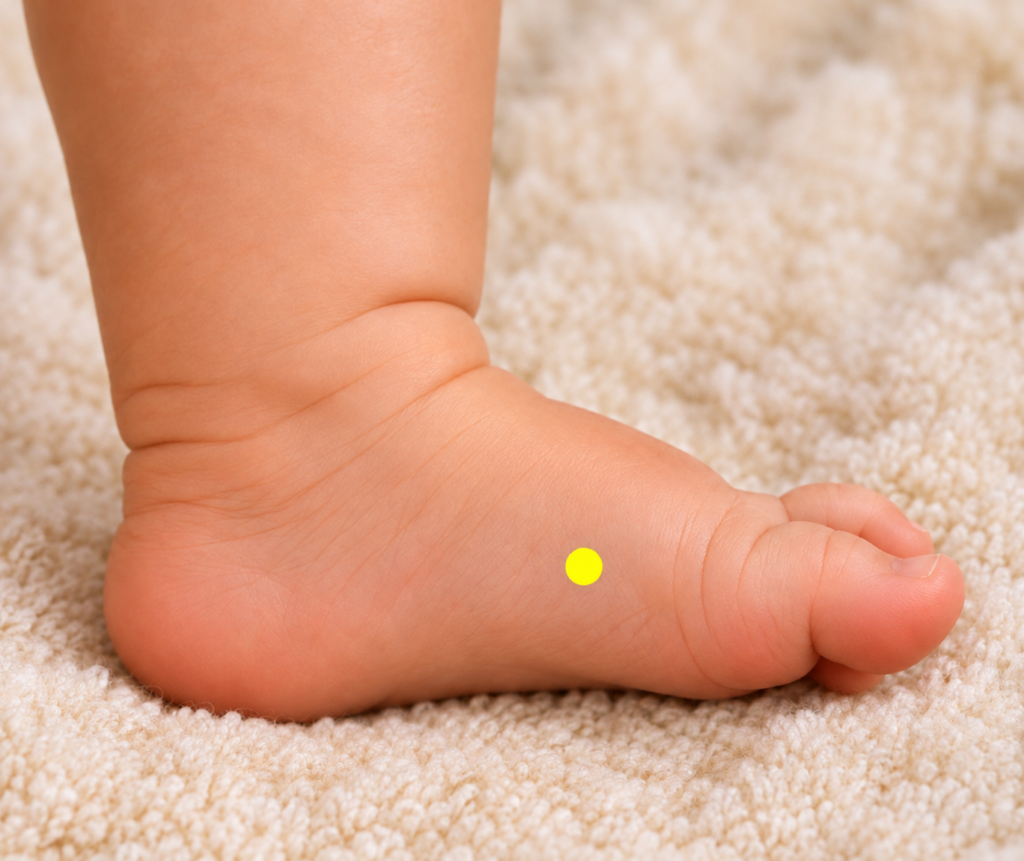
7. Press SP4 on the inner foot to settle the Stomach. SP4 sits on the inner edge of the foot, in the hollow just behind and below the bony bump at the base of the big toe, where the top of the foot meets the sole. Make tiny, light circles with your fingertip for 30 seconds on each foot. SP4 is called “Gongsun,” the “Grandfather Grandson.”
SP4 is the connecting point of the Spleen. It harmonizes the Spleen and Stomach and pairs well with PC6 for rising Stomach Qi.
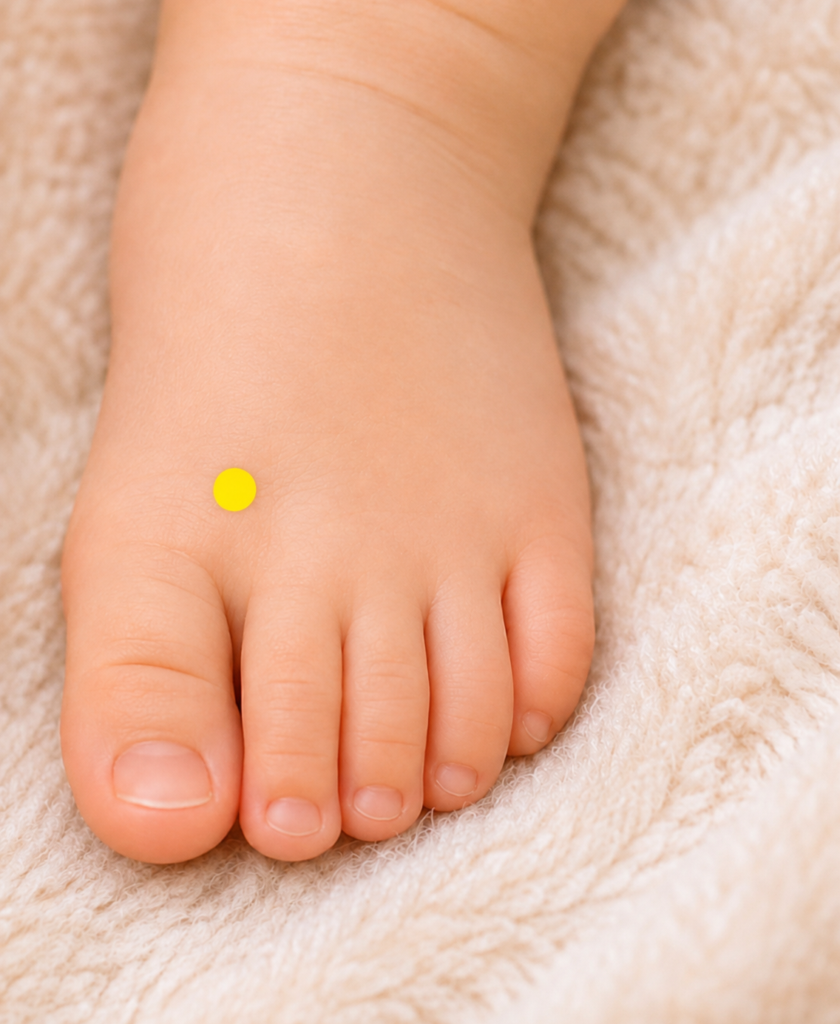
8. Press LV3 on the top of the foot to smooth the flow of Qi. LV3 sits on the top of the foot, in the hollow where the bones of the big toe and second toe meet. Rest your fingertip on the point with very light pressure for 30 seconds on each foot. LV3 is called “Taichong,” the “Great Rushing.”
LV3 is the source point of the Liver. It helps Qi flow smoothly and calms a baby who gets hiccups when overexcited or upset.
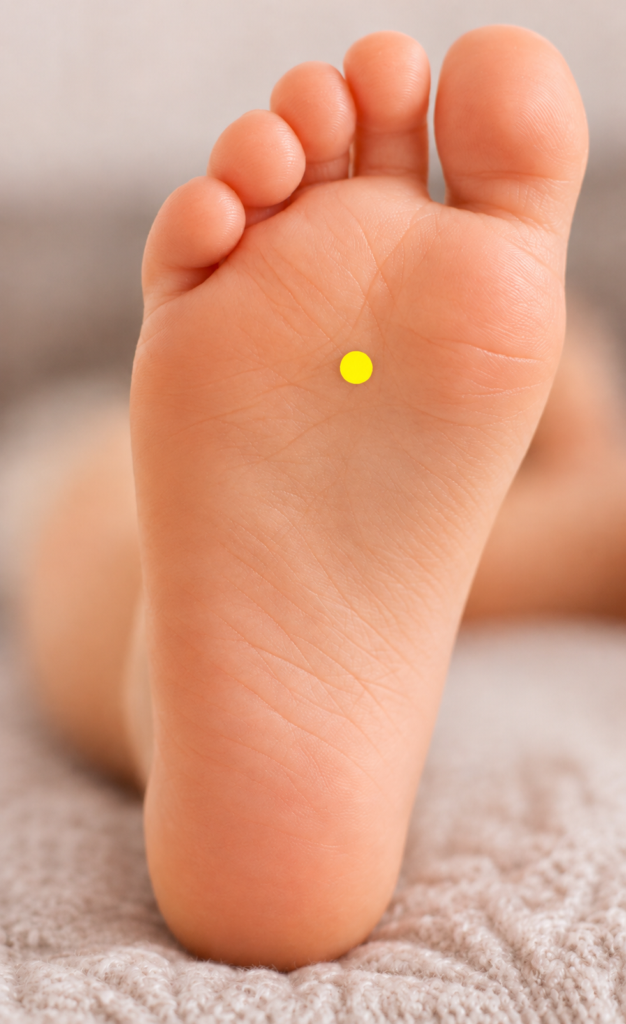
9. Rub KI1 on the sole of the foot to draw Qi down. KI1 sits on the sole of the foot, in the small hollow near the front of the foot, about one-third of the way from the base of the toes to the back of the heel. Rub gently with your thumb in small circles for 30 seconds on each foot. KI1 is called “Yongquan,” the “Bubbling Spring.”
KI1 is the lowest point on the body and the well point of the Kidney. Gently rubbing the soles draws rising Qi downward and is a soothing way to finish.
Why These Acupressure Points Work
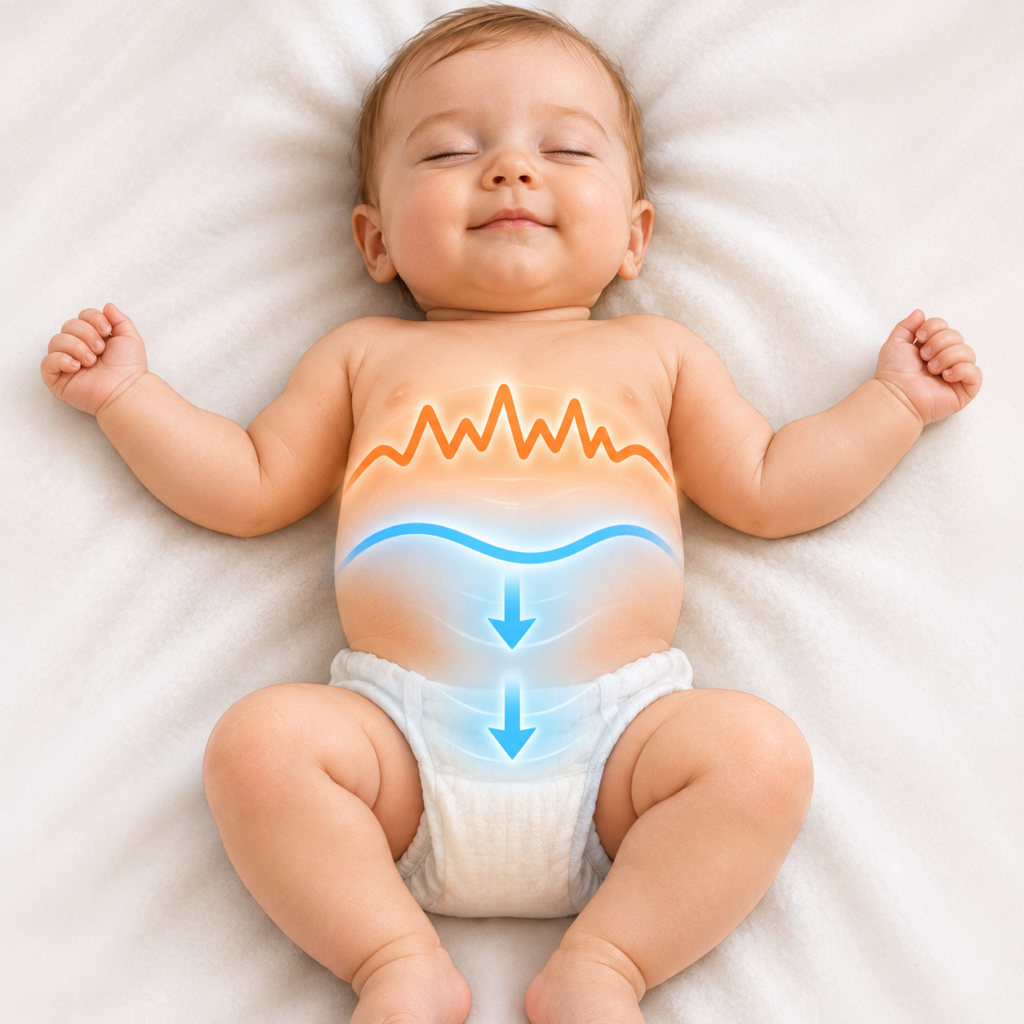
From the perspective of Traditional Chinese Medicine, hiccups in infants are attributed to Stomach Qi rising upward rather than descending, often following a large or hurried feeding. Points on the ear, chest, and back are understood to calm the diaphragm directly, while points on the arm, abdomen, and leg are believed to settle the Stomach and encourage Qi to descend. Points on the feet are thought to promote the smooth flow of Qi and guide it downward.
The nine points work together to help relieve baby hiccups:
- TE17 and BL17 calm the spasm of the diaphragm.
- PC6, CV12, and SP4 settle the Stomach and help Stomach Qi move downward.
- CV17 and ST36 open the chest and strengthen digestion.
- LV3 and KI1 smooth the flow of Qi and draw it downward.
How to Properly Use These Acupressure Points
Acupressure for infant hiccups is most effective when the infant is held upright after feeding, while being burped, or whenever a bout of hiccups appears to cause discomfort.
- Hold the baby upright against your shoulder and begin by applying light pressure to TE17 behind each earlobe.
- While burping, gently make slow circles over BL17 on both sides of the spine.
- With the baby on their back or reclined in your arms, trace tiny circles on PC6, rest a fingertip on CV17, and slowly make clockwise circles on the belly over CV12.
- Finish by making light circles on ST36, SP4, and LV3, then gently rub KI1 on both soles.
- Use only light, slow fingertip pressure, much lighter than you would use on an adult. Stop if the baby fusses, spits up, or seems uncomfortable. Avoid the soft spots on the top of the head, and do not use these points on broken, irritated, or rashy skin. If the baby is not bothered by the hiccups, it is fine to let them pass.
Simple habits can help prevent hiccups. Baptist Health recommends feeding the baby before they become very hungry or upset, offering smaller, more frequent feedings, making sure the baby’s mouth fully covers the nipple during nursing, burping often, and keeping the baby upright for about 30 minutes after feeding. Bouncing or other high-energy play right after a feeding can trigger hiccups. Baptist Health advises against startling the baby, giving water, pulling the tongue, pinching the nose, or offering more food to stop hiccups. Always talk to your doctor before using gripe water, as it is not a regulated medicine. Always place babies on their backs to sleep. Traditional Chinese Medicine adds keeping the baby’s belly and feet comfortably warm and feeding in a calm, quiet setting.
Find out more about whether acupressure is safe for children.
When to Get Professional Help

Call 911 if the baby has trouble breathing, turns blue or gray around the lips, becomes floppy, or is very difficult to wake. Get immediate medical care if the baby is under 3 months old and has a temperature of 100.4°F or higher, or is vomiting violently (forcefully, green, or repeatedly). Contact your pediatrician if the hiccups are very frequent or last more than about 10 minutes, or occur along with spitting up, fussiness or arching after feedings, poor feeding, poor weight gain, or any breathing difficulty, as these may be signs of reflux or another problem.
Acupressure is a gentle, supportive practice for baby hiccups. It complements, and does not replace, diagnosis and medical care.
For related health concerns, acupressure for hiccups, acupressure for colic, and acupuncture for kids are companion posts.
Above and Beyond Acupuncture offers acupuncture, cupping, and lifestyle coaching at the North Frank Lloyd Wright Boulevard location in Scottsdale.
Schedule an appointment online to start your healing journey.
The points above are only as effective as the technique used to apply them. Where to press, how firmly, and for how long all affect the result. For a full breakdown of how to perform acupressure properly at home, read Performing Acupressure in 3 Easy Steps.

About the Publisher
Paul Kerzner, L.Ac., is a licensed acupuncturist and board-certified herbalist, as well as the founder of Above and Beyond Acupuncture in Scottsdale. His own journey from chronic patient to practicing acupuncturist shapes his commitment to providing honest, clinically grounded information about acupuncture and Traditional Chinese Medicine. Learn more about Paul and his clinical approach on the About Us page.