Key Takeaways
- Achilles tendinitis is pain and stiffness in the large tendon at the back of the ankle, usually caused by overuse. In long-standing cases, it is often called Achilles tendinopathy.
- It most often affects runners, active middle-aged adults, and people who suddenly increase their activity, and it is typically worst with the first steps in the morning.
- Traditional Chinese medicine views Achilles pain as stagnation of Qi and Blood in the Kidney and Bladder channels, often with cold and dampness, or as the Liver Blood and Kidney failing to nourish the tendons.
- Nine acupressure points ease pain and stiffness, improve circulation in the calf and ankle, and nourish the tendons so they can heal.
- Acupuncture has shown strong results in treating chronic Achilles tendinopathy, and daily acupressure complements a gradual strengthening program.
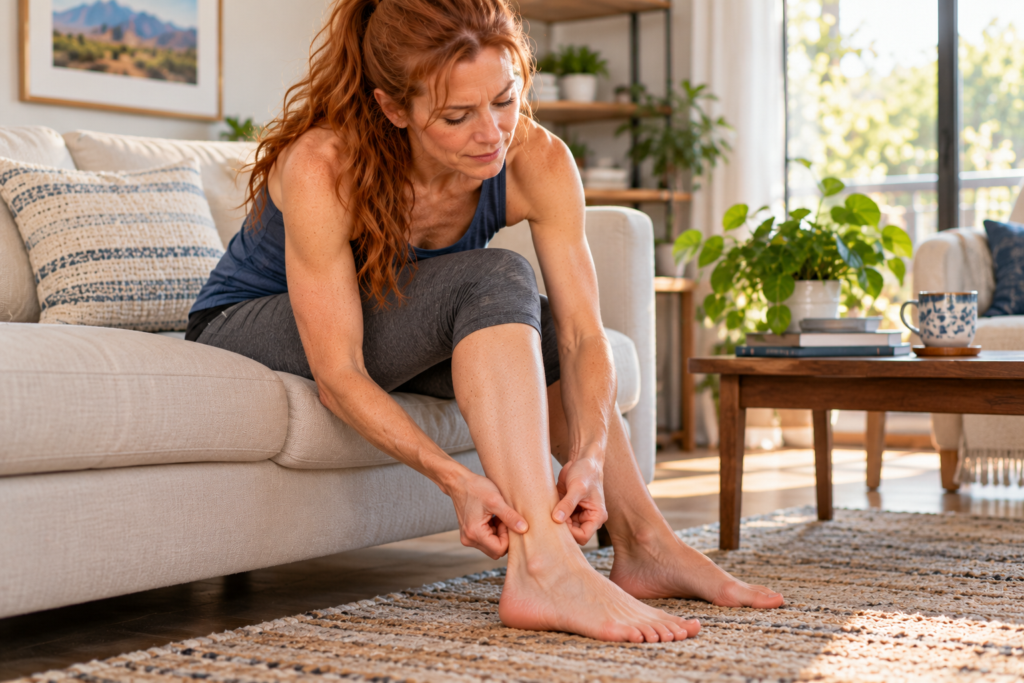
Do you experience stiffness and heel pain upon waking, or does it flare up after running, hiking, or a long day on your feet? Does the discomfort get better with warm-up but come back later in the day or the next morning? This pattern is a typical sign of Achilles tendinitis, a common overuse injury in the lower leg.
The Achilles tendon is the largest and strongest in the body, enduring significant force with each step, jump, and climb. When overloaded, it can become irritated, thicken, and become painful. While Achilles tendinitis may take time to heal, it often responds well to a combination of rest, gradual strengthening, and treatment that improves blood flow. Acupressure offers a simple, at-home way to reduce pain and stiffness and support healing. The following points may help.
What Is Achilles Tendinitis?
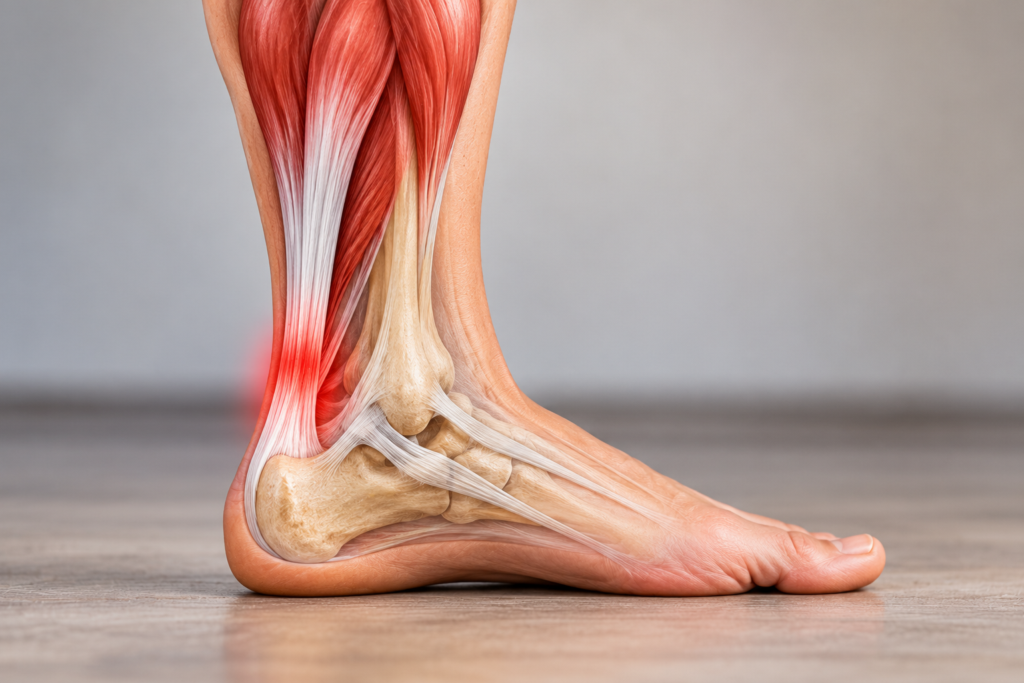
The Achilles tendon connects the calf muscles to the heel bone, allowing you to push off while walking, running, or rising on your toes. Achilles tendinitis is a condition characterized by pain and inflammation of this tendon, usually caused by repeated strain rather than a single injury.
At first, the tendon may become inflamed and sensitive. If this persists for several weeks, the tendon undergoes changes, including small areas of degeneration and thickening that are hard for the body to repair. This is why chronic cases are called Achilles tendinopathy, emphasizing the structural changes rather than just inflammation.
There are two main types: midportion Achilles tendinitis affects the middle part of the tendon, a few inches above the heel, and is more common in younger, active people. Insertional Achilles tendinitis impacts the lower part of the tendon where it connects to the heel bone and can occur in anyone, regardless of activity level; it is sometimes linked to a bone spur at the back of the heel.
Common symptoms of Achilles tendinitis include:
- Pain and stiffness along the back of the heel or lower calf
- Stiffness that is worst with the first steps in the morning or after sitting
- Pain that eases as you warm up and returns after activity
- Tenderness when the tendon is squeezed between the fingers
- A thickened area or small lump along the tendon
- Swelling, warmth, or a creaking feeling along the tendon in some cases
- Pain when rising onto your toes, climbing stairs, or walking uphill
- Pain at the back of the heel that is aggravated by the back of a shoe
What Causes Achilles Tendinitis and Who Gets it?

Achilles tendinitis occurs when the stress placed on the tendon exceeds its capacity to recover. The most common cause is a sudden change in activity, such as running longer or faster, introducing hill training, resuming sport after a break, or starting a new exercise program. Tendons adapt more slowly than muscles, so a person may feel strong enough to continue with more before the tendon is ready.
Common risk factors include:
- Running, jumping, and sports with quick starts and stops, such as tennis, pickleball, and basketball
- Sudden increases in training distance, intensity, or frequency
- Tight or weak calf muscles
- Flat feet or feet that roll inward excessively
- Worn-out or poorly supportive shoes, or frequent switching between high heels and flat shoes
- Middle age, since tendons become less elastic and slower to repair over time
- Excess body weight, high cholesterol, and diabetes
- Certain antibiotics in the fluoroquinolone family, such as ciprofloxacin and levofloxacin, and corticosteroid injections near the tendon, which can weaken it
Achilles tendinitis commonly occurs in runners and active adults in their thirties to fifties who participate in weekend sports; it is more frequent in men, although insertional Achilles tendinitis can also affect women.
How Achilles Tendinitis Differs From Other Causes of Heel Pain
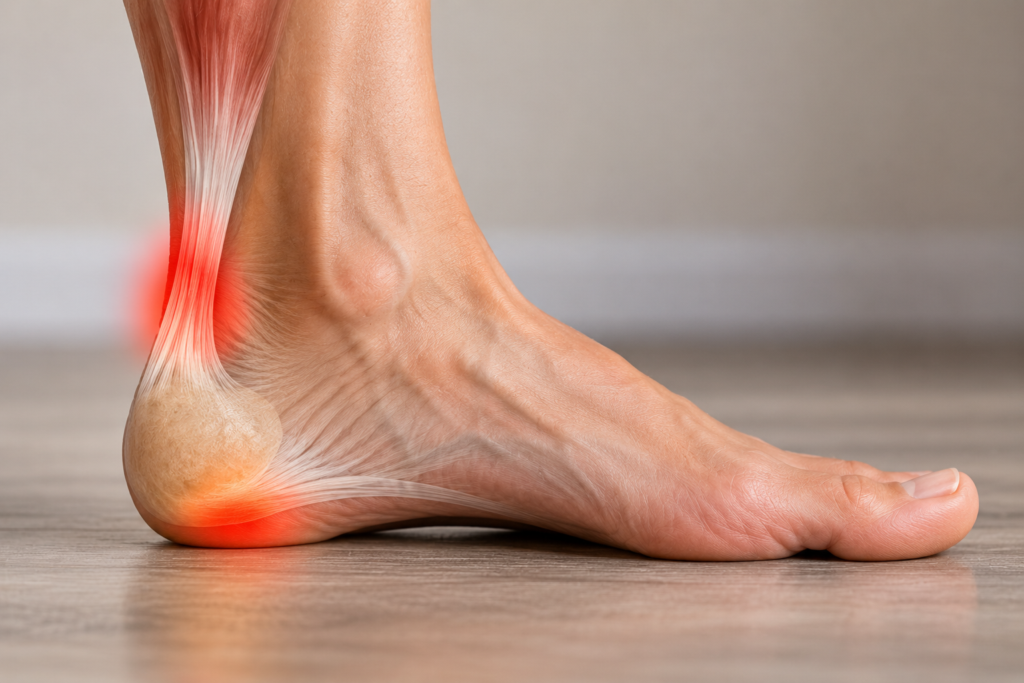
Various conditions can lead to pain in the back or lower heel, making it essential to identify the specific cause, as each may require a different treatment approach.
- Plantar fasciitis causes pain on the bottom of the heel and along the arch, not the back of the heel, though it can cause the same sharp pain with the first steps in the morning. Acupressure for plantar fasciitis covers that condition.
- An Achilles tendon rupture causes a sudden, sharp pain at the back of the ankle, often with a pop or a feeling of being kicked in the calf, followed by difficulty pushing off or rising onto the toes. It needs prompt medical care.
- Retrocalcaneal bursitis is inflammation of the small fluid-filled sac between the Achilles tendon and the heel bone, and it often occurs alongside insertional Achilles tendinitis.
- Tarsal tunnel syndrome causes burning, tingling, or numbness along the inner ankle and sole rather than stiffness at the back of the heel. Acupressure for tarsal tunnel syndrome addresses that nerve condition.
- Calf strain causes pain higher up in the muscle belly of the calf, usually after a sudden push-off. Acupressure for calf pain targets muscle pain in that area.
Signs of Achilles tendinitis include heel or lower calf pain and stiffness, morning stiffness that improves with activity, tenderness when compressing the tendon, and a recent increase in physical activity.
How Traditional Chinese Medicine Views Achilles Tendinitis
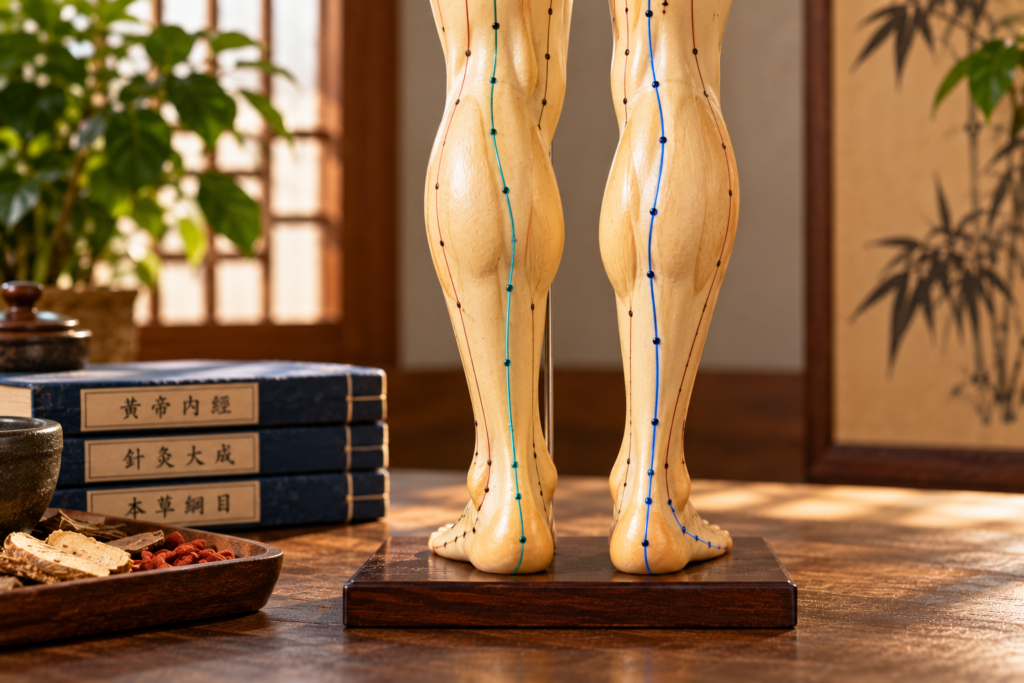
In Traditional Chinese Medicine, the Achilles tendon lies between two key channels: the Kidney channel runs along its inner side, while the Bladder channel follows the outer side and ascends the back of the calf. The Liver is thought to govern the sinews, including tendons and ligaments, with Liver Blood nourishing them to maintain their flexibility and strength. Many cases of Achilles tendinitis display one or more of these patterns, which inform the selection of acupuncture points in this treatment to target each particular pattern.
- Qi and Blood stagnation: sharp, fixed pain at the back of the heel; tenderness to touch; and pain after overuse or sudden increases in activity. BL60, BL57, BL40, and SP6 move Qi and Blood through the channels and ease pain.
- Cold and dampness obstructing the channels: stiffness and aching that worsen in the morning or in cold weather, a heavy feeling in the legs, and relief with warmth and movement. BL60, BL57, and ST36 warm and open the channels and help clear dampness.
- Liver Blood fails to nourish the sinews: stiff, tight tendons that heal slowly, calf cramping, and a tendency toward recurrent tendon problems. GB34, LR3, and SP6 nourish and relax the sinews.
- Kidney deficiency: long-standing pain in older adults, weak ankles, aching in the lower back and knees, and fatigue. KI3 and KI7 strengthen the Kidney and support the tendons from the inside.
- Heat from acute irritation: a red, warm, swollen tendon during a flare. BL40 clears heat from the Bladder channel and the back of the leg.
The objective is to facilitate the smooth movement of Qi and Blood in the calf and ankle, eliminate cold and dampness, nourish the sinews, and strengthen the Kidney to support tendon recovery.
What the Research Shows
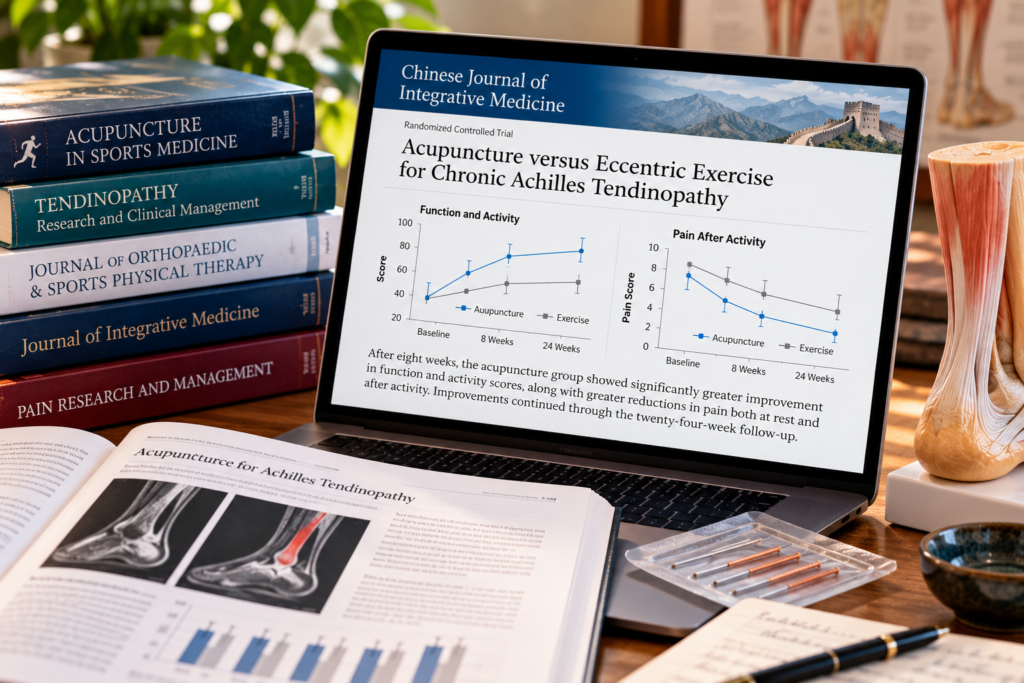
Acupuncture has produced encouraging results for chronic Achilles tendinopathy. In a randomized controlled study published in the Chinese Journal of Integrative Medicine, 64 people with chronic Achilles tendinopathy received either acupuncture or eccentric calf exercises, one of the most widely recommended treatments for the condition. After eight weeks, the acupuncture group showed significantly greater improvement in function and activity scores, along with greater reductions in pain both at rest and after activity. Improvements continued through the twenty-four-week follow-up.
Acupuncture often treats tendon issues like tennis elbow and shoulder tendinitis, reducing pain and improving mobility. Although research on acupressure for Achilles tendinitis is limited, it works on many of the same points and channels, making it a convenient option to aid recovery between sessions. For optimal results, it should be paired with a gentle, progressive strengthening routine for the calf and tendons.
Here are nine acupressure points that can help:
What Acupressure Points to Press and Why
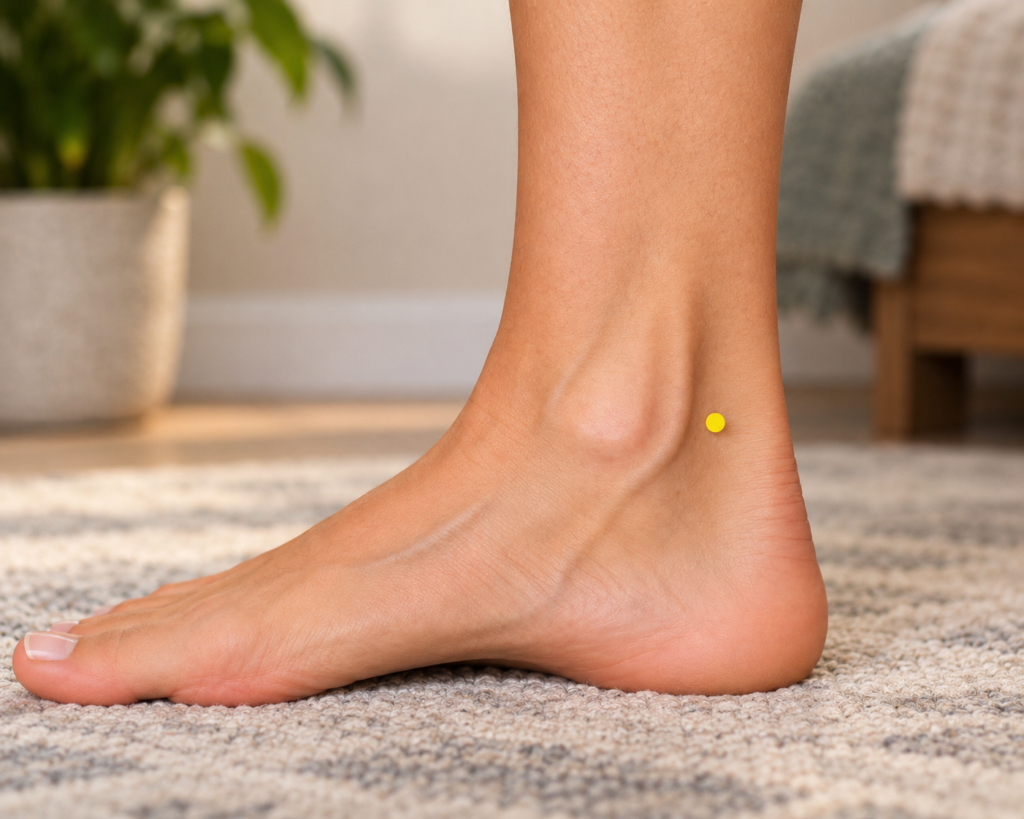
1. Press on BL60 behind the outer ankle to ease heel and ankle pain. BL60 sits in the hollow between the outer ankle bone and the Achilles tendon, level with the tip of the ankle bone. Press firmly with your thumb for one to two minutes on each ankle, pressing into the hollow rather than directly on the sore part of the tendon. BL60 is called “Kunlun,” named after the Kunlun Mountains. The use of BL60 is contraindicated during pregnancy.
BL60 is a key acupressure point for alleviating pain anywhere along the Bladder channel, such as in the heel, back, or head. It is situated adjacent to the Achilles tendon. This point promotes Qi and Blood circulation in the heel and ankle, relieves stiffness, and helps relax the calf and tendon. For Achilles tendinitis, BL60 plays a central role in treatment and is typically tender, so gentle pressure is recommended.
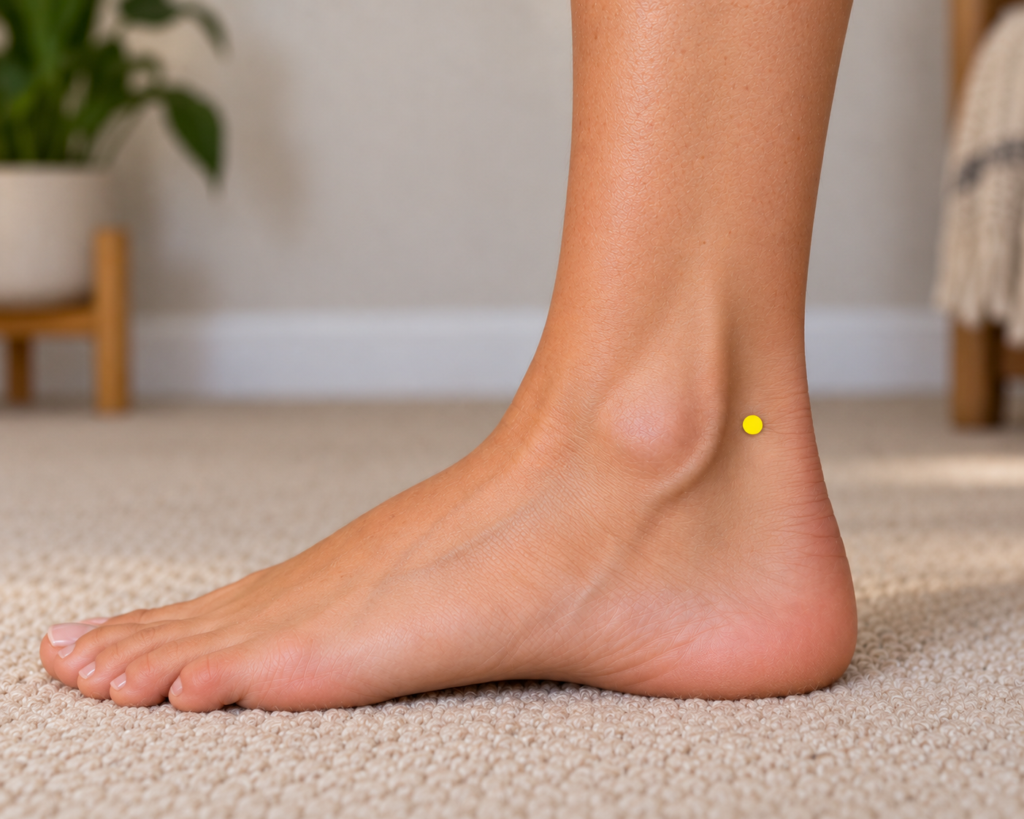
2. Press on KI3 behind the inner ankle to strengthen the tendon from within. KI3 sits in the hollow between the inner ankle bone and the Achilles tendon, level with the tip of the ankle bone. Press firmly with your thumb for one to two minutes on each ankle. KI3 is called “Taixi,” the “Great Stream,” and is the source point of the Kidney.
KI3 is positioned directly opposite BL60 on the inner side of the tendon and can be easily accessed by gently pinching the depression with the thumb and index finger. In Traditional Chinese Medicine, KI3 enhances Kidney function, which supports the bones and tendons. It is especially beneficial for chronic Achilles’ tendon pain, pain in elderly individuals, and tendons that heal more slowly.
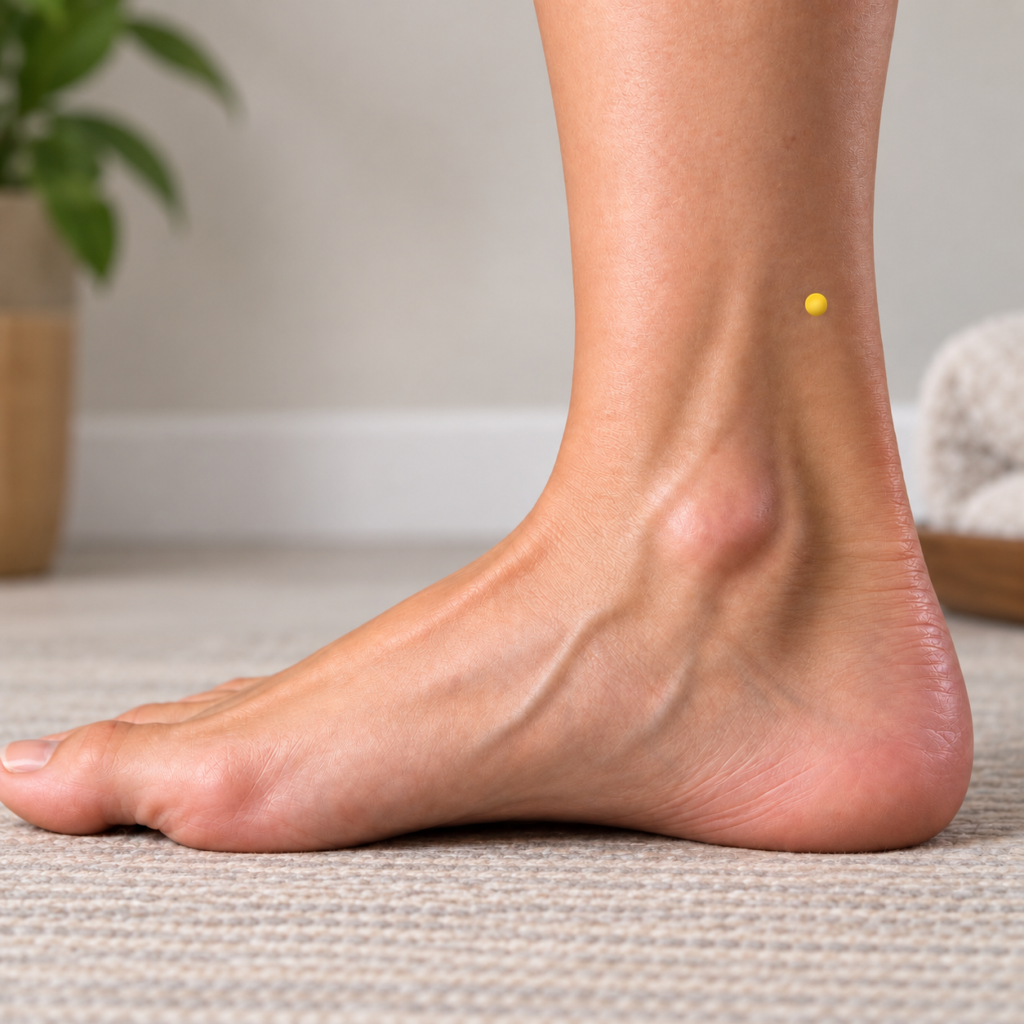
3. Press on KI7 above the inner ankle to support the lower tendon. KI7 sits on the inner side of the lower leg, three finger-widths directly above KI3, just in front of the Achilles tendon. Press firmly with your thumb for one to two minutes on each leg. KI7 is called “Fuliu,” the “Returning Current.”
KI7 sits alongside the middle portion of the Achilles tendon, where midportion tendinitis is most often felt. This point boosts Kidney function, offers local support to the tendon, and helps alleviate stiffness and pain in the lower calf. When applying pressure, focus on the soft area just in front of the tendon, avoiding direct pressure on the tendon itself.
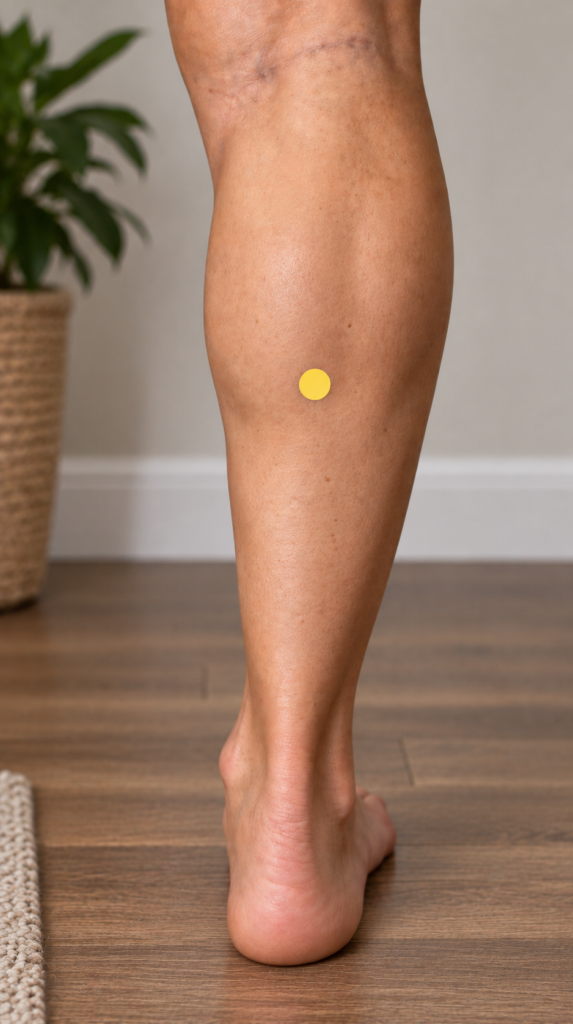
4. Press on BL57 on the back of the calf to release calf tension. BL57 sits on the back of the lower leg, midway between the back of the knee and the heel, in the hollow where the two bellies of the calf muscle meet the tendon. When you rise onto your toes, a small upside-down V forms at this spot. Press firmly with your thumb for one to two minutes on each leg. BL57 is called “Chengshan,” the “Supporting Mountain.”
With each step, the tight calf muscles pull on the Achilles tendon. To alleviate Achilles pain, it is crucial to relax the calf. BL57 is a traditional point used to relieve pain, cramping, and tension in the calf. It helps direct Qi and Blood downward along the back of the leg toward the heel. Using BL57 before stretching or strengthening exercises is especially beneficial, as it helps the calf muscles relax and lengthen.
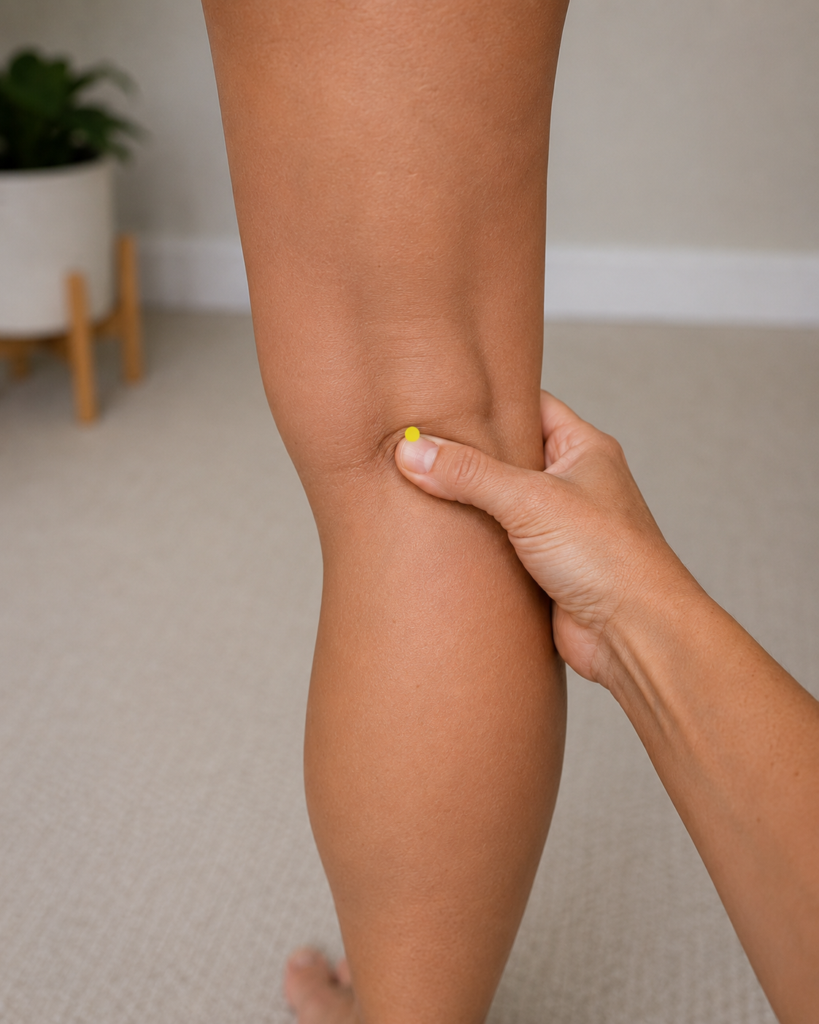
5. Press on BL40 at the back of the knee to clear heat and move the Blood. BL40 sits in the center of the back-of-the-knee crease, between the two tendons. Press gently with your thumb or fingertips for about a minute on each leg. BL40 is called “Weizhong,” the “Middle of the Crook.”
BL40 is the command point for the back and the back of the leg, helping to clear heat and promote blood flow in the Bladder channel. During a flare-up, when the tendon is warm and irritated, BL40 can cool and calm the area from a distance. Because the area behind the knee is sensitive, use gentle pressure when applying this point and avoid it if you have varicose veins or swelling behind the knee.
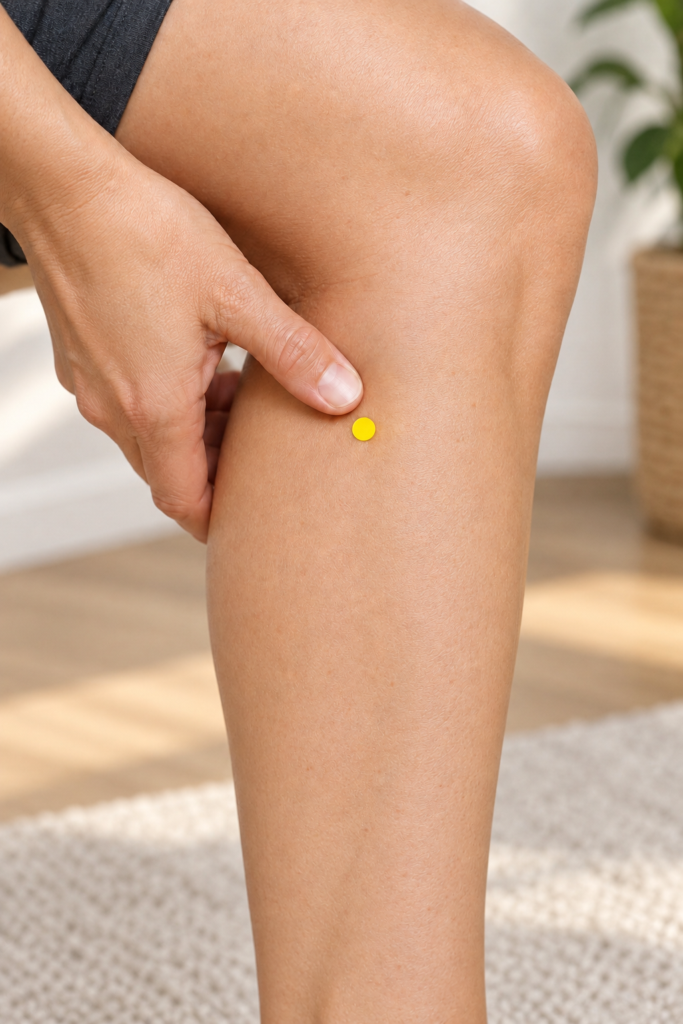
6. Press on GB34 below the outer knee to relax the tendons. GB34 sits on the outer side of the lower leg, in the hollow just in front of and below the bony bump at the top of the outer leg bone, just below the knee. Press firmly with your thumb for one to two minutes on each leg. GB34 is called “Yanglingquan,” the “Yang Mound Spring.”
GB34 is the influential point of the sinews, meaning it has a special effect on the tendons and ligaments throughout the body. This point is especially important for people who frequently suffer from tendon and ligament injuries.
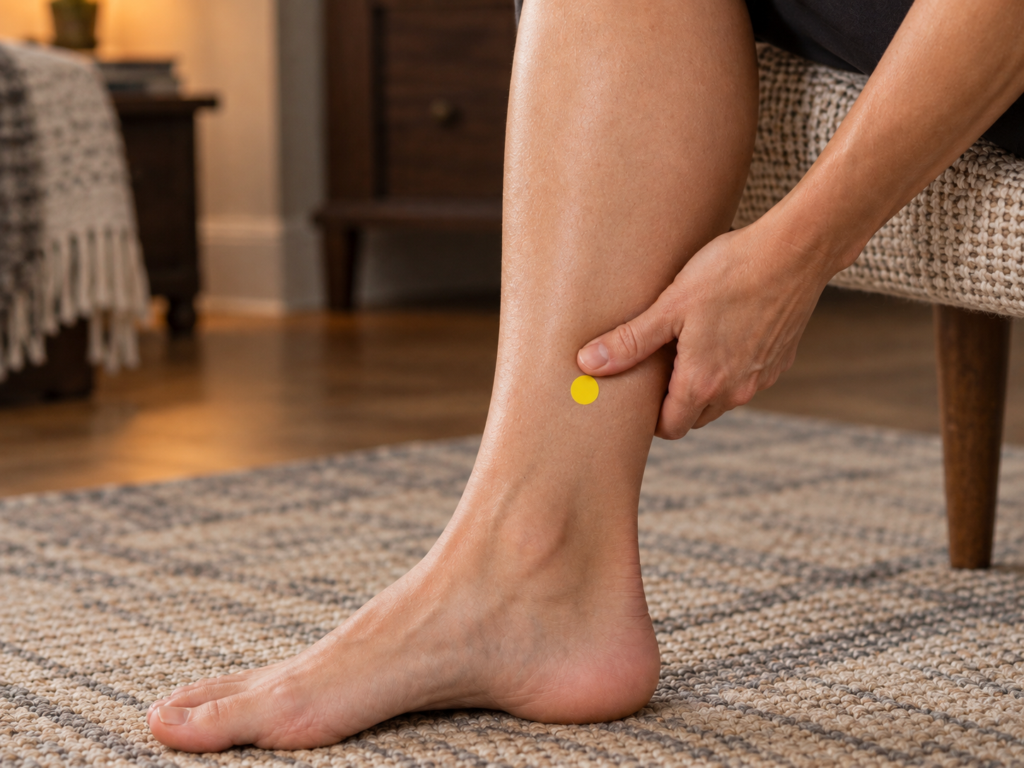
7. Press on SP6 above the inner ankle to nourish the Blood. SP6 sits four finger-widths up from the tip of the inner ankle bone, just behind the back edge of the shinbone. Press firmly with your thumb for one to two minutes on each leg. SP6 is called “Sanyinjiao,” the “Three Yin Intersection.” SP6 is contraindicated during pregnancy.
SP6 is a key point where the Spleen, Liver, and Kidney channels converge, supporting blood nourishment. This helps keep tendons flexible by promoting blood circulation and alleviating pain. It also assists in healing tendons that are thickened, stiff, or slow to mend. Additionally, SP6 can be effectively combined with KI3 and KI7 on the inner leg.
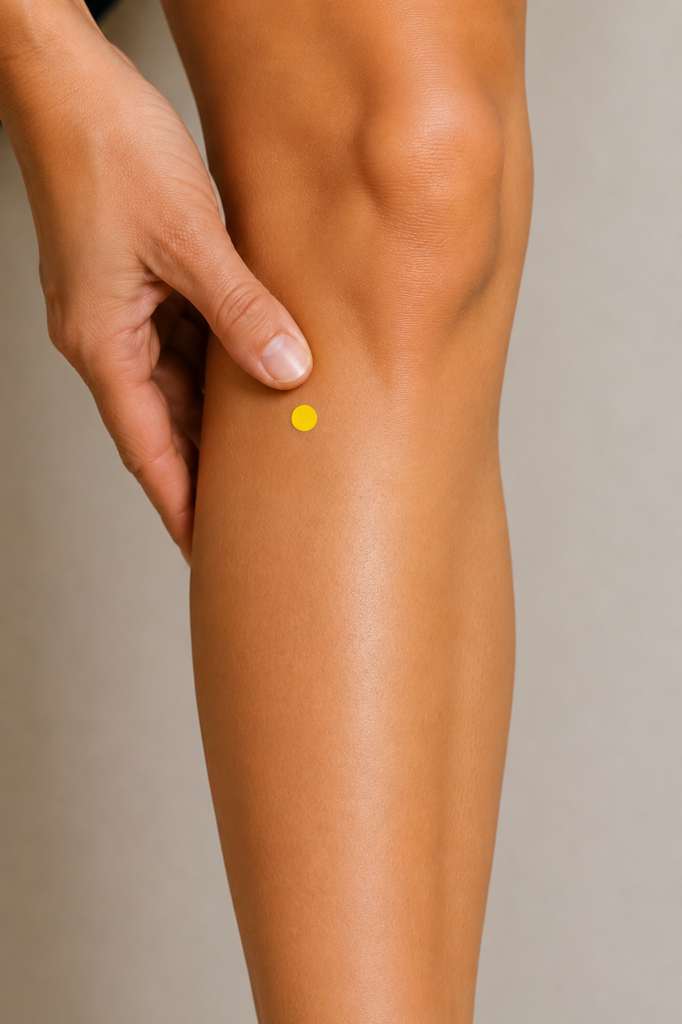
8. Press on ST36 below the knee to build energy for healing. ST36 sits four finger-widths below the lower edge of the kneecap and one finger-width to the outside of the shinbone, on the muscle that rises when you flex your foot. Press firmly with your thumb for one to two minutes on each leg. ST36 is called “Zusanli,” the “Leg Three Miles.”
Tendons heal slowly and need consistent energy and good blood flow for proper repair. ST36 boosts Qi and Blood, strengthens the legs, and helps clear dampness, which can cause morning heaviness and stiffness. Its traditional name reflects its ability to revive tired legs, making it perfect for those returning to walking, running, or sports.
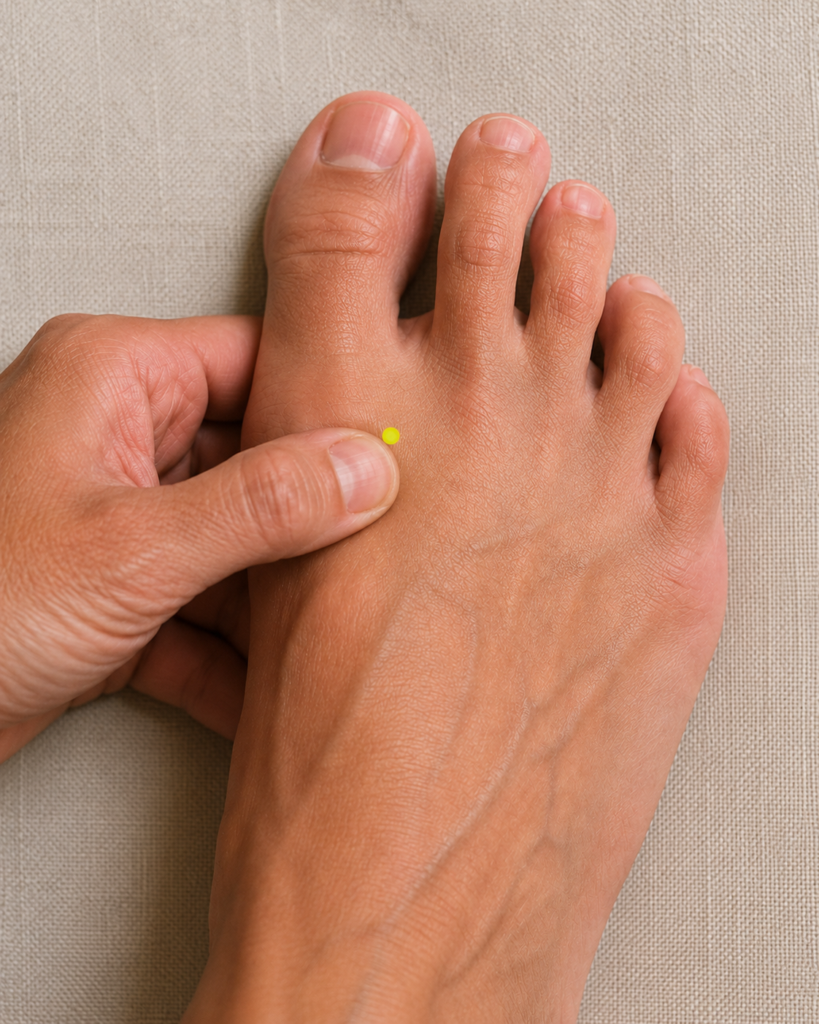
9. Press on LR3 on the top of the foot to relax the sinews. LR3 sits on the top of the foot, in the webbing between the big toe and second toe, about two finger-widths back from the webbing, in the hollow just before the two bones meet. Press firmly with your thumb for one to two minutes on each foot. LR3 is called “Taichong,” the “Great Surge.”
In Traditional Chinese Medicine, the Liver is believed to regulate the sinews. LR3 is the main point for soothing and nourishing the Liver; it relaxes tight tendons and muscles throughout the body, relieves pain, and helps release tension from guarding a sore heel. When combined with GB34, these points form a classic pair for treating tendon and ligament issues.
Why These Acupressure Points Work
In Traditional Chinese Medicine, Achilles tendinitis is seen as caused by stagnation of Qi and Blood in the Kidney and Bladder meridians, often combined with cold and dampness, along with Liver blood deficiency that fails to nourish the sinews or Kidney deficiency. The nine points target all these issues.
- The ankle points (BL60, KI3, KI7) move circulation around the tendon and strengthen it from both sides.
- The calf and knee points (BL57, BL40) release calf tension, clear heat, and move the Blood down the back of the leg.
- The sinew points (GB34, LR3) relax and nourish the tendons throughout the body.
- The nourishing points (SP6, ST36) build and move the Qi and Blood that tendons need to repair.
How to Properly Use These Acupressure Points
- Perform the full routine once or twice daily, holding each point for one to two minutes, and spend about a minute on BL40.
- Press into the hollows beside the tendon instead of directly on the most painful area of the tendon.
- Apply firm pressure to the ankle, calf, and leg areas, and gentle pressure behind the knee.
- Pinch BL60 and KI3 simultaneously using your thumb and index finger to target both sides of the tendon at once.
- Work BL57 and the ankle points before calf stretches or strengthening exercises to help the calf relax.
- Immediately after a flare or sudden irritation, applying ice briefly can soothe the area. For ongoing stiffness, warming the tissues before acupressure aids in relaxation.
- Apply the routine consistently over several weeks, as tendons heal more slowly than muscles.
Sample routines:
- Morning, before getting out of bed (three minutes): BL60 and KI3 together, then gentle ankle circles to ease the first-step stiffness.
- Before exercise or strengthening work (five minutes): BL57, BL60, KI3, and KI7, followed by gentle calf stretches.
- After activity (five minutes): BL40, BL57, and GB34 to release the calf and calm the tendon.
- Evening (ten to fifteen minutes): the full routine, finishing with LR3 and SP6.
Home Care and Lifestyle Support for Achilles Tendinitis
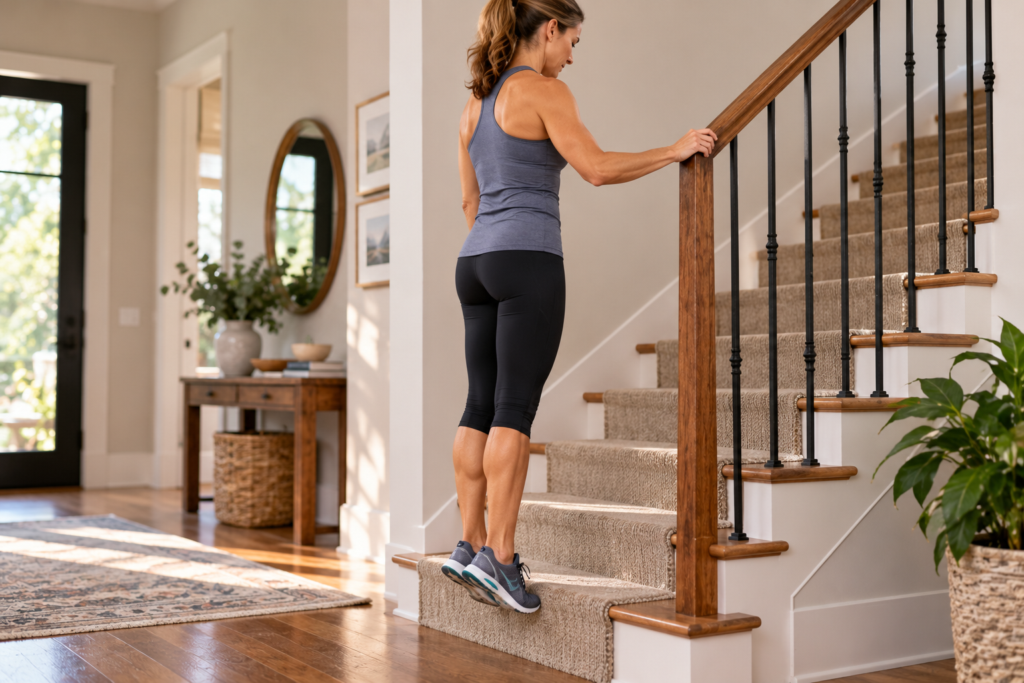
Tendons respond to proper loading: complete rest can lead to weakening, while too much load may cause irritation. The goal is to determine the ideal activity level the tendon can handle and steadily increase it.
- Reduce, rather than stop, activity. Switch temporarily from running or jumping to lower-impact activities such as cycling or swimming, and keep pain during and after activity mild.
- Start a gradual strengthening program. Slow, controlled heel raises and heel drops, often guided by a physical therapist, are among the most effective treatments for Achilles tendinitis.
- Stretch the calf gently and regularly, keeping the stretches comfortable rather than forceful.
- Wear supportive shoes with a slight heel, and avoid walking barefoot on hard floors while the tendon is sore.
- A small heel lift in the shoe can reduce strain on the tendon, especially for insertional tendinitis.
- Avoid shoes with a stiff back that presses into the back of the heel.
- Return to running and sport gradually, increasing distance or intensity by small amounts each week.
- Ask your doctor about any medications you take, including fluoroquinolone antibiotics, that can affect tendon health.
Traditional Chinese Medicine emphasizes maintaining warmth in the lower legs and ankles to prevent cold from tightening the sinews and hindering healing. Avoid walking barefoot on cold surfaces. Evening warm foot baths can relax calf muscles and tendons. Consuming warm, cooked foods, soups, and bone broths supports Blood health, vital for nourishing tendons. Dark leafy greens and goji berries are traditionally used to nourish the Liver Blood. Limiting cold, raw, heavy, and greasy foods is recommended, as these can cause dampness and heaviness in the legs. Adequate rest is crucial, and one should avoid overexertion when exhausted, since tissue repair occurs primarily during rest.
How Acupuncture Can Help
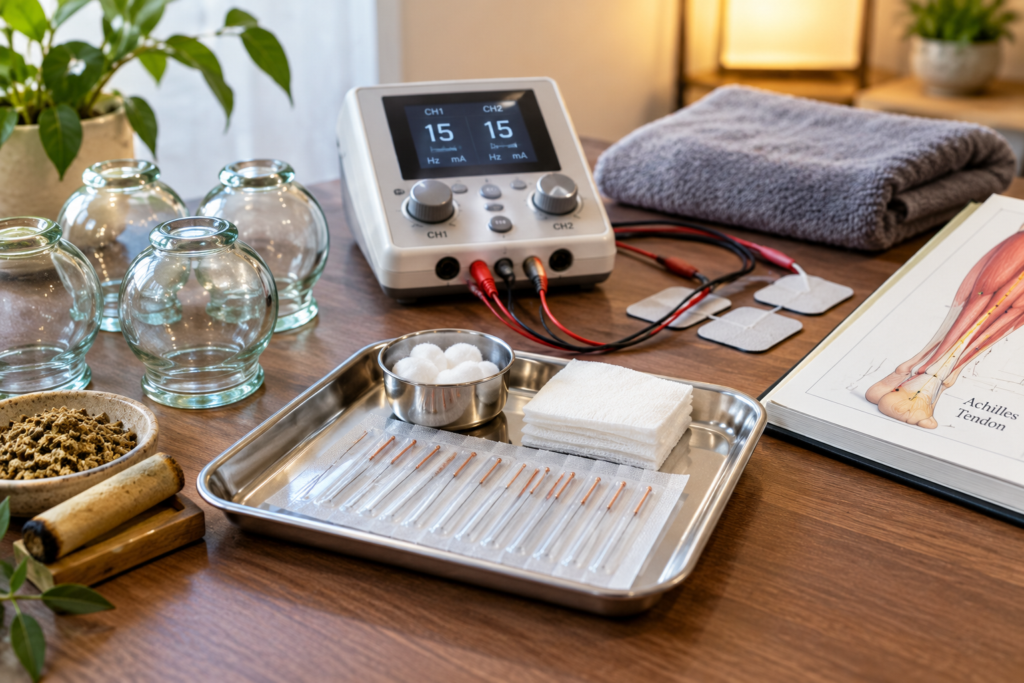
Acupuncture addresses Achilles tendinitis by enhancing blood flow to the tendon, relaxing tight calf muscles, alleviating pain, and supporting tissue repair. The treatment typically involves local points around the ankle and calf, as well as distant points that relax the sinews and nourish Blood. Treatment is tailored to whether the condition is recent or chronic. Many patients find that acupuncture eases pain and morning stiffness, helping them resume strengthening exercises and activities more comfortably. Additionally, cupping on the calf and moxibustion to warm the area may be used to reduce stiffness and chronic pain.
Acupuncture works well alongside physical therapy and a gradual strengthening program. Learn more about how acupuncture can reduce inflammation and how cupping helps release tight fascia and muscles.
When to Get Professional Help
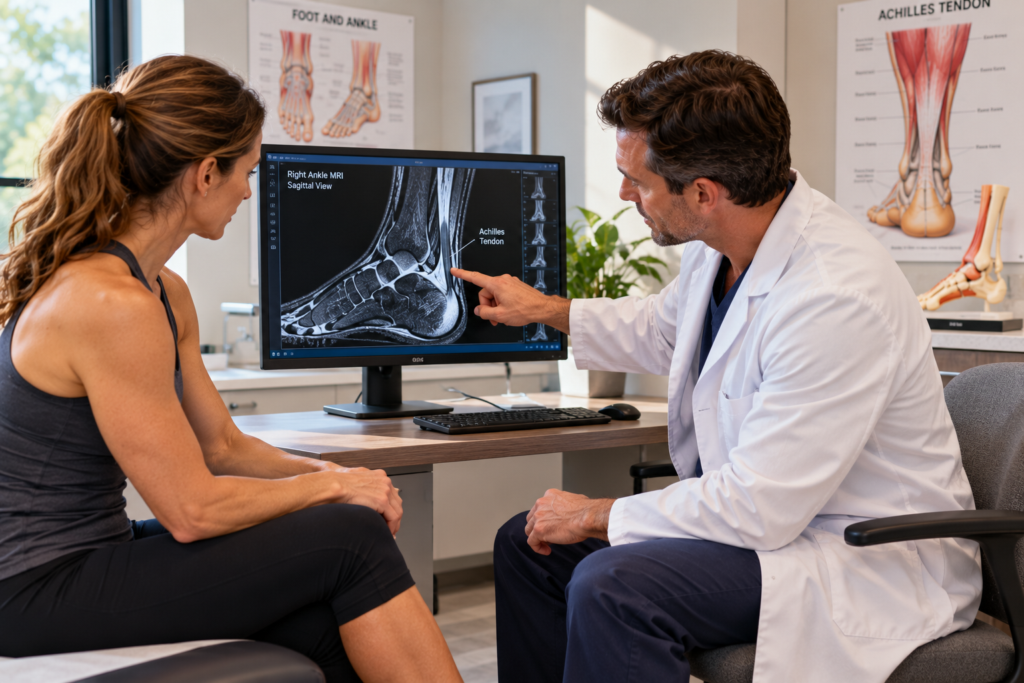
If your Achilles tendinitis pain persists after a few weeks of home treatment, consult a doctor, physical therapist, or sports medicine specialist for accurate diagnosis and appropriate treatment. Seek medical attention immediately if you experience a sudden pop or snap at the back of your ankle, feel like you’ve been kicked in the calf, or are unable to push off or stand on your toes, as these could indicate an Achilles tendon rupture requiring urgent care. Visit the emergency room if your calf becomes swollen, red, warm, and painful, especially after travel, surgery, or inactivity, as this could signal a blood clot. Contact your doctor promptly if Achilles pain occurs while taking a fluoroquinolone antibiotic, if your heel is very swollen or red, if you develop a fever, or if pain wakes you at night.
Acupressure can provide gentle support for Achilles tendinitis, but it should complement medical treatment, not replace it.
For other foot and lower leg conditions, acupressure for heel pain, acupressure for plantar fasciitis, acupressure for ankle pain, and acupressure for calf pain are companion posts. If calf cramps come along with your Achilles pain, acupressure for leg cramps offers quick relief, and acupressure for tarsal tunnel syndrome covers nerve pain along the inner ankle.
Above and Beyond Acupuncture offers acupuncture, cupping, and lifestyle coaching at the North Frank Lloyd Wright Boulevard location in Scottsdale.
Schedule an appointment online to start your healing journey.
The points above are only as effective as the technique used to apply them. Where to press, how firmly, and for how long all affect the result. For a full breakdown of how to perform acupressure properly at home, read Performing Acupressure in 3 Easy Steps.

About the Publisher
Paul Kerzner, L.Ac., is a licensed acupuncturist and board-certified herbalist, as well as the founder of Above and Beyond Acupuncture in Scottsdale. His own journey from chronic patient to practicing acupuncturist shapes his commitment to providing honest, clinically grounded information about acupuncture and Traditional Chinese Medicine. Learn more about Paul and his clinical approach on the About Us page.