Key Takeaways
- Menstrual migraines typically occur a few days before and during menstruation, often triggered by hormonal changes.
- Acupressure for menstrual migraines involves pressing on specific points to alleviate pain and nausea, including GB20, Taiyang, and LI4.
- Pressing on GB41 and LR3 helps calm rising Liver energy and relieves headache tension. Regular practice enhances effectiveness.
- To use acupressure effectively, start two to three days before your period and maintain consistency over several cycles.
- Seek professional help if migraines worsen, last over 72 hours, or deviate from your usual pattern.

Do you get migraines every month, typically a day or two before your period or on its first heavy day? Do they last longer, feel more intense, and cause more nausea than your other headaches? This pattern is known as menstrual migraine and affects many people with menstrual cycles.
Menstrual migraines are identified by their timing. They typically begin about two days before your period and continue through the first three days of bleeding, recurring at the same point in each cycle. Some people get migraines only during this window, while others experience them throughout the month; however, migraines related to their period are often the most severe.
Hormones are the main trigger. Estrogen rises during the first half of the cycle, then drops sharply just before your period. This sudden shift can make the blood vessels and nerves in your head more sensitive, increasing the likelihood of migraines. Menstrual migraines often last longer, may return after fading, and may not respond as well to usual treatments.
Traditional Chinese Medicine teaches that the Liver stores Blood and keeps Qi moving smoothly, both of which are important for the menstrual cycle. Before your period, Qi and Blood gather in the uterus. If Liver Qi becomes tight or stuck, its energy can rise and cause throbbing pain at the temples, sides of the head, or behind the eyes. During and after your period, blood loss can leave the head undernourished, leading to a dull, tiring headache.
The positive news is that headaches associated with a recurring pattern can often be prevented. The following nine acupressure points can help alleviate head and neck pain, reduce nausea, calm rising Liver energy, and support a regular cycle.
What Acupressure Points to Press and Why
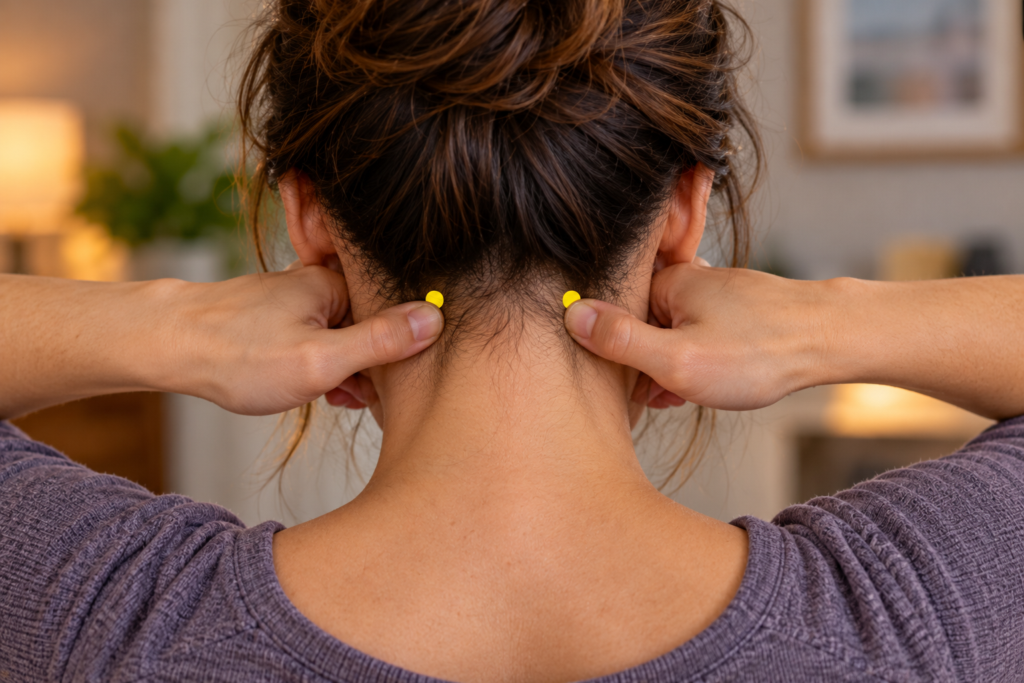
1. Press on GB20 at the base of the skull to release pain in the head and neck. GB20 sits at the base of the skull, in the hollows on either side of the two large neck muscles, roughly level with the earlobes. Press upward into both points at once with your thumbs for one to two minutes while letting the head rest back into your hands. GB20 is called “Fengchi,” the “Wind Pool.”
In Traditional Chinese Medicine, GB20 is a key point for all types of headaches. It lies on the Gallbladder channel, which runs up the side of the head, where many menstrual migraines are felt. Pressing it relaxes neck muscles that tighten during a migraine and helps bring energy back down.
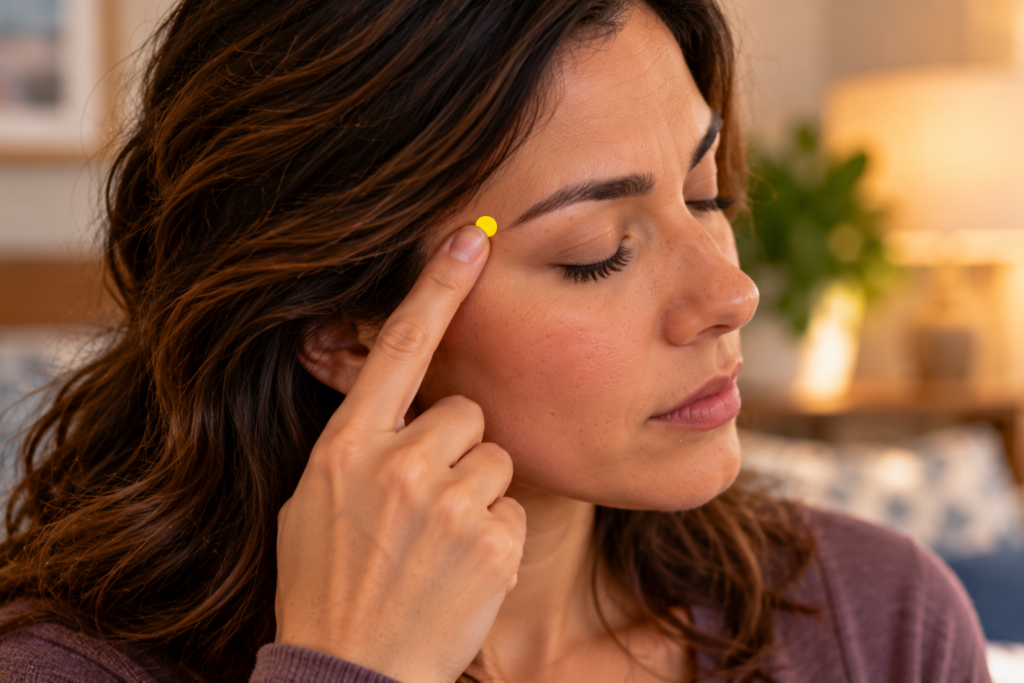
2. Press on Taiyang at the temple to ease throbbing pain. Taiyang sits in the soft hollow at the temple, about one finger-width behind the midpoint between the outer end of the eyebrow and the outer corner of the eye. Press gently with your fingertips, or make slow circles, for one to two minutes on both sides. Taiyang is called the “Supreme Yang.”
In Traditional Chinese Medicine, Taiyang is considered an extra point used to relieve pain in the temples and behind the eyes, which are common sites for menstrual migraines. Gentle pressure on this point can be soothing, even when your head is very sensitive.
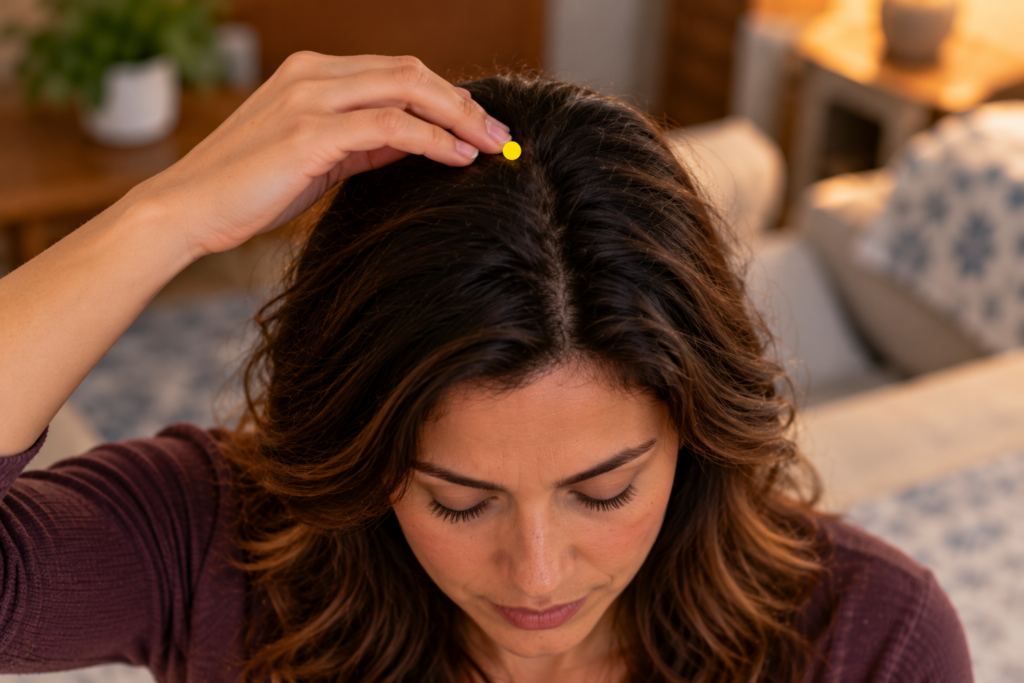
3. Press on GV20 at the top of the head to calm the mind and ease pain. GV20 sits on the top of the head, at the midpoint of an imaginary line drawn from the top of one ear to the top of the other. Press gently but steadily with your fingertips for one to two minutes. GV20 is called “Baihui,” the “Hundred Meetings.”
In Traditional Chinese Medicine, the Liver channel travels through the body to the top of the head, where it meets GV20. This makes GV20 important for pain that spreads across the crown. It can also calm the mind and ease irritability and restlessness before your period.
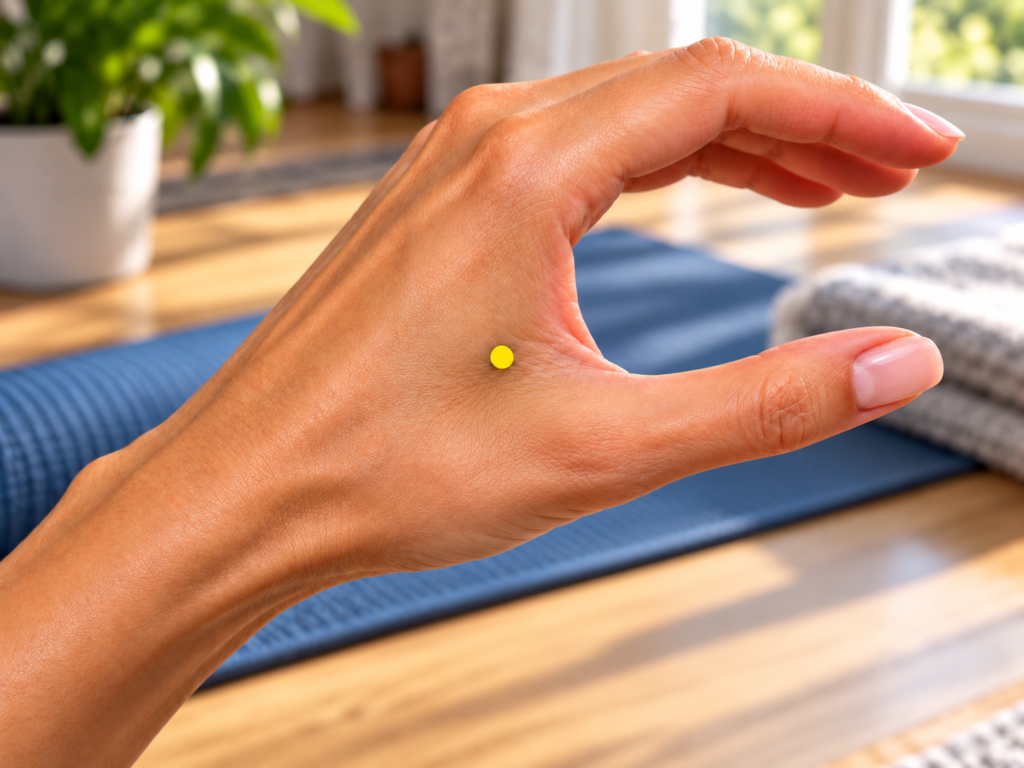
4. Press on LI4 in the hand to relieve pain. LI4 sits in the webbing between the thumb and index finger, at the highest point of the muscle when you bring the thumb and index finger together. Press firmly with the thumb of your other hand for one to two minutes on each hand. LI4 is called “Hegu,” the “Joining Valley.” LI4 is avoided during pregnancy.
LI4 is a key point for pain, especially in the head and face. You can press it discreetly at work, in the car, or anywhere you feel a migraine starting to build.
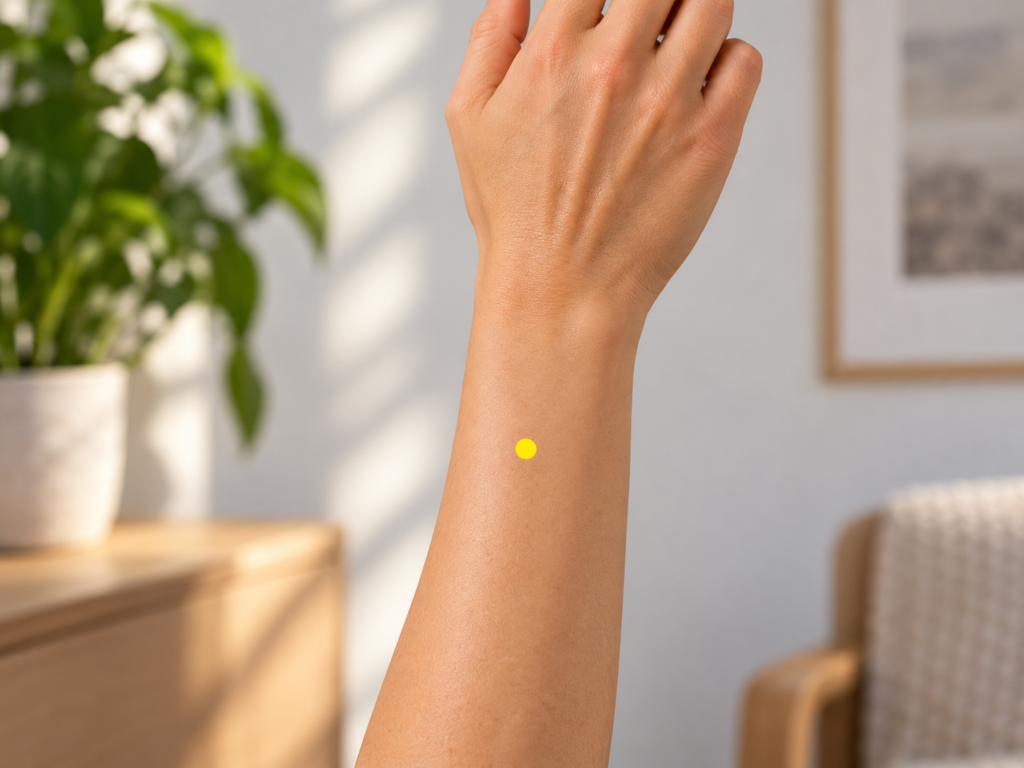
5. Press on PC6 on the inner forearm to settle nausea. PC6 sits on the inner forearm, three finger-widths above the wrist crease, between the two tendons. Press firmly with the thumb of your other hand for one to two minutes on each arm. PC6 is called “Neiguan,” the “Inner Pass.”
Nausea and vomiting are common with menstrual migraines and can make them much harder to manage. PC6 is the most studied point for nausea and may also ease anxiety that can accompany a severe headache.

6. Press on SJ5 on the back of the forearm to open the sides of the head. SJ5 sits on the back of the forearm, three finger-widths above the wrist crease, in the space between the two forearm bones, directly opposite PC6. Press firmly with your thumb for one to two minutes on each arm. SJ5 is called “Waiguan,” the “Outer Pass.”
SJ5 lies on the San Jiao channel, which, like the Gallbladder channel, runs along the side of the head around the ear and temple. In Traditional Chinese Medicine, SJ5 is paired with GB41 on the foot to help open the sides of the head, making it especially useful for one-sided, throbbing migraines.
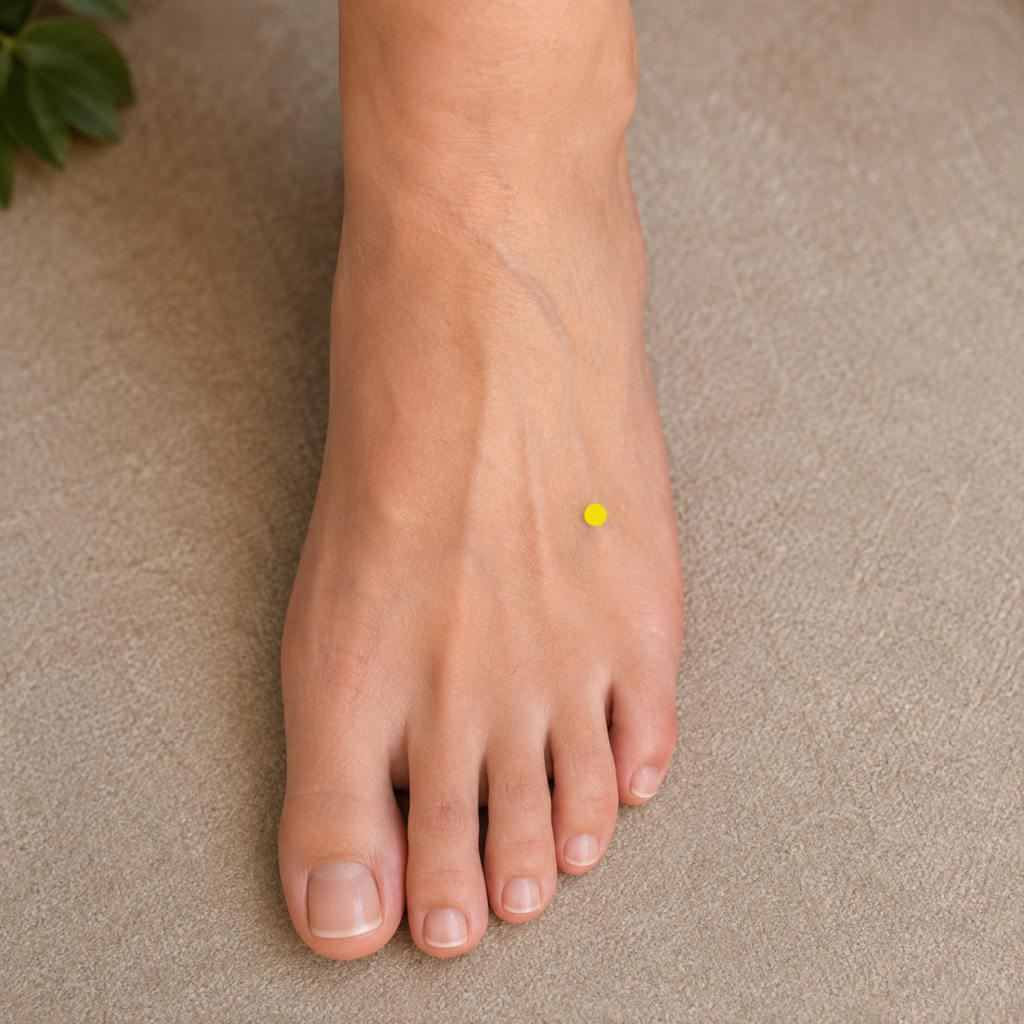
7. Press on GB41 on the top of the foot to relieve headaches tied to the cycle. GB41 sits on the top of the foot, in the hollow just before the bones of the fourth and fifth toes meet, on the outer side of the small tendon that runs to the little toe. Press firmly with your thumb for one to two minutes on each foot. GB41 is called “Zulinqi,” the “Foot Overlooking Tears.”
In Traditional Chinese Medicine, GB41 is a classic point for headaches that come and go with your cycle and for breast tenderness before your period. It follows the Gallbladder channel from the foot to the side of the head, helping draw excess energy down and away from the painful area.
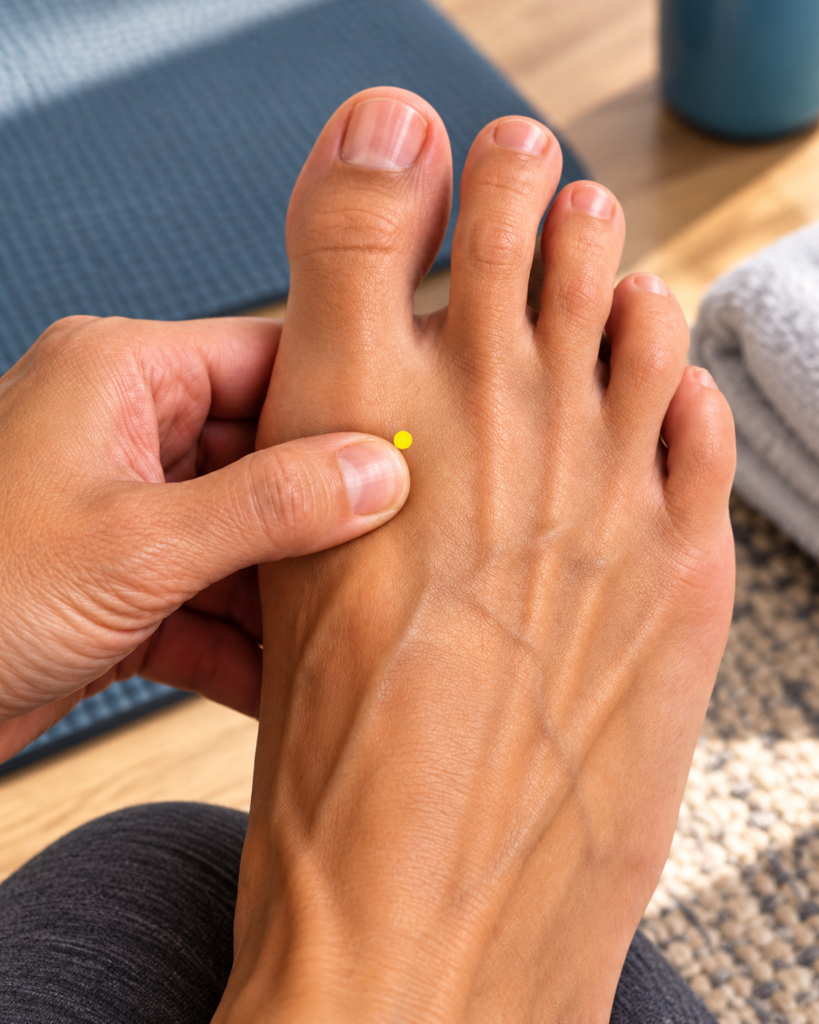
8. Press on LR3 on the top of the foot to calm rising Liver energy. LR3 sits in the webbing between the big toe and second toe, about two finger-widths back from the webbing, in the hollow just before the two bones meet. Press firmly with your thumb for one to two minutes on each foot. LR3 is called “Taichong,” the “Great Surge.”
LR3 is the Liver’s main point and is especially helpful for headaches caused by rising Liver Yang. It helps move stagnant Liver Qi, ease premenstrual tension and irritability, and draw energy away from the head.
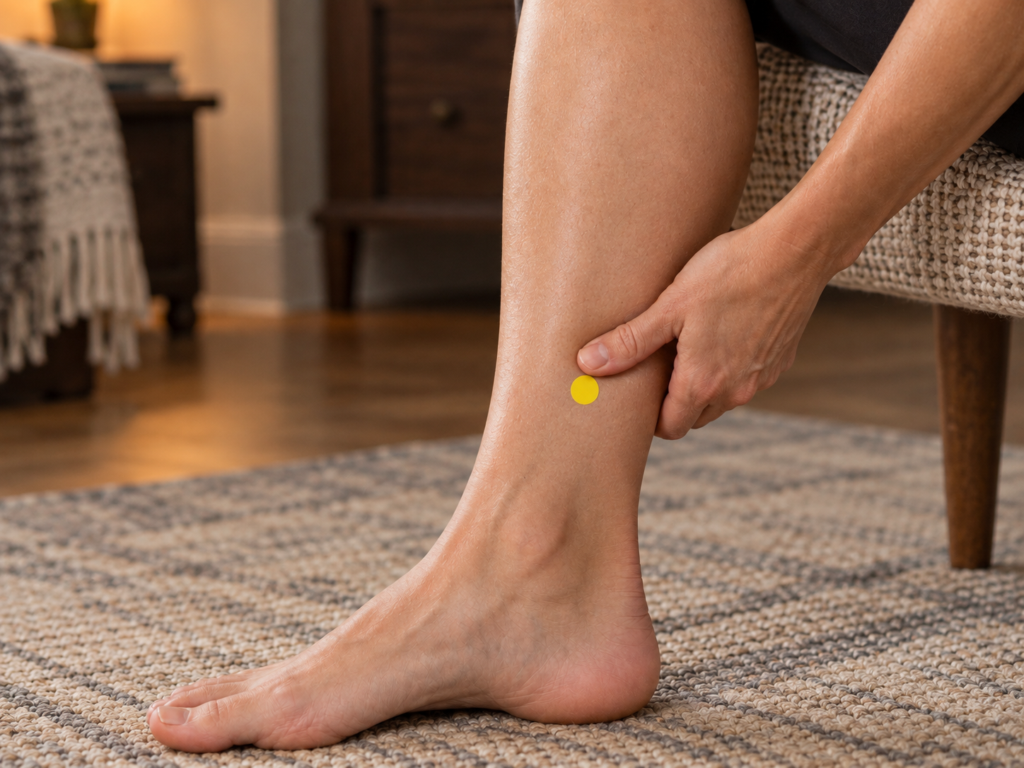
9. Press on SP6 above the inner ankle to regulate the cycle. SP6 sits four finger-widths up from the tip of the inner ankle bone, just behind the back edge of the shinbone. Press firmly with your thumb for one to two minutes on each leg. SP6 is called “Sanyinjiao,” the “Three Yin Intersection.” SP6 is avoided during pregnancy.
SP6 is where the Spleen, Liver, and Kidney channels meet, and all three influence the menstrual cycle. SP6 helps regulate menstruation, nourish the Blood, and ease cramps. Using SP6 before your period may address the root cause of menstrual migraines, not just the headache.
Why These Acupressure Points Work
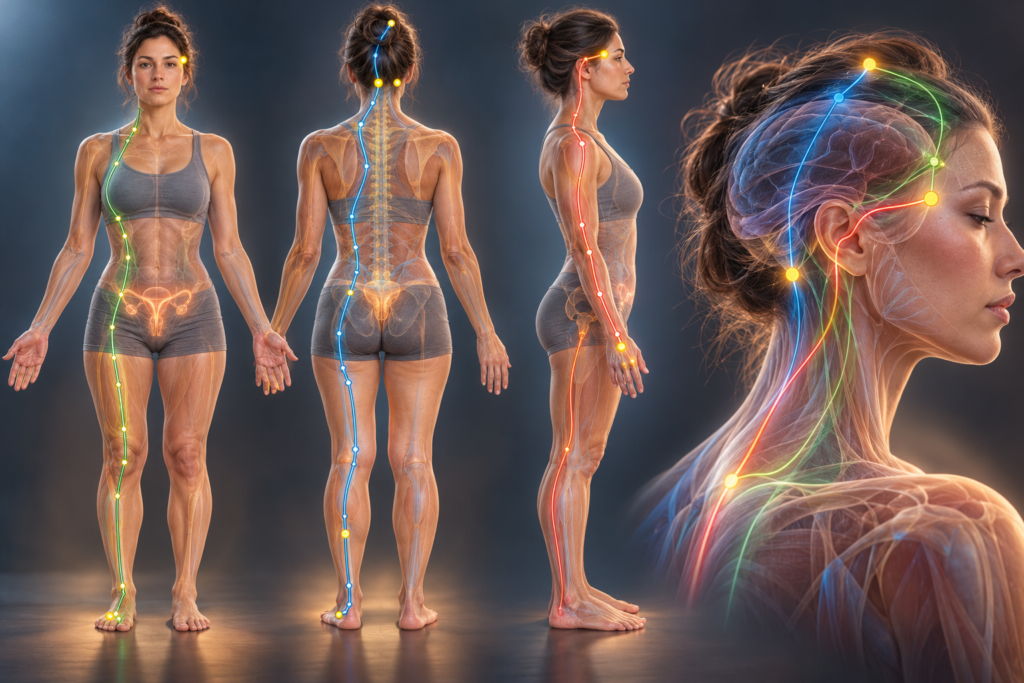
According to Traditional Chinese Medicine, a calm, clear head during your cycle depends on smooth Liver Qi, sufficient Blood to nourish the head, and an easy-flowing cycle. If Liver Qi becomes constrained before your period, its energy rises to the head, causing throbbing pain. When Blood is low during your period, the head receives insufficient nourishment.
The nine points ease the pain and address its cause:
- The head and neck points (GB20, Taiyang, GV20) ease pain where it occurs and release tension in the neck and scalp.
- The hand and arm points (LI4, PC6, SJ5) ease pain at a distance, calm nausea, and relieve tension along the sides of the head.
- The foot points (GB41, LR3) help calm rising Liver energy and draw it down, away from the head.
- The cycle point (SP6) helps regulate the menstrual period and nourish the Blood.
How to Properly Use These Acupressure Points

Acupressure is most effective for menstrual migraines when timed to the cycle.
- Begin the full routine two to three days before the expected period and continue once a day through the first three days of bleeding, holding each point for one to two minutes.
- At the first sign of a migraine, press GB20, Taiyang, LI4, and LR3 right away, and add PC6 if nausea starts.
- Use gentle pressure on the head and temples and firm pressure on the hands, arms, feet, and legs.
- Practice consistently for at least three cycles, since the pattern of a menstrual migraine often takes a few months to change.
Your daily habits leading up to your period matter just as much as using acupressure points. Track your cycle to identify when you’re most vulnerable, and keep your sleep, meals, and water intake consistent. Skipped meals, poor sleep, and dehydration can trigger migraines. Limit alcohol and keep your caffeine intake steady rather than changing it suddenly. When a migraine starts, rest in a dark, quiet room and try a cool cloth on your forehead or a warm compress at the back of your neck, whichever feels better.
If you also experience cramping, bloating, or mood changes before your period, consider learning more about acupressure for PMS.
When to Get Professional Help

See your doctor if your migraines become more frequent or severe, last longer than 72 hours, or do not respond to your current treatment. Talk to your doctor about migraines with aura before starting or continuing estrogen-containing birth control, because this combination can increase the risk of stroke. Contact your doctor promptly if you have a migraine that differs from your usual pattern, your first migraine after age 50, or headaches that begin during pregnancy or after giving birth. Seek emergency care for a sudden, severe headache that feels like the worst of your life; a headache with fever and a stiff neck; or a headache accompanied by confusion, weakness or numbness on one side of the body, trouble speaking, vision loss, or fainting. These symptoms can signal a stroke, bleeding in the brain, or an infection that requires immediate treatment.
Acupressure may help support menstrual migraines but doesn’t replace diagnosis or medical care.
For related health concerns, acupressure for migraines, acupressure for menstrual cramps, and acupressure for vestibular migraine are companion pieces.
Above and Beyond Acupuncture offers acupuncture, cupping, and lifestyle coaching at the North Frank Lloyd Wright Boulevard location in Scottsdale.
Schedule an appointment online to start your healing journey.
The points above are only as effective as the technique used to apply them. Where to press, how firmly, and for how long all affect the result. For a full breakdown of how to perform acupressure properly at home, read Performing Acupressure in 3 Easy Steps.

About the Publisher
Paul Kerzner, L.Ac., is a licensed acupuncturist and board-certified herbalist, as well as the founder of Above and Beyond Acupuncture in Scottsdale. His own journey from chronic patient to practicing acupuncturist shapes his commitment to providing honest, clinically grounded information about acupuncture and Traditional Chinese Medicine. Learn more about Paul and his clinical approach on the About Us page.