
Key Takeaways
- Emotions can activate the fight-or-flight response, impairing clear thinking; acupressure offers a straightforward, effective method to relax.
- Specific acupressure points, like PC6 and HT7, help soothe the heart and mind during moments of anxiety.
- A quick 60-second calming method includes pressing PC6 and concentrating on deep breathing to restore calmness rapidly.
- Alongside acupressure, be aware of when it’s essential to seek professional assistance for ongoing emotional issues or panic attacks.
- Acupressure to calm down is a portable method that can complement professional care and improve overall stress management.

Is your heart pounding, your jaw clenched, and your mind racing?
Everyone faces moments when emotions take over, like during a tense talk, a scary call, traffic jams, a crying child, or when you’re exhausted at the end of the day. In these moments, the fight-or-flight response kicks in: your heart races, breathing quickens and deepens, muscles tense up, and clear thinking becomes hard. Acupressure provides an easy, private way to interrupt this response, helping your body restore calm through just your hands and breathing.
Research shows that many people experience relief by stimulating specific acupressure points. According to Traditional Chinese Medicine, intense emotions are thought to cause Qi to move upward and outward. For instance, anger and frustration can cause Liver Qi to rise, resulting in symptoms like a hot face, clenched jaw, and pounding headache. Fear and panic tend to disperse the Qi, potentially leading to a racing heart and dizziness. Strong emotions also affect the Shen, the mind and spirit linked to the Heart.
The 60-Second Calm-Down
If you need to quickly calm yourself, start with this technique. Use your thumb to press the PC6 point on your inner forearm. Inhale slowly through your nose for four seconds, then exhale through your mouth for six or eight seconds. Alternatively, take two quick breaths in through your nose, then perform one slow, deep exhale through your mouth. Repeat this cycle for five or six breaths, then switch to the other arm. Longer exhales help signal your nervous system to relax, and pressing PC6 enhances your focus. You can do this quietly anywhere without drawing attention.
Here are nine acupressure points that help calm the Heart and Shen, restore Qi, open the chest for deeper breathing, and help you feel grounded.
What Acupressure Points to Press and Why
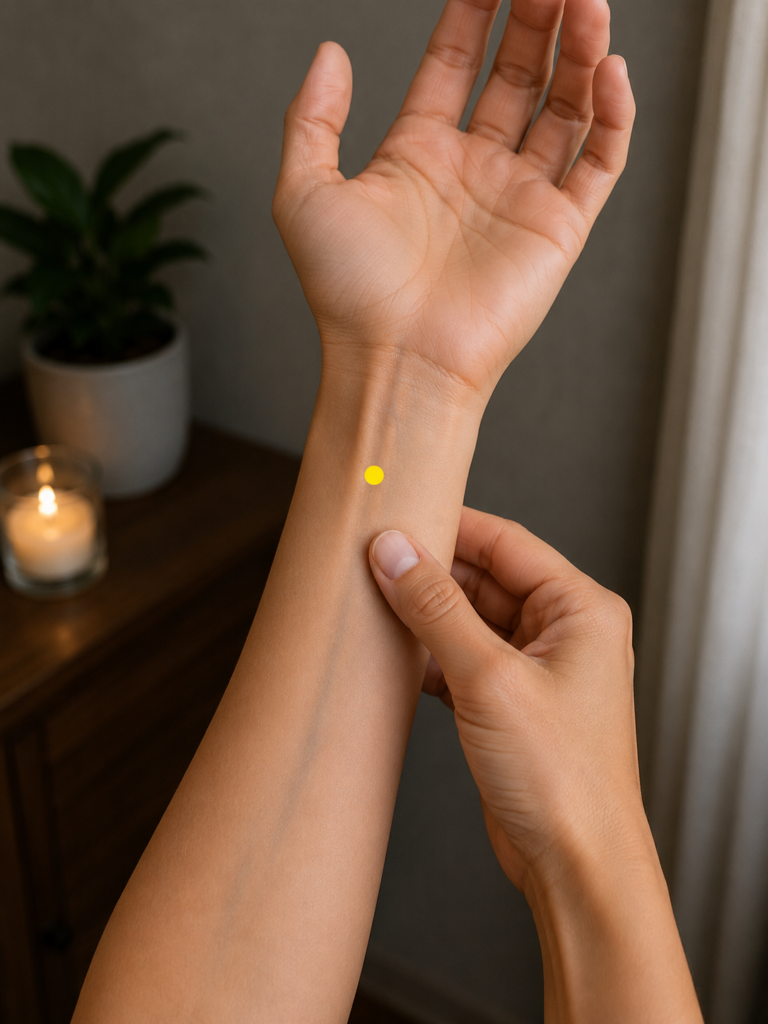
1. Press on PC6 on the inner forearm to slow a racing heart. PC6 sits three finger-widths above the inner wrist crease, in the center of the forearm between the two tendons. Press firmly with your thumb for one to two minutes on each arm while breathing slowly. PC6 is called “Neiguan,” the “Inner Pass.”
PC6 helps soothe the Heart, open the chest, and calm the stomach at the same time. It is effective for relieving a pounding heart, tight chest, or upset stomach during intense emotions. This point is key for the 60-second calm-down method, and you can press it discreetly during meetings, in the car, or amidst tense conversations.
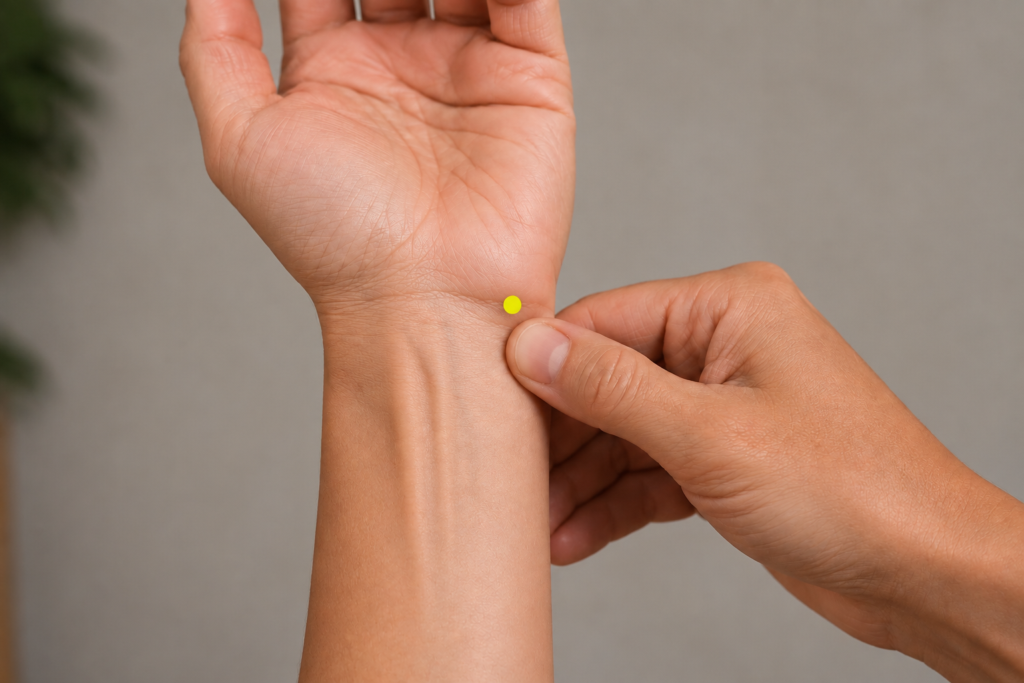
2. Press on HT7 at the wrist to settle the mind. HT7 sits on the inner wrist crease, on the pinky side, in the small hollow just inside the tendon. Press firmly with your thumb for one to two minutes on each wrist. HT7 is called “Shenmen,” the “Spirit Gate.”
HT7 is essential for calming the Shen, addressing issues like agitation, restlessness, and racing thoughts that interfere with clear thinking. Located just below PC6, it’s easy to reach by moving your thumb from one point to the other.
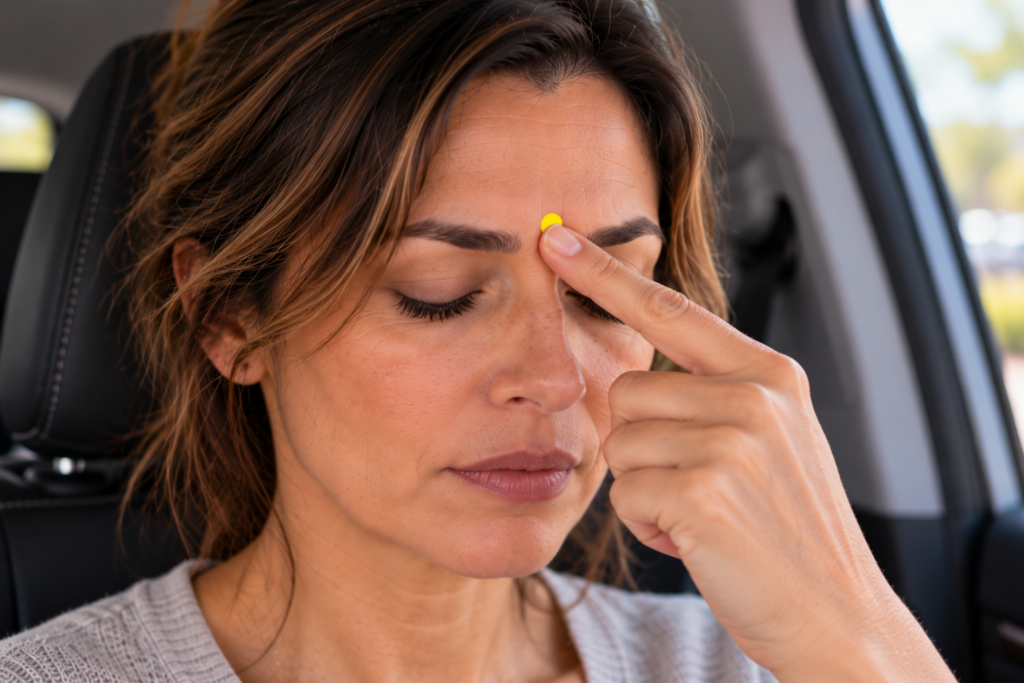
3. Press on Yintang between the eyebrows to quiet the storm. Yintang sits in the small hollow directly between the two eyebrows. Press steadily, or make small, slow circles with your fingertip for one to two minutes, eyes closed if possible. Yintang is an extra point.
Yintang is a highly calming point, extensively researched for its effects on anxiety. It can soothe a racing mind and ease tension in the brow caused by frustration or worry. By closing your eyes and pressing this point while taking slow, deep breaths, you can rapidly achieve a sense of calm.
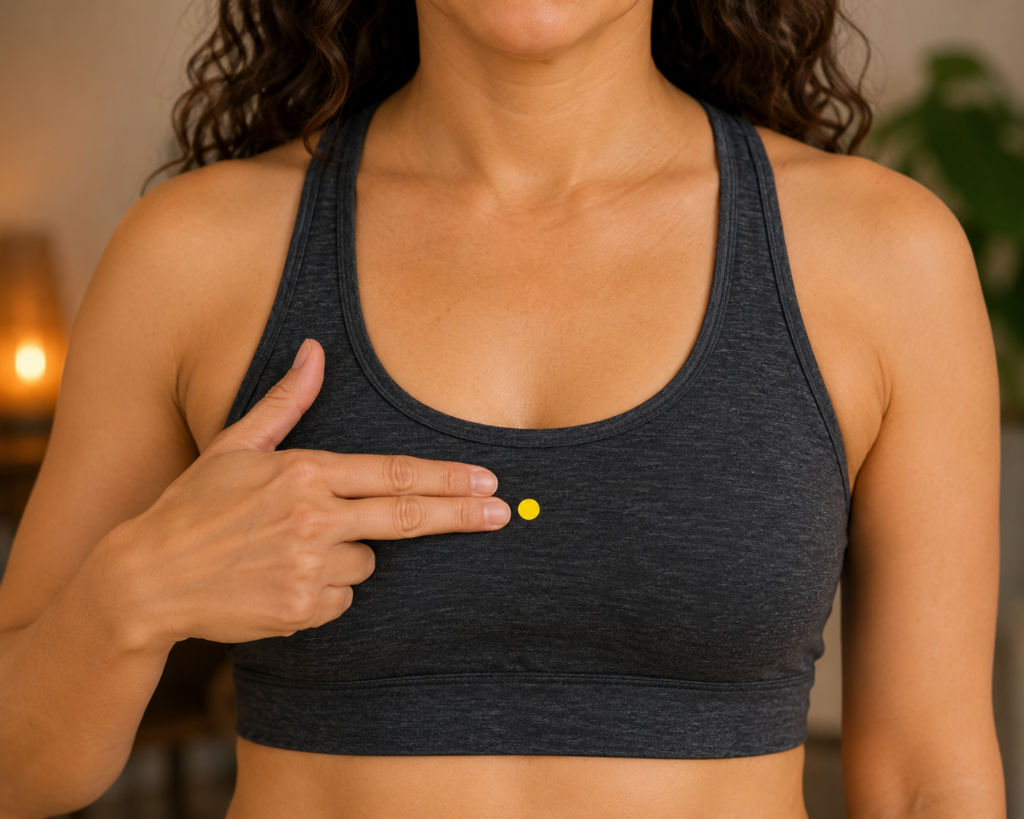
4. Press on CV17 at the center of the chest to release tightness. CV17 sits on the midline of the breastbone, level with the space between the nipples. Press gently with your fingertips, or rest your palm over it, for one to two minutes while breathing slowly into the chest. CV17 is called “Shanzhong.”
When intense emotions arise, you might experience a tight chest and shallow breathing. CV17 aids in opening and relaxing the chest, allowing for deeper breaths. Placing your hand here can be comforting, especially if you’re feeling choked, tearful, or unable to breathe fully.
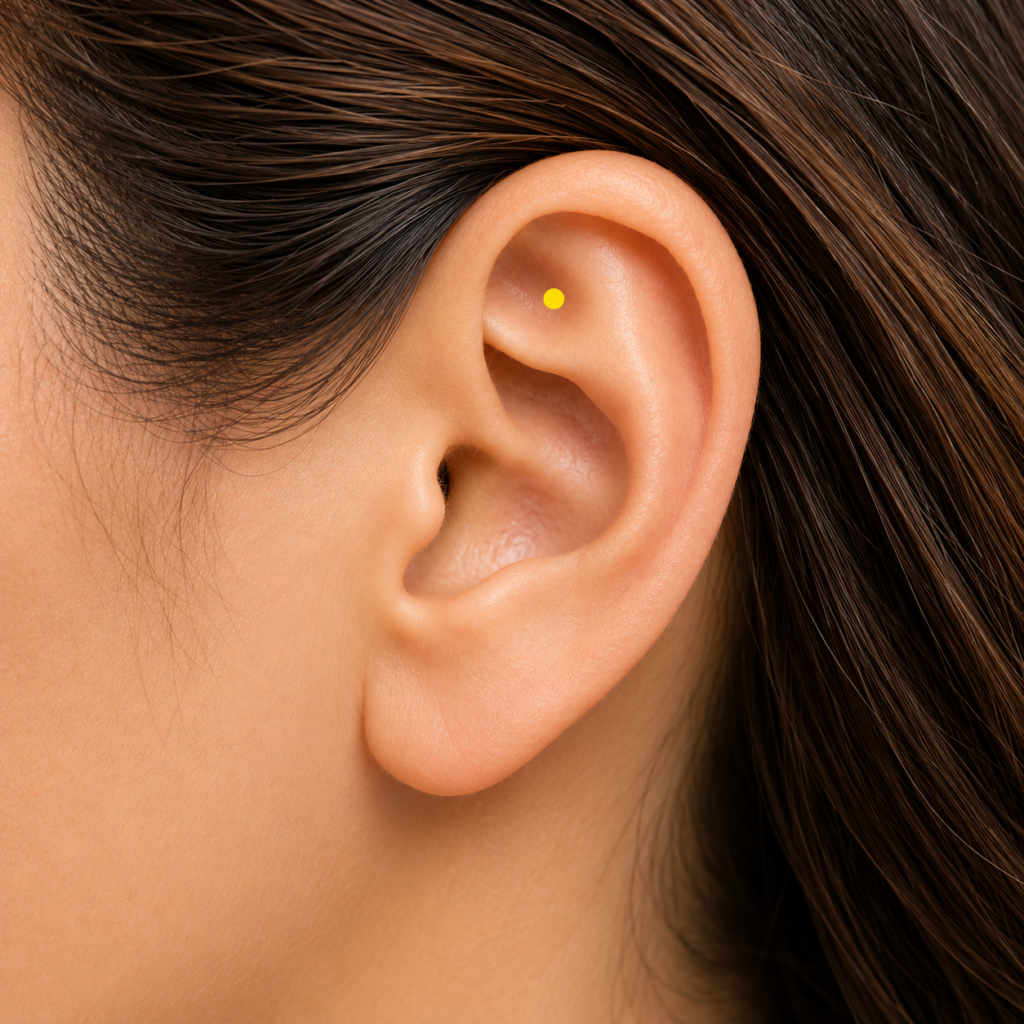
5. Press Ear Shenmen for fast, quiet calm. Ear Shenmen sits in the upper part of the ear, in the triangular hollow near the top, at its apex. Press gently with a fingertip or squeeze between the finger and thumb for about a minute on each ear.
Ear Shenmen is a traditional calming point on the ear that acts quickly. You can press it while resting your head on your hand, making it look like you’re simply thinking.
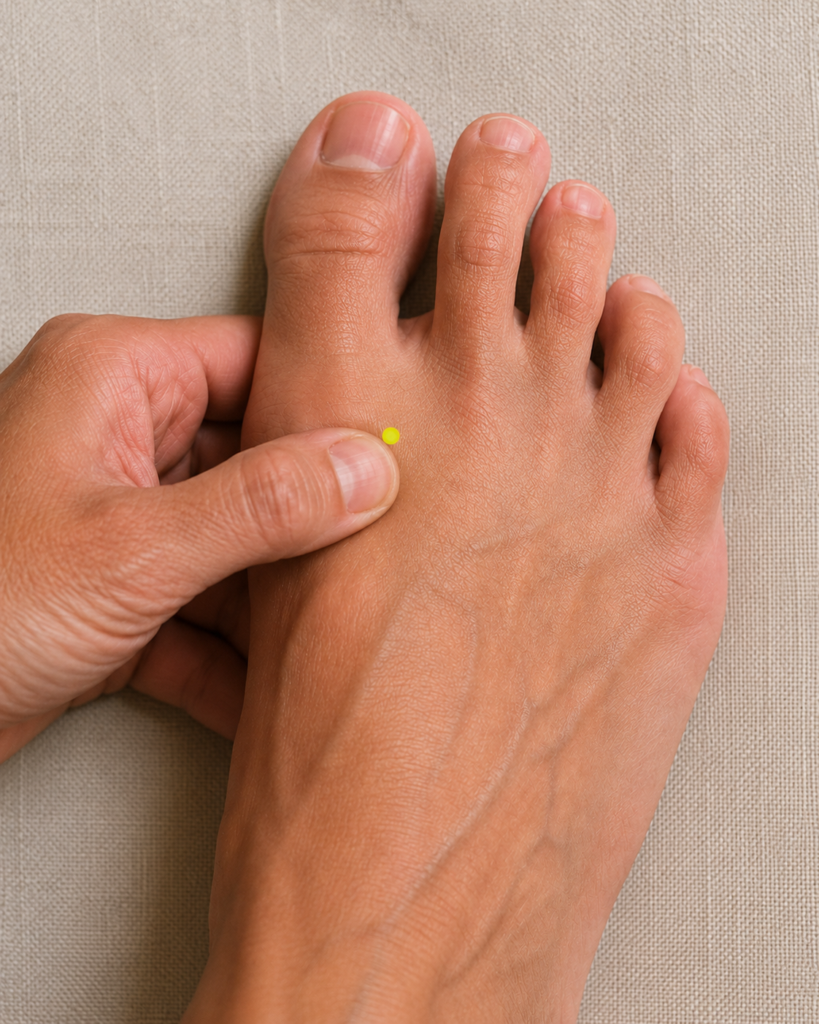
6. Press on LR3 on the top of the foot to bring down anger and frustration. LR3 sits on the top of the foot, in the webbing between the big toe and second toe, about two finger-widths back where the bones meet in a small hollow. Press firmly with your thumb for one to two minutes on each foot. LR3 is called “Taichong.”
When you feel anger, frustration, or irritation, Liver Qi rises, leading to facial heat and tension in the jaw and shoulders. LR3 is the primary point for diminishing this energy. If seated, you can also press on it through your shoe with the heel of your other foot.
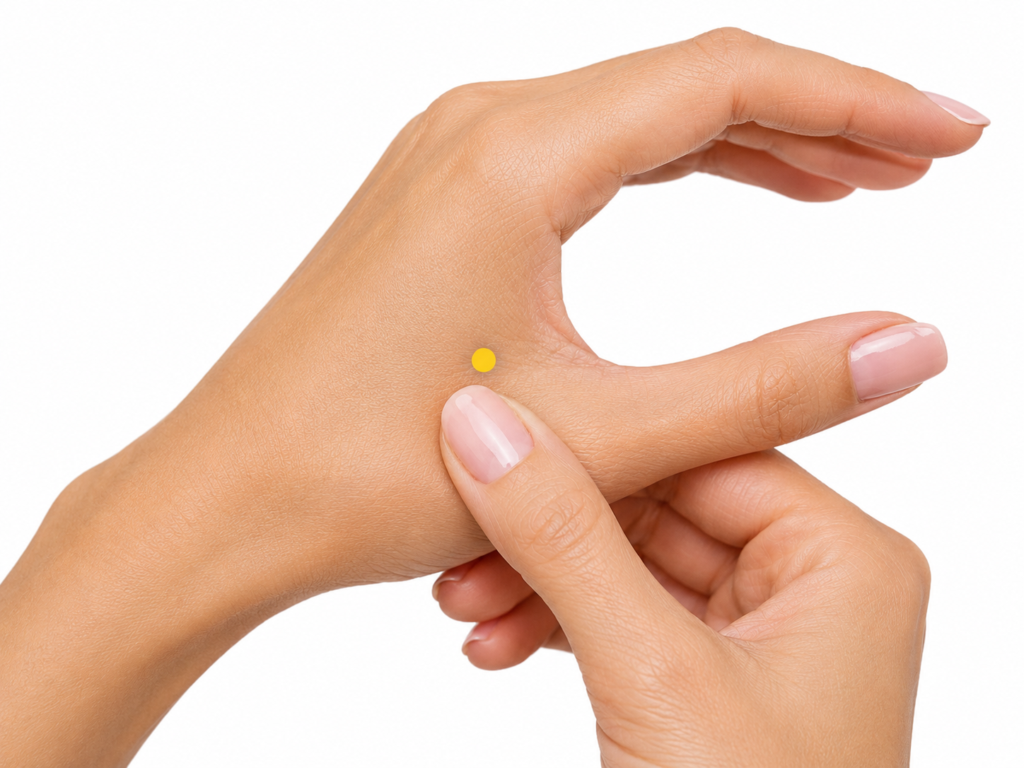
7. Press on LI4 in the hand to release tension. LI4 sits in the webbing between the thumb and index finger, at the highest point of the muscle when you bring them together. Press firmly with the thumb of your other hand for one to two minutes on each hand. LI4 is called “Hegu.” LI4 is avoided during pregnancy.
LI4 helps relieve tension throughout the body. It can alleviate a clenched jaw, tension headaches, and tight shoulders. When combined with LR3, these points form the Four Gates, a traditional method to promote the flow of stuck Qi and soothe the entire system.
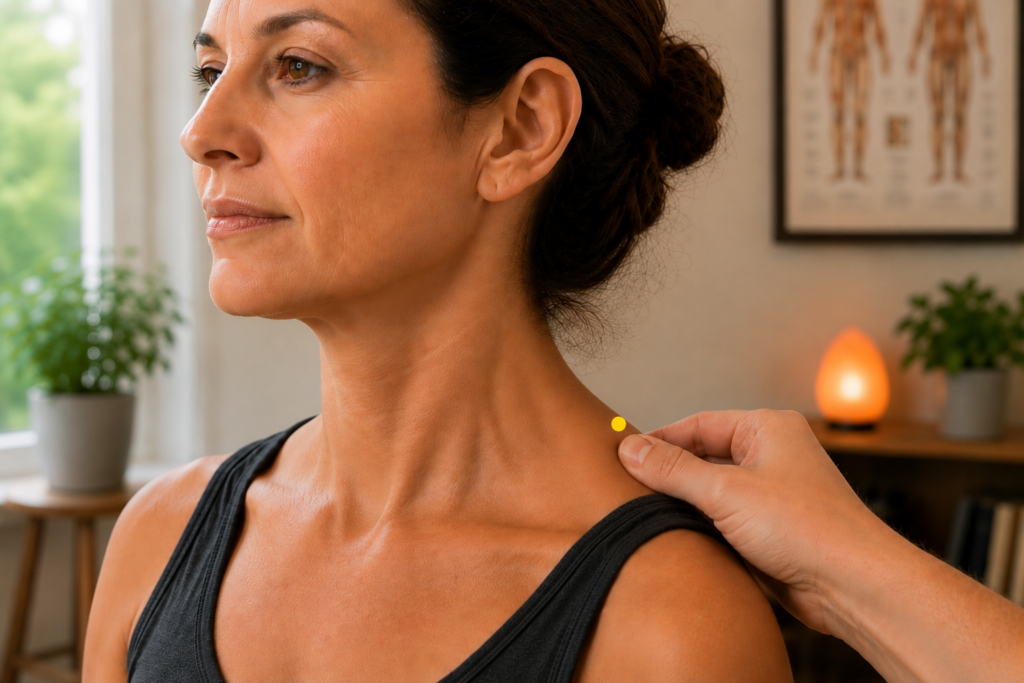
8. Squeeze GB21 on top of the shoulders to let the tension drop. GB21 sits at the highest point of the shoulder, midway between the base of the neck and the tip of the shoulder, on the ridge of the trapezius muscle. Squeeze the muscle firmly between your fingers and thumb, or press down, for about a minute on each side, then let the shoulders drop as you exhale. GB21 is called “Jianjing.” GB21 is avoided during pregnancy.
When emotions intensify, tension often builds in your shoulders. Pressing GB21 and then relaxing your shoulders as you exhale can help relieve this tension and promote overall relaxation.
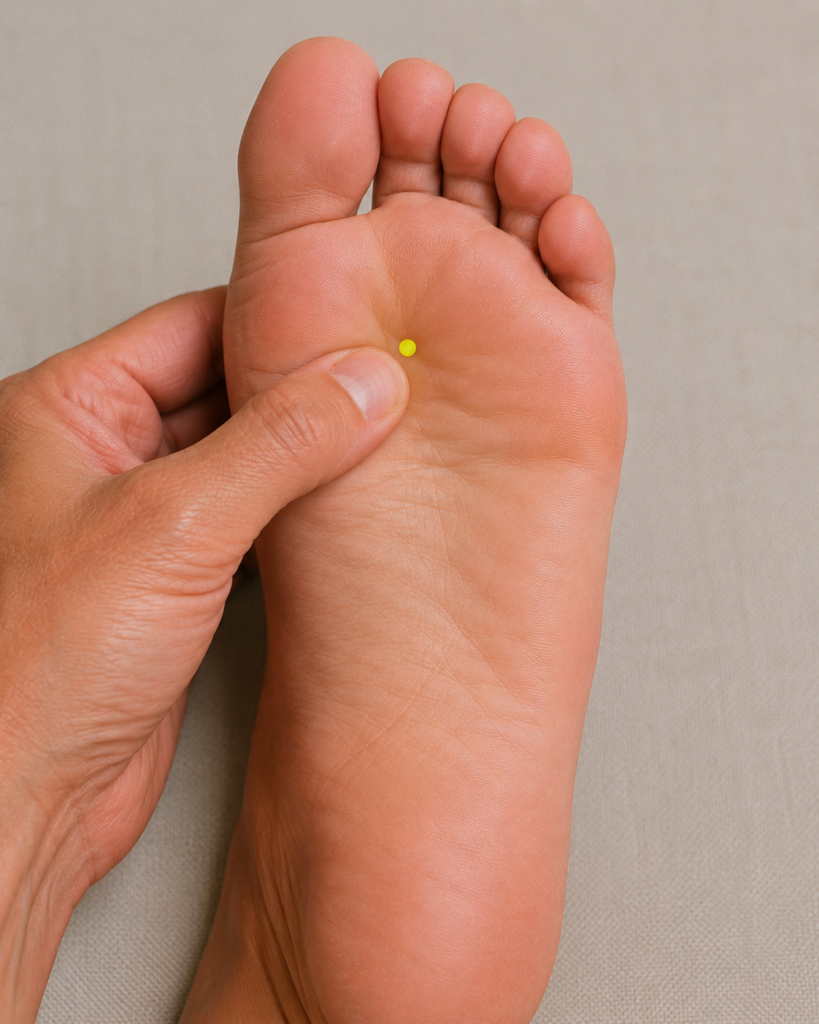
9. Press on KI1 on the sole of the foot to ground yourself. KI1 sits on the sole of the foot, in the hollow that forms in the center of the ball of the foot when you curl the toes. Press firmly with your thumb for about a minute on each foot, or stand and press the balls of your feet firmly into the floor. KI1 is called “Yongquan,” the “Bubbling Spring.”
When emotions cause your energy to surge into your head and chest, KI1, the lowest point on the body, helps to ground it. Pressing your feet into the ground and taking slow breaths quickly restores a sense of stability and presence.
Why These Acupressure Points Work
In Traditional Chinese Medicine, an emotional surge causes Qi to ascend and spread, disturbing the Shen. These nine points assist in reversing that process.
- The mind points (PC6, HT7, Yintang, Ear Shenmen) help calm the Heart and settle the Shen.
- The chest point (CV17) helps relieve tightness, allowing for deeper breathing.
- The releasing points (LR3, LI4, GB21) help reduce rising anger and release stored tension.
- The grounding point (KI1) directs energy downward, helping to establish stability.
The 5-Minute Calm-Down Routine
If you have a few minutes, go through these points one by one. Breathe slowly throughout, with longer exhales.
- Start with PC6 and HT7 on both wrists.
- Move to Yintang with your eyes closed, then rest a hand on CV17.
- Squeeze GB21 and let your shoulders drop on the exhale.
- Press LI4 and LR3, the Four Gates.
- Finish with Ear Shenmen and KI1, pressing your feet into the floor.
Hold each point for 30 seconds to a minute. Afterward, look around and identify a few things you can see, hear, and feel. This practice helps you reconnect with the present moment.
When possible, step away from the situation for a few minutes. Splash cold water on your face or hold something cold in your hands. Taking a short walk can also help because physical activity supports stress management. Wait to make decisions or send messages until you feel calmer. Spending a few minutes each day on slow breathing or acupressure can gradually lower your overall tension, resulting in fewer and shorter stress episodes.
When to Get Professional Help
Call emergency services if you experience chest pain or pressure, pain spreading to your arm, jaw, or back, severe shortness of breath, or fainting, especially if it’s your first time or you’re unsure whether it’s panic or a physical issue. If you have thoughts of harming yourself, contact the 988 Suicide and Crisis Lifeline immediately by phone or text. If you feel so angry that you might hurt someone, step away from the situation and seek help. Visit a doctor or counselor if you frequently feel overwhelmed, have ongoing panic attacks, struggle with anger, or find it harder to calm down. These problems often respond well to support.
Acupressure is a simple, portable method to soothe yourself quickly and can be used alongside professional care when necessary.
Above and Beyond Acupuncture offers acupuncture, cupping, and lifestyle coaching at the North Frank Lloyd Wright Boulevard location in Scottsdale.
Schedule an appointment online to start your healing journey.
The points above are only as effective as the technique used to apply them. Where to press, how firmly, and for how long all affect the result. For a full breakdown of how to perform acupressure properly at home, read Performing Acupressure in 3 Easy Steps.
For stress that develops over days and weeks, “How to use Acupressure for Stress” provides more in-depth guidance, while for persistent worry and nervousness, “How to use Acupressure for Anxiety” serves as the companion resource.

About the Publisher
Paul Kerzner, L.Ac., is a licensed acupuncturist and board-certified herbalist, as well as the founder of Above and Beyond Acupuncture in Scottsdale. His own journey from chronic patient to practicing acupuncturist shapes his commitment to providing honest, clinically grounded information about acupuncture and Traditional Chinese Medicine. Learn more about Paul and his clinical approach on the About Us page.