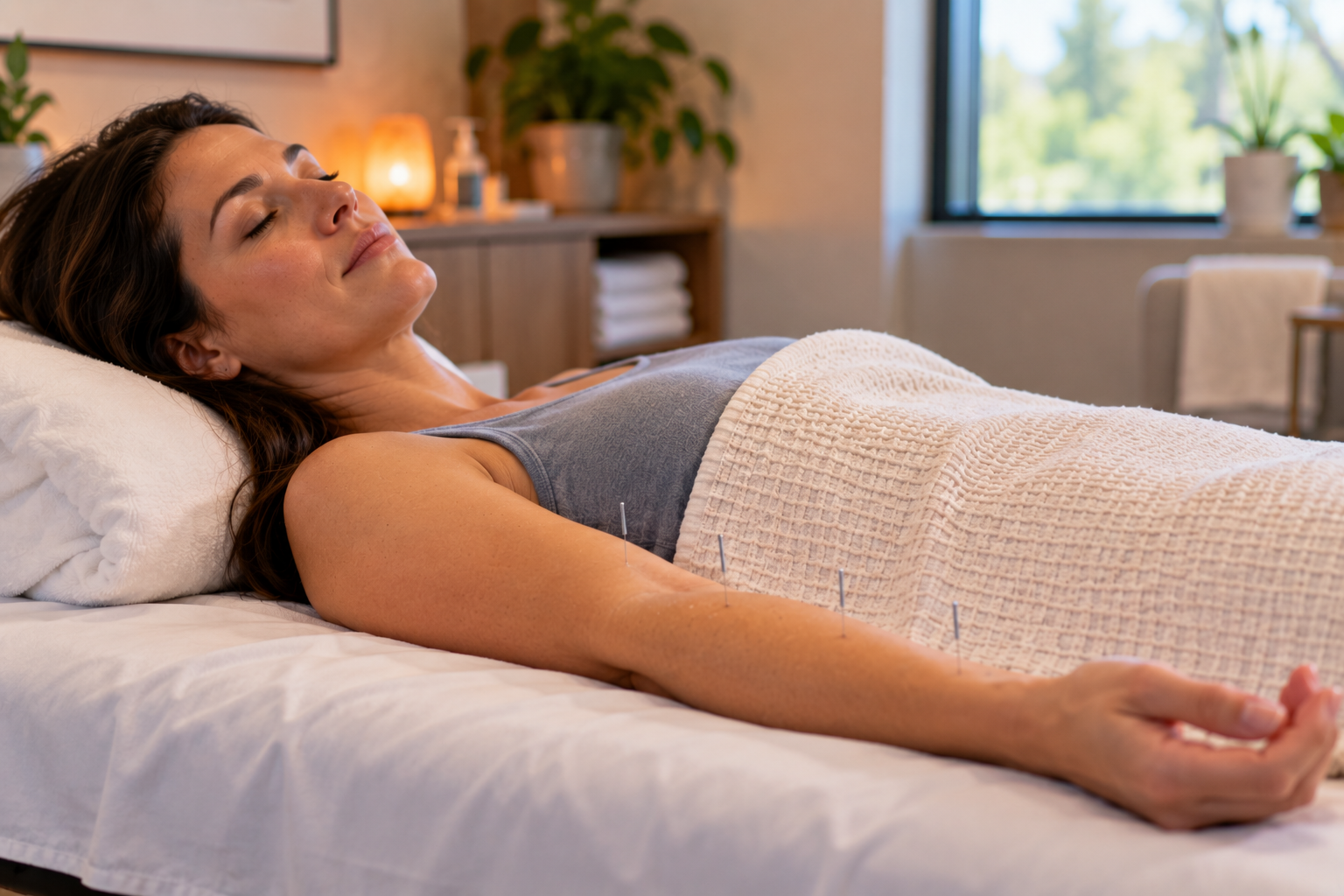
Key Takeaways
- Cortisol is a hormone produced by the adrenal glands. It normally peaks just before waking and reaches its lowest level around bedtime.
- Ongoing stress, short sleep, and night shifts can keep the stress response activated, while very high cortisol over a long period usually indicates Cushing syndrome and requires medical care.
- In Traditional Chinese Medicine, a body stuck on high alert reflects constrained Liver Qi, a restless Heart, and Kidney reserves being depleted faster than they are replenished.
- Nine acupressure points located on the head, chest, abdomen, wrists, legs, and feet may help reduce the stress response and replenish the resources it depletes.
- Acupressure is most effective when paired with consistent sleep, daily physical activity, and slow breathing. A physician should evaluate symptoms such as a rounded face, wide purple stretch marks, or new high blood pressure.

Cortisol follows a daily rhythm. It rises in the early morning, peaks just before you wake to help you get out of bed, then gradually declines throughout the day, reaching its lowest point at bedtime. When this pattern stays on track, mornings feel manageable and nights naturally wind down.
According to Cleveland Clinic, cortisol is a steroid hormone produced by the adrenal glands, which sit atop the kidneys. It helps regulate the stress response by releasing sugar from the liver for quick energy, briefly limiting inflammation, affecting blood pressure, and shaping the sleep-wake cycle. Stress of any kind triggers cortisol release, while insomnia and night-shift work can raise levels further. Very high levels over a long period usually indicate Cushing syndrome, most often caused by high-dose steroid medication or a tumor, and require medical treatment. To manage everyday stress, Cleveland Clinic recommends quality sleep, regular exercise, deep breathing to activate the body’s “rest and digest” system, laughter, and healthy relationships.
The vast majority of people looking for ways to reduce their cortisol aren’t actually suffering from a tumor. They’re suffering from a stress response that never gets the ‘switch off’ signal. The pattern is familiar: lying awake at 11 pm with a mind going absolutely wild, dragging at 7 am, crashing at 3 pm, then picking up a second wind just before bedtime. The shoulders are perpetually up at the ears, the breath is high in the chest, and the stomach is always tight.
Traditional Chinese Medicine has no concept of cortisol, but it certainly describes this pattern. Stress restricts Liver Qi, so tension builds up. The Heart is the house of the mind, and when the mind is agitated, sleep becomes light, and the mind will not switch off. Over months, the body runs on stress and depletes the Kidneys’ reserves (which, in Traditional Chinese Medicine terms, are the body’s deep battery). That’s why you end up with that wired-and-tired feeling. No amount of time off on the weekend will really fix it.
The nine points address two issues: the racing mind and the shallow breathing that’s the hallmark of a stress response that’s simply been left in the ‘on’ position. They also address the drained reserves underneath it all.
What Acupressure Points to Press and Why
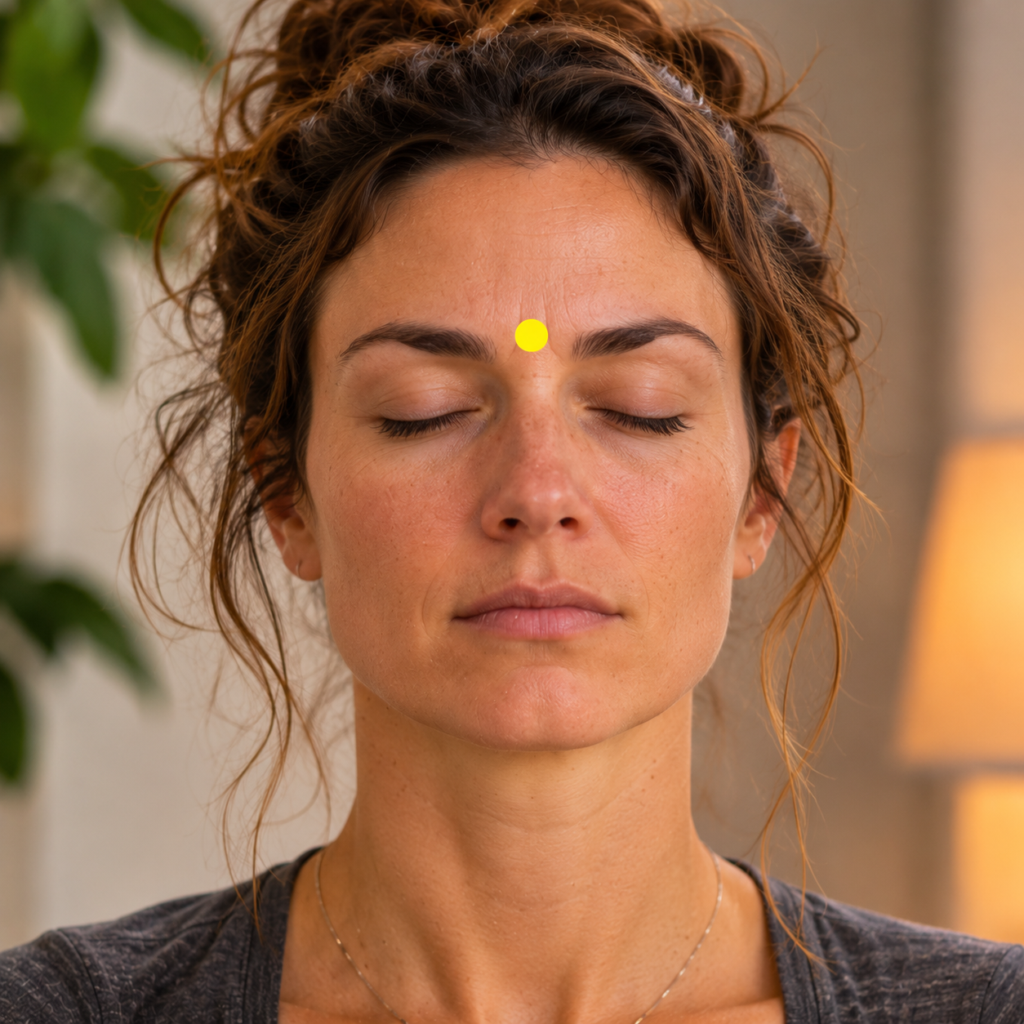
1. Press on Yintang between the eyebrows to quiet a racing mind. Yintang sits on the midline of the forehead, directly between the inner ends of the eyebrows. Press gently with your fingertip, or make slow, small circles, for one to two minutes with the eyes closed. Yintang is called the “Hall of Impression.”
Yintang is an extra point that helps calm the mind and ease anxiety. Close your eyes, slow your breath, and spend a minute here to gently signal to your body that the emergency has passed.
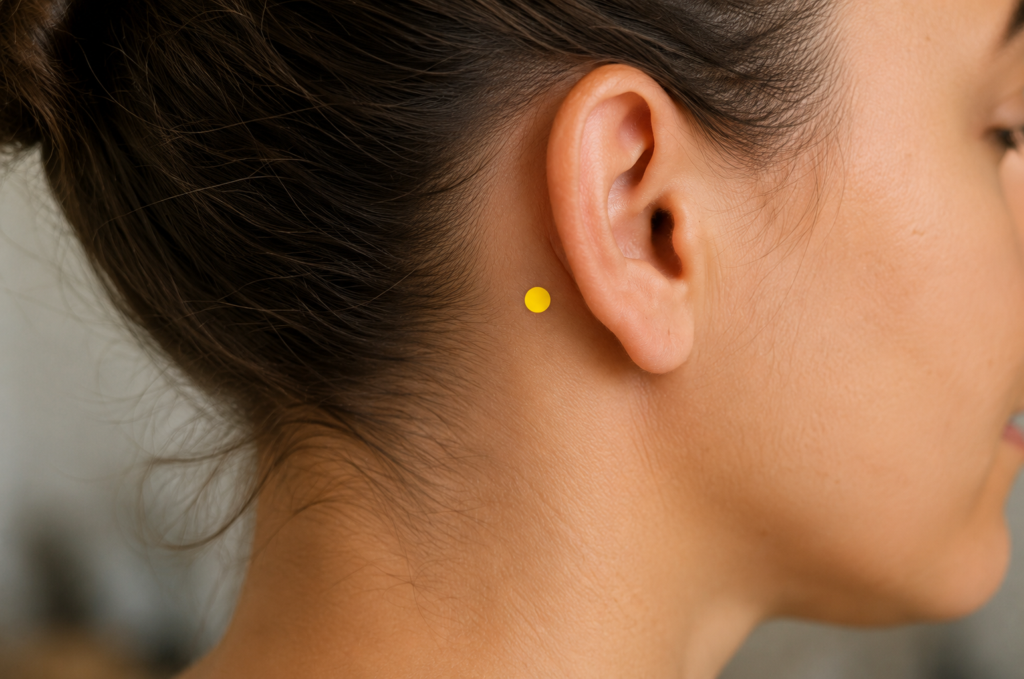
2. Press on Anmian behind the ear to settle the mind for sleep. Anmian sits behind the earlobe, in the soft hollow midway between the bony bump behind the ear and the hollow at the base of the skull. Press gently with your fingertip for one to two minutes on each side, ideally in bed with the lights off. Anmian is called “Peaceful Sleep.”
Anmian is an extra point used for insomnia, restlessness, and a mind that won’t switch off at night. Cortisol is supposed to be at its lowest around bedtime, so it’s the point you’d reach for if your body seems to have its schedule all wrong.
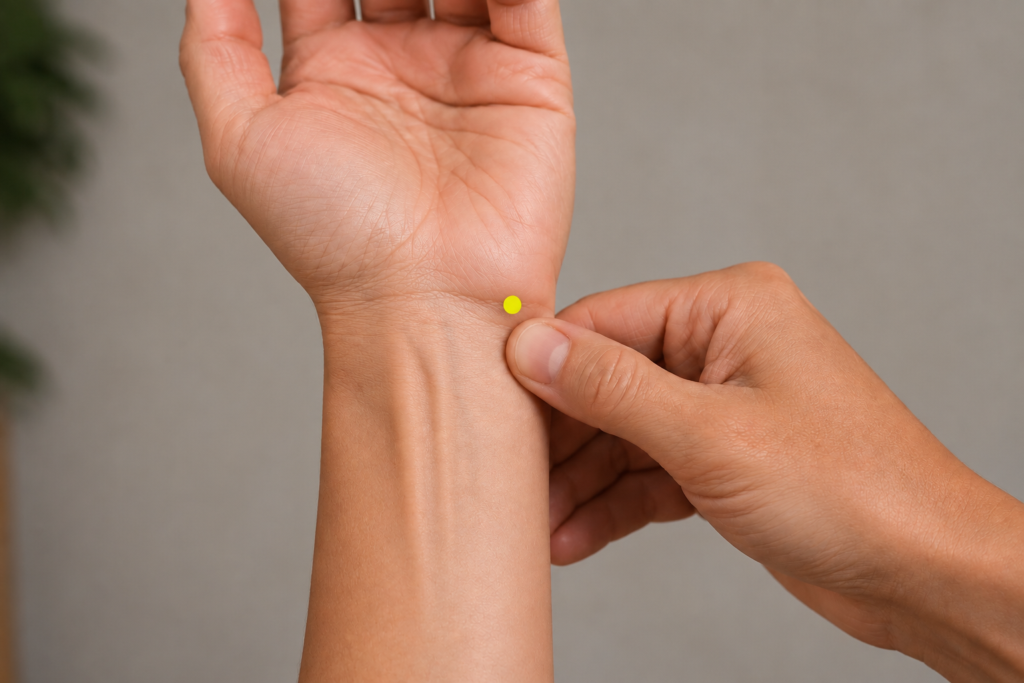
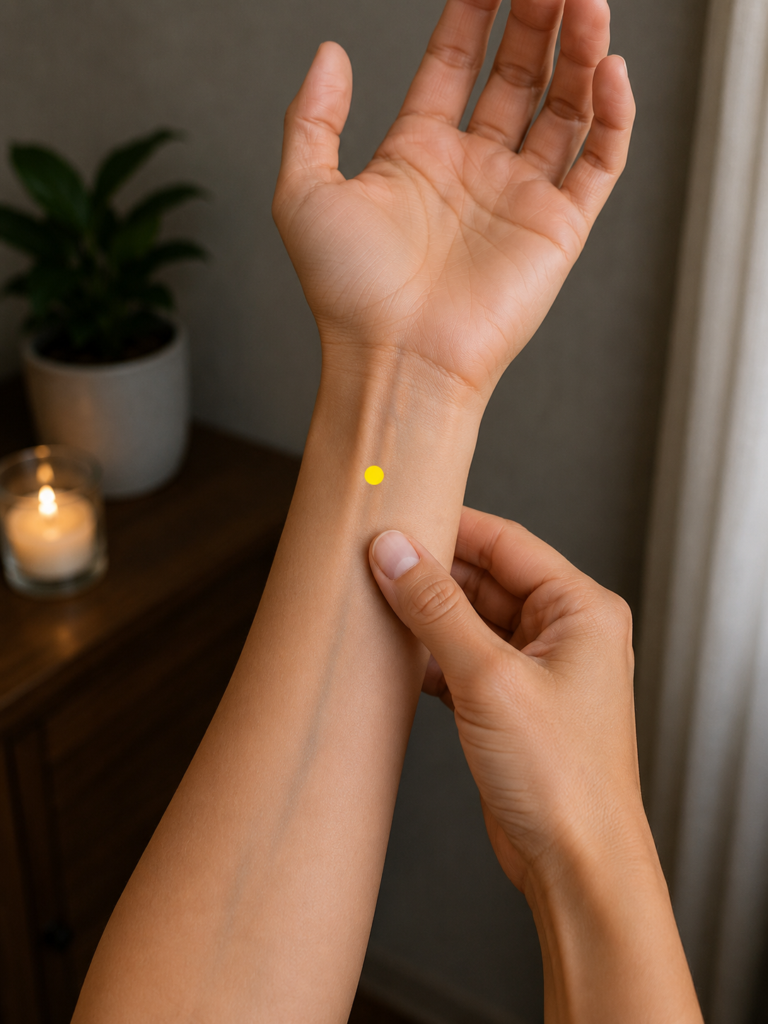
3. Press on HT7 on the wrist crease to calm the Heart. HT7 sits on the inner wrist crease, on the pinky side, in the small hollow just to the thumb side of the tendon that runs along the edge of the wrist. Press gently with the thumb of your other hand for one to two minutes on each wrist. HT7 is called “Shenmen,” the “Spirit Gate.”
HT7 is the source point of the Heart, which houses the mind in Traditional Chinese Medicine. It is used for anxiety, a pounding heart, and light, broken sleep. It also pairs well with Anmian at bedtime.
4. Press on PC6 on the inner forearm to ease a tight, anxious chest. PC6 sits on the inner forearm, three finger-widths above the wrist crease, between the two tendons. Press firmly with the thumb of your other hand for one to two minutes on each arm while breathing out slowly. PC6 is called “Neiguan,” the “Inner Pass.”
PC6 is the connecting point of the Pericardium, which protects the Heart. It opens the chest and calms a nervous stomach, two of the first places daytime stress shows up. You can press it at your desk or in traffic without anyone noticing.
5. Press on CV17 on the center of the chest to deepen the breath. CV17 sits on the breastbone, on the midline of the chest, about midway between the nipples. Press gently with your fingertips, or rest the palm flat over the area, for one to two minutes while breathing slowly into the belly. CV17 is called “Danzhong,” the “Chest Center.”
CV17 is the meeting point for the Qi of the chest. Stress can make the breath short and shallow, while slow belly breathing with a hand on CV17 can help bring it back down. The Cleveland Clinic points out that deep breathing activates the rest-and-digest system, and CV17 gives that breathing a physical anchor.

6. Press on CV6 below the navel to rebuild energy. CV6 sits on the midline of the belly, about two finger-widths below the navel. Press gently with two or three fingertips, or rest a warm palm over the area, for one to two minutes while breathing into the belly. CV6 is called “Qihai,” the “Sea of Qi.” CV6 is avoided during pregnancy.
CV6 is traditionally used to tonify Qi when the body feels drained. A tight, guarded belly is common in people experiencing stress, and slow breathing beneath the warm palm can help soften it.

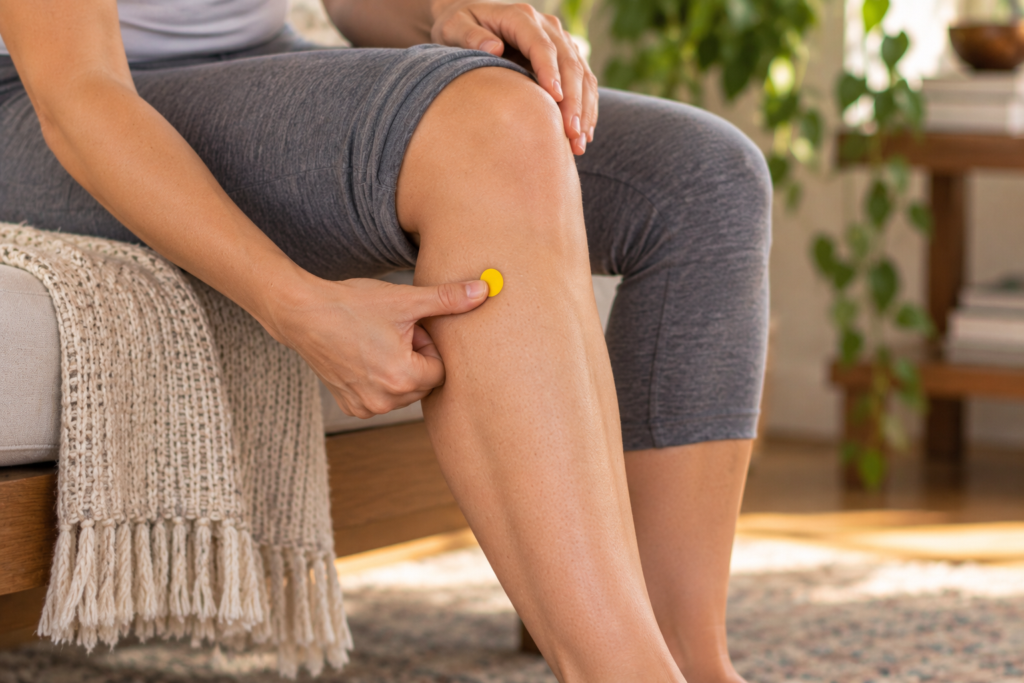
7. Press on ST36 below the knee to steady energy through the day. ST36 sits four finger-widths below the bottom of the kneecap, about one finger-width to the outside of the shinbone. Press firmly with your thumb for one to two minutes on each leg. ST36 is called “Zusanli,” the “Leg Three Miles.”
ST36 supports the Spleen and Stomach (Traditional Chinese Medicine’s view of the organs that turn food into usable energy). It’s a helpful point to use when the afternoon slump hits and you’re reaching for another cup of coffee or something sweet.
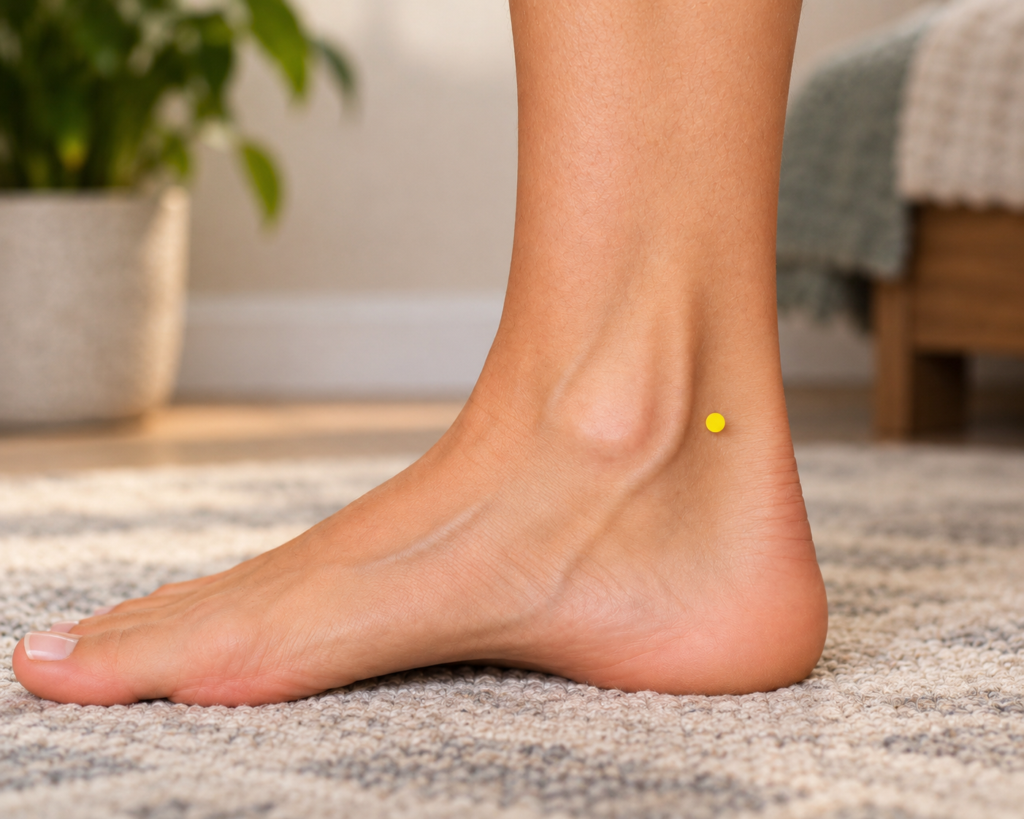
8. Press on KI3 at the inner ankle to restore deep reserves. KI3 sits on the inside of the ankle, in the hollow between the tip of the inner ankle bone and the Achilles tendon. Press gently with your thumb for one to two minutes on each ankle. KI3 is called “Taixi,” the “Great Ravine.”
KI3 is the source point of the Kidney. In Traditional Chinese Medicine, the Kidneys are regarded as the body’s deepest reservoirs, and prolonged stress, inadequate sleep, and overwork may deplete these reserves. Consistent with this perspective, the adrenal glands are located atop the kidneys; however, the Traditional Chinese Medicine concept of the Kidney encompasses far more than the anatomical organ. KI3 is a primary point for replenishing those reserves.
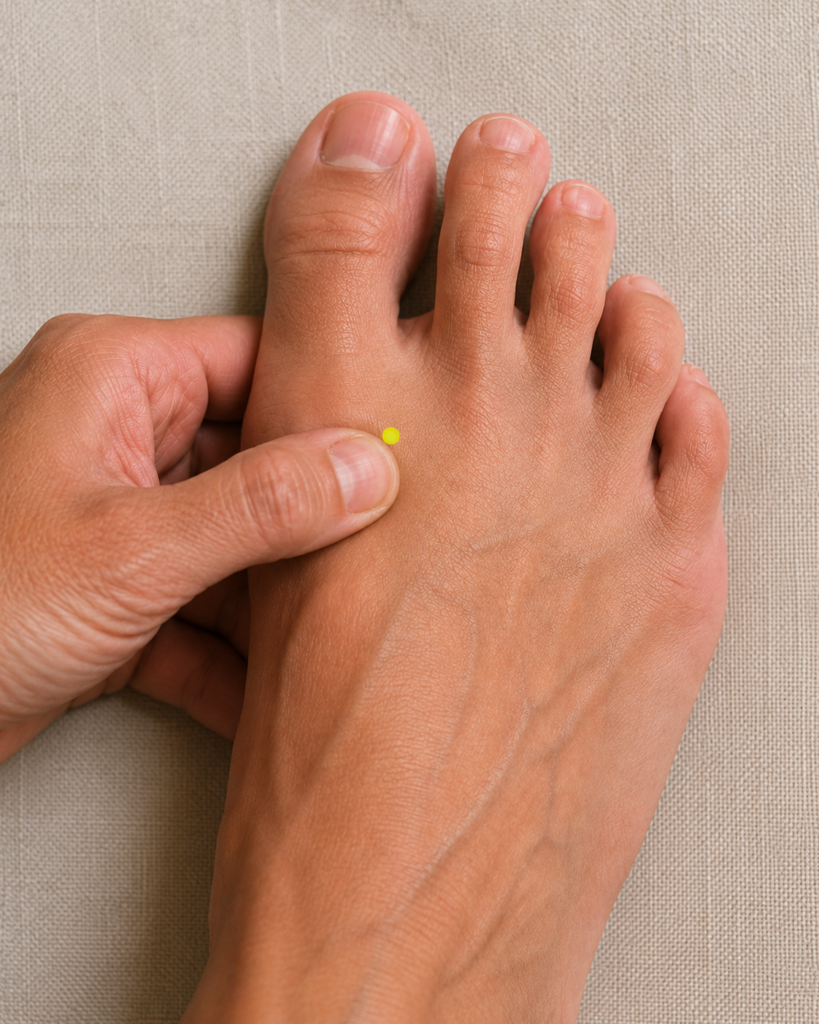
9. Press on LR3 on the top of the foot to release built-up tension. LR3 sits on the top of the foot, in the hollow where the bones of the big toe and second toe meet, about two finger-widths above the web between the toes. Press firmly with your thumb for one to two minutes on each foot. LR3 is called “Taichong,” the “Great Surge.”
LR3 is the Liver’s source point and helps keep Qi flowing smoothly. When stress restricts that flow, tension can build in the jaw, neck, and shoulders. LR3 helps release the tension and is often tender in people who have been under pressure for a long time.
Why These Acupressure Points Work

From a Traditional Chinese Medicine perspective, a body under chronic stress is effectively using energy it doesn’t have. Stuck Liver Qi keeps tension high, while an unsettled Heart leaves the mind and sleep restless. The Kidneys draw on their reserves to make up the difference. Treatment addresses both aspects at once: calming what is overactive and replenishing what has been depleted.
The nine points work together to reduce stress and restore energy:
- Yintang, Anmian, and HT7 calm the mind and help sleep come back on schedule.
- PC6 and CV17 open the chest and slow the breath.
- CV6, ST36, and KI3 rebuild the energy and reserves that stress drains.
- LR3 releases the tension that builds when stress has nowhere to go.
How to Properly Use These Acupressure Points

Acupressure to lower cortisol works best when timed to the parts of the day that tend to feel too wired or too drained.
- In the morning, press ST36 and KI3 for a minute each before reaching for a cup of coffee.
- During a stressful time of the day, press PC6 while breathing in for four counts and out for six, then rest a palm on CV17 for a few more breaths.
- At bedtime, with the lights off, press Anmian, HT7, and Yintang, then finish with a palm over CV6.
- Apply gentle pressure to the head, behind the ears, chest, stomach, and wrist crease, and firmer pressure to the forearms, legs, and feet. Continue daily for at least four to six weeks.
The habits that help restore a healthy cortisol rhythm are primarily related to timing. Get daylight within approximately the first hour after waking, and maintain consistent bedtimes and wake times, ideally within a 30-minute range each day, including weekends. Engage in daily physical activity, but avoid strenuous workouts in the evening, as they can keep the body revved up at bedtime. Eat breakfast and avoid going for extended periods without food. Limit caffeine to the morning and reduce alcohol consumption, as alcohol can disrupt deep sleep. Spend time laughing with people you feel comfortable around. Traditional Chinese Medicine recommends warm, cooked foods and going to bed early during stressful periods, as both support Kidney reserves.
Find out more about what cortisol is and why stress keeps it so high.
When to Get Professional Help

See a doctor if stress symptoms occur alongside signs that cortisol may be too high or too low. A round face, weight gain around the abdomen or between the shoulder blades, wide purple stretch marks, weakness in the upper arms and thighs, newly developed high blood pressure or blood sugar, and bones that break easily can all indicate Cushing’s syndrome, which may require blood, urine, or saliva testing. Low cortisol is also important to recognize: persistent fatigue, dizziness when standing, salt cravings, and unexplained weight loss can be signs. If you take a steroid such as prednisone, never stop taking it or change your dose without speaking with your doctor first. If stress has developed into constant anxiety, panic attacks, depression, or thoughts of self-harm, contact a mental health professional or call or text 988 to reach the Suicide and Crisis Lifeline.
Acupressure is a gentle, supportive practice for lowering cortisol. It complements, and does not replace, diagnosis and medical care.
For related health concerns, acupressure for stress, acupressure for adrenal fatigue, and acupressure for burnout are companion articles.
Above and Beyond Acupuncture offers acupuncture, cupping, and lifestyle coaching at the North Frank Lloyd Wright Boulevard location in Scottsdale.
Schedule an appointment online to start your healing journey.
The points above are only as effective as the technique used to apply them. Where to press, how firmly, and for how long all affect the result. For a full breakdown of how to perform acupressure properly at home, read Performing Acupressure in 3 Easy Steps.

About the Publisher
Paul Kerzner, L.Ac., is a licensed acupuncturist and board-certified herbalist, as well as the founder of Above and Beyond Acupuncture in Scottsdale. His own journey from chronic patient to practicing acupuncturist shapes his commitment to providing honest, clinically grounded information about acupuncture and Traditional Chinese Medicine. Learn more about Paul and his clinical approach on the About Us page.