
Key Takeaways
- In Traditional Chinese Medicine, restlessness stems from an unsettled Shen, commonly associated with Liver Qi stagnation and deficiencies in Blood and Yin.
- Acupressure targets nine key points to soothe restlessness, such as HT7 for the spirit, KI1 for grounding, and Yintang to promote a calm mind.
- Applying pressure to these acupressure points can help stabilize your system and effectively reduce feelings of agitation and anxiety.
- If you experience ongoing restlessness, see a doctor to check for underlying issues such as anxiety disorders or ADHD.
- Acupressure should supplement professional medical care, not replace it.

You might feel tense or restless, with a racing mind, difficulty relaxing, and an inability to stop fidgeting. This could involve pacing, struggling to sit through meals or conversations, or lying in bed feeling wired despite being tired. While these symptoms can be occasional, persistent bouts can be exhausting and difficult to manage. Acupressure can alleviate agitation, balance the body, and calm the mind.
In Traditional Chinese Medicine, restlessness is seen as an unsettled Shen, showing that the mind and spirit can’t find peace. When the Shen is unsettled, you may experience anxiety and difficulty relaxing. Liver Qi stagnation often worsens this, leading to tension and agitation. Sometimes, the root cause is Yin and Blood deficiency, usually from poor sleep, overexertion, or fatigue. This deficiency weakens the Shen’s foundation, resulting in wired, agitated restlessness that can actually indicate exhaustion. As a result, you might feel most restless when you are truly tired. The acupressure points discussed aim to calm and stabilize the Shen, move stagnant Liver Qi, ground the system, and restore Yin and Blood, helping you feel more at ease.
Restlessness is closely related to its more anxious counterpart. If your feelings lean more towards worry and fear rather than just an inability to relax, acupressure for anxiety aligns more closely with this experience.
Here are nine acupressure points to help you find some inner peace and stillness.
What Acupressure Points to Press and Why
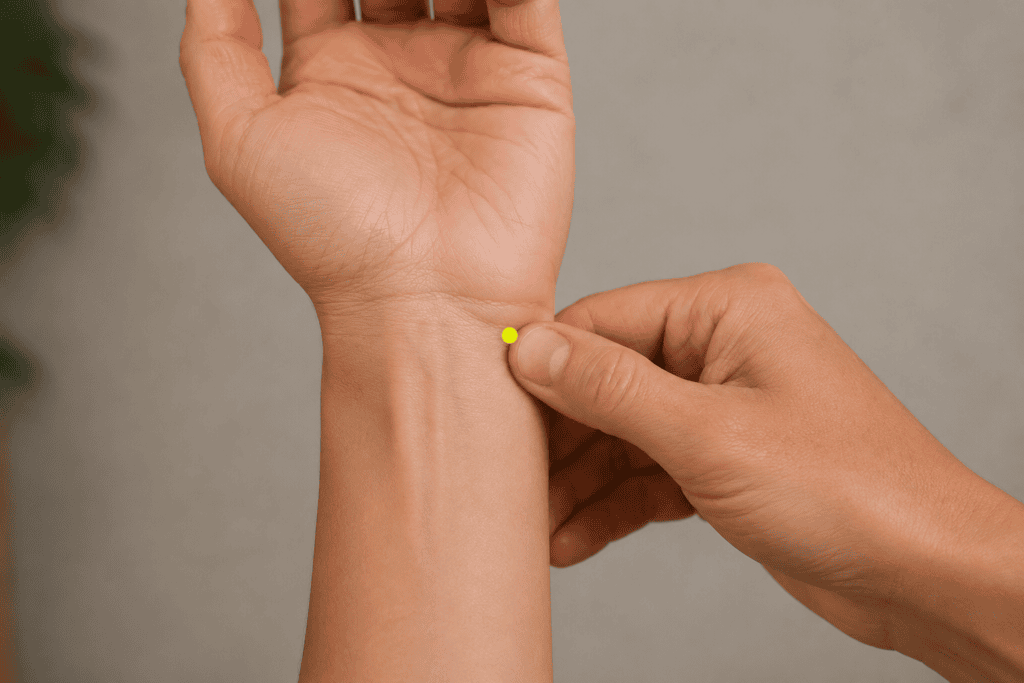
1. Press on HT7 at the wrist to anchor the restless spirit. HT7 sits on the inner wrist crease, on the pinky side, in the small hollow just inside the tendon. Press firmly with your thumb for one to two minutes on each wrist. HT7 is called “Shenmen,” the “Spirit Gate,” and it is the source point of the Heart and the most important point for calming the Shen.
This point is the most direct way to relieve restlessness. As the Spirit Gate and a key point for the Shen, it calms and anchors an unsettled spirit that struggles to find peace. It eases agitation and quiets a restless mind and body. As the Heart’s source point, it stabilizes the spirit at its core rather than just on the surface. Whenever restlessness arises, use this point first; you can gently press it discreetly anywhere.
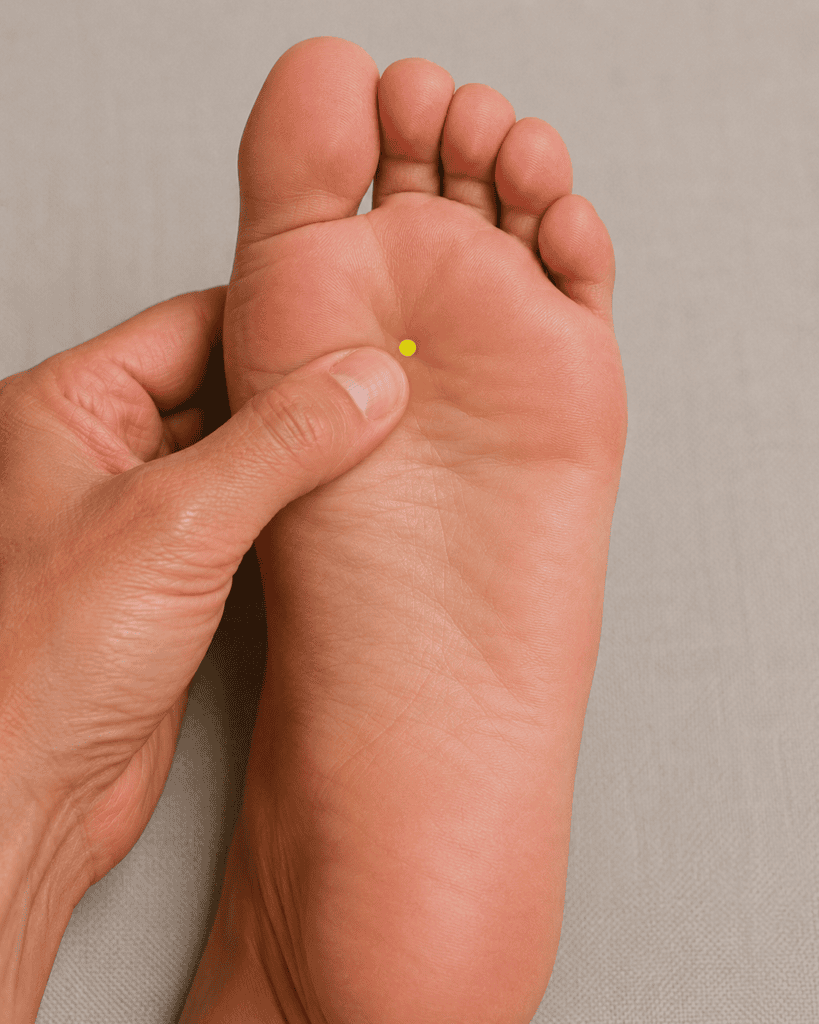
2. Press on KI1 on the sole of the foot to ground an unsettled system. KI1 sits on the sole of the foot, in the hollow that forms in the center of the ball of the foot when you curl the toes, about a third of the way down from the toes to the heel. Press firmly with your thumb for one to two minutes on each foot. KI1 is called “Yongquan,” the “Bubbling Spring,” and it is the lowest point on the body.
Restlessness often feels like your energy is trapped in your head and chest, with no clear outlet. KI1 serves as a grounding point that helps redirect that energy downward. As the body’s lowest point, it anchors restless energy and provides a solid foundation to settle into. This sense of grounding is essential for alleviating restlessness, which is why this point is particularly effective. If you feel fidgety or unstable, pressing this point can help you feel grounded.
3. Press on Yintang between the eyebrows to quiet a churning mind. Yintang sits in the small hollow directly between the two eyebrows. Press steadily and hold, or make small, slow circles with your fingertip for one to two minutes. Yintang is an extra point and one of the most calming points in the body.
Yintang calms the Shen and quiets racing thoughts associated with restlessness. It relaxes the nervous system and alleviates tension between the eyebrows during agitation, helping to anchor the mind. For predominantly mental restlessness with persistent thoughts, gently pressing this point while breathing deeply can be a highly effective way to relax.

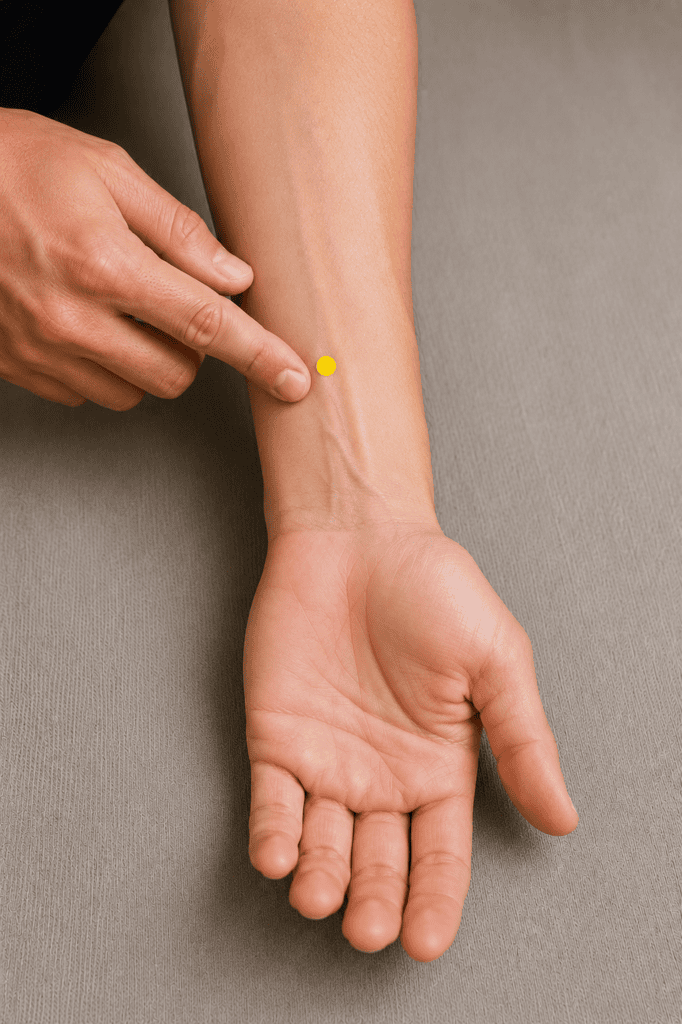
4. Press on PC6 on the inner forearm to ease the keyed-up chest. PC6 sits three finger-widths above the inner wrist crease, in the center of the forearm between the two tendons. Press firmly with your thumb for one to two minutes on each arm. PC6 is called “Neiguan,” the “Inner Pass,” and it opens the chest and calms the spirit.
PC6 helps open the chest and relieve the tight, agitated sensation commonly associated with restlessness. It can also soothe an unsettled, fluttery stomach. This point helps calm the nervous system and release tension in your core. If your restlessness manifests as a tight chest or a racing sensation, PC6 can provide relief, especially when combined with HT7 to calm both the Heart and spirit.
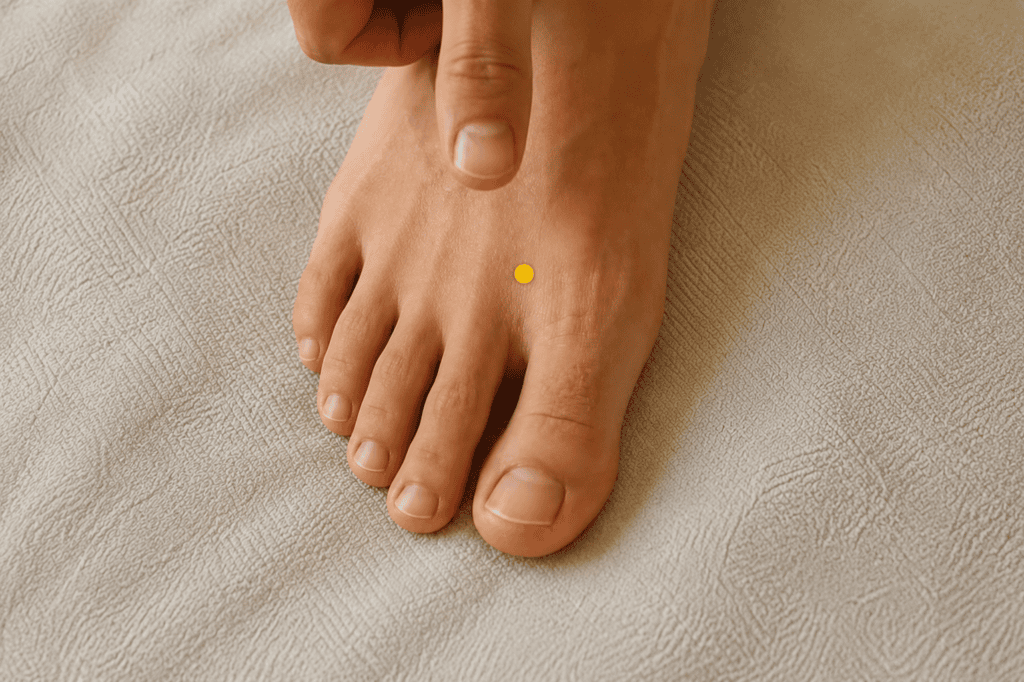
5. Press on LR3 on the top of the foot to release the wound-up tension. LR3 sits on the top of the foot, in the webbing between the big toe and second toe, about two finger-widths back where the bones meet in a small hollow. Press firmly with the thumb for one to two minutes on each foot. LR3 is called “Taichong,” the primary point for moving stuck Liver Qi.
Restlessness often feels like a tense, wound-up sensation that urges you to move but keeps you from relaxing. In Chinese medicine, this is seen as stagnation of Liver Qi, which LR3 helps alleviate. This point helps release the underlying tension behind that agitated, restless feeling and promotes a sense of calm in your energy. Additionally, it grounds you by directing energy downward toward your feet. If your restlessness feels tense and fidgety, this point can help you relax, particularly when combined with KI1 to both release tension and ground your energy.
6. Press on SP6 above the inner ankle to nourish what is depleted. SP6 sits four finger-widths up from the tip of the inner ankle bone, just behind the back edge of the shinbone. Press firmly for one to two minutes on each leg. SP6 is called “Sanyinjiao,” the “Three Yin Intersection,” where the Spleen, Liver, and Kidney channels meet. SP6 is avoided during pregnancy.
Restlessness often stems from being depleted and low on Blood and Yin, which support the Shen. SP6 is a key point for nourishment, connecting the Spleen, Liver, and Kidney channels to replenish Blood and Yin. This helps calm the agitation caused by exhaustion. If your restlessness comes with fatigue, poor sleep, or feeling overwhelmed, regularly stimulating this point can help restore the foundation your Shen needs for restful sleep.
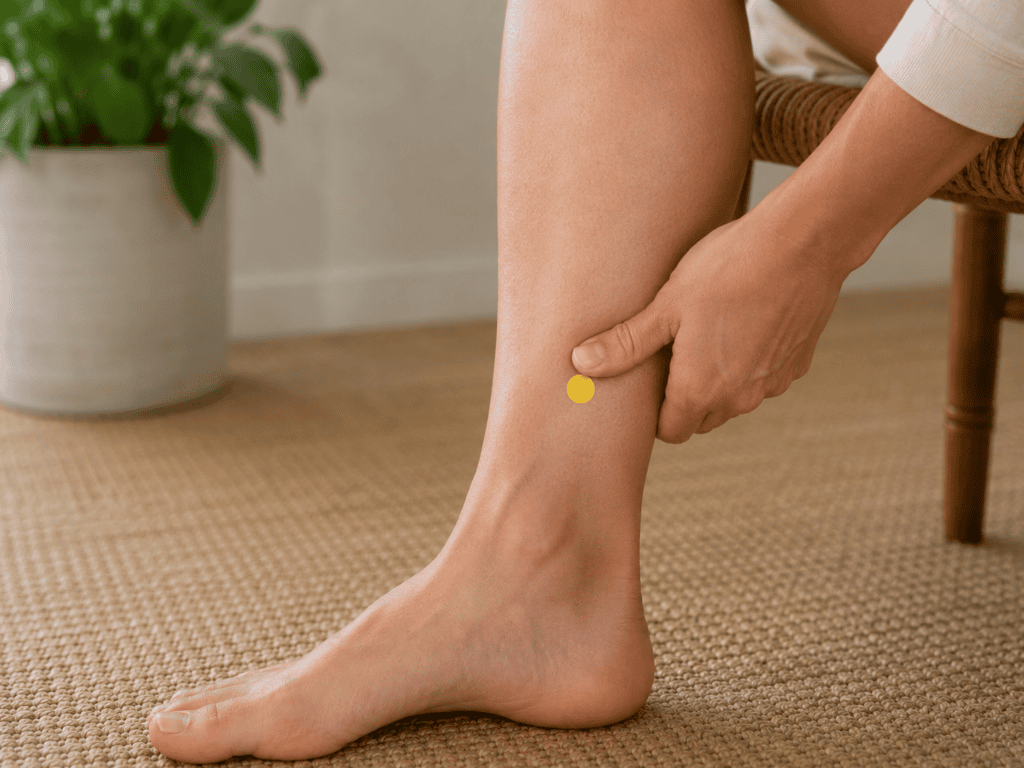
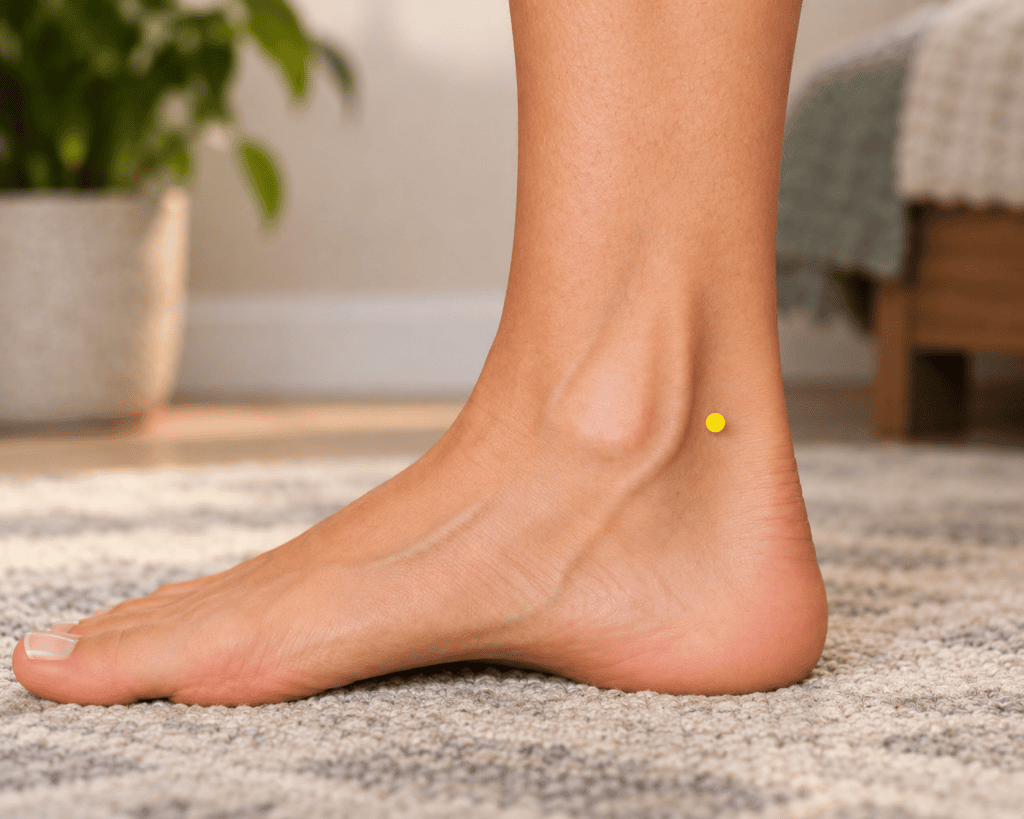
7. Press on KI3 above the inner ankle to settle wired, depleted restlessness. KI3 sits in the hollow between the inner ankle bone and the Achilles tendon, level with the tip of the ankle bone. Press firmly with your thumb for one to two minutes on each ankle. KI3 is called “Taixi,” the source point of the Kidney.
If your restlessness comes with burnout, overheating, and feeling wired despite fatigue, Traditional Chinese Medicine interprets this as a deficiency of Kidney Yin, leading to empty, agitated heat. The KI3 point, the Kidney’s source point, helps rebuild and calm this condition. It nourishes your deep reserves and alleviates the restless sensation caused by depletion. For restlessness from burnout, this point can help restore stability and grounding, especially when used with SP6 to support a depleted system.
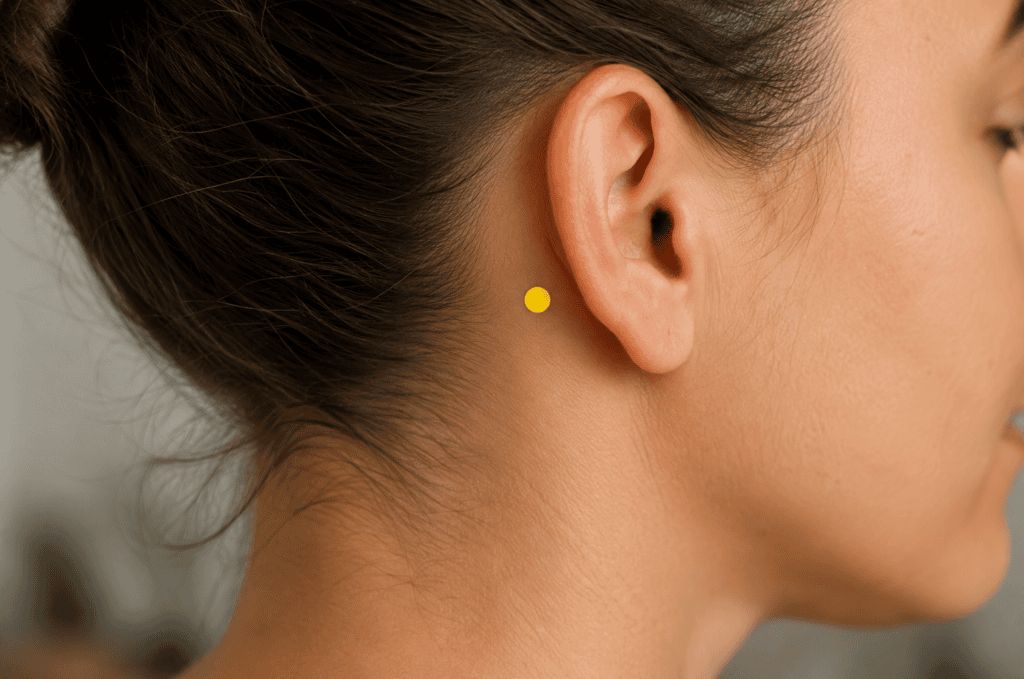
8. Press on Anmian behind the ear to settle a restless mind for sleep. Anmian sits behind the ear, in the hollow between the bony bump behind the earlobe and the base of the skull, a little above the jaw. Press firmly with your fingertip for one to two minutes on both sides. Anmian is an extra point whose name literally means “Peaceful Sleep,” and it is used specifically for insomnia.
Nighttime restlessness can be frustrating, especially when you’re exhausted but can’t relax. Anmian specifically targets sleeplessness. It helps calm an agitated mind and supports your body in settling down when you can’t do so alone. If you find it difficult to stay still at bedtime, this point can help quiet your mind and is especially useful during your evening wind-down.
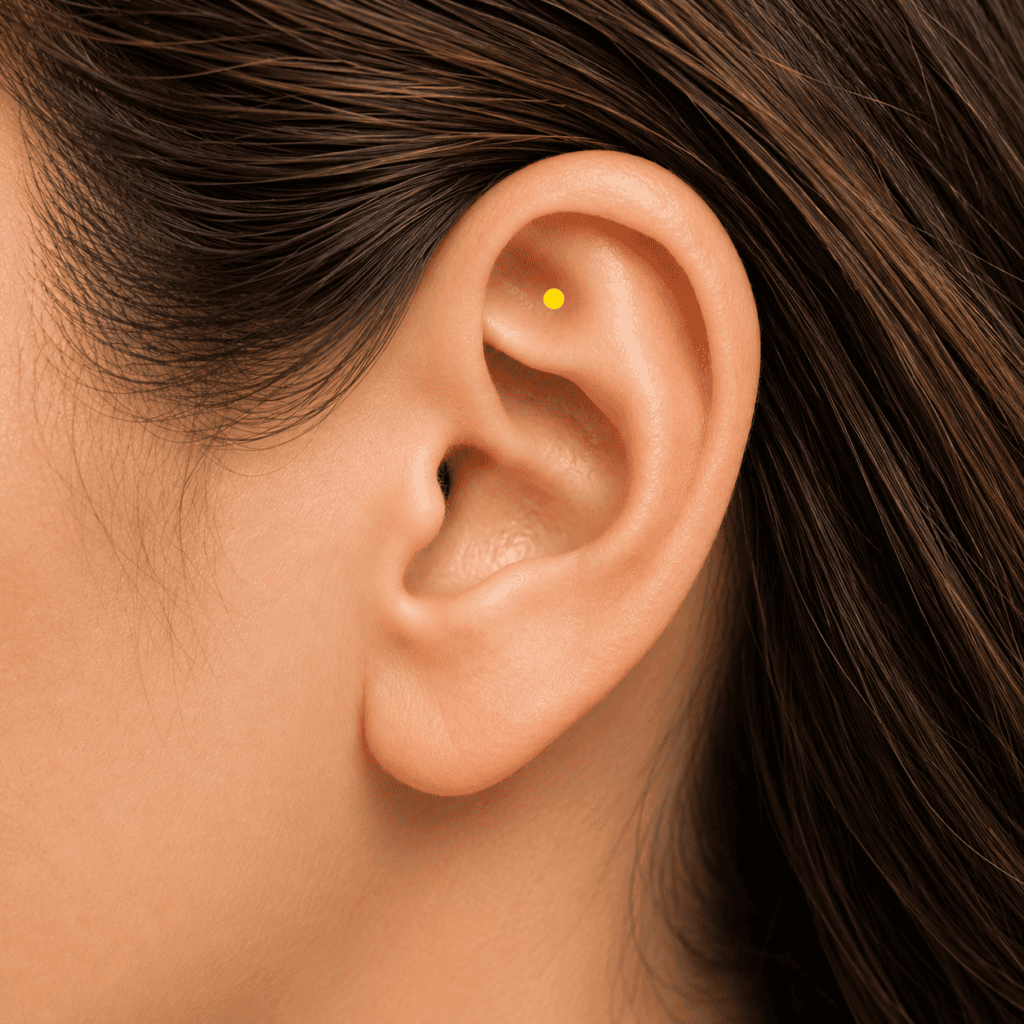
9. Press on Ear Shenmen for quick, deep calm. Ear Shenmen sits in the upper part of the ear, in the triangular hollow near the top, at its apex. Press gently with your fingertip, or squeeze between your finger and thumb, for about a minute on each ear. Ear Shenmen is one of the most calming points on the ear and shares its name, “Spirit Gate,” with the Heart point HT7.
Ear Shenmen is a highly calming point that acts quickly, ideal for sudden restlessness. It quickly soothes the Shen and eases that tense, restless sensation in moments. Its discreet location makes it easy to access whenever you need it. If you experience an abrupt wave of agitation, this point can quickly help stabilize your entire system, making it a useful way to end a practice aimed at achieving stillness.
Why These Acupressure Points Work
In Traditional Chinese Medicine, restlessness is viewed as an unsettled Shen that cannot find peace. It often results from stuck Liver Qi leading to tension, and sometimes from deficiencies in Blood and Yin, which leave the spirit without a stable foundation. This produces a wired, agitated feeling that often signals exhaustion. The nine points target these various factors.
- The Shen-calming points (HT7, Yintang, PC6, Ear Shenmen) anchor the restless spirit and quiet the keyed-up mind and chest.
- The grounding points (KI1, LR3) draw the ungrounded, up-and-out energy down and release the wound-up tension.
- The nourishing points (SP6, KI3) rebuild the Blood and Yin whose depletion leaves you unable to settle, calming the wired-but-depleted agitation.
- The sleep point (Anmian) settles a restless mind toward rest when it will not settle on its own.
The common theme is anchoring, grounding, and nourishing a system that can’t remain still. This is the reason why anxiety, stress, and depression – often associated with chronic restlessness – are addressed through the same therapeutic approach.
How to Properly Use These Acupressure Points
Use these points consistently, especially during restless moments, to gradually calm yourself.
- When restlessness takes hold, reach for the calming and grounding points, HT7 and Ear Shenmen to settle the spirit, KI1 and LR3 to ground and release, and Yintang and PC6 to quiet the mind and chest, pressing them with slow breathing.
- To address the depletion underlying a chronic restless state, work SP6 and KI3 regularly, since rebuilding what is run low helps the Shen settle at the root.
- Use Anmian in the evening when restlessness keeps you from sleep.
- Hold each point for one to two minutes with steady pressure, breathing slowly, and let the grounding points and your feet on the floor bring you back down.
Acupressure may help, and other methods can reduce restlessness. Taking slow, deep breaths can immediately soothe your nervous system. Since restlessness often signals fatigue, protecting your sleep and avoiding overexertion is crucial. Gentle, consistent movement provides a safe outlet for restlessness, whereas excessive caffeine can increase your nervous energy. Grounding activities, spending time outdoors, and maintaining a regular daily routine can further help you feel calmer.
When to Get Professional Help
Feeling restless now and then is normal, and these tools aim to support that. But if your restlessness persists, worsens, or disrupts sleep, concentration, or daily life, see a doctor. Ongoing restlessness could signal treatable conditions like anxiety disorders or other issues such as an overactive thyroid, ADHD, or medication side effects like akathisia. If you experience sudden, intense, or unexplained agitation – especially if it differs from your usual behavior – seek medical help immediately.
If you’re experiencing intense anxiety, distress, or thoughts of self-harm, reach out for help right away. The 988 Suicide and Crisis Lifeline is available 24/7 for support by call or text.
While acupressure may help with occasional restlessness, it should not replace professional medical treatment when health problems arise.
Above and Beyond Acupuncture offers acupuncture, cupping, and lifestyle coaching at the North Frank Lloyd Wright Boulevard location in Scottsdale.
Schedule an appointment online to start your healing journey.
The points above are only as effective as the technique used to apply them. Where to press, how firmly, and for how long all affect the outcome. For a full breakdown of how to perform acupressure properly at home, read Performing Acupressure in 3 Easy Steps.

About the Publisher
Paul Kerzner, L.Ac., is a licensed acupuncturist and board-certified herbalist, as well as the founder of Above and Beyond Acupuncture in Scottsdale. His own journey from chronic patient to practicing acupuncturist shapes his commitment to providing honest, clinically grounded information about acupuncture and Traditional Chinese Medicine. Learn more about Paul and his clinical approach on the About Us page.