Key Takeaways
- Occipital neuralgia results in sharp, shooting pain at the base of the skull, typically caused by irritated occipital nerves.
- Acupressure provides relief by stimulating specific points, aiding in muscle relaxation and enhancing Qi and Blood circulation.
- Important acupressure points include GB20, GB12, and additional points near the skull base, as well as on the hands and feet.
- Activate these points with gentle pressure for one to two minutes, while including neck movements and heat therapy.
- Seek medical advice from a doctor if you have severe or ongoing pain, since an accurate diagnosis is essential.

Occipital neuralgia differs significantly from a typical headache.
Instead of dull pain, it presents as sharp, shooting, stabbing, or electric sensations that start at the base of the skull and travel up the back of the head, usually on one side. You might also feel scalp tenderness or soreness behind the eye. This happens when the occipital nerves, which run from the top of the neck over the head, become irritated, compressed, or inflamed, often because of tight muscles at the base of the skull. Acupressure can be beneficial by relaxing these muscles, reducing pain, and calming the affected area.
In Traditional Chinese Medicine, occipital neuralgia is viewed as a blockage of Qi and Blood within the channels at the back of the head and neck. This blockage can result from wind, cold, or tense, knotted muscles pressing on the area, especially along the Bladder and Gallbladder channels and the Governing Vessel. When these channels are obstructed, sharp, shooting pain travels along the nerve up the back of the skull. Stress and tension may tighten the muscles at the base of the skull around the nerve, while heat or rising yang can intensify the pain. The acupressure points listed below aim to relax these tense muscles, promote the movement of stagnated Qi and Blood, open the channels, and soothe the irritated nerve.
Here are nine acupressure points that can help, mainly near the base of the skull, where discomfort begins.
What Acupressure Points to Press and Why
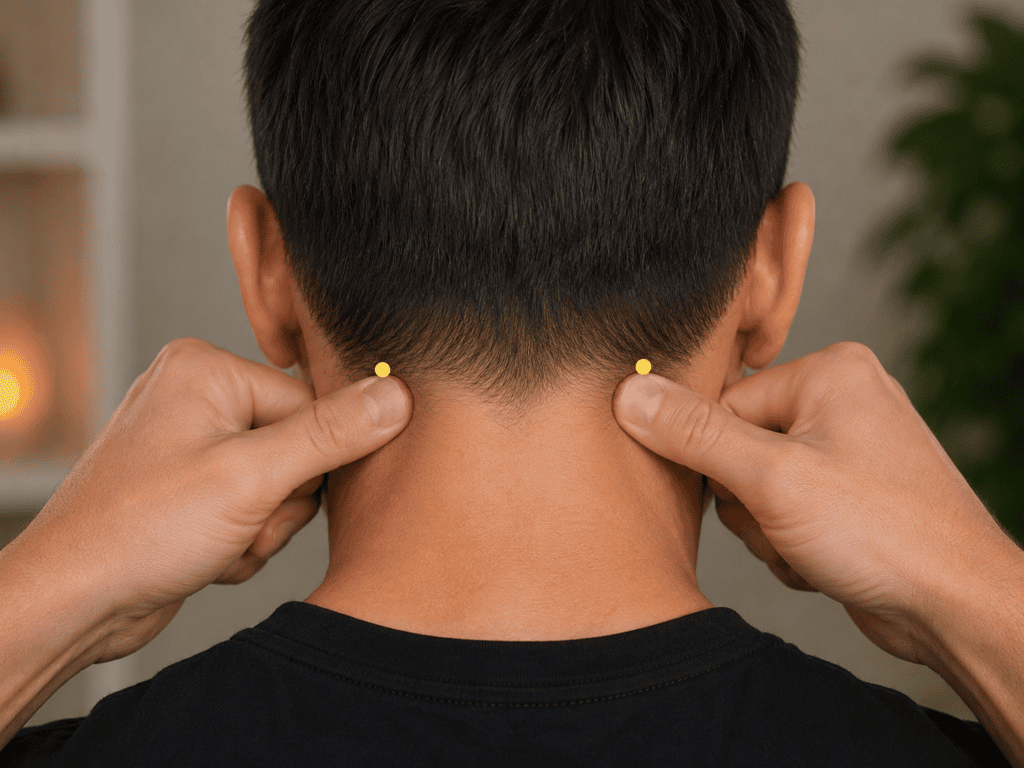
1. Press on GB20 at the base of the skull, right where the nerve trouble begins. GB20 sits in the two hollows at the base of the skull, between the two large vertical neck muscles and the outer edge, roughly level with the tops of the ears. Tip your head back slightly and press firmly up and inward with your thumbs for one to two minutes. GB20 is called “Fengchi,” and it is one of the most important points for the back of the head and neck.
This point is particularly significant for occipital neuralgia because it lies where the occipital nerves emerge, and tight muscles here often press on them. Applying pressure helps release tension, promote the flow of Qi and Blood, and ease pain at its source. It is a key point for headaches and discomfort at the back of the head. Since this area can be sensitive, adjust the pressure to what feels comfortable. If your pain begins at the base of the skull and radiates upward, start with this point.
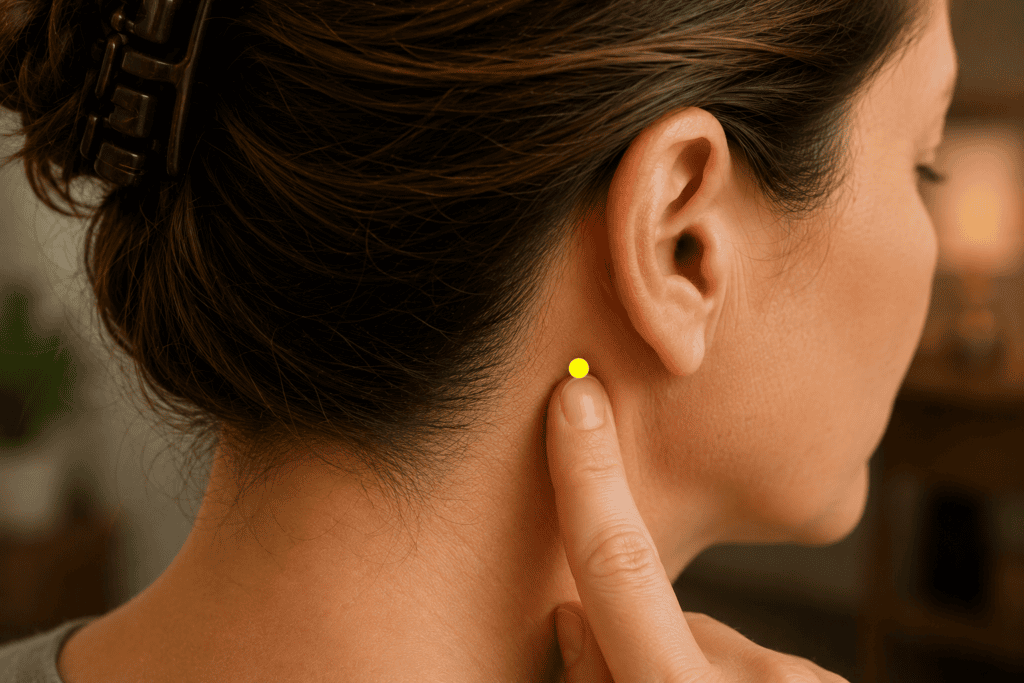
2. Press on GB12 behind the ear to release the skull base. GB12 sits in the hollow just behind and below the bony bump behind the ear, at the base of the skull. Press firmly with your fingertip for one to two minutes on the affected side. GB12 is called “Wangu,” a local point at the base of the skull.
GB12 is situated at the base of the skull, just behind the ear, where the occipital nerves and tense muscles are located. It is a useful local point for occipital neuralgia. Applying pressure here helps relax muscle tension and promotes the flow of Qi and Blood along the skull base, reducing pain that radiates up and around the back and sides of the head. Combining this point with GB20 targets a larger area of tightness and sensitivity at the skull base. For pain and tension behind the ear and along the skull base, this point directly addresses the issue.
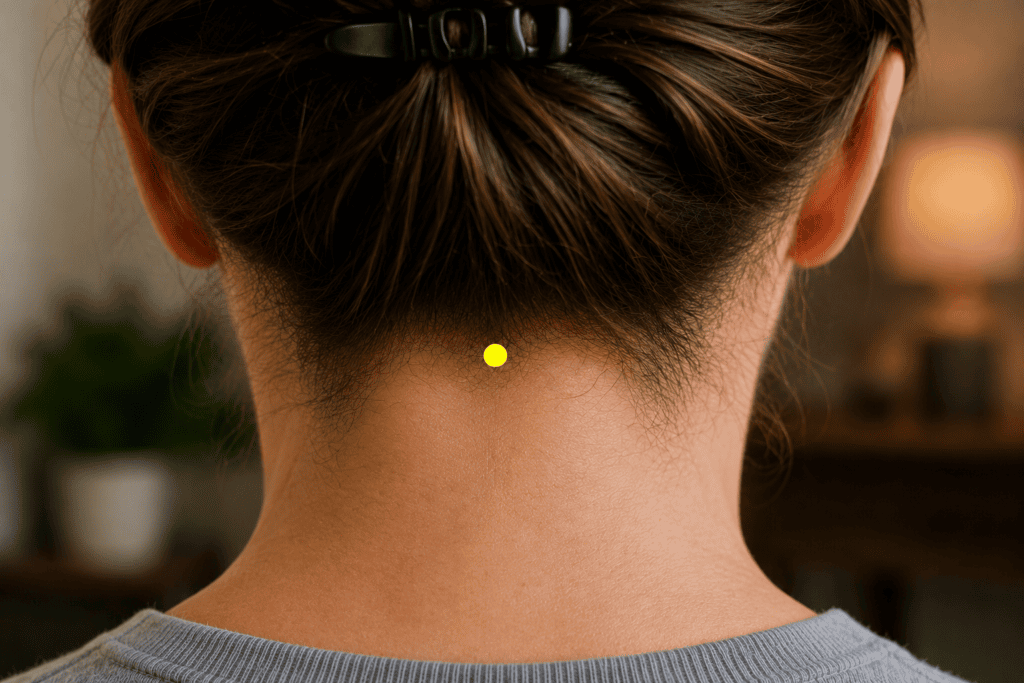
3. Press on GV16 at the center of the skull base to open the back of the head. GV16 sits in the hollow at the center of the skull base, in the midline just above the top of the neck where the head meets the neck. Press gently but firmly with your fingertip for one to two minutes. GV16 is called “Fengfu,” the “Wind Mansion,” and it is a key point on the midline at the base of the skull.
GV16 lies at the center of the skull base along the Governing Vessel, which runs along the midline at the back of the head. This makes it a key point for relieving pain and tension in that area. Its name, Wind Mansion, reflects its role in releasing the ‘wind’ associated with this pain in traditional Chinese medicine. The point helps open the back of the head and calm the area. Apply gentle pressure here, as it is sensitive. For pain along the center of the back of the head, this point can help relieve it.
4. Press on BL10 beside the spine at the nape to ease the nerve pain. BL10 sits on the back of the neck, about one thumb-width out to each side of the spine, just below the base of the skull, on the thick muscles there. Press firmly with your thumbs for one to two minutes on both sides. BL10 is called “Tianzhu,” a key point for the back of the head and neck.
BL10 lies on the Bladder channel, just beside the spine at the top of the neck, within muscles that often tighten and irritate the occipital nerves. It is an excellent point for addressing this condition. Applying pressure here helps relax the tight muscles at the nape, promotes the movement of stuck Qi and Blood, and alleviates pain and stiffness that extend up the back of the head. It is one of the primary points used for occipital pain and neck tension. For nerve pain originating at the nape, this point treats the source directly and works well with GB20 to loosen the entire base of the skull.

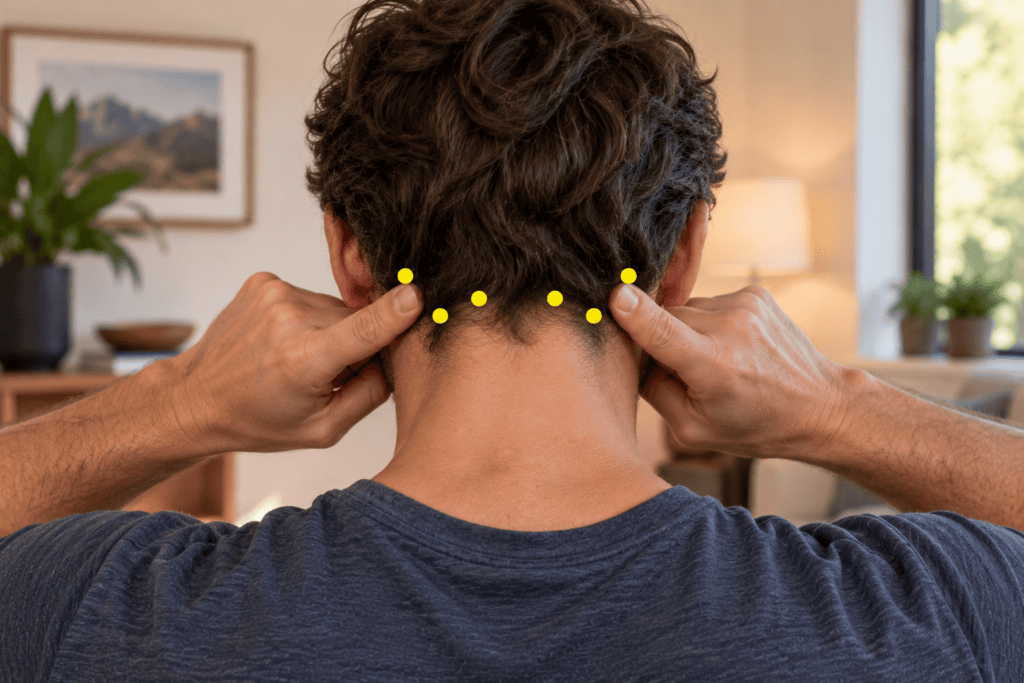
5. Press on the Ashi points along the base of the skull. Ashi points are specific tender, sore spots along the base of the skull and the top of the neck, and often the trigger spots where pressing reproduces or eases shooting pain. Feel carefully along the skull base and nape, and press each tender spot, adjusting the pressure to what you can tolerate, for about a minute. “Ashi” means “that’s it,” the sound of finding the exact sore point.
In Traditional Chinese Medicine, practitioners treat these sensitive points directly because pain indicates where Qi and Blood are most blocked. In occipital neuralgia, tight, painful areas at the back of the skull often press on the nerve because of knotted muscles. Applying gentle pressure and holding these points can help relax the muscle tension and reduce nerve compression, providing relief. Be cautious, as this area can be very tender, and stop if pressing worsens the pain. For your case, these sore spots at the skull base specifically target the nerve compression.
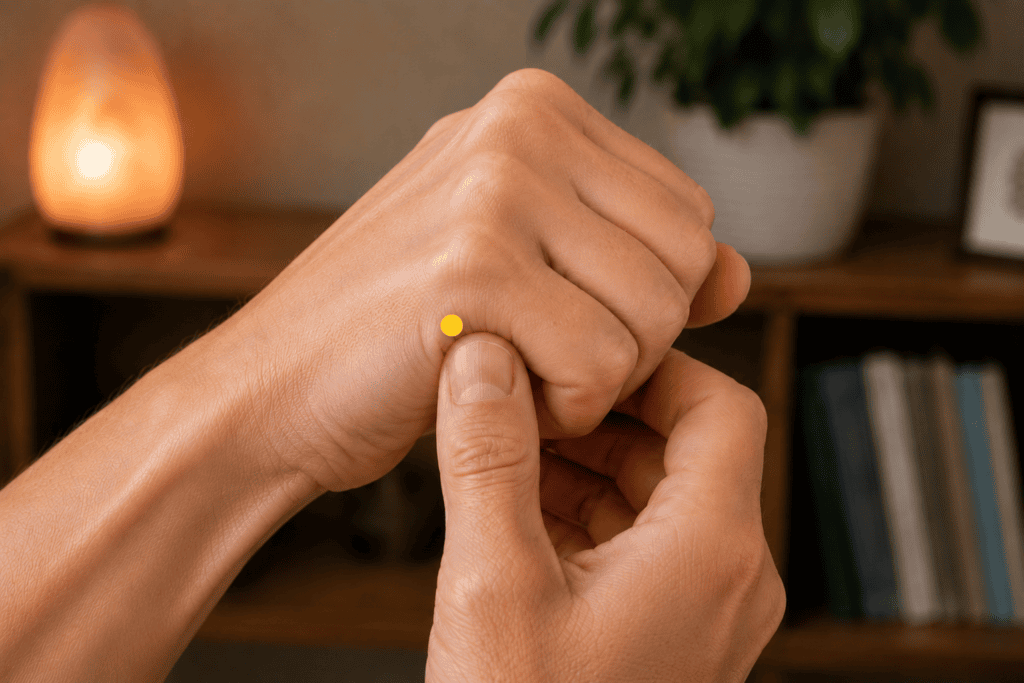
6. Press on SI3 on the side of the hand to open the channel at the back of the head. SI3 sits on the side of the hand, on the pinky edge, in the crease that forms just below the knuckle of the little finger when you make a loose fist. Press firmly with the thumb of your other hand for one to two minutes on each hand. SI3 is called “Houxi,” and it opens the Governing Vessel that runs up the back of the head and neck.
SI3 relieves the back of the head and neck from a distance, as it lies on the Small Intestine channel that ascends over the shoulder blade and neck. It is the primary point for opening the Governing Vessel, which runs along the midline of the back of the head, where occipital pain often occurs. Applying pressure here can ease pain and stiffness in the neck and back of the head, especially when the sore spot is too sensitive to touch. Using your hand allows firm pressure without causing discomfort. This point also supports relief along the back of the head via the channel.
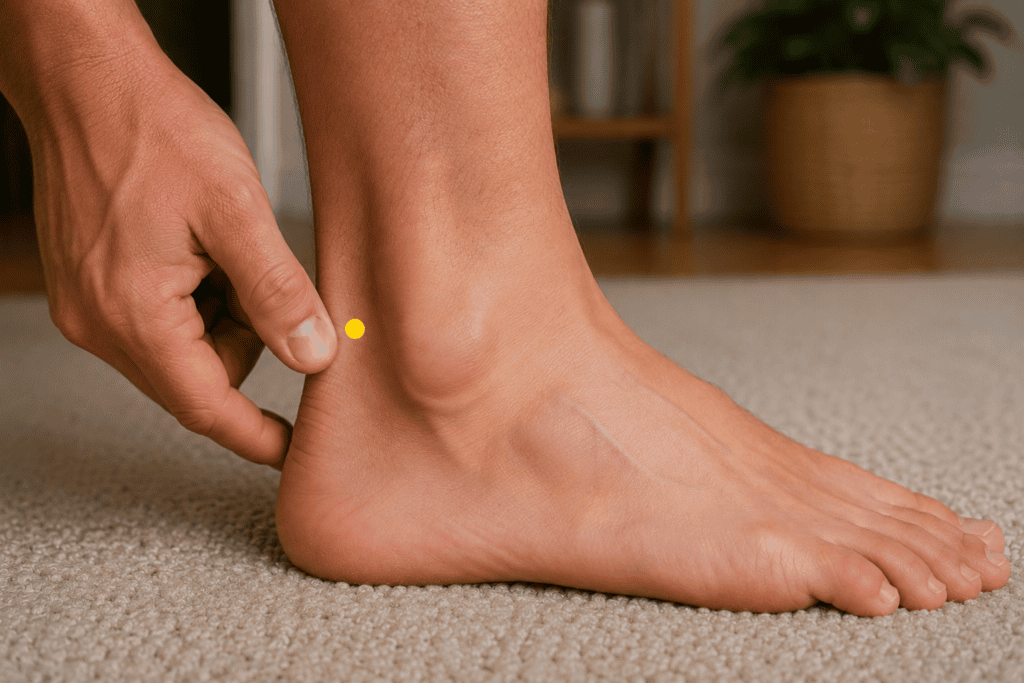
7. Press on BL60 behind the outer ankle to relieve pain along the channel. BL60 sits in the hollow between the outer ankle bone and the Achilles tendon, level with the tip of the ankle bone. Press firmly with your thumb for one to two minutes on each ankle. BL60 is called “Kunlun,” a major point on the Bladder channel, and it corresponds to pain along its length.
BL60 is at the end of the Bladder channel, which also extends up the back of the neck and into the head, where occipital pain occurs. Pressing this point can ease pain throughout the channel, including the back of the head. It’s often used for headaches and neck pain and is sometimes called the aspirin point because it can relieve pain along the back of the body. Being at the ankle, you can press firmly without touching your sore head. For occipital neuralgia pain along the Bladder channel, pressing this point benefits the entire pathway and works well with BL10 at the nape.
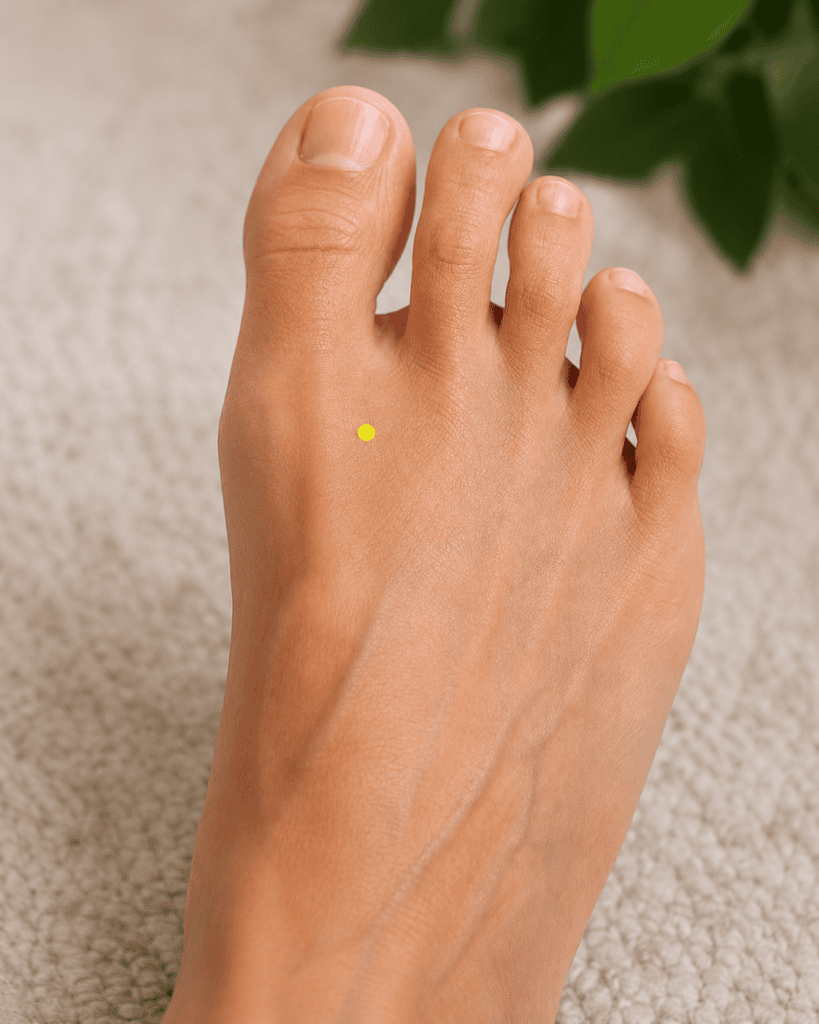
8. Press on LR3 on the top of the foot to calm the irritated nerve. LR3 sits on the top of the foot, in the webbing between the big toe and second toe, about two finger-widths back where the bones meet in a small hollow. Press firmly with your thumb for 1 to 2 minutes on each foot. LR3 is called “Taichong,” the primary point for the Liver.
If stress, tension, or a sharp, irritable sensation accompanies your occipital neuralgia, Traditional Chinese Medicine often attributes this to a Liver imbalance, where rising yang and stagnated Qi exacerbate the pain. LR3 functions by reducing the rising yang, calming the Liver, and promoting smooth Qi flow. This alleviates the sharp, irritable nerve pain and relieves tension in the surrounding muscles. Additionally, it helps stabilize your system by drawing energy downward toward your feet, away from the head. For stress-induced or acute occipital neuralgia, this point provides a calming and grounding effect.
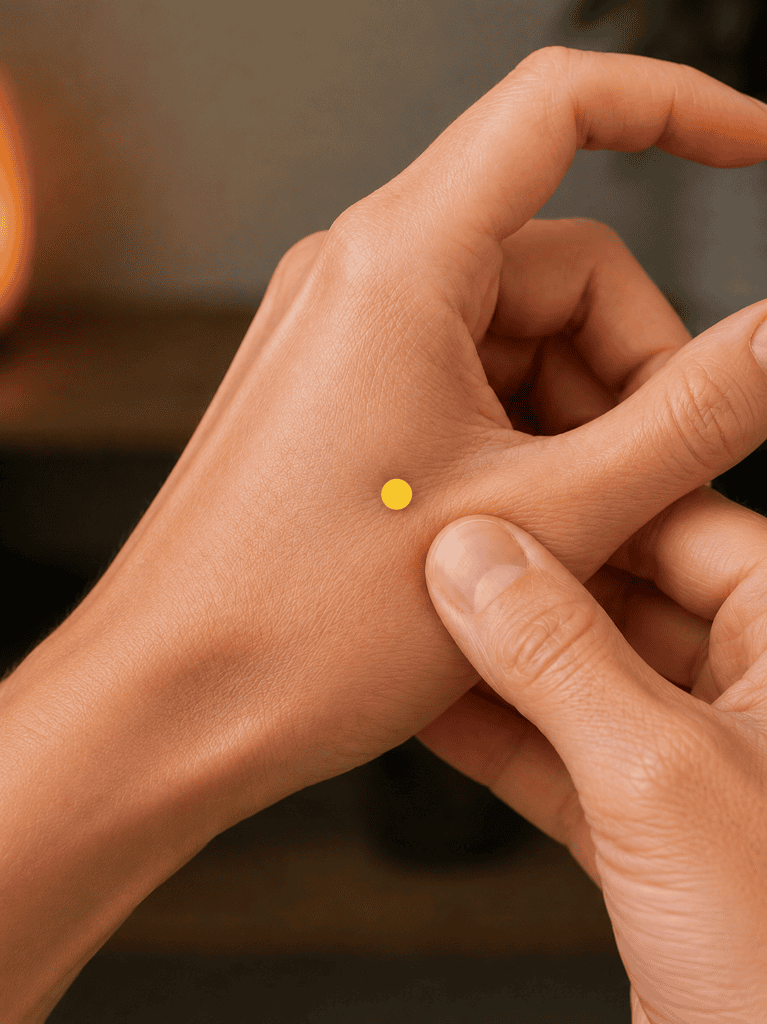
9. Press on LI4 in the hand to relieve the pain from a distance. LI4 sits in the webbing between the thumb and index finger, at the highest point of the muscle when you bring the thumb and finger together. Press firmly with the thumb of your other hand for one to two minutes on each hand. LI4 is called “Hegu,” and it is the command point for the head and one of the strongest pain-relieving points in the body. LI4 is avoided during pregnancy.
LI4 is a highly effective point for alleviating head pain. It promotes Qi flow throughout the area and relieves discomfort from a distance, which is especially useful when the head or scalp is too sensitive for direct pressure. As the primary point for head issues, it reduces head pain and eases tension. Located on the hand, it can be pressed firmly without irritating tender areas. For occipital neuralgia, this powerful point provides relief without needing to target the painful spot directly, making it a valuable point for frequent use.
Why These Acupressure Points Work
In Traditional Chinese Medicine, occipital neuralgia is viewed as a blockage of Qi and Blood in the channels at the back of the head and neck. Tight muscles near the skull base can compress this area, and wind or rising yang can intensify the pain. These nine points target these underlying problems.
- The points at the base of the skull (GB20, GB12, GV16, BL10) help relax the tight muscles that squeeze the occipital nerve and relieve pain at the back of the head.
- The Ashi points target the tender areas at the base of the skull directly, where nerve compression often occurs.
- The distal channel points (SI3, BL60) activate the channels at the back of the head and help alleviate pain from a distance, safely away from the sore area.
- The calming points and pain points (LR3, LI4) soothe the irritated nerve and rising yang, effectively relieving headache symptoms.
The common theme is releasing muscle tension that affects the nerve and shifting the stuck Qi and Blood, which is why the skull-base points and tender spots there often provide the most relief.
How to Properly Use These Acupressure Points
Concentrate on releasing the base of the skull, and utilize the distal points if the area is too tender to touch.
- Activate the skull-base points GB20, GB12, GV16, BL10, and Ashi spots along the skull base, adjusting pressure to the sensitivity, as this is where the nerve is usually compressed.
- Use the distal points SI3, BL60, LR3, and LI4 to relieve pain in the hands and feet when the head and scalp are too sore to press directly, and to enhance relief throughout.
- Combine point work with gentle massage of tight neck muscles and slow movements to release muscles pressing on the nerve.
- Hold each point for one to two minutes, ease off anything that sharply worsens the shooting pain, and work the area a few times a day.
Acupressure can help relieve tension around the nerve, along with several other methods. Applying heat to the base of your skull and neck with a heat pack or warm compress relaxes tight muscles and boosts circulation, which can reduce compression. Maintaining good posture is crucial, as slouching or prolonged screen time can tighten muscles that press on the occipital nerve. Keep your screen at eye level and take regular breaks. Gentle neck stretches, stress management, and using a supportive pillow at night can also ease muscle tension and discomfort.
When to Get Professional Help
Getting an accurate diagnosis of occipital neuralgia is crucial because its sharp, shooting pain can resemble other conditions and often requires multiple treatment strategies. If you suspect you have occipital neuralgia but haven’t been diagnosed, consult a doctor. They can confirm the cause, rule out other issues, and recommend treatments like nerve blocks or medications if self-care isn’t enough. Seek medical help if your pain is severe, persistent, or worsening. Sometimes, a neck issue can press on a nerve, which requires evaluation. Seek emergency care if you have sudden, intense headaches unlike any before, or if head or neck pain occurs with fever, stiff neck, confusion, weakness, numbness, vision problems, or after an injury. These symptoms may indicate a serious condition.
Acupressure can relieve muscle tension and pain but should complement proper diagnosis and medical treatment.
Above and Beyond Acupuncture offers acupuncture, cupping, and lifestyle coaching at the North Frank Lloyd Wright Boulevard location in Scottsdale.
Schedule an appointment online to start your healing journey.
The points above are only as effective as the technique used to apply them. Where to press, how firmly, and for how long all affect the result. For a full breakdown of how to perform acupressure properly at home, read Performing Acupressure in 3 Easy Steps.
Since occipital neuralgia is frequently mistaken for a regular tension headache at the back of the head, if your discomfort is a dull ache rather than sharp, shooting nerve pain, focus on acupressure for occipital headaches.

About the Publisher
Paul Kerzner, L.Ac., is a licensed acupuncturist and board-certified herbalist, as well as the founder of Above and Beyond Acupuncture in Scottsdale. His own journey from chronic patient to practicing acupuncturist shapes his commitment to providing honest, clinically grounded information about acupuncture and Traditional Chinese Medicine. Learn more about Paul and his clinical approach on the About Us page.