Key Takeaways
- Calf pain may result from overuse, muscle tightness, or poor circulation, but it is important to distinguish these causes from emergencies such as blood clots.
- Acupressure can effectively ease muscular calf pain by stimulating specific points that promote Qi and Blood flow.
- The article highlights nine key acupressure points, each offering distinct benefits for relaxing and nourishing the calf muscles.
- Combine pressure, massage, and warmth with acupressure to maximize results and relieve pain.
- Seek medical help if calf pain is accompanied by swelling or other symptoms, as it may indicate a serious condition.
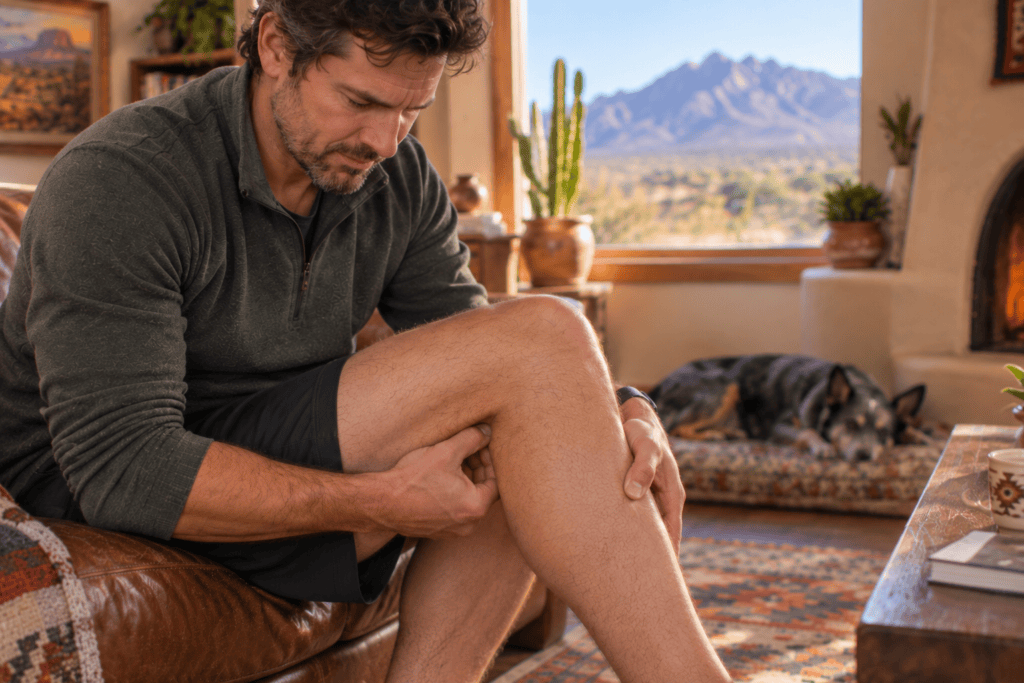
Calf pain is a common health issue that can manifest in many different ways.
You may feel tightness or aching after standing or walking for a long time, exercise-related strain, knotted tension in a stiff calf, or a deep ache in the back of your lower leg. Most calf pain results from overuse, tight muscles, strain, or poor circulation, and it usually responds well to acupressure.
Remember that calf pain isn’t always muscular. If it involves swelling, warmth, redness, or tenderness, especially in one leg without an obvious exercise-related cause, it may indicate a blood clot, which is a medical emergency. Do not use acupressure or massage in that situation, since pressing on a clot can be dangerous. Seek medical care immediately. The points below are intended for ordinary muscular calf pain.
In Traditional Chinese Medicine, muscular calf pain is understood as a blockage of Qi and Blood in the calf’s muscles and channels, known as Bi syndrome. Overuse, strain, prolonged standing, poor circulation, or exposure to cold and damp can cause Qi and Blood to stagnate, resulting in tightness, aching, and pain. The Bladder channel runs down the back of the leg and through the calf, while the Kidney and Spleen channels also pass through the lower leg. When Blood does not adequately nourish the muscles, the calf may feel tight and prone to cramps; overuse can also cause knots and soreness. The points below help move Qi and Blood, relax the calf muscles, and relieve pain.
Here are nine acupressure points that can relax tight muscles, relieve pain, and soothe a sore calf.
What Acupressure Points to Press and Why
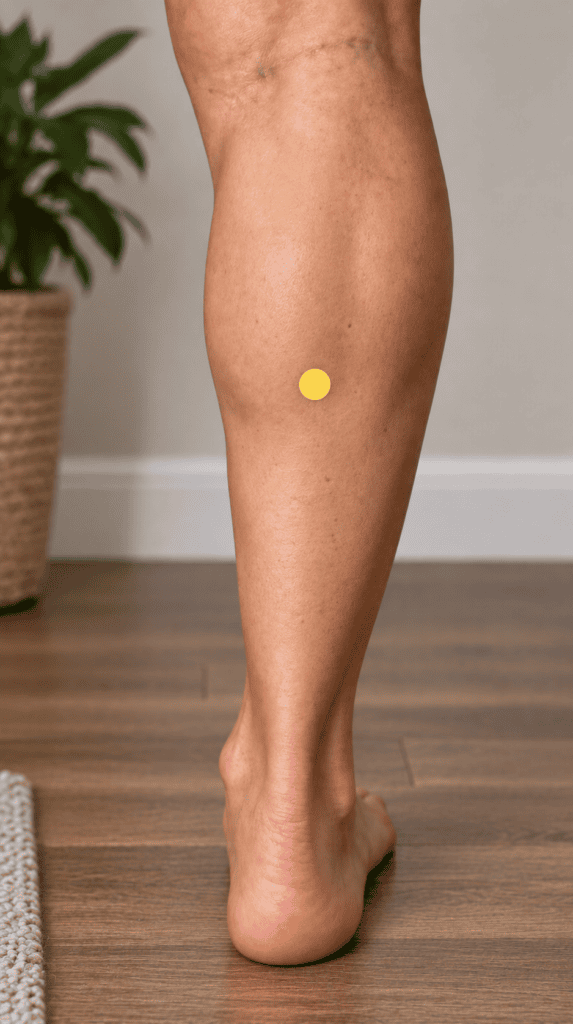
1. Press on BL57 in the calf, the primary point for calf pain. BL57 sits in the center of the back of the lower leg, in the hollow where the calf muscle bulges meet the Achilles tendon, about midway between the back of the knee and the heel. Press firmly with your thumb on the affected leg for one to two minutes. BL57 is called “Chengshan,” and it is the single most important point for the calf.
This point is especially important for calf pain because it lies at the center of the calf muscle, where pain and tightness most often occur. It helps move Qi and Blood, relax tight, aching muscles, and relieve pain and cramps at the source. It is the classic point for all types of calf pain, tightness, and spasms. Begin by pressing firmly into the sore muscle, and combine it with calf massage for the best relief.
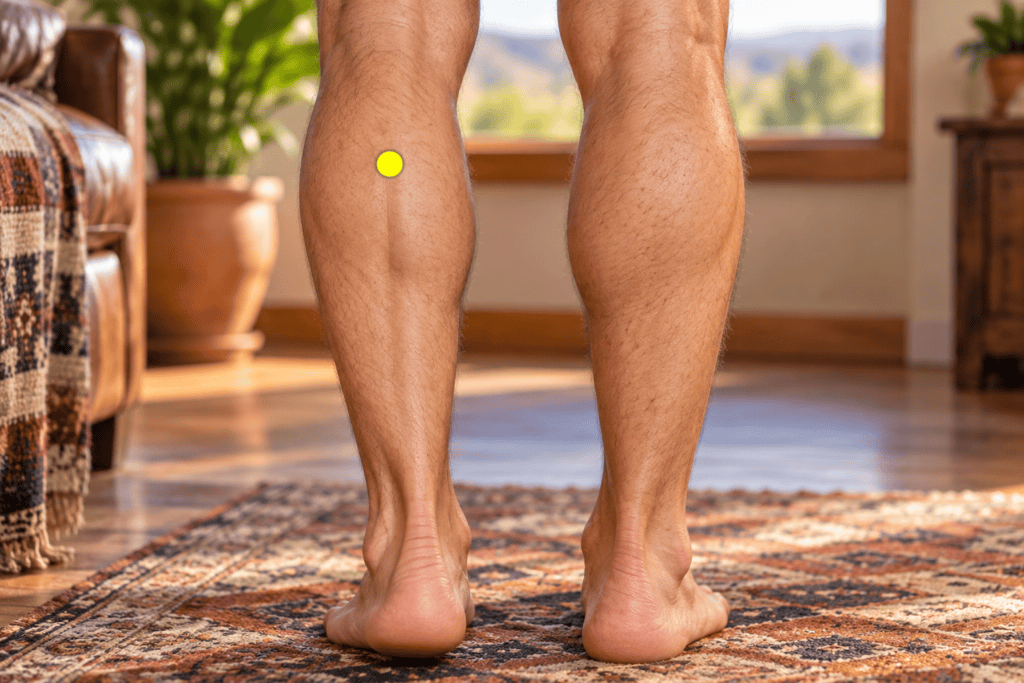
2. Press on BL56 in the upper calf to release the muscle belly. BL56 sits on the back of the lower leg, in the belly of the calf muscle, midway between the back of the knee and BL57. Press firmly with your thumb for one to two minutes on the affected leg. BL56 is called “Chengjin,” a point in the calf muscle.
BL56 sits higher in the calf than BL57, within the muscle’s thickest section. Using both points helps treat the calf’s full length. BL56 eases tension and aching in the upper and middle calf while helping Qi and Blood move through the muscle. If the pain is closer to the knee, this point may help. Working with BL56 and BL57 together, along with massage between them, helps release the entire calf muscle from top to bottom.
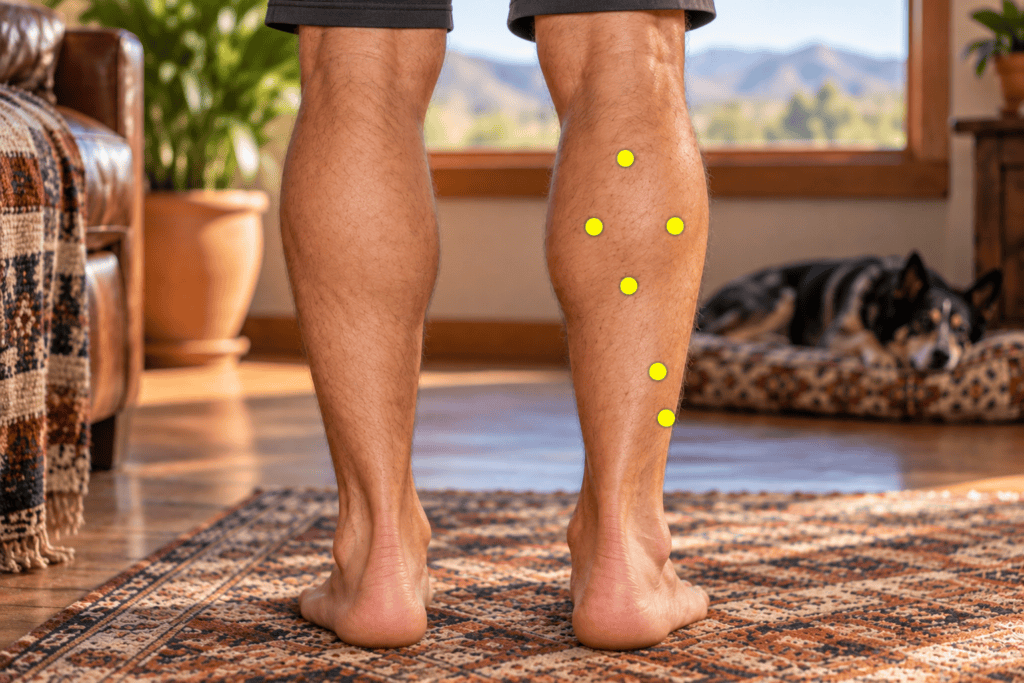
3. Press on the Ashi points in the tight calf muscle. The Ashi points are the tightest, sorest knots and taut bands in your calf; the tender spots you can feel when you press into the muscle. Feel along the calf and press each knot firmly but tolerably, holding until it softens, for about a minute. “Ashi” means “that’s it,” the sound of finding the exact sore point.
In Traditional Chinese Medicine, Ashi points are treated directly because pain indicates where Qi and Blood are most blocked. The calf often develops tight knots and trigger points through overuse or strain. Your most painful spots are the best areas to target. Pressing and holding these points, or massaging them in small circles, can help release the tension causing the pain. For calf pain, these knots are where you may find relief, and combining this approach with firm massage along the muscle can be highly effective.
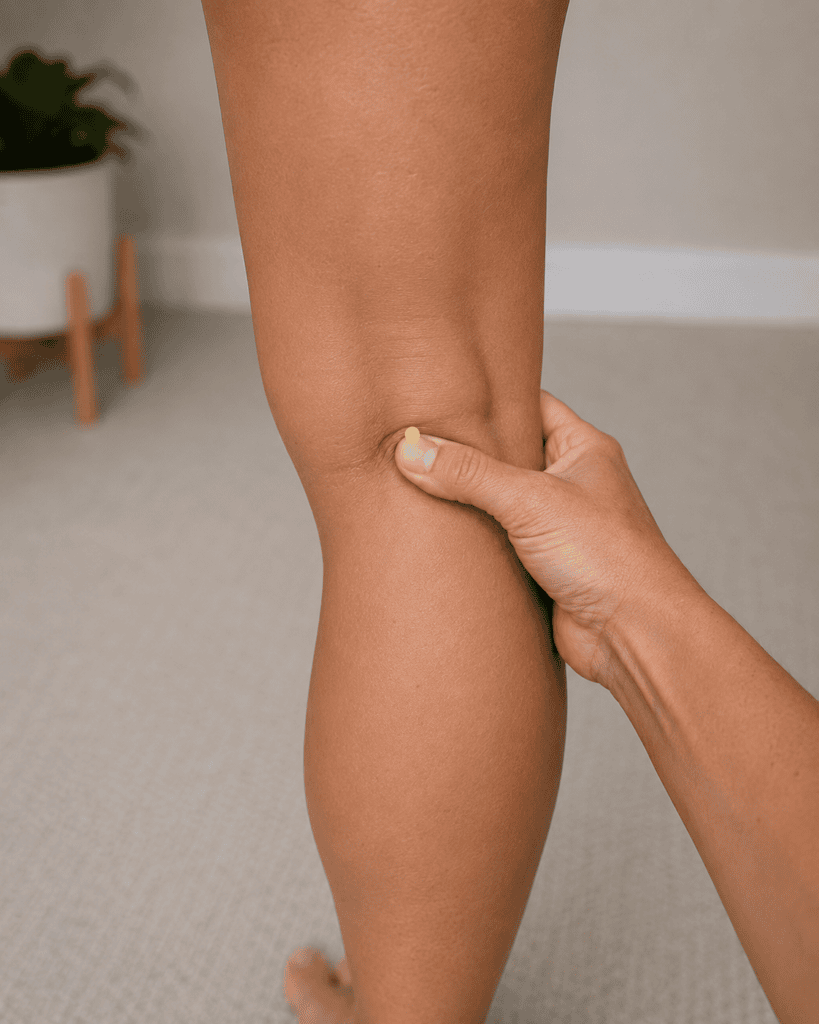
4. Press on BL40 behind the knee to relax the whole leg. BL40 sits in the center of the crease at the back of the knee, in the hollow midway across. Press firmly with your fingers for one to two minutes on the affected leg. BL40 is called “Weizhong,” and it is the command point for the back and the legs.
BL40 is located at the top of the calf, behind the knee, along the Bladder channel that runs through the calf. It is an important point for relaxing the legs and relieving pain and stiffness. As the primary point for the lower back and legs, it helps release tension throughout the back of the leg, including the calf. For pain and tightness along the back of the leg, this point helps relax the entire area and works well with BL56 and BL57 farther down the same channel.
5. Press on GB34 below the outer knee to relax the sinews. GB34 sits on the outer lower leg, in the hollow just below and in front of the head of the fibula, the bony knob below the outer side of the knee. Press firmly with your thumb for one to two minutes on the affected leg. GB34 is called “Yanglingquan,” and it is the influential point for the sinews and muscles of the whole body.
GB34 is a key point for the muscles and tendons, making it especially useful for calf pain caused by muscle tension. It helps loosen tight, cramped muscles and targets the tissues that ache and knot in the calf. Located on the outer lower leg near the top of the calf, it is easy to find and works well alongside the other calf points. If your calf pain mainly comes from tight muscles, this point helps them relax and supports the entire area.
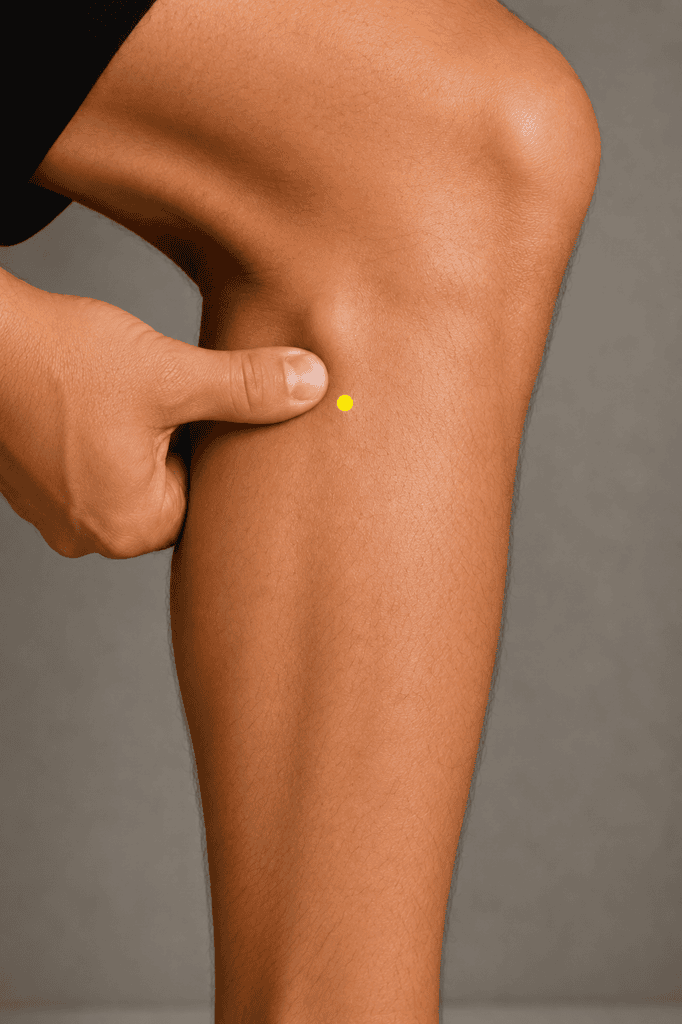
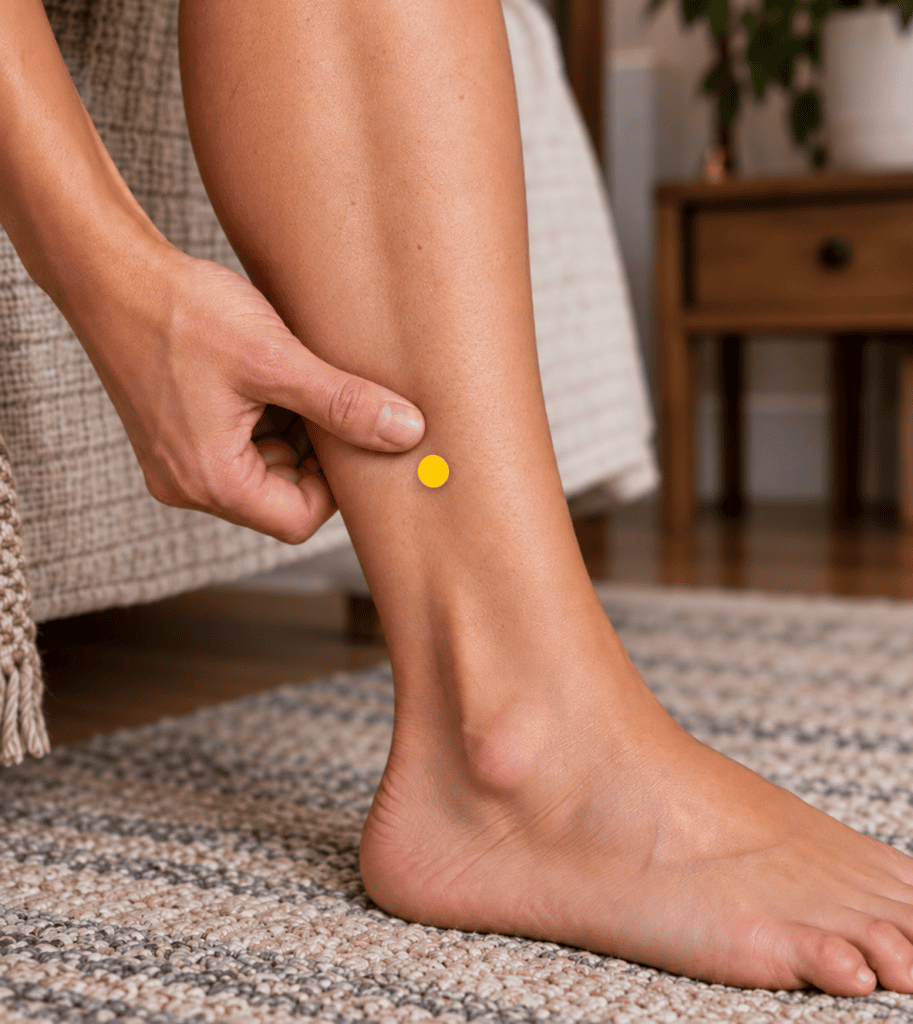
6. Press on KI3 behind the inner ankle to support the lower leg. KI3 sits in the hollow between the inner ankle bone and the Achilles tendon, level with the tip of the ankle bone. Press firmly with your thumb for one to two minutes on each ankle. KI3 is called “Taixi,” the Kidney’s source point.
KI3, the Kidney’s source point, sits at the base of the calf and Achilles and supports the lower leg because the Kidney governs the bones and deep reserves that sustain leg health. It helps move Qi and Blood through the lower calf and Achilles and supports the tissues there, complementing the calf-belly points higher up. For calf pain that extends toward the Achilles, or for a generally run-down, depleted lower leg, this point supports the ankle and rounds out the calf work from below.
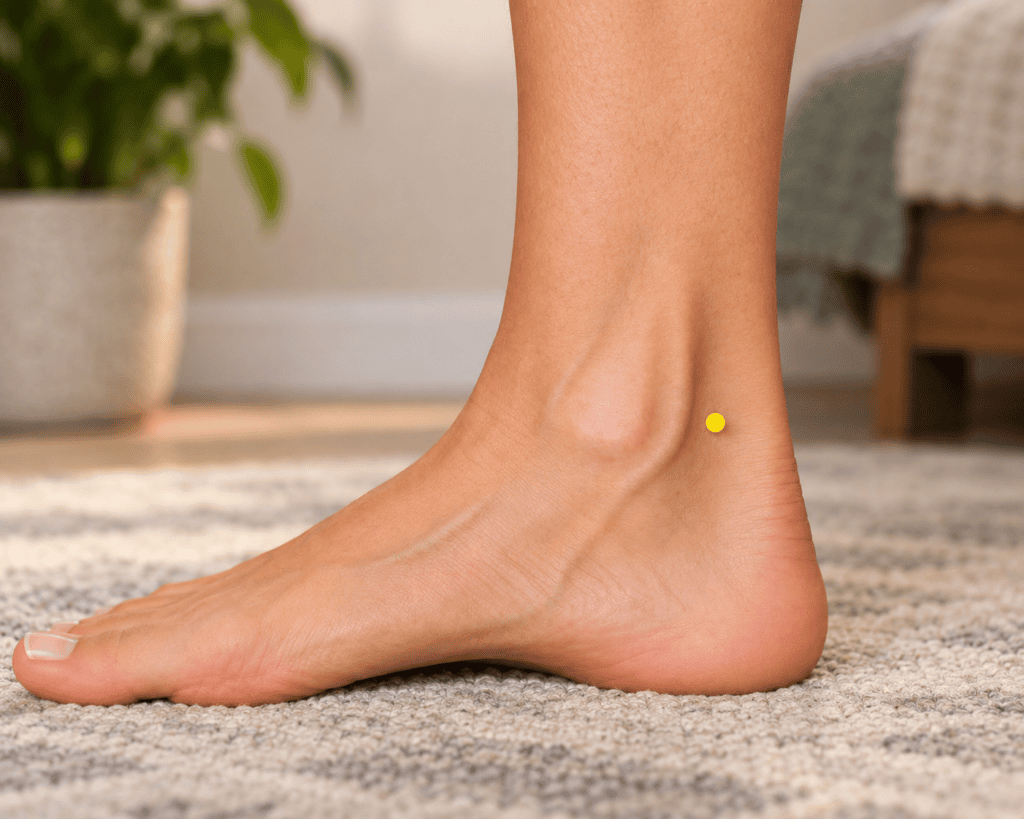
7. Press on SP6 above the inner ankle to nourish the muscle. SP6 sits four finger-widths up from the tip of the inner ankle bone, just behind the back edge of the shinbone. Press firmly for one to two minutes on each leg. SP6 is called “Sanyinjiao,” the “Three Yin Intersection,” where the Spleen, Liver, and Kidney channels meet. SP6 is avoided during pregnancy.
SP6 is one of the body’s most nourishing points because it brings together the three Yin channels of the leg. It nourishes Blood and supports flexible, healthy calf muscles. If your calf feels tight, aches, or cramps because it is not well nourished, this point may help. SP6 works with the other calf points to relax and support the muscle. Remember, do not use this point during pregnancy.
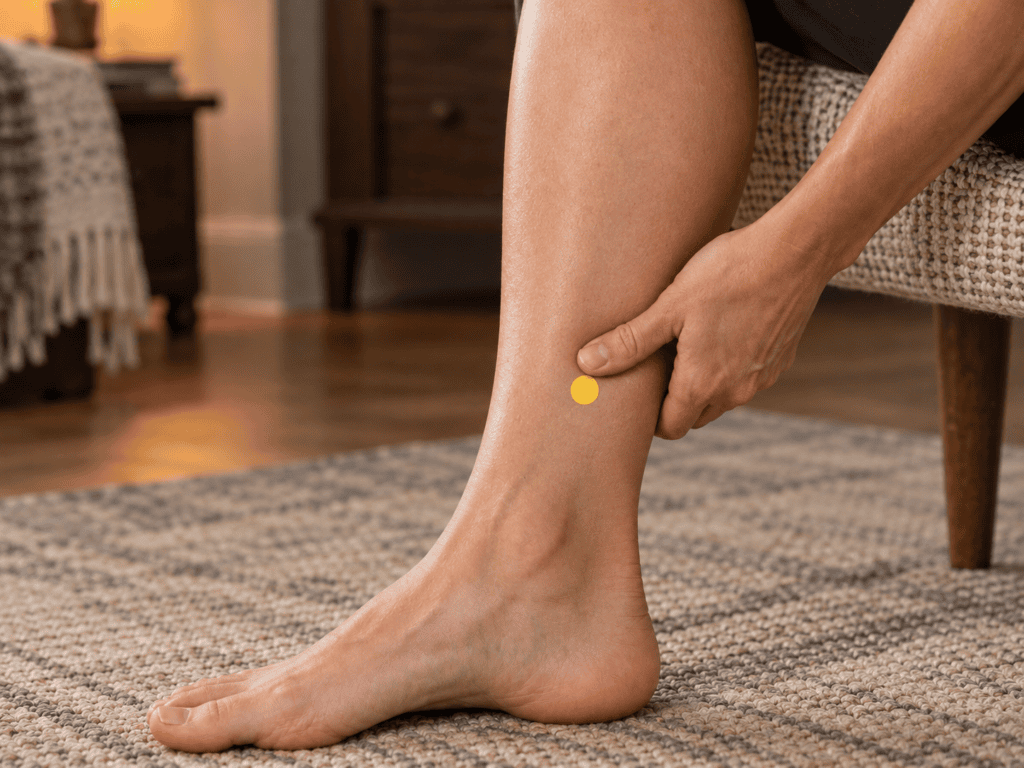
8. Press on ST36 below the knee to rebuild circulation and strength. ST36 sits four finger-widths below the lower edge of the kneecap and one finger-width to the outside of the shinbone, on the muscle that rises when you flex your foot. Press firmly with your thumb for one to two minutes on each leg. ST36 is called “Zusanli,” the “Leg Three Miles,” and it is the master point for energy and for the legs.
ST36 helps rebuild Qi and Blood, improving circulation and energy in your leg. This supports recovery in a sore or overused calf. It strengthens the entire lower leg and increases blood flow, which is important when poor circulation contributes to calf pain. For pain caused by overuse, fatigue, or poor circulation, this point helps restore strength and nourishment to the leg. Located on the front of the shin near the top of the calf, it is easy to use alongside the other calf points.
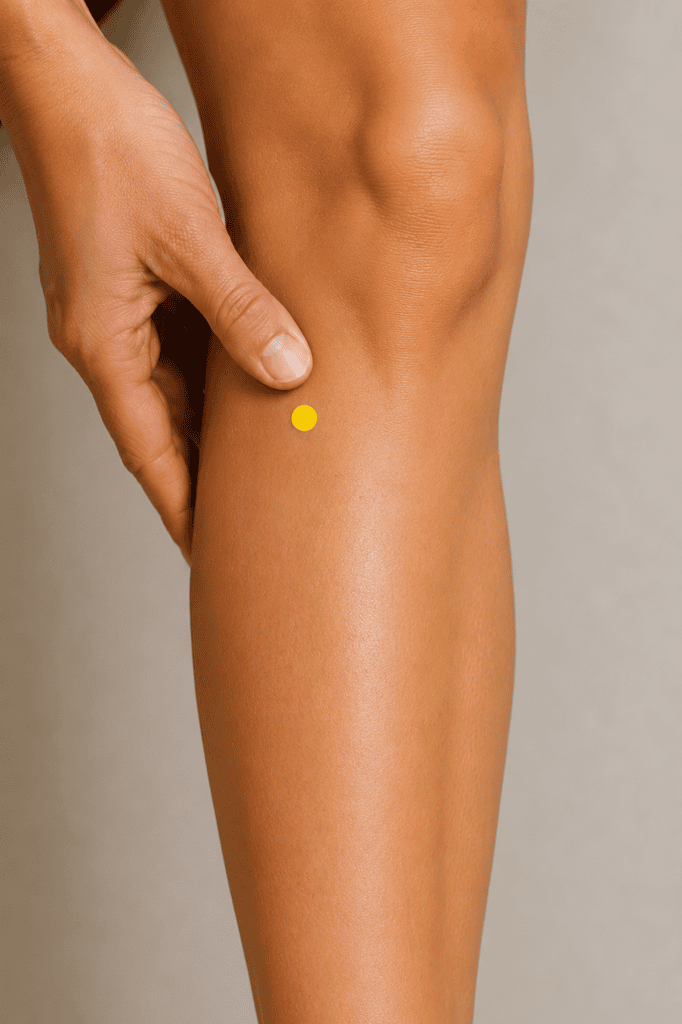
9. Press on GB39 above the outer ankle for the lower leg. GB39 sits on the outer lower leg, about four finger-widths above the tip of the outer ankle bone, just in front of the fibula. Press firmly with your thumb for one to two minutes on each leg. GB39 is called “Xuanzhong,” an influential point for marrow and a useful point for the lower leg.
GB39 is located on the outer lower leg and helps relieve pain, weakness, and stiffness there, particularly in the outer and lower calf along the Gallbladder channel. As the main point for marrow, it supports the leg’s deeper tissues. It pairs well with BL57 and the Bladder channel points on the back of the calf, complementing their focus by addressing the outer side. If calf pain extends into the outer lower leg, or if the lower leg feels stiff and achy, this point can help complete the treatment from the outer ankle.
Why These Acupressure Points Work
In Traditional Chinese Medicine, muscular calf pain is understood as a blockage of Qi and Blood in the calf’s muscles and channels. It often results from overuse, strain, prolonged standing, or poor circulation and usually occurs along the Bladder channel, which runs down the back of the leg. The nine points above help address all of these causes.
- The calf-muscle points (BL57, BL56, and the Ashi knots) help loosen tight, aching muscles throughout the calf.
- The leg-relaxing points, BL40 and GB34, help relax the entire back of the leg and its tendons, with GB34 serving as the primary point for the muscles.
- The nourishing and circulation points (KI3, SP6, and ST36) help nourish the muscles, improve blood flow, and support the lower leg.
- The outer-leg point (GB39) targets the outer and lower parts of the calf.
The main goal is to release tight muscles and move Qi and Blood. That’s why combining these points with firm calf massage and warmth is so helpful.
How to Properly Use These Acupressure Points
Target the calf directly, combining pressure, massage, and warmth.
- Use BL57 and BL56 on the calf muscle, together with the tender Ashi knots. Apply firm pressure and massage along the muscle’s length until it softens.
- Add BL40 and GB34 to help relax the entire leg and its tendons. Use KI3, SP6, ST36, and GB39 to nourish the muscles, improve circulation, and target the lower and outer leg.
- Combine these points with firm calf massage and gentle stretching to help release a tight, sore calf. Apply warmth to the muscle to relax it and improve circulation, as Chinese medicine recommends warmth to move stagnation.
- Hold each point for one to two minutes, and perform this exercise on your calf several times a day, particularly after physical activity or prolonged periods of standing.
Acupressure can help relieve pain, and other measures may support a sore calf. Rest from activities that worsen it, but keep the calf gently moving and stretch it to prevent stiffness. Stretch regularly, especially if your calf tends to tighten, and stay hydrated, since dehydration can cause tightness and cramps. Warmth can relax a sore calf, while supportive shoes may help. Ease back into activity gradually to protect a strained muscle and promote healing, particularly if the strain occurred during exercise.
When to Get Professional Help
Most calf pain is muscular and improves with pressure, massage, stretching, and rest; acupressure may also help. However, some calf pain requires medical attention, and one warning sign is especially important. If your calf pain is accompanied by swelling, warmth, redness, or tenderness, particularly in one leg without an obvious exercise-related cause, it could indicate deep vein thrombosis (a blood clot), which is a medical emergency. Do not press or massage the area; seek urgent care, especially if you also have shortness of breath or chest pain, which could mean the clot has traveled to your lungs.
You should see a doctor if your calf pain began after a sudden injury, especially if you felt a sharp pain or popping sensation (which could indicate a muscle or Achilles tear); if you have severe pain or cannot put weight on your leg; if the pain begins when walking and goes away with rest (which could indicate a circulation problem); or if it is severe, persistent, or not improving.
Acupressure and self-care may help with everyday sore, tight, or strained calves, but they are not a substitute for medical care in these situations, especially when a blood clot is suspected.
Above and Beyond Acupuncture offers acupuncture, cupping, and lifestyle coaching at the North Frank Lloyd Wright Boulevard location in Scottsdale.
Schedule an appointment online to start your healing journey.
Because a sudden, seizing calf cramp and the restless, crawling feeling of restless legs are different health conditions, explore acupressure for leg cramps and acupressure for restless legs, depending on which best matches your symptoms.
The points above are only as effective as the technique used to apply them. Where to press, how firmly, and for how long all affect the result. For a full breakdown of how to perform acupressure properly at home, read Performing Acupressure in 3 Easy Steps.

About the Publisher
Paul Kerzner, L.Ac., is a licensed acupuncturist and board-certified herbalist, as well as the founder of Above and Beyond Acupuncture in Scottsdale. His own journey from chronic patient to practicing acupuncturist shapes his commitment to providing honest, clinically grounded information about acupuncture and Traditional Chinese Medicine. Learn more about Paul and his clinical approach on the About Us page.