
Key Takeaways
- A panic attack is a sudden surge of intense fear or discomfort, often accompanied by a racing heart, trembling, tingling, chest tightness, and difficulty breathing, even when there is no real danger.
- Panic attacks are distressing but not life-threatening, and panic disorder, in which attacks recur unexpectedly, can be managed with the right treatment and support.
- In Traditional Chinese Medicine, fright throws the Qi into chaos, leaving the Heart and its protector, the Pericardium, unable to keep the mind settled.
- Nine acupressure points on the wrists, hands, chest, forehead, and feet help slow a racing heart, ease a tight chest, calm the mind, and ground the body. Most can be pressed discreetly during an attack.
- Acupressure for panic attacks works best alongside slow breathing and professional care; chest pain that radiates to the arm, jaw, or back, or a first episode with heart risk factors, requires emergency care.

A panic attack can happen anywhere, whether you’re waiting in line, sitting in a meeting, driving, or lying in bed at night. Your heart pounds, breathing feels difficult, your hands tingle, and a wave of fear comes out of nowhere. Soon, your body feels certain that something is very wrong.
The NIMH defines a panic attack as a sudden surge of fear or discomfort or a sense of losing control, even in the absence of any actual threat. You may experience a racing heart, sweating, chills, trembling, difficulty breathing, feeling faint or weak, tingling or numbness in the hands, chest or abdominal pain or nausea. The attack will typically last anywhere from a few minutes to an hour (though it can be longer), and while it is extremely frightening, it is not life-threatening.
Researchers describe panic attacks as false alarms, when the body’s survival response activates too often or too intensely. A racing heart may feel like a heart attack, adding to the fear and creating a cycle of attacks that seem to come out of nowhere. When attacks keep happening and you begin to worry about the next one, this is called panic disorder. It often begins in the late teens or early adulthood, is more common in women, and usually improves with therapy or medication.
Traditional Chinese Medicine teaches that fear causes Qi to sink, while fright scatters it. The Heart is said to house the mind, and the Pericardium (the Heart Protector) shields the Heart from emotional shock. When stress, exhaustion, or sudden fright overwhelms the Pericardium’s protection, Qi rushes upward. The chest may feel tight, the heart may race, and the mind may feel scattered. People who are easily startled, sleep poorly, or are generally on edge are more likely to experience this.
These nine points slow a racing heart, ease a tight chest, calm the mind, and draw scattered Qi back down, helping the body settle.
What Acupressure Points to Press and Why
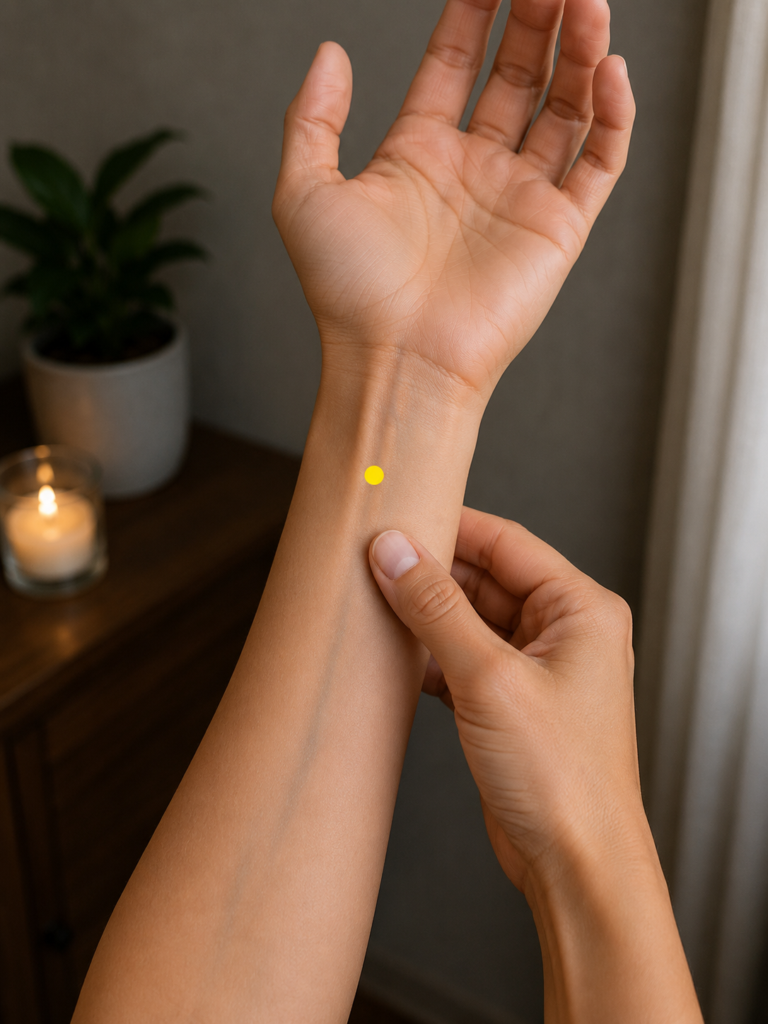
1. Press on PC6 on the inner forearm to slow a racing heart. PC6 sits on the inner forearm, three finger-widths above the wrist crease, between the two tendons. Press firmly with the thumb of your other hand for one to two minutes on each arm while breathing out slowly. PC6 is called “Neiguan,” the “Inner Pass.”
PC6 is the connecting point of the Pericardium (Heart Protector) and one of the most commonly used points in Traditional Chinese Medicine for anxiety, palpitations, chest tightness, and nausea. It’s the first point to reach for when panic starts to build, and you can press it anywhere without anyone noticing.
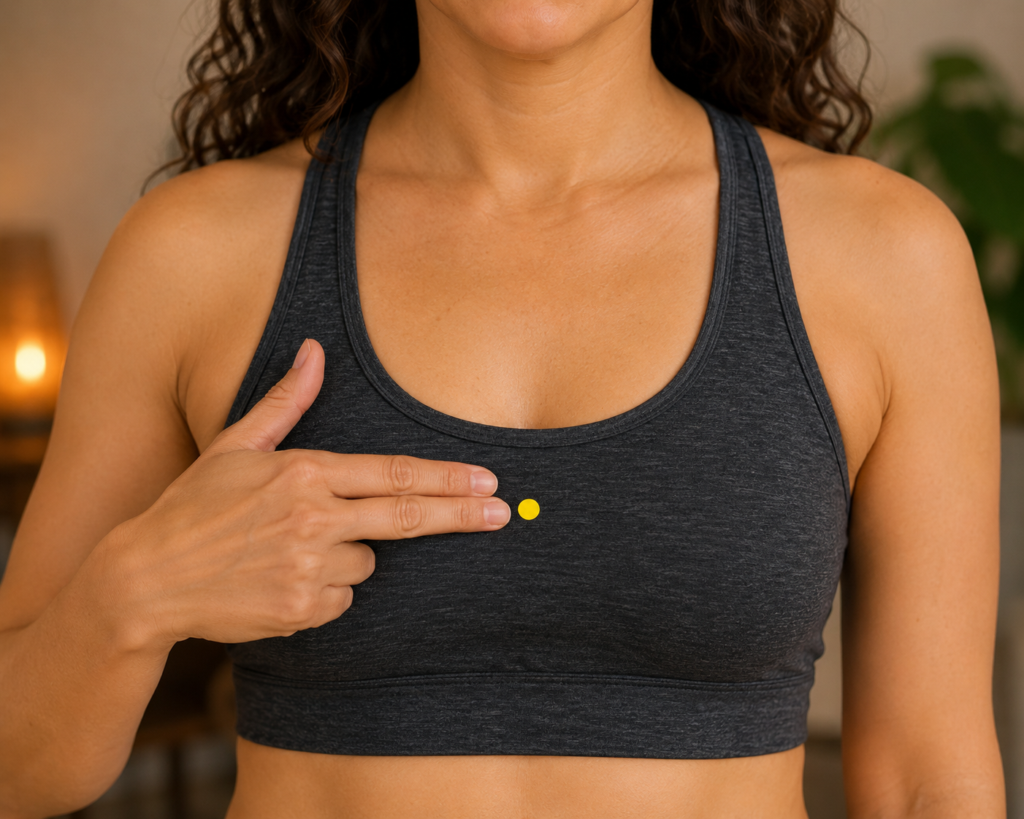
2. Press on CV17 at the center of the chest to relieve tightness. CV17 sits on the midline of the breastbone, level with the space between the fourth and fifth ribs, about even with the nipples. Rest your fingertips on the point and press gently, or make slow circles, for one to two minutes while breathing slowly into the belly. CV17 is called “Danzhong,” the “Chest Center.”
CV17 is the influential point of Qi and the Pericardium’s front collecting point. In Traditional Chinese Medicine, it is the primary point for opening the chest, easing the tight, suffocating feeling of panic, and helping restore the flow of breath.
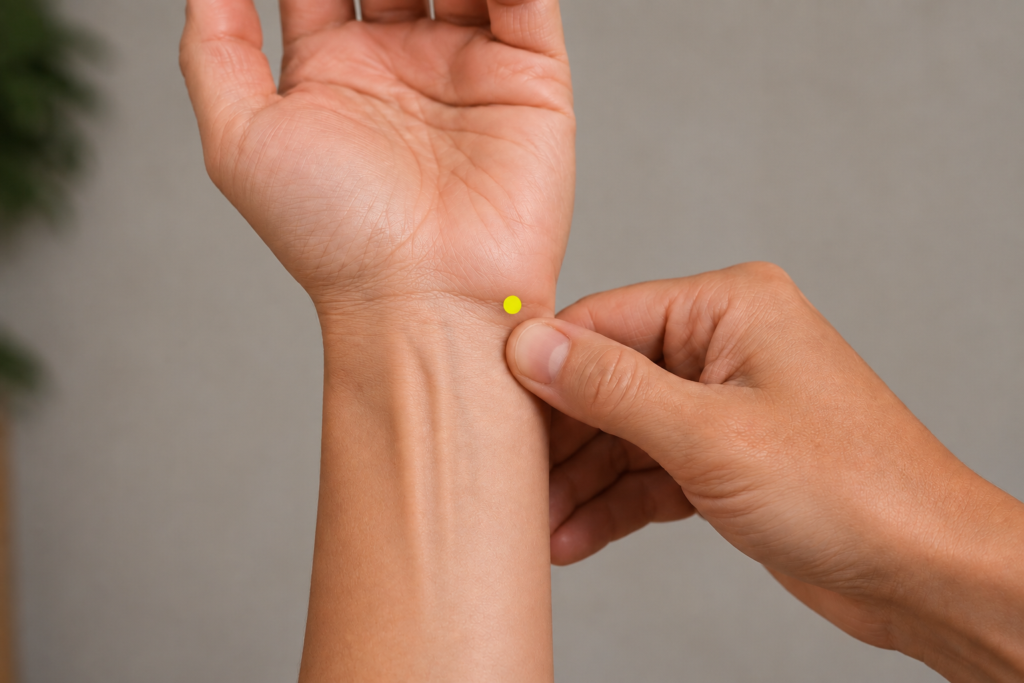
3. Press on HT7 on the wrist crease to calm the mind. HT7 sits on the inner wrist crease, on the pinky side, in the small hollow just to the thumb side of the tendon that runs along the edge of the wrist. Press gently with the thumb of your other hand for one to two minutes on each wrist. HT7 is called “Shenmen,” the “Spirit Gate.”
HT7 is the source point of the Heart, which houses the mind in Traditional Chinese Medicine. It is commonly used for anxiety, fear, palpitations, and restless sleep, and to help the mind return to the Heart after a shock.
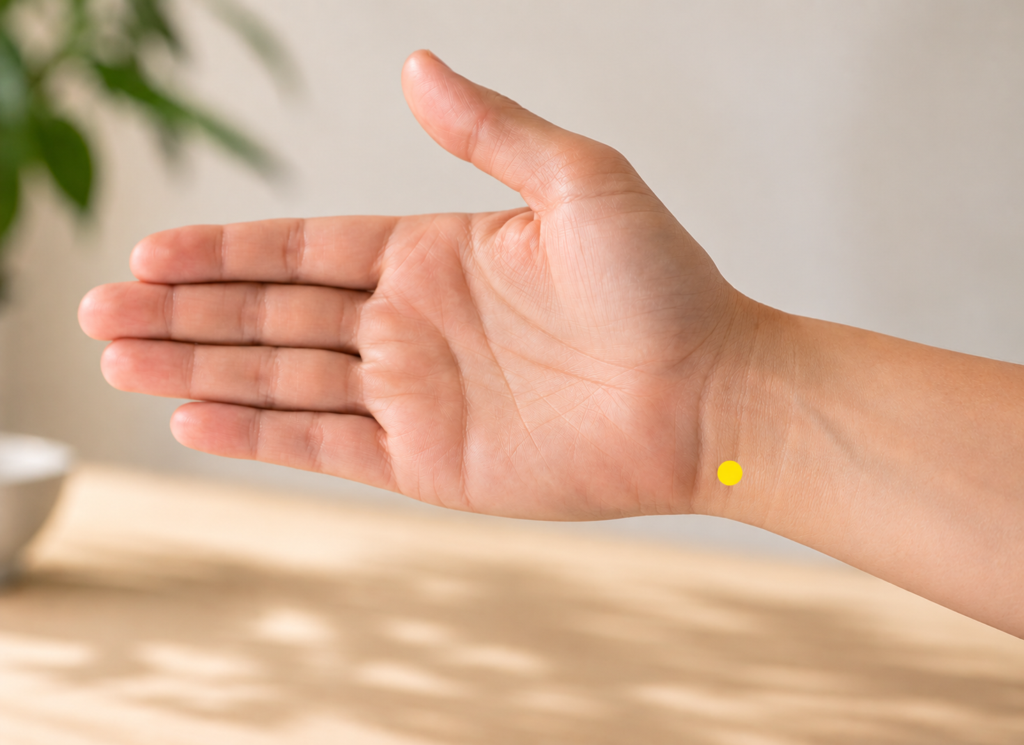
4. Press on HT6 just above the wrist crease to steady the heart during an attack. HT6 sits on the inner forearm, on the pinky side, just inside the tendon, about half a thumb-width above HT7. Press firmly with the thumb of your other hand for one to two minutes on each wrist. HT6 is called “Yinxi,” the “Yin Cleft.”
HT6 is the cleft point of the Heart channel and is used for acute, sudden conditions. It’s traditionally indicated for palpitations, fright, and a pounding heart, making it especially useful during an attack. HT6 and HT7 are so close together that you can press both at once with the side of your thumb.
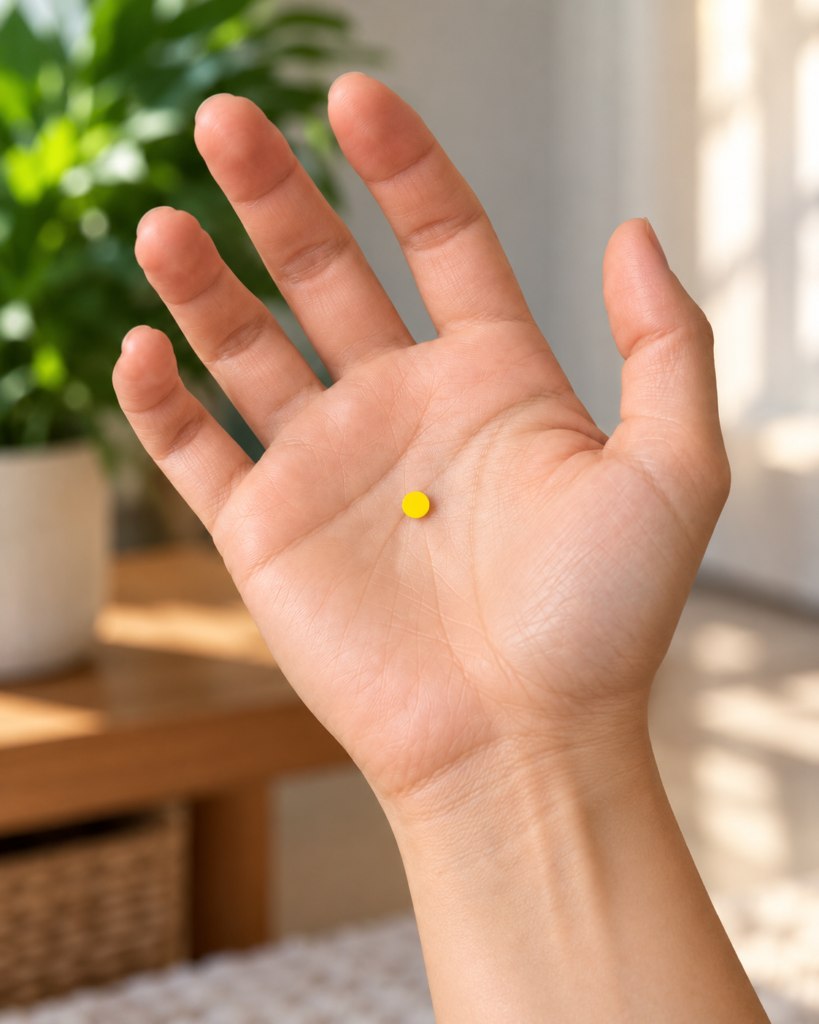
5. Press on PC8 in the center of the palm to release heat and fear. PC8 sits in the center of the palm, where the tip of the middle finger touches when you make a loose fist. Press firmly with the thumb of your other hand for one to two minutes on each hand, or simply close a loose fist and press the middle fingertip into the palm. PC8 is called “Laogong,” the “Palace of Toil.”
PC8 is a Pericardium point traditionally used to clear heat from the Heart and calm the mind. If panic comes with a flushed face, sweaty hands, and a mind racing a thousand miles an hour, PC8 is said to clear that heat and restore calm. It is one of the easiest points to press, and you can do it without anyone noticing.
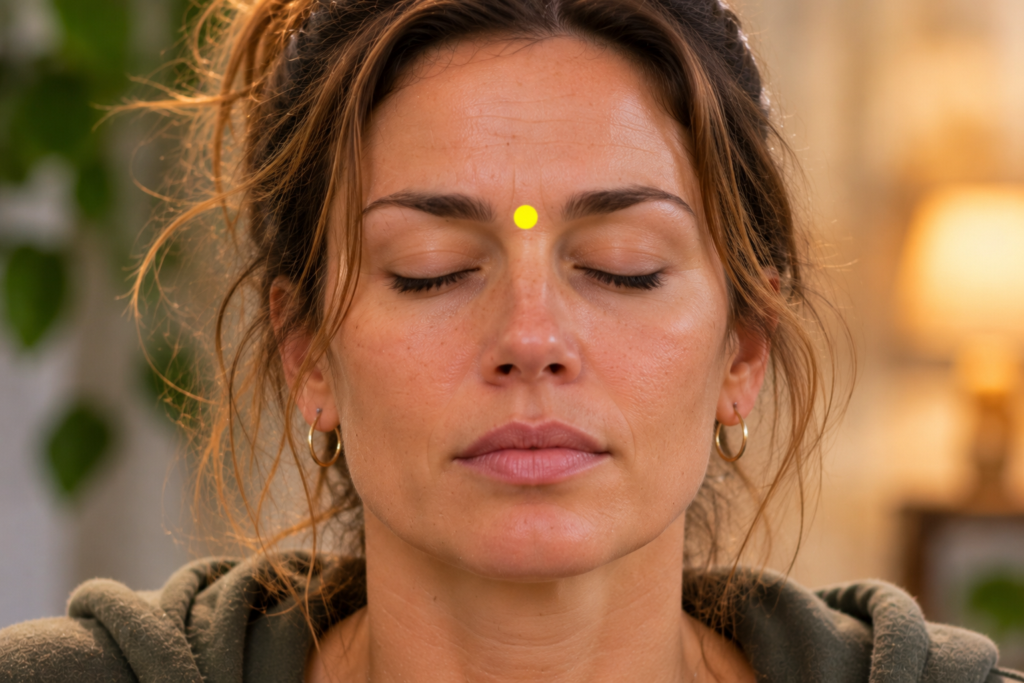
6. Press on Yintang between the eyebrows to quiet a racing mind. Yintang sits on the midline of the forehead, directly between the inner ends of the eyebrows. Press gently with your fingertip, or make slow, small circles for one to two minutes while breathing slowly. Yintang is called the “Hall of Impression.”
Yintang is an extra point traditionally used to calm the mind and ease anxiety. During a panic attack, it may help quiet spiraling thoughts that ‘something is terribly wrong’, especially when paired with slow, long exhales.
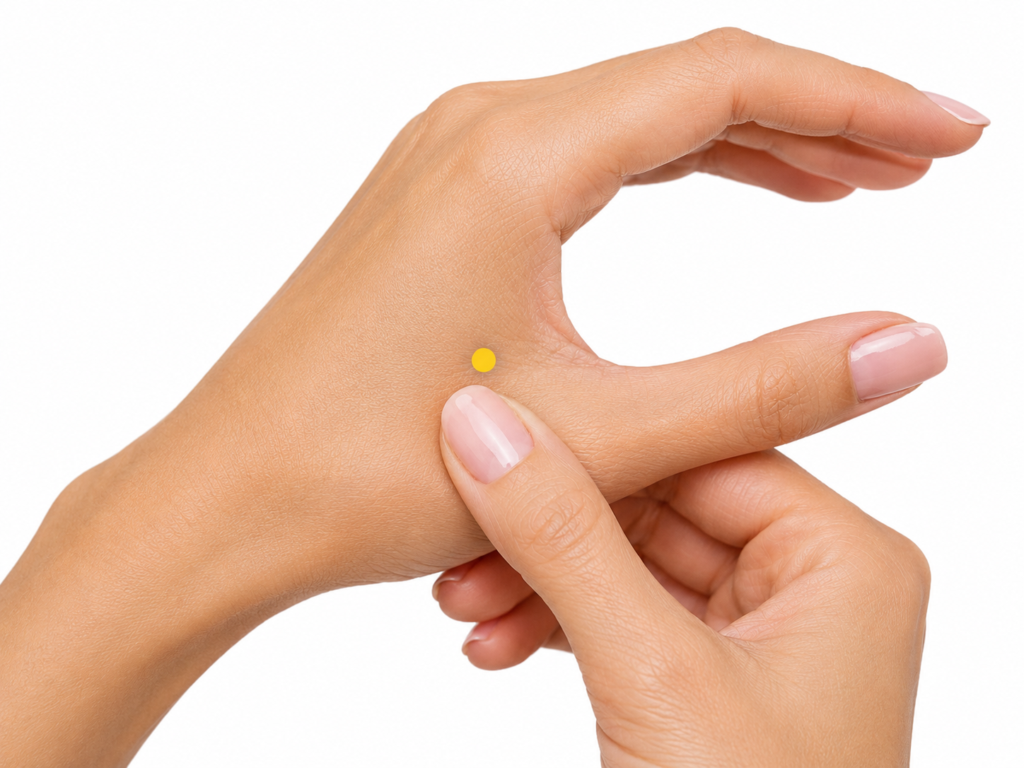
7. Press on LI4 on the back of the hand to release tension. LI4 sits in the webbing between the thumb and index finger, at the highest point of the muscle when the two are pressed together. Press firmly with the thumb of your other hand for one to two minutes on each hand. LI4 is called “Hegu,” the “Joining Valley.” LI4 is contraindicated during pregnancy.
LI4 is one of the key points for easing tension, headaches, and pain. It’s one of the two points in the classic ‘Four Gates’ (along with LR3), which are used to move Qi through the body and calm the nervous tension that tends to build before and after an attack.
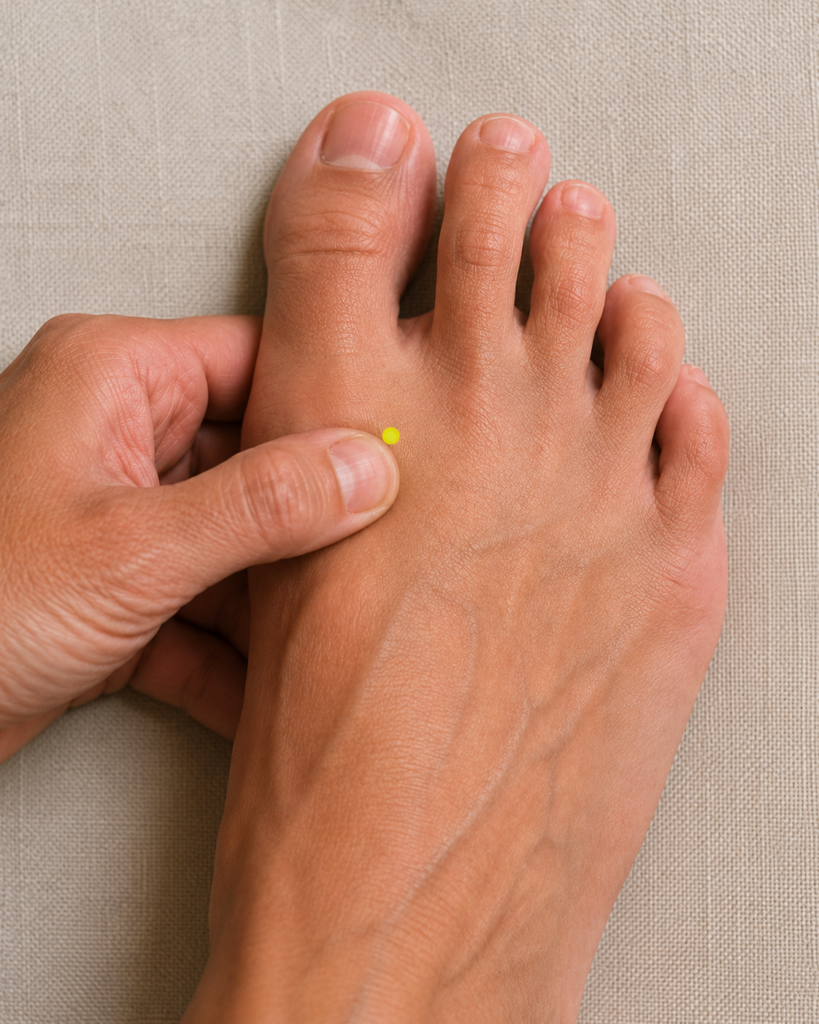
8. Press on LR3 on the top of the foot to ease stress and irritability. LR3 sits on the top of the foot, in the hollow where the bones of the big toe and second toe meet, about two finger-widths above the web between the toes. Press firmly with your thumb for one to two minutes on each foot. LR3 is called “Taichong,” the “Great Surge.”
LR3 is the source point of the Liver and helps keep Qi flowing smoothly throughout the body. Chronic stress can constrict Liver Qi, and as that pressure builds, it may rise and trigger an attack. LR3 helps release this constriction and reduce the underlying tension that can make panic much more likely.
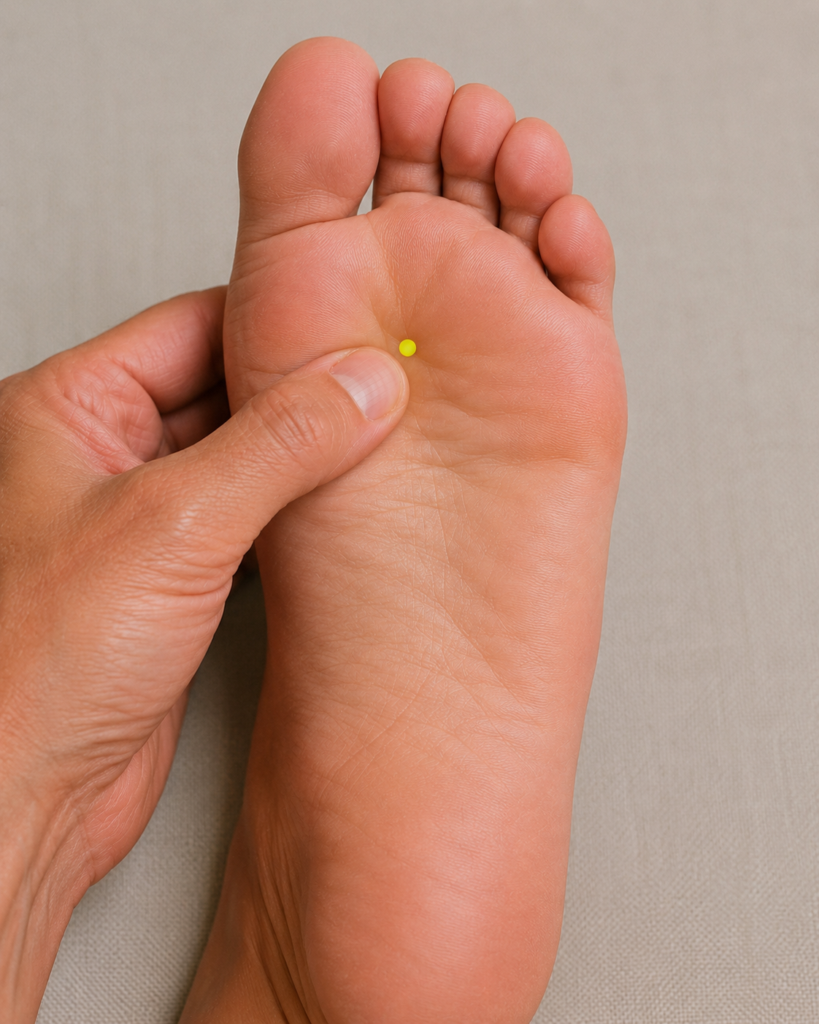
9. Press on KI1 on the sole of the foot to ground the body. KI1 sits on the sole of the foot, in the hollow that appears about one-third of the way from the base of the second toe to the back of the heel when the toes are curled. Press firmly with your thumb for one to two minutes on each foot, or press the soles firmly into the floor while seated. KI1 is called “Yongquan,” the “Bubbling Spring.”
KI1 is the body’s lowest point and the first point on the Kidney channel. In Traditional Chinese Medicine, it’s traditionally used to draw Qi down from the chest and head, helping settle the upward rush of panic and create a sense of being grounded in the body.
Why These Acupressure Points Work
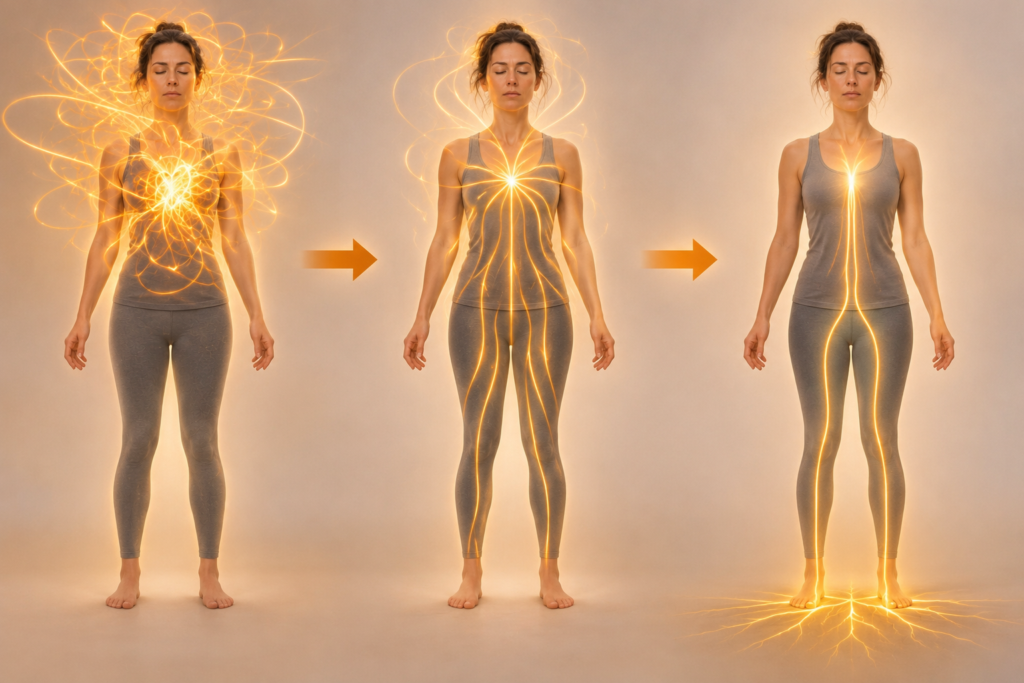
In Traditional Chinese Medicine, a panic attack occurs when fright scatters the Qi, the Heart loses its protection, and energy rushes up into the chest and head. The approach is to steady the Heart and Pericardium, open the chest to restore the breath, calm the mind, and draw the Qi downward so the body can feel grounded again.
The nine points work together to settle an attack and reduce the underlying tension:
- The Heart and Pericardium points (PC6, HT7, HT6, PC8) slow a racing heart, steady the mind, and cool rising heat.
- The chest point (CV17) opens the chest and helps the breath move freely.
- The calming points (Yintang, LI4, LR3) quiet spiraling thoughts and release built-up stress.
- The grounding point (KI1) draws the scattered Qi down and returns a sense of stability.
How to Properly Use These Acupressure Points
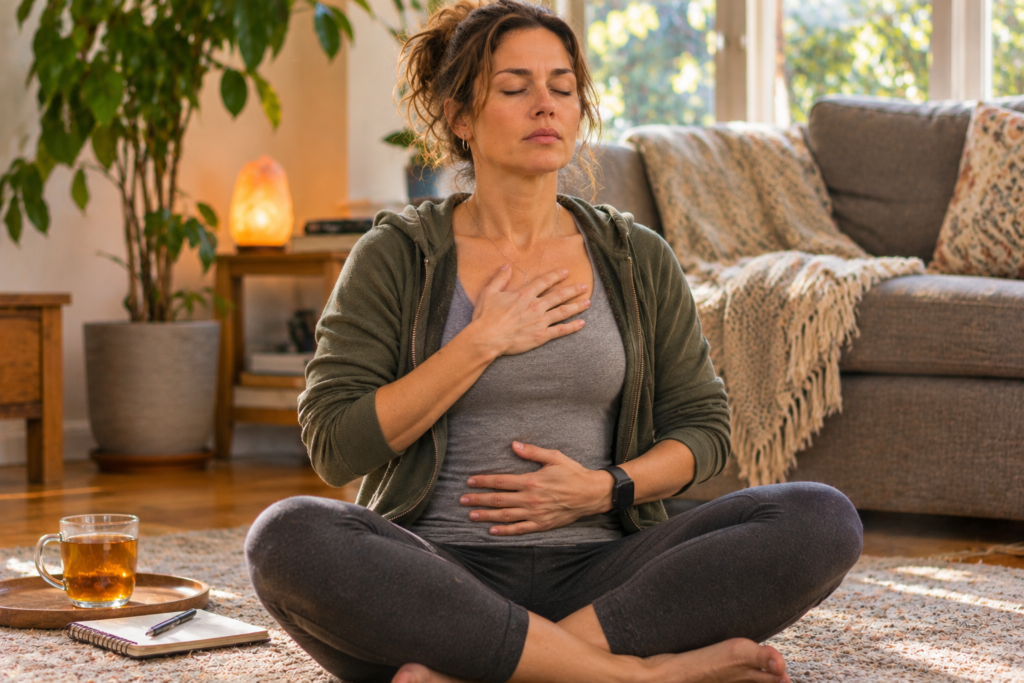
Acupressure for panic attacks is most effective both as an immediate coping tool and as part of a daily routine to reduce the likelihood of another attack.
- When panic begins, apply pressure to PC6 on one arm while inhaling slowly through the nose and exhaling for twice as long. Then switch arms and proceed to HT6 and HT7.
- If you are in a public setting, gently close your hand into a loose fist to apply pressure to PC8, or press both soles firmly against the floor to stimulate KI1 while breathing.
- Work through all nine points at least once a day, holding each for one to two minutes. Use gentle pressure at CV17 and Yintang, and firmer pressure on the hands, wrists, and feet.
- Practice daily for several weeks, as establishing a calmer baseline may reduce the frequency of attacks and make them easier to manage.
Daily habits can go a long way toward reducing the frequency of panic attacks. Practice slow breathing for a few minutes each day, with a longer exhalation, so it feels natural during an attack. Limit caffeine, alcohol, and nicotine, which can trigger or worsen an attack, and try to keep a regular sleep schedule. Move every day, eat regular meals to help keep your blood sugar stable, and keep a brief log of when attacks occur to identify patterns or triggers. Gradually returning to places you have avoided, ideally with a therapist’s support, can help prevent panic from increasingly restricting your life.
Find out more about how to stop a panic attack when you feel one coming on.
When to Get Professional Help

Call 911 if you have chest pain or pressure that radiates to your arm, jaw, neck, or back; shortness of breath that doesn’t improve; or fainting. Call 911 for a first attack in someone with heart disease or heart risk factors, since a heart attack can feel like a panic attack and must be ruled out. See a doctor if attacks recur, worry about another attack changes your behavior or affects your life, or attacks begin after you start a new medication or supplement. Other conditions, such as thyroid problems, can cause similar symptoms. Talk with your doctor about cognitive behavioral therapy and medication; both can effectively treat panic disorder. Never stop a prescribed anxiety medication without first discussing it with your provider.
If panic is accompanied by thoughts of self-harm, call or text 988 to reach the Suicide and Crisis Lifeline.
Acupressure is a gentle, supportive practice during a panic attack. It is a complementary therapy and not a substitute for diagnosis or medical care.
For related emotional concerns, acupressure for anxiety, acupressure for general anxiety disorder, and acupressure to calm down are companion articles. If fear of another panic attack has started to keep you from certain activities, learn about acupressure for fear.
Above and Beyond Acupuncture offers acupuncture, cupping, and lifestyle coaching at the North Frank Lloyd Wright Boulevard location in Scottsdale.
Schedule an appointment online to start your healing journey.
The points above are only as effective as the technique used to apply them. Where to press, how firmly, and for how long all affect the result. For a full breakdown of how to perform acupressure properly at home, read Performing Acupressure in 3 Easy Steps.

About the Publisher
Paul Kerzner, L.Ac., is a licensed acupuncturist and board-certified herbalist, as well as the founder of Above and Beyond Acupuncture in Scottsdale. His own journey from chronic patient to practicing acupuncturist shapes his commitment to providing honest, clinically grounded information about acupuncture and Traditional Chinese Medicine. Learn more about Paul and his clinical approach on the About Us page.