Key Takeaways
- A stiff neck, also called acute torticollis or wry neck, often develops overnight and leaves the head stuck turned or tilted, with sharp pain when trying to turn it back.
- Sleeping in an awkward position, poor neck support, long hours in front of a screen, and carrying uneven loads are common causes, and acute torticollis usually resolves within one to two days.
- In Traditional Chinese Medicine, a stiff neck results from Qi and Blood becoming stuck in the neck’s channels, often after sleeping in a cold draft that allows Wind-Cold to settle into the muscles.
- Nine acupressure points on the hands, wrists, legs, ankles, neck, and shoulders, including the “Stiff Neck” point (Luozhen), help release locked muscles and restore the ability to turn the head.
- Acupressure for a stiff neck works best with gentle movement and warmth. A stiff neck with fever and headache, numbness or weakness in the arms, or stiffness after a fall or accident needs medical care.

Many languages have a nickname for it. In English, it’s called a crick in the neck or a wry neck. In Chinese, it’s luozhen, meaning “fallen from the pillow,” a phrase that captures how it usually begins. The night seems ordinary, but by morning the head won’t turn. Looking over one shoulder brings a sharp catch of pain, the head tilts slightly to one side, and backing the car out of the driveway requires turning the whole body.
According to UK government health guidance, a painful or stiff neck often develops after sleeping awkwardly, spending long periods at a computer, or straining muscles through poor posture. Anxiety and stress can also increase tension. A twisted or locked neck, known as acute torticollis, results from an injury to the neck muscles, often caused by poor posture, inadequate neck support while sleeping, or carrying uneven loads. It usually lasts just 24 to 48 hours. Keeping the neck moving, using a low, firm pillow, applying warmth, and taking ordinary pain relievers can help; it is generally best to avoid a neck collar.
The problem usually starts in the muscles that support and turn your head. One may spasm to protect your neck, and turning your head can strain it again. Keeping your neck stiff may feel safer, but it can prolong the spasm. That’s why gentle movement can help you recover.
In Traditional Chinese Medicine, a stiff neck occurs when Qi and Blood become stuck in the channels that run through the neck. Keeping your neck twisted for hours slows their flow, while sleeping under a fan, air conditioning, or an open window can allow Wind-Cold to settle in and further tighten the muscles. Difficulty turning your head from side to side points to the channels along the sides of your neck. Trouble looking up or down points to the channels along the back of your neck and spine. This distinction helps determine which points to use.
These nine points help release tight muscles, ease pain, warm the neck, and restore the ability to turn your head freely.
What Acupressure Points to Press and Why
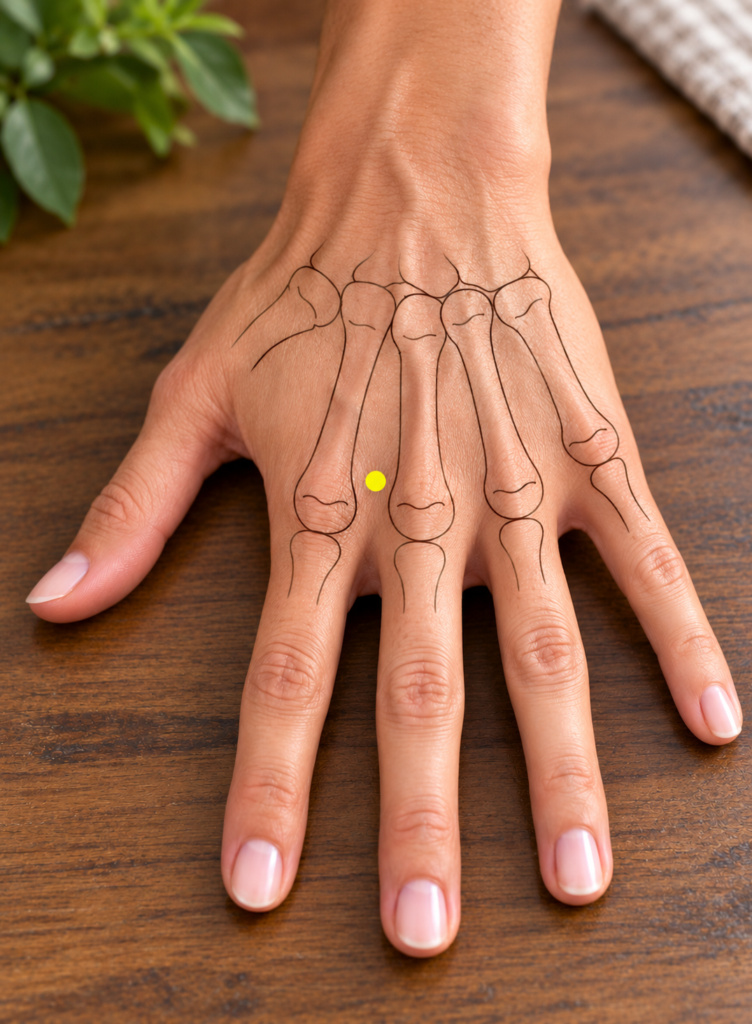
1. Press on Luozhen on the back of the hand to release a stiff neck. Luozhen sits on the back of the hand, in the groove between the bones of the index and middle fingers, about one finger-width behind the knuckles. Press firmly with the thumb of your other hand for one to two minutes on each hand while slowly turning your head side to side within a comfortable range. Luozhen is called the “Stiff Neck” point.
Luozhen is an extra point for a stiff neck; its name is the same Chinese word used for a neck that’s “fallen from the pillow.” Traditionally, it’s the first point you’d try. It works best when you gently move your neck while applying pressure, allowing the locked muscles to release a little at a time.
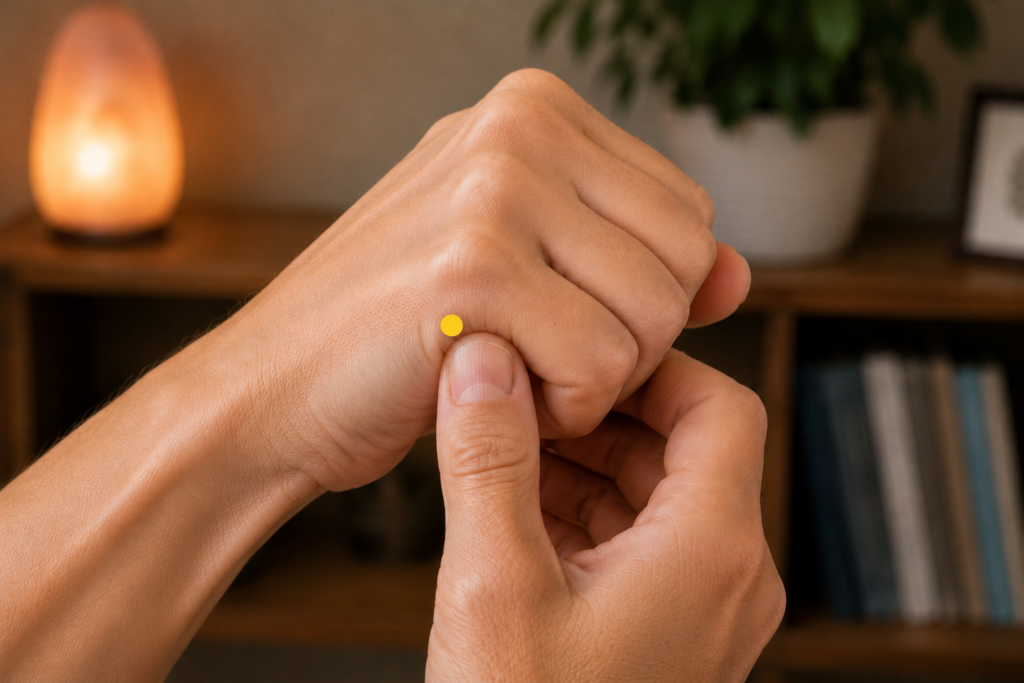
2. Press on SI3 on the edge of the hand to ease stiffness when looking up or down. SI3 sits on the pinky side of the hand. Make a loose fist; SI3 is at the end of the crease just behind the little finger knuckle. Press firmly with the thumb of your other hand for one to two minutes on each hand while slowly nodding your head. SI3 is called “Houxi,” the “Back Stream.”
SI3 opens the Governing Vessel, which runs along the center of the spine and the back of the neck. In Traditional Chinese Medicine, it’s one of the most important distal points for neck and upper-back stiffness and pain, especially when bending the head forward or tipping it back hurts.
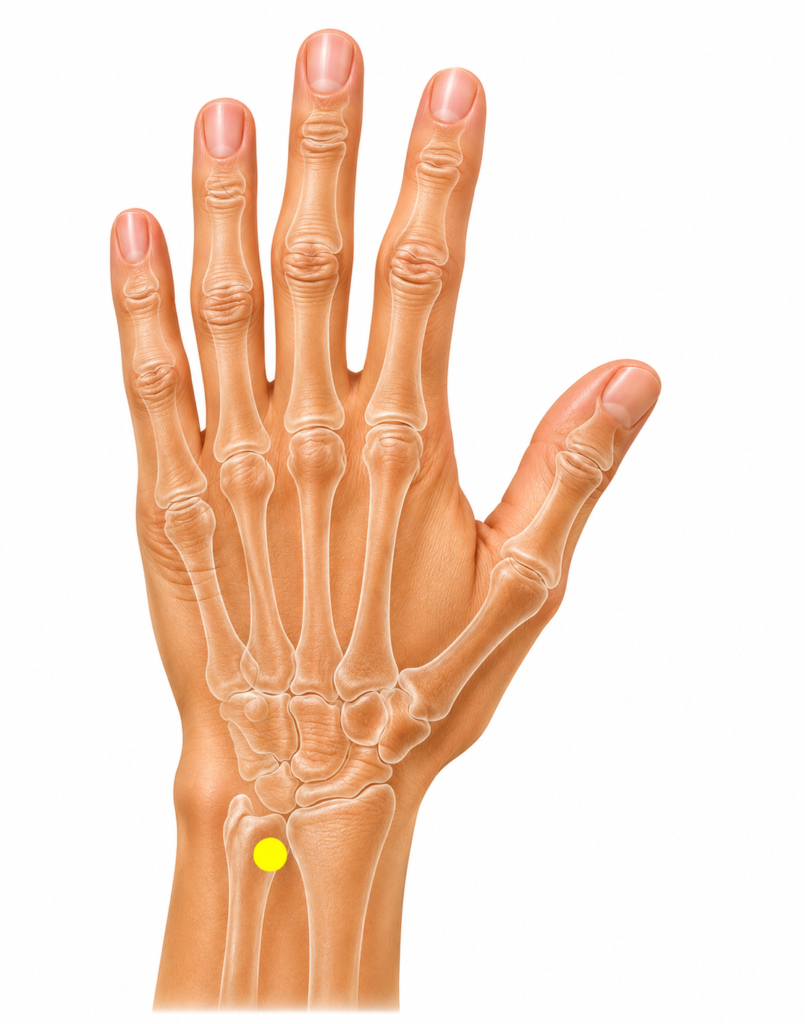
3. Press on SI6 on the back of the wrist to help the head turn. SI6 sits on the back of the wrist, on the pinky side. Place a fingertip on top of the round bony knob of the wrist, then turn the palm toward the chest, and the fingertip will slide into a small groove beside the bone. Press firmly for one to two minutes on each wrist while slowly turning your head. SI6 is called “Yanglao,” the “Support of the Aged.”
SI6 is the Small Intestine channel’s cleft point. The channel runs up the back of the shoulder and along the side of the neck. Cleft points are traditionally used for acute pain, and SI6 is a classic choice for a stiff neck and shoulder when you can’t turn your head.
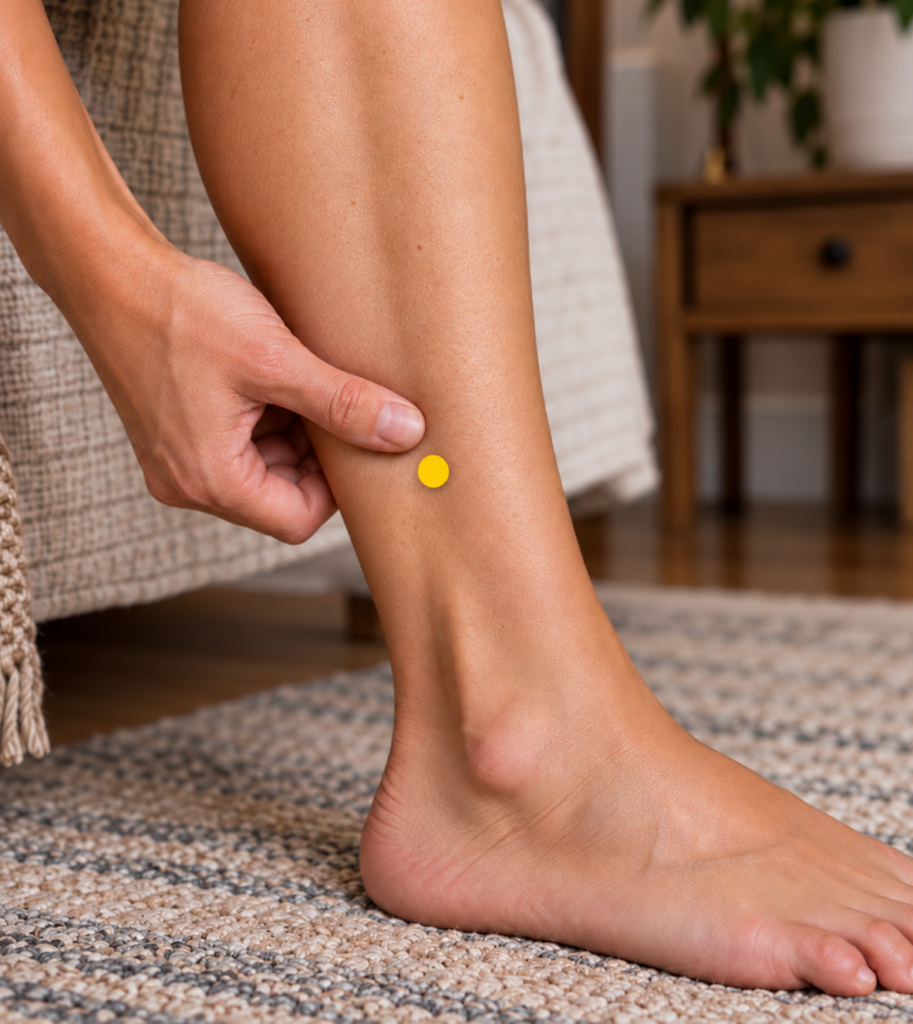
4. Press on GB39 on the outer side of the lower leg to freely turn the neck side to side. GB39 sits on the outer lower leg, four finger-widths above the tip of the outer ankle bone, just in front of the outer leg bone. Press firmly with your thumb for one to two minutes on each leg while slowly turning your head side to side. GB39 is called “Xuanzhong,” the “Suspended Bell.”
GB39 is one of the best-known Traditional Chinese Medicine points for a stiff neck. The Gallbladder channel runs along the side of the neck, making GB39 especially useful when turning your head to look over your shoulder is the most difficult movement.
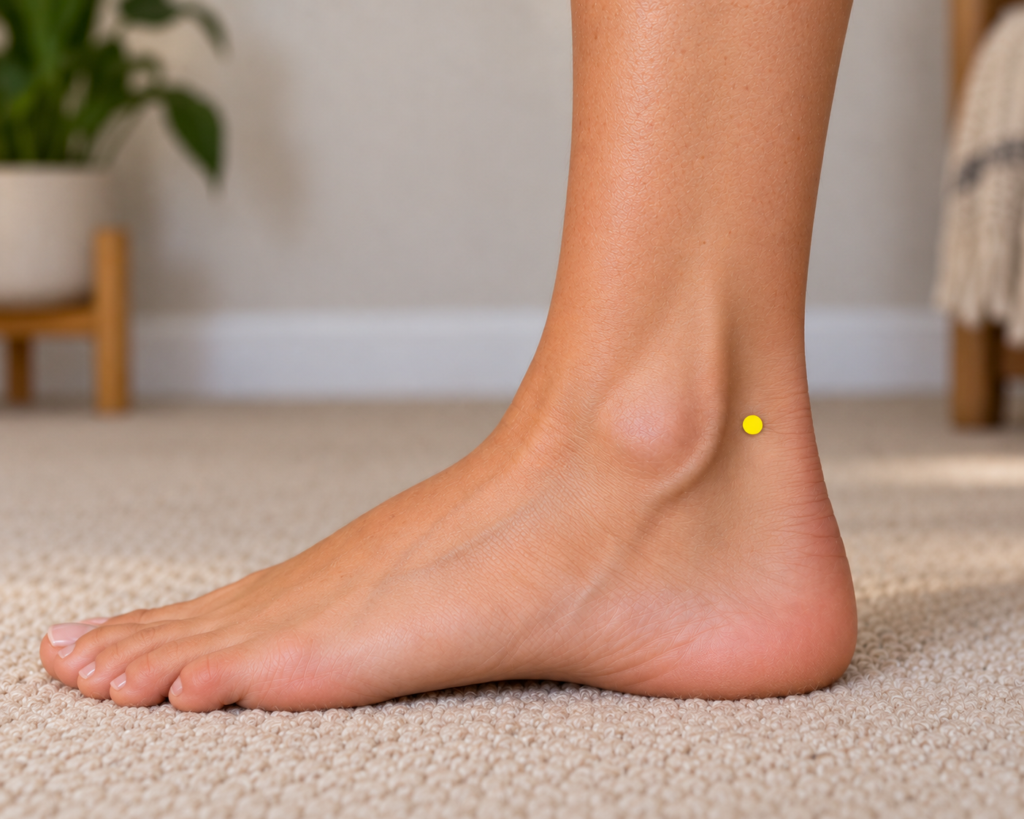
5. Press on BL60 behind the outer ankle to release tension in the back of the neck. BL60 sits on the outside of the ankle, in the hollow between the outer ankle bone and the Achilles tendon. Press firmly with your thumb for one to two minutes on each ankle. BL60 is called “Kunlun,” the “Kunlun Mountains.” BL60 is avoided during pregnancy.
BL60 is on the Bladder channel, which runs from the head down the back of the neck and along the spine. It’s traditionally indicated for stiffness and pain anywhere along this channel, and pairs well with SI3 when looking up or down causes pain.
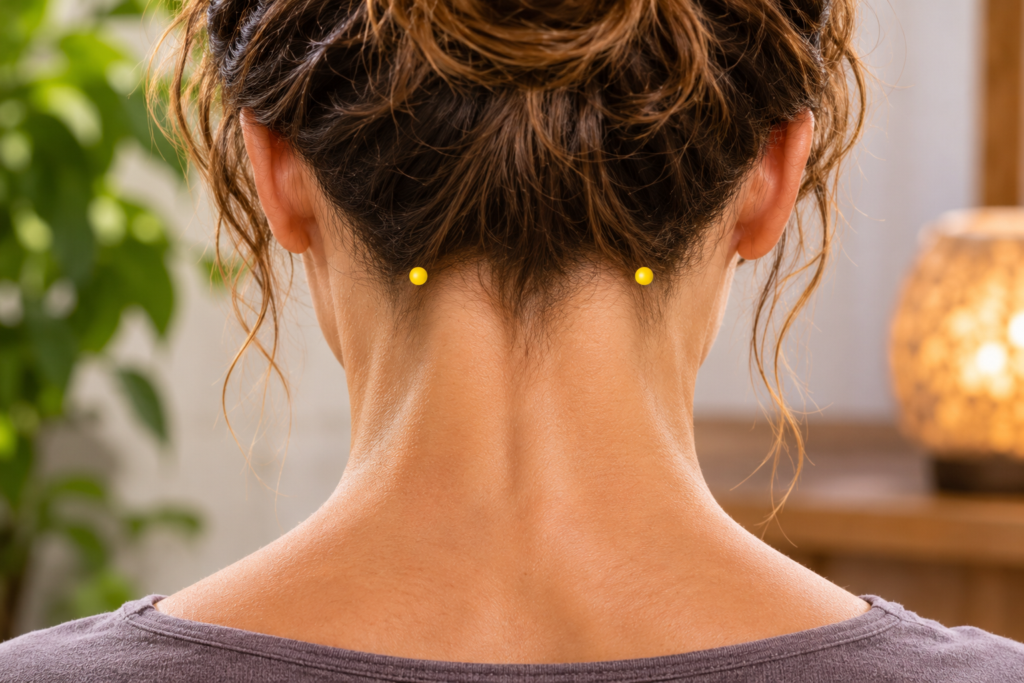
6. Press on GB20 at the base of the skull to release tension and Wind-Cold. GB20 sits at the base of the skull, in the hollows on either side of the two thick muscles that run up the back of the neck, about level with the bottom of the earlobes. Press upward toward the skull with your thumbs or fingertips for one to two minutes while breathing slowly. GB20 is called “Fengchi,” the “Wind Pool.”
GB20 is one of the most important points for releasing Wind and easing tension in the neck and head. It is especially useful when stiffness develops after sleeping in a draft and is accompanied by a headache at the base of the skull.
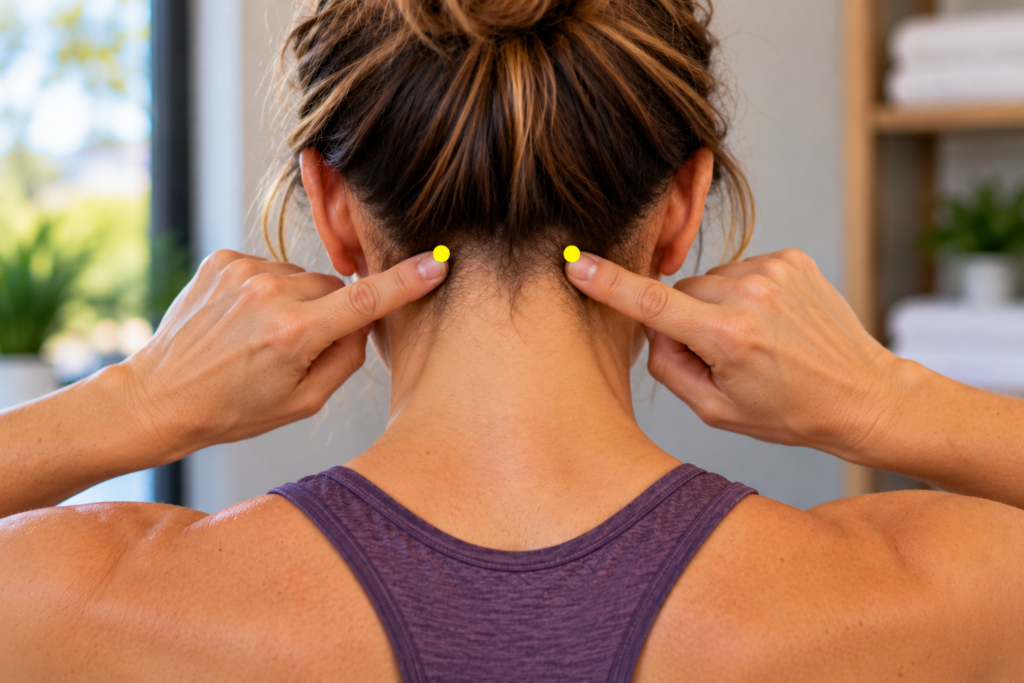
7. Press on BL10 below the base of the skull to loosen the back of the neck. BL10 sits about one finger-width below the base of the skull, on the outer edge of the two thick, rope-like muscles that run up either side of the spine. Press gently with your fingertips for one to two minutes on each side. BL10 is called “Tianzhu,” the “Celestial Pillar.”
BL10 is a local point for stiffness and pain at the back of the neck. Its name refers to the neck as the pillar supporting the head. It’s used to relax the muscles that tighten and make looking down painful.
8. Press on GB21 on top of the shoulder to release the muscles in the upper shoulder. GB21 sits on top of the shoulder, at the highest point of the muscle, midway between the base of the neck and the tip of the shoulder. Press with the fingertips of your opposite hand, or squeeze the muscle gently between the thumb and fingers, for one to two minutes on each side. GB21 is called “Jianjing,” the “Shoulder Well.” GB21 is avoided during pregnancy.
In Traditional Chinese Medicine, GB21 is one of the most commonly used points for a tight, painful shoulder or neck. A stiff neck can pull the top of the shoulder toward the ear, and GB21 can help release that guarding.

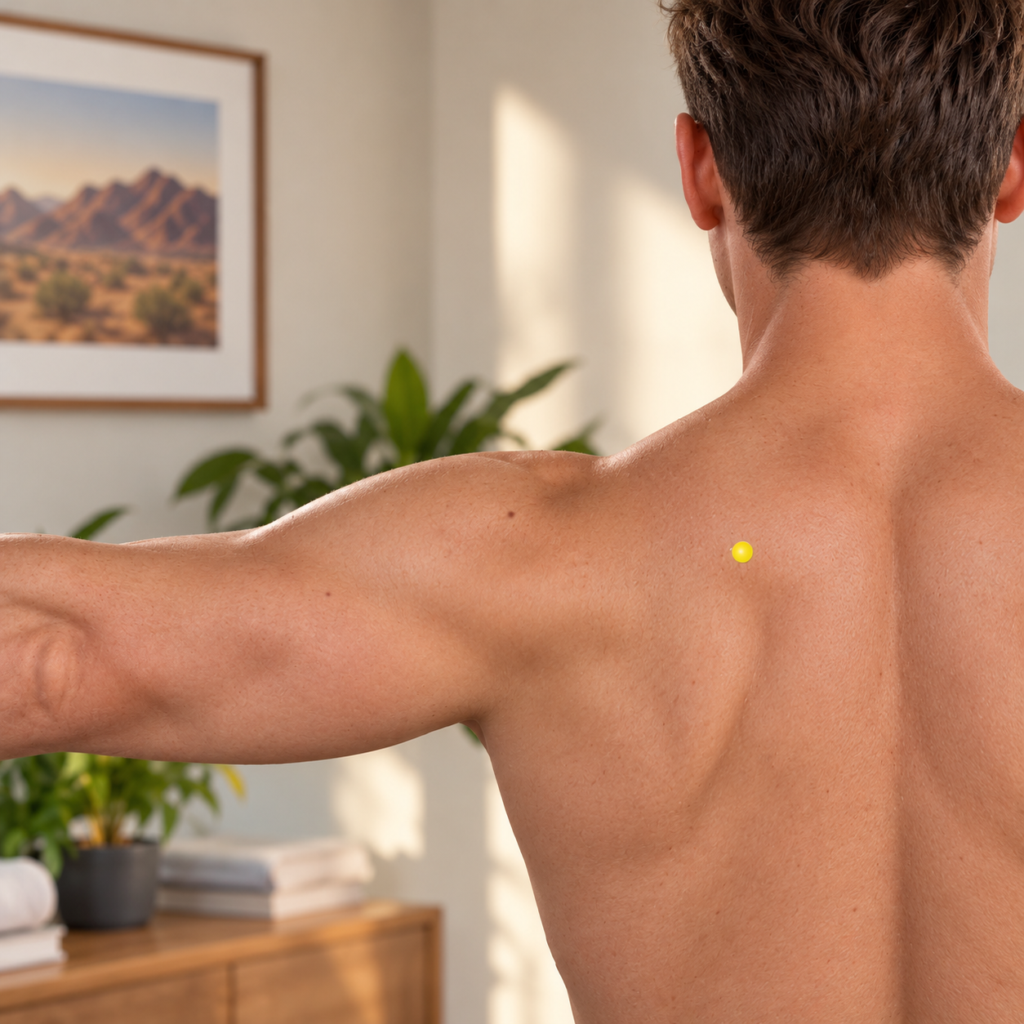
9. Press on SI14 above the shoulder blade to release the muscle that locks the neck. SI14 sits on the upper back, just above the upper inner corner of the shoulder blade, about four finger-widths to the side of the spine at the level just below the large bump at the base of the neck. Reach across with the fingertips of your opposite hand, or lean a tennis ball between the upper back and a wall, and press for one to two minutes on each side. SI14 is called “Jianwaishu,” the “Outer Shoulder Transport.”
SI14 is located over the muscle that extends from the upper inner corner of the shoulder blade up the side of the neck. This muscle is commonly tight in cases of a stiff neck. Traditionally, SI14 is indicated for neck and shoulder stiffness that makes turning the head very painful.
Why These Acupressure Points Work
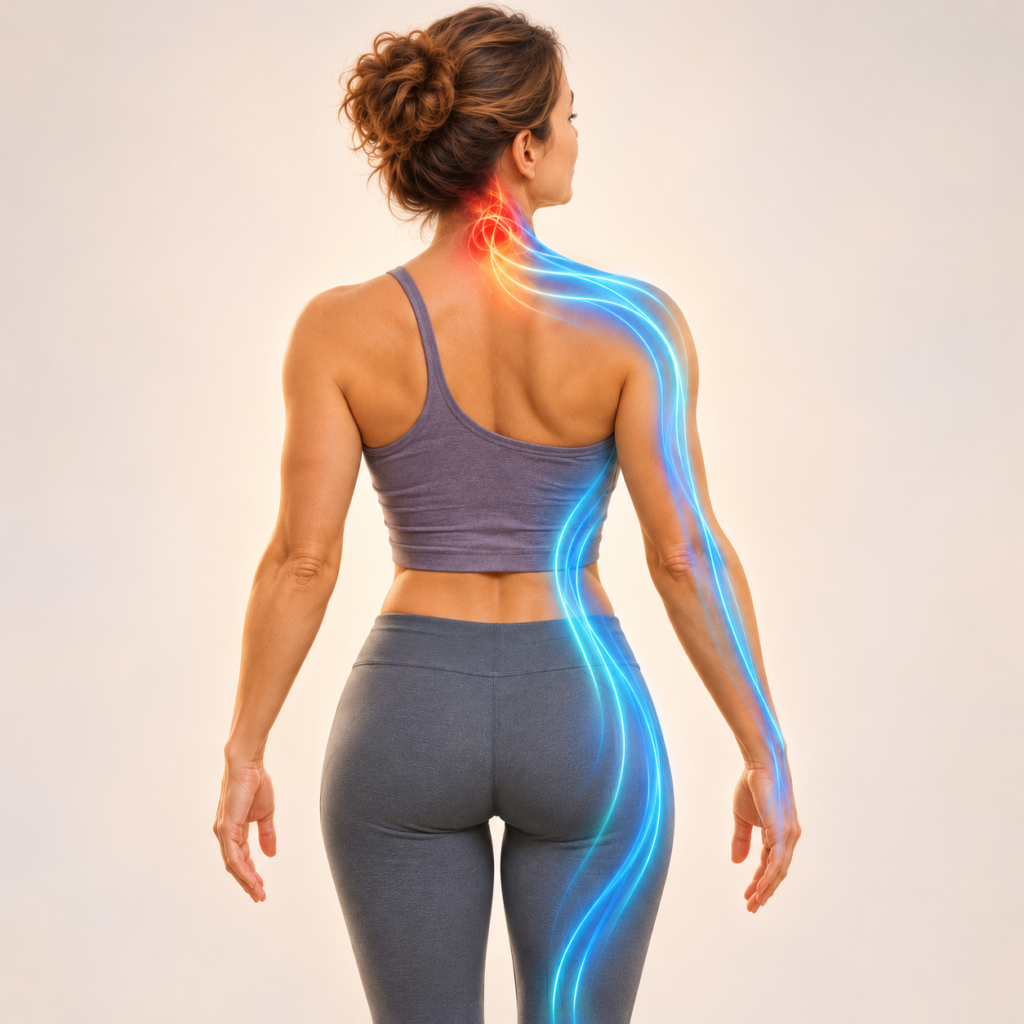
In Traditional Chinese Medicine, a stiff neck is seen as Qi and Blood not flowing smoothly through the neck’s channels, with Wind-Cold constricting the muscles from the outside. The approach is to release the channels from a distance first, allowing the neck to begin moving, then work locally to warm and loosen the stiff muscles.
The nine points work together to relieve the stiff neck and restore movement:
- The stiff neck point (Luozhen) releases the locked muscles from the hand while the neck moves gently.
- The turning points (SI6, GB39) restore the ability to turn the head side to side.
- The bending points (SI3, BL60) ease stiffness when looking up or down.
- The local neck and shoulder points (GB20, BL10, GB21, SI14) release tight muscles and clear Wind-Cold from the neck.
How to Properly Use These Acupressure Points

For a stiff neck, acupressure is best performed by first applying pressure to the distal points while gently moving the neck, then proceeding to the local points once the neck has loosened.
- Begin with Luozhen, then press SI3, SI6, or GB39 for one to two minutes each, slowly turning or nodding your head only within a comfortable range.
- Then move to GB20, BL10, GB21, and SI14, applying steady, moderate pressure and easing up if the muscle begins to spasm.
- Repeat the routine two or three times daily, as an acute stiff neck often eases noticeably within a day or two.
- Before pressing the points on your neck and shoulders, apply a warm compress or take a warm shower to help your muscles relax.
Daily habits can help a stiff neck recover and prevent it from returning. Keep your neck gently moving throughout the day instead of holding it still. Sleep on a low, firm pillow that keeps your head level with your spine, and avoid sleeping on your stomach with your head turned to one side. Keep your neck covered and away from fans, air-conditioning vents, and open windows at night, as Traditional Chinese Medicine considers cold drafts a common trigger. Raise screens to eye level, take short breaks to roll your shoulders, and carry bags on alternating sides or use a backpack.
Learn more about healthy posture.
When to Get Professional Help

See a doctor if the stiffness doesn’t improve after a few days, ordinary pain relievers don’t control the pain, or the stiff neck keeps returning. Seek prompt care for numbness, tingling, or weakness in the arms or hands; trouble walking; poor coordination; loss of bladder or bowel control; or stiffness after a fall, car accident, or other injury. Call 911 if a stiff neck occurs with fever, a severe headache, light sensitivity, nausea, vomiting, or confusion, as these symptoms can signal meningitis. A baby or young child with a head tilt or stiff neck should be seen by a pediatrician, especially if it follows a sore throat or illness.
Acupressure is a gentle, supportive practice for a stiff neck. It complements, and does not replace, diagnosis and medical care.
For related health concerns, acupressure for neck pain, acupressure for upper back pain, and acupressure for a tension headache are companion posts. If the stiffness keeps returning after long hours at a screen, read Do I Have Tech Neck?
Above and Beyond Acupuncture offers acupuncture, cupping, and lifestyle coaching at the North Frank Lloyd Wright Boulevard location in Scottsdale.
Schedule an appointment online to start your healing journey.
The points above are only as effective as the technique used to apply them. Where to press, how firmly, and for how long all affect the result. For a full breakdown of how to perform acupressure properly at home, read Performing Acupressure in 3 Easy Steps.

About the Publisher
Paul Kerzner, L.Ac., is a licensed acupuncturist and board-certified herbalist, as well as the founder of Above and Beyond Acupuncture in Scottsdale. His own journey from chronic patient to practicing acupuncturist shapes his commitment to providing honest, clinically grounded information about acupuncture and Traditional Chinese Medicine. Learn more about Paul and his clinical approach on the About Us page.