Key Takeaways
- A middle ear infection is an infection behind the eardrum, often following a cold, and children get them much more often than adults.
- Ear pain, fever, fussiness, trouble sleeping, and tugging at the ear are common signs, and many mild infections resolve on their own within a few days.
- In Traditional Chinese Medicine, an ear infection is wind and heat invading the channels that wrap around the ear, especially the San Jiao and Gallbladder channels.
- Nine acupressure points around the ear, neck, hands, arms, and leg help ease ear pain and pressure, reduce fever, and support recovery.
- Acupressure eases discomfort but does not treat the infection itself. A high fever, fluid draining from the ear, hearing loss, or symptoms lasting more than two to three days require a doctor.

Ear infections often develop a few days after a cold. As the stuffy nose improves, a dull ache or sharp pain can develop deep in one ear, often worsening at night when lying down. In young children, the signs can be harder to spot. They might tug at their ear, cry more than usual, refuse to lie flat, or wake up repeatedly.
According to the Centers for Disease Control and Prevention, a middle ear infection occurs in the space behind the eardrum, and children get them more often than adults. Most are caused by bacteria, though viruses that cause colds can also be responsible. Common symptoms include ear pain, fever, fussiness, rubbing or tugging at the ear, and difficulty sleeping. The CDC says many middle ear infections clear up without antibiotics. For mild cases, a doctor may recommend watching and waiting for two to three days. In the meantime, rest, extra fluids, and over-the-counter medicine for pain or fever can help. Severe infections, or those that last longer than two to three days, need antibiotics right away.
Those two or three days of waiting can feel endless. The ear throbs, sleep is fitful, and there is little to do but wait for the body to turn the corner. Gentle pressure around the ear and on a few well-chosen points on the hands and arms gives the hands something useful to do as the ear heals.
In Traditional Chinese Medicine, the San Jiao and Gallbladder channels circle the ear, while the Small Intestine channel ends just in front of it. When a cold persists, wind and heat may penetrate deeper along these pathways, causing the throbbing pain and fever associated with an infection. Fluid trapped behind the eardrum is viewed as dampness that cannot drain, creating a full, blocked sensation.
The nine points listed below start around the ear, then address the channels that supply it and the body’s capacity to dissipate heat and recover.
What Acupressure Points to Press and Why
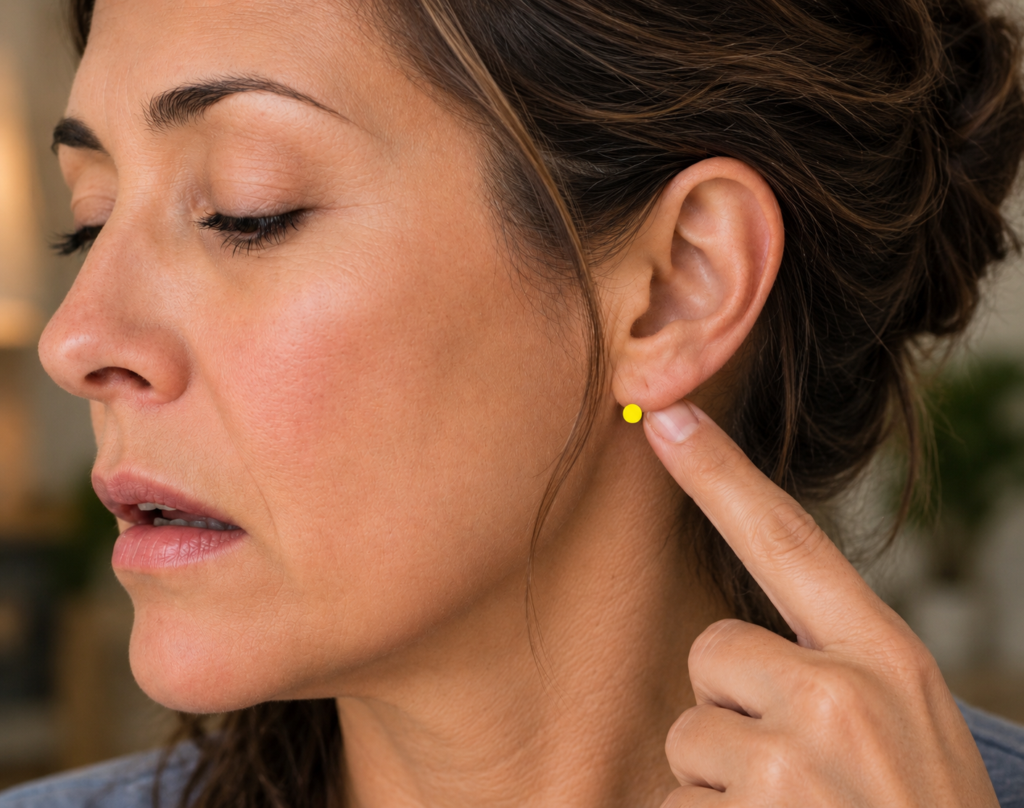
1. Press on TE17 behind the earlobe to ease ear pain. TE17 sits in the soft hollow just behind the earlobe, between the angle of the jaw and the bony bump behind the ear. Press gently with your fingertip for one to two minutes on the affected side. TE17 is called “Yifeng,” the “Wind Screen.”
In Traditional Chinese Medicine, TE17 is a primary local point for ear pain, pressure, and blocked hearing. Its name reflects its traditional use for wind that settles around the ear after a cold.
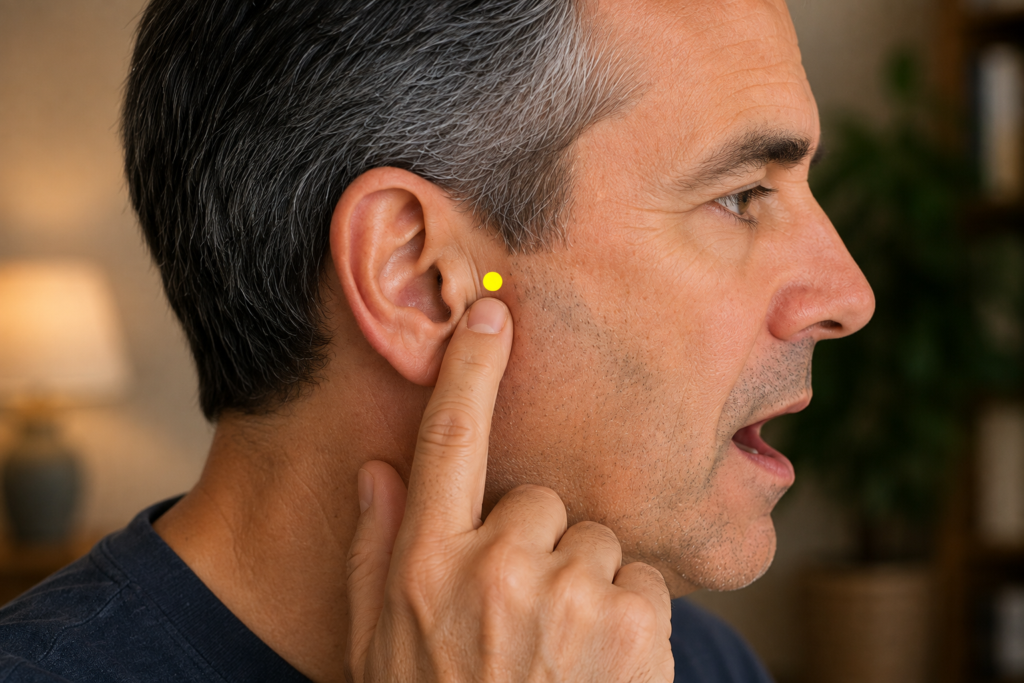
2. Press on SI19 in front of the ear to relieve pressure. SI19 sits just in front of the small flap of cartilage at the front of the ear. Open the mouth slightly, and the point drops into a small hollow. Press gently with your fingertip for one to two minutes on the affected side. SI19 is called “Tinggong,” the “Palace of Hearing.”
SI19 is the last point of the Small Intestine channel and is a classic point for earache, a full or blocked feeling in the ear, and muffled hearing.
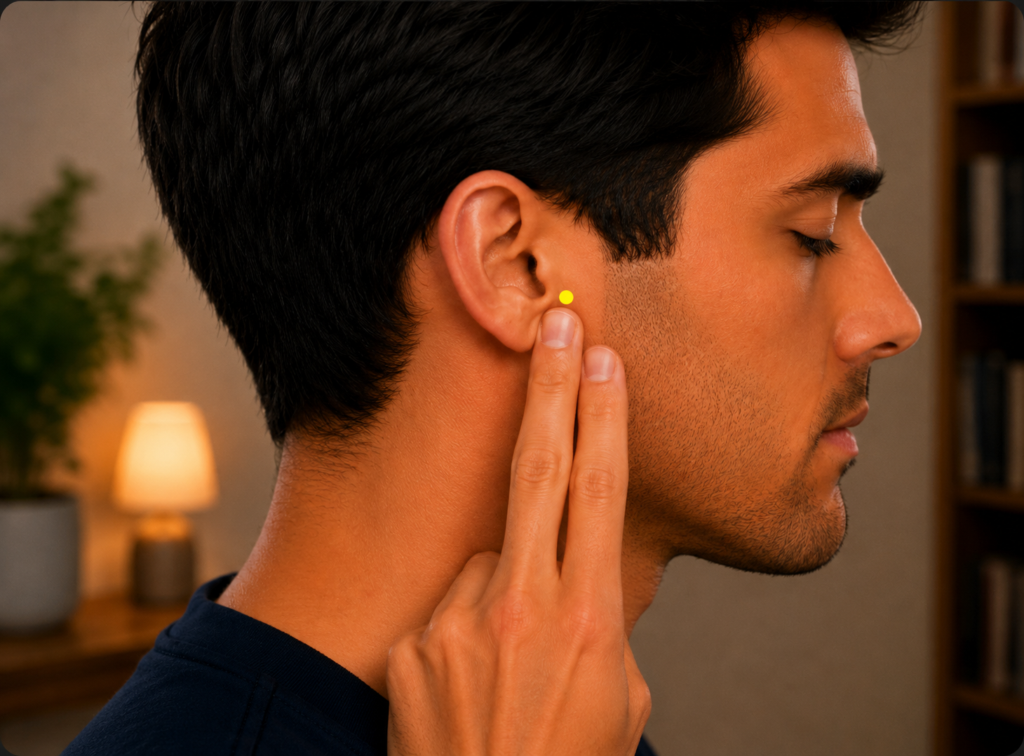
3. Press on GB2 just below SI19 to open the ear. GB2 sits directly below SI19, in the hollow in front of the notch at the bottom of the small flap of cartilage, and is also easiest to find with the mouth slightly open. Press gently with your fingertip for one to two minutes on the affected side. GB2 is called “Tinghui,” the “Meeting of Hearing.”
GB2 is located on the Gallbladder channel, one of two channels that run around the ear. It’s used with SI19 to help ease the pressure and fullness caused by fluid trapped behind the eardrum.
4. Press on GB20 at the base of the skull to release wind. GB20 sits at the back of the head, in the hollows on either side of the neck just below the base of the skull, between the two large neck muscles. Press gently with your thumbs for one to two minutes, tilting the head slightly back. GB20 is called “Fengchi,” the “Wind Pool.”
GB20 is a primary point for clearing wind from the head, a Traditional Chinese Medicine concept associated with the cold or virus that often precedes an ear infection. It may also ease the stiff neck and headache that can accompany it.

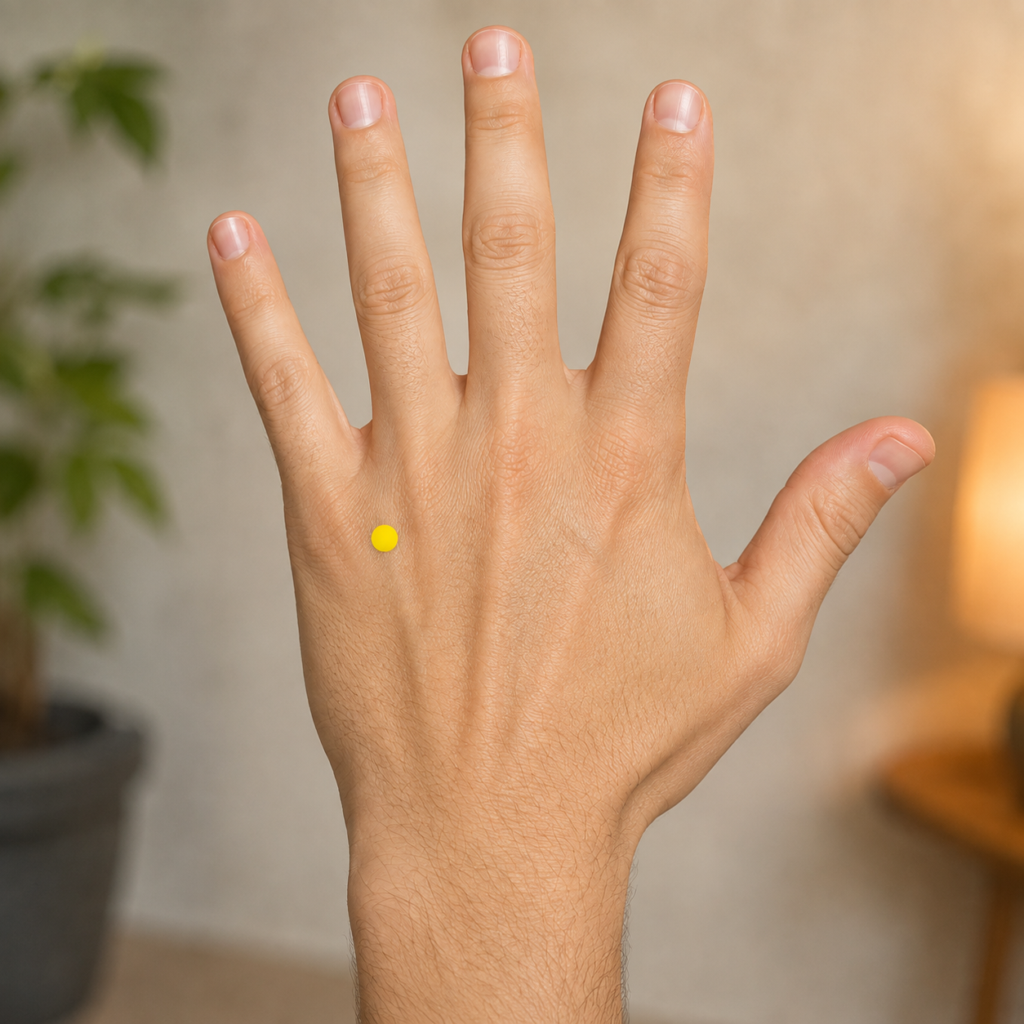
5. Press on TE3 on the back of the hand for ear problems. TE3 sits on the back of the hand, in the groove between the bones of the ring finger and little finger, just behind the knuckles. Press firmly with the thumb of your other hand for one to two minutes on each hand. TE3 is called “Zhongzhu,” the “Middle Islet.”
TE3 is a classic distal point for ear issues, including earache, ringing, and muffled hearing. Because the San Jiao channel runs from the hand up to the ear, TE3 can be used to treat ear problems from a distance.
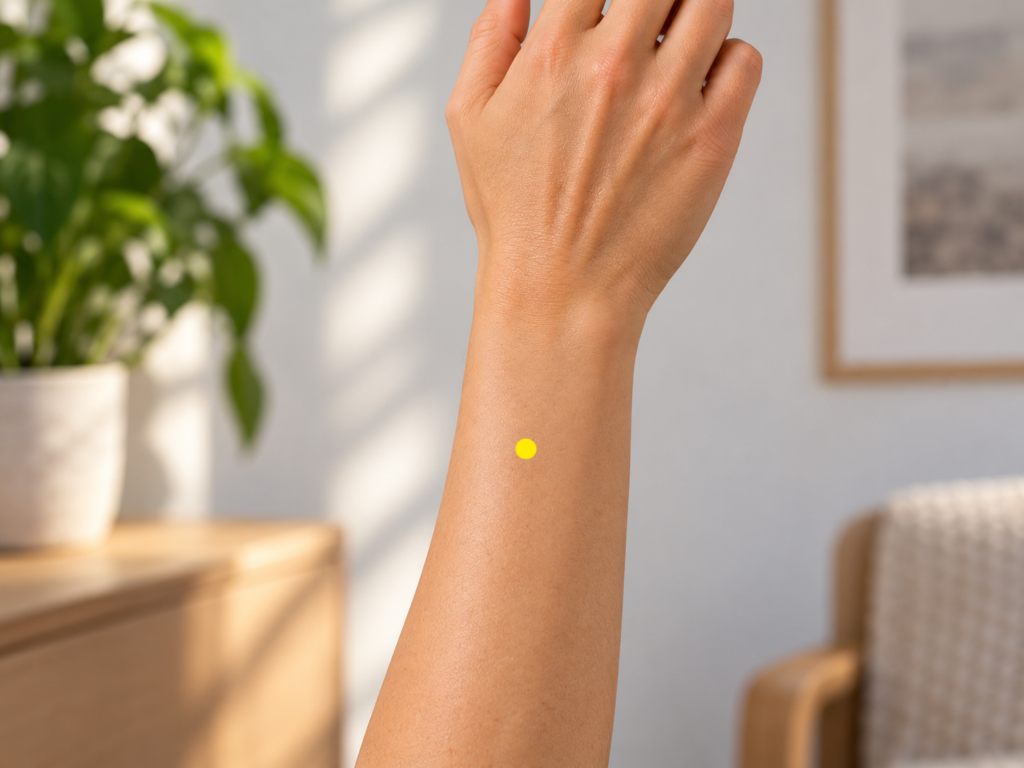
6. Press on TE5 on the back of the forearm to clear heat. TE5 sits on the back of the forearm, about three finger-widths above the wrist crease, in the groove between the two forearm bones. Press firmly with your thumb for one to two minutes on each arm. TE5 is called “Waiguan,” the “Outer Pass.”
TE5 is traditionally used to clear wind and heat, especially along the San Jiao channel around the ear. It may be helpful for an ear infection accompanied by fever, a sore throat, or a lingering cold.
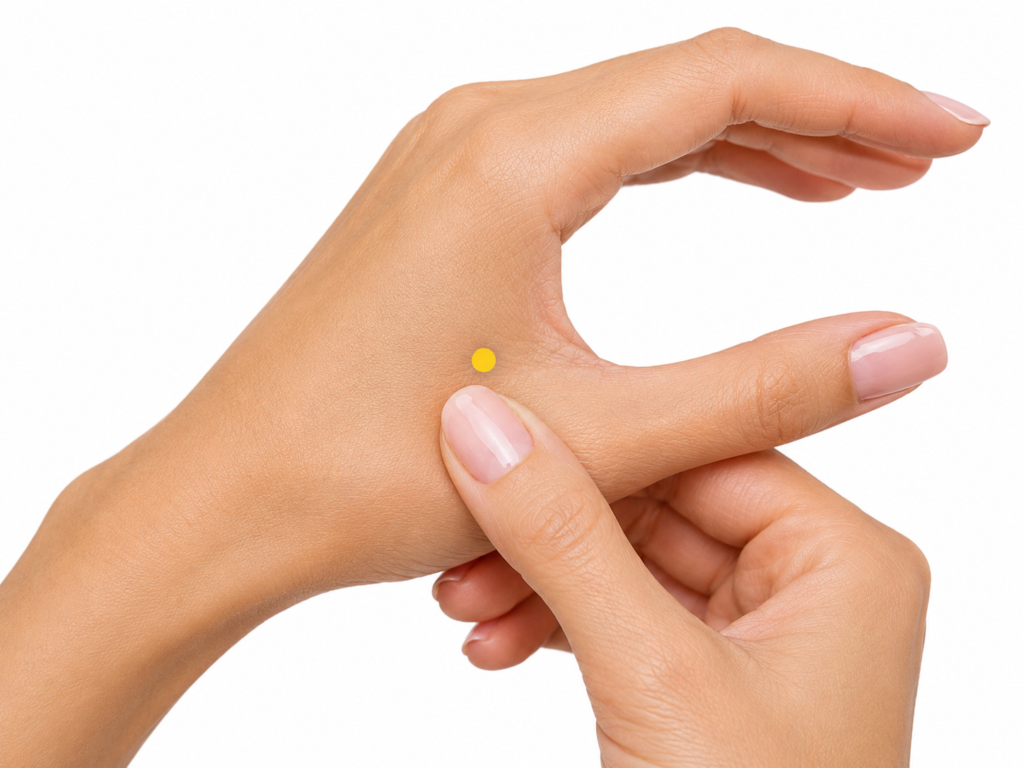
7. Press on LI4 on the back of the hand to relieve pain in the head. LI4 sits in the webbing between the thumb and index finger, at the highest point of the muscle when the two are pressed together. Press firmly with the thumb of your other hand for one to two minutes on each hand. LI4 is called “Hegu,” the “Joining Valley.” LI4 is avoided during pregnancy.
LI4 is the most commonly used point for pain anywhere in the head or face. It can also help clear the fever and congestion often associated with an ear infection.
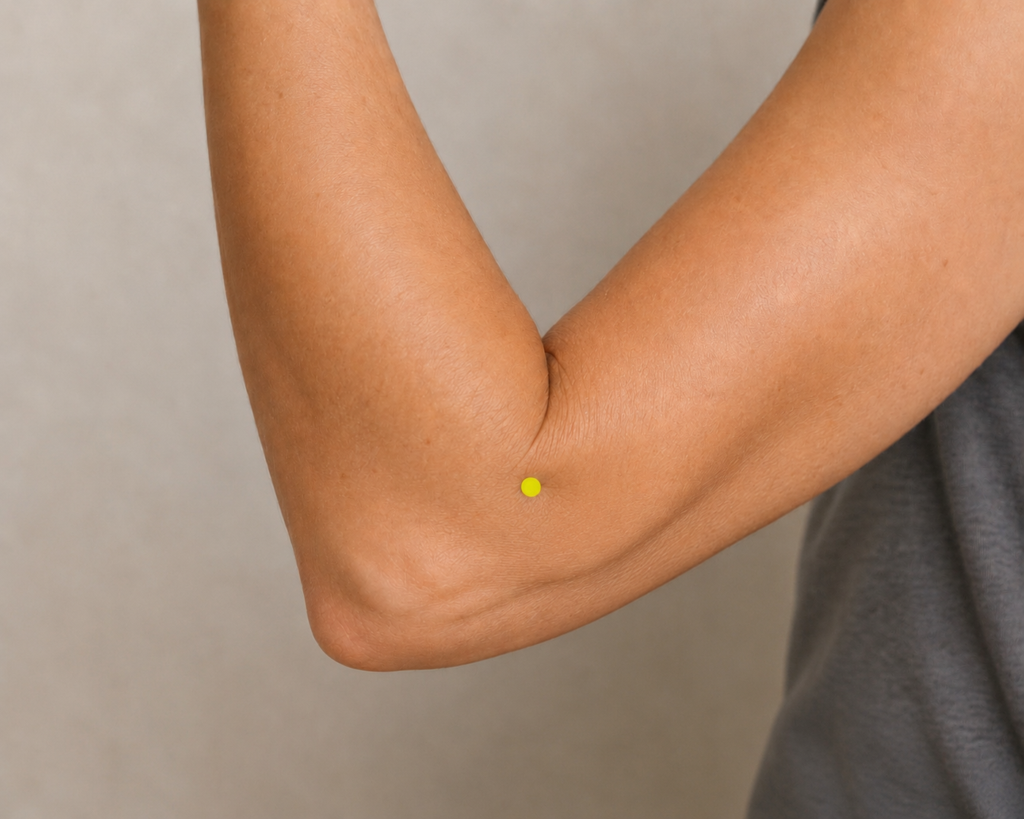
8. Press on LI11 at the outer elbow crease to bring down fever. LI11 sits on the outer end of the elbow crease. Bend the elbow, and the point is in the hollow at the end of the crease, on the thumb side. Press firmly with your thumb for one to two minutes on each arm. LI11 is called “Quchi,” the “Pool at the Crook.”
LI11 is a primary point for clearing heat from the whole body. Used in conjunction with LI4, it’s traditionally indicated for reducing fever and calming inflammation.
9. Press on ST36 below the knee to support recovery. ST36 sits four finger-widths below the bottom of the kneecap, about one finger-width to the outside of the shinbone. Press firmly with your thumb for one to two minutes on each leg. ST36 is called “Zusanli,” the “Leg Three Miles.”
ST36 strengthens Qi and the body’s defenses in Traditional Chinese Medicine and helps the body recover from the cold that’s behind the ear infection. It’s useful for people (including children) who seem to get one ear infection after another.

Why These Acupressure Points Work
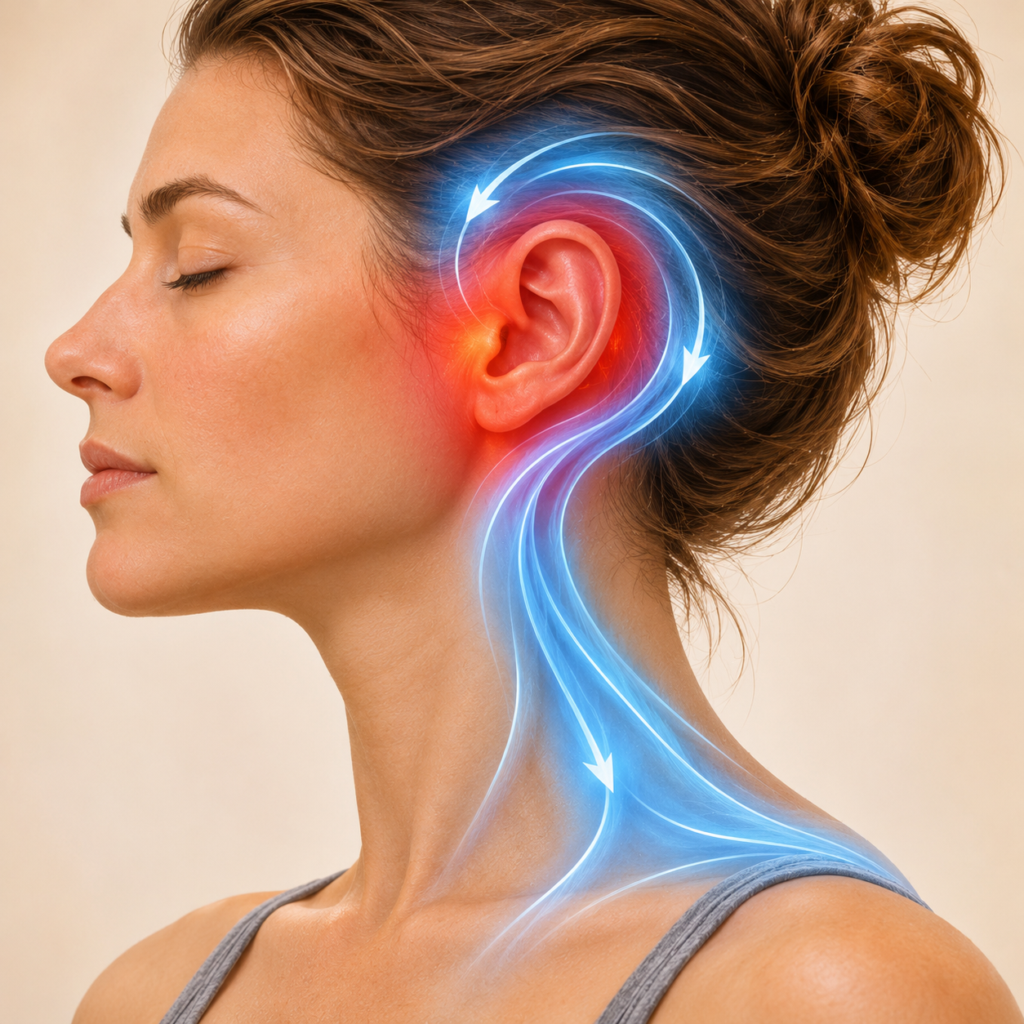
From a Traditional Chinese Medicine perspective, an ear infection is a cold that has settled in the ear. Wind and heat travel along the channels around the ear and become trapped, causing pain, fever, and pressure. Fluid that cannot drain creates a feeling of fullness and blockage. Treatment focuses on opening the area around the ear, clearing heat from the channels that supply it, and supporting the body as it fights the infection.
The nine points work together to relieve ear discomfort and help the body recover:
- TE17, SI19, and GB2 surround the ear and ease pain, pressure, and fullness.
- GB20 clears wind from the head and neck.
- TE3, TE5, LI4, and LI11 clear heat and fever along the channels that reach the ear.
- ST36 supports the body’s defenses and recovery.
How to Properly Use These Acupressure Points

Acupressure may provide support during the few days the body requires to recover from an ear infection, in conjunction with any treatment recommended by a physician.
- Begin with the hand and arm points, TE3, TE5, LI4, and LI11, which can be pressed firmly without aggravating a sore ear.
- Next, work on GB20 and ST36, then finish at TE17, SI19, and GB2, applying only light pressure to the affected side.
- Don’t press inside the ear or insert anything into the ear canal. Stop if anything makes the pain worse.
- For children, apply light fingertip pressure for 30 seconds to one minute per point. For adults, apply one to two minutes, and repeat two or three times a day while symptoms persist.
Rest and plenty of fluids help the body recover from an ear infection. Gently holding a warm compress over the ear can ease pain, while sleeping with your head slightly elevated on an extra pillow may relieve pressure at night. For adults, chewing gum or yawning can help open the tube that drains the middle ear. Keep children away from secondhand smoke, which increases the risk of ear infections, and wash hands often during cold season. After swimming, gently dry the outer ear with a towel. Traditional Chinese Medicine recommends warm soups and broths during a cold and suggests cutting back on cold, raw, and sugary foods, which are believed to contribute to dampness and mucus.
Learn more about acupressure for the common cold.
When to Get Professional Help

See a doctor if a suspected ear infection lasts more than two to three days, worsens, or is accompanied by a fever of 102.2°F or higher, fluid or pus draining from the ear, or hearing loss. Infants younger than three months with a fever of 100.4°F or higher should be seen right away. Seek urgent care for swelling, redness, or tenderness behind the ear; a severe headache; a stiff neck; weakness or drooping on one side of the face; confusion; or severe dizziness, as these may signal that the infection is spreading. Children who have repeated ear infections should also be checked by a doctor.
Acupressure is a gentle, supportive practice for an ear infection. It complements, and does not replace, diagnosis and medical care.
For related health concerns, acupressure for ear pain, acupressure for ear pressure and clogged ears, and is acupressure safe for kids are companion pieces.
Above and Beyond Acupuncture offers acupuncture, cupping, and lifestyle coaching at the North Frank Lloyd Wright Boulevard location in Scottsdale.
Schedule an appointment online to start your healing journey.
The points above are only as effective as the technique used to apply them. Where to press, how firmly, and for how long all affect the result. For a full breakdown of how to perform acupressure properly at home, read Performing Acupressure in 3 Easy Steps.

About the Publisher
Paul Kerzner, L.Ac., is a licensed acupuncturist and board-certified herbalist, as well as the founder of Above and Beyond Acupuncture in Scottsdale. His own journey from chronic patient to practicing acupuncturist shapes his commitment to providing honest, clinically grounded information about acupuncture and Traditional Chinese Medicine. Learn more about Paul and his clinical approach on the About Us page.