
Key Takeaways
- Ear pain, or otalgia, can stem from multiple causes, such as infections, jaw tension, or referred pain from other areas.
- Acupressure for ear pain offers relief by targeting specific points to ease discomfort and tension in the jaw and surrounding areas.
- Key acupressure points include ST7 and ST6 for jaw pain, SJ5 and LI11 for cold symptoms, and KI3 for chronic conditions.
- Traditional Chinese Medicine links ear pain to blockages in meridians and emphasizes a holistic approach to treatment.
- Get medical attention if you experience severe, ongoing pain or symptoms such as fever, drainage, or sudden hearing loss.
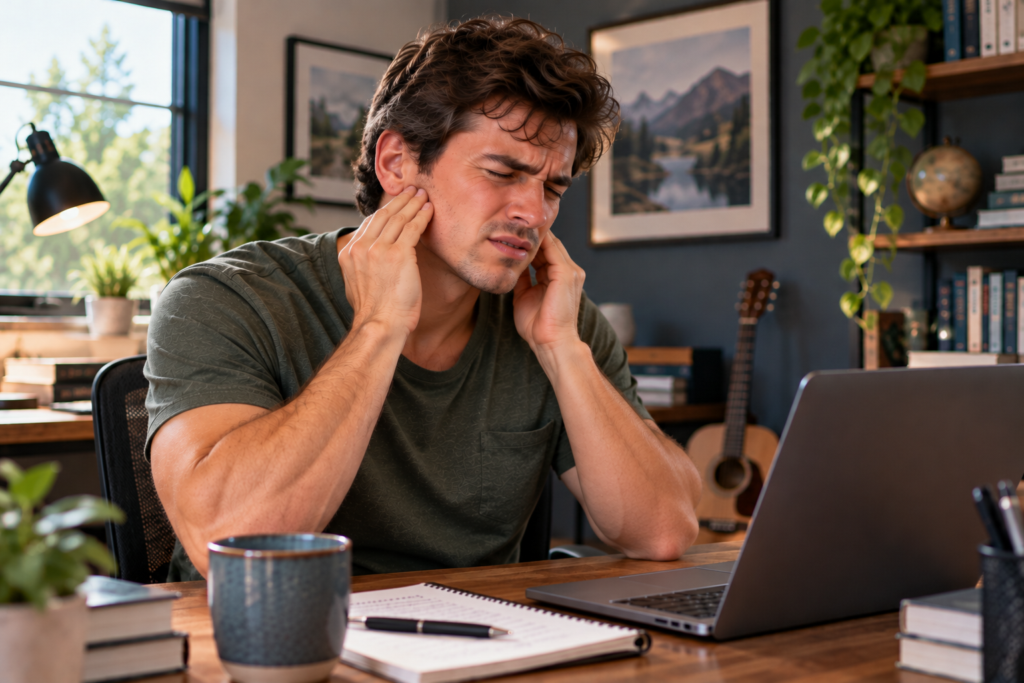
Do you have a sharp, throbbing, or dull ache in your ear, perhaps after a cold, a swim, a flight, or a long period of jaw clenching? Does the pain worsen when you chew, yawn, or lie on that side? Ear pain is one of the most common reasons people visit a doctor, and it can be surprisingly intense for such a small area.
Ear pain differs from ear pressure, which feels full or clogged. It is a genuine ache that may originate in the ear or radiate from the jaw, teeth, throat, or neck. Identifying the source matters, as treatment depends on it. Acupressure offers a gentle way to relieve pain, relax tense jaw muscles commonly responsible for ear pain, and support the body during treatment of the underlying cause.
What is Ear Pain?
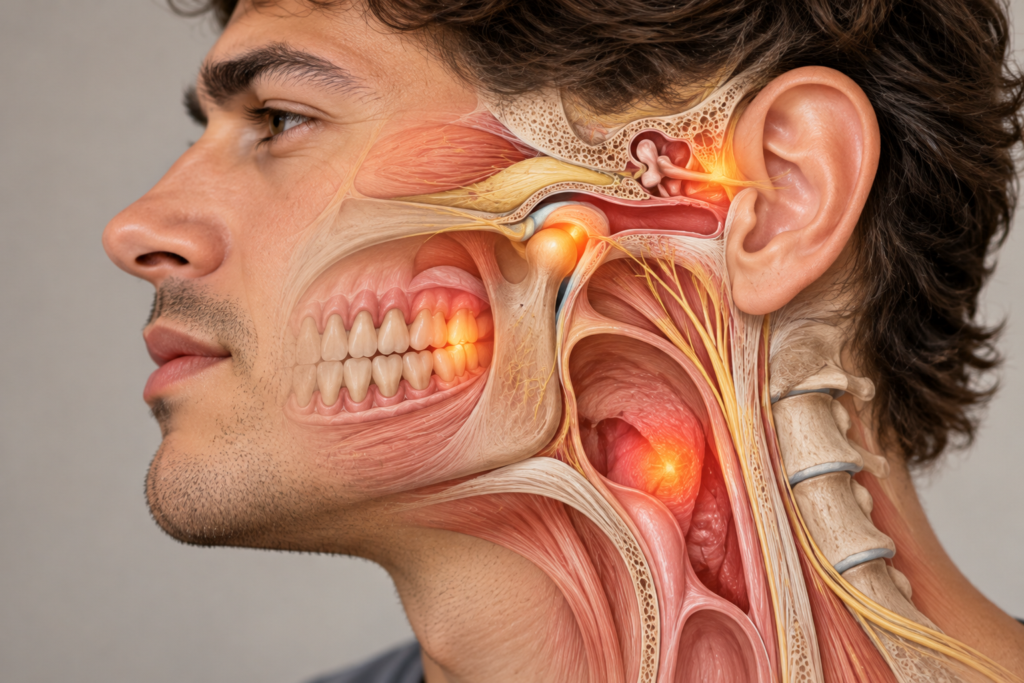
Ear pain, or otalgia, refers to discomfort in or around the ear. Medical professionals categorize it into two primary types.
Primary ear pain originates in the ear itself. It is often caused by a middle ear infection behind the eardrum, an outer ear canal infection, earwax buildup, pressure changes from flying or diving, or an ear injury.
Referred ear pain occurs in the ear but originates elsewhere. Since the ear shares nerves with the jaw, teeth, throat, tonsils, and upper neck, pain in these regions can mimic an earache. In adults with healthy-looking ears, referred pain is common, and the jaw joint is often the cause.
Common symptoms that come with ear pain include:
- A sharp, dull, throbbing, or burning pain in or around the ear
- Pain that worsens when chewing, yawning, or opening the mouth wide
- Pain when pulling on the outer ear or pressing on the small flap in front of the ear canal
- A feeling of fullness or muffled hearing
- Ringing in the ear
- Drainage from the ear
- Fever, especially with an ear infection
- Jaw clicking, tightness, or tenderness in front of the ear
- Sore throat, tooth pain, or neck stiffness alongside the ear pain
- In young children, tugging at the ear, fussiness, and trouble sleeping
What Causes Ear Pain and Who Gets it?
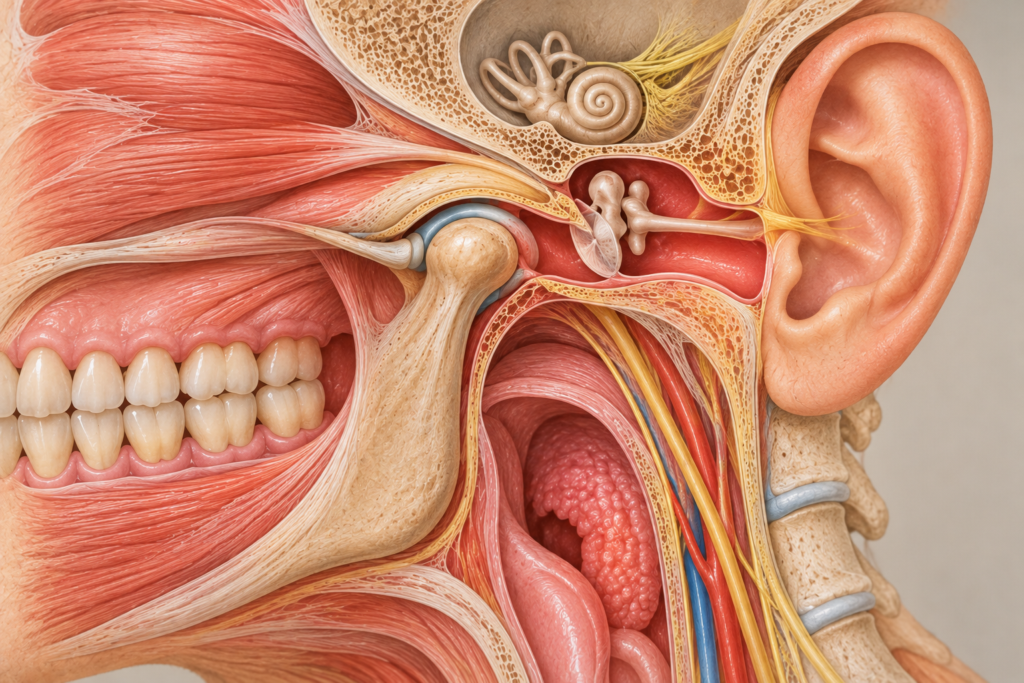
Ear pain occurs across all age groups, but its causes vary. Children often experience middle ear infections due to their shorter, more horizontal Eustachian tubes, which make it easier for fluid to collect behind the eardrum after a cold. Adults more commonly experience ear pain related to issues with the jaw, teeth, or throat.
Common causes of ear pain include:
- Middle ear infections, often following a cold or allergies
- Outer ear infections, often called swimmer’s ear, which follow water exposure or scratching the ear canal
- Pressure changes during flying, diving, or driving through the mountains
- Earwax buildup, especially after using cotton swabs
- Jaw tension, teeth grinding, and TMJ problems
- Dental problems, such as an infected tooth or impacted wisdom tooth
- Sore throat, tonsillitis, and sinus infections
- Neck tension and arthritis in the upper neck
- Nerve pain in the face or throat
- Less commonly, shingles affecting the ear, or growths in the throat or neck, especially in people who smoke or drink heavily
How Ear Pain Differs From Related Ear and Jaw Problems
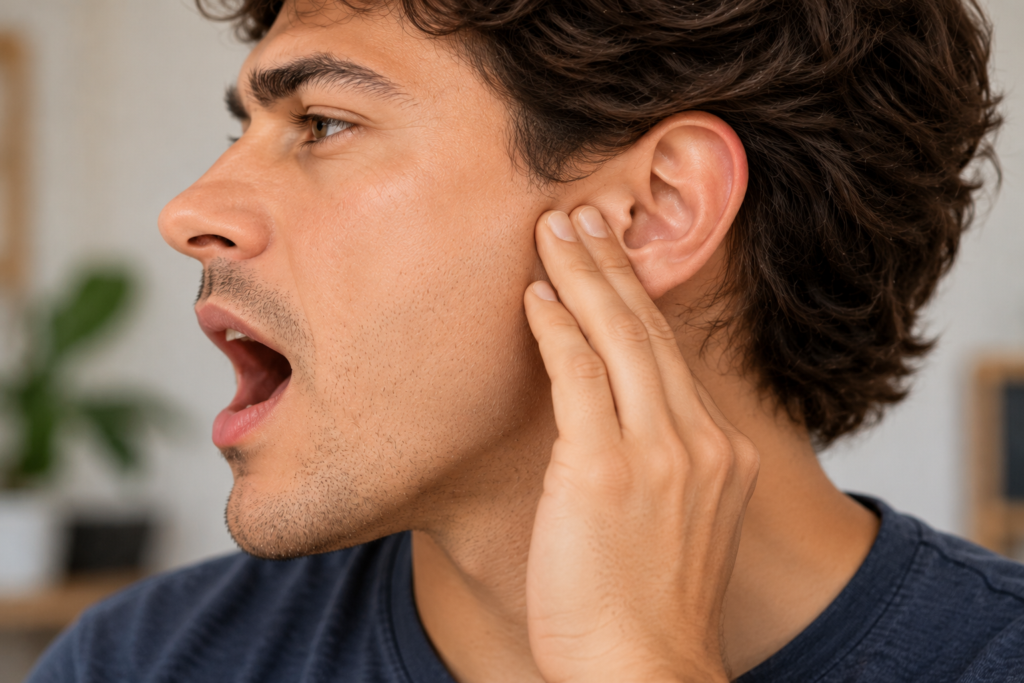
Several conditions can cause symptoms that mimic ear pain, so knowing the difference helps you get the right care.
- Ear pressure and clogged ears can feel full, blocked, or like being underwater, rather than causing real pain. This usually happens because the Eustachian tubes are congested after a cold, allergies, or changes in altitude. Acupressure for ear pressure and clogged ears can help.
- Tinnitus causes ringing, buzzing, or hissing sounds in the ear, usually without pain. Acupressure for tinnitus can help with this problem.
- TMJ pain causes aching in front of the ear and in the jaw, often with clicking, tight chewing muscles, and pain that worsens with chewing. Acupressure for TMJ pain focuses on the jaw itself.
- A toothache, especially in the back teeth, can cause pain that spreads to the ear on the same side. Acupressure can help relieve toothache pain.
- A sore throat or tonsillitis can often cause ear pain when you swallow. Acupressure for a sore throat can help in these cases.
- Trigeminal neuralgia causes sudden, sharp, stabbing pain in the face that can also be felt near the ear. Acupressure can help with trigeminal neuralgia.
Ear pain related to the jaw often worsens when chewing, yawning, or clenching, with tenderness in front of the ear, jaw clicking, and a normal ear exam. Conversely, ear infection signs include fever, drainage, muffled hearing, and pain that starts during or after a cold or swimming.
How Traditional Chinese Medicine Views Ear Pain
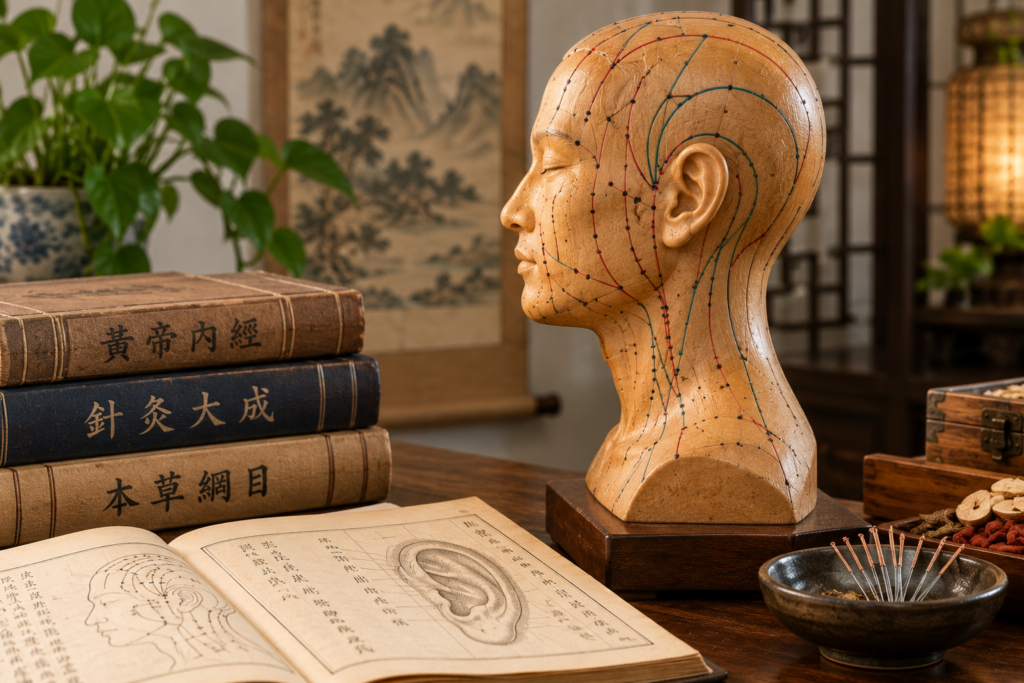
In Traditional Chinese Medicine, the Triple Burner and Gallbladder meridians pass around the ear, while the Stomach meridian runs along the front of the jaw. Because the Kidney is believed to open into the ears, chronic ear issues are often linked to Kidney health. Ear pain is considered to result from heat, wind, or stagnation that blocks Qi and Blood flow within these meridians. Most people with ear pain show more than one of these patterns, and the points in this routine are chosen to address each.
- Wind heat: ear pain that comes on with a cold, sore throat, fever, or swollen glands. SJ5, LU7, and LI11 release the wind and clear the heat.
- Liver and Gallbladder fire: sudden, intense, throbbing ear pain, sometimes with drainage, irritability, a bitter taste in the mouth, a red face, or a headache. LR2, GB43, and SJ5 clear the fire from the channels that circle the ear.
- Stomach channel stagnation from the jaw: ear pain linked to clenching, grinding, chewing, or tooth problems, with tightness in front of the ear. ST7 and ST6 release the jaw locally.
- Qi and Blood stagnation: ear pain after pressure changes, an injury, or long hours of tension, with a fixed, aching quality. SJ2, SJ5, and ST7 move the Qi and Blood around the ear.
- Kidney deficiency: a dull, recurring earache in older adults or after a long illness, often with ringing, low back pain, and fatigue. KI3 strengthens the Kidney that nourishes the ears.
The goal is to eliminate heat and wind from the ear, relax the jaw, enhance Qi and Blood circulation around the ear, and strengthen the Kidney over the long term.
What the Research Shows
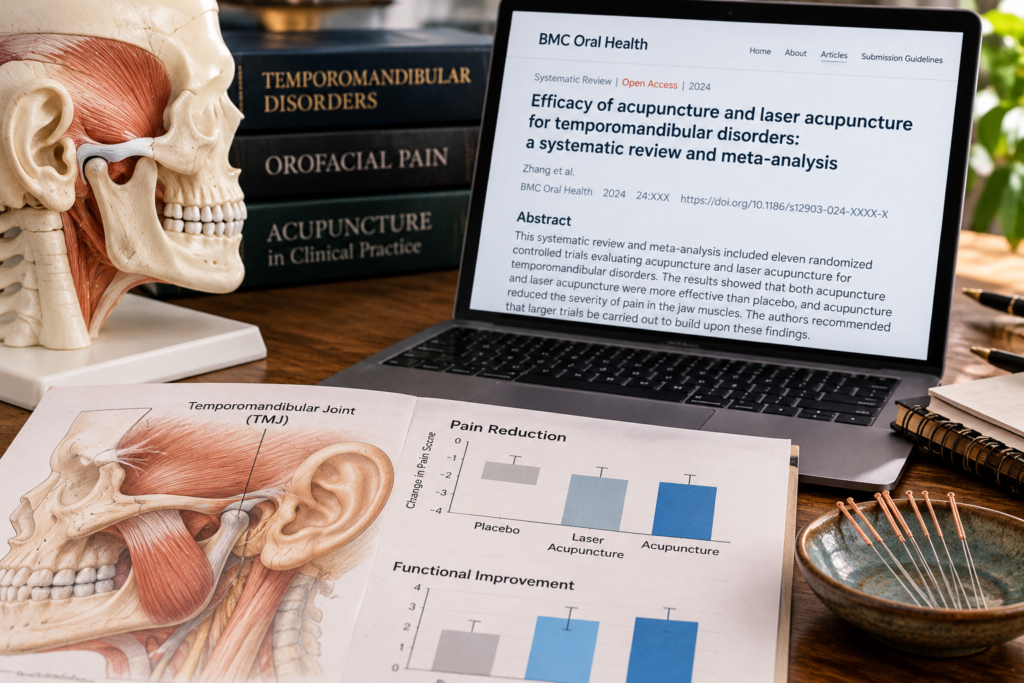
Since jaw problems are one of the most frequent causes of ear pain in adults, studies focusing on the jaw are particularly important. A systematic review and meta-analysis published in BMC Oral Health in 2024 collected eleven randomized controlled trials involving acupuncture and laser acupuncture for temporomandibular disorders, which are problems of the jaw joint and muscles often experienced in and around the ear. The results showed that both acupuncture and laser acupuncture were more effective than the placebo treatment, and acupuncture was found to reduce the severity of pain in the jaw muscles. The authors recommended that larger trials be carried out in order to build upon these findings.
Research on acupressure for ear pain specifically is still developing, but acupressure targets many of the same points and channels. It is a practical way to ease ear pain and jaw tension at home while you identify and treat the cause.
Here are nine acupressure points that can help:
What Acupressure Points to Press and Why
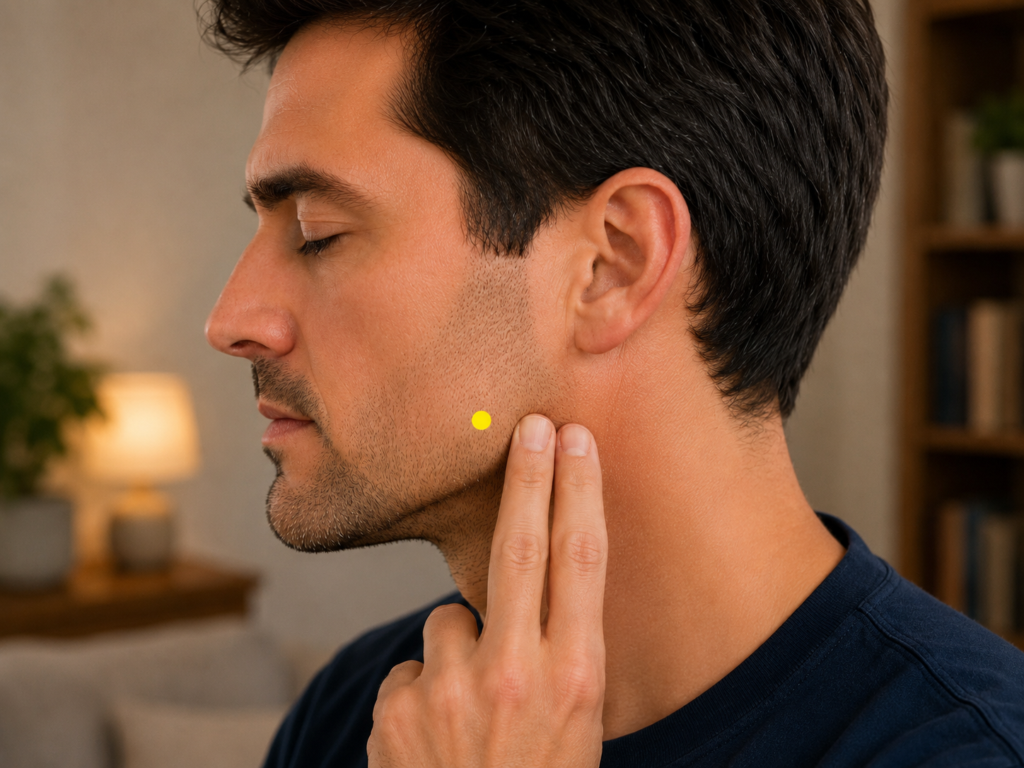
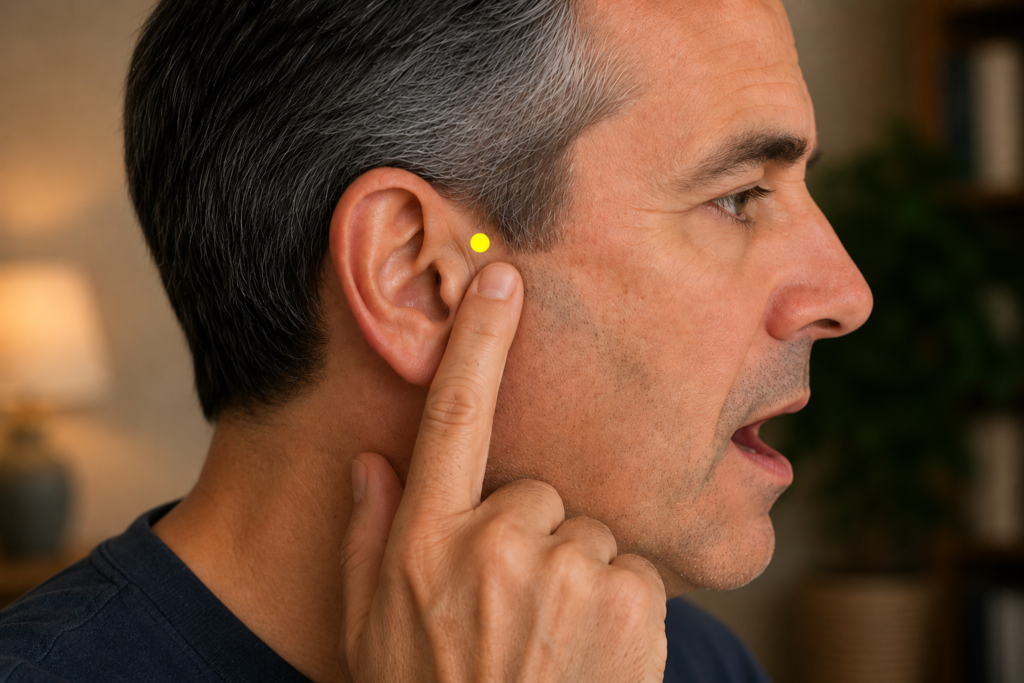
1. Press gently on ST7 in front of the ear to ease jaw-related ear pain. ST7 sits just in front of the ear, in the hollow below the cheekbone, about a finger-width in front of the ear opening. With your mouth closed, you will feel the hollow; when you open your mouth, the jawbone moves forward to fill it. Press gently with your fingertips for about a minute on the affected side, with your mouth closed and your jaw relaxed. ST7 is called “Xiaguan,” the “Lower Gate.”
The ST7 point is situated just above the jaw joint, a common cause of ear pain in adults. Stimulating this point relaxes the joint and the surrounding chewing muscles, while also improving blood flow in the area in front of the ear. It is especially beneficial when ear pain intensifies during chewing, yawning, or clenching. Use gentle pressure and stop if the area is very tender or swollen. This point is the most important in the routine.
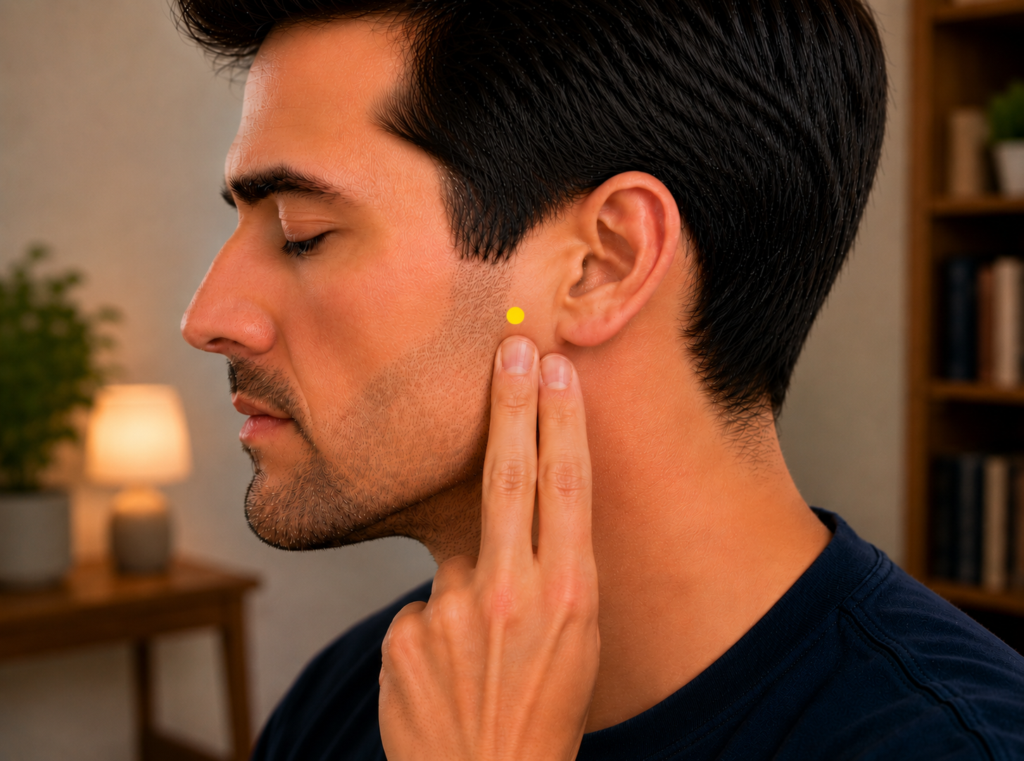
2. Press on ST6 at the angle of the jaw to release clenching. ST6 sits about one finger-width up and forward from the lower angle of the jaw, on the muscle that bulges when you clench your teeth. Press firmly with your fingertips for one to two minutes on the affected side, then let your jaw hang slightly open as the muscle softens. ST6 is called “Jiache,” the “Jaw Bone.”
Point ST6 lies on the main chewing muscle and often contracts under stress or during nighttime teeth grinding, which can cause ear pain. Relaxing this muscle can help reduce jaw-related ear discomfort and back tooth pain. It naturally works with ST7 to relax the full jaw on the affected side.
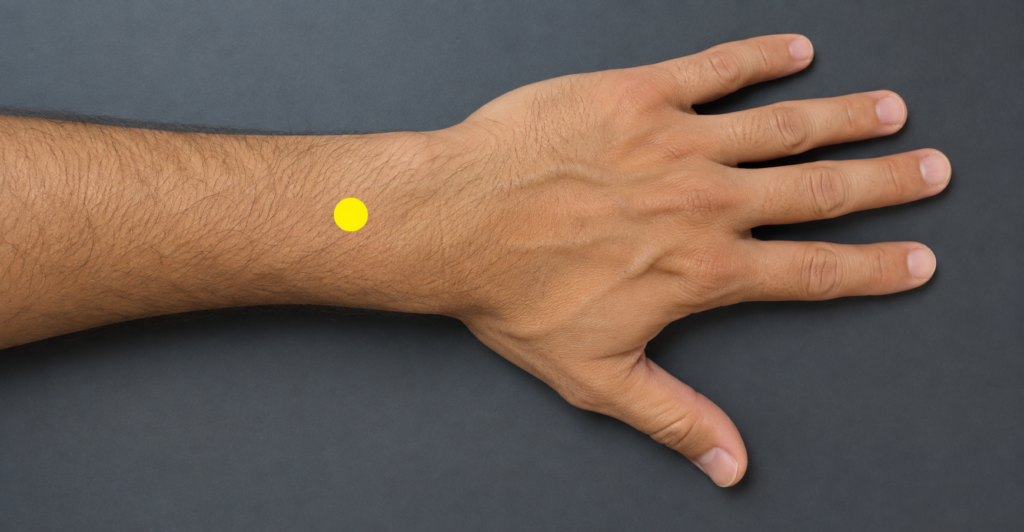
3. Press on SJ5 on the back of the forearm to ease ear pain from a distance. SJ5 sits on the back of the forearm, three finger-widths above the wrist crease, in the hollow between the two forearm bones. Press firmly with your thumb for one to two minutes on each arm. SJ5 is called “Waiguan,” the “Outer Gate.”
SJ5 lies on the Triple Burner meridian, which runs along the outer arm, behind the ear, then curves back toward the ear. This acupoint is crucial for relieving ear pain because it helps to eliminate wind and heat from the meridian and eases discomfort around the ear without directly touching the ear. It is especially beneficial when ear pain is accompanied by cold, fever, or neck stiffness.
4. Press on SJ2 between the ring and little fingers to clear heat from the ear. SJ2 sits on the back of the hand, in the webbing between the ring finger and little finger, just behind the edge of the web. Press firmly with your thumb and index finger for one to two minutes on each hand. SJ2 is called “Yemen,” the “Fluid Gate.”
SJ2 is located near the beginning of the Triple Burner channel, so its effects can reach the opposite end, the ear. Traditionally, SJ2 is used to alleviate sudden ear pain, ringing, sore throats, and to clear heat rising to the ear. Pinching the web between the ring and little fingers from the back of the hand is easy to do anywhere.
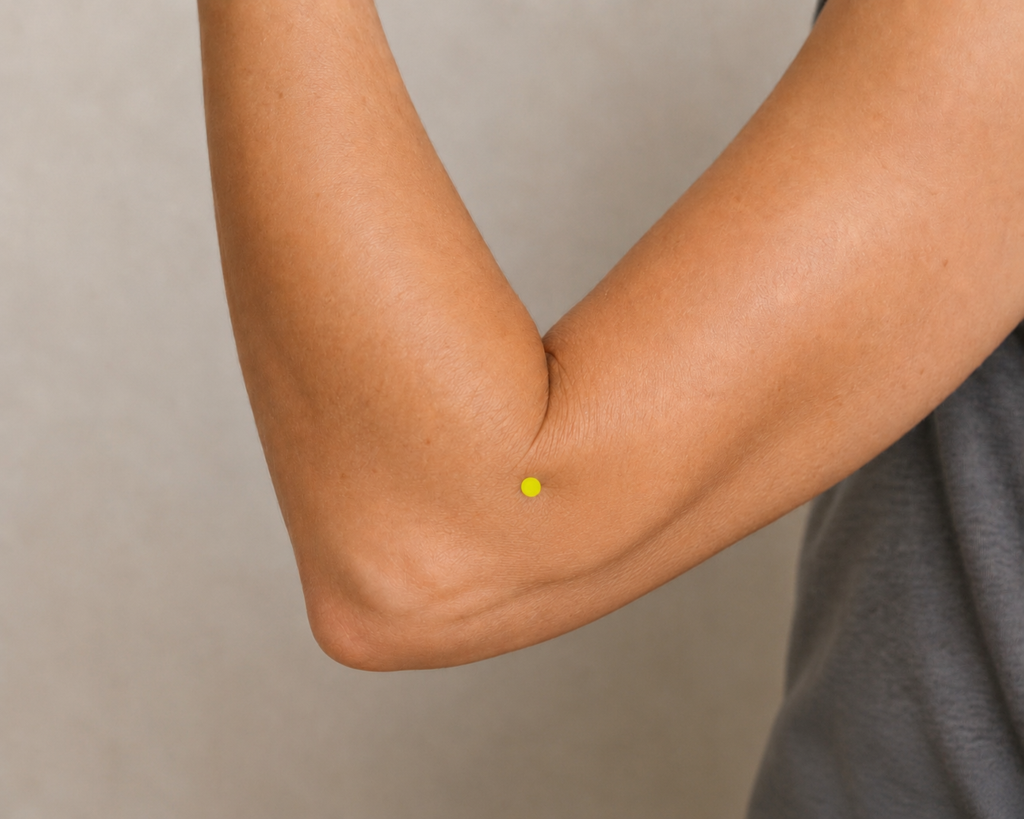
5. Press on LI11 at the elbow to clear heat and ease infection-related pain. LI11 sits on the outer end of the elbow crease when the elbow is bent. Press firmly with your thumb for one to two minutes on each arm. LI11 is called “Quchi,” the “Pool at the Crook.”
LI11 is a crucial point for dissipating heat from the body, especially when ear pain occurs alongside cold symptoms, sore throat, fever, or swollen glands—considered signs of wind-heat in Chinese medicine. It also supports the immune system during colds that often lead to ear infections.
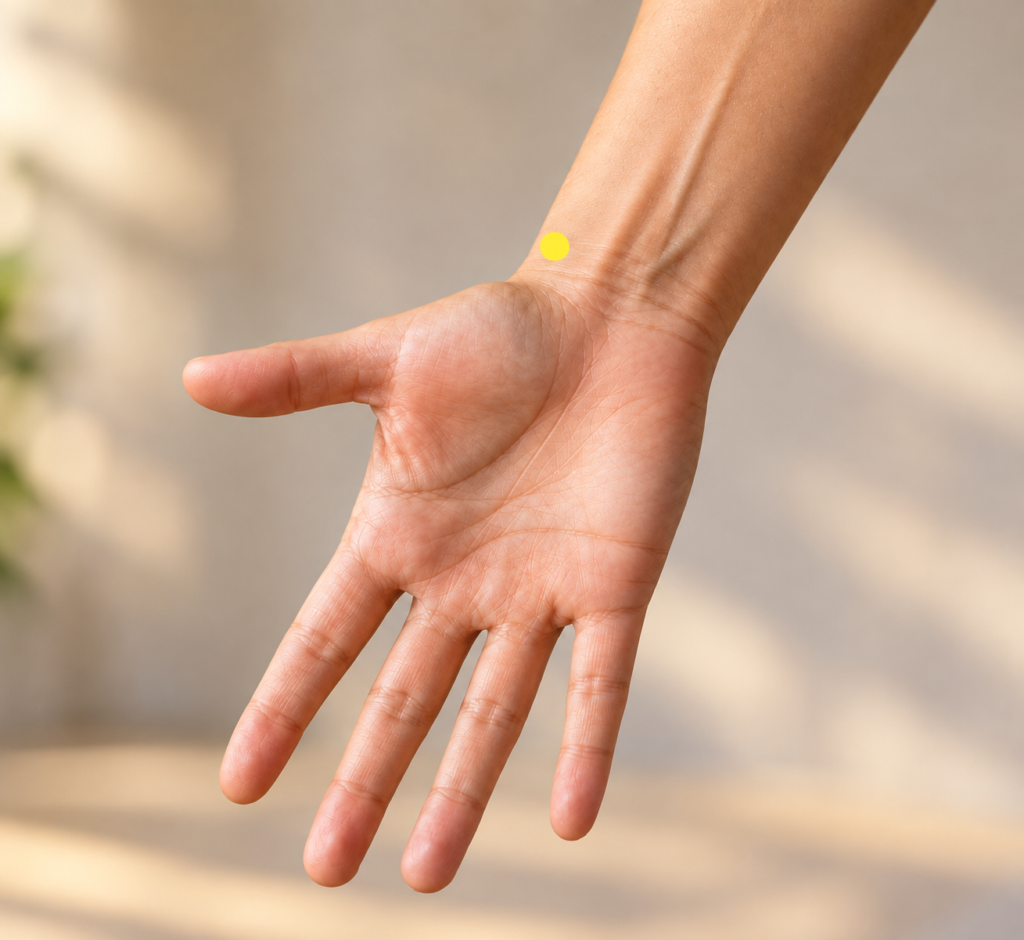
6. Press on LU7 above the wrist to release wind and ease the neck. LU7 sits on the thumb side of the forearm, about two finger-widths above the wrist crease, in a small groove on the edge of the bone. Press firmly with your thumb or fingertip for one to two minutes on each arm. LU7 is called “Lieque,” the “Broken Sequence.”
LU7 helps relieve wind from the head and neck and is commonly used for colds, sore throats, and neck stiffness. If ear pain follows a cold, chill, or draft exposure in the neck area, LU7 can help dispel the wind lodged there. It is effective when combined with LI11 and SJ5 during the early stages of a cold.
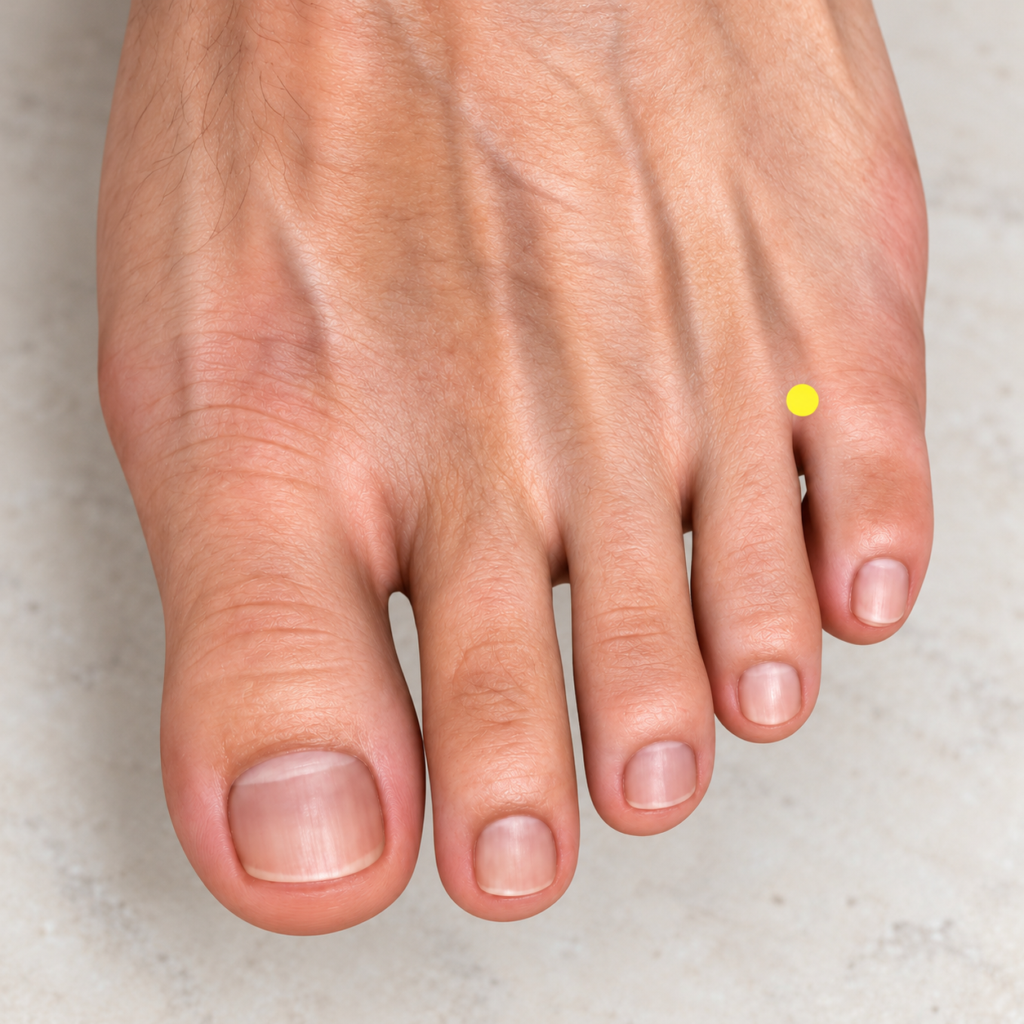
7. Press on GB43 on the top of the foot to clear the ear. GB43 sits on the top of the foot, at the end of the webbing between the fourth and fifth toes. Press firmly with your thumb or fingertip for one to two minutes on each foot. GB43 is called “Xiaxi,” the “Clamped Stream.”
The Gallbladder channel circles the ear, with GB43 near the foot’s end being a key point for ear issues like pain, ringing, and sudden hearing changes. It helps dissipate heat and fire rising up the channel to the ear and temples; pressing this point draws that heat away from the ear and head.
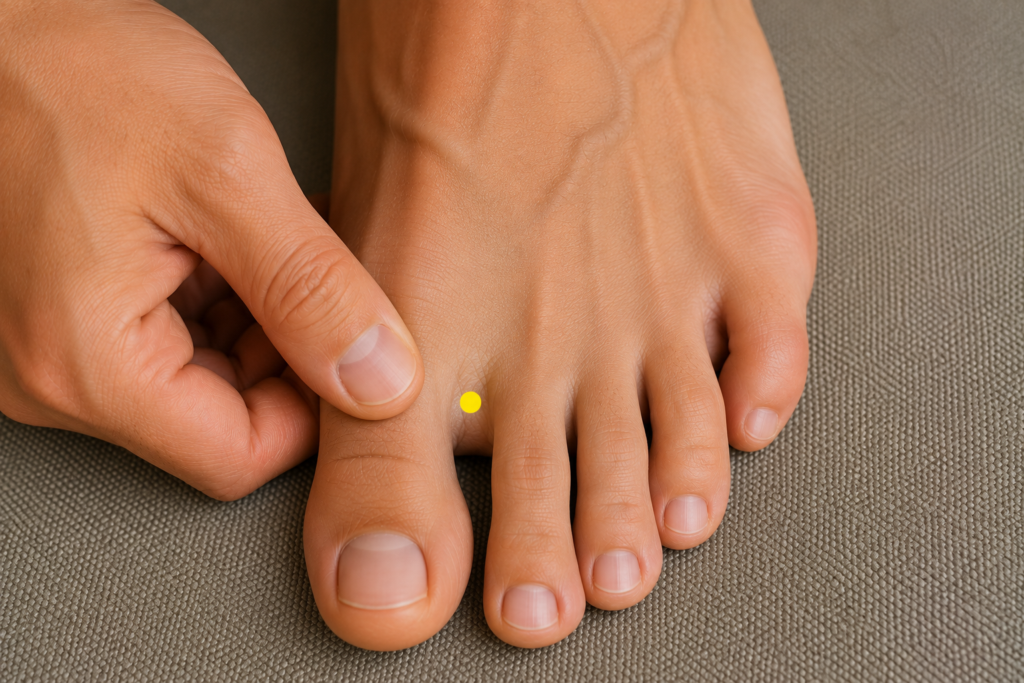
8. Press on LR2 on the top of the foot to calm intense, throbbing pain. LR2 sits on the top of the foot, at the end of the webbing between the big toe and the second toe. Press firmly with your thumb for one to two minutes on each foot. LR2 is called “Xingjian,” the “Moving Between.”
LR2 serves as the main acupoint for calming Liver fire, a condition in Chinese medicine characterized by sudden, intense throbbing pain in the head and ears, along with irritability, a flushed face, and a bitter taste. It works with GB43 to clear heat from the Liver and Gallbladder channels and is especially effective when ear pain intensifies during stress or anger.
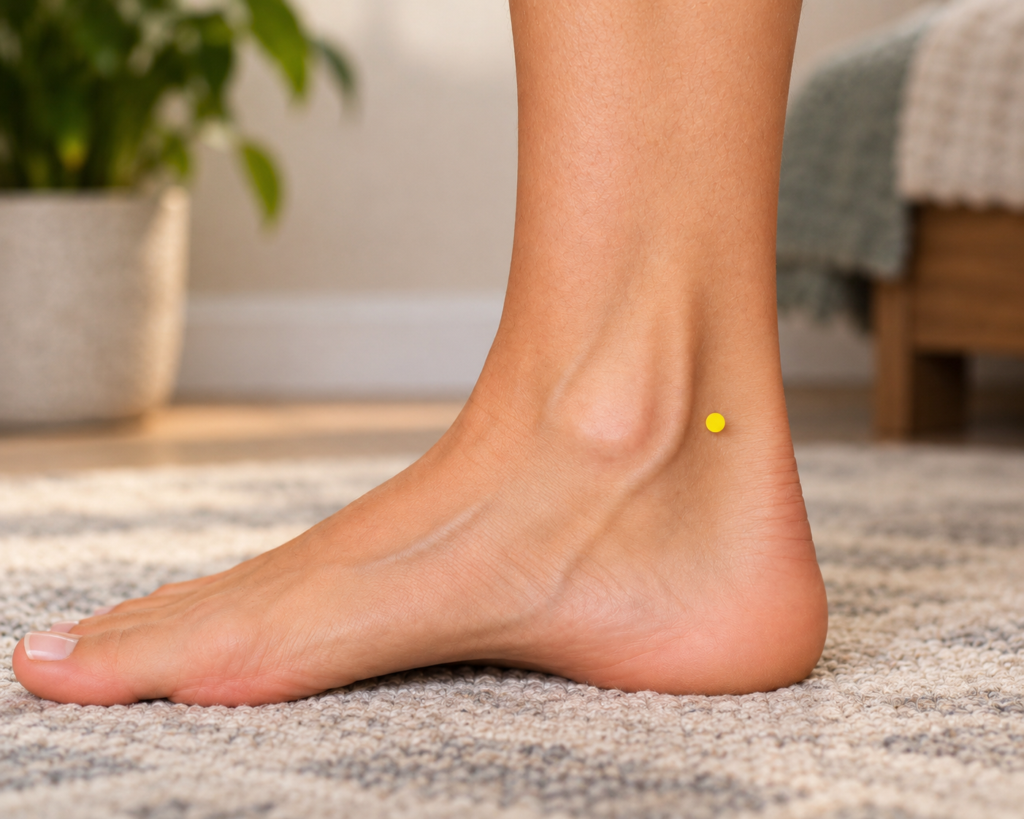
9. Press on KI3 behind the inner ankle to strengthen the ears. KI3 sits in the hollow between the inner ankle bone and the Achilles tendon, level with the tip of the ankle bone. Press firmly with your thumb for one to two minutes on each ankle. KI3 is called “Taixi,” the “Great Stream,” and is the source point of the Kidney.
In Traditional Chinese Medicine, the Kidney system connects to the ears, and KI3 strengthens the Kidney. This acupoint is especially effective for dull and recurring earaches, ear pain with ringing, gradual hearing loss, and ear issues in the elderly or after prolonged illness. It should be stimulated daily for chronic ear problems, rather than during sudden, severe pain episodes.
Why These Acupressure Points Work
In Traditional Chinese Medicine, pain in the ear is considered to be due to heat, wind, or stagnation in the meridians that encircle the ear and run down the jaw, and in some chronic cases, there is also a deficiency of the Kidney qi. The nine points apply to this scenario.
- The jaw points (ST7, ST6) release tension in the jaw joint and chewing muscles, which often refer pain to the ear.
- The Triple Burner points (SJ5, SJ2) work on the channel that wraps around the ear, easing pain from a distance.
- The heat and wind points (LI11, LU7) clear the wind heat behind ear pain that comes with colds and sore throats.
- The foot points (GB43, LR2) clear fire from the Gallbladder and Liver channels and draw intensity down from the ear.
- The Kidney point (KI3) helps enhance ear health in chronic cases.
How to Properly Use These Acupressure Points
- Do not press on the ear itself, the area directly behind the ear, or any area that is swollen, red, or draining.
- For ear pain with chewing, clenching, or jaw tension, focus on ST7, ST6, SJ5, and SJ2.
- For ear pain with a cold, sore throat, or fever, focus on SJ5, LI11, LU7, and SJ2, and see a doctor if the pain is severe or does not improve.
- For sudden, intense, throbbing ear pain, add GB43 and LR2.
- For dull, recurring ear aches, add KI3 daily.
- Hold each point for one to two minutes, with about a minute for ST7.
- Use gentle pressure in front of the ear and at the jaw, and firm pressure on the arms, hands, legs, and feet.
- For children, use light pressure on the hand and arm points for thirty seconds to a minute, and always have a doctor check a child’s ear pain.
Sample routines:
- Jaw-related ear pain (five minutes): ST7 and ST6 on the affected side, then SJ5 and SJ2, finishing with slow jaw opening and closing.
- Ear pain with a cold (five minutes): LI11, LU7, SJ5, and SJ2, along with a warm compress over the ear.
- Sudden, throbbing ear pain (three minutes): SJ5, GB43, and LR2 while you arrange to be seen.
- Evening (ten minutes): ST6 and ST7 to release the day’s clenching, then SJ5, KI3, and slow breathing before sleep.
Home Care and Lifestyle Support for Ear Pain
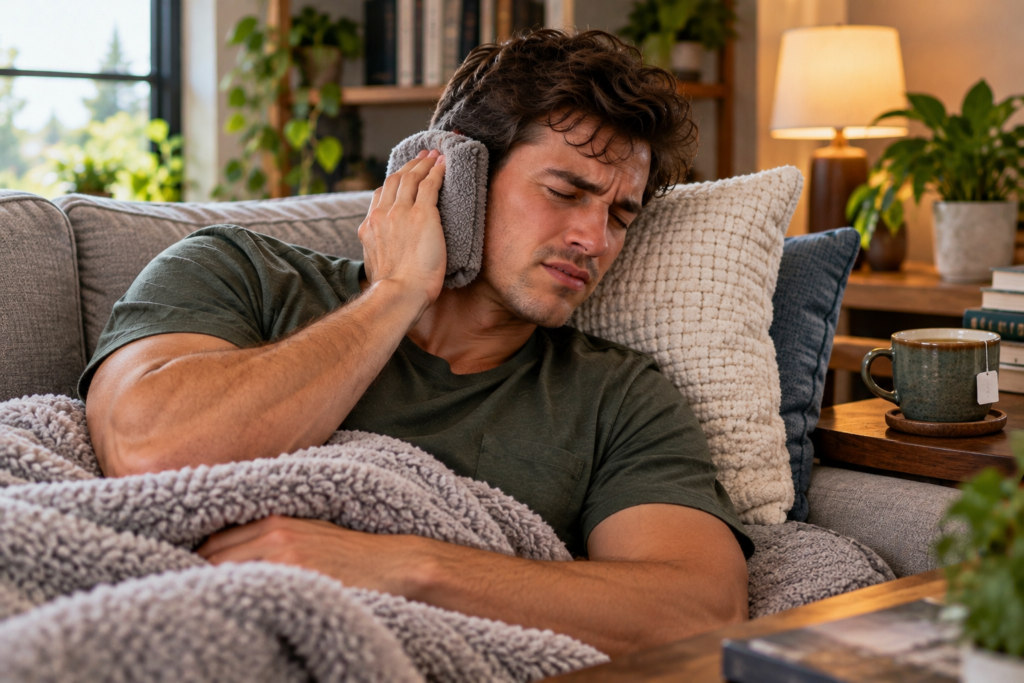
Basic home care can help alleviate ear pain during diagnosis and treatment.
- Apply a warm compress or a warm, damp washcloth to the ear for ten to twenty minutes. Some people find a cool compress more soothing, and alternating between the two is fine.
- Sleep with your head raised on an extra pillow, and avoid lying on the painful ear.
- Chew gum, swallow, or yawn during flights and descents to help equalize pressure.
- Rest the jaw by choosing soft foods, avoiding gum and chewy or hard foods, and keeping the teeth apart and the jaw relaxed during the day.
- Ask your dentist about a night guard if you grind or clench your teeth at night.
- Treat colds and allergies early with rest, fluids, steam, and saline nasal rinses.
- Keep the ears dry after swimming or showering by tilting the head and gently drying the outer ear.
- Never insert cotton swabs, fingers, or other objects into the ear canal.
- Avoid ear candling, which does not remove wax and can cause burns.
- Do not put oils or drops in the ear if you may have a hole in the eardrum, have ear tubes, or have drainage from the ear, unless your doctor recommends them.
Traditional Chinese Medicine emphasizes protecting the ears and back of the neck from wind and cold by wearing a hat or scarf when it’s windy and avoiding direct airflow from air conditioning and fans. When you have a cold, it recommends eating warm, simple foods such as broths and soups while avoiding greasy, fried, spicy, sugary foods and alcohol, as these can cause heat to rise to the head and ears. Traditionally, mint and chrysanthemum tea are used to cool the head, and reducing stress and frustration is important because Traditional Chinese Medicine links rising Liver fire with sudden, intense ear pain. For chronic ear issues, rest and nourishing foods that support the Kidney, like black sesame seeds, walnuts, and bone broth, are advised.
How Acupuncture Can Help

Acupuncture alleviates ear pain by relaxing the muscles of the jaw and neck, which often cause referred pain to the ear. It also works by removing heat and wind from the areas surrounding the ear and supporting the body’s recovery during and after colds and sinus issues. The treatment is tailored to address the specific cause of pain, whether it stems from the jaw, sinuses, frequent infections, or chronic ear conditions like ringing or hearing changes. Many patients with jaw-related ear pain experience benefits such as reduced teeth clenching and grinding, decreased pain in front of the ear, and improved sleep. Use this approach alongside medical care from your doctor, dentist, or ear specialist, especially when infections require medical intervention.
Learn more about how acupuncture can help with TMJ and whether acupuncture can treat tinnitus.
When to Get Professional Help

If you have ear pain that continues for more than two or three days, is severe, or recurs, you should see a doctor because a simple examination of the ear can determine whether the pain is due to the ear or to the jaw, the teeth, or the throat. You should seek medical attention as soon as possible if the ear pain is accompanied by a fever, if there is drainage of pus or blood from the ear, if there is a sudden loss of hearing, or if there is pain and swelling in the outer ear canal. Seek care the same day if there is a red, swollen, tender area behind the ear, or if the ear is pushed forward or sticking out more than usual, since these can signal a spreading infection. Seek prompt medical attention if ear pain is accompanied by a rash or blisters near the ear or facial weakness on one side, as these may indicate shingles affecting the ear.
Emergency care is needed if the ear pain is accompanied by a severe headache, a stiff neck, confusion, or severe dizziness, or if clear fluid or blood comes from the ear following a head injury. Babies under the age of two, children with a high fever, and children who are abnormally irritable or who are pulling at their ears should all be seen by a doctor. Adults who smoke or consume large amounts of alcohol and who have ear pain that does not go away, particularly when they have a hoarse voice, difficulty swallowing, or a lump in the neck, should have it evaluated as soon as possible.
Acupressure provides a gentle, supportive way to alleviate ear pain. It should be used alongside, not instead of, diagnosis and medical care.
For other ear and jaw concerns, acupressure for ear pressure and clogged ears, acupressure for tinnitus, and acupressure for TMJ pain are companion pieces. If your ear pain comes with a cold or congestion, acupressure for the common cold and acupressure for sinus congestion and pressure can help; if you also have dizziness or vertigo, acupressure for Ménière’s disease covers ear problems that affect balance.
Above and Beyond Acupuncture offers acupuncture, cupping, and lifestyle coaching at the North Frank Lloyd Wright Boulevard location in Scottsdale.
Schedule an appointment online to start your healing journey.
The points above are only as effective as the technique used to apply them. Where to press, how firmly, and for how long all affect the result. For a full breakdown of how to perform acupressure properly at home, read Performing Acupressure in 3 Easy Steps.

About the Publisher
Paul Kerzner, L.Ac., is a licensed acupuncturist and board-certified herbalist, as well as the founder of Above and Beyond Acupuncture in Scottsdale. His own journey from chronic patient to practicing acupuncturist shapes his commitment to providing honest, clinically grounded information about acupuncture and Traditional Chinese Medicine. Learn more about Paul and his clinical approach on the About Us page.