
Key Takeaways
- Crohn’s disease is a chronic autoimmune condition affecting the digestive tract, requiring ongoing medical management.
- Acupuncture complements standard gastroenterology care by addressing inflammation, stress, and quality of life issues.
- IgG food sensitivity testing identifies dietary triggers that exacerbate Crohn’s symptoms and improves patient outcomes with proper dietary management.
- An integrated approach to managing Crohn’s includes medication, nutritional support, acupuncture, and stress management practices.
- Complementary therapies like acupuncture can help with symptom relief but are not a replacement for standard medical care.
Crohn’s disease is one of the most serious digestive conditions in modern medicine. The chronic autoimmune inflammatory condition can affect any part of the digestive tract from mouth to anus, produces significant complications when uncontrolled, and requires ongoing medical management to prevent progression. Roughly 800,000 Americans live with Crohn’s disease, and the number continues to rise.
Patients with Crohn’s disease often search for complementary approaches that can support their care regimen. Acupuncture and Traditional Chinese Medicine offer meaningful adjunctive support that works alongside standard medical management. The important word is alongside. Crohn’s disease requires ongoing gastroenterology care and appropriate pharmaceutical management, and acupuncture is not a replacement for that care. Acupuncture is a complementary approach that addresses symptom burden, inflammation, stress dimensions, and quality of life factors that standard care does not always fully address.
Here is what Crohn’s disease actually is, why standard care is essential, and how acupuncture supports the overall treatment approach.
What Is Crohn’s Disease?
Crohn’s disease is an autoimmune inflammatory condition that produces chronic inflammation of the digestive tract. The inflammation can affect any part of the tract but most commonly involves the terminal ileum (the end of the small intestine) and the beginning of the colon. Unlike ulcerative colitis, which affects only the colon and only the superficial layers of the tissue, Crohn’s can affect any part of the tract and typically involves all layers of the intestinal wall.
Common symptoms include chronic abdominal pain, diarrhea (sometimes with blood), fatigue, weight loss, reduced appetite, and low-grade fever. Extraintestinal manifestations including joint pain, skin conditions, eye inflammation, and liver involvement occur in a subset of patients.
Complications of uncontrolled Crohn’s disease include intestinal strictures that produce obstructions, fistulas that create abnormal connections between tissues, abscesses, malnutrition from impaired absorption, and increased risk of colorectal cancer over time.
Crohn’s disease belongs to the broader category of inflammatory bowel disease (IBD), which also includes ulcerative colitis. This is a completely different condition from irritable bowel syndrome (IBS), which is a functional disorder without the underlying inflammation and structural damage that characterizes IBD. The distinction is important because the treatment approaches differ substantially and confusing them can lead to inappropriate care.
The Mayo Clinic overview of Crohn’s disease and the NIDDK summary provide the medical framework for understanding the condition.
What Causes Crohn’s Disease?

The underlying cause of Crohn’s disease is not fully understood, but the current model involves several interconnected factors.
- Genetic predisposition plays a role. Patients with a family history of IBD have higher risk, and specific gene variants have been identified that increase susceptibility.
- Immune dysregulation is central to the condition. The immune system inappropriately attacks the digestive tract, producing the chronic inflammation that damages tissue over time.
- Microbiome patterns contribute significantly. Patients with Crohn’s typically have altered gut microbiome composition compared to healthy controls. Whether this is cause or consequence continues to be studied, but the pattern is consistent.
- Environmental triggers including specific dietary patterns, smoking, certain medications, and infections can precipitate flares in genetically susceptible individuals.
- Food sensitivities vary by patient but often play a substantial role. IgG-mediated food sensitivities in particular contribute to ongoing inflammation for many Crohn’s patients even when their disease appears to be otherwise controlled.
- Chronic stress worsens Crohn’s symptoms through effects on immune function, gut-brain axis regulation, and microbiome patterns. The stress connection is well-documented and clinically significant.
Why Standard Care Is Essential
Crohn’s disease requires ongoing medical management. The pharmaceutical mainstays include 5-ASA drugs (mesalamine, sulfasalazine) for mild disease, corticosteroids for acute flares, immunomodulators (azathioprine, methotrexate) for maintenance, and biologics (anti-TNF drugs like infliximab and adalimumab, integrin inhibitors, interleukin inhibitors) for moderate to severe disease. Surgery becomes necessary in a substantial percentage of patients over time to address strictures, fistulas, abscesses, or areas of severely damaged tissue that no longer respond to medical therapy.
These interventions are essential. They control inflammation, prevent progression, reduce complications, and preserve quality of life. Patients who abandon standard care in favor of alternative approaches often experience disease progression, hospitalizations, and complications that could have been prevented.
What standard care sometimes does not fully address includes ongoing symptom burden during periods of clinical remission, the fatigue and quality of life impacts that persist even when inflammation is controlled, the stress and anxiety that accompany chronic disease, and the specific dietary triggers that continue to contribute to inflammation. These are the areas where acupuncture and integrated care add meaningful value.
How Acupuncture Supports Crohn’s Disease Management
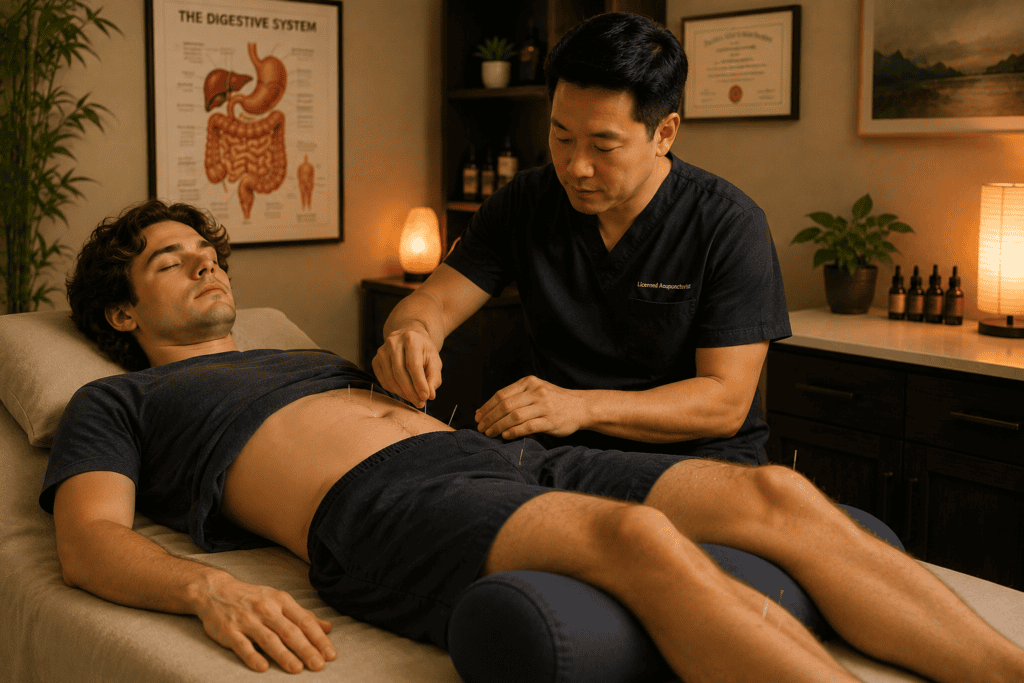
Acupuncture addresses several dimensions of Crohn’s disease that work alongside standard care.
- Anti-inflammatory effects. Acupuncture has documented anti-inflammatory effects through several mechanisms including vagal stimulation of the cholinergic anti-inflammatory pathway, modulation of pro-inflammatory cytokines, and effects on regulatory T-cell function. These effects do not replace pharmaceutical anti-inflammatory treatment but provide adjunctive support. What Is Inflammation and Why Is It Affecting Me? covers the inflammatory component in more detail.
- Gut-brain axis regulation. The gut-brain axis is central to IBD flare patterns. Acupuncture directly stimulates the vagus nerve and shifts autonomic balance toward parasympathetic activation, which supports immune regulation and reduces stress-driven flares.
- Pain management. Chronic abdominal pain is one of the most persistent symptoms in Crohn’s disease. Acupuncture reduces visceral pain sensitivity and provides meaningful pain relief for many patients.
- Nausea and appetite. Acupuncture has strong research support for reducing nausea and supporting appetite, both of which are common concerns in Crohn’s patients.
- Fatigue. The chronic fatigue that persists in many Crohn’s patients even during remission responds to the systemic effects of acupuncture on energy, sleep, and stress regulation.
- Stress and mental health. Depression and anxiety rates are substantially elevated in Crohn’s patients compared to the general population. Acupuncture addresses these dimensions directly. What Is Cortisol and Why Do I Have So Much of It? explains the chronic stress dimension.
- Pattern differentiation. Traditional Chinese Medicine identifies specific patterns producing digestive dysfunction in each patient. Damp Heat in the Large Intestine produces the acute inflammatory presentation with pain and diarrhea. Spleen Qi Deficiency with Dampness produces the chronic fatigue and malabsorption pattern. Liver Qi Stagnation invading the Spleen produces the stress-triggered flare pattern. A licensed acupuncturist identifies which patterns are dominant and treats accordingly.
What Does Acupuncture Actually Do to Your Body? covers the mechanisms in more detail.
The Critical Role of The IgG Food Sensitivity Test

One of the most valuable diagnostic tools for Crohn’s patients is IgG food sensitivity testing. This deserves specific emphasis because it addresses a genuine gap in standard Crohn’s care.
Standard care addresses the inflammatory disease process through pharmaceutical management but rarely identifies the specific dietary triggers that continue to contribute to inflammation in individual patients. Two Crohn’s patients on identical medication regimens can have completely different clinical trajectories depending on whether their specific food sensitivities are identified and eliminated.
IgG-mediated food sensitivities are delayed immune reactions that produce ongoing low-grade inflammation. Unlike IgE food allergies which produce immediate reactions, IgG sensitivities can produce symptoms hours or days after exposure, which makes them difficult to identify through observation alone. Common IgG triggers for Crohn’s patients include gluten, dairy, eggs, corn, soy, and specific individual foods that vary widely between patients.
Comprehensive IgG testing identifies the specific foods that trigger immune activation in each patient. Elimination of these identified triggers often produces substantial improvement in symptom burden, inflammation markers, and quality of life beyond what medication alone achieves. Many Crohn’s patients report meaningful symptomatic improvement within weeks of identifying and eliminating their specific triggers.
The Many Benefits of the IgG Food Sensitivity Test covers the specific benefits and clinical application in more detail.
The Integrated Holistic Approach

Crohn’s disease responds best to a coordinated integrated approach.
- Ongoing gastroenterology care. This is the foundation. Regular monitoring, appropriate medication management, and surveillance for complications are not optional in Crohn’s disease.
- IgG food sensitivity testing and elimination. Identifying and removing individual dietary triggers reduces ongoing inflammation.
- Nutritional support. Working with a registered dietitian or nutritionist familiar with IBD supports appropriate nutrient absorption and disease management. Specific dietary approaches including the specific carbohydrate diet, the Mediterranean diet, and low-FODMAP protocols have research support for different subsets of Crohn’s patients.
- Acupuncture treatment. Regular acupuncture supports symptom management, stress regulation, and quality of life alongside standard care.
- Stress management. Direct nervous system practices reduce the stress-driven component of flares.
- Sleep support. Consistent sleep supports immune regulation and reduces symptom burden.
- Movement. Appropriate physical activity supports overall health, mood, and inflammation regulation.
- Smoking cessation. For patients who smoke, quitting is one of the most important interventions for Crohn’s disease. Smoking significantly worsens Crohn’s outcomes.
When to See Your Doctor
Crohn’s disease requires ongoing medical care. Symptoms warranting urgent medical evaluation include severe abdominal pain, high fever, persistent vomiting, signs of intestinal obstruction, heavy rectal bleeding, and severe dehydration. Regular gastroenterology follow-up is essential regardless of how well controlled the disease appears.
For patients with Crohn’s disease looking for complementary support alongside their gastroenterology care, acupuncture treatment offers a meaningful adjunct that addresses inflammation, stress, symptom burden, and quality of life.
Anxiety, Stress, and Depression covers the nervous system framework that contributes to a health imbalance like Crohn’s Disease.
Acupuncture, Cupping & Lifestyle Coaching covers what services this clinic offers.
Reach out to Above and Beyond Acupuncture on North Frank Lloyd Wright Boulevard in Scottsdale to schedule a consultation.
Schedule an appointment online or call us today to start your healing journey.