Key Takeaways
- Indigestion includes discomfort like bloating and nausea, and acupressure can help settle your stomach.
- Learn how to use acupressure for indigestion by pressing specific points, such as PC6 for nausea and CV12 for fullness.
- Strengthening points like ST36 and SP6 help improve digestion, while moving points like ST25 relieve gas and bloating.
- For stress-related indigestion, use LR3 to release tension that affects digestion under pressure.
- If indigestion is frequent or severe, seek medical attention to rule out serious conditions.

Indigestion is a common condition marked by a heavy, overly full feeling after eating, along with bloating, gas, nausea, burning sensations, belching, and the sensation that food isn’t progressing. Typically, it’s not harmful but can be quite unpleasant. Acupressure provides an easy method to calm your stomach using only your hands. Whether you’re sitting at the table or relaxing on the couch after a meal that feels off, the following points can alleviate discomfort and support healthy digestion.
Traditional Chinese medicine considers digestion central to health, regulated by the Stomach and Spleen. The Stomach is responsible for taking in food and, in this tradition, “rots and ripens” it before moving it downward. The Spleen then transforms this into Qi and Blood that nourish the body. Indigestion occurs when this process stalls: the Stomach Qi does not descend properly, causing fullness, nausea, and belching; the Spleen’s transformation falters, leading to heaviness and bloating; food may stagnate; heat can build up, turning into acid and burning sensations; and often, stress affects the Liver, which overreacts on the Stomach and disrupts the entire process. The points listed below aim to settle the stomach, strengthen digestion, promote movement of stuck substances, clear heat, and reduce stress, which frequently underlies stomach issues.
Acupressure can help with everyday indigestion and relieve painful symptoms. For a clinical perspective on how digestion is addressed, “Can Acupuncture Treat Indigestion?” explores the topic in more depth.
Here are nine acupressure points that can help:
What Acupressure Points to Press and Why
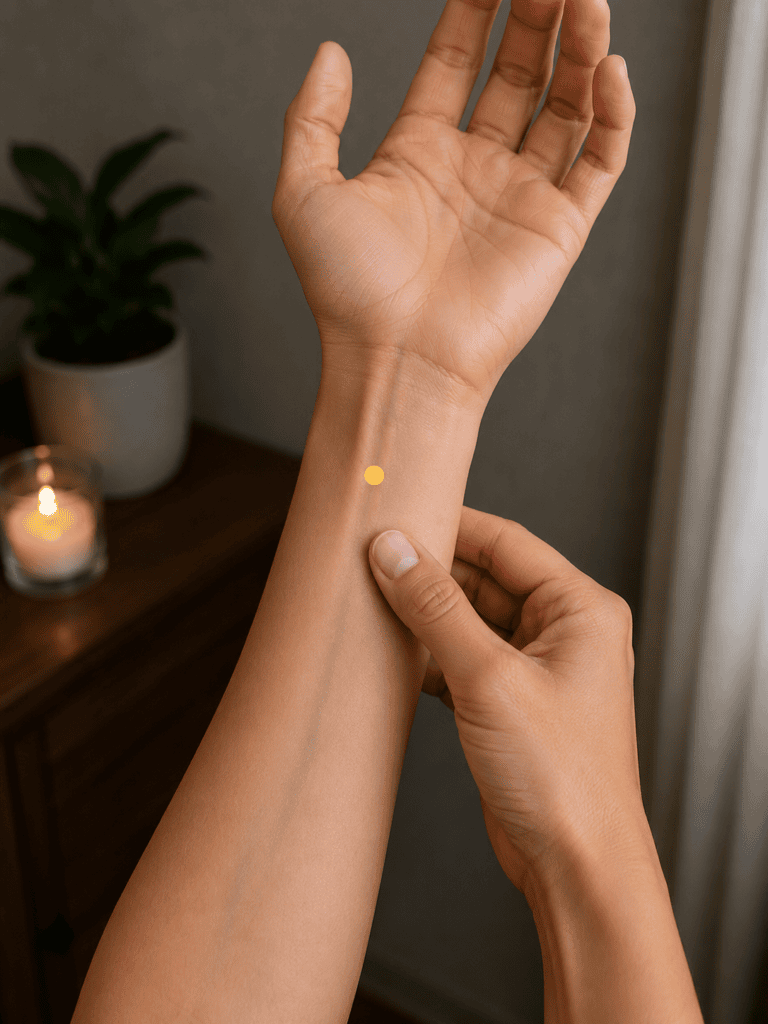
1. Press on PC6 on your inner forearm for nausea and a churning stomach. PC6 sits about three finger-widths above the inner wrist crease, in the center of the forearm between the two tendons. Press firmly with your thumb for one to two minutes on each arm. PC6 is called “Neiguan,” the “Inner Pass,” and it is the single best-known point for nausea.
PC6 settles the stomach and the chest and directs rebellious Stomach Qi back downward, which is the Chinese medicine way of describing the upward churn of nausea, queasiness, and belching. For indigestion that comes with a sick, unsettled, or churning stomach, this is the first point to reach for, and it is discreet enough to press under the table when a meal turns on you. It pairs naturally with SP4 further down this list for a stomach that will not settle.
2. Press on CV12 above your navel for fullness and stomach discomfort. CV12 sits on the midline of the abdomen, halfway between the navel and the lower end of the breastbone, about four finger-widths above the belly button. Press gently but steadily with your fingertips or the flat of your palm for one to two minutes. CV12 is called “Zhongwan,” the front-mu point of the Stomach, where the Stomach’s Qi gathers at the front of the body.
This is the central local point for the stomach and the most direct one for indigestion. It harmonizes the Stomach, relieves the epigastric fullness, distension, and discomfort of a meal that will not move, and eases pain and bloating in the upper abdomen. Because it sits directly over the stomach, keep the pressure gentle, especially soon after eating, and let slow breathing carry the pressure inward. If one point defines a stomach routine, it is this one.

3. Press on ST36 below your knee to strengthen digestion. ST36 sits four finger-widths below the lower edge of the kneecap and one finger-width to the outside of the shinbone, on the muscle that rises when you flex your foot. Press firmly with your thumb for one to two minutes on each leg. ST36 is called “Zusanli,” the “Leg Three Miles,” and it is the master point for digestion in the entire body.
ST36 harmonizes the Stomach and strengthens the Spleen, the two organs that run digestion, which makes it useful for nearly every kind of indigestion, the bloating, the fullness, the sluggish heaviness, and the poor digestion that leaves food sitting. It also builds overall Qi and energy, so where the other points ease a single episode, ST36 worked regularly strengthens the digestion that keeps producing the trouble. It is the workhorse of any digestive routine.

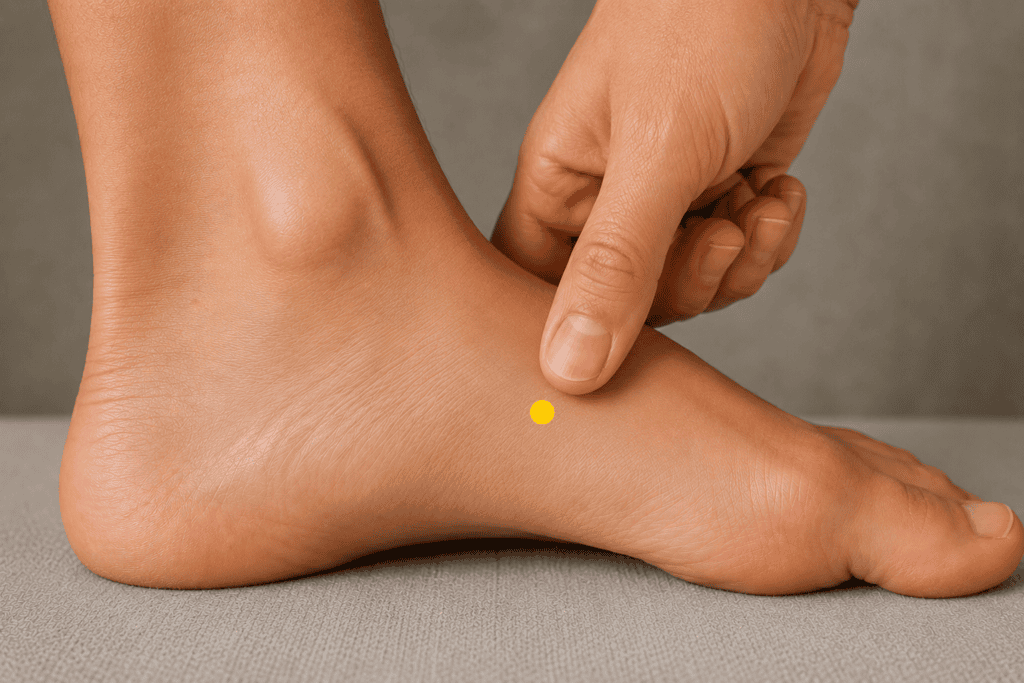
4. Press on SP4 on the arch of your foot for epigastric pain and bloating. SP4 sits on the inner side of the foot, in the depression along the arch just below and forward of the base of the big toe, where the long foot bone meets the joint. Press firmly with your thumb for one to two minutes on each foot. SP4 is called “Gongsun,” and it is the classic partner to PC6 for the stomach and chest.
SP4 strengthens the Spleen’s transformation of food and moves stuck Qi in the middle of the body, which makes it one of the strongest points for epigastric pain, bloating, and a heavy, overfull stomach. Paired with PC6, the two form one of the most reliable combinations in all of acupressure for settling a distressed stomach, one at the wrist and one at the foot working the same middle ground from both ends. Reach for the pair together when the discomfort is stubborn.
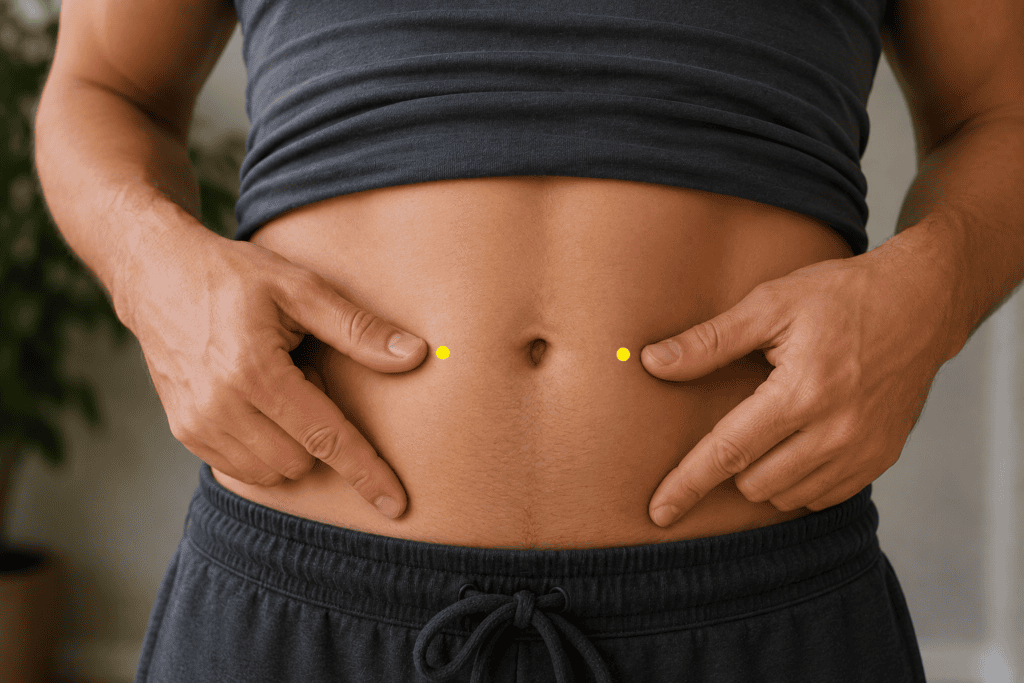
5. Press on ST25 beside your navel for bloating and the intestines. ST25 sits about three finger-widths to each side of the navel, level with the belly button. Press gently but firmly with your fingertips for one to two minutes on each side. ST25 is called “Tianshu,” the “Heavenly Pivot,” and it is the front-mu point of the Large Intestine.
Where CV12 governs the stomach above, ST25 governs the intestines below, which makes it the point for abdominal bloating, distension, gas, and the disordered bowels that often ride along with indigestion, whether that tends toward constipation or loose stools. It regulates the intestines and gets the lower abdomen moving again. For the indigestion that is as much about a bloated, gassy, distended belly as an unsettled stomach, ST25 does the work the higher points cannot reach.
6. Press on CV6 below your navel for lower abdominal gas. CV6 sits on the midline of the lower abdomen, about two finger-widths below the navel. Rest your fingertips there and press gently for one to two minutes. CV6 is called “Qihai,” the “Sea of Qi,” the gathering point for the body’s Qi in the lower abdomen.
CV6 moves the Qi that collects and stalls in the lower belly as gas, bloating, and a tight, distended, stuck feeling. When indigestion settles low and the lower abdomen feels full of trapped air, this point helps free and move it. It works well alongside ST25 for a bloated lower belly, the two together addressing the gas and distension that make the whole midsection uncomfortable after a heavy meal.

7. Press on ST44 between your toes for acid and burning. ST44 sits on the top of the foot, in the webbing between the second and third toes, just where they meet. Press firmly with your thumb for one to two minutes on each foot. ST44 is called “Neiting,” the “Inner Courtyard,” and it is the point for clearing heat from the Stomach.
Some indigestion runs hot: the burning, the acid and sour reflux, the bad breath, the discomfort that follows rich, greasy, spicy food or too much of it. Chinese medicine reads this as heat in the Stomach, and ST44 is the point that clears it. For the indigestion that burns rather than simply sits, especially after overindulging, ST44 cools the stomach in a way the warming, strengthening points do not. It pairs well with CV12 when heat and fullness come together.

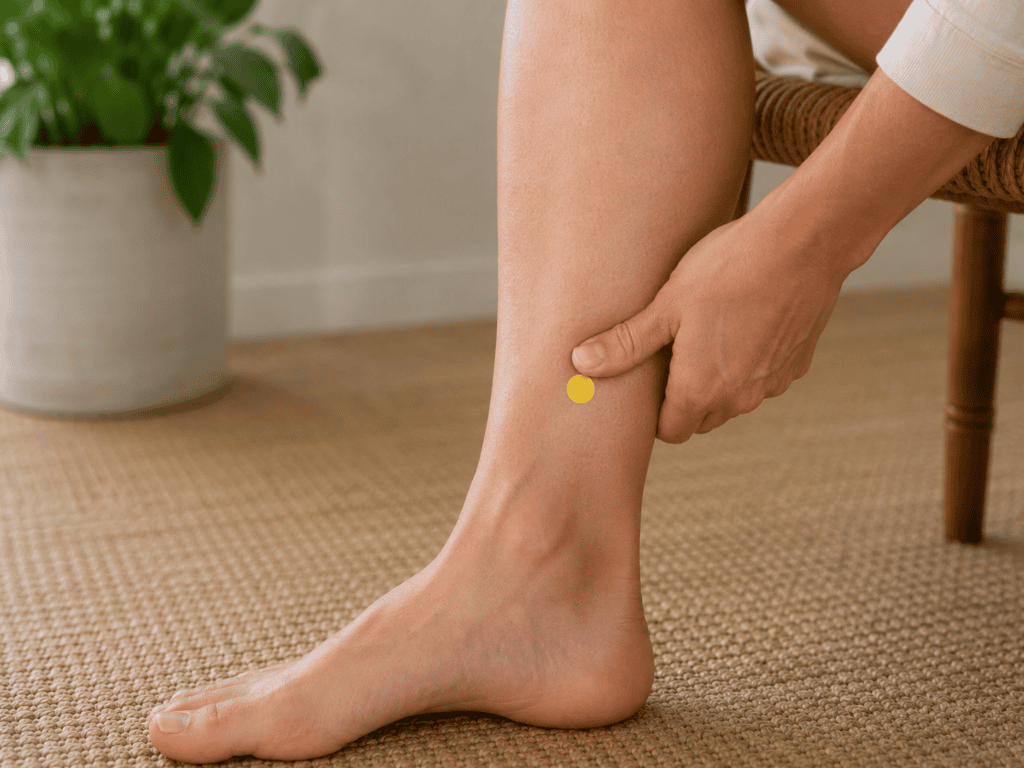
8. Press on SP6 above your inner ankle to support the Spleen. SP6 sits four finger-widths up from the tip of the inner ankle bone, just behind the back edge of the shinbone. Press firmly for one to two minutes on each leg. SP6 is called “Sanyinjiao,” the “Three Yin Intersection,” where the Spleen, Liver, and Kidney channels meet.
Because the Spleen governs the transformation of food, SP6 supports digestion at a deeper level, strengthening the Spleen’s ability to process what you eat and move it along rather than leaving it to stagnate as bloating and heaviness. It also helps settle the Liver, which connects it to the stress side of indigestion. As one of the central points for the lower body, it rewards regular use for anyone whose digestion is chronically weak or sluggish. SP6 is avoided during pregnancy.
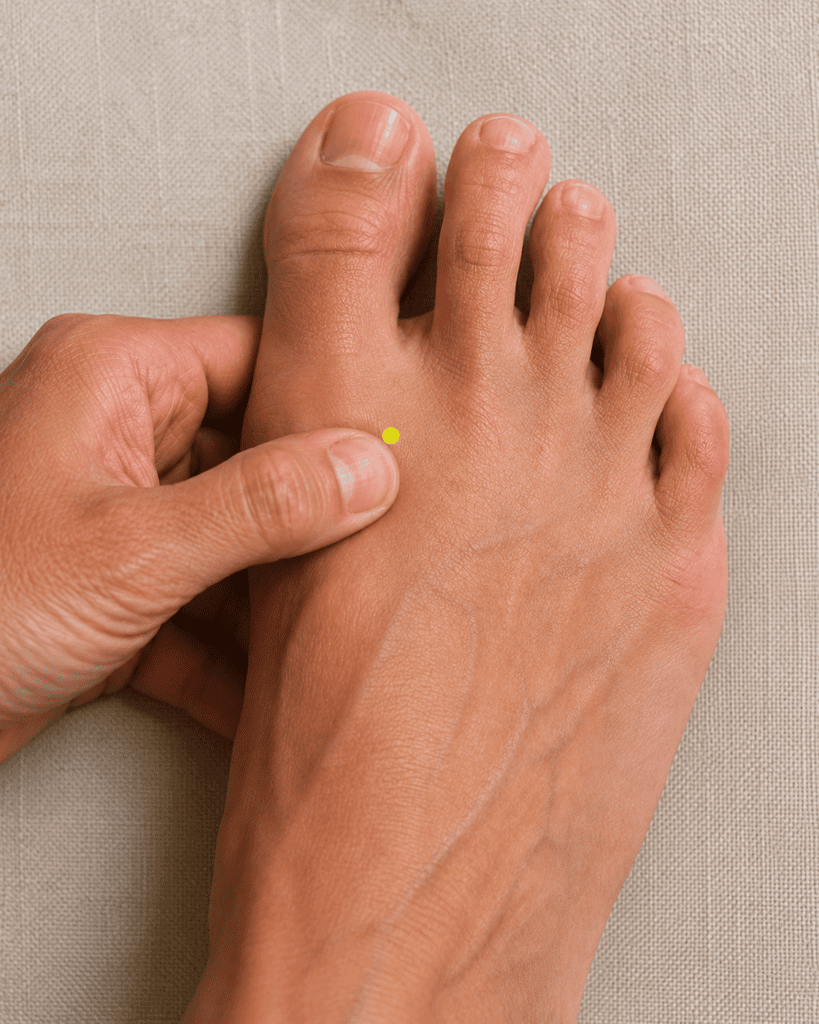
9. Press on LR3 on the top of your foot for stress-related indigestion. LR3 sits on the top of the foot, in the webbing between the first and second toes, about two finger-widths back where the bones meet in a small hollow. Press firmly with your thumb for one to two minutes on each foot. LR3 is called “Taichong,” the “Great Rushing,” and it is the primary point for moving stuck Liver Qi.
A great deal of everyday indigestion is stress-driven, the bloating and discomfort that come from eating in a hurry, eating while tense, or a stomach that knots up the moment life does. Chinese medicine reads this as the Liver, burdened by stress, overacting on the Stomach and disrupting digestion. LR3 frees that stuck Liver Qi and takes the pressure off the stomach, which is why it belongs in any routine for a nervous or stress-sensitive stomach. For the person whose digestion falls apart under stress, this point reaches the root the local stomach points cannot.
Why These Acupressure Points Work
In Chinese medicine, healthy digestion relies on the Stomach sending food downward and the Spleen transforming it, then sending the clear part upward. Indigestion occurs when this flow is disrupted, and the nine points address each part. If the Stomach Qi fails to descend, it causes nausea, fullness, and belching. When the Spleen cannot transform food properly, it leads to bloating and sluggish heaviness. Stagnation of food and Qi in the stomach and intestines results in distension and gas. Heat buildup causes acid reflux and a burning sensation. Additionally, stress affects the Liver, which then overreacts on the Stomach, further disrupting digestion.
- The stomach-settling points (PC6, CV12) direct rebellious Stomach Qi back down and calm nausea and fullness.
- The digestive-strengthening points (ST36, SP6, SP4) build the Spleen and Stomach’s ability to transform and move food.
- The moving points (ST25, CV6) free the stuck Qi and food that collect as bloating, gas, and distension.
- The heat-clearing point (ST44) cools the acid and burning of a hot stomach.
- The stress point (LR3) frees the Liver Qi that overacts on the Stomach when you eat under pressure.
How to Properly Use These Acupressure Points
Match the acupressure points to your indigestion, and press gently on the abdominal points, especially after eating.
- For the heavy, overfull feeling after a meal, work CV12, PC6, and ST36.
- For nausea and a churning stomach, press PC6 and CV12, and add SP4 if it will not settle.
- For bloating, gas, and a distended belly, work ST25, CV6, and ST36.
- For acid, burning, and sour reflux, press ST44 and CV12.
- For a stomach that knots up under stress, work LR3 with PC6 and ST36.
- Keep the pressure on the belly gentle and comfortable, wait a little while after eating before pressing the abdominal points firmly, and let your breathing slow while you work them.
Combining acupressure with holistic digestive practices helps prevent symptoms from recurring:
- Eat slowly and chew thoroughly, as indigestion often starts when you eat too quickly.
- Choose smaller meals instead of large, heavy ones, and limit greasy, spicy, and very cold foods that can strain the stomach.
- Avoid eating when stressed or in a hurry, and remain upright after eating instead of lying down.
- Chinese medicine generally favors warm, cooked foods over raw and cold options, as they are gentler on digestion for many individuals.
When to Get Professional Help
Occasional indigestion can be normal, and the tools mentioned above can help manage it. However, some cases require medical supervision.
Consult a doctor if indigestion persists, worsens, or is accompanied by weight loss, swallowing difficulties, vomiting, or black stools, as these may indicate a serious condition needing diagnosis and treatment. Severe or ongoing abdominal pain also requires prompt medical assessment. Importantly, not all symptoms labeled as indigestion are benign: if heartburn or upper abdominal discomfort occurs with chest pain, pressure, shortness of breath, sweating, dizziness, or pain radiating to the arm, neck, or jaw, treat it as a possible heart issue and seek emergency care immediately. Acupressure is suitable for common upset stomachs but is not a replacement for medical evaluation of potentially serious symptoms.
Above and Beyond Acupuncture offers acupuncture, cupping, and lifestyle coaching at the North Frank Lloyd Wright Boulevard location in Scottsdale.
Schedule an appointment online or call us today to start your healing journey.
The points above are only as effective as the technique used to apply them. Where to press, how firmly, and for how long all affect the result. For a full breakdown of how to perform acupressure properly at home, read Performing Acupressure in 3 Easy Steps.

About the Publisher
Paul Kerzner, L.Ac., is a licensed acupuncturist and board-certified herbalist, as well as the founder of Above and Beyond Acupuncture in Scottsdale. His own journey from chronic patient to practicing acupuncturist shapes his commitment to providing honest, clinically grounded information about acupuncture and Traditional Chinese Medicine. Learn more about Paul and his clinical approach on the About Us page.