
Key Takeaways
- Postpartum depression can lead to low mood, anxiety, and emotional heaviness, making recovery challenging for mothers.
- Acupressure offers an easy way to address these sensations by focusing on specific points that soothe the mind and restore energy.
- Nine acupressure points provide relief: for anxiety, use Yintang, HT7, PC6, and CV17; for mood elevation, add GV20; for irritability and renewal, work with LR3, SP6, ST36, and KI3.
- Daily practice supports recovery; even brief sessions with a few key points can make a difference during the postpartum period.
- Seeking help from professionals and loved ones is crucial; postpartum depression is treatable and recovery often requires support.

The period after a baby’s birth can be especially difficult for women, often bringing prolonged feelings of low mood, exhaustion, anxiety, and tearfulness. Acupressure provides an easy, accessible method for new mothers to manage these challenges, requiring just their hands and some quiet time to soothe a racing mind and start regaining their strength. It’s gentle, free of cost, and simple enough to practice with one hand while the baby feeds or during sleepless nights.
Chinese medicine considers the postpartum period a time of significant depletion and deficiency. Pregnancy, childbirth, and breastfeeding greatly deplete a mother’s Blood, Qi, and Kidney reserves. Since Blood nourishes and stabilizes the Shen, the mind and spirit, a Blood deficiency can lead to Shen instability. This connection explains many postpartum depression cases in this tradition: Qi exhaustion, an anxious and unsettled Shen lacking support, profound Kidney depletion, and often stagnant Liver Qi causing irritability, pressure, and heaviness. The points below address these issues by calming the mind, lifting mood, and replenishing the lost reserves during childbirth.
Acupressure can support this process by providing stability and promoting recovery. It works best when combined with support from loved ones and integrative care. For a more comprehensive understanding of how Traditional Chinese Medicine approaches this in the clinic, see “Can Acupuncture Help With Postpartum Depression?” for more detail.
Here are nine acupressure points that can provide relief:
What Acupressure Points to Press and Why
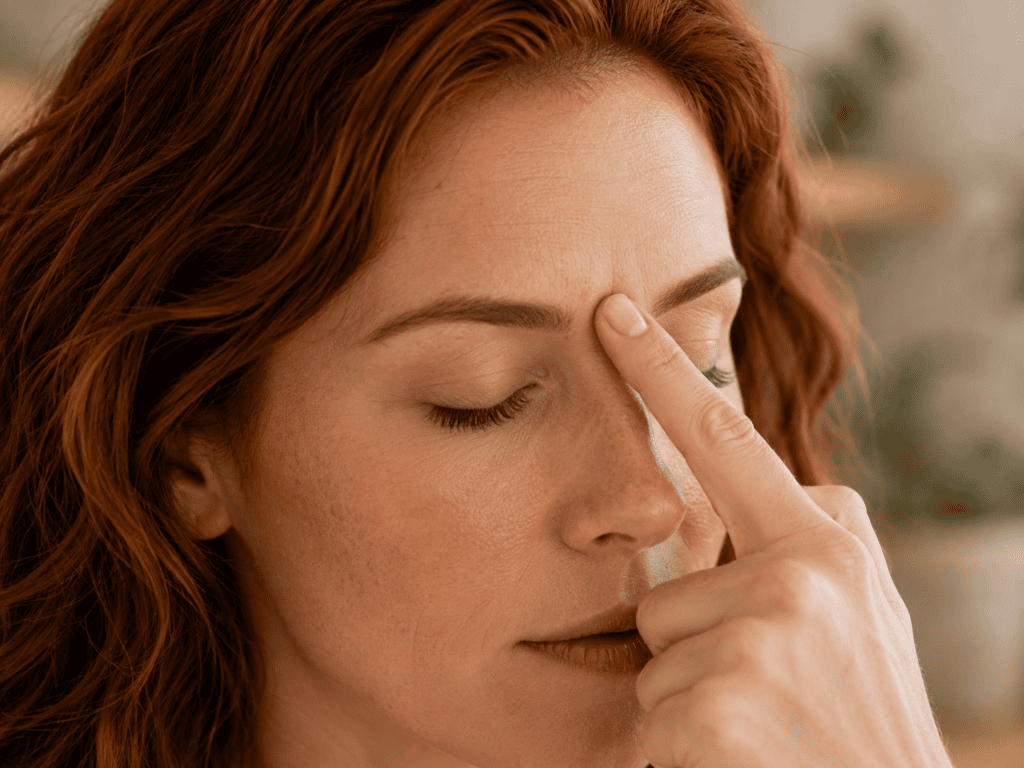
1. Press on Yintang between your eyebrows for a frayed, anxious mind. Yintang sits in the small hollow directly between the eyebrows, just above the bridge of the nose. Rest a fingertip there and press gently for one to two minutes, letting your breathing slow. Yintang is one of the most calming points on the body, and it asks almost nothing of you to use.
This is the point for the anxious, racing, cannot-quite-settle quality that so often rides alongside postpartum low mood. It calms the Shen and shifts the body toward the parasympathetic rest state, easing worry and helping quiet the mind toward sleep. In a wakeful, wired middle-of-the-night moment, a minute of gentle pressure here begins to settle the whole system.
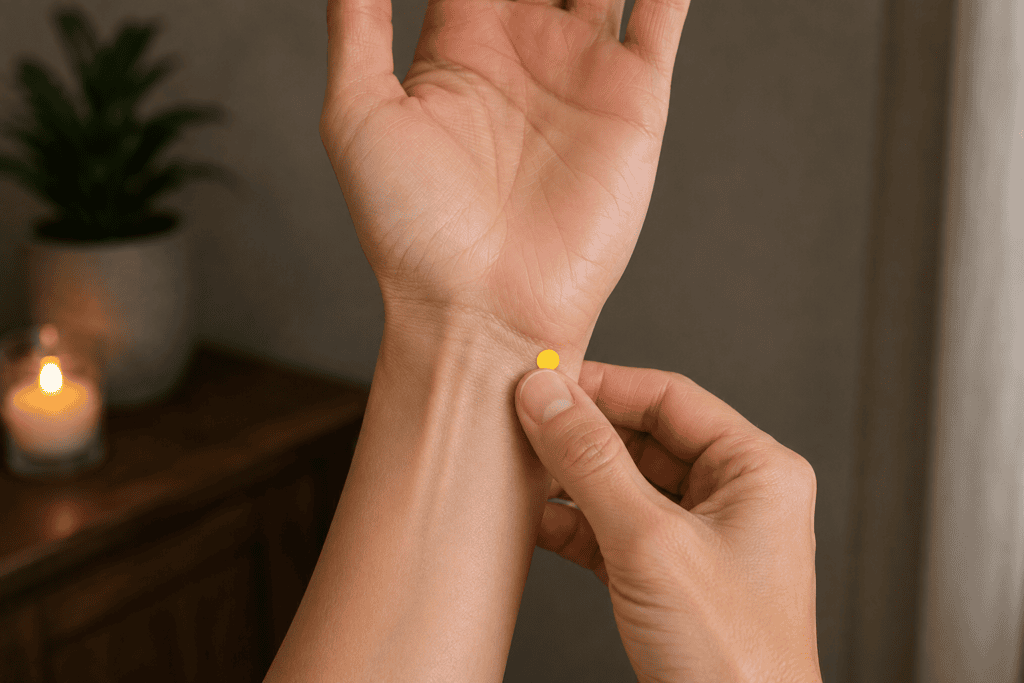
2. Press on HT7 at your wrist for the unsettled Heart. HT7 sits at the wrist crease on the pinky side, in the small hollow just inside the bony bump at the base of the hand. Press gently with your thumb for one to two minutes on each hand. HT7 is called “Shenmen,” the “Spirit Gate,” and it is the source point of the Heart channel.
In Chinese medicine the Heart houses the Shen, and when childbirth depletes the Blood that should anchor it, the Shen grows restless, which shows up as anxiety, a racing or pounding heart, and the kind of exhausted wakefulness where the body cannot fall asleep even when the baby finally does. HT7 settles the Heart and the Shen directly. It is completely discreet, easy to press with a thumb while you hold or feed your baby with the other arm.
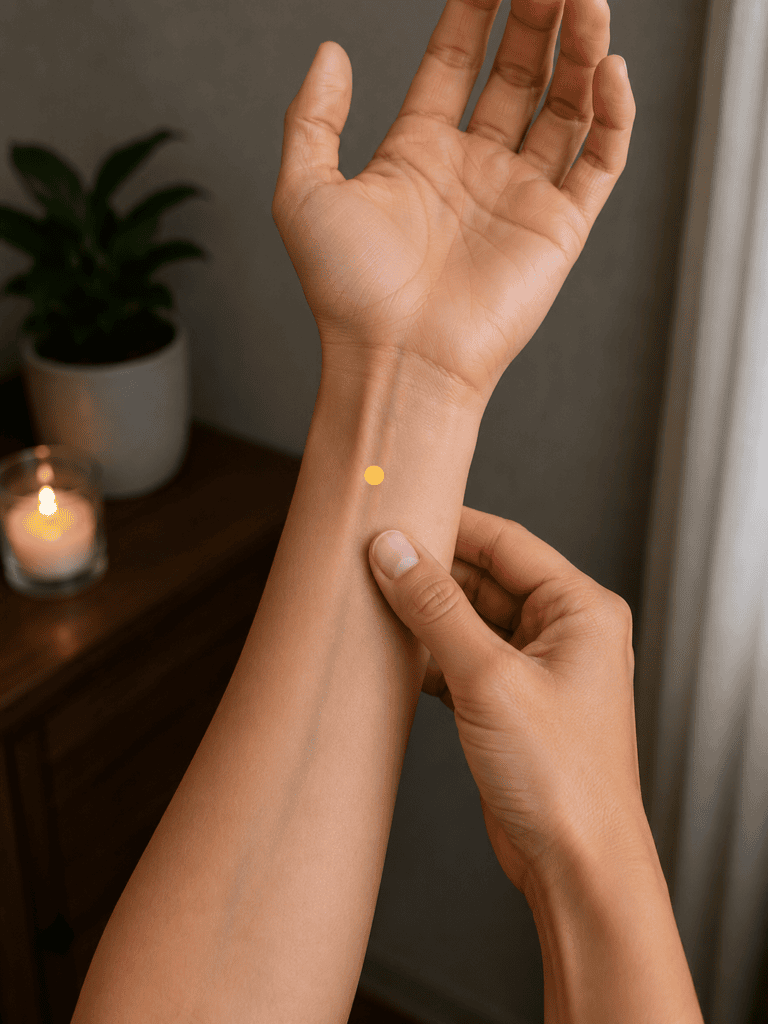
3. Press on PC6 on your inner forearm for an anxious, tight chest. PC6 sits about three finger-widths above the inner wrist crease, in the center of the forearm between the two tendons. Press with your thumb for one to two minutes on each arm. PC6 is called “Neiguan,” the “Inner Pass,” and it opens the chest and calms the Heart region.
Postpartum anxiety often sits physically in the chest, a tightness, a fluttering, a held and shallow breath. PC6 eases that directly, opening the constricted feeling and settling the anxiety that produces it, and it quiets nausea as well, which lingers for some mothers. Like HT7, it is easy to reach and gentle to use, and the two work beautifully together for a chest that will not unclench.
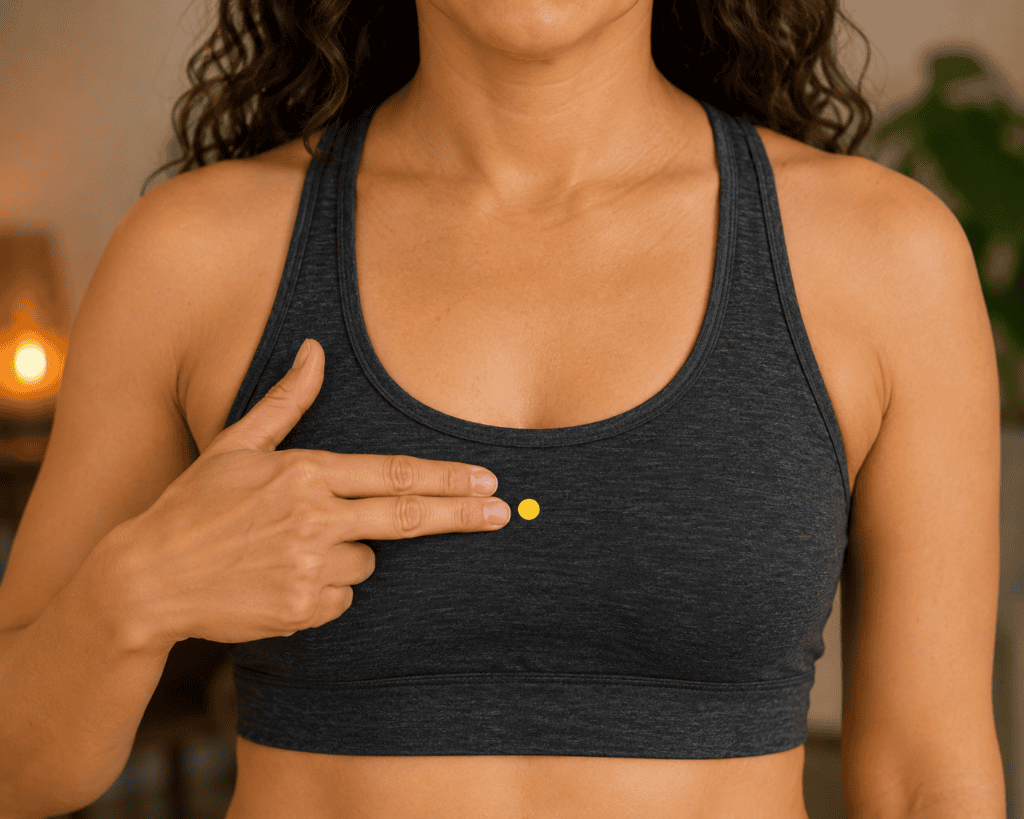
4. Press on CV17 at the center of your chest for emotional heaviness. CV17 sits on the midline of the breastbone, level with the space between the fifth ribs, roughly at nipple height. Rest two or three fingertips there and press gently, or tap lightly, for one to two minutes while you breathe slowly. CV17 is called “Shanzhong,” and one of its names is the “Sea of Tranquility.”
This is the point for the weight that settles on the chest in postpartum depression, the pressure, the welling grief, the emotion that sits heavy behind the breastbone and will not lift. CV17 gathers and frees the Qi of the chest and eases that heaviness, and its calming quality gives the welling feelings somewhere to soften. A few slow breaths with your hand resting here can loosen a chest that has felt tight for days.
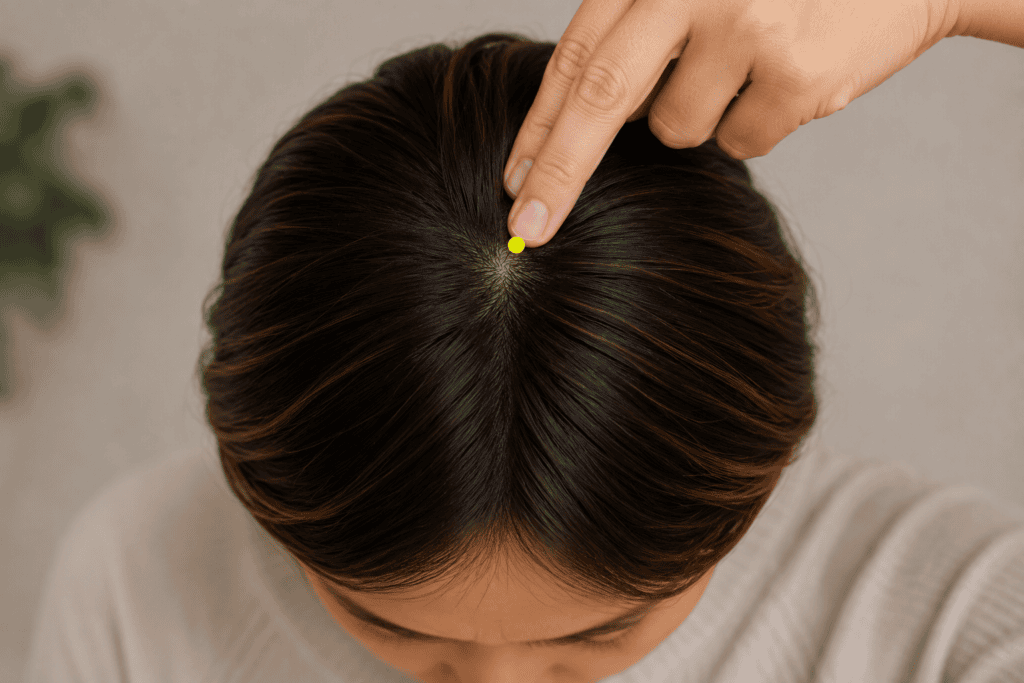
5. Press on GV20 at the top of your head to lift a sinking mood. GV20 sits at the crown of the head, at the midpoint of a line drawn up and over from the top of one ear to the other. Press or lightly tap with your fingertips for one to two minutes. GV20 is called “Baihui,” the “Hundred Meetings,” where the yang channels of the body converge.
Where the other calming points settle what is agitated, GV20 lifts what has sunk. It raises the clear, light energy to the head, which makes it the point for the heavy, foggy, weighed-down quality of a low mood, the sense of everything pressing downward. For the flat, sunken heaviness at the center of depression, GV20 gently lifts, and it clears some of the mental fog that makes each day feel harder to move through.
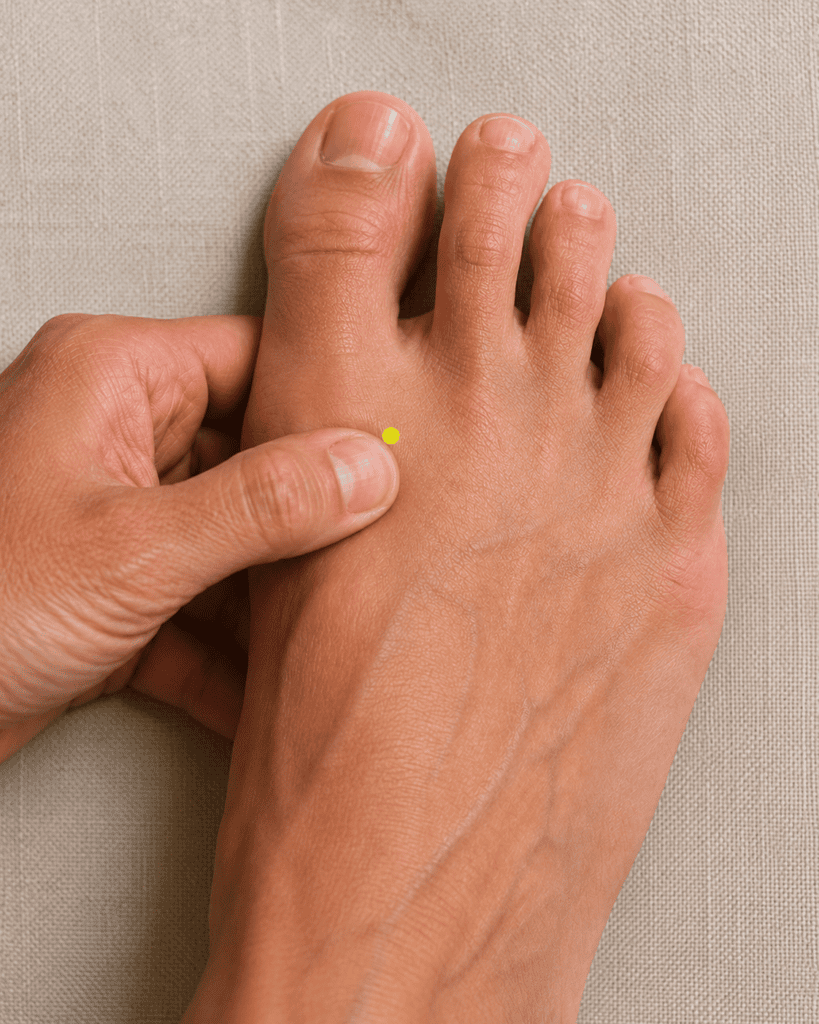
6. Press on LR3 on the top of your foot for irritability and overwhelm. LR3 sits on the top of the foot, in the webbing between the first and second toes, about two finger-widths back where the bones meet in a small hollow. Press firmly with your thumb for one to two minutes on each foot. LR3 is called “Taichong,” the “Great Rushing,” and it is the primary point for moving stuck Liver Qi.
Postpartum depression is not only heaviness. For many mothers it carries a layer of irritability, resentment, mood swings, and a trapped, pressured feeling, which Chinese medicine reads as Liver Qi that has become stuck. LR3 moves that stagnation and releases the pressure behind it, easing the snappish, overwhelmed, boxed-in feeling and letting the mood even out. For the days that feel more agitated than sad, this is the point to lean on.
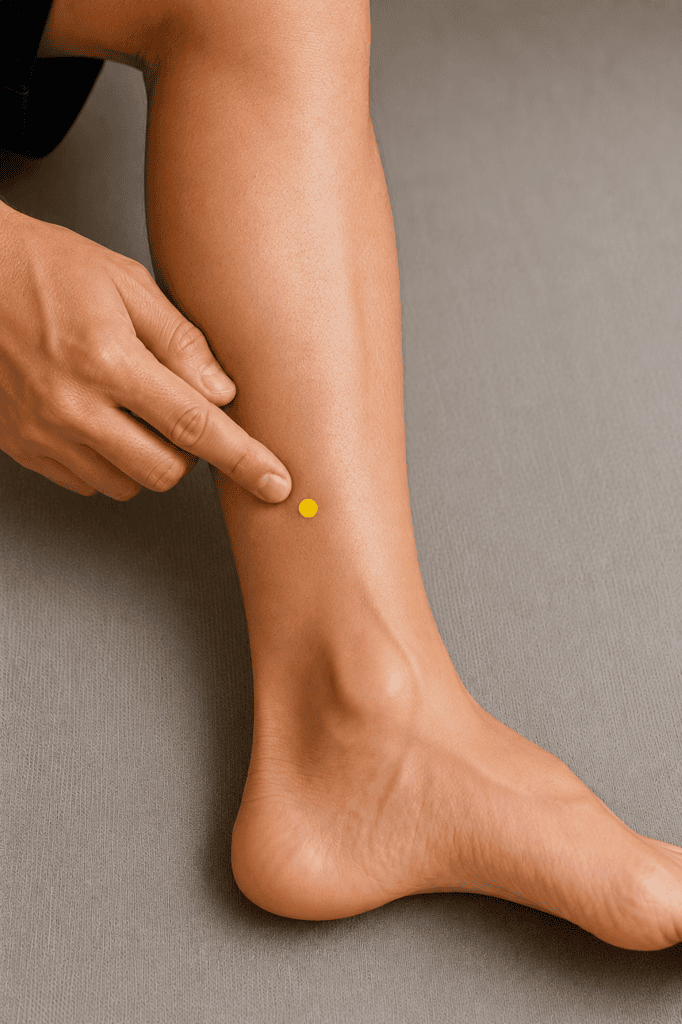
7. Press on SP6 above your inner ankle to rebuild what birth depleted. SP6 sits four finger-widths up from the tip of the inner ankle bone, just behind the back edge of the shinbone. Press firmly for one to two minutes on each leg. SP6 is called “Sanyinjiao,” the “Three Yin Intersection,” where the Spleen, Liver, and Kidney channels all meet, and it is one of the central points for a woman’s body. Avoided during pregnancy, it becomes a primary point once the baby has arrived.
Because three channels cross here, SP6 does exactly what a depleted postpartum body needs. It nourishes the Blood that birth emptied, supports the Spleen that produces that Blood, and in nourishing the Blood it re-anchors the restless Shen at its root. This is the rebuilding point, the one that addresses the deficiency underneath the anxiety and low mood rather than only the feelings on the surface. Worked daily, it is part of the slow restoration of the reserves that make everything else easier to carry.
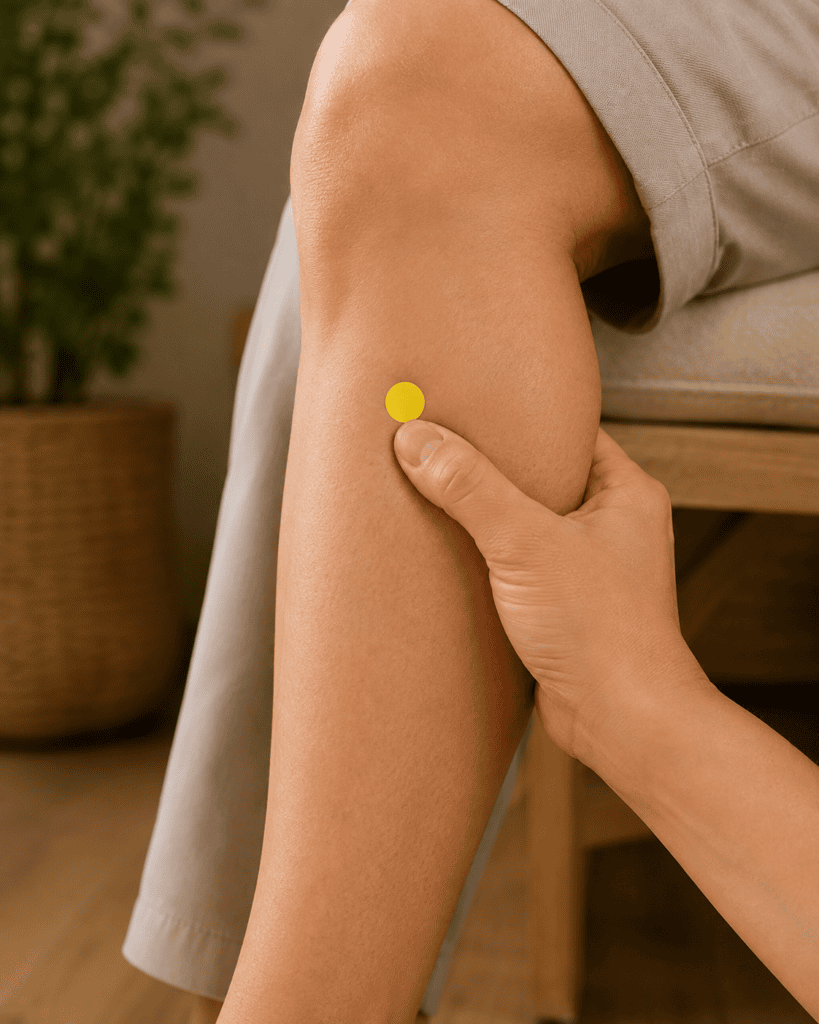
8. Press on ST36 below your knee for exhaustion. ST36 sits four finger-widths below the lower edge of the kneecap and one finger-width to the outside of the shinbone, on the muscle that rises when you flex your foot. Press firmly with your thumb for one to two minutes on each leg. ST36 is called “Zusanli,” the “Leg Three Miles,” the premier point in the body for building strength and energy.
The exhaustion of new motherhood is not ordinary tiredness, it is the bone-tired depletion of a body that has given enormously and is running on almost nothing. ST36 rebuilds Qi and Blood at the deepest level, strengthens the Spleen that makes them, and steadily restores the energy and resilience that spent reserves have taken. It will not replace sleep, but worked daily it helps the body generate more of the strength it has lost, which is the ground that mood and coping are built on.
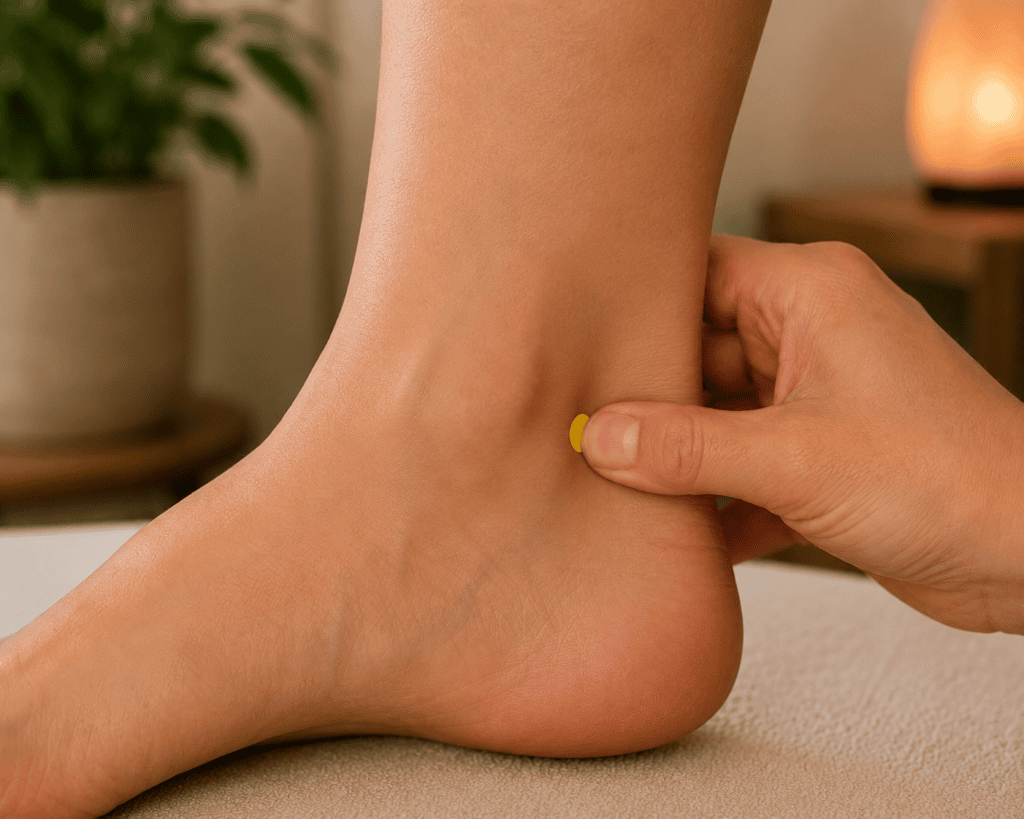
9. Press on KI3 behind your inner ankle for deep depletion. KI3 sits in the hollow between the inner ankle bone and the Achilles tendon. Press firmly with your thumb for two to three minutes on each ankle. KI3 is called “Taixi,” the “Great Ravine,” the source point of the Kidney channel.
In Chinese medicine the Kidneys hold the deepest reserves a person has, and pregnancy and birth draw on them more than almost anything else in life. When those reserves run low, the result is the profound exhaustion, the low mood, and the underlying fear and anxiety that sit beneath so much postpartum depression. KI3 tends that deep root. Paired with ST36 and SP6, it rebuilds the foundation the whole recovery rests on, the quiet, patient work beneath the more immediate calming and lifting the other points provide.
Why These Acupressure Points Work
In Chinese medicine, postpartum depression is seen as a state of depletion accompanied by an unsettled mind, with nine acupressure points targeting both issues. Childbirth depletes the Blood and Qi, as well as the Kidney Qi (energy). It also leaves the Shen, or spirit, restless because its anchoring Blood has been exhausted. Additionally, a layer of stuck Liver Qi often contributes to irritability and a sense of pressure.
- The calming points (Yintang, HT7, PC6, CV17) settle the unsettled Shen, easing the anxiety, the tight chest, the emotional heaviness, and the wired exhaustion that will not let go into sleep.
- The lifting point (GV20) raises the clear energy to the head to lift a sunken, heavy, foggy mood.
- The moving point (LR3) frees the stuck Liver Qi behind the irritability, mood swings, and trapped feeling.
- The rebuilding points (SP6, ST36, KI3) nourish the Blood, Qi, and deep Kidney reserves that birth depleted, addressing the deficiency at the root of it all.
A persistent link exists between sleep deprivation, recovery difficulties, and elevated cortisol due to stress, all of which affect mood. Implementing calming practices that soothe the nervous system and aid recovery can have a meaningful impact, even with little daily effort.
How to Properly Use These Acupressure Points
These acupressure points are safe to use regularly; you don’t need to do all nine every time. A few minutes spent on two or three that resonate with you is enough, and the practice can fit into a busy day with a newborn.
- When you are anxious or cannot settle, reach for Yintang, HT7, PC6, and CV17. These are the calming points, and most can be pressed one-handed while you feed or hold the baby, or in a wakeful stretch at night.
- When the mood is flat, heavy, and foggy, add GV20 to lift it, and LR3 if the day carries more irritability and overwhelm than sadness.
- Every day, when you can find the minutes, work SP6, ST36, and KI3 to rebuild the reserves birth depleted. This is the slower, quieter part of the practice, and it is where the real restoration happens over weeks.
- Keep the pressure firm but comfortable, and let your breathing slow while you press. None of these should ever hurt.
- Do not ask perfection of yourself. One point, once, in a hard moment still counts. The practice is meant to support you, not to become one more thing you are failing at.
In addition to focusing on acupressure, prioritize rest whenever possible, even briefly. Eating nutritious foods can help restore your strength, and don’t hesitate to rely on others—they’re there to support you and help share the load. While acupressure can help your recovery, remember you’re not alone in this process, and seeking help and support is integral.
When to Reach Out
Postpartum depression is a common and treatable condition. Asking for help shows strength. Many mothers recover when they seek support. If you still feel overwhelmed, if these feelings interfere with caring for yourself or your baby, or if they persist, contact your doctor, midwife, or someone you trust. They can help you find the support necessary.
If you ever think about harming yourself or your baby, please contact the 988 Suicide and Crisis Lifeline immediately by calling or texting; it’s available 24/7. For a comprehensive overview of care options, including medical and emotional support, see “Can Acupuncture Help With Postpartum Depression?” which discusses these topics in detail.
Above and Beyond Acupuncture offers acupuncture, cupping, and lifestyle coaching at the North Frank Lloyd Wright Boulevard location in Scottsdale.
Schedule an appointment online or call us today to start your healing journey.
The points above are only as effective as the technique used to apply them. Where to press, how firmly, and for how long all affect the result. For a full breakdown of how to perform acupressure properly at home, read Performing Acupressure in 3 Easy Steps.

About the Publisher
Paul Kerzner, L.Ac., is a licensed acupuncturist and board-certified herbalist, as well as the founder of Above and Beyond Acupuncture in Scottsdale. His own journey from chronic patient to practicing acupuncturist shapes his commitment to providing honest, clinically grounded information about acupuncture and Traditional Chinese Medicine. Learn more about Paul and his clinical approach on the About Us page.