Key Takeaways
- Male factors contribute to approximately half of all fertility challenges among couples; however, men are often the last to be evaluated.
- Sperm take approximately three months to develop; therefore, changes in health, stress levels, and habits may affect sperm quality around three months later.
- Traditional Chinese Medicine links male fertility to the Kidney, with the Liver, Spleen, and Heart influencing sperm quality, hormones, and stress.
- Nine acupressure points strengthen the Kidney, build energy and Blood, ease stress, and support circulation to the reproductive organs.
- Acupuncture has shown benefits for sperm count, motility, and shape in clinical research, and daily acupressure is a practical way to support those results at home.

Have you and your partner been trying to conceive for months without success? Perhaps a semen analysis showed a low sperm count, poor motility, or abnormal morphology. Or maybe you want to support your fertility before you start trying. Male fertility is often overlooked in conversations about conception, but it plays a role in about half of all cases where couples have difficulty conceiving.
The good news is that sperm are continually renewed. A new batch is produced about every three months, so what you do now can help improve sperm quality in the months ahead. Acupressure is a simple daily habit that may support your body’s strength, reduce stress, and improve blood flow to the reproductive organs. It works best alongside medical checkups and healthy lifestyle changes. The following points may help.
What is Male Infertility?

Infertility is generally defined as the inability to achieve pregnancy after one year of regular, unprotected sexual intercourse, or after six months if the woman is 35 years of age or older. Male infertility refers to issues with sperm production, function, or transport that may make conception more difficult.
A semen analysis is the first step in evaluating male fertility. This simple lab test measures several factors:
- Sperm count, or concentration: how many sperm are present in each milliliter of semen
- Motility: how many sperm are moving, and how well they swim forward
- Morphology: how many sperm have a normal shape
- Semen volume: the total amount of fluid
- Other factors, such as how well the semen liquefies, signs of infection, and in some cases, damage to the genetic material in the sperm
Many men with fertility challenges have no symptoms, and testing is the only way the problem is discovered. In other cases, signs may include:
- Difficulty with erections or ejaculation
- Low sex drive
- Pain, swelling, or a lump in the testicles or scrotum
- A soft, worm-like swelling above a testicle, which can signal a varicocele
- Reduced facial or body hair or other signs of low testosterone
- Fatigue, low energy, and low mood
What Causes Male Infertility and Who Is Affected?

Male fertility depends on appropriate hormonal signaling from the brain, the production of healthy sperm in the testicles, and unobstructed passage of sperm. Disruptions at any of these stages can affect fertility, and multiple factors may be involved. In some cases, no single cause is identified.
Common causes and contributing factors include:
- Varicocele, an enlargement of the veins in the scrotum that raises the temperature around the testicles and is one of the most common treatable causes
- Hormonal imbalances involving testosterone, FSH, LH, prolactin, or thyroid hormone
- Past infections, including sexually transmitted infections and mumps affecting the testicles
- Undescended testicles in childhood, testicular injury, or past surgery in the groin or scrotum
- Chemotherapy, radiation, and certain medications
- Testosterone therapy and anabolic steroids, which signal the body to shut down its own sperm production
- Heat exposure from hot tubs, saunas, heated seats, laptops on the lap, and tight underwear
- Smoking, heavy alcohol use, cannabis, and other recreational drugs
- Excess body weight, diabetes, and poor metabolic health
- Chronic stress and poor sleep
- Exposure to pesticides, heavy metals, and certain industrial chemicals
- Age, since sperm quality gradually declines after about forty
How Male Fertility Challenges Differ From Related Conditions

Several conditions overlap with male fertility, and understanding the difference helps guide the right care.
- Erectile dysfunction affects the ability to have intercourse, while sperm quality may be completely normal. The two often share causes, such as stress, poor circulation, and diabetes. Learn more about whether acupuncture can treat erectile dysfunction.
- Low testosterone causes fatigue, low libido, and low mood, and it can affect sperm production. Taking testosterone, however, usually lowers sperm production rather than raising it, so it is important to talk with a specialist before starting it.
- Female factor infertility involves ovulation, the fallopian tubes, the uterus, or egg quality. Because both partners contribute, both should be evaluated. Acupressure for fertility covers fertility support more generally.
- Recurrent pregnancy loss can sometimes involve damage to the genetic material in the sperm, even when a standard semen analysis looks normal.
For any couple having trouble conceiving, the best first step is to evaluate both partners at the same time, beginning with a semen analysis for the male partner.
How Traditional Chinese Medicine Views Male Fertility
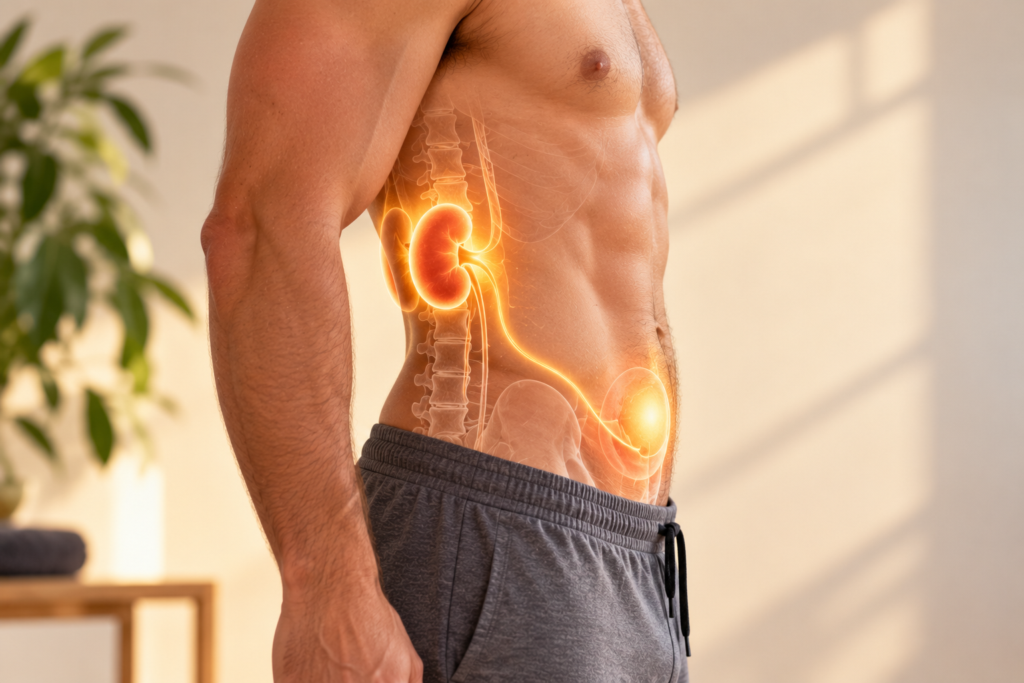
In Traditional Chinese Medicine, fertility is rooted in the Kidney, which stores Jing, or Essence. This deep reserve governs growth, reproduction, and aging, and is closely tied to sperm quality. The Liver channel wraps around the genitals and helps Qi and Blood flow smoothly to the reproductive organs. The Spleen derives Qi and Blood from food, while the Heart, which houses the mind, is affected by stress, worry, and poor sleep.
Most men with fertility challenges show more than one of these patterns, and the points in this routine are chosen to address them.
- Kidney Jing deficiency: low sperm count, low semen volume, low back weakness, fatigue, and a sense of being worn down. CV4, BL23, and KI3 strengthen the Kidney and replenish the Jing.
- Kidney Yang deficiency: poor motility, low libido, difficulty with erections, cold hands and feet, and frequent urination. CV4, CV6, BL23, and GV4 warm and strengthen the Kidney Yang.
- Kidney Yin deficiency: abnormal sperm shape, thick semen that liquefies poorly, night sweats, warmth in the palms and soles, and a dry mouth. KI3 and SP6 nourish the Yin.
- Liver Qi stagnation: stress, irritability, tension, and the pressure that builds when trying to conceive becomes stressful, often with a varicocele or a sense of heaviness in the groin. LR3 moves the Liver Qi and keeps circulation flowing to the reproductive organs.
- Spleen Qi deficiency: fatigue, poor appetite, loose stools, and low sperm count due to insufficient Qi and Blood production. ST36 and SP6 strengthen digestion and build the Qi and Blood.
- Damp heat in the lower body: signs of infection, poor liquefaction, and a history of heavy alcohol use, greasy food, or prostate irritation. SP6 and LR3 help clear damp heat, and diet changes support the process.
- Heart and Shen disturbance: anxiety, worry, and poor sleep, especially when fertility challenges become emotionally draining. HT7 calms the Heart and settles the mind.
The aim is to strengthen the Kidney, restore Jing, build up Qi and Blood, keep blood flowing to the reproductive organs, and reduce the stress that often comes with trying to have a baby.
What the Research Shows
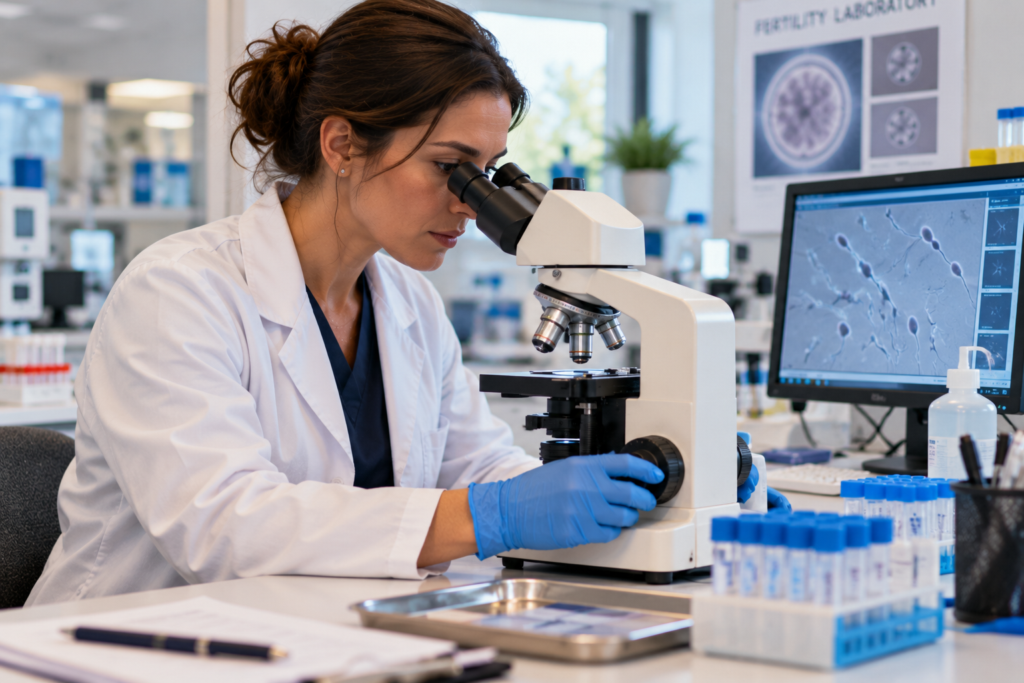
Acupuncture has shown encouraging results for male fertility.
A 2022 review of the research in Frontiers in Endocrinology found that clinical trials of acupuncture, electroacupuncture, and electrical stimulation of acupuncture points reported improvements in sperm count, motility, and the proportion of normally shaped sperm. A meta-analysis of twelve randomized trials included in the review found acupuncture effective for improving semen quality in men with low sperm count and poor motility, and one study found acupuncture produced pregnancy rates comparable to surgery for varicocele. Acupuncture was also associated with healthier hormone levels, and side effects were minor. The authors concluded that acupuncture can effectively treat male infertility and called for larger trials to build on these results.
Research on acupressure for male fertility is developing, but it uses many of the same points studied in acupuncture. Because sperm take about three months to develop, try acupressure daily for at least three months, along with medical checkups, healthy habits, and acupuncture if possible.
Here are nine acupressure points that can help:
What Acupressure Points to Press and Why
1. Press on CV4 below the navel to strengthen the Kidney and Jing. CV4 sits on the midline of the lower abdomen, four finger-widths below the navel. Lie on your back and press gently but steadily with two or three fingertips for one to two minutes while breathing slowly into the lower belly. CV4 is called “Guanyuan,” the “Gate of Origin.”
CV4 is one of the most important acupoints for strengthening the Kidney and replenishing Jing, the deep reserve responsible for reproduction. It lies directly above the lower abdomen, which traditional Chinese medicine regards as the source of reproductive energy. CV4 is the foundation of this treatment and should be stimulated daily, especially in cases of low sperm count, small semen volume, or fatigue. Avoid pressing on a full stomach.
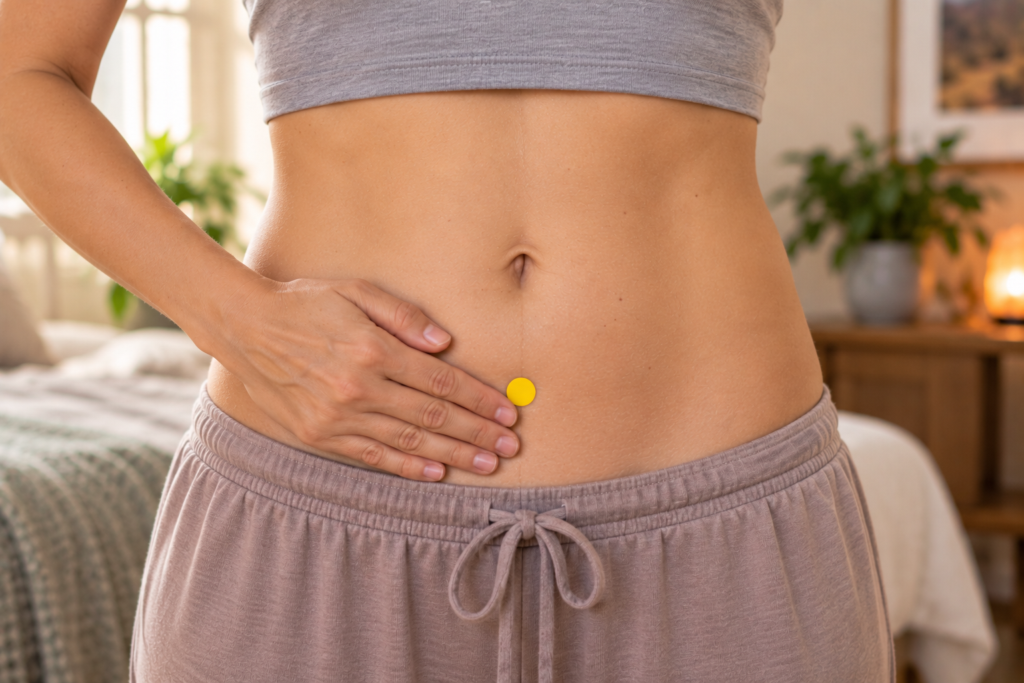
2. Press on CV6 below the navel to build the Qi. CV6 sits on the midline of the lower abdomen, two finger-widths below the navel. Press gently with two or three fingertips for one to two minutes while breathing slowly. CV6 is called “Qihai,” the “Sea of Qi.”
CV6 strengthens the body’s Qi and supports Kidney Yang, the warming energy associated with sperm motility and libido. It pairs well with CV4; press the two points in turn or warm them together by resting your palm over the lower abdomen. CV6 is especially useful for poor motility, fatigue, and low drive.
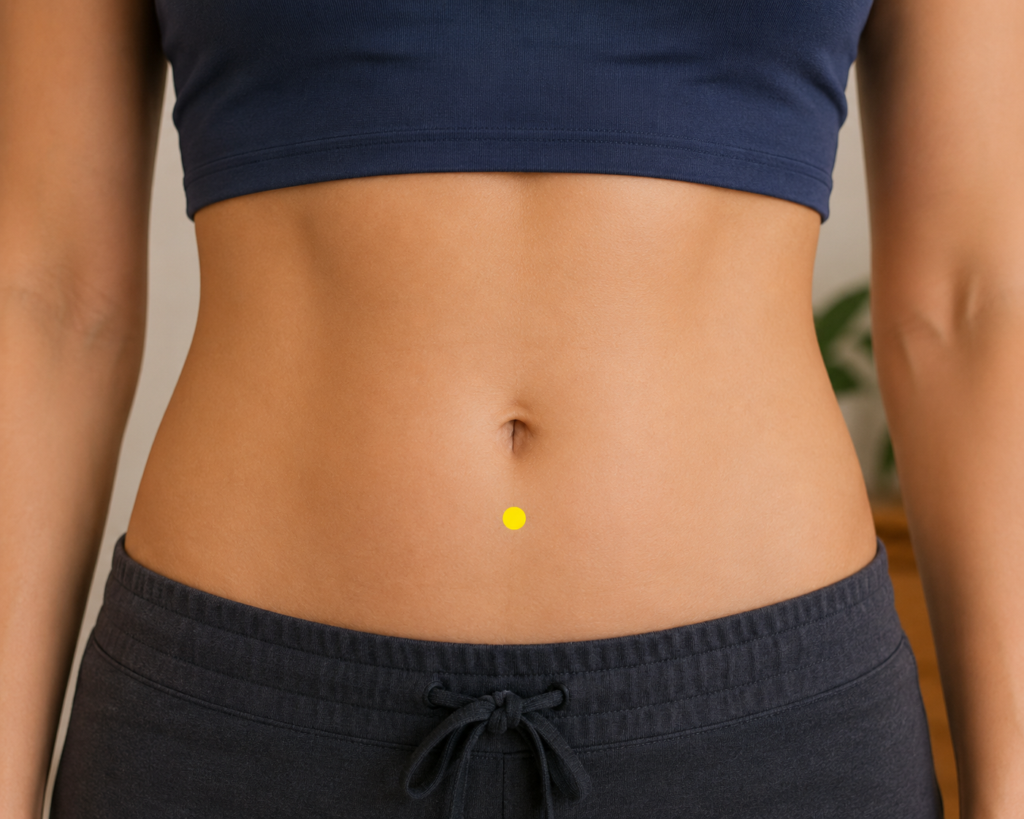
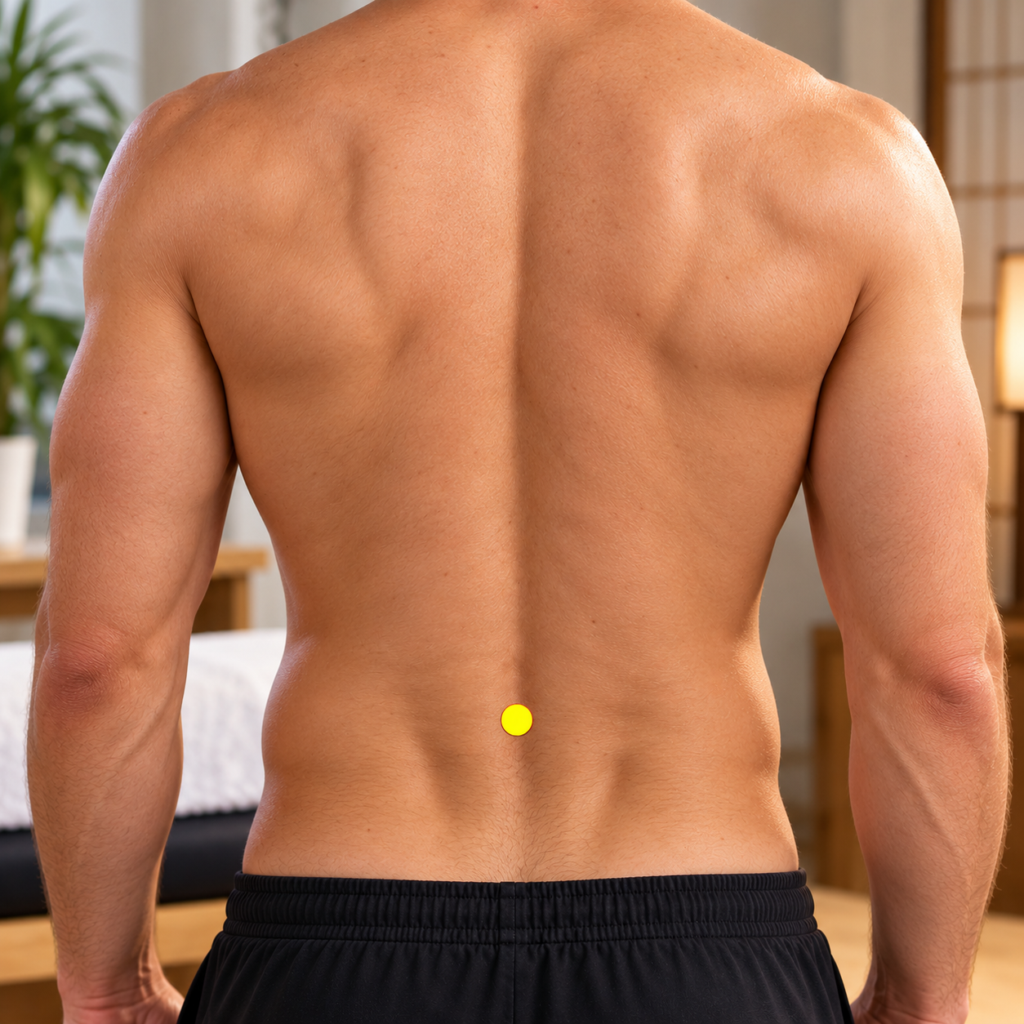
3. Press on BL23 on the lower back to strengthen the Kidney. BL23 sits on the lower back, two finger-widths on either side of the spine, at the waist, roughly level with the bottom of the rib cage. Make loose fists and press the knuckles into both points at once, or rub the area briskly with your palms until warm, for one to two minutes. BL23 is called “Shenshu,” the “Kidney Shu.”
BL23 is a back-shu point of the Kidney, where the Kidney’s energy gathers on the back. It is one of the most important points for boosting Kidney Yang and Jing, warming the lower back, and supporting reproductive health. Traditionally, people rub the lower back until it feels warm to support the Kidney.
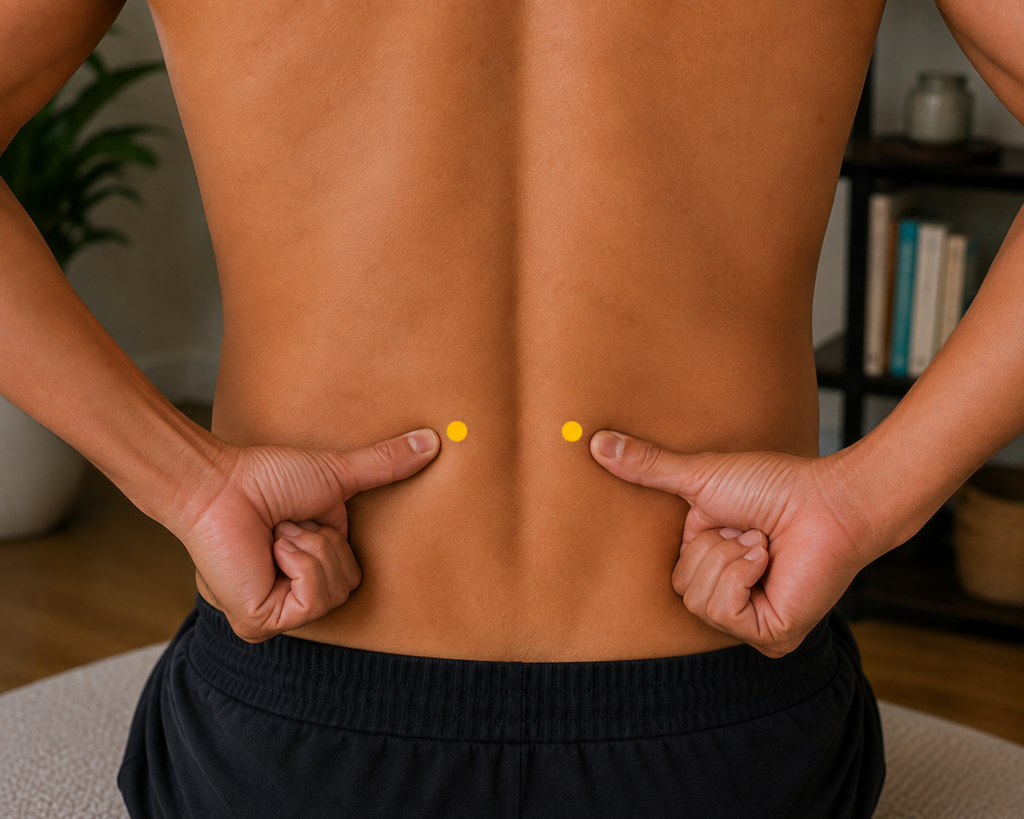
4. Press on GV4 on the lower back to warm the Kidney Yang. GV4 sits on the midline of the lower back, in the hollow just below the bony bump of the second lumbar vertebra, directly between the two BL23 points. Press with your knuckle or fingertips for one to two minutes, or rub the area until warm. GV4 is called “Mingmen,” the “Gate of Life.”
GV4 is considered the opening through which the body’s warming, stimulating vital energy flows. It strengthens Kidney Yang, which supports sperm motility, libido, and energy levels. It may be especially beneficial when fertility problems occur alongside cold hands and feet, lower back pain, low libido, or fatigue. Using GV4 together with the two BL23 points covers the entire lower back in one simple movement.
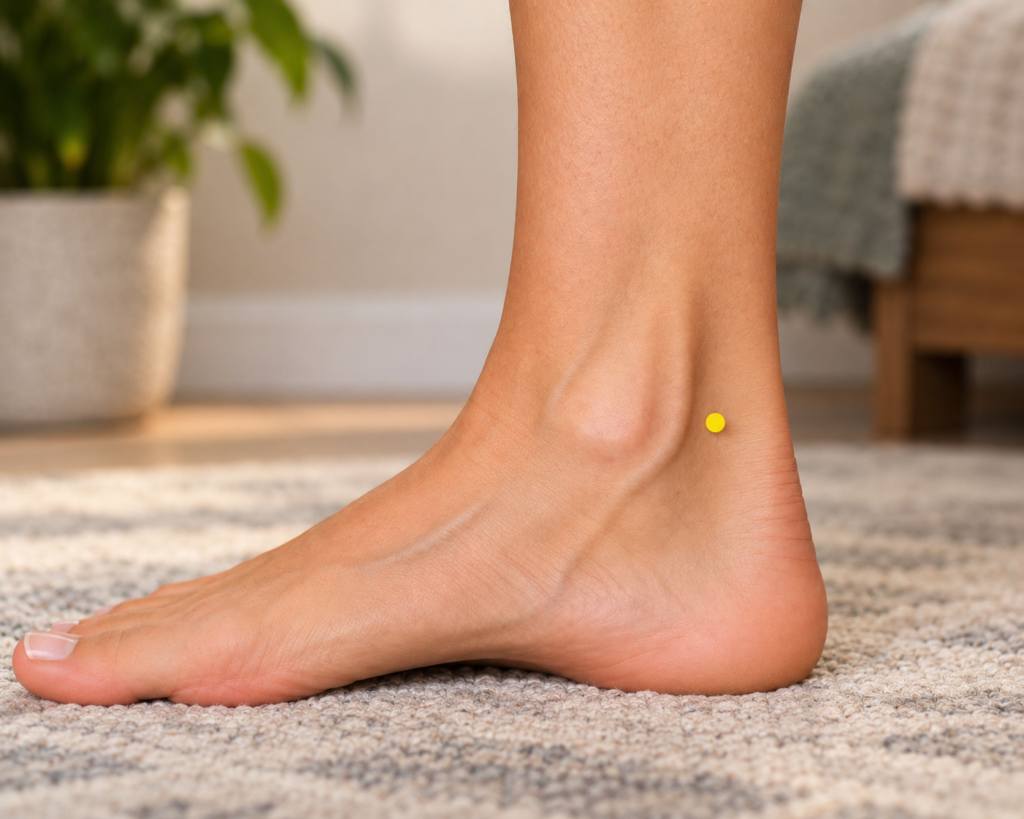
5. Press on KI3 behind the inner ankle to nourish the Kidney. KI3 sits in the hollow between the inner ankle bone and the Achilles tendon, level with the tip of the ankle bone. Press firmly with your thumb for one to two minutes on each ankle. KI3 is called “Taixi,” the “Great Stream,” and is the source point of the Kidney.
KI3 strengthens both Kidney Yin and Kidney Yang, making it one of the most balanced acupoints for supporting fertility. It nourishes the Jing, eases weakness in the back and knees, and supports healthy sperm development. Work on it daily throughout the three-month sperm development cycle.
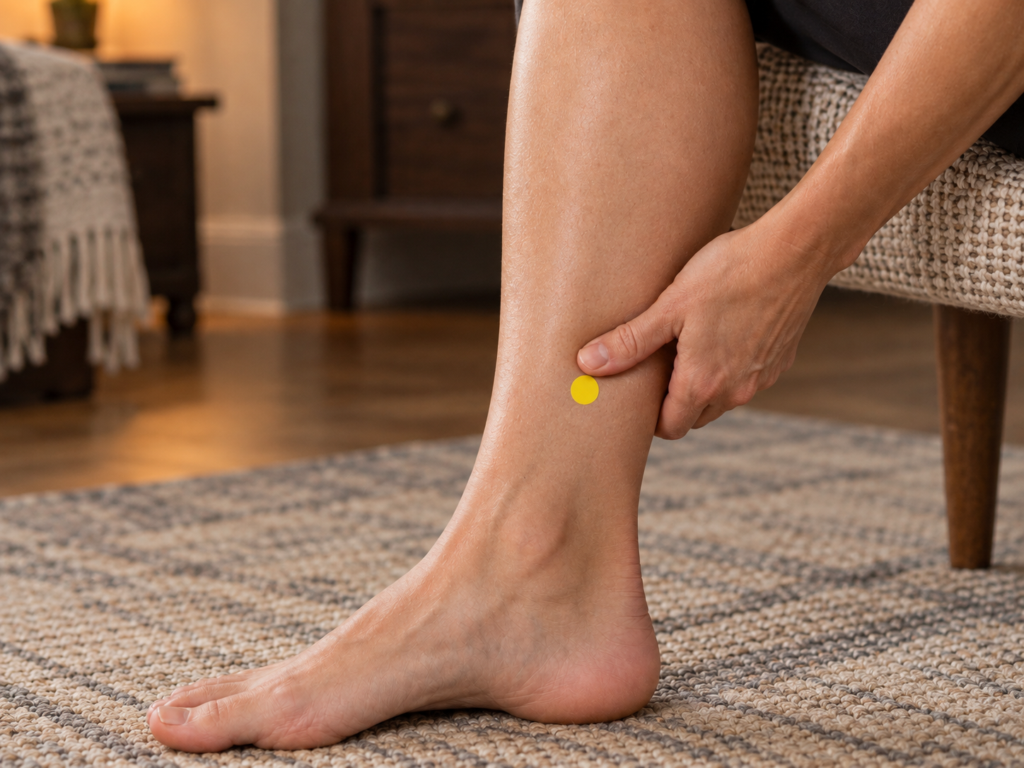
6. Press on SP6 above the inner ankle to nourish the Yin and Blood. SP6 sits four finger-widths up from the tip of the inner ankle bone, just behind the back edge of the shinbone. Press firmly with your thumb for one to two minutes on each leg. SP6 is called “Sanyinjiao,” the “Three Yin Intersection.” SP6 is avoided during pregnancy, so partners who are pregnant should not use it.
SP6 is where the Spleen, Liver, and Kidney channels converge. All three pass through the lower abdomen and reproductive organs. It nourishes Yin and Blood, clears damp heat from the lower body, and supports healthy circulation to the reproductive organs. It may be especially beneficial for abnormally shaped sperm, poor liquefaction, and a history of prostate or urinary irritation.
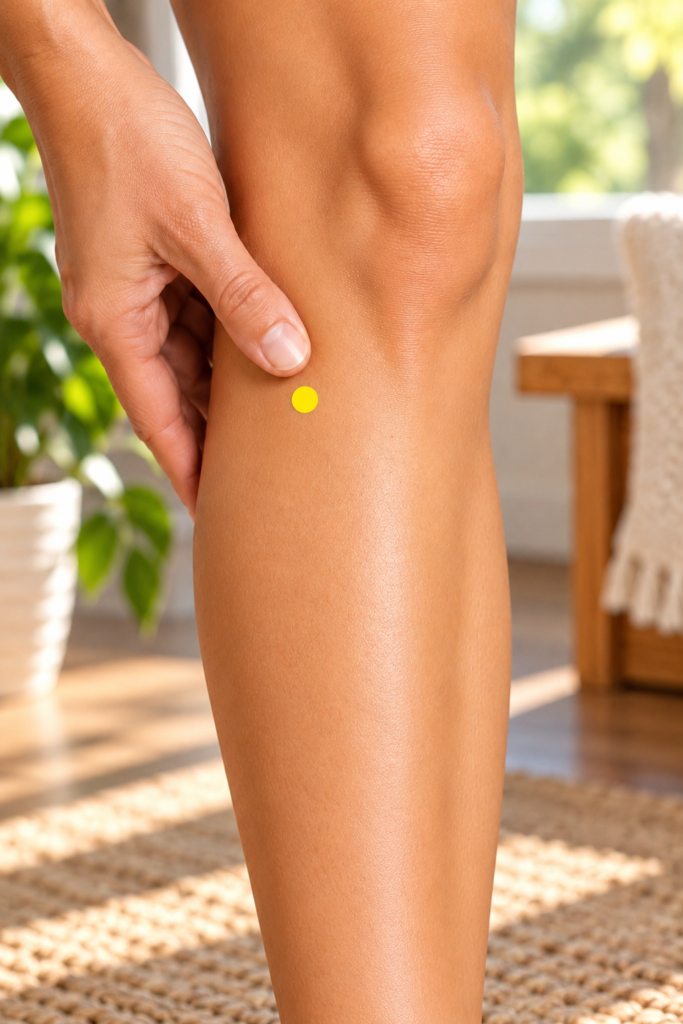
7. Press on ST36 below the knee to build Qi and Blood. ST36 sits four finger-widths below the lower edge of the kneecap and one finger-width to the outside of the shinbone, on the muscle that rises when you flex your foot. Press firmly with your thumb for one to two minutes on each leg. ST36 is called “Zusanli,” the “Leg Three Miles.”
Healthy sperm production depends on a continuous supply of Qi and Blood. Acupoint ST36 supports both at their source by improving digestion. In Chinese medicine, Kidney Jing is continually replenished by the Qi and Blood derived from food, so ST36 indirectly supports the Kidneys. It is also considered one of the best points for combating fatigue and promoting overall resilience.
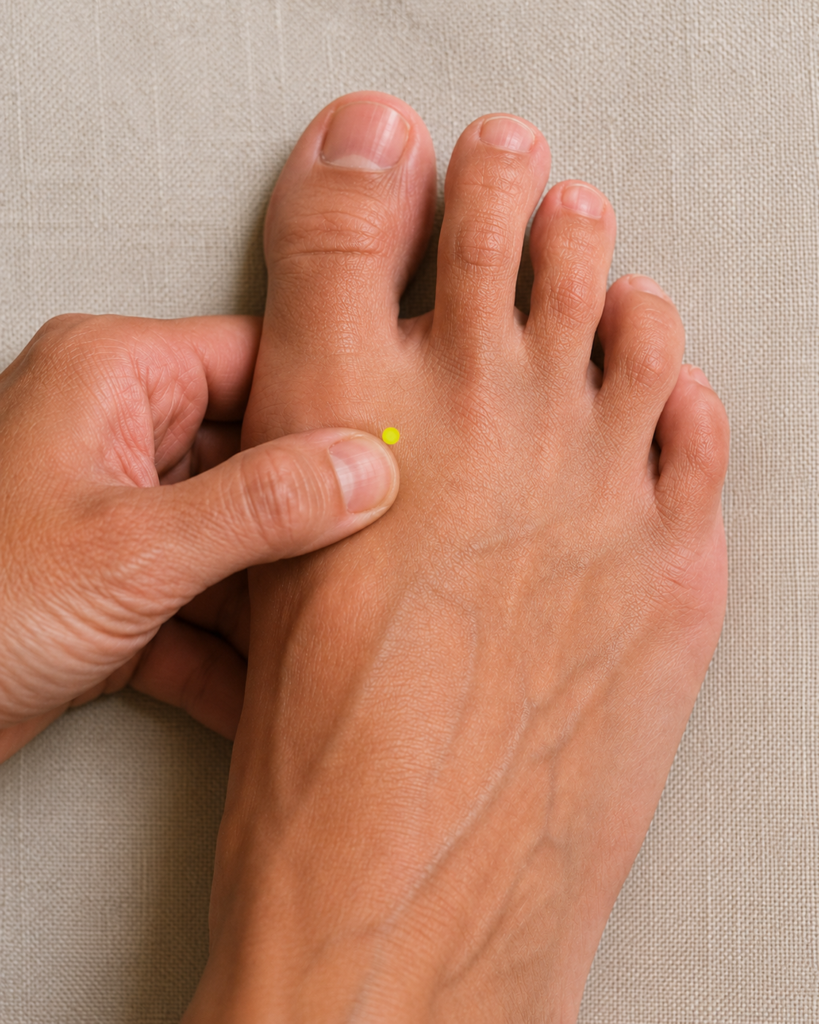
8. Press on LR3 on the top of the foot to ease stress and move the Qi. LR3 sits on the top of the foot, in the webbing between the big toe and second toe, about two finger-widths back from the webbing, in the hollow just before the two bones meet. Press firmly with your thumb for one to two minutes on each foot. LR3 is called “Taichong,” the “Great Surge.”
The Liver meridian encircles the genital area, and LR3 helps ensure that Qi and Blood flow smoothly to the reproductive organs. It is the principal point for relieving stress, frustration, and tension, which often accumulate when the effort to conceive becomes a monthly source of pressure. LR3 may also be useful when fertility problems are accompanied by a varicocele, a sensation of heaviness in the groin, or irritability.
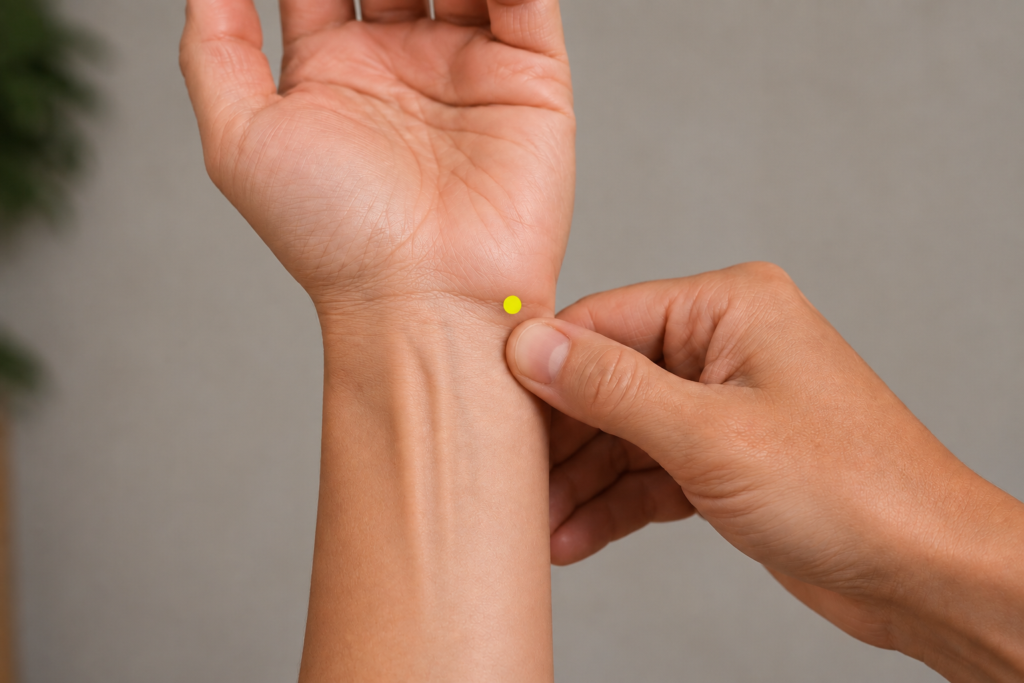
9. Press on HT7 at the wrist to calm the mind and improve sleep. HT7 sits on the inner wrist crease, on the pinky side, in the small hollow just inside the tendon. Press firmly with your thumb for one to two minutes on each wrist. HT7 is called “Shenmen,” the “Spirit Gate.”
Stress and inadequate sleep can affect hormone levels and sperm quality, while the emotional strain of trying to conceive can be considerable for both partners. The HT7 point calms the Heart and stabilizes the Shen, helping reduce worry, anxiety, and restless sleep. Pressing HT7 in bed before sleep is a simple way to close out the day and help the body get the deep rest it needs to recover.
Why These Acupressure Points Work
In Traditional Chinese Medicine, male fertility is associated with strong Kidney Jing and Yang, abundant Qi and Blood, smooth Liver Qi, and a calm mind. These nine points help support each of these areas.
- The lower abdomen points (CV4, CV6) strengthen the Kidney, replenish the Jing, and build the Qi at the root of reproductive energy.
- The lower back points (BL23, GV4) warm and strengthen the Kidney Yang that supports motility, libido, and energy.
- The leg points (KI3, SP6, ST36) nourish the Kidney, Yin, and Blood and build the Qi and Blood that sperm production depends on.
- The calming points (LR3, HT7) ease stress, keep circulation moving to the reproductive organs, and support restful sleep.
How to Properly Use These Acupressure Points
- Do the full routine once a day. Hold each point for one to two minutes and breathe slowly into your lower belly.
- Press the abdominal points gently and steadily while lying on your back, and avoid pressing them on a full stomach.
- Use firm pressure on the back, legs, and feet, and on HT7 at the wrist.
- Rub the lower back over BL23 and GV4 until warm, but avoid applying heat to the groin, since the testicles need to stay cooler than the rest of the body.
- Practice the routine daily for at least three months, since that is how long a new generation of sperm takes to develop.
- If your partner is pregnant or may be pregnant, she should not use SP6.
Sample routines:
- Morning (five minutes): rub the lower back over BL23 and GV4 until warm, then press KI3 and ST36.
- During the workday (two minutes): LR3 or HT7 when stress builds.
- Evening (ten to fifteen minutes): the full routine, beginning with CV4 and CV6 lying down and finishing with HT7 before sleep.
- With a partner (ten minutes): take turns working BL23 and GV4 on each other’s lower back, a simple way to share the process of trying to conceive.
Home Care and Lifestyle Support for Male Fertility

Daily habits strongly influence sperm quality. Since sperm take about three months to develop, changes you make now can benefit you in the months ahead.
- Keep the testicles cool. Avoid hot tubs, saunas, heated car seats, laptops on your lap, and long periods of sitting, and choose looser underwear.
- Stop smoking and avoid cannabis and other recreational drugs.
- Limit alcohol, since heavy drinking lowers testosterone and sperm quality.
- Do not use testosterone, anabolic steroids, or testosterone-boosting products without talking to a specialist, since they can shut down sperm production.
- Reach and maintain a healthy weight, and keep blood sugar steady.
- Exercise regularly and moderately, since both inactivity and extreme training can lower sperm quality.
- Eat plenty of vegetables, fruits, whole grains, nuts, seeds, and fish, which provide antioxidants and nutrients that support healthy sperm.
- Get seven to nine hours of sleep each night.
- Limit exposure to pesticides, solvents, and heavy metals, and avoid heating food in plastic.
- Ask your doctor whether any of your medications could affect fertility, and ask about supplements before starting them.
- Have intercourse every one to two days around your partner’s fertile window, and avoid lubricants that can harm sperm.
Traditional Chinese Medicine offers its own guidance. Eating warm, cooked, nourishing meals is believed to support the Spleen and Kidney. Foods such as walnuts, black sesame seeds, black beans, goji berries, bone broth, and eggs are thought to strengthen the Kidney. Try to limit greasy, fried, or very spicy foods, as well as alcohol, which may contribute to damp heat in the lower body. Avoid eating too many cold, raw foods or drinking iced beverages, as they can weaken digestion and Kidney Yang.
Rest is also important: overwork, late nights, and prolonged stress are believed to deplete Jing over time. Make time to relax and connect with your partner, rather than treating conception as a task; this may benefit both your well-being and your relationship.
How Acupuncture Can Help
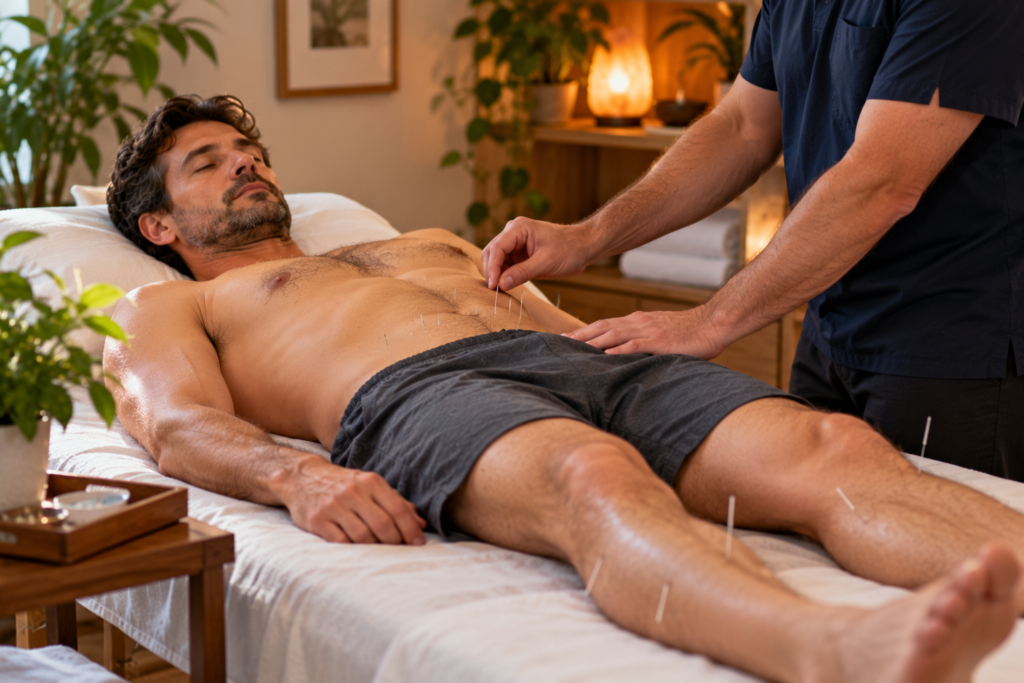
Acupuncture may address male fertility challenges by strengthening the Kidney and Jing, improving circulation to the reproductive organs, balancing hormones, and relieving the stress that often comes with trying to conceive. Treatment is tailored to each man’s pattern and semen analysis, whether the primary concern is low count, poor motility, abnormal shape, or a varicocele. Most acupuncturists recommend weekly sessions for at least three months, in line with the sperm development cycle, and often add herbal formulas to support the Kidney and Jing from within. Many couples find that treating both partners together offers the best support.
Acupuncture can complement care from a urologist or reproductive specialist and be used alongside assisted reproductive treatments such as IUI or IVF.
Learn more about treating infertility with acupuncture, acupuncture and in vitro fertilization, and the top acupuncture points for fertility.
When to Get Professional Help

Consult a physician, preferably a urologist or reproductive specialist, if you and your partner have not conceived after twelve months of regular, unprotected intercourse, or after six months if your partner is thirty-five or older. Seek specialist care sooner if you have a history of undescended testicles, testicular injury or surgery, chemotherapy or radiation, a known varicocele, difficulty with erections or ejaculation, or current or past use of testosterone or anabolic steroids. A semen analysis is a simple and important first step. It should be performed for the male partner at the same time the female partner undergoes evaluation. Consult your physician promptly if you notice a lump, swelling, or persistent pain in a testicle or the scrotum. Seek emergency care for sudden, severe testicular pain, particularly if accompanied by swelling, nausea, or vomiting, as these symptoms may indicate testicular torsion, which requires immediate treatment to save the testicle.
Acupressure is a natural, holistic, supportive practice for male fertility. It complements, and does not replace, diagnosis and medical care.
For general fertility support, acupressure for fertility is a companion piece. Because stress is such a common part of trying to conceive, acupressure for stress offers simple tools for difficult days, and if low energy is a concern, acupressure for fatigue can help restore steady energy.
Above and Beyond Acupuncture offers acupuncture, cupping, and lifestyle coaching at the North Frank Lloyd Wright Boulevard location in Scottsdale.
Schedule an appointment online to start your healing journey.
The points above are only as effective as the technique used to apply them. Where to press, how firmly, and for how long all affect the result. For a full breakdown of how to perform acupressure properly at home, read Performing Acupressure in 3 Easy Steps.

About the Publisher
Paul Kerzner, L.Ac., is a licensed acupuncturist and board-certified herbalist, as well as the founder of Above and Beyond Acupuncture in Scottsdale. His own journey from chronic patient to practicing acupuncturist shapes his commitment to providing honest, clinically grounded information about acupuncture and Traditional Chinese Medicine. Learn more about Paul and his clinical approach on the About Us page.