
Key Takeaways
- Sjögren’s syndrome is an autoimmune condition causing dryness in mucous membranes, leading to symptoms like dry eyes, mouth, and severe fatigue.
- Acupressure for Sjögren’s syndrome can help relieve dryness and improve overall comfort by targeting specific points to nourish Yin and body fluids.
- Common symptoms include dry, gritty eyes, a burning mouth, and joint pain, often with a gradual onset and possible links to other autoimmune disorders.
- Traditional Chinese Medicine views Sjögren’s as a deficiency of Yin, where specific acupressure points can address moisture and energy imbalances.
- A combination of medical treatment, acupressure, and lifestyle adjustments can significantly improve daily living for those with Sjögren’s syndrome.
Do your eyes feel gritty and burning, your mouth so dry that eating and talking are a struggle, and your energy drained no matter how much you rest? Those are the hallmarks of Sjögren’s syndrome, an autoimmune condition in which the immune system attacks the glands that produce moisture, most often the tear and saliva glands.
This results in dryness in the eyes, mouth, throat, nose, skin, and vaginal tissues, accompanied by severe fatigue, joint and muscle pain, and sometimes swelling of the glands in the jaw. Medical treatment is essential not only to relieve these symptoms but also to monitor vaginal tissues and other affected areas. Acupressure offers a gentle daily routine that helps preserve moisture, reduce fatigue and discomfort, and nourish the body internally. The points discussed in this article may help.
What Is Sjögren’s Syndrome?

Sjögren’s syndrome, a long-term autoimmune disorder, is increasingly called Sjögren’s disease by some organizations. It involves immune cells gathering in glands that produce tears and saliva, gradually damaging them and reducing moisture output. Because the immune response affects the entire body, Sjögren’s is not limited to the eyes and mouth; it can also impact the joints, skin, nerves, lungs, kidneys, and blood vessels.
Sjögren’s syndrome is termed primary when it occurs independently, and secondary when it develops alongside another autoimmune disease, such as rheumatoid arthritis, lupus, or scleroderma. Symptoms tend to develop gradually, and many individuals live for years experiencing dryness and fatigue before receiving a diagnosis.
Common symptoms of Sjögren’s syndrome include:
- Dry, gritty, burning, or itchy eyes, often with a feeling of sand in the eyes
- Sensitivity to light, wind, and screens, and blurred vision that clears with blinking
- A dry, sticky mouth, difficulty swallowing dry food, and needing water to talk or eat
- Changes in taste, a burning tongue, cracked lips, and sores at the corners of the mouth
- Frequent cavities and dental problems, since saliva protects the teeth
- A dry nose, dry throat, hoarseness, and a dry cough
- Dry skin, and vaginal dryness
- Deep fatigue that rest does not fully relieve
- Joint pain, stiffness, and muscle aching
- Swelling of the saliva glands along the jaw or in front of the ears
- Numbness, tingling, or burning in the hands or feet in some people
- Brain fog and poor sleep
What Causes Sjögren’s and Who Gets it?

Like other autoimmune diseases, the exact cause of Sjögren’s remains unknown. It is believed that the condition develops when an individual with a genetic predisposition to autoimmunity encounters a trigger, such as a viral infection, causing the immune system to attack the body’s moisture-producing glands. Hormonal factors also appear to play a role, which might explain why about 90% of people with Sjögren’s are women and why symptoms often begin or intensify around menopause.
Sjögren’s typically begins after age forty but can occur at any age. Those with rheumatoid arthritis, lupus, scleroderma, autoimmune thyroid disease, or a family history of autoimmune disorders are at higher risk.
The diagnosis typically involves blood tests for specific antibodies, such as anti-Ro or SSA and anti-La or SSB. It also includes evaluating tear and saliva production, conducting eye examinations, and occasionally performing a minor biopsy of the salivary glands inside the lower lip. Usually, a rheumatologist oversees the care, often working together with an ophthalmologist and a dentist.
How Sjögren’s Differs From Other Causes of Dryness

Dry eyes and dry mouth are common, and most people experiencing them do not have Sjögren’s. Determining the cause is crucial because it shapes the treatment plan and how much additional body monitoring is needed.
- Dry mouth is most often caused by medications. Drugs such as antihistamines, decongestants, antidepressants, blood pressure medications, bladder medications, and a number of other types reduce saliva production. When dry mouth occurs and there is no autoimmune cause involved, acupressure for dry mouth can be used as a complementary measure.
- Everyday dry eyes result from screen use, contact lens wear, aging, low humidity, and issues with the eyelid oil glands.
- The hormonal changes associated with menopause can cause the eyes, mouth, skin, and vaginal tissues to dry out, a condition that is similar to Sjögren’s.
- Burning mouth syndrome causes a burning sensation in the tongue and mouth, sometimes with dryness, unlike Sjögren’s, which involves gland damage.
- Radiation to the head and neck, diabetes, dehydration, and mouth breathing during sleep can also dry the mouth.
Symptoms of Sjögren’s typically involve increasing dryness of the eyes and mouth, swollen jaw glands, profound fatigue, joint pain combined with dryness, and a personal or family history of autoimmune diseases.
How Traditional Chinese Medicine Views Sjögren’s Syndrome
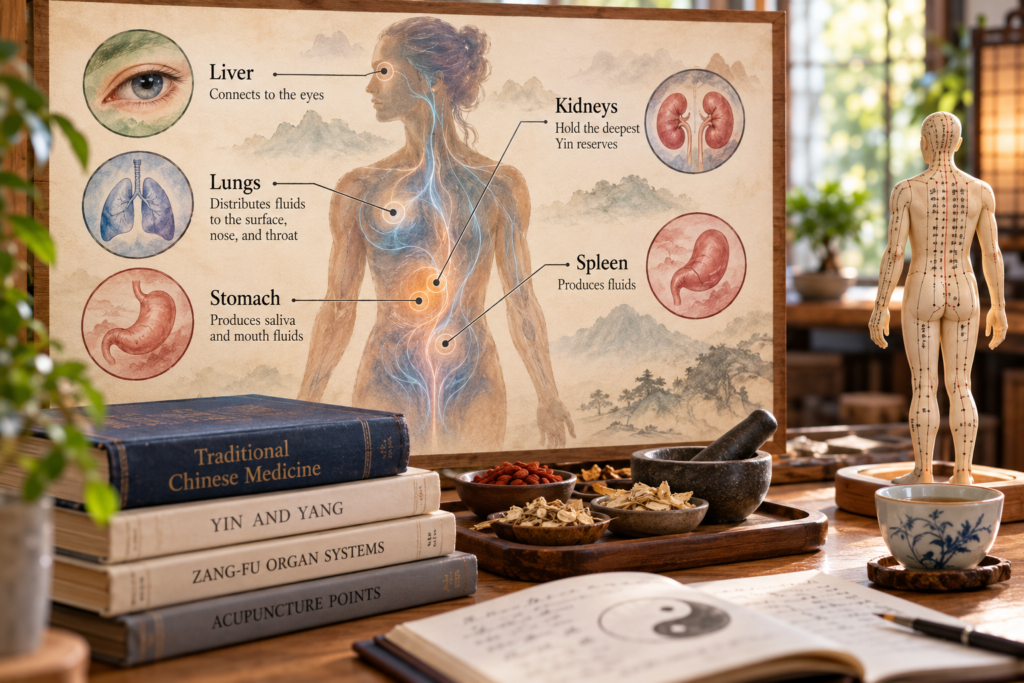
Traditional Chinese Medicine has long recognized a pattern called dryness, which closely aligns with Sjögren’s condition. The primary cause is depletion of Yin, meaning the body’s cooling, moistening reserves and the fluids it produces. All organ systems are involved. The Kidneys hold the deepest Yin reserves, while the Lungs distribute fluids to the surface, nose, and throat. The Liver connects to the eyes, and the Spleen and Stomach produce saliva and mouth fluids. Many individuals with Sjögren’s show multiple patterns, and the selected acupressure points in this treatment target each one.
- When the Yin of the Kidney and Liver is depleted, symptoms include dry, gritty, tired eyes; blurred vision; a dry throat at night; lower back and knee pain; and dizziness. To address this, use points KI6, KI3, SP6, and LR8 to nourish Yin and moisturize the eyes.
- When there is a deficiency of Yin in the Lungs and Stomach, this results in a dry mouth, a dry nose, a dry throat, dry skin, and difficulty in swallowing dry food. LU7 and KI6 are used together to moisten the mouth and throat, and CV23 promotes local saliva production.
- When Yin deficiency leads to deficient heat, the patient has a burning sensation in the eyes and mouth, a red tongue with scant coating, warmth in the palms and soles, night sweats, and irritability. Use the acupuncture points KI6, KI3, and SP6 to nourish the Yin so the heat settles on its own.
- When both Qi and Yin are depleted, deep fatigue, weakness, poor appetite, and frequent illness follow. Acupressure points ST36 and KI3 strengthen energy and help the body manage chronic conditions.
- Stagnation of Blood in the meridians and joints causes aching joints, muscle pain, and hard, swollen glands. The points LI4 and SP6 promote Blood flow and relieve pain.
The goal is to nourish Yin and fluids, directly moisten the eyes and mouth, settle the dry, empty heat, strengthen Qi, and relieve pain.
What the Research Shows

Research on acupuncture for Sjögren’s is still growing, and the results so far are encouraging. In a randomized trial of 120 people with primary Sjögren’s published in Frontiers in Medicine, patients received twenty acupuncture sessions over eight weeks. Dryness, pain, and fatigue all improved, and resting saliva production increased.
The comparison group in that trial received a form of sham treatment in which blunt needles were pressed against the skin without piercing it. That group improved by a similar amount, and the gains in both groups lasted well beyond the treatment period. This matters for anyone using this routine at home. Firm, steady pressure on these points brought real relief, which is exactly what acupressure is.
There is also a stronger body of research on acupuncture for dry mouth caused by radiation treatment for head and neck cancer. Several trials in that area have found that acupuncture meaningfully reduced dryness and improved quality of life. Acupressure is a practical way to carry that support into daily life between treatments, alongside the medical care that protects the eyes, teeth, and organs.
Here are nine acupressure points that can help provide relief:
What Acupressure Points to Press and Why
1. Press on KI6 below the inner ankle, the key point for dryness. KI6 sits in the hollow just below the tip of the inner ankle bone. Press firmly with your thumb for one to two minutes on each ankle. KI6 is called “Zhaohai,” the “Shining Sea.”
KI6 is a vital acupressure point for alleviating dryness, as it supports Kidney Yin and bodily fluids. Historically used to treat dry eyes and throat, especially at night, its name, Shining Sea, reflects its role in restoring moisture. In cases like Sjögren’s syndrome, where dryness is persistent and severe, KI6 targets the root cause rather than just symptoms, making it a key part of this treatment approach.
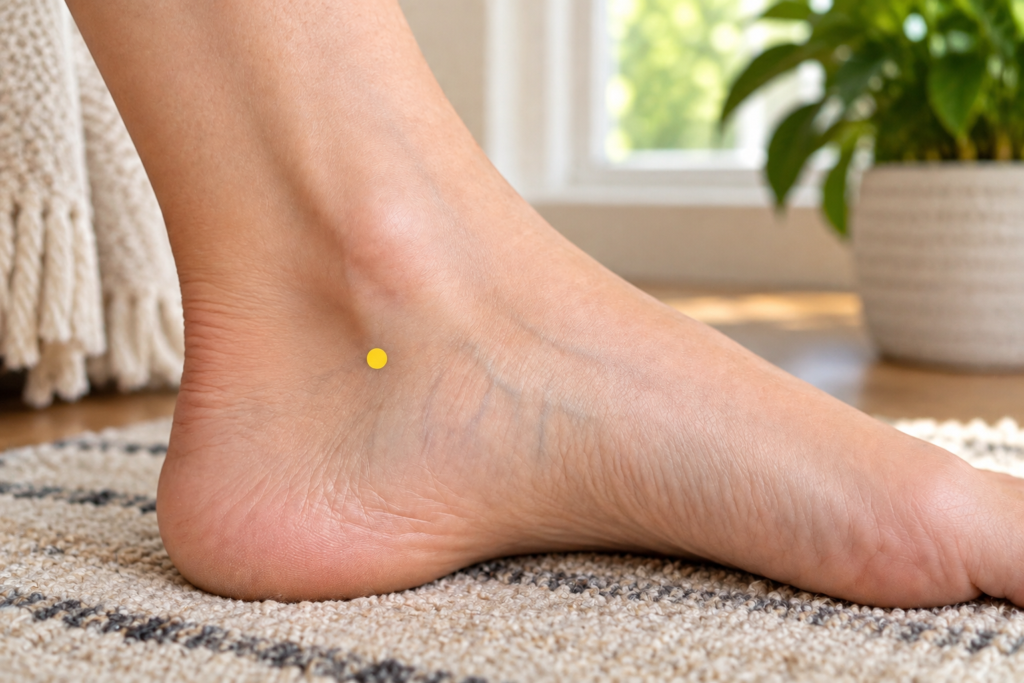
2. Press on LU7 above the wrist, KI6’s classic partner. LU7 sits on the thumb side of the forearm, about two finger-widths above the wrist crease, in a small groove on the edge of the bone. Press firmly with your thumb or fingertip for one to two minutes on each arm. LU7 is called “Lieque,” the “Broken Sequence.”
LU7 and KI6 are a classic pair of points in Traditional Chinese Medicine used together to hydrate the throat, chest, and mouth. LU7 helps the Lung distribute fluids to the surface areas like the nose, throat, and skin, while KI6 restores these fluids from below. This combination is especially effective for symptoms such as a dry nose, dry throat, hoarseness, and dry cough, common in Sjögren’s syndrome. They can be stimulated simultaneously, with one hand on the wrist and the other on the opposite ankle, creating a unified treatment approach.
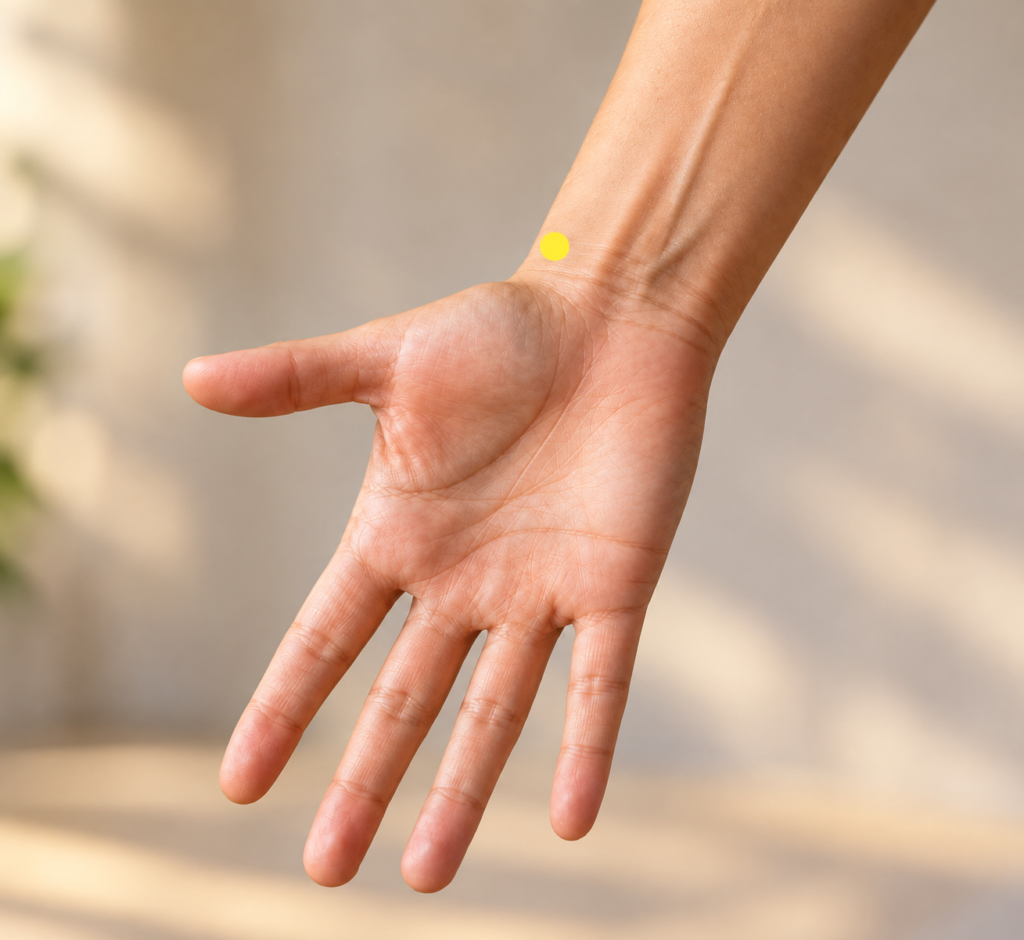
3. Press on KI3 behind the inner ankle to rebuild the deep Yin. KI3 sits in the hollow between the inner ankle bone and the Achilles tendon, level with the tip of the ankle bone. Press firmly with your thumb for one to two minutes on each ankle. KI3 is called “Taixi,” the “Great Stream,” and is the source point of the Kidney.
KI3 rebuilds the Kidney, which holds the body’s deepest reserve of Yin. In chronic conditions like Sjögren’s disease, frequent stimulation of this point can enhance the body’s ability to generate moisture over time. KI3 is additionally beneficial for addressing fatigue, weak knees, and dull lower back ache caused by severe depletion. Positioned near KI6, these two points are conveniently used together.
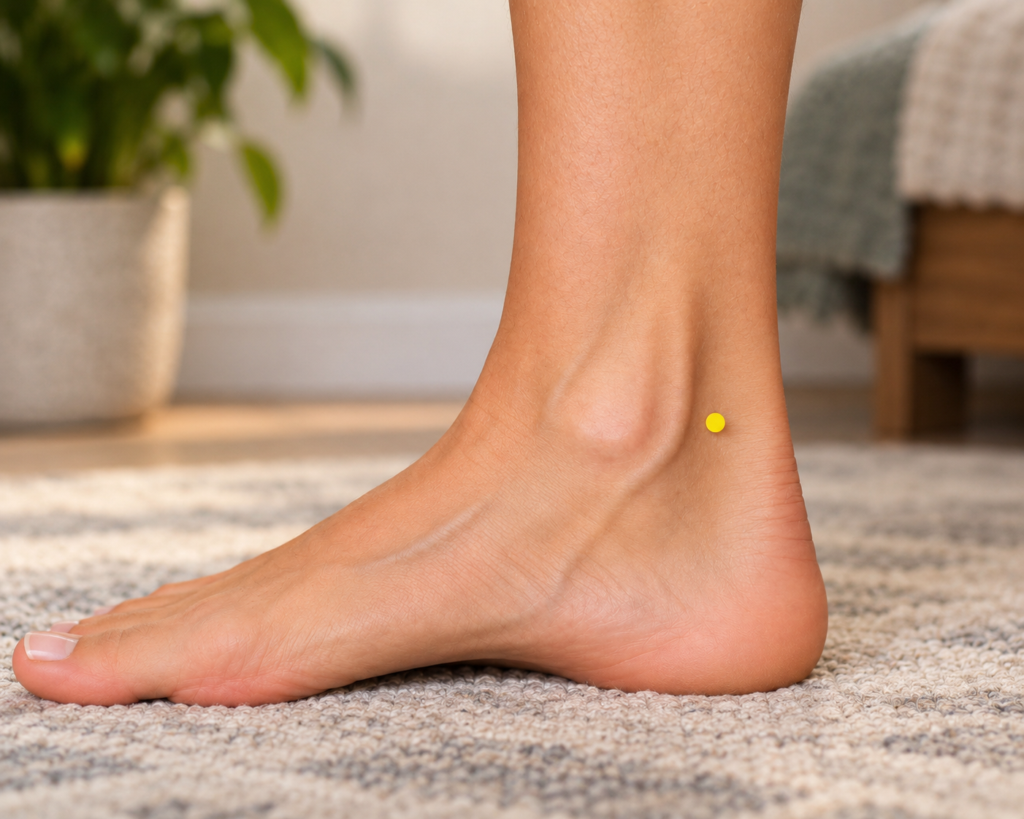
4. Press on SP6 above the inner ankle to nourish the Yin and Blood. SP6 sits four finger-widths up from the tip of the inner ankle bone, just behind the back edge of the shinbone. Press firmly for one to two minutes on each leg. SP6 is called “Sanyinjiao,” the “Three Yin Intersection.” SP6 is avoided during pregnancy.
SP6 is a point where the channels of the Spleen, Liver, and Kidney converge, nourishing their Yin and Blood. This helps support the body’s fluids in the mouth, eyes, skin, and vaginal tissues. It also enhances blood flow, which can reduce joint pain, and has a calming effect that promotes better sleep. Since sleep deprivation can worsen fatigue and dryness, SP6 plays a beneficial role in overall balance.
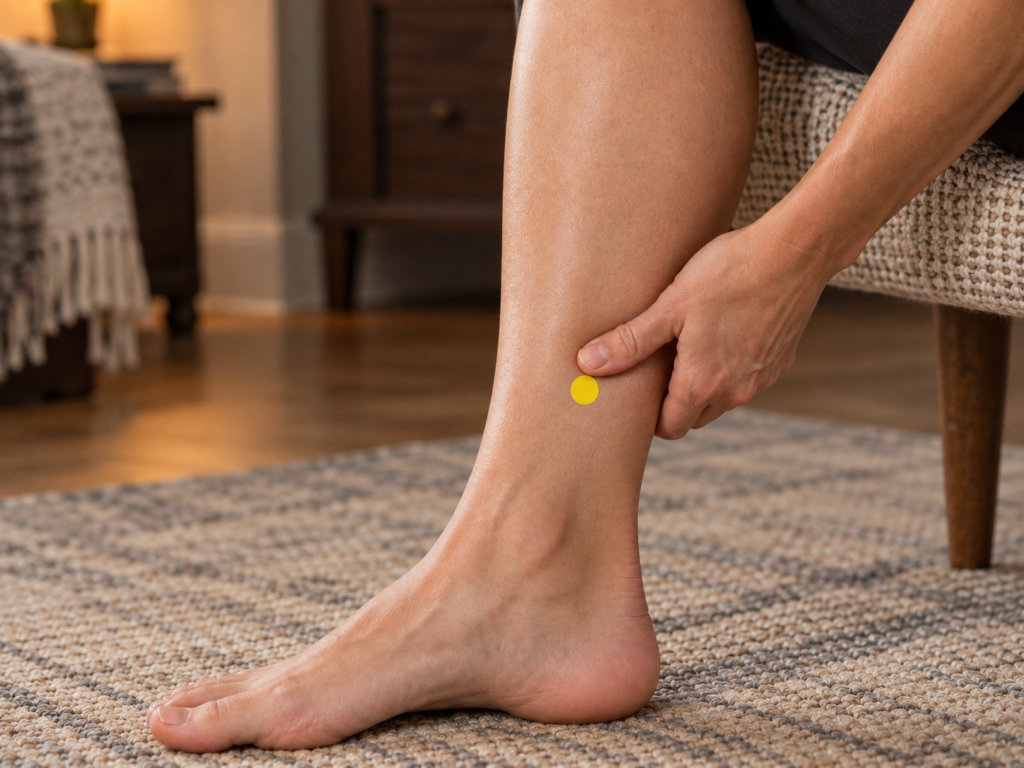
5. Press on LR8 at the inner knee to nourish the eyes. LR8 sits on the inner side of the knee. Bend the knee and find the inner end of the knee crease, then press into the hollow just in front of the tendons there. Press firmly with your thumb for one to two minutes on each leg. LR8 is called “Ququan,” the “Spring at the Crook.”
The Liver connects to the eyes, with LR8 supporting Liver Blood and Yin and helping keep the eyes moist and comfortable. The term ‘spring’ reflects its role in replenishing fluids. For gritty, burning, or tired eyes linked to Sjögren’s, LR8 addresses the root cause, while BL1 provides local support around the eye. It is also helpful when dry eyes are paired with blurred vision that worsens throughout the day.
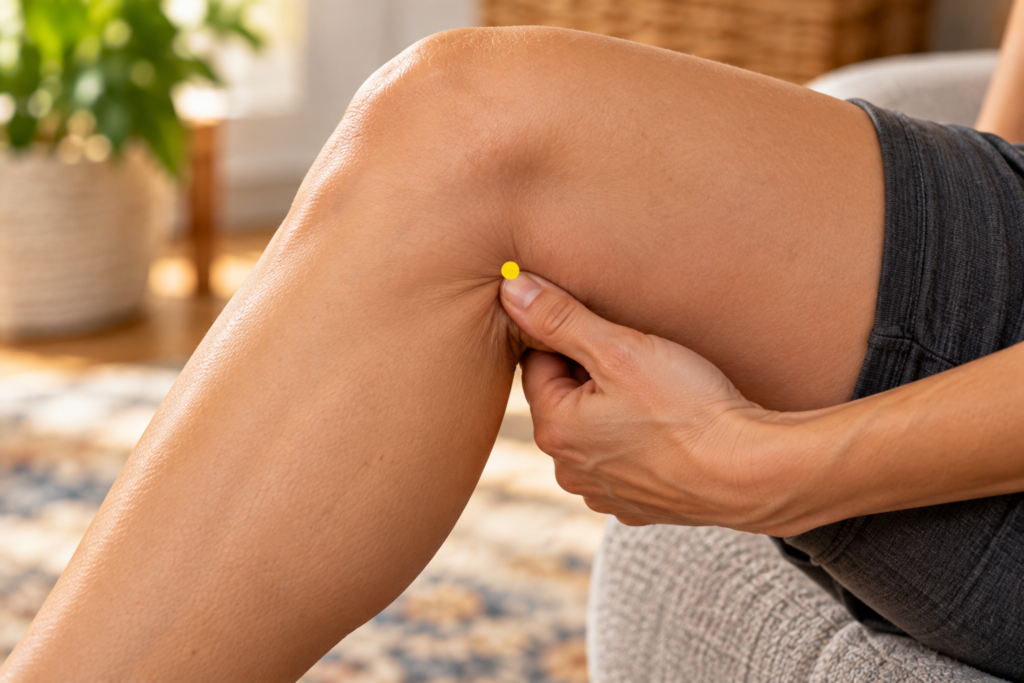
6. Press on BL1 at the inner corner of the eye to support tear flow. BL1 sits in the small hollow just above and inside the inner corner of the eye, beside the bridge of the nose. With clean hands and eyes closed, press gently against the bone toward the bridge of the nose, never into the eye itself, for thirty seconds to a minute on both sides. BL1 is called “Jingming,” the “Bright Eyes.”
BL1 is a primary remedy for dry and itchy eyes, as it enhances blood flow around the tear ducts and relieves burning and gritty sensations. Before application, using a warm compress on closed eyes for a few minutes can loosen eyelid oils, increasing effectiveness. Remove contact lenses first, apply gentle pressure on the bone rather than the eye, and avoid this procedure if the eye is red, painful, or infected.
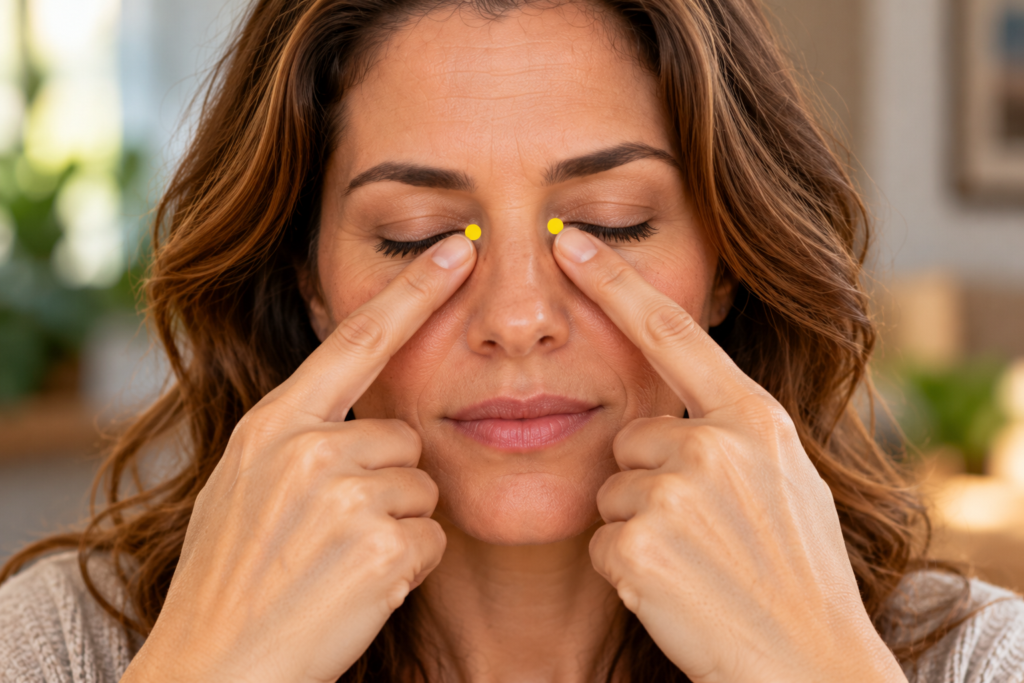
7. Press on CV23 under the chin to encourage saliva. CV23 sits under the chin, on the midline, in the soft hollow just above the small bone that sits above the voice box. Press gently upward with your fingertip for about a minute. CV23 is called “Lianquan,” the “Angle Spring.”
CV23 is a traditional pressure point related to the tongue and saliva, historically used to treat dry mouth. Gentle upward pressure on this point can boost saliva production and reduce dryness, easing eating, swallowing, and speech. Press it a few minutes before meals to prepare the mouth. Use only light pressure, as the area above the throat is sensitive, and avoid pressing on swollen glands.

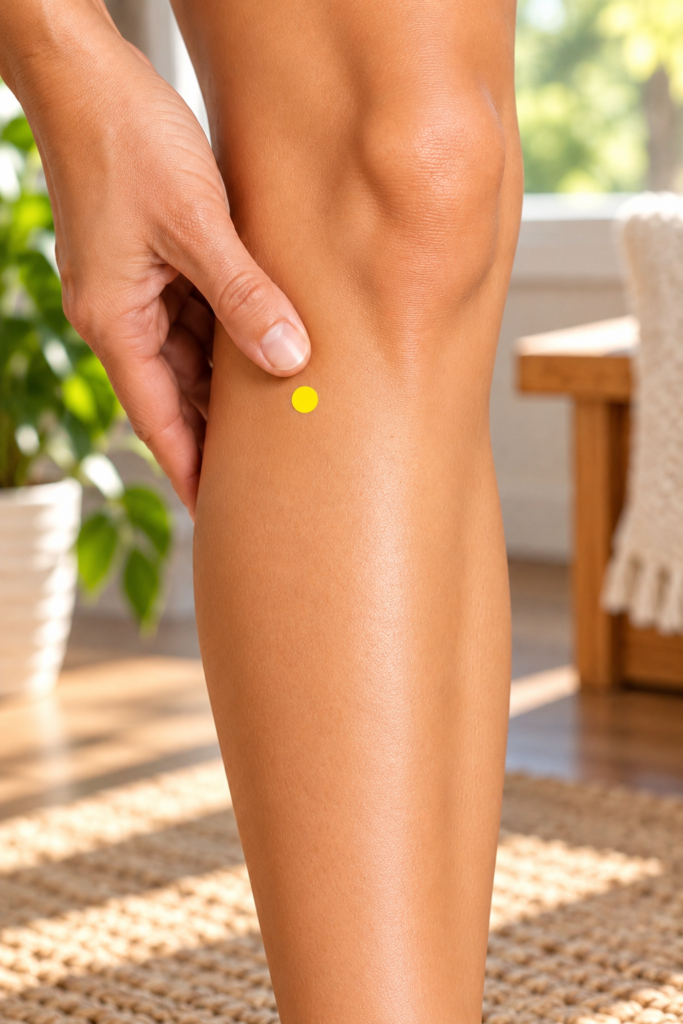
8. Press on ST36 below the knee to build energy. ST36 sits four finger-widths below the lower edge of the kneecap and one finger-width to the outside of the shinbone, on the muscle that rises when you flex your foot. Press firmly with your thumb for one to two minutes on each leg. ST36 is called “Zusanli,” the “Leg Three Miles.”
Fatigue is often the most challenging symptom of Sjögren’s, frequently more difficult to manage than dryness. The ST36 point supports the development of Qi and Blood at their source, boosts digestion, and enhances the body’s capacity to endure the condition over time. In Traditional Chinese Medicine, the Stomach also governs saliva production, so ST36 benefits both moisture and energy. Regular daily stimulation of this point is recommended.
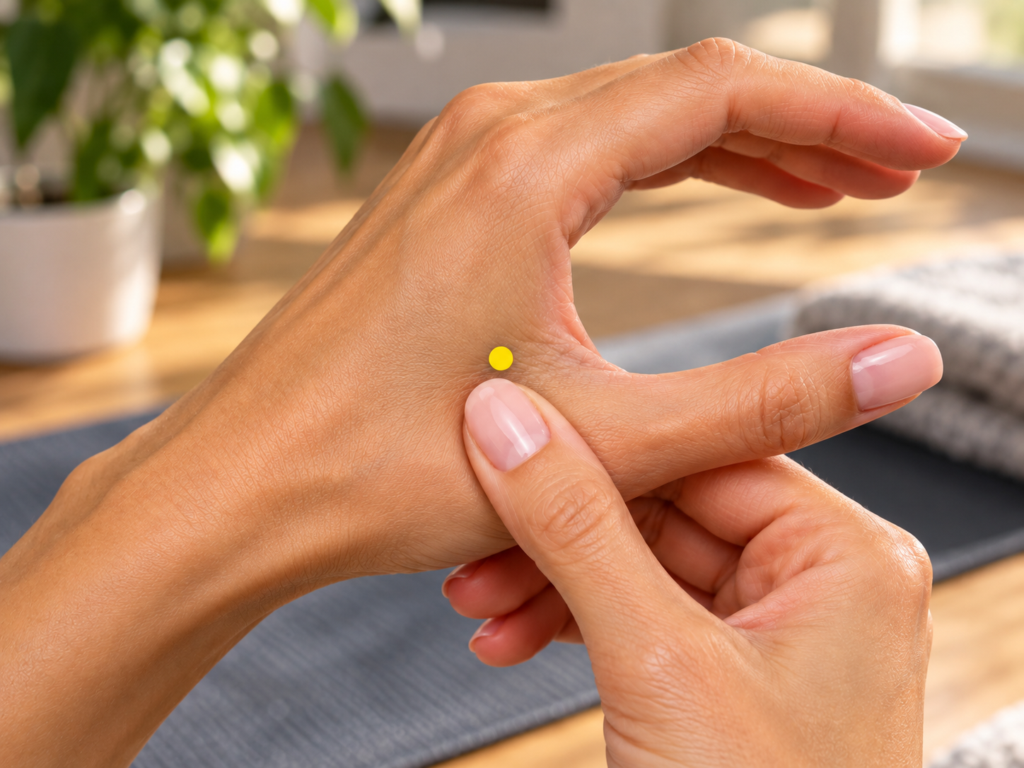
9. Press on LI4 in the hand for aching and facial dryness. LI4 sits in the webbing between the thumb and index finger, at the highest point of the muscle when the thumb and finger are brought together. Press firmly with the thumb of your other hand for one to two minutes on each hand. LI4 is called “Hegu,” the “Joining Valley.” LI4 is avoided during pregnancy.
LI4 is a key acupuncture point for the face and mouth, and it plays a vital role in reducing pain throughout the body. It enhances blood circulation to the face, mouth, and nose, and helps relieve joint and muscle aches often linked to Sjögren’s syndrome. Pressing LI4 can help during a flare-up of hand or wrist stiffness, or beforehand, to support easier movement throughout a long day.
Why These Acupressure Points Work
In Traditional Chinese Medicine, Sjögren’s syndrome is viewed as a profound deficiency of Yin and fluids, characterized by dryness, empty heat, reduced Qi, and stagnant Blood in the joints. The nine points address all these factors.
- The moistening points (KI6, LU7, KI3, SP6) replenish the Yin and fluids from the root, with LU7 and KI6 forming a classic pair for the throat and mouth.
- The eye and mouth points (LR8, BL1, CV23) nourish the eyes and encourage tears and saliva locally.
- The strengthening point (ST36) builds the energy that long-standing illness drains and supports the fluids of the mouth.
- The pain point (LI4) eases joint and muscle aching and brings circulation to the face.
How to Properly Use These Acupressure Points
- Work the full routine once or twice a day, holding each point for one to two minutes, with thirty seconds to a minute for BL1 and about a minute for CV23.
- Press LU7 and KI6 together, one hand at the wrist and the other at the opposite ankle, as a single combination.
- Before working BL1, place a warm compress over closed eyes for five minutes, wash your hands, and remove contact lenses.
- Press CV23 a few minutes before meals to encourage saliva.
- Press firmly on the arms and legs, and gently around the eyes and under the chin.
- Avoid pressing on any swollen gland along the jaw or in front of the ear.
- Sip water as you work through the routine, and use it consistently for several weeks, since replenishing moisture takes time.
Sample routines:
- Morning (five minutes): ST36 and KI3 to build energy for the day, then LU7 and KI6 together.
- Before meals (two minutes): CV23, followed by a few sips of water.
- During screen work or reading (two to three minutes): a warm compress over closed eyes, then BL1 and LR8.
- Evening (ten to fifteen minutes): the full routine, finishing with KI6 and SP6 to nourish the Yin and settle the body before sleep.
Home Care and Lifestyle Support for Sjögren’s
Daily habits do make a real difference in cases of Sjögren’s, improving comfort and safeguarding eyes and teeth.
- Sip water often throughout the day, and keep water by the bed at night.
- Chew sugar-free gum or use xylitol lozenges to stimulate saliva.
- Use preservative-free artificial tears throughout the day and a nighttime eye gel or ointment if your eye doctor recommends it.
- Because a dry mouth greatly increases the risk of cavities, see your dentist regularly, brush and floss carefully, and ask about fluoride treatments.
- Avoid smoking and limit alcohol and caffeine, which are diuretics.
- Ask your doctor whether any of your medications could be adding to the dryness.
- Moisturize your skin right after bathing, and use lukewarm rather than hot water.
- Pace your activities to manage fatigue, and rest before exhaustion sets in.
- Protect your sleep by maintaining a regular bedtime and using a humidifier in your bedroom.
Traditional Chinese Medicine emphasizes certain principles: it recommends eating moistening foods like pears, soups, congee, cooked grains, black sesame, and goji berries, which are traditionally used to nourish the eyes. For a dry throat, warm water with a little honey can be beneficial. It advises avoiding spicy, fried, roasted, and very salty foods, as these can increase heat and dryness. Getting to bed before eleven gives the body its best window to restore Yin, and avoiding overwork helps conserve the deep reserves that Sjögren’s syndrome depletes. A practitioner can recommend herbal formulas that nurture Yin, tailored to your specific pattern and other medications.
How Acupuncture Can Help
Acupuncture in Sjögren’s disease aims to strengthen Yin and body fluids, reduce dry, empty heat that causes burning eyes and mouth, boost energy, and ease joint and muscle pain. The treatment is tailored to each person’s pattern, whether dryness impacts the eyes, mouth, or skin, or if fatigue or pain is more severe. Many patients find regular acupuncture helps them feel calmer, improves sleep, and alleviates fatigue linked to chronic illness, often complemented with herbal remedies to support internal moisture.
Acupuncture should be used in conjunction with the medical treatment needed for Sjögren’s, such as care from a rheumatologist, an eye specialist, and a dentist.
When to Get Professional Help
Your doctor, typically a rheumatologist, should diagnose and regularly review Sjögren’s because it can impact other organs beyond just the eyes and mouth, and it carries a higher risk of lymphoma compared to the general population.
- Seek emergency care for sudden loss of vision, chest pain, severe shortness of breath, or sudden weakness.
- Get same-day care for eye pain, redness, light sensitivity, or changes in vision, as the surface of a very dry eye can be damaged.
- See your doctor if you experience persistent swelling of the glands along your jaw or in front of your ears, swollen lymph nodes, unexplained weight loss, fevers, or night sweats.
- Seek medical attention promptly if you experience a persistent cough or shortness of breath, numbness or tingling in your hands or feet, a rash with small purple spots on your legs, or swelling in the legs.
- See your dentist if you experience tooth pain, swollen or painful gums, or white patches and soreness in your mouth, as these can be signs of infection.
Acupressure offers a natural and gentle support for Sjögren’s, complementing ongoing medical care and monitoring.
Because dry eyes and dry mouth are the most common symptoms, acupressure for dry eyes and acupressure for dry mouth are companion posts. Because Sjögren’s can affect the nerves and the circulation in the hands, acupressure for neuropathy and acupressure for Raynaud’s syndrome may also be useful and applicable.
Above and Beyond Acupuncture offers acupuncture, cupping, and lifestyle coaching at the North Frank Lloyd Wright Boulevard location in Scottsdale.
Schedule an appointment online to start your healing journey.
The points above are only as effective as the technique used to apply them. Where to press, how firmly, and for how long all affect the result. For a full breakdown of how to perform acupressure properly at home, read Performing Acupressure in 3 Easy Steps.

About the Publisher
Paul Kerzner, L.Ac., is a licensed acupuncturist and board-certified herbalist, as well as the founder of Above and Beyond Acupuncture in Scottsdale. His own journey from chronic patient to practicing acupuncturist shapes his commitment to providing honest, clinically grounded information about acupuncture and Traditional Chinese Medicine. Learn more about Paul and his clinical approach on the About Us page.